Home Blog Page 267

BSP’s term deposits fetch lower rate on easing hopes

BW FILE PHOTO

THE BANGKO SENTRAL ng Pilipinas’ (BSP) one-week term deposits fetched a lower average rate on Wednesday amid strong demand as weak growth data strengthened the case for further monetary easing.

Total bids for the central bank’s seven-day term deposit facility (TDF) reached P121.841 billion, exceeding the P110-billion auctioned off and the P106.037 billion in tenders for the same offer volume a week ago.

This led to a bid-to-cover ratio of 1.1076 times, up from the 0.9640 ratio recorded last week.

However, the BSP only accepted P107.441 billion in bids for the one-week papers, below the program, as it sought to keep the average yield low.

Tenders accepted had yields ranging from 4.45% to 4.5185%, slightly wider than 4.45% to 4.5125% band in the previous auction. This brought the average accepted rate to 4.4967%, edging down by 0.06 basis point (bp) from 4.4973% last week.

“The seven-day BSP TDF average auction yield was again marginally lower… after the relatively weaker local GDP growth data that somewhat increased the odds of a 25-bp BSP rate cut in the next BSP rate-setting meeting on Feb. 19,” Rizal Commercial Banking Corp. Chief Economist Michael L. Ricafort said in a Viber message.

He added that expectations that inflation remained benign in January also support prospects of an easing move.

Philippine gross domestic product (GDP) grew by 3% in the fourth quarter, slower than 5.3% in the same period a year prior and the revised 3.9% print in the third quarter, the government reported last week.

This was the slowest quarterly print in nearly five years or since the 3.8% contraction in the first quarter of 2021. Outside of the coronavirus pandemic, this was the economy’s worst performance since the 1.8% growth recorded in the fourth quarter of 2009, or during the Global Financial Crisis.

This brought full-year 2025 GDP growth to 4.4%, below the government’s 5.5%-6.5% goal. This was slower than 2024’s 5.7% and was the weakest annual expansion since the 3.9% in 2011, counting out the 9.5% contraction in 2020 due to the pandemic.

Officials said tighter public spending and weak investor confidence due to the flood control scandal continued to drag growth.

BSP Governor Eli M. Remolona, Jr. said on Sunday that a cut is possible at the Monetary Board’s Feb. 19 policy review if the fourth-quarter GDP slowdown proves demand-driven.

“If we can help on the demand side and still keep inflation low, then of course we’ll help,” he said.

He added that they will continue to assess the available data and decide “one meeting at a time.”

The Monetary Board has slashed benchmark borrowing costs by 200 bps since August 2024, bringing the policy rate to 4.5%

Analysts said weak economic prospects and manageable inflation give the BSP room to deliver one to two more cuts this year to end its current easing cycle.

A BusinessWorld survey of 18 economists yielded a median forecast of 1.8% for the January consumer price index, within the BSP’s 1.4% to 2.2% projection for the month. That means inflation would be unchanged from December and slower than 2.9% a year earlier.

January would also mark the 11th straight month that inflation stayed below the BSP’s 2% to 4% target.

The Philippine Statistics Authority is set to release January inflation data on Thursday (Feb. 5).

The central bank uses the TDF and BSP bills to mop up excess liquidity in the financial system and better guide market rates towards the policy rate.

It last auctioned off both the seven-day and 14-day deposits on Oct. 29. It has not offered 28-day term deposits for over five years to give way to its weekly offerings of securities with the same tenor.

Based on the BSP’s latest monetary policy report, its market operations have absorbed P1.5 trillion in liquidity as of mid-November 2025, with 5.4% of this being siphoned off via the term deposit facility. — Katherine K. Chan

Excise the rot

OFFICIALGAZETTE.GOV.PH

It was a sunny morning that working day early in the pandemic.

After hearing news on the radio (I now forget what exactly it was all about) as I drove to the office, I pulled the car to the side along an empty White Plains Avenue before the People Power Monument in order to fire off my thoughts to editors and reporters to help start their day.

As I typed away on my mobile phone, I sensed another car draw up by my window. Glancing up to my left, I saw a patrol car right beside my door. The police sergeant (well, judging from the air of authority and experience he had) at the passenger seat was looking at me intently as he called out: “Magandang umaga po: okay ba kayo? (Good morning, sir: are you okay?)”

Startled by the sudden break to the train of thought in my messaging, I stammered: “Oo” and waved absentmindedly. And the squad car drove off.

I realized later on how I must have looked to those cops: a car parked along that lonely road amid a raging pandemic, whose driver was slumped in his seat, seemingly staring blankly at the floor with head bowed. Is this guy in trouble? Is he contemplating suicide? Is he having a heart attack, in pulmonary distress or some other health emergency?

I have since regretted not having stopped those cops to get their names, to thank them, and not having commended them to their regional superiors and to the Philippine National Police chief back then.

But it is their image that automatically comes to mind as I strain to believe the government’s insistence that most cops conscientiously do their duties away from the limelight, in the face of news on crimes committed by rogue cops that bombard us almost daily.

That incident demonstrated to me the timeless silent power of even just one simple good deed, or the extra mile travelled in the fulfillment of duty, with neither fanfare nor thought of any reward.

So, allow me to start this discussion on this hopeful note.

IN SEARCH OF EXPLANATIONS…
The Philippine National Police (PNP) — together, in varied degrees, with the Bureau of Fire Protection (which the Interior and Local Government chief earlier this month described as “one of the most corrupt organizations in the country”1), the Bureau of Jail Management and Penology (BJMP) and the Bureau of Corrections (BuCor) —— has been getting a bad rap lately.

There seems to be some variance between the police’s public trust ratings and views of folks I deal with (business owners, senior executives, economists and other academicians, etc.). While the latter generally say that they would deal with cops at arm’s length due to reports of crimes committed by a few misfits among them (anyone here think differently, by chance?), surveys conducted by the public opinion outfit OCTA Research showed PNP trust and performance ratings rising to 71% and 73%, respectively, in July 2025 from 62% on both counts in April that same year2.

The police garnered those readings, mind you, less than half a year after hearings in the House of Representatives implicated a couple of retired senior cops in the drug war killings, adding to the regular fare of news reports on active or dismissed/absent-without-leave policemen involved in other crimes.

At the same time, a December 2025 survey by OCTA showed “to avoid being a victim of any serious crime” as the fifth biggest “urgent personal concerns for adult Filipinos” — an issue that falls squarely under the PNP’s purview3.

Not that police involvement in crime is unique to the Philippines. (I recall a Japanese friend who once complained of corruption in the Osaka police.) It is a problem that hounds police departments around the world, so much so that this is a favorite theme for films like Serpico (1973), based on the true-to-life story of an idealistic, unconventional undercover cop who blew the whistle on widespread corruption hounding New York’s Finest in the 1970s; The Untouchables (1987); L.A. Confidential (1997); Training Day (2001); Internal Affairs (2002); American Gangster (2007), etc.

There is no lack of research on this phenomenon. Such studies blame factors like individual failings, organizational (including structural) weakness or actual involvement with crime groups, lack of deterrence, a departmental value system that condones wrongdoing, weak leadership/management, general cynicism in the leadership and ranks, etc.4

Other possible explanations include the very environment in which cops operate that is marked by their close proximity both to the people they are supposed to protect and to criminals they are supposed to fight (requiring police infiltration of crime groups that expose undercover cops to co-option — I personally know of a particularly tragic case in which the cop vanished and has been presumed dead by his wife and kids), their armed authority, widespread opportunities to make a quick buck through crime, etc.

Closer to home, one particular study on the PNP itself found that, among others, the institution remains “highly militarized” and “thoroughly politicized”; maintains a system wherein good works by lower ranks are not always supported by senior officers; and has “a closed culture which separates it from the wider society in terms of governance and management, even though most of its problems involving unethical conduct and corruption are merely part of a wider civic tolerance for corruption in the broader Philippine society.”5

Just a thought on the observation that the PNP is “highly militarized”: I do recall a senior police officer complaining in a radio interview two years ago that, unlike before when the police were still under military command, superiors today hesitate to correct erring cops because the latter might shoot them. That’s a clear breakdown in basic discipline right there. Private sector managers tell supervisory and rank-and-file folks that “this is not a democracy” when objectives and targets are set, and directives are given after hearing subordinates’ inputs, reservations and objections. But I have yet to hear of any manager who feared for his/her life in giving such directives or correcting flaws/shortcomings/misdeeds.

… AND ANSWERS
That we are not alone here is little consolation though, and the current government’s rush to curb corruption that is fast eroding the country’s attractiveness to investors provides a once-in-a-blue moon window to take more energetic measures to rid our cops, firemen, and jailers of this disease (law and order, plus personal safety, after all, being key indicators which businesses monitor).

1. Basics first. As with most problems, any remedial effort starts with the basics. How many of us have seen news stories on new cops involved in crimes like road rage shootings, drug trafficking, and murder, and asked: “What the hell are they teaching at the PNPA (Philippine National Police Academy, which also provides officers of the BFP, BJMP, and BuCor)?” Recall that the former senior PNP officers implicated in the drug war killings were all classmates in that academy. Add to the PNPA the one-year basic training program for enlisted cops, firemen, and jailers; the Philippine Public Safety College, which further trains PNP, BFP, BJMP, and BuCor officers and personnel; as well as the National Fire Training Institute and the National Jail Management and Penology Training Institute.

So, at least, we have education and training structures established along the promotion route in these institutions.

Before proceeding, let’s get one consideration out of the way: the old complaint that cops (as well as firemen and jailers) are not paid enough. Even in the private sector, this would be a fair comment — one cannot attract and keep talent if they are paid peanuts.

But for all uniformed personnel, this complaint no longer holds. The basic monthly pay of the lowest patrolman, fireman, and jailer is P31,151, while the entry level for officers — police lieutenant/fire inspector/jail inspector — is P52,0046. Those amounts dwarf entry-level pay for college grads in small- and medium-sized enterprises that make up more than 99% of registered businesses in the country. On top of basic pay and the mandatory 13th month pay are additional remuneration like hazard pay, subsistence and clothing allowance, anniversary bonus, yearend bonus, longevity pay, etc.

If any recruit or officer still thinks that their pay is low, then by all means leave.

I, for one, laud the pay hike of uniformed personnel (some -— though not all — of who risk their lives for our safety and security), but I, as a taxpayer, do expect a corresponding improvement in professionalism and performance to match that benefit.

2. Mind the method… I don’t know how values are taught to cops, firemen, and jailers — requests for interviews with those in charge went unanswered — but, based on how this concern is handled elsewhere in the government and even in several private organizations, chances are this effort involves a subject, seminar, or module that forms part of a requirement for appointment or promotion.

This is WRONG.

Mere attendance, which is usually the sole requirement, does not translate to conviction.

We all know how required one-off subjects/seminars/modules go — in all probability, they are viewed with indifference, skepticism, or derision, making ideas enter one ear and exit the other. Very little, if any, of the lesson is retained.

I would go with the framework which the University of Asia and the Pacific adopted for its new Public Governance and Leadership program, which involves both values-focused subjects and seminars, as well as an injection of such formation wherever and whenever applicable in all the other subjects.

Applied to the uniformed services, this means values formation ought to permeate the entire organizational structure, and not be confined to periodic seminars.

3. … The tone… I have heard that some of these lessons are conducted by chaplains. Yes, priests, pastors, and imams have their role to play here.

But any kind of pep talk with religious overtones risks prompting participants to compartmentalize what they learn (just observe how many of those we know act during the rest of the week after hearing homilies/sermons in their respective weekly services). Better if ideals are applied to real-life situations in case studies (e.g., demonstrating utang ng loob (debt of gratitude) vs. rule of law, personal loyalties vs. whistleblowing, personal/parochial considerations vs. institutional integrity, etc.). In this way, such principles are shown contributing to practical positive outcomes, both in society and one’s personal circumstances (including work performance, and, in turn, promotion).

4. … and the need for exemplars. There is nothing more convincing than a lecturer/speaker who’s “been there, done that” and has “walked the talk.” At the same time, nothing kills credibility faster than leadership hypocrisy.

Save for a handful, I have yet to hear government leaders who speak convincingly of standards, sounding instead as if they were reciting the text of some manual from memory.

I’m sure that the uniformed services have had partnerships with institutions like the School of Diplomacy and Governance at De La Salle-College of Saint Benilde, the Ateneo School of Government, and the University of the Philippines National College of Public Administration and Governance (meaning they can tap experts there), etc., but, again, tapping trainers/lecturers among uniformed veterans (yes, who are also products of these schools) will improve chances that participants will better internalize what they hear in the classroom.

5. Cement values across the system. Find ways to tighten the bolt after imparting values, by putting relevant mechanisms in place.

For example: I have not seen how PNP performance appraisals are conducted, but it is clear from successive cases of crimes committed by cops all these years that much remains to be desired here. A thorough review of this system is, therefore, in order.

Secondly, put in place a support system for those striving to apply prescribed values on specific operations. Such a system necessarily includes supportive PNP, BFP, BJMP, BuCor chiefs and regional directors who will whip subordinate commanders in line, as well as mentors from respected veterans, both in active service and retired.

Such a support system may even lead to the formation of a support group of peers. The Young Officers Union of the 1980s comes to mind, although that group was formed for a completely different reason and evolved in undesired ways. The formation of such a clique in the uniformed services is a double-edged sword.

6. Find ways to better insulate the PNP from politics. It is galling to hear of cops who act as errand boys for politicians. That these cases persist show that efforts here, so far, have been wanting.

Hence, the need for a better way to protect them from political influence and interference. This step forms an indispensable part of an overall reform that will make sure that they are not coopted and swallowed up by patronage.

Now that governance is such a hot topic, it cannot be business as usual for values formation in the PNP and other uniformed services.

Let’s not kid ourselves though: it will take a few generations to rid an entire bureaucracy of corruption. Well did Rossana A. Fajardo, country managing partner at SGV & Co. (EY Philippines) and former commissioner of the Independent Commission for Infrastructure, say that “it would take several lifetimes” to do so, “[b]ecause then you will probably need to take out everyone who is part of the system”.

Without genuine systemic change, no amount of “ethics/value formation” and “moral recovery program” will uproot and reform entrenched bad habits. These efforts will just be a waste of time and money.

1 https://tinyurl.com/22p62wj

2 https://tinyurl.com/2boyewd8

3 https://tinyurl.com/2bxxk4lb

4 Mark Pagrebin and Burton Atkins, “Probable causes for police corruption: some theories,” Journal of Criminal Justice, Vol. 4, Issue 1, Spring 1976, pp. 9-16.

Paul G. Mascara, “Police corruption and organizational structures: An ethicist’s view,” Journal of Criminal Justice, Vol. 12, Issue 3, 1984, pp. 235-245.

Wim Broer and Maurice Punch, “Corruption in the police — A sociological perspective,” Tijdschrift voor de polite, Vol. 41, Issue 4, 1979, pp. 173-189.

5 Glenn Matatag and Seville Varona, “Towards Improving Ethics and Governance in the Philippine National Police: A critical systemic review,” School of Social and Policy Studies, Flinders University, 2011.

6 Executive Order No. 107, s. 2025 (https://www.dbm.gov.ph/wp-content/uploads/Issuances/2026/National-Budget-Circular/NATIONAL-BUDGET-CIRCULAR-NO-600.pdf)


Wilfredo G. Reyes was editor-in-chief of BusinessWorld from 2020 through 2023.

Tanduay reenters the brandy market with Torres Brandy

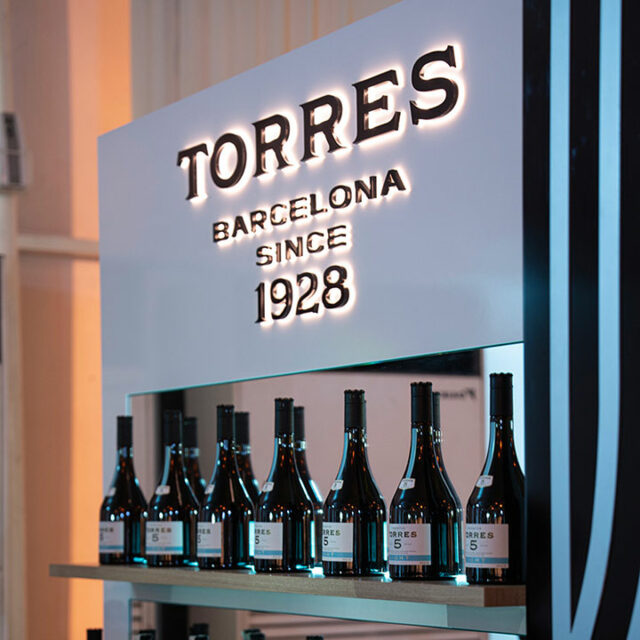
TANDUAY is banking on the over 90 years of history of the Spanish brandy they’re distributing this year, Torres Brandy.

Torres, founded in 1928, arrives here on a distribution deal with spirits giant Tanduay, which itself is already 172 years old.

“The arrival of Torres in the Philippines marks the coming of two great houses that are united by a shared commitment to excellence and growth. This partnership reflects our vision to offer Filipino consumers world-class spirits,” said Lucio Tan III, president and chief executive officer of Tanduay in a statement.

Its first product in the Philippines, Torres 5 Light, was launched on Jan. 27 in Quezon City. According to Christian Visalli, Torres Spirits global managing director, launches of more premium lines — Torres 10, Torres 10 Double Barrel, Torres 20, and Jaime I — are forthcoming, though through other channels distinct from Torres 5 Light, which will be sold in supermarkets.

“We have chosen the Philippine market because it’s the biggest brandy market in the world,” said Mr. Visalli in an interview with BusinessWorld. An article in The Spirits Business (“Top 10 World’s largest brandy markets,” Amy Hopkins, 2014) places the Philippines at No. 2 with 287.9 million liters. “With Tanduay’s strengths in distribution, we believe we can actually have a successful result here,” said Mr. Visalli.

Bottled at 25% ABV, and crafted from quality grapes and aged using the Solera method in oak barrels, it has a clear-medium-gold appearance with delicate aromas of grape, dried fruits, and vanilla, and a smooth, subtly sweet taste featuring notes of prune, grape, and vanilla, according to a company statement. To us, it was fragrant, fruity, and an easy drink.

Roy Kristoffer Sumang, Tanduay international business development manager, confirmed that several years ago, Tanduay had a brandy brand, called Companero, now defunct. “Who we partnered with is a brand that has that premium-ness to it; there’s no need to create the brand from scratch,” he said. “They already have the storytelling, they have the heritage, the capability — and they have a good brand.”

“We don’t want to compete on that price positioning,” said Mr. Sumang on a similar product from Emperador Inc., Emperador Light, which retails for a little below P200 at 750 ml. Torres will be priced at about P320 to P350. “They’re going into a bit of luxury, but not so much that you’ll spend up to P1,000,” he said of Torres in a mix of English and Filipino.

An article from SGX Group, the Singapore Exchange, (“Emperador Inc. — Philippines’ Largest Global Liquor Company — Debuts on SGX,” 2022), said Emperador Inc. had an “82.3% market share among all local and imported brandies in the Philippines.”

The family behind Torres has been in the alcohol business since the 16th century, concentrating on vineyards and wine (in the 1870s). Brandy making started with one of its descendants, Juan Torres Casals, in 1928. Speaking about the heritage behind Torres, Mr. Sumang said, “[What is] important for us is authenticity. We want to have that kind of storytelling to make people believe that we have a good brand that we want to bank on.” — Joseph L. Garcia

Manila Water shifts East Zone operations to full RE

MANILA WATER

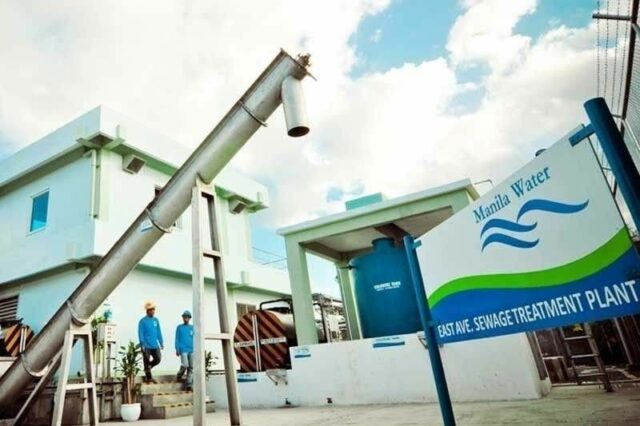
RAZON-LED Manila Water Co., Inc. has shifted the operations of its major facilities in its East Zone service area to renewable energy (RE), a first for the Philippine water sector, the company said on Wednesday.

In a statement, Manila Water said it signed a renewable retail electricity supply agreement with AdventEnergy, the retail electricity arm of Aboitiz Power Corp., as part of its efforts to reduce its carbon footprint.

“We take pride in formalizing this partnership. It truly makes a difference in the lives of our customers knowing that a water utility can work with a partner like AdventEnergy to deliver sustainable solutions that we have worked so hard to pursue,” Manila Water President and Chief Executive Officer Roberto R. Locsin said.

Under the agreement, AdventEnergy will supply 100% renewable energy to the water utility’s operations in Metro Manila and Rizal within the East Zone.

Meanwhile, non-East Zone business units, including Cebu Water, Tagum Water, Calbayog Water, Laguna Water, Estate Water, LARC Water, Boracay Water, and South Luzon Water, will be supplied with a 20% renewable energy mix.

“This pursuit goes hand-in-hand with Manila Water’s promise of creating better lives and resilient economies through the provision of critical infrastructure,” AdventEnergy President James Yu said.

The collaboration, which began in 2023, aims to contribute to the government’s renewable energy agenda and national decarbonization efforts.

Manila Water also participated in the government’s expanded retail aggregation program (RAP) after consolidating the power demand of its 10 wastewater facilities.

RAP allows end-users within the same franchise area to combine their electricity demand and qualify as a single contestable customer, enabling them to participate more competitively in the retail electricity market.

Manila Water serves the East Zone of Metro Manila, covering parts of Marikina, Pasig, Makati, Taguig, Pateros, Mandaluyong, San Juan, portions of Quezon City and Manila, as well as several towns in Rizal province. — Sheldeen Joy Talavera

EastWest Bank eyes broad-based growth as governance concerns affect consumer loan demand

PHILIPPINE STAR/DEEJAE DUMLAO

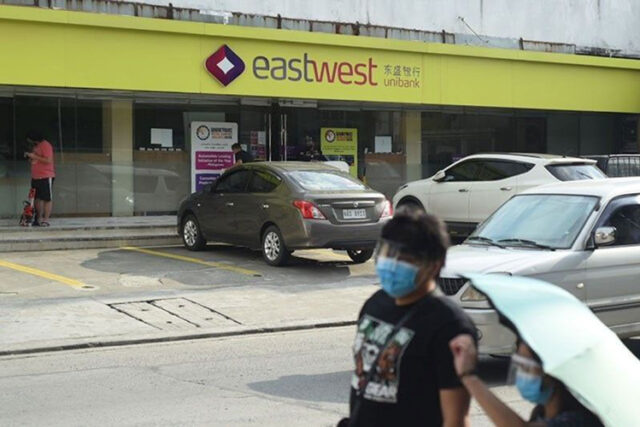
EAST WEST Banking Corp. (EastWest Bank) is looking to expand its other business segments as it expects slower consumer loan demand due to lingering weakness in investor sentiment amid the economic fallout from a corruption scandal.

“Obviously, loan demand from consumers will be affected due to a slower economic [situation]. So, it’s a balance. We’re still hopeful. We’re still very, very bullish about the whole thing. But, as you go through the whole thing, you stop and you modulate. And that’s what we’re doing right now, is just modulating it from one focus to the other. But we will still continue to grow and continue to push,” EastWest Bank Chief Executive Officer Jerry G. Ngo told BusinessWorld on the sidelines of a central bank event last month.

Philippine gross domestic product (GDP) grew by 3% in the fourth quarter of 2025, bringing the full-year average to 4.4%, below the government’s 5.5%-6.5% goal. This was slower than 2024’s 5.7% and was the weakest annual expansion since the 3.9% in 2011, counting out the 9.5% contraction in 2020 due to the pandemic.

Officials said tighter public spending and weak consumer and business confidence due to the flood control scandal continued to drag growth,

The Gotaniun-led bank will be more aggressive in expanding its corporate, high net-worth, and small and medium enterprise (SME) segments this year, Mr. Ngo said.

Still, they expect growth to be mainly driven by the consumer business, he said. The official earlier said that about 80% of EastWest Bank’s loan book is made up of consumer credit.

As of end-September, the bank’s total loans stood at P361.7 billion.

Mr. Ngo said corporate loans currently make up about 15-16% of their total portfolio, giving the segment room to grow.

He added that the bank aims to increase the share of corporate borrowings in its total portfolio by two to three percentage points this year, with the segment expected to grow faster than its entire loan book’s expansion.

Meanwhile, the bank also wants to sustain the momentum of its high-net-worth segment as it saw strong growth in its assets under management (AUM) last year.

“The priority banking business is also quite big now. So, we’re trying to push that even further. Client acquisition has also grown quite significantly. The platform has been good,” he said, adding that the segment’s AUMs grew by about 20%-30% last year.

EastWest Bank is likewise looking to further grow its nascent SME segment, Mr. Ngo said.

“The SME loan book is very small. It’s just beginning. We’re trying to see as much as possible how we can push for that. But no target as of this point. It’s a bit too early at the moment.”

EastWest Bank’s attributable net income rose by 6.25% year on year to P2.48 billion in the third quarter of 2025, driven by its consumer book.

This brought its nine-month profit last year to P6.62 billion, up by 13.81% from the same period in 2024.

EastWest Bank shares went up by six centavos or 0.48% to close at P12.56 apiece on Wednesday. — Aaron Michael C. Sy

Rolling over data

STOCK PHOTO | Image by Benzoix from Freepik

When the House of Representatives approved House Bill No. 87 last December, consumers seemed to have scored a victory. The proposed Roll Over Internet Data Act sought to answer public frustration over expiring data balances, and to ensure that unused data allocations roll over.

I understand the frustration. I share it. But I still cannot support HB 87 as drafted. The bill carries unintended consequences, and those consequences will likely hit hardest the very users it claims to protect — the prepaid users who reload only when cash allows.

HB 87 requires all internet service providers to allow customers to carry over unused data from daily, weekly, or monthly packages. They will not expire but will instead be added to the next subscription period. And any accumulated unused data at the end of the year can be converted into rebates.

Today, in postpaid plans, carryover is only for one month, as a plan feature and not as a mandatory obligation. And there is no accumulation until yearend, and no conversion into rebates. For prepaid customers, unused data do not carry over beyond the subscription period, unless the service is for no-expiry data.

If Congress mandates accumulation and rebate, then it will force providers to recognize a continuing liability to its customers beyond a calendar year. They will then need to build systems to track, verify, and apply value later. This will entail costs that will reappear as higher prices or smaller data allocations.

For prepaid and postpaid users who buy data promo offers, the bill requires unused data allocation to roll over, but only if the subscriber renews right after the lapse of the promo. If the subscriber fails to renew, the unused allocation declines by 20% per day until renewal. If the subscription is not renewed after five days, unused data expires under what appears to be a legislated forfeiture schedule.

Under current practice, prepaid promos typically expire, and unused allocations usually drop to zero at expiry, unless the product is expressly designed as no-expiry data. Some providers already sell packages marketed precisely for data that stays valid until fully consumed.

Existing regulation already protects prepaid consumer value through load validity for one year, rather than mandatory rollover of promo data. Regulators have not required that every promo allocation roll over, and they have not forced postpaid plans to carry unused data indefinitely.

In practice, any carryover you see today is a product feature a provider chooses to offer. It is not mandatory. The existing structure preserves choice. Prepaid consumers can pick time-bound promos when they want low prices and high volume for a short period, or they can pay for flexibility through longer validity or no-expiry offers. Postpaid users can choose plans that include carryover within a defined window.

The market offers options because regulation does not force all offers into one mold. HB 87 intends to change that. It would turn rollover from an optional feature into a universal entitlement for both prepaid and postpaid users, subject to conditions. And this is where Congress and I part ways. As a postpaid and prepaid subscriber, I find the current structure workable.

Telcos sell capacity and access to a network. A data promo resembles a gym membership. You pay for access within a defined period. If you go only twice in a month, the gym does not refund the rest of the month. The gym prices memberships on the assumption that not everyone will show up every day.

In telecom, providers price promos with a similar assumption. Some users consume every unit. Many do not. Average utilization often falls below 100%. Expiration and validity periods function as limits that make cheap, time-bound promos viable. They also help providers manage peak load and reduce the risk of carrying long-lived obligations.

I fear that HB 87 provides for a mandated product architecture that will ultimately raise prices for everyone. It will push providers toward accumulation, rollover, and rebate conversion. This will push utilization upward and extend the period during which the provider must carry a liability for unused allocation.

In short, the bill treats unused data as stored value that must carry forward and, in some cases, later convert into rebates usable for future payment. This shift will have economic consequences. Providers will have to provision for those liabilities, resulting in higher operating costs.

Providers will also attempt to better manage risks by simplifying offers, tightening rules, and avoiding creative promos that invite complaints. Over time, new costs and risks will surface in price adjustments. We should thus expect higher priced promos, smaller allocations, fewer promo variants, and more restrictive usage controls.

I am certain many consumers will not welcome such an outcome, especially those who survive on small weekly reloads. Moreover, lower-income prepaid users often miss immediate renewal windows for lack of cash. They stretch promos and reload only when they have cash. HB 87 punishes that behavior with a 20% per day decay and a hard cutoff after five days. While the bill claims to protect the public, its mechanics punish the poor.

HB 87 still awaits Senate action before it can become law. This gives lawmakers time to improve the approach. If the goal is consumer protection, regulators can achieve much of it without forcing a single design on every plan. They should remove the 20% per day reduction because it punishes the people who least deserve it.

If lawmakers insist on mandating rollover, perhaps it is better to set predictable caps. Allow a defined carryover window tied to the promo duration if renewal happens before expiry. Or set a maximum accumulated balance or a maximum carryover period. In short, make it predictable, not open-ended.

An option is to maintain the present practice of postpaid data rolling over into the next month and applying this across the board to all plans. Accumulation is time bound, without conversion. And let the customer choose a plan that he can maximize. For pre-paid, the same monthly rollover can apply.

In short, give telcos elbow room. Competition should drive product variety. Regulation should police clarity and fairness, not dictate the mechanics of every promo. Mandating rollover and year-end rebates risks turning a premium feature into a universal obligation, then pretending it has no cost.

Data that does not expire tends to cost more. That is why rollover data is a premium feature. If we take that feature now enjoyed by people willing to pay for it, and mandate it for everyone, then we ignore why it was premium in the first place. Instead of giving the poor a free lunch, the bill may just force them to buy a more expensive lunch.


Marvin Tort is a former managing editor of BusinessWorld, and a former chairman of the Philippine Press Council

matort@yahoo.com

A complete guide to the 1st Philippine Cocktail Week

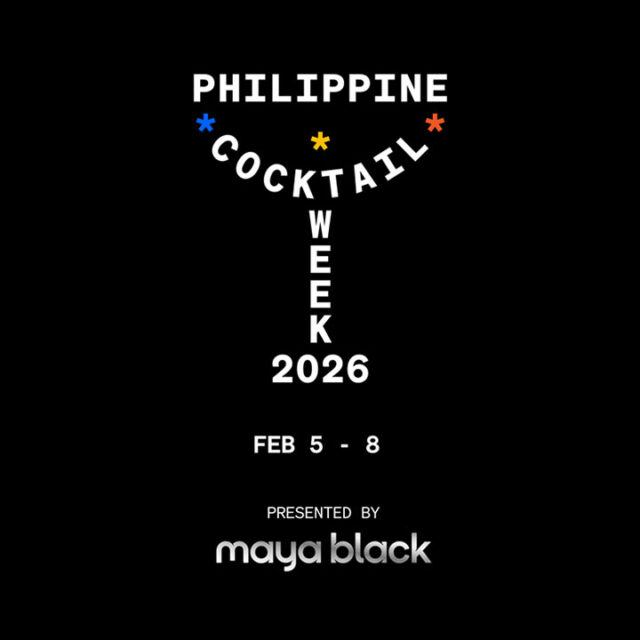
THE FIRST Philippine Cocktail Week (PHCW) will be held from Feb. 5 to 8. Over 50 of the world’s best cocktail bars and the Philippines’ finest will be serving their drinks over four nights in four neighborhoods across Metro Manila. Each night will focus on one neighborhood, with local bars hosting international guest bartenders for one-night-only collaborations. No registrations and no tickets are required.

Many of the participating international bars are recognized by Asia’s 50 Best Bars and The World’s 50 Best Bars.

On Feb. 5, Philippine Cocktail Week will be celebrated at Bonifacio Global City in Taguig. The international bars teaming up with local bars there are:

1. The Golden Tooth (Jakarta, Indonesia) at Somewhere Quiet

2. Virtù (Tokyo, Japan) at The Attic

3. Reka:Bar (Kuala Lumpur, Malaysia) at Southbank Café + Lounge

4. Enigma Mansion (Ho Chi Minh, Vietnam) at The Back Room

5. WU (Nothingness) (Taipei, Taiwan) at No Entry Cocktail Club

6. Boilermaker (Goa, India) at LIT Manila

On Feb. 6, it moves to Legazpi and MCS (formerly Makati Cinema Square) in Makati.

1. Use Bar (Hanoi, Vietnam) at Big Fuzz

2. Bar Bon Funk (Singapore) at The Grasshopper Bar

3. Mostly Harmless (Hong Kong) at From Management Inc.

4. G.O.D. (Bangkok, Thailand) at The Curator

5. CMYK (Changsha, Hunan, China) at El Gato

6. The Cocktail Club (Jakarta, Indonesia) at Cattery

7. Penicillin (Hong Kong) at Fat Cat

On Feb. 7 it moves to Makati’s Poblacion and Jupiter neighborhoods, and The Peninsula Makati.

1. Artifact (Hong Kong) at The Spirits Library

2. Barc (Kathmandu, Nepal) at Banter and Jive

3. Origin (Singapore) at OTO

4. Hope & Sesame (Guangzhou, China) at Opal Bar

5. COA (Hong Kong) at Problem Child

6. Vesper (Bangkok, Thailand) at The Jury

7. Craftroom (Osaka, Japan) at The Bar at The Peninsula Manila

On Feb. 8, the event heads to the north of the metro, to Quezon City and San Juan. The final day runs in two parts: the Sunday Sessions and the regular bar takeovers.

Sunday Sessions takes place from 1-7 p.m. at Corner House in San Juan, bringing together a mix of some of the world’s best bars and the Philippines’ rising stars in a relaxed open-air setting. Unlike the nights, Sunday Sessions is a ticketed event. Check @PhilippineCocktailWeek for more details.

The collaborations are:

1. Southbank Café + Lounge (Alabang, Muntinlupa) x Opal (Poblacion, Makati)

2. Polilya (Ebro St., Makati) x Southside Parlor (Seoul, South Korea)

3. Afterhours (Diliman, Quezon City) x Maltail (Kaohsiung City, Taiwan)

4. Last Chance (Siargao) x Night N’ Day (Taipei, Taiwan)

5. Lost Unicorn (Cebu) x Merry Dessert (Taipei, Taiwan)

6. Hello Sailor (Boracay) x Not Bar (Taoyuan, Taiwan)

7. Bar Hometown (Subic) x Reka:Bar (Kuala Lumpur, Malaysia)

That night, the format returns to one-night-only takeovers across Quezon City and San Juan. The participating bars are:

1. Bar Us (Bangkok, Thailand) at Skybar at Solaire North

2. Mius (Hong Kong) at AKA

3. Epic (Shanghai, China) at After Hours

4. Alice (Seoul, South Korea) at Sa’min

5. Obsidian (Shenzhen, China) at Raion

6. Dry Wave Cocktail Studio (Bangkok, Thailand) at Malagihay

7. Zest (Soul, South Korea) at Gaea

8. Moonrock (Tainan City, Taiwan) at Three Dots

Since the event is presented by Maya Black, its cardholders will enjoy a 20% cashback (capped at P600 with a minimum spend of P2,500) and earn up to 10x Maya Miles at participating bars from Feb. 5-28. Maya Black cardholders can also join the Neighborhood Stamp Rally in which if they complete a whole neighborhood’s worth of bars in the month, they can receive PHCW merch.

Meanwhile, since it is a very bad idea to drink and drive, guests can use the code PHCOCKTAILWEEK to get 30% off GrabCar rides to and from participating bars.

Spotify is the event’s official music partner, bringing DJs to soundtrack the Sunday Sessions. It also put together the official Philippine Cocktail Week playlist, available on Spotify, alongside a collection of playlists from participating bars.

Ayala Land Hospitality to open Mandarin Oriental Makati this year

AYALALAND.COM

By Beatriz Marie D. Cruz, Reporter

AYALA LAND HOSPITALITY (ALH) is on track to open its 276-room Mandarin Oriental Makati this year, despite subdued tourism arrivals, a company official said.

“Mandarin [will open] for sure this year, depending on market conditions,” ALH Head of Marketing and Commercial Roshan Nandwani told reporters on the sidelines of an event on Wednesday.

The hotel, developed through a partnership between Ayala Land, Inc. (ALI) and international hospitality company Mandarin Oriental Hotel Group, is located within Ayala Triangle Gardens at the corner of Paseo de Roxas and Makati Avenue.

The upcoming Mandarin Oriental Makati will cater to business and corporate guests while offering leisure-related amenities, Ms. Nandwani said.

“Mandarin will be more leisure, but we’re expecting a heavy global business traveler as well, like the big corporates and multinationals,” she added.

The hotel’s opening marks the return of the Mandarin Oriental brand to the Philippine market, following the closure of the original Makati property in 2014.

Tourism arrivals reached 6.48 million in 2025, according to the Bureau of Immigration, significantly below neighboring Southeast Asian markets such as Malaysia (38.2 million), Thailand (32.9 million), and Vietnam (21.1 million).

Other hotels in ALH’s pipeline include a 400-room Canopy by Hilton and a 260-room Moxy Hotel in partnership with Marriott International.

Ms. Nandwani said ALI’s Seda Hotels, including its properties in Cebu, Iloilo, and Bacolod, are performing well.

ALH has said it plans to invest $500 million (around P28.63 billion) over the next five years to double its room portfolio to 8,000 by 2030.

The company currently has over 4,000 rooms across its homegrown brands, such as Seda Hotels, El Nido Resorts, and Huni Lio, as well as foreign luxury brands like Raffles and Fairmont.

Meanwhile, ALI is eyeing two government assets set for auction by the Department of Finance’s Privatization and Management Office, according to ALI Chief Financial Officer Jose Eduardo A. Quimpo II.

These include a portion of the Food Terminal, Inc. complex in Taguig City and The Atrium condominium in Makati City.

Mr. Quimpo added that ALI has raised a billion dollars in sustainability-linked financing, noting strong demand from investors and clients.

“[Our] sustainability program is good for us. We’re starting to see that there’s really tangible benefits for us, especially when we do financing,” he said.

The company has about P20 billion in maturities due this year. ALI posted P21.4 billion in nine-month earnings, with revenues from its leasing and hospitality portfolio contributing P35.1 billion.

At the local bourse on Wednesday, ALI shares fell 0.92% or 20 centavos to close at P21.60 apiece.

LANDBANK posts record profit

LAND BANK of the Philippines (LANDBANK) saw its net income grow by 24.38% year on year to a record-high P43.98 billion in 2025 on continued lending to its mandated sectors.

This was up from P35.36 billion in 2024.

The bank’s net interest income rose by 14% year on year to P110.86 billion from P97.25 billion in 2024.

This came as its interest income increased by 8.58% to P152.6 billion from P140.63 billion, supported by higher returns on loans and stronger fixed-income earnings from investments, the Department of Finance (DoF) said in a statement.

Meanwhile, interest expense dropped by 3.57% to P41.84 billion from P43.39 billion.

On the other hand, LANDBANK’s other operating income declined by 16.51% to P11.54 billion in 2025 from P13.82 billion the prior year.

Operating expenses jumped by 16.06% year on year to P63.63 billion from P54.83 billion, mainly due to higher compensation costs.

LANDBANK’s gross loans stood at P1.68 trillion as of end-2025, with 53.5% or P896.61 billion being loans for agriculture, fisheries, and rural development, the DoF said.

Meanwhile, net loans were at P1.28 billion, up by 4.52% year on year from P1.22 billion at end-2024.

Even as its loan book grew, the DoF said LANDBANK’s asset quality “improved” last year.

On the funding side, deposits with the bank hit a record P3.11 trillion last year, up by 3.27% from P3.01 trillion in 2024.

Total assets rose by 2.73% to P3.52 trillion at end-2025 from P3.11 trillion in 2024.Capital funds stood at P278.44 billion.

“The bank’s capital position remained strong and supportive of balance sheet growth, underpinned by sustained profitability and prudent balance sheet management initiatives,” the DoF said.

“LANDBANK’s strong financial performance allows us to do more of what we are mandated to do — extend affordable and accessible financing to Filipinos, especially to farmers, fishers, and the entire agricultural value chain. By strengthening primary production and scaling value-adding activities, we promote food security and drive inclusive, sustainable growth,” LANDBANK President and Chief Executive Officer Lynette V. Ortiz said. — A.M.C. Sy

ASEAN trade and China exports dominance

As it is the Chair of the Association of Southeast Asian Nations (ASEAN) this year, the Philippines is hosting many meetings prior to the ASEAN Summit plus related summits with major economies — the US, Canada, Japan, Korea, India, Australia, Russia, the EU, etc. — in November.

Recent meetings included the 18th Meeting of the Committee of the Whole (CoW) for the ASEAN Economic Community on Jan. 25, the 34th Meeting of the ASEAN Trade Facilitation Joint Consultative Committee (ATF-JCC) on Jan. 26-28, and the 45th ASEAN+3 Bond Market Forum (ABMF) and Related Events on Feb. 2-4.

There will be an interesting event, the ASEAN Editors and Economic Opinion Leaders Forum, sponsored by the ASEAN Committee on Business and Investment Promotion (CBIP), on Feb. 24 here in Manila.

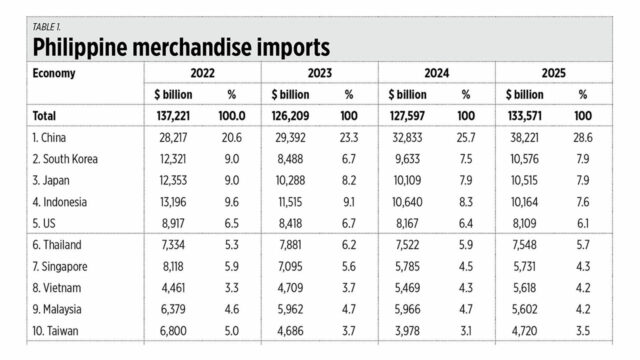
Last week, the Philippine Statistics Authority (PSA) released the full year 2025 merchandise exports and imports data, along with 2024 data. I checked the previous PSA data for 2022 and 2023 and compiled it all in a single table here.

One can see that our merchandise or goods exports increased from $73.3 billion in 2024 to $84.4 billion in 2025. Our merchandise exports also increased, from $127.6 billion in 2024 to $133.6 billion in 2025. This is a bit lower than 2022’s imports of $137.2 billion.

An interesting trend emerges — the share of imports from China has been rising steadily: from 21% of total imports in 2022, to 23% in 2023, 26% in 2024, and nearly 29% in 2025. In contrast, the shares of imports of the US, Japan, South Korea, Indonesia, Singapore, Malaysia, Taiwan, and Australia have been declining from 2022 to 2025.

There has been a mild increase in the import shares of Thailand and Vietnam, while other countries’ share are generally flat (see Table 1).

So for all the anti-China propaganda and campaigns in the Philippines resulting in survey results of low “trust in China,” the economic and trade data show an entirely different story: trust by Philippines businesses and consumers is rising for Chinese products. The Philippines’ trucking, logistics, and construction companies buy more Howo, Shackman, and Jac trucks than Japanese or Korean trucks, and no US trucks. Philippine’ bus companies and tour companies buy more Yutong, Higer, Kinglong, and Zhongtong buses than Japanese, Korean, or European buses, and no US buses. And Philippine motorists are buying more BYD, Geely, MG, and GAC cars, which can endanger the market share of Japanese, Korean, and US car brands.

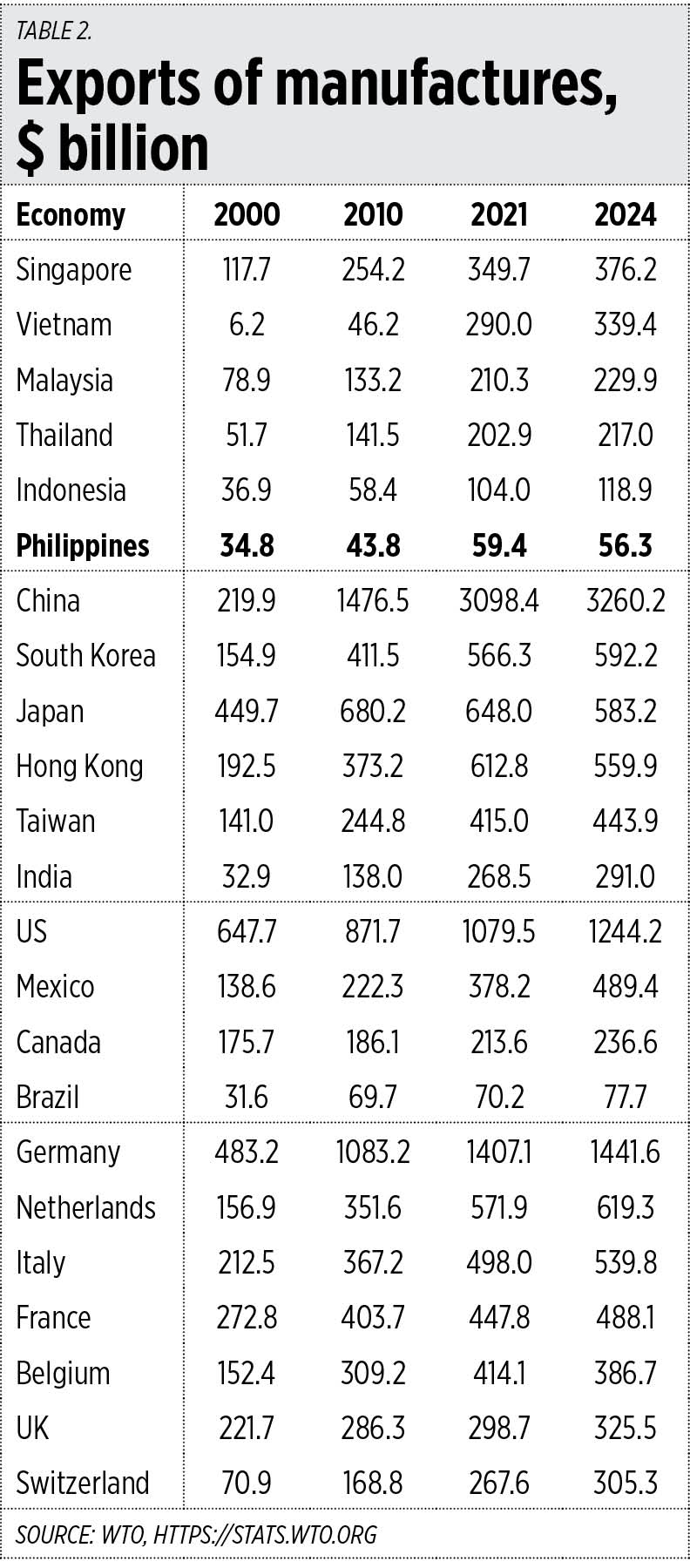
I also checked World Trade Organization (WTO) data on merchandise trade. I chose to focus on exports of manufactures over the last two decades until 2024, as there is no data yet for 2025.

Until 2000, the largest exporter of manufactured goods in the world was the US with $648 billion, followed by Germany with $483 billion, and Japan with $450 billion. China had only $220 billion.

China overtook them all by 2010 or just one decade later, with $1,476 billion, nearly twice that of the US. In 2024, China’s manufactured exports of $3.26 trillion was nearly three times that of the US, more than two times that of Germany, nearly six times that of Japan and South Korea, and 10 times that of the UK. This demonstrates China’s exports dominance especially in manufactured goods.

Among the ASEAN-6, Vietnam’s exports are hopping like a kangaroo, from being the smallest exporter in 2000 with only $6 billion, to the second largest in 2024 with $339 billion. The Philippines has the smallest amount of exports in the ASEAN-6 (see Table 2).

The Philippines’ chairmanship of the ASEAN this year should be a great opportunity for the country to focus more on increasing trade, and merchandise exports and imports — non-merchandise or services trade like tourism, overseas labor, and business process outsourcing businesses should follow.

The current preoccupation by the unproductive war-mongering sectors to exaggerate the Philippines-China dispute over territory should be tamed. We should focus on more trade and investment, more tourism and cultural exchange, more diplomacy and endless negotiations.

We should have more spending on trucks, tractors, buses, gadgets and electronics, and not spending on battleships, jet fighters, and missiles. The ASEAN is a zone of business and commerce hungry for peace and prosperity. We should keep it that way.


Bienvenido S. Oplas, Jr. is the president of Bienvenido S. Oplas, Jr. Research Consultancy Services, and Minimal Government Thinkers. He is an international fellow of the Tholos Foundation.

minimalgovernment@gmail.com

We had a lot, not a little, lamb

SCREENGRAB from Meat & Livestock Australia’s I Love Aussie Lamb event. — AUSSIE BEEF & LAMB PHILIPPINES OFFICIAL FACEBOOK PAGE

PUT TOGETHER Meat & Livestock Australia (MLA) and a dozen Tagaytay restaurants and you get a lamb-a-palooza!

Twenty-five lamb dishes from the participating restaurants greeted us on the morning of Jan. 30. We lost count of how much we ate, but we went home burping-full of both lamb and knowledge.

Last Friday, MLA held I Love Aussie Lamb, a collaboration between the body and the Tagaytay-based restaurants. Held at Elaia by Cyma, by chef Roby Goco, MLA’s “Lambassador,” the event was preceded by a butcher workshop by MLA Master Butcher Kelly Pane. The preceding event taught chefs the myriad ways one can cook lamb, beyond lamb chops and roasts.

Participating restaurants of course included Mr. Goco’s itself, but also Anya Resort, Asador Dos Mestizos, Anzani/Villa Sommet, Farmer’s Table, Gorio’s Roadside, Fatima, Reynaldo’s Smokehouse, Taal Vista Hotel, Textures by Tamayo, The Fatted Calf, and Butcher’s Steaks and Grill.

Standout dishes included the offering from Taal Vista (a lamb birria with a matching consommé; tangy), Anya’s lamb fabada (a stew with beans; comforting), Fatted Calf’s balbacua (heavy and filling in the Tagaytay chill), and their own version of lamb curry patterned after the Thais.

We also liked Tamayo’s take with lamb on perilla leaves (refreshing), and Anzani’s, with a cutlet topped up with a cool Moroccan sauce (it was certainly the most aesthetically pleasing dish). Butcher’s Steaks and Grill had a slow-braised lamb neck turned into hash; its simmering evident and falling apart in the mouth with its tenderness. Finally, Mr. Goco wasn’t to be left out at his home court with a whole roasted lamb served with a lamb paella.

Luisa Rust, senior trade commissioner of the Australian Trade Commission (Austrade) Philippines said in a speech that exports of Australian lamb in the Philippines have grown 18% year on year, culminating in 577 tons of lamb imported into the Philippines in 2025 alone. About this number, Paul Perez, MLA consultant said in an interview, “The things that we’ve planted through the years, those are seeds that are growing now.” He credits the big number to several partnerships with restaurants and chefs.

Meanwhile, Mr. Goco combats misconceptions about lamb. “Perception kasi with lamb is it’s expensive. In reality, it’s not. It’s not cheap, but with better value. But it’s not as expensive as beef,” he pointed out. “You can roast a whole lamb cheaper than a whole pig,” he said, and we’ll take his word for it, considering he had just finished roasting one.

Mr. Perez, meanwhile, pointed to the notion that lamb isn’t as popular in the Philippines due to its gamey taste. Yes, lamb has a flavor all its own, but the misconception comes from older lambs, qualified as mutton (older sheep) imported to the Philippines and passed off as lamb. He says that lamb has to be less than a year old to still be considered lamb, but strictly speaking, as soon as the lamb’s baby teeth transition into adult chompers, it graduates into mutton status.

“These misconceptions are the ones blocking it,” from becoming more popular, Mr. Perez said. “What we do now is to break down all these barriers.”

Mr. Goco talked about the nutritional benefits of lamb, including omega-3, and numerous vitamins and minerals. On food safety, Mr. Perez discussed the importance of traceability in the lamb industry (that is, knowing exactly where the lamb comes from). “It’s one of the biggest industries in Australia” after all, he said. “Anything that hits them will hit the economy of Australia.” — Joseph L. Garcia

PHL companies must brace for faster, automated cyberattacks — CrowdStrike

REUTERS

By Beatriz Marie D. Cruz, Reporter

PHILIPPINE COMPANIES must secure their systems with the help of artificial intelligence (AI) as online attacks become increasingly automated, leading to faster breaches, according to American cyber defense firm CrowdStrike.

“As adversaries weaponize AI to accelerate their attacks and scale their operations, AI-powered defenses help organizations to level the playing field and shift from reactive response to proactive threat disruption,” Fabio Fratucello, field chief technology officer worldwide at CrowdStrike, said in an e-mail.

Companies must use agentic security capabilities that can act across identity, endpoint, and cloud domains in real-time, he said.

“Organizations should consider adopting an agentic security platform that enables security teams to command and orchestrate these capabilities across the security lifecycle, connecting context and data, so agents can reason and act dynamically together in real time, and always under human control.”

This would allow them to move beyond assisted workflows to autonomous security operations, he added.

Mr. Fratucello said attackers have been injecting hidden instructions into generative AI tools to hijack agents, manipulate outcomes, and access sensitive data.

“The weaponization of AI by adversaries has accelerated attack timelines, with what once took days now taking hours or minutes, collapsing the window for defenders to respond,” Mr. Fratucello said.

Philippine companies should also adopt zero-trust security principles and continuous identity monitoring, as more attackers focus on login attempts to kickstart their attacks, the official said.

He likewise emphasized the need for authentication measures with phishing-resistant multi-factor solutions.

Companies should implement strong access policies, like just-in-time access and eliminating standing privileges, he said. Employees should also be educated to recognize social engineering, phishing, and voice phishing threats.

Cloud intrusions, or an attacker’s illegal access to an organization’s cloud computing system, jumped by 136% globally in the first half of 2025 compared to end-2024, according to the 2025 CrowdStrike Threat Hunting Report.

About 40% of these attacks were attributed to China-linked adversaries, and eCrime actors were responsible for 73% of interactive intrusions, it said.

“These threats are proliferating on a global scale, and we expect them to accelerate in 2026,” Mr. Fratucello said.

Meanwhile, CrowdStrike’s 2025 Asia-Pacific & Japan eCrime Landscape Report showed that an eCrime actor has been targeting Philippine banks and foreign exchange services.

These attackers allegedly “leverage financial transaction-themed phishing lures to deliver remote access tools and commodity malware payloads,” Mr. Fratucello said.