Home Blog Page 266

US appeals court lets Trump continue ending deportation protections

A “Make America Great Again” hat is seen on display on the trading floor at The New York Stock Exchange. — REUTERS

A US APPEALS court in California on Monday temporarily lifted a federal judge’s order that had blocked the Trump administration from ending deportation protections for nearly 89,000 migrants from Honduras, Nepal, and Nicaragua.

The 9th US Court of Appeals said the government could likely prove there were “legitimate” reasons to end Temporary Protected Status for immigrants from those countries and paused a California federal judge’s ruling against the administration for the duration of the appeal.

“TPS was never designed to be permanent, yet previous administrations have used it as a de facto amnesty program for decades,” US Homeland Security Secretary Kristi Noem said on X in response to the decision. “Given the improved situation in each of these countries, we are wisely concluding what was intended to be a temporary designation.”

Attorneys and spokespeople for the National TPS Alliance, which represents the migrants, did not immediately respond to requests for comment on the ruling.

TPS provides deportation relief and work permits to people already in the US if their home countries experience a natural disaster, armed conflict or other extraordinary event. Mr. Trump has sought to end most TPS enrollment as part of a broader effort to restrict immigration.

US District Judge Trina Thompson in San Francisco blocked Ms. Noem in December from ending TPS for migrants from Honduras, Nepal, and Nicaragua, finding the administration failed to adequately consider conditions in the three countries that would prevent them from returning. Ms. Thompson also said the terminations may have been motivated by racial animus, citing statements from Ms. Noem and Republican President Donald Trump portraying immigrants as criminals and a drain on US society.

A unanimous three-judge 9th Circuit panel said on Monday, however, that the terminations may not have been eligible for court review. The panel also said the government could likely show that Ms. Noem appropriately considered conditions in the countries before ending the migrants’ TPS.

The three judges were appointed by Mr. Trump, Republican President George W. Bush and Democratic President Bill Clinton. — Reuters

French central bank chief Villeroy to leave early, Macron to pick successor

STOCK PHOTO | Image by Rodrigo Pignatta from Pixabay

PARIS — Bank of France Governor Francois Villeroy de Galhau will stand down in June, more than a year before the end of his term, allowing President Emmanuel Macron to name his replacement before a 2027 presidential election that the far-right could win.

Mr. Villeroy, 66, has been a consistent voice for lower interest rates in the European Central Bank’s governing council, although analysts expect his successor to adopt a similar stance.

Mr. Villeroy announced his departure in a letter to the central bank’s staff, saying he was leaving to lead a Catholic foundation supporting vulnerable youth and families. He had been due to stand down in October 2027.

A source familiar with the matter said the timing of his departure was deliberate, aimed at ensuring continuity at the central bank and heading off any market jitters that could arise if a successor had to be chosen under a far‑right presidency.

Polls show either euroskeptic far-right leader Marine Le Pen or her protege Jordan Bardella could win the next presidential election in spring 2027.

“I made this important decision naturally and independently,” Mr. Villeroy told central bank staff. “The time between now and the beginning of June is sufficient to organize my succession in peace.”

And he told Les Echos that nobody had told him to do anything. “If I had been asked, I would have refused. It’s a strictly personal decision.”

Mr. Macron’s office did not immediately reply to a request for comment.

Mr. Villeroy’s successor would have a six-year term, renewable once, and must be approved by the finance commissions of the National Assembly and Senate.

Their term of office may be terminated early only if they become incapable of performing their duties or are guilty of serious misconduct, according to French law.

Lawmaker Jean-Philippe Tanguy from the far-right Rassemblement National told Reuters the move was aimed at putting in place anti-RN allies in case there is a change of power and said it was “another step towards illiberalism under Macron’s regime.”

ECB LOSES POLICY DOVE
With Mr. Villeroy’s departure, the ECB will lose one of its most outspoken policy doves. Mr. Villeroy has been consistently warning for months about the downside risks to inflation, most recently due to the euro’s strength.

“The victory over inflation has been won, and even though international uncertainties remain high, of course, monetary policy is in a good position with the ECB,” he told staff.

French Finance Minister Roland Lescure said Mr. Villeroy’s actions “have always been guided by rigor, independence and concern for the public interest.”

Governors of the Bank of France usually have previously spent time at the Treasury, which deals with many of the most sensitive issues within the French Finance Ministry.

Two sources said that its current director Bertrand Dumont or past head Emmanuel Moulin would be good candidates, as well as Bank of France deputy governor Agnes Benassy-Quere or former ECB policymaker Benoit Coeure, both of whom have had positions in the Treasury.

Former OECD Chief Economist Laurence Boone, currently at Spanish bank Santander, is also seen as a possible candidate to replace Mr. Villeroy, both sources said.

While Mr. Coeure tended to support an accommodative monetary policy when he was at the ECB, little is known about where the other possible contenders stand.

However, French policymakers tend to lean dovish, a stance that could prove useful as France grapples with a growing public debt burden. — Reuters

Moody’s keeps stable outlook for Philippine banks

Buildings in Manila are seen under cloudy skies. — PHILIPPINE STAR/RYAN BALDEMOR

THE PHILIPPINE BANKING system remains stable as its steady profitability, funding and liquidity, as well as strong capital position can help temper potential asset quality risks from the rise in retail loans and the economic fallout from an ongoing corruption probe, Moody’s Ratings said. 

“We maintain a stable outlook for the Philippines’ (Baa2 stable) banking system, underpinned by a stable operating environment and adequate loan-loss buffers,” Moody’s Ratings said in a report on Monday. 

A stable outlook means the debt watcher’s assessment of rated local lenders will likely be unchanged over the next 12 to 18 months.

Moody’s currently rates eight commercial banks in the country, namely, BDO Unibank, Inc., Metropolitan Bank and Trust Co., Bank of the Philippine Islands, China Banking Corp., Rizal Commercial Banking Corp., Philippine National Bank, Union Bank of the Philippines, and Security Bank Corp.

These lenders hold about 66% of the sector’s total assets as of end-September 2025.

Of the eight, only Security Bank has a negative outlook from Moody’s.

The debt watcher noted that weak investor sentiment arising from the flood control scandal poses risks to the industry, particularly in potential payment delays in the construction sector. 

This, alongside higher credit costs, could taint the industry’s asset quality, Moody’s said.

Late last year, several lawmakers, Public Works officials and private contractors were embroiled in corruption allegations tied to anomalous flood control projects across the country.

“Unsecured products accounted for most of the growth in retail loans, so credit costs will likely increase as this portfolio seasons,” Moody’s said.

“At the same time, the ongoing probe is likely to delay payments to the construction sector and related industries, which will affect the repayment capacity of borrowers in these areas.”

However, Moody’s said the anticipated economic recovery and further easing by the Bangko Sentral ng Pilipinas (BSP) may offer some relief for Philippine banks. 

For 2026, Moody’s sees the country’s gross domestic product (GDP) growing by 5.5% on the back of strong household consumption, sustained remittance inflows from overseas Filipinos, improving public investments and ongoing reforms.

If realized, this year’s GDP growth would pick up from the five-year low of 4.4% in 2025 and would settle at the midpoint of the government’s 5%-6% target for the year.

The BSP has so far lowered borrowing costs by a total of 200 basis points (bps) since August 2024, bringing the key policy rate to 4.5%.

In 2025 alone, it delivered five straight 25-bp cuts, with the last two prompted by dim consumer and business sentiment due to the flood control fallout.

BSP Governor Eli M. Remolona, Jr. has left the door open for another cut at their Feb. 19 meeting if the fourth-quarter growth slowdown proves to be demand-driven.

“Nonetheless, a more accommodative monetary policy stance will help support private consumption and ease the debt servicing costs of some borrowers,” Moody’s said.

Moody’s likewise expects Philippine banks to maintain strong capitalization as internal capital generation matches capital consumption.

However, it sees lending growth slowing to between 8% and 9% over the next 12 to 18 months.

Bank lending has posted double-digit expansion for nearly two years, since May 2024, based on BSP data.

Meanwhile, Moody’s said the industry could continue to rake in profits as wider net interest margins due to rising higher-yielding retail loans offset the impact of higher provisions and lower interest rates. 

Local banks’ funding and liquidity are also likely to hold up this year, the debt watcher noted.

“Banks maintain healthy loan-to-deposit ratios, indicating sufficient liquidity to support credit demand,” Moody’s said. “While the rise in long-tenor project financing introduces funding risks from maturity transformation, Philippine banks have consistently maintained steady net stable funding ratios, a trend we expect will continue.”

“Strong liquidity positions, primarily in cash and government securities, will also remain stable and help address short-term funding gaps,” it added. — Katherine K. Chan

Meralco rates likely to rise in February

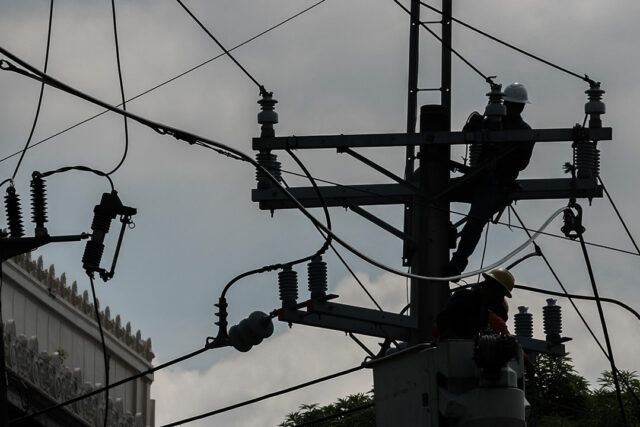
Linemen conduct maintenance work along Magallanes Drive in Manila. — PHILIPPINE STAR/NOEL B. PABALATE

ELECTRICITY RATES in Metro Manila and nearby provinces are likely to go up this month, as initial indications from Manila Electric Co. (Meralco) point to increases across several cost components.

In a statement on Monday, Meralco Spokesperson Joe R. Zaldarriaga said that although the company has yet to receive the final billings from its suppliers, there is an upward pressure on several pass-through charges.

He said the increase in the power prices in the Wholesale Electricity Spot Market (WESM) likely have contributed to the higher generation charge.

Tight supply margins in Luzon drove the average WESM price 9% higher month on month to P3.25 per kilowatt-hour (kWh). Power supply fell by 8.3% to 13,228 megawatts (MW), while demand slipped by 8% to 8,574 MW.

Meanwhile, power procured from Meralco’s suppliers is expected to have increased due to the peso depreciation, which affected their costs that are mostly dollar denominated.

The peso closed at P58.86 per dollar on Jan. 30, weakening by seven centavos from its P58.79 finish on Dec. 29.

“There is also a possible increase in transmission charge due to higher market prices for regulating and contingency reserves,” Mr. Zaldarriaga said.

Meanwhile, he said that an additional P0.08 per kWh will be charged to consumers following the approval of the Energy Regulatory Commission (ERC) of a new rate for universal charge for missionary electrification (UCME).

The ERC approved an increase in the rate for UCME to P0.2763 per kWh from P0.1993 per kWh previously.

UCME is a charge collected from on-grid electricity end-users used to subsidize the more expensive cost of providing power in off-grid areas.

“As these are still initial, the overall rate movement could still change,” the Meralco official said.

Last month, the power distributor decreased electricity rates by P0.1637 per kWh month on month to P12.9508 per kWh, driven by lower transmission charge.

The ERC earlier approved the cost recovery sought by four power generators amounting to P31 billion in fuel cost recovery. As a result, Meralco will collect an additional P0.2816 per kWh starting March.

Meralco is the country’s largest private electric distribution utility, serving over 8.1 million customers in Metro Manila and surrounding provinces, including Bulacan, Cavite, Rizal, and parts of Laguna, Batangas, Pampanga, and Quezon.

Meralco’s controlling shareholder, Beacon Electric Asset Holdings, Inc., is partly owned by PLDT Inc. Hastings Holdings, Inc., a unit of PLDT Beneficial Trust Fund subsidiary MediaQuest Holdings, Inc., has an interest in BusinessWorld through the Philippine Star Group, which it controls. — Sheldeen Joy Talavera

Informal work fills the gap as Philippine economic growth slows

A vendor serves various street food along Carriedo Street in Manila. — PHILIPPINE STAR/RYAN BALDEMOR

By Erika Mae P. Sinaking

FRENY C. DONGOYA sells pares — Filipino comfort food made of braised beef in a sweet-savory soy sauce served with garlic fried rice — for P120 ($2) a plate in Pasay City near the Philippine capital.

On most days, her customers are call center agents and motorcycle riders grabbing quick meals between shifts. She hasn’t raised prices despite higher food costs.

“If I increase prices, they stop coming,” she told BusinessWorld in Filipino. “Then I earn nothing.”

Ms. Dongoya works long hours, but she’s not counted in official job statistics. Like millions of Filipinos, she operates in the informal economy — without permits, tax registration or social protection.

Her situation captures the tension in the Philippine economy as it enters 2026.

Growth slowed sharply last year. Full-year expansion in 2025 eased to 4.4%, the weakest in 14 years excluding the pandemic. Infrastructure spending stalled and global trade softened. Yet officials continue to project confidence about reaching upper middle-income status.

On the ground, the picture looks uneven.

Outside business districts such as Bonifacio Global City and Ortigas, much of the workforce depends on low-paid, unstable jobs. Informal workers sell food, run small stores or take on casual labor. They cushion daily life for formal workers — but see little benefit from economic growth.

About 42% of the workforce or 20.6 million Filipinos remain in informal employment, according to estimates by IBON Foundation.

Christopher James R. Cabuay, an associate professor of economics at De La Salle University in Manila, said this helps explain why growth feels disconnected from household income.

“The current growth model is not structured to favor those in the informal sector,” he told BusinessWorld via teleconference.

“Most of the jobs we produce are in sectors like wholesale and retail trade or accommodation and food services. These employ many workers, but value-added per worker is small, so wages grow slowly,” he added.

Productivity gains are limited, and many workers stay near subsistence levels even during expansion years.

High-value sectors tell a different story. Business process outsourcing, finance and information technology earn in foreign currency and benefit from global demand. These industries helped stabilize growth during external shocks.

But their gains don’t spread evenly.

Analysts describe this as a two-track economy. One track is globally linked and relatively stable. The other is local, informal, and exposed to inflation and weak demand.

Warfredo Alejandro II works in the first track. The 27-year-old is a credit card specialist in the business process outsourcing sector. He has a steady paycheck and benefits. But he depends on the informal economy to manage daily costs.

He notes that affordable meals from vendors like Ms. Dongoya are the only way many employees can stretch their take-home pay.

“Street vendors make life affordable,” he said. “Without them, many employees would struggle to stretch their salaries.”

‘HIDDEN SAFETY NET’
Mom-and-pop stores and food stalls cluster around office towers for a reason. They sell cheap meals and essentials. For workers on entry-level wages, that matters.

Alellie B. Sobreviñas, an associate professor of economics at La Salle, said informal vendors act as an economic buffer for urban workers.

“They are a hidden safety net” especially for workers with long or irregular hours, she said in an e-mailed reply to questions.

When authorities clear sidewalks or relocate vendors without alternatives, costs rise quickly. Workers pay more for food. Commute times increase. Disposable income shrinks.

“That is an effective pay cut,” Ms. Sobreviñas said.

This does not mean informality is desirable, she said. Informal workers lack protection, access to credit and legal security. But removing them without replacing the services they provide creates pressures.

Formalization is often presented as the solution. In practice, it is costly.

For a small food vendor, registering a business requires multiple permits, fees and tax compliance. Costs can reach tens of thousands of pesos. For operators earning thin margins, that’s out of reach.

Ms. Dongoya pays her helpers P400 to P500 a day — below Metro Manila’s P695 minimum wage, which only applies to formal jobs.

Mr. Cabuay said this creates another gap. Wage policies help those already inside the system. They do little for those outside it.

“The difference between what an informal worker earns and what they could earn in the formal jobs available to them is often not that large,” he said.

Many formal openings are also low skill: cleaners, service crew and laborers. They offer stability but limited wage gains. For some workers, informality still pays more.

This weak incentive slows formalization and keeps productivity low.

Economists warn that this structure limits long-term growth. Without stronger manufacturing and higher-value domestic industries, job quality will remain constrained.

Mr. Cabuay and his colleagues have raised concerns about government targets of 6% to 8% growth. Without upgrading jobs, growth will not translate into higher incomes for most workers.

Other barriers remain. Small firms struggle to access credit. Regulations are complex and public investment has been uneven.

The result is an economy that grows without lifting the base.

In business districts, consumption looks strong. Malls are busy and offices are full. But many households remain one shock away from hardship.

For informal workers, inflation hits first and hardest. Food and fuel costs rise, earnings don’t adjust quickly and savings are limited, yet their role remains essential.

Without informal vendors, entry-level formal workers would face higher living costs. Without informal transport, commutes would be longer. Without small retailers, neighborhoods would lose access to cheap goods.

The challenge is not choosing between formal and informal work. It is closing the gap between them.

That means lowering the cost of formalization, improving access to credit, and creating jobs that pay more because they produce more.

Until then, growth will continue to feel abstract for millions.

Ms. Dongoya doesn’t talk about gross domestic product targets. She watches foot traffic and rice prices.

“If customers disappear, I disappear,” she said.

For now, they keep coming. That says as much about the Philippine economy as any official forecast.

Renewable energy contracts for sale fuel Philippines crackdown

STOCK PHOTO | Image from Pixabay

MANY PROSPECTIVE INVESTORS who won contracts for renewable energy projects in the Philippines had no plans of building them. They were only waiting to sell those rights to someone else for the right price.

That led the Department of Energy to terminate agreements for nearly 18 gigawatts of solar, wind and other clean-power projects, according to Energy Secretary Sharon S. Garin.

It’s a costly speed bump for the nation that’s ahead of its Southeast Asian neighbors in its push for green energy projects with full foreign ownership and tax incentives. Manila aims to boost the share of renewables in its energy mix to more than a third by the end of the decade from about a quarter now.

“There are companies that are just getting contracts and they’re waiting to sell it to somebody else,” Ms. Garin said in an interview. “It’s like bonds or stocks, they’re just waiting for the time when the price rises.”

Excluding the canceled contracts, the country still has more than 130 gigawatts of renewable energy projects in the pipeline, far more than any other nation in Southeast Asia, according to data compiled by Global Energy Monitor.

Ms. Garin said that puts the government on track to meet its target of increasing the share of clean power in the country’s energy mix to 35% by 2030 and eventually to 50% after a decade. The contribution of renewables is ahead of natural gas that’s at around 10%, but coal dominates the mix at about 60%.

“Because there are more credible investors that are willing” to get contracts and fill the gap caused by the cancellations, she said. The agency will hold an investment forum on Friday to announce new auctions for the contracts. “This year alone, we’ll probably have about eight auctions compared to only one or two every year previously,” the former lawmaker said.

The Philippines will lead the region’s deployment of battery energy storage systems with 2.6 gigawatts expected to be added this year, according to BloombergNEF, as more clean-power projects are built. Nearly all of the new storage capacity additions will come from the first phase of Manila Electric Co.’s Terra Solar project that has a total capacity of 3.5 gigawatts, it said.

Bulk of the solar power contracts terminated by the government belonged to Solar Philippines, with 33 out of its 42 contracts canceled, Ms. Garin said, after the company failed to deliver on its commitments and in updating the agency on the status of the projects despite repeated calls to do so.

Congressman Leandro Leviste, who founded the company, referred Bloomberg News to a previous video post on his Facebook account when sought for comment. In that video, he denied delivering only a fraction of the contracts and that he didn’t sell any franchise. Last month, he stepped down as board member of the firm behind the Terra Solar project.

“We will protect the credible and reliable investors, but we will discipline those who are not delivering,” Ms. Garin said. “We’re past the infancy stage. Now, different sets of rules have to be established.”

Apart from green energy, the nation of 113 million people is also seeking to prolong the life of its main Malampaya gas field.

President Ferdinand R. Marcos, Jr. last month announced that a Philippine contractor discovered a new gas source near Malampaya, which is estimated to contain around 98 billion cubic feet of gas and would help extend the life of its depleting gas field.

Ms. Garin said the new energy source will be connected to the power system by end of the year and that two other areas near the field have also shown potential. But the country will need to continue importing liquefied natural gas to meet its growing energy needs. “The more renewables you have, the more gas you need,” she said. — Bloomberg

Aboitiz-led consortium takes helm of 797-MW Laguna hydro plant

The Kalayaan Pumped Storage Power Plant overlooks Laguna de Bay.—ABOITIZ POWER CORP.

THE GOVERNMENT has officially turned over the 797-megawatt (MW) Caliraya-Botocan-Kalayaan hydroelectric power plant (CBK HEPP) complex in Laguna to a consortium led by Aboitiz Renewables, Inc., the renewable energy arm of Aboitiz Power Corp. (AboitizPower).

This follows Thunder Consortium’s winning of the bidding process conducted by state-run Power Sector Assets and Liabilities Management Corp. (PSALM) last year, after offering a P36.27-billion bid.

Aboitiz Renewables holds a 64% stake in Thunder Consortium, which also includes Japan’s Sumitomo Corp. and Electric Power Development Co.

The ceremonial turnover was led by President Ferdinand R. Marcos, Jr., together with PSALM, and was witnessed by Japanese Ambassador to the Philippines Endo Kazuya, Philippine government officials, and representatives from the consortium partners.

“Today’s turnover of the Caliraya-Botocan-Kalayaan Hydroelectric Power Plant marks a deliberate step toward an energy system that is steadier in operations, smarter in design, and ready for the future that we are building,” Mr. Marcos said in his speech.

Aboitiz Equity Ventures President and Chief Executive Officer and AboitizPower Chairman Sabin M. Aboitiz said the consortium is ready to operate the facility and support the country’s energy needs.

“[The facility] provides flexibility, stability, and resilience in a rapidly changing energy system. It allows us to manage peaks in demand, support reserves, and integrate more renewable energy into the grid without compromising reliability,” he said.

Mr. Aboitiz added that the CBK would become “even more critical” as the country integrates more solar and wind capacities into the grid.

The CBK HEPP utilizes three hydropower technologies: pumped-storage hydropower, impoundment, and run-of-river systems — contributing to energy security through various functions. The asset provides dispatchable renewable energy and functions as a large-scale energy storage system.

The turnover of the CBK hydro asset is part of the government’s power sector privatization program, generating additional fiscal resources.

Aboitiz Renewables expects the acquisition of CBK to significantly expand its hydropower portfolio and add a massive pumped-storage asset to its renewable energy mix.

AboitizPower is the holding company of the Aboitiz Group’s investments in the country’s power sector. It is the leading power producer, with a market share of 23.86% in the national grid as of July 2025, according to the Energy Regulatory Commission. — Sheldeen Joy Talavera

Globe expects faster data center growth after partner stake sale

STTELEMEDIAGDC.COM

GLOBE TELECOM, INC. expects to accelerate the growth of its data center business after its partner ST Telemedia Global Data Centres (STT GDC) secured new backing from global investment firms KKR and Singtel.

“What this really just means for us here in the Philippines is a stronger partner that allows us to have enhanced scaling power globally with the backing of KKR and Singtel,” STT GDC Philippines President and Chief Executive Officer Carlomagno E. Malana said during a media briefing on Monday.

“It also creates an opportunity for us to increase our ability to future proof, with the expanded capital investment opportunities,” he added.

The development follows an agreement for investment firm KKR and communications technology group Singtel to acquire an 82% stake in Singapore-based data center operator STT GDC.

STT GDC operates in the Philippines through STT GDC Philippines, a joint venture with Globe and Ayala Corp.

STT GDC Philippines operates seven data centers in the country with a combined information technology (IT) load of about 150 megawatts (MW), based on information from its website. Aside from STT Fairview, the company is also constructing STT Cavite 2, which has an estimated IT load of six MW.

Mr. Malana said the new ownership structure is expected to support the local unit’s long-term expansion, particularly as demand for data storage and cloud services continues to grow.

Separately, Globe last month partnered with Elon Musk’s Starlink to bring direct-to-cell satellite services to the Philippines, making the country the first in Southeast Asia to offer the technology.

Globe said it plans to offer the service commercially by end-March, adding that it is working to lower pricing to make the service more accessible.

Mr. Cruz said Globe does not expect the service to be a major revenue driver.

“It is very obvious to all of you that we won’t make money out of this. It is a very costly service but it’s something that we decided to offer to the Philippines. This service will now allow our subscribers or potential subscribers even in far-flung areas, those communities that are unreachable to be reached by satellite,” he said.

For this year, Globe expects low- to mid-single-digit revenue growth, following a decline in 2025.

The Ayala-led telecommunications company said its 2025 net income fell by 4.12% to P23.3 billion from P24.3 billion in 2024, weighed down by higher depreciation and interest expenses and lower revenues.

Globe said strong demand and continued growth in mobile data services are expected to support revenue growth this year.

At the local bourse on Monday, shares in the company rose by P15, or 0.87%, to close at P1,733 apiece. — Ashley Erika O. Jose

PAL expands aircraft support partnership with Airbus

PHILIPPINEAIRLINES.COM

PHILIPPINE AIRLINES (PAL) has expanded its partnership with European aircraft manufacturer Airbus SE after signing an extended Flight Hour Services (FHS) agreement covering fleet maintenance and operational support.

“By delivering comprehensive component support and onsite services in Manila, we are helping PAL optimize fleet performance while benefiting from predictable, long-term maintenance costs,” Airbus Asia-Pacific President Anand Stanley said in a media release on Monday.

The extended contract now covers nine A350-1000s, 11 A330 Family aircraft, and 43 A320 Family aircraft, Airbus said, adding that it includes comprehensive component support through standard exchange, component repairs, component reliability, and engineering services.

The agreement is designed to enhance the flag carrier’s fleet availability, operational reliability, and cost predictability, Airbus said. The contract also covers the provision of on-site stock at PAL’s main base in Manila.

“We thank Philippine Airlines for extending its Flight Hour Services agreements across its entire Airbus fleet to cover the A350, A330 Family and A320 Family. This demonstrates the strength of our long-standing partnership and our shared commitment to operational excellence,” Mr. Stanley said.

Airbus FHS is a comprehensive support program aimed at maximizing aircraft uptime and helping reduce operational costs. The services cover component supply, engineering and repairs, fleet technical management, and airframe maintenance support.

Airbus and PAL began their FHS partnership in 2018 through an initial agreement supporting PAL’s A350-900 fleet.

The partnership was expanded in 2022 to include PAL’s A320 and A330 fleets, reflecting the airline’s continued use of Airbus’ integrated, multi-fleet maintenance solutions.

In January, PAL received its first Airbus A350-1000 aircraft, with at least four more expected to arrive this year.

PAL plans to deploy the aircraft — the first of its kind in Southeast Asia — on flights to North America and other international destinations.

The Airbus A350-1000 is a long-haul widebody aircraft designed to carry a large number of passengers on long-distance routes.

The flag carrier has also outlined a refurbishment program for older aircraft as part of its fleet modernization and growth strategy.

PAL is refurbishing 18 Airbus A321ceo aircraft, which are expected to operate on Asian routes by 2027. Routes include Tokyo (Haneda and Narita), Osaka, Jakarta, Bali, and Guam starting this year, and other key Asian destinations by 2026 and 2027.

PAL plans to roll out three refurbished aircraft this year, nine in 2026, and six in 2027.

PAL Holdings reported an attributable net income of P9.03 billion for the January-to-September period in 2025, up 33.58% from P6.76 billion a year earlier, supported by higher passenger revenues of P116.56 billion, from P115.66 billion. — Ashley Erika O. Jose

BTr upsizes T-bill award as yields ease further

BUREAU OF THE TREASURY FACEBOOK PAGE

THE GOVERNMENT increased the amount of Treasury bills (T-bills) it awarded on Monday as yields continued to go down across the board and as the market expects the Bangko Sentral ng Pilipinas (BSP) to deliver a sixth straight cut next week.

The Bureau of the Treasury (BTr) raised P37.8 billion via the T-bills it auctioned off, higher than the P27-billion plan as the offer was oversubscribed, with total tenders reaching P158.173 billion. However, this was below the P176.819 billion in bids recorded last week.

The Auction Committee doubled its acceptance of noncompetitive bids for all tenors to P7.2 billion each as the T-bills fetched average yields lower than those seen during the previous week’s auction and at the secondary market, the Treasury said in a statement.

Broken down, the government awarded P12.6 billion in 91-day T-bills, above the P9-billion plan, as demand for the tenor reached P55.681 billion. The three-month paper fetched an average rate of 4.492%, down by 8.7 basis points (bps) from 4.579% last week. Yields accepted ranged from 4.44% to 4.525%.

The Treasury also borrowed P12.6 billion via the 182-day debt versus the P9-billion program as tenders hit P56.582 billion. The average rate of the six-month T-bill was at 4.578%, easing by 9.4 bps from 4.672% previously. Tenders awarded carried yields from 4.52% to 4.609%.

Lastly, the BTr raised P12.6 billion from the 364-day securities, more than the P9-billion plan as bids totaled P45.91 billion. The one-year paper’s average yield was at 4.615%, falling by 7.4 bps from 4.689% last week. Accepted rates were from 4.599% to 4.64%.

At the secondary market before Monday’s auction, the 91-, 182-, and 364-day T-bills were quoted at 4.5705%, 4.6827%, and 4.7374%, respectively, based on PHP Bloomberg Valuation Service Reference Rates data provided by the Treasury.

The BTr fully awarded its offer as T-bill yields dropped further in anticipation of another rate cut at the BSP’s policy meeting next week amid still-low inflation and weak economic prospects, Rizal Commercial banking Corp. Chief Economist Michael L. Ricafort said in a Viber message.

He added that demand stayed strong as players likely wanted to lock in returns at current yield levels as they expect further monetary easing.

Headline inflation rose to 2% in January from 1.8% in December but slowed from the 2.9% in the same month last year. This was the fastest print in 11 months or since 2.1% in February 2025.

BSP Governor Eli M. Remolona, Jr. earlier said that a rate cut is possible at the Monetary Board’s Feb. 19 meeting if they see the need to support domestic demand, especially after economic growth hit a five-year low last year due to the ongoing fallout from a corruption scandal that stalled both public and private spending.

However, the central bank last week reiterated it was nearing the end of its current easing cycle. The Monetary Board has slashed benchmark borrowing costs by 200 bps since August 2024, bringing the policy rate to 4.5%.

The government upsized its T-bill award as rates continued to go down amid strong demand, even as bids were lower from the week prior as players are repositioning before a jumbo 10-year bond offering next week, a trader said in a text message.

The BTr wants to raise at least P30 billion via new 10-year benchmark bonds, which it will offer to primary dealers and holders of government securities maturing over the next year.

The rate-setting auction will be held on Feb. 18, with the offer period set to run until Feb. 20. The offering also includes a bond exchange component for holders of maturing debt. The new bonds are scheduled to be issued on Feb. 23.

In April last year, the government raised P300 billion via fresh 10-year fixed-rate benchmark notes, above the initial P30-billion program. The offering was done through a new issuance format targeting institutional investors like corporates, cooperatives, trust funds, retirement funds, and provident funds.

On Tuesday, the government will offer P30 billion in reissued 10-year Treasury bonds (T-bonds) with a remaining life of seven years and six months.

The BTr wants to raise P308 billion from the domestic market this month, or P108 billion via T-bills and up to P200 billion through T-bonds.

The government borrows from local and foreign sources to help fund its budget deficit, which is capped at P1.647 trillion or 5.3% of gross domestic product this year. — Aaron Michael C. Sy

Celebrating Valentine’s Day

DIAMOND HOTEL Philippines Strawberry Caress Cake

WE’RE releasing our Valentine’s Day list of experiences and gifts with a little time to spare so you can have time to prepare. From grand experiences to simple gifts, there is something here for everyone. You can thank us later.

EXPERIENCES AND DINING
Celebrate Valentine’s weekend at The Peninsula Manila with a helicopter ride across the city. Two of The Pen’s venues are offering set meals that kick off with a romantic flight.

At Old Manila, where Michelin-selected chefs craft an evening of refined French gastronomy, begin the experience with a romantic 15-minute helicopter flight over the sights of Metro Manila, then settle in for a six-course dinner conceived as a love letter to French culinary tradition. The six-course set dinner with the helicopter city aerial tour, with a maximum of six persons per flight, costs P48,000 for two persons, while the six-course set dinner by itself costs P8,200 per person.

Meanwhile, dinner at The Lobby on the 14th unfolds with a helicopter journey just before sunset, when the Makati skyline is at its most luminous. Upon return, the celebration continues with a special four-course dinner. The four-course set dinner with a 15-minute helicopter city aerial tour, with a maximum of six persons per flight, costs P43,000 for two persons. The evening before, on Feb. 13, one can enjoy the four-course set dinner (sans helicopter) at P5,490 per person.

To cap the day, arrive to a room set for romance, complete with a special Valentine’s amenity. The evening unfolds with an intimate four-course dinner for two in The Lobby. The following morning, enjoy breakfast at Escolta, linger by the pool, and savor the gift of time with a late check-out. Room rates start at P19,200 for a Deluxe Room and P24,000 for a Premier Suite.

A less heady but still indulgent celebration can be had at Escolta, which is offering a Valentine’s lunch and dinner buffet from Feb. 13 to 15. A generous spread of international favorites and seasonal specialties awaits, enjoyed in a warm, elegant setting that invites lingering conversations and shared moments. The Lunch and Dinner Buffet costs P4,100 per adult and P2,050 per child aged 11 years and below.

Add something extra to the evening’s celebration by visiting the Peninsula Boutique and Flower Shop which has several offers on gifts and flowers from Feb. 9 to 14, from 10 a.m. to 6 p.m.

At The Peninsula Spa, share a moment of calm and connection with a 90-minute experience for two. The ritual begins with a gentle milk foot bath, followed by an antioxidant-rich strawberry hand and foot exfoliation, and concludes with a 60-minute massage. This costs P9,500 per couple and P5,000 per person.

Learn more at www.peninsula.com or follow them on Facebook and Instagram.

Celebrate the day at the Newport World Resorts with music as Champions of the Heart, a Valentine’s concert featuring some of the Philippines’ most celebrated vocalists (Martin Nievera, Sofronio Vasquez, Jed Madela, Jona, and Klarisse de Guzman) takes place on Feb. 14 at 8 p.m. at the Marriott Grand Ballroom. Tickets are available at all TicketWorld outlets and the Newport World Resorts Box Office, with tickets ranging in price from P3,800 to P13,500. For inquiries, contact Customer Care at 7908-8888 or info@fhtcentertainment.com.

With over 70 dining outlets across the property, Newport World Resorts has a wide range of ways to celebrate the occasion. Over at Hotel Okura Manila, Valentine’s Day is marked with a series of Japanese fine-dining experiences at the Michelin-recognized Yamazato. Couples may choose from the Valentine’s Teppan Kaiseki (P7,000++ per person), available from Feb. 9 to 15, or the Valentine’s Kaiseki (P8,000++ per person), offered during dinner service only across the same dates.

For a more intimate counter experience, Valentine’s Sushi Omakase is available at P12,000++ per person from Feb. 11 to 15, served during lunch (11:30 a.m. to 2:30 p.m.) and dinner (5:30 to 9:30 p.m.). For reservations, contact 5318-2888, 0917-818-9868, or e-mail yamazato.service@hotelokuramanila.com.

Meanwhile, over at the Manila Marriott Hotel’s Cru Steakhouse, Valentine’s Day will be marked with a thoughtfully curated dining experience, led by its Premium Selection, alongside two specially crafted Valentine’s set menus. Known for its hand-cut premium meats, the Michelin-recognized steakhouse presents a four-course set menu highlighted by an Australian Portoro Ribeye Steak, priced at P6,888+ on Feb. 13 and 14. Also available are Valentine’s Set Menu A and Set Menu B, allowing guests to tailor the evening around a preferred main course. Choices include Omi Wagyu Striploin, US Prime Tenderloin, seafood selections such as barramundi, tiger prawn thermidor, or salmon, and more, with prices starting at P4,790. For more information, visit crusteakhousemanila.com.

Meat lovers can instead opt to stop by the Gordon Ramsay Bar & Grill Philippines from Feb. 13 to 15, which is adding a festive touch to the weekend with two bespoke cocktails, paired with its signature Great British Brunch. The brunch experience includes flowing appetizers, soft drinks, juices, desserts, and a choice of signature main course. Available on Saturdays and Sundays from 11 a.m. to 2 p.m., the brunch is priced at P2,888 per person. For inquiries and reservations, contact 7908-8000 or 0917-147-6576.

Over at the Hilton Manila Newport World Resorts, executive chef Lord Carlo Bayaban presents a Valentine’s Day dinner on Feb. 14, inspired by Filipino courtship. Set by the Vega Poolside, the five-course experiential dinner draws from the love story of Maria Clara and Ibarra, weaving a culinary narrative that reflects devotion, resilience, and enduring love amid societal challenges. Each course alludes to a chapter in their courtship, beginning with Ensaladang Lato, followed by Laing Rolls, and Bulalo as the soup course. The experience continues with a surf-and-turf main course featuring Kare-Kare Royale, and concludes with Sylvanas de Maria Clara for dessert. Price starts at P15,000 for two pax. Contact 7239-7788 or 0917-851-4044 for bookings and reservations.

For couples seeking a more intimate or distinctive dining atmosphere, Newport World Resorts offers Valentine’s experiences that move beyond traditional restaurant settings. At the Sora Rooftop Bar, Valentine’s Day is celebrated with an exclusive five-course dinner under the stars on Feb. 14, priced at P5,000++ per person. Limited to 20 seats only, the menu features US scallops with champagne beurre blanc, Chilean seabass teriyaki, beef tenderloin with Japanese plum port wine jus, and dessert. For inquiries and reservations, contact 5318-2888, 0917-846-8372, or e-mail poolbar@hotelokuramanila.com.

For a distinctly Filipino expression of Valentine’s dining, La Serenata at Casa Buenas presents a five-course tasting menu on Feb. 14 and 15, offered across two seatings: 5:30 to 7:30 p.m. and 8:30 to 10:30 p.m. The menu moves through oysters with sinigang broth, kinilaw na tuna, kansi beef bone marrow dumplings, and a choice between grilled lapu-lapu or beef kare-kare oxtail croquetas, concluding with Corazón de Manila, a raspberry rose mousse with ube-passion insert. Pricing is set at P5,500 for the Couple’s Table, P15,500 net for La Cupula (six persons), and P20,500 net for the Pamilya Table (eight persons). An additional set menu is available at P3,000 per person. For reservations, call 7908-8988 or 0917-878-8312, or visit https://tickets.newportworldresorts.com/products/la-serenata-2026.

Valentine’s Day at Newport World Resorts also unfolds through buffet experiences. At Marriott Café at Manila Marriott Hotel at Newport World Resorts, guests may enjoy a special Valentine’s Day buffet dinner on Feb. 13 and 14, featuring highlights such as lobster, oysters, and a wide selection of premium meat offerings, paired with a round of sparkling wine. Priced at P3,888 net, contact https://www.marriottcafemanila.com/ for more details. Meanwhile, Yawaragi at Hotel Okura presents its Valentine’s Izakaya Buffet, priced at P3,500++ per person. The buffet is available on Feb. 13 and 14 during dinner (6 to 10 p.m.), and on Feb. 15 during lunch (noon to 3 p.m.). Reservations may be made via 5318-2888, 0917-842-9067, or yawaragi.service@hotelokuramanila.com.

In the City of Manila, love takes center stage at Diamond Hotel Philippines with “All for Love,” dining experiences designed for everyone — from couples and close friends to families celebrating together — from Feb. 13 to 15.

Corniche will serve Valentine’s buffets of international favorites. The buffet is available at P3,988 per person for Feb. 13 lunch, Feb. 14 lunch and first seating dinner, and Feb. 15 lunch or dinner. For those who prefer a more intimate evening affair, a special second seating dinner buffet on Feb. 14 is offered at P4,288 per person, inclusive of a glass of red or white wine.

For lovers of Japanese cuisine, Yurakuen blends a harmony of tradition and flavors for the occasion, offering an elegant eight-course Valentine’s set menu served with a glass of plum wine at P8,500 net for two persons. Guests may also opt for the interactive Teppanyaki Eat-All-You-Can at P4,280 per person or the Yakiniku Eat-All-You-Can at P3,780 per person, both complemented with a glass of red or white wine.

Meanwhile, the Lobby Lounge and Bar 27 offer relaxed yet romantic settings with a special four-course Valentine’s set menu for two at P5,800 net, paired with a standard drink.

No celebration of love is complete without something sweet. Charming confections including the Frosting Flowers Cupcake Bouquet, the Amour Doré Macaron collection, and cakes such as Caramel Kisses and Strawberry Caress are available for purchase at onlineshopping.diamondhotel.com until Feb. 15.

For reservations call 8528-3000 or e-mail restaurant_rsvn@diamondhotel.com. Guests may also purchase vouchers at onlineshopping.diamondhotel.com.

Gacha in Quezon City is offering a Valentine’s Day Menu by chef Martin Narisma. The menu includes starters of Negima (two thigh skewers, one with pickled leeks, the other with ginger-scallion sauce) or Buta Bao (braised pork with pickled mustard leaves and carrot purée). The mains include Nori Kiniing Pasta (for sharing), Hoho Niku (beef cheeks in dashi sauce poivre with mashed potatoes) or Sakana to Gohan (tanigue with miso cream with shimeji risotto). Dessert choices are Kinako Tupig (grilled rice cake, kinako powder, and palm sugar gelato) or Ichigo (poached strawberry, chocolate mousse, toasted sponge cake, vanilla ice cream). The set menu costs P3,500 per pair and P2,000 for singles. Gacha is located at 219 JP Rizal St., Project 4, Quezon City. For reservations, send a message to @eatsgacha on Instagram.

For something simpler but just as heartfelt, this Valentine’s season, Pancake House invites diners to celebrate love through the simple, comforting joy of good food. From Feb. 9 to 15, Pancake House is offering something simple yet unforgettable: a free PB&J (Peanut Butter & Jelly) or Blueberry & Cream Cheese Brioche Toast with a minimum purchase of P1,000. For delivery orders, diners will automatically receive the PB&J option. While the Valentine’s special highlights two fan favorites, Pancake House’s brioche toast lineup extends through March 31. 

Fountain Pen features a cream-colored resin body and signature gold-coated fittings, with a delicate feather pattern on the cap symbolizing the “bright angel” Romeo saw in his beloved. The signature gold-coated solid Au 585 gold nib is decorated with the heart and dagger symbols and Juliet’s name. The Meisterstück Romeo & Juliet notebook and two-pen pouch combine function and beauty. Crafted in cream and teal, the two-pen pouch can be bound together with the accompanying satin ribbon.

GIFTS
Swarovski unveils Charming Love, a joyful new collection for Valentine’s Day debuting all-new Swarovski Charms worn by Ariana Grande. The collection reinterprets hearts, love locks and arrows: the perfect gift for loved ones, or a token of self-love. Choose from designs including Sweethearts, dripping hearts that symbolize new romance, or Lovestruck, a Cupid’s arrow that strikes like lightning. Love Locks signify unbreakable bonds for best friends and lovers, while the Soulmates charm is crafted for the one who truly holds your heart. Rendered in Swarovski crystal and metal finishes, the charms can be mixed, matched, and worn on necklaces, pendants and bracelets.

For Valentine’s Day, Rustan’s invites you to press pause on the present and slip into a love story inspired by the golden age of Hollywood. “DRIVE INto LOVE” transforms the store into a dreamy 1950s movie drive-in, where twinkling lights, retro film posters, and vintage love songs create a cinematic backdrop for celebrating affection in all its forms. Guests can pose beside a classic car or beneath a glowing marquee, popcorn and sweet treats in hand.

Romance takes on a modern silhouette in Rustan’s Women’s, where elegance is expressed through thoughtful details and enduring design like the Adolfo Dominguez organic cotton tailored vest with tab, a refined layering piece that balances structure with softness, for women who appreciate understated sophistication. For those drawn to glamor with a romantic twist, the Aquazzura Chain of Love Sandal 105 makes a statement through delicate detailing and confident lines. Completing the look, the DeMellier Midi Miami shoulder bag brings polished versatility, designed to transition seamlessly from special occasions to everyday wear.

Rustan’s men’s selections embrace effortless refinement, focusing on texture, craftsmanship, and quiet confidence such as the Pedro del Hierro soft corduroy shirt in tan which delivers a relaxed yet elevated aesthetic, lending itself to both casual dates and dressed-up moments. Accessories such as the Elagatto Alchor Platinum Navy Gold add a subtle but distinctive accent.

Other Valentine’s Day gifts range from Malin + Goetz Candles, which set the mood with clean, comforting fragrances, to artistic objects that will make every day after Valentine’s more special like the Lladro Love III Sculpture, and the Cuddle+Kind Olivia the Honey Bear.

For gifts that go beyond the ordinary, The Paper Bunny, with its first store branch in the Philippines at Uptown Bonifacio, turns simple gestures into meaningful expressions of love. From clever everyday essentials like the Bottle Buddy to keepsakes, each item celebrates love in its many forms.

Also at Uptown Bonifacio is Pandora, which brings romance to life with timeless pieces, from delicately crafted charms to classic jewelry designed to be worn and treasured every day. Pandora’s Valentine’s gifts this year are perfect for couples, besties, or self-gifting, iconic baseball-inspired pieces that blend everyday comfort with statement-making style.

Inspired by one of the literary world’s greatest love stories, the Montblanc Meisterstück Romeo & Juliet collection tells the story of devotion and artistry. The Meisterstück Romeo & Juliet Romeo LeGrand Fountain Pen’s cap and barrel are crafted from teal-colored resin and feature platinum-coated fittings. On the cap, a leaf pattern evokes the shaded intimacy of Capulet’s orchard, while an engraved thorn motif on the cone depicts the passion of Romeo’s world. The rhodium-coated solid Au 585 gold nib bears Romeo’s name, together with the intricate symbols of a heart and dagger. The Meisterstück Romeo & Juliet Classique.


Office vacancies may rise anew by 2027 on fresh supply — PRIME Philippines

STOCK PHOTO | Image by Peoplecreations from Freepik

By Beatriz Marie D. Cruz, Reporter

THE Philippine office market may face rising vacancies by 2027 as new supply is expected to outpace demand, according to property consultancy PRIME Philippines.

“At least for 2026, office occupancy will climb closer to 90%. Then in 2027, it could balance out at around maybe 85% to 87% because of the new completion that will come in,” PRIME Philippines Founder and Chief Executive Officer Jettson P. Yu told BusinessWorld on the sidelines of a briefing on Friday.

In Metro Manila alone, PRIME expects between 328,000 square meters (sq.m.) and 478,000 sq.m. of new office supply through 2027.

“With office supply expected to increase between 1% and 2% in 2026, a downward pressure on overall occupancy and lease rates is expected as expansions may not exceed or keep pace with additional space,” the property consultant said in a report.

The Metro Manila office market ended 2025 with an 85% occupancy rate — 1.8 percentage points higher than a year earlier — as tenants such as business process outsourcing (BPO) firms, professional services companies, and government agencies drove take-up.

By submarket, the Makati Central Business District (CBD) recorded the highest occupancy rate in 2025 at 90.5%, followed by Bonifacio Global City (89.5%), Ortigas CBD (89.4%), Muntinlupa City (80.9%), and Quezon City (82.2%). The Bay Area posted the lowest demand, with a 68.5% occupancy rate.

PRIME also noted strong office demand in regional areas, particularly in Metro Davao, Metro Cebu, Metro Clark, Iloilo, and Bacolod.

“To be honest, we are still yet to see the holy grail that would replace the POGO (Philippine Offshore Gaming Operators) tenants,” Mr. Yu said.

Looking ahead, BPO tenants are expected to continue supporting the office market, with more expansion activity seen outside Metro Manila, including in Cavite, Iloilo, Laguna, and Bacolod.

INDUSTRIAL
In the industrial real estate sector, locators continue to favor build-to-suit spaces, as well as “hybrid” warehouses that combine storage with onsite sales, drop-off, and pick-up, said Joy Rosario, vice-president for the industrial market at PRIME Philippines.

In 2025, the country’s industrial sector posted a 97.3% full-year occupancy rate, driven by strong demand in key areas such as Metro Davao (98% occupancy), Misamis Oriental (98%), and Laguna (97.9%). Bulacan, Pampanga, and Cavite each registered occupancy of 97.4%.

The top demand drivers for warehousing include wholesale and retail trade (29.14%), transportation and storage (24.13%), and manufacturing (14.91%).

For this year, new warehouse supplies are expected to come from Pangasinan, Cavite, and Batangas, the report noted.

Meanwhile, Mr. Yu said some property developers have been liquidating assets while shifting investments to other ventures.

He said one developer sold Metro Manila properties to invest in cold storage facilities, while another liquidated residential assets to focus on renewable energy. He added that one developer has shifted from townships to high-end villages.

“That’s a massive signal that they are raising liquidity, lessening their debts, and at the same time, repositioning for the next five to 10 years,” Mr. Yu said at the briefing.