Home Blog Page 26

Slovenia sees EU trade agreement spurring bilateral trade with PHL

STOCK PHOTO | Image by Johnny Africa from Unsplash

SLOVENIA is betting on the Philippines’ upcoming free trade agreement (FTA) with the European Union (EU) to boost trade relations between the two countries.

Smiljana Knez, ambassador of Slovenia to the Philippines, told reporters late Monday that an EU FTA would “definitely help” unlock more trade opportunities between the Philippines and Slovenia. 

“We are really very happy that the negotiations have gone very well,” she said on the sidelines of an event.

Trade Secretary Ma. Cristina A. Roque has said that negotiations for the Philippines-EU FTA could finish by June or July, with signing due in 2027.

The Phil-ip-pines is looking to access addi-tional exports of about $12 bil-lion once the EU FTA is final-ized, the Department of Trade and Industry has said.

Total trade between Slovenia and the Philippines was $30 million in 2025, Ms. Knez said.

Commonly traded products between the two countries include medicine, dairy, semiconductors, and agricultural goods like coconut oil, she noted.

Ms. Knez is bullish about exploring trade and investment opportunities in semiconductors and other tech categories.

“I count on (Slovenian) companies to see the Philippines, and to realize the potential here,” she said. “Personally, I really focus a lot on knowledge-based, high-tech solutions, trying to bring them over.”

Slovenia is also looking to boost investment in the Philippines in the area of energy efficiency, she said, as geopolitical disruptions highlight the need for a secure power supply.

“In energy efficiency, I believe that there is potential, because you are also vulnerable and exposed as we are,” she said.

Last year, Slovenia opened its embassy in the Philippines, its first and only embassy within the Association of Southeast Asian Nations, with the focus on bringing in more Filipino workers there.

To better attract Slovenian companies, Ms. Knez cited the need to address corruption and red tape issues. — Beatriz Marie D. Cruz

Industrialists call on gov’t to protect revenue via smuggling crackdown

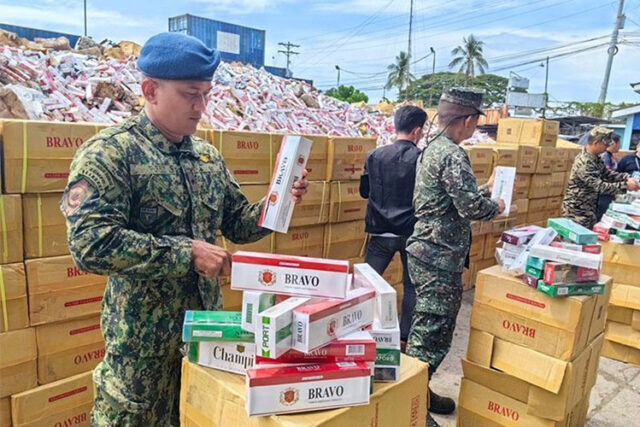
PHILSTAR FILE PHOTO/PHOTO COURTESY OF ROEL PAREÑO

THE Federation of the Philippine Industries (FPI) said the government needs to take action to protect its revenue and reduce its vulnerability to external shocks via a comprehensive crackdown against smuggling.

“In a high-inflation, high-cost environment, protecting revenue ensures government retains the capacity to cushion the most vulnerable sectors,” FPI Chairman Elizabeth H. Lee said in a statement late Monday.

She said curbing smuggling is an “economic necessity,” as the war in the Middle East raises firms’ operating costs through higher fuel and transport prices.

These external shocks affect import-dependent economies like the Philippines in the form of higher production costs, tighter margins, and weaker purchasing power.

“Smuggling compounds external shocks. It weakens the very sectors that must absorb global volatility and sustain domestic growth. Addressing it decisively is essential to economic resilience,” Ms. Lee added.

The entry of smuggled goods weakens domestic industries, she noted.

“At a time like this, the entry of smuggled goods becomes even more damaging. It distorts markets precisely when firms are least able to absorb additional pressure,” Ms. Lee said.

She noted that smuggling and customs leakages are estimated to cost the government up to P500 billion annually.

“With rising public expenditure needs — including fuel subsidies, inflation mitigation measures, and social protection — revenue protection becomes even more urgent,” Ms. Lee said.

She added that the illicit tobacco trade also represents P40 billion in revenue foregone annually by the government.

“These losses represent funds that could otherwise finance ayuda (cash aid), healthcare, and education,” Ms. Lee said.

Over P61 billion worth of illicit goods were seized in 2025, according to the Bureau of Customs (BoC).

The group also noted that the BoC latest administrative order extending the importer accreditation period supports the government’s ease of doing business efforts.

“Predictability and speed are important to reduce business frictions. It is a timely measure given current economic circumstances,” she said. — Beatriz Marie D. Cruz

German businesses expecting ‘more challenging’ conditions 

PHILSTAR FILE PHOTO

A MAJORITY of German businesses active in the Philippines expect more challenging economic conditions in the next 12 months as global energy prices and supply chain pressures cloud the outlook, the German-Philippine Chamber of Commerce and Industry (GPCCI) said.

“While business operations in the Philippines remain stable for our member companies, our latest survey shows that strategically, companies are becoming more cautious on investments and hiring amid rising global uncertainties and cost pressures,” according to Marian Norbert Majer, GPCCI Policy and Advocacy Committee chairman, said in a statement.

In its Spring 2026 AHK World Business Outlook Survey, 51% of German businesses in the Philippines expect more challenging local economic conditions over the next 12 months.

Only 9% expect conditions to improve over the period, GPCCI said.

Energy prices (cited by 65% of respondents) were the top concerns of German firms, reflecting their exposure to geopolitical uncertainties and supply shocks caused by the Iran war.

Supply chain disruptions (49%) and raw material costs (47%) were also singled out as areas of concern, the GPCCI said.

Companies are most concerned about the conflict’s impact on input costs (85%), supply chain disruptions (62%), and difficulties with staff deployment overseas (6%).

“While operations remain stable, rising global tensions and cost volatility are weighing on business confidence,” the group said.

While most German firms (57%) report stable conditions, sentiment is growing more cautious. Meanwhile, 34% reported improvements, while 9% said conditions have worsened.

Growth expectations have also softened, with only 31% expecting improvement, and 18% expecting worse conditions.

About 34% of German firms expect to recalibrate their Philippine investments in the next 12 months. Only 25% plan to invest more, while 31% expect to keep investment stable.

Employment is also expected to soften as German firms grow cautious, GPCCI said.

While 53% expect stable employment levels, only 25% plan to increase hiring, and 22% are looking to adjust workforce levels.

Geopolitical uncertainties have pushed firms to diversify externally. Around 70% of German firms are expanding or planning supplier networks, and 79% are exploring new markets. Meanwhile, 75% have no plans to relocate in the face of external shocks.

Nearly half of respondents reported that US trade policies are not directly relevant to their business.

“Among affected firms, responses favor maintaining the status quo or shifting focus to domestic and established markets, rather than expanding US engagement,” the GPCCI said.

The GPCCI surveyed about 3,200 German companies, with 68 operating in the Philippines, between March 16 and April 10. — Beatriz Marie D. Cruz

Security Bank finances P2.7-B Ilocos solar plant 

PHILIPPINE STAR/DEEJAE DUMLAO

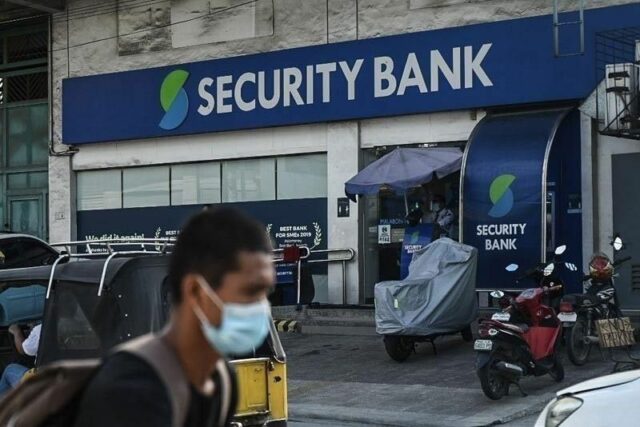
SECURITY BANK Corp. said it signed a P2.7-billion financing facility to fund construction of Astra Solar Energy Corp.’s 80.6-megawatt (MW) solar plant in Ilocos Norte.

“This transaction reflects our continued focus on financing infrastructure that supports long-term economic growth and the energy transition,” Security Bank EVP and Wholesale Banking Segment Head John Cary Lee Ong said in a statement on Tuesday.

Security Bank acted as the sole lender, green loan coordinator, and hedging bank for the transaction, while Security Bank Capital Investment Corp. was the mandated lead arranger and bookrunner.

The solar plant forms part of the bank’s growing renewable energy cluster in Currimao, alongside Mirae Asia Energy Corp.’s 20-MW solar facility and Nuevo Solar Energy Corp.’s 83-MW plant, both owned and operated by Vena Energy.

Security Bank is the sole lender for all three adjacent projects.

“We’re pleased to continue our partnership with Security Bank, who have now financed over 800 MW of clean energy capacity with us in the Philippines,” Vena Group Chief Investment Officer Simone Grasso said. “This reflects the strong confidence local financial institutions have in the country’s renewable energy sector and in Vena Group’s ability to deliver reliable, clean energy to Filipino communities.”

To date, Security Bank has supported 25 renewable energy projects nationwide.

As of October, Security Bank has disbursed P99.4 billion in sustainable finance loans. — Aaron Michael C. Sy

AG&P expected to be locator at proposed Albay economic zone

AGPGLOBAL.COM

THE Philippine Economic Zone Authority (PEZA) said Atlantic Gulf & Pacific Co. (AG&P) is considering locating at a proposed economic zone (ecozone) in Albay.

In a statement on Tuesday, PEZA said the infrastructure company is hoping to set up a manufacturing operation in the proposed Bicol Region Economic Zone (BREZ) in Libon, Albay.

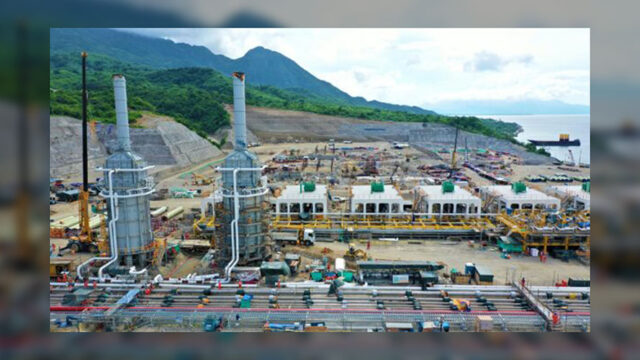
AG&P, a long-time PEZA locator, specializes in industrial and modular infrastructure and services liquefied natural gas terminals, refineries, petrochemical plants, utilities, LNG liquefaction modules, and other complex process units.

To date, the company has invested over P8 billion in the Philippines with staffing topping 1,200 workers.

PEZA said the proposed BREZ has attracted interest from prospective investors and PEZA-registered companies seeking alternative locations.

BREZ is located at Barangay Pantao and can access a port operated by the provincial government.

PEZA Director General Tereso O. Panga said it needs to obtain approvals from some government agencies before BREZ can be proclaimed an ecozone by the President.

PEZA is in the process of completing the documentary requirements before the President can proclaim BREZ, an approval process governed by Republic Act 7916 or the Special Economic Zone Act, as amended.

PEZA still needs sign-off from the departments of Environment and Natural Resources and Agrarian Reform, as well as the National Water Resources Board. — Beatriz Marie D. Cruz

UST needs a win vs Lady Bulldogs to fill up the stepladder Final Four

UNIVERSITY OF SANTO TOMAS GOLDEN TIGRESSES — UAAP/NEO GARCIA

Games on Wednesday
(Smart Araneta Coliseum)
9 a.m. – FEU vs Ateneo (Men)
11 a.m. – NU vs UST (Men)
1 p.m. – FEU vs Ateneo (Women)
3 p.m. – NU vs UST (Women)

WIN and get in.

The order is clear as University of Santo Tomas (UST) aims to complete the stepladder Final Four there and then without any complications against reigning champion National University (NU) at the close of the UAAP Season 88 women’s volleyball eliminations on Wednesday at the Smart Araneta Coliseum.

At 8-5, the UST Golden Tigresses hold their own fate in sealing the fourth seed and eluding a tie with the Far Eastern University (FEU) Lady Tamaraws (7-6) with a win against the NU Lady Bulldogs in the main game at 5 p.m. FEU, at 3 p.m., needs a win against also-ran Ateneo de Manila University (2-11) and a loss by Santo Tomas in order to forge a knockout for the fourth seed.

NU (9-4) and Adamson (9-5) are already in as De La Salle University turned the traditional Final Four into a rare stepladder one after a 14-0 sweep. It’s the school’s first sweep since 2014 and the first in the league since the 16-0 feat of NU in 2022 led by the legend Bella Belen.

Adamson University is also on the lookout for the remaining duels, sporting a chance to tie NU for the second seed if Santo Tomas pulls off an upset.

The Golden Tigresses are locked at No. 4 even with a win with inferior points compared to the Lady Bulldogs and Lady Falcons given a three-way tie at 9-5, thus facing the loser of their possible duel for the No. 2 seed in the first phase of the stepladder.

And all of these scenarios depend on the Golden Tigresses alone.

But the vengeful NU is not keen on handing it on a silver platter, especially with its own need to seal the second seed for a bye in the stepladder against the winner of the first knockout stage.

In the men’s division featuring a preview of sealed Final Four duels, Santo Tomas (9-4) also has its own aspirations of forcing a knockout with five-peat champion NU (10-3) at 11 a.m. for the second spot and a win-once bonus while FEU (12-1) and Ateneo (7-6) collide at 9 a.m. — John Bryan Ulanday

Alex Eala dazzles as a guest in 2026 Laureus World Sports Awards

ALEX EALA — INSTAGRAM.COM/WTA

FROM the tennis court to the red carpet.

Clad in beige Filipiniana gown, Alexandra “Alex” Eala dazzled as a guest in the distinguished 2026 Laureus World Sports Awards in Madrid before strutting her stuff in the Mutua Madrid Open this week.

Ms. Eala graced the red carpet of what is considered as the “Oscars of Sports” as Spanish star Carlos Alcaraz and Aryna Sabalenka were crowned as Sportsman and Sportswoman of the Year, respectively.

Legendary players Novak Djokovic of Serbia (tennis) and Eileen Gu of China (freestyle skiing) hosted the momentous occasion feting the world’s best athletes today.

And Ms. Eala took the most out of the golden moment with a rare selfie with the sporting greats at the historic Palacio de Cibeles in Madrid.

“Sandwiched between greatness,” beamed Ms. Eala on her photo with 22-time Grand Slam champion Mr. Djokovic and three-time Olympic gold medalist Ms. Gu.

Ms. Eala, a graduate of the Rafael Nadal Academy also in Spain, wore an iconic Filipino dress designed by her own uncle, Rhett Eala, who’s a renowned fashion designer abroad.

Her appearance in the world’s most prestigious awarding ceremony should serve handy in an expected killer stretch starting with the WTA 1000 Madrid Open that runs on Wednesday until May 3.

Ms. Eala, who slightly improved to No. 44 in the WTA rankings, will go up against a qualifier at a still-to-be-determined schedule.

After Madrid, Ms. Eala is also listed in the WTA 1000 Rome Open and the WTA 125 Parma Ladies Open both in Italy for the continuation of her clay campaign.

Ms. Eala started her clay season with second-round and first-round stints in the Upper Austria Ladies Linz Open in Austria and the Porsche Tennis Grand Prix in Stuttgart, Germany, both WTA-500 level tours, respectively.

All of these serve as Ms. Eala’s buildup for the queen of clay that’s the French Open on May 24 to July 7 in Paris.

The Roland Garros will be Ms. Eala’s second Grand Slam this season after debuting in the main draw of the Australian Open in Melbourne earlier this year.

Then there’s Wimbledon in London and the US Open in New York later this season. — John Bryan Ulanday

Wembanyama unanimously named NBA Defensive Player of the Year

THE NBA Defensive Player of the Year award has been around since 1983, and in that time, no player has ever received 100% of the first-place votes for the award.

Victor Wembanyama is now the first.

The San Antonio Spurs superstar center received 100 first-place votes out of a possible 100 to unanimously win the prestigious award, the NBA announced on Monday.

Wembanyama, a candidate for Most Valuable Player, led the league in blocks (3.1 per game) for the third straight season in becoming the youngest player to ever earn the award (22 years, 98 days).

The two-time All-Star also averaged career highs in points (25) and rebounds (11.5) while chipping in a steal per game for a Spurs team that compiled the second-best record in the league (62-20) and also ranked No. 3 in the league in defensive rating.

Wembanyama secured 500 points in the voting and joined fellow Spur legend David Robinson in becoming the only two players since 1991-92 to win the award within their first three seasons. — Reuters

The Big Fundamental

By design, the postseason is meant to be revealing. It strips away excess, tightens margins, and shines the spotlight on those who are able to sustain excellence when the game slows and the stakes rise. Which, to no one’s surprise, was exactly what Victor Wembanyama did the other day. In his playoff debut, he put up 35 points on 21 shots to lead the Spurs to an emphatic 111-98 win over the Blazers. His stat line stood out, certainly, but more telling was how he didn’t even seem to strain in the process.

Needless to say, history found its way into the conversation. The Spurs’ mark for a playoff debut had long belonged to Tim Duncan, whose 32-marker introduction 28 years ago signaled the beginning of a sustained era of relevance. Wembanyama surpassed it with plenty of room to spare, doing so with both remarkable range (via five three-pointers) and with effortless rhythm. If The Big Fundamental’s arrival was steady and foundational, the 2024 Rookie of the Year’s entrance on the big stage had a different cadence: more expansive, yet no less controlled. And while the comparison between the foundational stars may be natural, it ultimately yields to a simple truth: The current iteration of the silver and black is not at all interested in revisiting the past. Rather, it wants to make its own mark in as singular a manner as its undisputed leader.

To be sure, context is critical. Wembanyama entered the playoffs already positioned among the league’s most consequential figures, named a Most Valuable Player finalist alongside Shai Gilgeous-Alexander and Nikola Jokic. His name on the shortlist says as much about expectation as it does about production. Clearly, he is no longer viewed through the lens of promise, but of presence. And his influence extends beyond the box score: He is influential in the intangibles on both ends of the court.

In the aftermath of the triumph, Wembanyama spoke of routine, of adherence to structure, of trusting what had been built over the season. His is a posture that resists spectacle, never mind that his game invites it. And perhaps it’s why he seems to play with no pressure. From his vantage point, the playoffs do not demand that he become something more; they simply confirm what he already is.


Anthony L. Cuaycong has been writing Courtside since BusinessWorld introduced a Sports section in 1994. He is a consultant on strategic planning, operations and human resources management, corporate communications, and business development.

US positive on Iran deal but talks still uncertain as ceasefire end nears

AN EXPLOSION caused by a projectile impact after Iran launched missiles into Israel following Israel and the US launched strikes on Iran, in Tel Aviv, Israel, Feb. 28, 2026. — REUTERS/GIDEON MARKOWICZ

WASHINGTON/CAIRO/ISLAMABAD — The United States expressed confidence that peace talks with Iran would go ahead in Pakistan and a senior Iranian official said Tehran was considering joining, but significant hurdles and uncertainty remained as the end of a ceasefire approached.

US President Donald J. Trump wants an agreement that would prevent further oil price rises and stock markets shocks but has insisted Iran cannot have the means to develop a nuclear weapon. Tehran hopes to leverage its control of the Strait of Hormuz to strike a deal that averts a restart of the war, eases sanctions but does not impede its nuclear program.

The Iranian official, speaking to Reuters, said Tehran was “positively reviewing” its participation in talks, despite earlier ruling them out, but stressed no decision had been made.

A Pakistani source involved in the discussions said there was momentum for talks to recommence on Wednesday and MR. Trump could attend in person, or virtually, if a deal were to be signed.

“Things are moving forward and the talks are on track for tomorrow,” the source said on Tuesday on the condition of anonymity.

OIL PRICE DOWN ON TALKS OPTIMISM
Oil prices fell and stocks bounced back in early trading in Asia on Tuesday on expectation that US-Iran peace talks will resume this week, after earlier meetings in Islamabad broke down without an agreement. Oil prices had jumped around 6% in Monday trading on doubts over the talks.

Brent crude futures declined 54 cents, or 0.6%, to $94.94 a barrel and US West Texas Intermediate for May fell $1.11, or 1.2%, to $88.50.

But tensions remained high, with Iran’s foreign ministry on Tuesday condemning the United States for what it called an attack on the Iranian commercial vessel Touska over the weekend, demanding the immediate release of the vessel, its crew and their families.

“Iran would use all its capabilities to defend its national interests and security and protect the rights and dignity of its citizens… the United States would bear full responsibility for any further escalation in the region,” it said, according to Iranian state media.

Maritime security sources said on Monday the vessel was likely to have what Washington deems dual-use items that could be used by the military onboard. The US Central Command said Touska’s crew failed to comply with repeated warnings over a six-hour period and the vessel violated the US blockade.

China, the main buyer of Iranian crude, has expressed concern over the “forced interception.”

Iranian Foreign Minister Abbas Araghchi on Monday had said truce violations by Washington were a major obstacle to the diplomatic process, while top negotiator Mohammad Bagher Ghalibaf accused Mr. Trump on X of increasing pressure through a blockade of Iran’s ports.

He said Mr. Trump was deluded in seeking to “turn the negotiating table into a table of submission,” adding Iran rejects negotiations under threat.

‘THEY’RE GOING TO NEGOTIATE,’ TRUMP SAYS
Thousands of people have been killed by US-Israeli strikes on Iran and in an Israeli invasion of Lebanon conducted in parallel since the war began on Feb. 28. The war triggered a historic shock to global energy supplies and fears that prolonged conflict could push the global economy to the brink of recession.

The US has maintained its blockade of Iranian ports, while Iran lifted and then soon reimposed its own blockade of the Strait of Hormuz, which typically handles roughly one-fifth of the world’s oil and liquefied natural gas supply. Mediator Pakistan has lobbied for Washington to end its blockade.

Mr. Trump on the John Fredericks Media Network on Monday said Iran would negotiate but reiterated Washington would not allow Tehran to develop a nuclear weapon.

“They’re going to negotiate, and hopefully they’ll make a fair deal, and they’ll build their country back up, but they will not have — when they do it — they will not have a nuclear weapon,” Mr. Trump said.

The United States has not specified when the two-week ceasefire will end. A Pakistani source involved in the talks said it would expire at 8 p.m. Eastern time on Wednesday, or midnight GMT or 3:30 a.m. Thursday in Iran.

PAKISTAN PREPARING FOR TALKS
Pakistan has been preparing to host the talks despite uncertainty about whether they would go ahead. Nearly 20,000 security personnel have been deployed across Islamabad, officials said.

US Vice-President JD Vance will travel to Pakistan on Tuesday for Iran talks, Axios reported on Monday citing US sources.

A source had earlier told Reuters Mr. Vance was in the United States on Monday, denying reports he was already on his way to Pakistan.

Mr. Trump warned on Sunday that the US would destroy every bridge and power plant in Iran if it rejected his terms, continuing a recent pattern of such threats.

Iran has said that if the United States were to attack its civilian infrastructure, it would strike power stations and desalination plants in its Gulf Arab neighbors.

White House Press Secretary Karoline Leavitt on Fox News’ Hannity program said the United States was close to a deal with Iran.

“Thanks to the success of the military operation and his (Trump’s) hardline negotiating style, we’re on the brink of a deal,” Ms. Leavitt said.

“And if not, the president, as commander in chief, still has a number of options at his disposal that he’s unafraid to use.” Reuters

With tariffs stalled, Trump’s China policy drifts

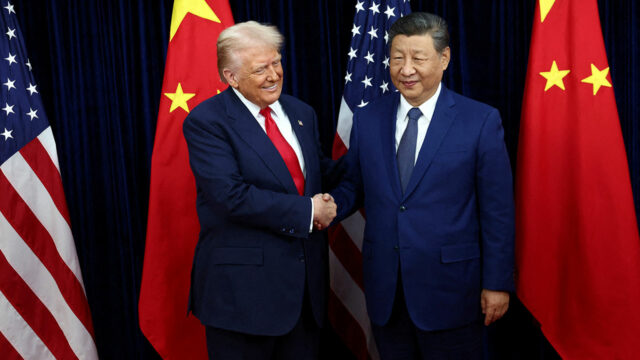
US PRESIDENT Donald J. Trump shakes hands with Chinese President Xi Jinping as they hold a bilateral meeting at Gimhae International Airport on the sidelines of the Asia-Pacific Economic Cooperation (APEC) summit in Busan, South Korea, Oct. 30, 2025. — REUTERS/EVELYN HOCKSTEIN

WASHINGTON — When President Donald J. Trump returned to office in 2025, he vowed to use tariffs to reset relations with China, which he said was “killing” the United States with its trade policies.

Now, more than a year into his second term, Mr. Trump’s aggressive trade moves have not fundamentally altered Beijing’s trade or military actions. Instead, Washington’s China policy appears adrift, causing confusion among officials and driving contradictory decisions.

The administration’s erratic moves toward Beijing have been on full display in recent months. Those include adding top Chinese companies to a military blacklist only to withdraw the list moments later, and a decision by Mr. Trump to greenlight artificial intelligence (AI) semiconductor sales to China within minutes of his government labeling Chinese access to them a national security threat.

As Mr. Trump prepares for his planned May 14-15 visit to China to meet President Xi Jinping, the first such trip by an American president in eight years, critics argue such inconsistencies, coupled with his improvisational dealmaking style, have undermined the US in its competition with Beijing.

“You have departments and agencies acting on their own accord, often with different objectives, and even at times in countervailing ways,” said Ely Ratner, a former assistant secretary of defense for Indo-Pacific Security Affairs.

“On any given day, it feels like the policy can zigzag in either direction,” Mr. Ratner said.

Responding to Reuters questions on the administration’s approach to China, White House spokesperson Kush Desai said Mr. Trump’s trade agenda had “flipped the script” on decades of failed policy that hollowed out the US industrial base.

“By leveraging our economy — the biggest and best consumer market in the world — and his great relationship with President Xi, President Trump has empowered America to finally operate from a position of strength in global diplomatic and trade matters,” Mr. Desai said.

NO PLAN B
Mr. Trump launched his second term China policy with a dramatic trade broadside, initially hiking tariffs on Chinese goods to around 145%.

Beijing did not back down, however, and retaliated with tariff increases of its own.

The countries eventually forged an uneasy détente after China, which holds a virtual monopoly on the refining and processing of the world’s rare earths, threatened to choke off supplies of the minerals needed by US industries.

A February ruling by the Supreme Court invalidating many of Mr. Trump’s duties further undercut the administration’s strategy

“Their entire original strategy was centered around using tariffs to pressure China into major concessions. That effort quickly ran aground,” said Scott Kennedy, a China expert at the Center for Strategic and International Studies think tank. “There has been no coherent Plan B.”

The tariffs did produce at least one result Mr. Trump has sought: the US goods trade deficit with China decreased by 32% to $202 billion in 2025 compared to 2024, US government data show.

But tariffs have not changed Beijing’s mercantilist trade policies, and their fitful use likely reduced industry incentive to reshore manufacturing, a major goal of Mr. Trump’s America First approach. The US lost 91,000 manufacturing jobs from February to December of last year.

Treasury Secretary Scott Bessent and US Trade Representative Jamieson Greer, who have run China policy instead of hawkish Secretary of State Marco Rubio, appear to have lowered expectations for an overhaul in commercial relations, shifting emphasis to a new “managed trade.”

“Where do we want to be with China? We want relations to be stable. We want our trade to be more balanced. We want it to be in non-sensitive goods,” Mr. Greer said in March.

In the face of Mr. Trump’s turmoil, China has sought to portray itself as the responsible power.

“We… stay committed to acting as a positive and stable force for good,” its foreign ministry said in January when asked if Beijing benefited from the chaotic US approach.

CONFLICTING SIGNALS
The administration’s reversals haven’t just been on tariffs.

In December, Mr. Trump declared on social media that he had approved the controversial sale of advanced Nvidia H200 AI semiconductors to China, the very chips his Justice department only 30 minutes earlier said were being smuggled to China, constituting a threat to national security.

Two US officials told Reuters those conflicting signals left them and others in the government flummoxed.

In February, Mr. Trump’s Pentagon blacklisted top Chinese technology companies for allegedly aiding the Chinese military, only to mysteriously withdraw the list an hour later with little explanation.

In the fall, the Commerce department issued rules to extend export controls to thousands of subsidiaries of Chinese companies, arguing it closed a significant loophole by which foreign companies could access sensitive technology. But the US paused those measures, along with planned US port fees for Chinese-built vessels intended to boost American shipbuilding, in the face of China’s threat to restrict rare earths.

“These contradictions ultimately trace back to President Trump, who makes decisions in the moment, unconstrained by a broader strategy,” said Zack Cooper, who studies US strategy in Asia at the American Enterprise Institute think tank.

‘TAKING PAWNS’
Some of Mr. Trump’s actions have put Beijing on the back foot.

His military operations in Iran and Venezuela have weakened two countries that have been close partners for China as well as significant oil suppliers.

Mr. Trump in December approved $11 billion in weapons sales to Taiwan, a major boost for the democratically governed island China claims as its territory.

He also pressured Panama to dislodge a Hong Kong port operator from around the Panama Canal and blockaded oil from reaching Communist-run Cuba.

“Iran was an extremely powerful signal to the Chinese that the United States continues to have overmatch,” said Alex Gray, a former senior national security official during Mr. Trump’s first term.

But the costly war with Iran has burned through advanced missile stockpiles and redirected US military assets away from Asia. And even the additional support for Taiwan has been tempered by fears that Mr. Trump might barter away US backing for a favorable trade deal from Mr. Xi.

“If this is a chess match, the US is taking pawns off the periphery rather than controlling the center of the board. Beijing doesn’t like it, but it’s an inconvenience rather than a strategic setback,” said Jonathan Czin, a China expert at the Brookings Institution.

Meanwhile, Mr. Trump’s antagonism toward American allies — over the NATO alliance, tariffs and the Iran conflict — may erode the hard-earned consensus on the need to push back against China’s actions on the global stage.

To Beijing, the US approach looks like institutional breakdown, said Wang Dong, a professor at China’s Peking University, adding that China would not be diverted from its strategic course by short-term “gambits.”

“While transactional tactics and coercive signaling persist, they are increasingly overshadowed by deep coordination failures across the US government,” Mr. Wang said. “This inconsistency erodes US credibility.” — Reuters


UK’s Starmer seeks to deflect blame over Mandelson appointment

BRITAIN’S PRIME MINISTER KEIR STARMER — POOL VIA REUTERS

LONDON — British Prime Minister (PM) Keir Starmer put the blame firmly on foreign ministry officials on Monday over the appointment of a US ambassador, saying they had withheld information about Labor veteran Peter Mandelson that would have halted his employment.

Mr. Starmer, under pressure to resign by political opponents over the scandal, has repeatedly sought to defend his role in the appointment of Mr. Mandelson and turned to parliament to set out his case that he was unaware that foreign ministry officials had been advised not to give security clearance to him.

He again said he regretted appointing Mr. Mandelson, whom he sacked in September after revelations about the depth of his ties to the late US sex offender Jeffrey Epstein. The events have prompted questions about the prime minister’s judgment, which resurfaced when the government said last week it had just found out Mr. Mandelson had failed a security vetting process.

On Monday, Mr. Starmer again expressed his anger over not being told by foreign ministry officials that in January 2025 they had disregarded advice and decided to grant Mr. Mandelson what is known as “developed vetting” clearance, a status that allows individuals access to information regarded as top secret.

“It beggars belief that throughout the whole timeline of events, officials in the foreign office saw fit to withhold this information from the most senior ministers in our system in government,” Mr. Starmer told parliament.

“That is not how the vast majority of people in this country expect politics, government or accountability to work.”

STARMER SAID HE WOULD NOT HAVE APPOINTED HIM IF HE HAD KNOWN
An appointment that once was hailed as a stroke of genius for employing a Labor veteran with trade experience who could win over incoming US President Donald J. Trump has turned out to be an ongoing nightmare for Mr. Starmer.

Mr. Trump in a post on Truth Social agreed that the appointment was a “really bad pick.”

“Prime Minister Keir Starmer of the United Kingdom acknowledged that he ‘exercised wrong judgement’ when he chose his Ambassador to Washington. I agree, he was a really bad pick. Plenty of time to recover, however!” he said.

Mr. Starmer said he would not have appointed Mr. Mandelson if he had known the UK Security Vetting unit had advised that he should not gain the necessary clearance and that he had stopped the foreign office from being able to go against such advice in the future.

Mr. Starmer, whose popularity has sunk since he won a landslide majority for Labor at a national election in 2024, had previously told parliament all due process had been followed over Mr. Mandelson.

Earlier, his spokesperson said: “The PM would never knowingly mislead parliament or the public… He clearly did not have this information when he previously spoke to parliament.”

After last week’s revelations that the foreign office had overridden a warning Mr. Mandelson should not be appointed, Mr. Starmer sacked Olly Robbins, Britain’s top foreign ministry official, who the prime minister said had signed off on a statement on Mr. Mandelson clearing the vetting process.

Mr. Robbins has yet to make a formal statement on his sacking, but friends of his have been reported as saying he had followed the usual procedure, which allowed the foreign office to overrule advice from UK Security Vetting.

Opponents have accused Mr. Starmer of lying and incompetence, and said his position is no longer tenable.

Three weeks before local elections in which Labor is expected to suffer heavy losses, the resurgence of the scandal has triggered new questions about Mr. Starmer’s grip on government, although no senior Labor lawmakers have urged him to go.

Kemi Badenoch, leader of the main opposition Conservative Party, accused Mr. Starmer of failing to face up to the consequences of his action.

“It is how you face up to those mistakes that shows the character of a leader,” she told parliament. “Instead of taking responsibility for the decisions he made, the prime minister has thrown his staff, and his officials, under the bus.” — Reuters

ADVERTISEMENT
ADVERTISEMENT