Home Blog Page 25

Term deposit yields drop on policy bets

BW FILE PHOTO

THE BANGKO SENTRAL ng Pilipinas’ (BSP) seven-day term deposits fetched slightly lower yields on Wednesday on expectations for further monetary policy easing.

Bids for the central bank’s term deposit facility (TDF) amounted to P162.768 billion, well above the P110 billion auctioned off and the P150.07 billion in bids for the same offer volume last week.

This was equivalent to a bid-to-cover ratio of 1.4797 times, up from the 1.3643 seen a week earlier.

The BSP fully awarded its offering of one-week papers.

Accepted yields were from 4.44% to 4.5075%, narrowing from the 4.44% to 4.5149% band recorded in the previous auction. With this, the average rate of the one-week deposits slipped by 0.28 basis point (bp) to 4.4982% from 4.501%.

The central last auctioned off both the seven-day and 14-day deposits on Oct. 29.

It has not offered 28-day term deposits for over five years to give way to its weekly offerings of securities with the same tenor.

Both the TDF and BSP bills are used by the central bank to mop up excess liquidity in the financial system and better guide market rates towards the policy rate.

TDF yields declined on bets that the BSP would cut benchmark rates and big banks’ reserve requirement ratios (RRR) further, Rizal Commercial Banking Corp. Chief Economist Michael L. Ricafort said.

“These could further reduce borrowing costs, help spur greater demand for loans and investments that, in turn, could help lead to faster economic growth, which has been a policy priority after softer economic growth while inflation remains relatively benign,” he said in a Viber message.

BSP Governor Eli M. Remolona, Jr. earlier said they could consider a sixth straight 25-bp cut at their first policy review this year on Feb. 19, although this could be “unlikely” as the current key rate is already close to their ideal level, signaling a nearing end to their easing cycle.

The Monetary Board has slashed key borrowing costs by a cumulative 200 bps since August 2024, bringing the policy rate to an over three-year low of 4.5%.

Analysts expect the central bank to ease its policy stance further to help support the economy amid the fallout from a graft scandal linked to allegedly anomalous flood control and infrastructure projects.

Governance concerns have stalled public spending and hit investor confidence, leading to weaker growth, which analysts expect to persist this year as issues remain unresolved.

Meanwhile, Mr. Remolona has also said that they are open to lowering universal and commercial banks’ RRR further this year as the current 5% level is “still a bit high.”

The BSP last trimmed banks’ RRR in February last year. It has delivered a total of 450 bps in cuts to big banks’ RRR since October 2024, 350 bps for digital banks, 200 bps for thrift banks, and 100 bps for rural and cooperative banks. — Katherine K. Chan

FTC appeals ruling in Meta antitrust case over Instagram, WhatsApp acquisition

DESIGN.FACEBOOK.COM

THE US Federal Trade Commission (FTC) is seeking to revive its case accusing Facebook parent company Meta Platforms of bolstering an illegal monopoly by acquiring Instagram and WhatsApp, the FTC’s spokesperson said on Tuesday.

The case is part of a crackdown on Big Tech that President Donald Trump started during his first term. Despite a ruling last year dismissing the case, “our position has not changed,” FTC spokesperson Joe Simonson said.

“Meta violated our antitrust laws when it acquired Instagram and WhatsApp. Consequently, American consumers have suffered from Meta’s monopoly,” Mr. Simonson said.

Facebook bought Instagram in 2012 and WhatsApp in 2014. The FTC did not seek to block the deals at the time, but sued in 2020 alleging that Meta, then known as Facebook, held a monopoly on US platforms used to share content with friends and family.

The agency sought to force Meta to restructure or sell Instagram and WhatsApp to restore competition, saying the company spent billions of dollars on the acquisitions to eliminate nascent competitors.

US District Judge James Boasberg in Washington ruled in November that the company does not hold a monopoly now because it faces competition from TikTok.

“The District Court’s decision to reject the FTC’s arguments in this matter is correct — and it recognizes the fierce competition we face. Meta will remain focused on innovating and investing in America,” Meta spokesperson Andy Stone said in a post on social media site X on Tuesday. — Reuters

Russell Brand appears in UK court by video link on further rape, sex assault charges

Russell Brand in a 2010 appearance on Conan. — IMDB

LONDON — British actor and comedian Russell Brand appeared in a London court by video link on Tuesday charged with additional sexual offences allegedly committed against two women nearly two decades ago.

Mr. Brand, once one of Britain’s most high-profile broadcasters and former husband of US pop singer Katy Perry, appeared at Westminster Magistrates’ Court accused of raping one woman and sexually assaulting a second woman in 2009.

The 50-year-old, wearing a denim shirt, appeared remotely for the brief hearing from Florida in the United States, his lawyer Ian Winter said.

Brand has consistently denied having non-consensual sex since allegations were first aired in 2023.

He was charged last year with two counts of rape, one count of indecent assault and two counts of sexual assault against four women between 1999 and 2005.

He pleaded not guilty in May to those five charges and is due to stand trial in June at Southwark Crown Court, where a hearing in the case of the new charges will be held next month.

After the original charges were announced, he said he had been a fool and a sex addict in his younger days but “what I never was, was a rapist.”

In the 2000s, Mr. Brand was a regular on British screens, known for his flamboyant style and appearance.

He worked for the BBC and starred in a number of films including Get Him to the Greek before marrying Ms. Perry in 2010. They divorced 14 months later.

By the early 2020s, he had faded from mainstream culture, appearing primarily on his internet channel where he airs his views on US politics and free speech. — Reuters

No more coddling

STOCK PHOTO | Image by from Freepik

THERE’S ALWAYS a search for the best way to motivate people in the workplace. Is constant praise from the boss accompanied by the encouragement of peers and subordinates still in vogue? (You look good with the butterfly tattoos on your neck, Jack.)

Does the coddling approach really work in achieving corporate goals? Or do compliments just encourage mediocrity and a false sense of complacency that everything is just fine, even in a crisis?

Whether coddling (You have a unique talent we need to tap) or toughness (Read my lips — you’re out of here) defines a corporate culture, success is still measured in the resulting numbers of market share, revenue, and net profits.

Is a tough management style applicable even in the home? A parenting book in 2011 dismissed the almost obsessive quest for self-esteem in children (Oh you spilled milk on the sofa, Dear…nice creamy color). Instead, the school of tough love promotes a drill sergeant’s tactics to build a child’s competitiveness — don’t shame me with your silly silver medal. (I must disclose here that I have yet to read Amy Chua’s The Battle Hymn of the Tiger Mother).

It is not easy to differentiate verbal attacks born out of tough love to elicit excellent performance from mere loathing. (I don’t even like the way he tucks in his shirt). “Constructive criticism” indeed may be an oxymoron, a self-contradicting phrase like “working vacation.” Criticism in any form is meant to be destructive.

The only time criticism can be considered constructive is if it is explicitly solicited — do you think I should back out of the project?

Hiding behind tough love to deliver a disparaging attack on subordinates or peers is neither courageous nor honest. Why not just criticize and then leave it at that, without expecting a warm embrace afterwards? To make verbal punches feel like going to the gym (no pain, no gain) requires fancy footwork.

Still, there are clues when disparagement comes from a true desire to be helpful.

The tone of the censure can be teasing or merely ironic, maybe accompanied by a little finger-wagging — you’ve been a naughty boy. It can also be visceral and filled with invectives like the repetition of the word for a low IQ three times.

The attack may be isolated and specific to the action being denounced. It is the sin and not the sinner that is being singled out — although the two are inseparable at that point. The incident is not demonstrated in the context of past actions going all the way back to birth and parentage.

The self-proclaimed friend voicing out her negative opinion can speak in a low voice and not making a public scene — there’s snot hanging out of your left nostril, Dear.

Critics seldom take censure well themselves. They’re very liberal with putting down others publicly. But when it comes to taking even a mild rebuke, they can overreact with emotional outrage.

Tough bosses may pride themselves with having trained executives to take criticism and learn from their mistakes. (They are now CEOs themselves in bigger companies.)

Anyway, even tough bosses can show a warmer side. Even a single incident of uncharacteristic charity can stand out in the nostalgic get-togethers of former subordinates. Maybe, the SOB (those are his initials) secretly assisted financially with somebody’s hospitalization.

Constructive criticism as a management tool needs to be reviewed. It is possible to lead by showing the way and even extending a helping hand without delivering any disparaging remark — of course, you didn’t see the motorcycle swerving in front of you.

Anyway, there are now companies that take pride in being recognized as “the best place to work in.” Maybe the culture of praise and encouragement still has a place. An occasional reminder need not be harsh. (Are you sure you turned off the faucet?)

Correcting another person’s mistake can even be mentioned much later. The lessons from mistakes made can still be learned over drinks and cholesterol-laden snacks… definitely with less stress and resentment.


Tony Samson is chairman and CEO of TOUCH xda

ar.samson@yahoo.com

IWG to open six new flexible work centers in PHL

STOCK PHOTO | Image by Photoangel from Freepik

MULTINATIONAL OFFICE solutions firm International Workplace Group (IWG) plans to open six new centers in the Philippines in the first quarter.

“We’re excited to bring six new IWG centers to key cities across the Philippines. Our goal is to provide businesses of all sizes with flexible, fully equipped workspaces that make hybrid working seamless and productive,” IWG Philippines Country Manager Rowena Bravo-Natividad said in a statement on Wednesday.

“These openings reflect the growing demand for high-quality office solutions, and we’re proud to offer work environments that are professional, adaptable, and close to where people live,” she added.

According to Colliers’ 2026 Asia Pacific Workplace Insights Report, 82% of Philippine organizations use hybrid work models, 32% plan workplace upgrades next year, and flexible workspaces could account for 30% of commercial real estate by 2030.

“We are expanding our presence across the Philippines with six new centers this quarter, at a time when flexible and platform working is becoming the default model for companies of all sizes,” IWG Plc Middle-East, Africa & Asia Pacific Chief Executive Officer Marc Descrozaille said.

“Our model not only supports better work-life balance and improves employee satisfaction, but also helps businesses boost productivity, scale efficiently, and manage costs, all while giving teams access to thousands of professional locations around the world,” he added.

The expansion is part of IWG’s plan to open 29 new nationwide locations, bringing its Philippine total to 76 centers by the end of 2026.

The six new centers are Spaces Calle Industria in Quezon City, Spaces The Stiles Enterprise Plaza in Makati City, HQ Kalayaan Building in Makati City, Regus E-Square Mall in San Juan City, Regus i2 Building in Cebu City, and Regus Island Central Mactan in Lapu-Lapu City, Cebu. These facilities will feature private offices, meeting rooms, and co-working and creative spaces.

IWG operates more than 5,000 locations across 121 countries. In the first half of 2025, it expanded further, with a network exceeding one million rooms worldwide. In 2024, the company added 899 partner locations and counted 83% of Fortune 500 companies among its clients. — Alexandria Grace C. Magno

How PSEi member stocks performed — January 21, 2026

Here’s a quick glance at how PSEi stocks fared on Wednesday, January 21, 2026.


TomTom: Davao 12th, Manila 40th most traffic-congested cities in Traffic Index

TWO Philippine cities made world’s most-congested rankings, with Davao City’s roads deemed the country’s busiest in 2025. Read the full story.

Stocks continue to decline on US tariff concerns

REUTERS

PHILIPPINE STOCKS dropped for a fourth straight session on Wednesday as negative sentiment on Wall Street amid tariff jitters spilled over to the local market.

The benchmark Philippine Stock Exchange index (PSEi) went down by 0.35% or 22.76 points to close at 6,330.10, while the all shares index declined by 0.28% or 10.12 points to finish at 3,596.69.

“The local bourse extended its decline amid weakening global markets, driven by Trump’s tariff imposition, which kept investors on their toes to further assess their next move,” AP Securities, Inc. said in a market note.

“The local market dropped again amid the negative cues from Wall Street caused by worries over the US’ tariff threats against selected European countries as it tries to get Greenland,” Philstocks Financial, Inc. Research Manager Japhet Louis O. Tantiangco said in a Viber message.

Lingering global uncertainty fueled cautiousness that caused stocks to end lower, but the peso’s rebound against the dollar helped cap the slide, Luis A. Limlingan, head of sales at Regina Capital Development Corp., said in a Viber message.

The peso jumped by 19.4 centavos to close at P59.261 per dollar on Wednesday as the greenback was also hit by trade war concerns.

All three major Wall Street indexes ended Tuesday with their biggest one-day drops in three months, in a broad sell-off triggered by concerns that fresh tariff threats from President Donald J. Trump against Europe could signal renewed market volatility, Reuters reported.

The S&P 500 lost 143.15 points or 2.06% to end at 6,796.86 points; while the Nasdaq Composite gave up 561.07 points or 2.39% to 22,954.32. The Dow Jones Industrial Average fell 870.74 points or 1.76% to 48,488.59.

The reinjection of tariff threats into global markets harkens back to April’s “Liberation Day,” when Mr. Trump’s levies on global trade partners pushed the S&P 500 to near bear market territory.

Sectoral indices were mixed on Wednesday. Services dropped by 0.63% or 16.40 points to 2,552.29; industrials retreated by 0.58% or 52.62 points to 8,999.21; and financials decreased by 0.47% or 10.18 points to 2,116.35.

Meanwhile, mining and oil jumped by 4.64% or 800.84 points to 18,055.78; property rose by 0.2% or 4.60 points to 2,301.02; and holding firms climbed by 0.14% or 7.17 points to 5,035.85.

“Aboitiz Equity Ventures, Inc. was the day’s top index gainer, climbing 3.11% to P31.50. DigiPlus Interactive Corp. was the main index laggard, falling 5.96% to P14.20,” Mr. Tantiangco said.

Decliners beat advancers, 108 to 85, while 66 names closed unchanged.

Value turnover went down to P6.87 billion on Wednesday with 1.21 billion shares traded from the P7.13 billion with 1.22 billion issues that changed hands on Tuesday.

Net foreign buying decreased to P252.82 million from P303.41 million. — Alexandria Grace C. Magno with Reuters

Philippines and China intensify Code of Conduct talks amid SCS tensions

BW FILE PHOTO

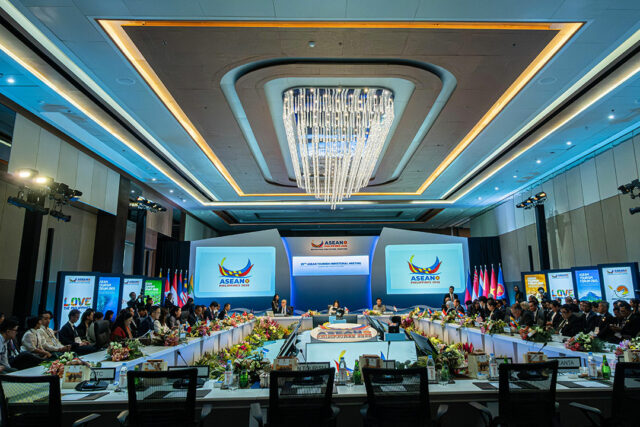
THE Philippines and China have stepped up discussions to finalize a Code of Conduct (CoC) for the South China Sea (SCS), Chinese Ambassador Jing Quan said on Tuesday, as Manila assumes the chairmanship of the Association of Southeast Asian Nations (ASEAN) this year.

“Both sides hope to accelerate negotiations on the Code of Conduct in the South China Sea,” he said in a speech delivered in Manila. “Consultations are becoming more frequent and more intensive.”

The CoC, first pledged in 2002, aims to manage disputes in the strategically critical waters, which serve as a corridor for trillions of dollars in annual trade.

But progress has been slow, with legal, political and strategic differences among ASEAN members and China repeatedly delaying the process. The next round of negotiations is scheduled for the first quarter.

Mr. Jing cited the importance of keeping communication channels open and avoiding actions that could escalate tensions while a legally binding framework is being drafted.

“Even if we cannot reach a solution quickly, it’s essential for us to keep communication channels open, refrain from provocative or confrontational actions and prevent tensions from escalating,” he said.

Diplomats on both sides have already reached preliminary consensus on a roadmap for the next stage of dialogue and negotiation, he added.

The South China Sea remains one of the region’s most volatile flashpoints. China has expanded its presence despite a 2016 ruling by a United Nations-backed arbitral tribunal that voided its sweeping claims over the waters.

The dispute involves overlapping claims from the Philippines, Vietnam, Malaysia, Brunei, Indonesia and Taiwan.

Mr. Jing also called for a measured diplomatic approach, underscoring the long-term importance of managing differences.

“There are maritime disputes between China and the Philippines, which in recent years have become more pronounced,” he said. “I believe that China and the Philippines have the ability and wisdom to properly manage our differences.”

Chester B. Cabalza, founding president of think tank International Development and Security Cooperation, said the renewed dialogue indicates a “more mature and responsible” approach to bilateral relations.

“If this is the diplomatic track that Beijing wants to pursue with Manila, we will see stronger, more stable ties moving forward,” he said via Facebook Messenger.

However, China has maintained nonnegotiable claims in the South China Sea and resists any CoC provisions that might weaken its control or invite international oversight, analysts said.

Beijing’s proactive engagement in finalizing the CoC would be in its interest, said Josue Raphael J. Cortez, a lecturer on diplomacy at De La Salle-College of St. Benilde.

Finalizing a legally binding Code of Conduct would not only ensure regional stability but also improve China’s perception among ASEAN countries, he said.

“Consensus decision-making, a key parcel of the ASEAN Way, is still the process through which the bloc will be able to achieve the final agreement, which takes time,” Mr. Cortez said.

The Philippines has sought to accelerate CoC negotiations as ASEAN chairman to strengthen its diplomatic influence and enhance regional security.

Manila has been advocating for a framework that balances China’s interests with those of smaller claimants, providing legally binding rules for maritime conduct, dispute resolution and conflict prevention.

Beijing and Manila have clashed repeatedly in recent years in contested waters. Chinese Coast Guard vessels have fired water cannons at Philippine fishing boats, and such incidents underscore the high stakes of reaching a CoC that both sides can respect.

Mr. Jing stressed that pending a final agreement, both nations must avoid provocative actions. — Adrian H. Halili

Marcos ouster case sent to Speaker’s office for action

PRESIDENT FERDINAND R. MARCOS, JR. FACEBOOK PAGE

By Kenneth Christiane L. Basilio, Reporter

THE impeachment complaint against President Ferdinand R. Marcos, Jr. has been referred to the Speaker’s office, the House of Representatives secretary-general said on Wednesday, as another group prepared a separate bid to oust him.

In a statement, House Secretary-General Cheloy E. Velicaria-Garafil said her office had sent the first complaint seeking Mr. Marcos’ ouster to the Office of Speaker Faustino “Bojie” Dy III on Tuesday, a day after it was filed.

“Pursuant to established procedure, the Office of the Secretary-General has transmitted the verified impeachment complaint… for appropriate action,” she said.

Mr. Marcos is facing an impeachment complaint over allegations he profited from anomalous infrastructure contracts, with a minority congressman endorsing on Monday a complaint by a lawyer that cited five grounds for removal, including three directly tied to the multibillion-peso graft scandal.

Ms. Garafil said her swift referral of the complaint to Mr. Dy’s office was meant to ensure it is handled in a procedurally proper manner and to avoid infirmities.

“Upon receipt of any impeachment complaint, the Office of the Secretary-General ensures that the document is properly entered, recorded and forwarded to the proper office, emphasizing that the initial step is meant to preserve order and due process,” she said. 

Ms. Garafil’s quick submission of the complaint against Mr. Marcos starkly differs with the handling of Vice-President Sara Duterte-Carpio’s case, who was impeached in February 2025 after more than one-third of lawmakers signed the bill in a single day.

Complaints against her had been filed as early as December 2024 but were not immediately forwarded to then-Speaker Ferdinand Martin G. Romualdez.

Meanwhile, a coalition of civil society groups plan to file a separate impeachment complaint against Mr. Marcos, citing betrayal of public trust as a ground for his removal.

Under the 1987 Constitution, impeachment can be pursued for culpable violation of the Constitution, bribery, graft and corruption, other high crimes or betrayal of public trust.

A complaint requires endorsement from at least one-third of House members before it can be sent to the Senate, which sits as an impeachment court.

“The impeachment is based on the systematic and large-scale plunder of public funds through a scheme of presidential and congressional ‘allocations’ for pet projects in the national budget, the unprecedented abuse of unprogrammed appropriations to fund even more anomalous infrastructure projects and the system of kickbacks,” Renato M. Reyes, Jr., president of Bagong Alyansang Makabayan, said in a statement.

Several officials, politicians and private contractors have been accused of pocketing funds meant for public works projects in the flood-prone nation. 

“All those involved must be held accountable, starting from the top,” he said. The complaint will be endorsed by three opposition lawmakers at the House and will be filed by workers, farmers and anti-corruption activists.

“We expect that this verified complaint will be transmitted to the Speaker and included in the order of business, and not be excluded in favor of what many are saying is a weak first complaint intended to shield the President,” Mr. Reyes said.

The Constitution bars Congress from initiating more than one impeachment proceeding against the same official within a single calendar year, and a lawmaker has warned the first complaint might be intended to trigger the ban amid what he described as weak arguments to back the President’s removal from office.

Arjan P. Aguirre, an associate political science professor at the Ateneo de Manila University, said the first complaint might be a political move by administration allies to pre-empt possible impeachment bids against Mr. Marcos.

“The filing appears less substantive and more performative, giving the strong impression that it was undertaken primarily for publicity rather than for serious legal or constitutional accountability,” he said in a Facebook Messenger chat.

Mr. Reyes said they would file their impeachment bid against Mr. Marcos as they were “concerned with the one-year ban.”

“Since the first complaint… was already transmitted to the Speaker, the same complaint can be referred to the Justice committee when session resumes on Monday, thus triggering the one-year ban,” he said in a Viber message.

Impeachment bids that will be filed this year could test a Supreme Court ruling in July last year that tightened rules on proceedings. The court said due process and fairness must apply at every stage of the process.

VP Duterte faces plunder, malversation charges before Ombudsman

VICE PRESIDENT SARA DUTERTE-CARPIO FACEBOOK PAGE

FORMER Senator Antonio F. Trillanes IV and a civil society group filed plunder, graft and malversation complaints against Vice-President (VP) Sara Duterte-Capio on Wednesday, asking the Office of the Ombudsman to investigate allegations they said could support the filing of an impeachment case.

In a 41-page complaint, Mr. Trillanes and members of The Silent Majority urged the Ombudsman to conduct a “swift and timely investigation and case buildup” into 23 counts of alleged plunder, malversation, graft and other high crimes attributed to Ms. Duterte.

“The verified complaint is being filed to request the honorable Office of the Ombudsman to conduct a formal investigation against Vice-President Duterte for the possible filing of a recommendation by this honorable office for Congress to initiate impeachment proceedings against her,” the complainants said.

They also asked the Ombudsman to recommend to the House of Representatives the filing of impeachment charges, and to pursue criminal cases should probable cause be found.

Israelito P. Torreon, a lawyer for the Duterte family, did not immediately respond to a request for comment. Ruth B. Castelo, an Office of the Vice-President (OVP) spokesperson, also did not immediately reply to a Viber message seeking comment.

Civil society leaders filed plunder complaints against Ms. Duterte in December over the alleged misuse of P612.5 million in confidential funds allocated to her and the Department of Education (DepEd), which she led from 2022 to 2024.

The latest complaint expands the allegations to include Ms. Duterte’s term as mayor of Davao City.

According to Jocelyn “Jozy” Marie Acosta, founder of The Silent Majority, the filing consolidates earlier complaints and introduces allegations based on audit reports, affidavits and public records.

These include the alleged plunder and malversation of P650 million in confidential funds from the OVP and DepEd; the plunder of P2.7 billion in confidential funds during her time as Davao City mayor; and graft and malversation involving about P8 billion worth of overpriced laptops procured during her tenure at DepEd.

The complaint also cited more than P12 billion in Commission on Audit disallowances at DepEd, P7 billion in unliquidated cash advances and the construction of only 192 classrooms out of a reported target of more than 6,000.

It further alleged the nondeclaration of more than P2 billion in bank deposits and other assets in Ms. Duterte’s statements of assets, liabilities and net worth.

Included in the filing is a sworn affidavit executed in November by Ramil L. Madriaga, described in the complaint as a former intelligence operative and campaign worker allegedly assigned by former President Rodrigo R. Duterte to Ms. Duterte during her vice-presidential campaign.

Mr. Madriaga said he was repeatedly instructed by Ms. Duterte’s security chief at the OVP to deliver large sums of money drawn from confidential funds of the OVP and DepEd to various people, according to the complaint.

The complaint further said Mr. Madriaga identified some recipients as people linked to illegal drug trafficking and Philippine Offshore Gaming Operators.

The complainants said the affidavit, along with other evidence, “bolsters and substantiates” their claims that the Vice-President committed plunder and malversation of public funds, which they argued constitute impeachable offenses.

Under the Constitution, impeachment proceedings must be initiated by the House of Representatives and tried by the Senate. — Erika Mae P. Sinaking

BSP briefs Marcos on economic outlook

BW FILE PHOTO

THE Bangko Sentral ng Pilipinas (BSP) briefed President Ferdinand R. Marcos, Jr. on the country’s economic outlook as the central bank signaled that it is nearing further policy easing.

Mr. Marcos met with BSP Governor Eli M. Remolona, Jr. in Malacañang on Tuesday to discuss the central bank’s recent interest rate cut and prospects for economic growth, the Presidential Communications Office (PCO) said on Wednesday.

The PCO did not say whether the meeting also covered the peso’s recent weakness against the dollar. The local currency closed at P59.261 a dollar, strengthening by 19.4 centavos from its P59.455 finish on Tuesday, data from the Bankers Association of the Philippines showed.

The peso has been trading around the P59 level since controversy erupted over anomalous flood control projects, with its weakest close so far at P59.46 on Jan. 15.

Malacañang has said there is no need for the BSP to intervene in the foreign-exchange market despite the peso’s weakness, adding that authorities are closely monitoring currency movements.

In December, the BSP lowered its benchmark policy rate by 25 basis points to 4.5%, down from 4.75% in October 2025 — the lowest level in more than three years.

The rate cut came as the Philippine economy faced headwinds from a multibillion-peso corruption scandal that disrupted public spending and dampened growth.

The BSP expects economic expansion to remain modest through the first half, before rebounding in 2027 with support from earlier monetary easing, the PCO said.

The country’s gross domestic product (GDP) grew 4% in the third quarter of 2025, the slowest in more than four years. Economic Secretary Arsenio M. Balisacan attributed the slowdown largely to reduced infrastructure outlays after the flood control controversy.

Mr. Balisacan said full-year growth for 2025 likely settled at 4.8% to 5%, below the government’s 5.5% to 6.5% target. Official full-year GDP data for 2025 will be released on Jan. 29.

The Development Budget Coordination Committee has also lowered its growth projections, setting targets of 5% to 6% for 2026 and 5.5% to 6.5% for 2027.

Despite the downgrade, the World Bank expects the Philippine economy to recover over the next two years. It said private consumption is likely to strengthen if inflation stays low, employment remains steady and easier monetary policy brings down borrowing costs, encouraging households and businesses to spend and invest. — Chloe Mari A. Hufana