Home Blog Page 240

Australian teen challenging social media ban says internet will be less safe

PIXABAY

SYDNEY — A teenager suing the Australian government to overturn a ban on social media for under-16s says the measure would make the internet more dangerous for young people and be widely circumvented.

Noah Jones, 15, is a co-plaintiff in a High Court case against Communications Minister Anika Wells and eSafety Commissioner Julie Inman Grant.

The law, due to take effect on December 10, would block minors from platforms such as Meta’s Instagram, TikTok, and Snap’s Snapchat. The government says the ban will protect children from harmful content and online predators.

Jones argues the policy will isolate teens and push them into riskier behavior.

“We should be cutting off the bad things about social media,” he told Reuters from his home in Sydney. “When kids do things in secret, that’s when things can be really harmful.”

Mr. Jones said social media is essential for staying connected and sharing ideas, likening it to a modern-day town square.

“I have almost all the people in my year on Snapchat. It’s a light way of being connected. Most people will get quite separated,” he said.

Mr. Jones warned the ban would create a “social divide” between those who evade restrictions and those who do not. “I most likely will get around the ban. I know a lot of my mates will,” he said.

Mr. Jones said parents, not the government, should decide how children use social media.

The Communications Minister and eSafety Commissioner were not immediately available for comment. Wells has said the government stands by the law regardless of any legal challenges.

The lawsuit, which includes another 15-year-old student, argues the ban infringes constitutional rights and should be replaced with targeted measures against cyberbullying and predatory behavior. It is backed by an advocacy group run by a Libertarian Party member of the New South Wales state parliament.

The case has yet to be scheduled for hearing. — Reuters

Macron heads to China as Europe walks tightrope between rivalry and reliance

FRENCH PRESIDENT EMMANUEL MACRON — REUTERS

PARIS — French President Emmanuel Macron will travel to China this week for his fourth state visit, as Europe seeks to balance economic and security threats from Beijing with reliance on the world’s second-largest economy during a time of global trade turmoil.

Mr. Macron in the past has sought to project a robust European front in dealing with China, while being careful not to antagonize Beijing, whose growing assertiveness is testing trade, security and diplomatic ties, analysts say.

“He must make clear to China’s leadership that Europe will respond to growing economic and security threats from Beijing, while preventing an escalation of tensions that leads to a full-blown trade war and diplomatic breakdown,” Noah Barkin, a China analyst with Rhodium Group, told Reuters.

“This is not an easy message to deliver,” he said.

CHINESE EXPORTS HAMMERING EUROPEAN INDUSTRY
Mr. Macron, who will start his trip with a visit to Beijing’s Forbidden City on Wednesday, will meet President Xi Jinping on Thursday in the capital and again on Friday during a trip to Chengdu, in southwestern Sichuan province.

His visit comes after a tense trip by European Commission President Ursula von der Leyen in July, when she said ties between the EU and China were at an “inflection point.”

British Prime Minister Keir Starmer and German Chancellor Friedrich Merz will visit early next year.

Trade tensions between China and Europe have risen as cheap Chinese exports, in the steel sector in particular after being shut out of the US market, are hammering swathes of European industry.

There is also anxiety in Europe at China’s growing technological superiority in the electric vehicle (EV) sector and its dominance in rare earths processing, which could threaten supplies for critical European industries.

With Washington’s tariffs squeezing global trade, Beijing is seizing the opportunity to present itself as a partner for business – hoping to mollify European concerns over China’s backing for Russia and its state-subsidized industrial model.

Ahead of the trip, Mr. Macron’s advisers said he would push for a rebalancing of trade dynamics so that China boosts domestic consumption and hoped the “gains from innovation could be shared”, so that Europe gets access to Chinese technology.

To combat growing concern over China trade, the European Union is expected to unveil a new economic security doctrine that could see the bloc deploy its toolbox of trade instruments in a more aggressive way towards China.

France, whose carmakers have negligible sales in China but are under pressure to succeed in their transition to EVs at home, backed a European Commission push to raise tariffs on Chinese electric car imports.

It also got embroiled in a dispute with Beijing for more than a year over a Chinese investigation into brandy imports, a move widely seen as Chinese retaliation for French support of the EV tariffs, before being offered a respite.

Despite recently opening a new assembly line in China, Airbus is unlikely to clinch a long-anticipated order of up to 500 jets during Mr. Macron’s visit, industry sources said. Such deals give Beijing leverage over Washington, which is pressing for fresh Boeing purchase commitments.

MACRON CANNOT AFFORD TO GO ROGUE
Mr. Macron will also be keen not to repeat the missteps of his last trip in 2023, when his remarks on Taiwan in an interview on his flight back home caused a backlash in the United States.

“Macron cannot allow himself to go rogue as in 2023,” Mr. Barkin said, adding the comments, in which he seemed to refuse to pick sides between China and the US, had “painted a misleading picture about where French policy towards China really was.”

French advisers said Mr. Macron would push for maintaining the status quo on Taiwan and urge China not to escalate, following recent Japanese comments on the island that triggered a diplomatic spat with Beijing.

“I expect him to be more disciplined this time,” Mr. Barkin said. “There is much more at stake for France and for Europe.” — Reuters

Philippines celebrates ‘heroic’ helper who survived Hong Kong fire

Rhodora Alcaraz in a news release photo from the Overseas Workers Welfare Administration (OWWA).— OWWA FB PAGE

MANILA/HONG KONG – A Filipino domestic helper has been hailed as a hero after emerging from a deadly Hong Kong tower fire with her employer’s three-month-old baby and elderly mother.

Just a day after arriving in the city, Rhodora Alcaraz, 28, found herself trapped and alone with her new employer’s loved ones in the family’s smoke-filled Wang Fuk Court apartment before being rescued by firefighters just in time, according to accounts of her ordeal shared by her family and friends.

Ms. Alcaraz’s story has for some highlighted the enduring role of the city’s hundreds of thousands of domestic helpers who cook, clean and care for the young and elderly, often living in cramped spaces and earning modest wages in one of the world’s most expensive cities.

“I salute you, Rhodora, and all overseas foreign workers who continue to sacrifice for their families even while far from home,” Senator Imee Marcos, the sister of the Philippines president, said in a Facebook post on Sunday after visiting Alcaraz in hospital.

She posted a photo of Ms. Alcaraz lying in a hospital bed wearing a purple gown and a face mask and giving a thumbs-up.

“A true modern-day hero and a model of compassion and courage of Filipinos in a foreign land,” the government’s Overseas Workers Welfare Administration (OWWA) wrote in a Facebook post on Saturday, prompting hundreds of comments from well-wishers.

Her employer’s baby and mother were also admitted to intensive care but were in a stable condition, her employer Kanon Chung said in a Facebook post.

FORMER EMPLOYER PRAYED FOR MIRACLE
Panicked audio messages Ms. Alcaraz sent to her sister during Wednesday’s blaze – that killed at least 151 people – went viral after they were shared online by family and friends trying to locate her in the chaotic aftermath.

“I’m feeling very weak. I can’t breathe,” she said in one of the clips, sobbing and struggling to speak.

Rhoda Lynn Dayo, Alcaraz’s former employer, was among those trying to reach people in Hong Kong to help establish her whereabouts, she said.

“I truly expected that she wouldn’t be found anymore. So I prayed: Please God … Perform a miracle, Lord,” she said.

Ms. Alcaraz, known by the nickname Jackie, had cared for Ms. Dayo’s children from the age of 17 for more than four years back in the Philippines.

She was so trusted by the family that Ms. Dayo said she was comfortable leaving her children with Alcaraz even when she had to travel to the US.

“The way she cared for the kids was different – there was real love … I don’t doubt that she would put her life on the line for the child she was caring for,” Ms. Dayo said.

Nine Indonesian domestic workers and one Filipino are confirmed among the dead at Wang Fuk Court, the city’s deadliest fire in more than 75 years. More than 40 people remain missing.

There are around 368,000 foreign domestic helpers in Hong Kong, according to the latest figures, accounting for nearly a tenth of the workforce. The majority come from the Philippines and Indonesia, and in recent years there have been increasing numbers from Bangladesh, Myanmar and Thailand.

Like many of her peers, Ms. Alcaraz – who has eight siblings – decided to work overseas to earn higher wages she could send back home to support her family.

She worked for two years in Qatar, before taking up the job in Hong Kong.

“We are poor. Our father is just a fisherman, that is why she decided to work abroad to help the family,” Ms. Alcaraz’s younger sister, Raychell Loreto, told Reuters.

“We are so proud of our sister,” she added. — Reuters

Manufacturing PMI falls to 4-year low

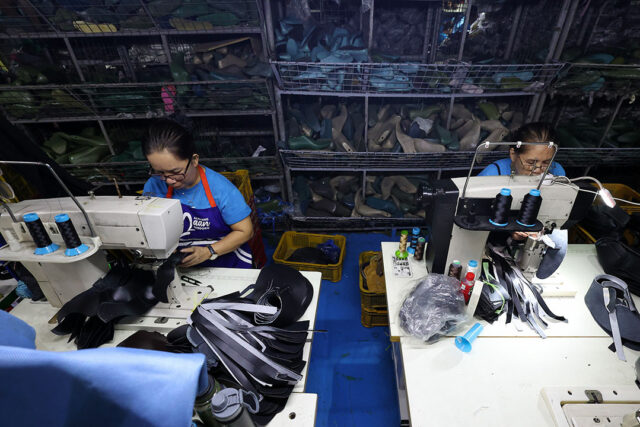
Workers assemble shoes at a warehouse in Marikina City, July 9. — PHILIPPINE STAR/MIGUEL DE GUZMAN

By Aubrey Rose A. Inosante, Reporter

PHILIPPINE FACTORY ACTIVITY fell sharply in November — the steepest drop in over four years — as output and new orders declined amid weather disruptions.

S&P Global Philippines Manufacturing Purchasing Managers’ Index (PMI) slumped to 47.4 in November, a reversal from the 50.1 in October.

In a report, S&P Global said this signaled the “strongest deterioration” in operating conditions in the Philippine manufacturing sector since the 46.4 reading in August 2021.

“Output and new orders contracted at their fastest rates since August 2021, driven by weak customer demand. Exports, purchasing and employment also declined, reflecting broader challenges in the sector,” Trevor Balchin, economics director at S&P Global Market Intelligence, said.

The headline PMI is a composite indicator of manufacturing performance. A PMI reading below 50 indicates an overall deterioration in operating conditions compared to the previous month, while a reading above 50 indicates better operating conditions.

The Philippines was the only country in the Association of Southeast Asian Nations (ASEAN) that saw a deterioration in manufacturing activity in November. ASEAN PMI rose to 53 in November from 52.7 in October, as new orders and production further accelerated.

Based on S&P ASEAN PMI data, Thailand recorded the highest PMI reading at 56.8, followed by Vietnam (53.8), Indonesia (53.3), Myanmar (51.4), and Malaysia (50.1).

In August, the US began imposing a 19% reciprocal tariff on many goods from the Philippines, Cambodia, Malaysia, Thailand and Indonesia.

S&P Global said Philippine manufacturers saw new orders drop for a third straight month, and at the fastest rate since August 2021. This was attributed to “weak customer demand and reduced requirements due to product life cycle changes.”

It noted new export orders fell for the second straight month, and at steepest pace since September 2024.

“Production followed the same trend as new orders in November, falling for the third month running and at the fastest rate since August 2021. Many businesses also noted that the typhoon had caused disruptions to business activities,” it said.

S&P Global said the sharp drop in new orders led to a decline in purchasing activity for a second month in a row. This prompted firms to reduce their inventory for the first time in five months.

“The rate of destocking was the fastest in just over five years. Meanwhile, suppliers’ delivery times were shortened for the first time since April 2024, albeit only slightly,” it added.

Manufacturers also reduced staff for the first time since May.

“The overall rate of job shedding was only marginal, but the fall was linked to layoffs and the non-renewal of contracts. Backlogs rose for the first time in three months, and stocks of finished goods were depleted at the fastest rate in nearly a year,” S&P Global said.

Inflationary pressures were subdued in November, mainly due to lower demand for raw materials.

“Input price inflation eased to a four-month low, remaining well below the long-term trend, while output prices rose slightly,” Mr. Balchin said.

Despite the decline in new orders, manufacturers were confident of output growth over the next 12 months. S&P Global noted that overall sentiment was the strongest since November 2024.

“There were signs of promise, however, as manufacturers expressed increased optimism for the next 12 months, anticipating growth due to new projects and improved economic conditions,” Mr. Balchin said.

“Overall, while the manufacturing sector faces immediate challenges, the outlook suggests cautious optimism for growth moving forward,” he added.

Meanwhile, analysts said the slump in manufacturing activity can be attributed to the typhoons and earthquakes that hit parts of the country in November.

S&P Global Market Intelligence Economics Associate Director Jingyu Pan said the decline in local factory output in November is likely temporary, driven by severe weather rather than a broader weakening in demand.

“As we delve into the comments coming through from manufacturers from whom we collect the survey responses, it does appear that the back-to-back typhoons that has hit in November has actually really been quite impactful for the Philippines,” she said in an interview on Money Talks with Cathy Yang on One News on Monday.

The multiple storms that hit the country have slowed demand and disrupted factory operations, she said.

Ms. Pan said she expects factory activity to recover in December as the impact of weather disruptions dissipate.

“Still relatively softer local manufacturing PMI still largely attributed to the weather-related disruptions particularly the spillover effects of the series of storms and earthquakes that reduced working days for some local manufacturers, thereby reducing their production,” Rizal Commercial Banking Corp. Chief Economist Michael L. Ricafort said.

Mr. Ricafort said November is usually the tail end of seasonal importation and production ahead of the holiday period.

He also noted the peso’s slide to a record low last month raised import costs, though this was partly offset by the Bangko Sentral ng Pilipinas’ recent rate cut.

John Paolo R. Rivera, a senior research fellow at the Philippine Institute for Development Studies, said some firms may have scaled back production due to recent economic uncertainty and the slowdown in government projects.

“Some manufacturers are also adjusting inventories more cautiously as they wait for clearer signals on demand heading into 2025,” he said.

Mr. Rivera warned that the slowdown in manufacturing could continue in December and early 2026 if business confidence remains weak and the peso remains volatile.

“But a recovery is still possible if holiday spending gives a short-term boost and if government spending normalizes soon. Firms will continue to be cautious until they see stronger, more stable demand and a clearer policy environment,” he said.

Meanwhile, Economy Secretary Arsenio M. Balisacan said the Philippine manufacturing sector continues to grapple with high business costs, particularly due to infrastructure gaps.

“We talked about digital connectivity, but also our physical infrastructure, transport, power. We have those challenges. That’s why in the last couple of years, our task was to increase the level of spending on our infrastructure, particularly quality infrastructure,” he said at a year-end press chat on Monday.

Another hurdle for the government is ensuring efficient use of funds, noting that 5-6% of gross domestic product may not be reaching intended projects due to corruption.

Philippines to miss GDP growth target for 3rd year in a row

Christmas decorations are on sale at the Dapitan tiangge in Quezon City, Nov. 29. — PHILIPPINE STAR/MIGUEL DE GUZMAN

THE PHILIPPINES is unlikely to hit even the low end of the government’s growth target this year, as bad weather and a corruption scandal weigh on economic activity, Department of Economy, Planning, and Development (DEPDev) said on Monday.

Economy Secretary Arsenio M. Balisacan conceded that this year’s 5.5-6.5% gross domestic product (GDP) growth target is out of reach.

“Honestly, that’s very unlikely now. We need to grow roughly 7% in the fourth quarter to achieve a 5.5% growth for the year. Given the situations and data that are coming out, that’s quite unlikely,” he said in a year-end press chat.

This will be the third straight year that the Philippines will miss its GDP growth target.

Mr. Balisacan said the Development Budget Coordination Committee (DBCC) is set to meet on Dec. 9 to review the macroeconomic assumptions and targets.

“Our DBCC is meeting to assess the situation, particularly given the recent developments in the third-quarter performance and what’s emerging in the fourth quarter. Those will be taken into account in setting a target for 2026,” he said.

The Marcos administration has been under pressure after a corruption scandal involving public works projects has dampened government spending and shaken investor and consumer confidence.

Third-quarter GDP grew by 4%, the slowest in over four years, bringing the nine-month average to 5%.

Last month, S&P Global Ratings cut its 2025 growth forecast to 4.8%, while the ASEAN+3 Macroeconomic Research Office trimmed its projection to 5.2%.

Mr. Balisacan said he is hoping the economy has seen the worst in the third quarter as President Ferdinand R. Marcos, Jr. instructed agencies to ramp up their spending.

However, he said the full-year GDP growth may still reflect cautious spending by infrastructure-related agencies in the fourth quarter, although the impact is expected to be less pronounced than in the third quarter.

Mr. Balisacan said the nine-month average growth of 5% is still “quite respectable.”

“That still places us something like in the middle of the pack among our neighbors. But hopefully, our intention is to move back to the top tier of these Asian countries next year,” he said.

Even though economic growth may have slowed, Mr. Balisacan said the Philippines remains one of the best-performing economies in the region.

“Don’t be misled by just looking at one quarter, because the economy goes through cycles. We are probably in this part of the cycle, and obviously instigated by these developments related to our governance issues,” he said.

Mr. Balisacan also said major political uncertainty is a deterrence to economic growth but noted that the rule of law needs to be respected.

“We have a constitution. We have rule of law. And we need to abide by those rules. Otherwise, the investing community and the public will not see certainty in the future,” he said.

Amid the flood control controversy, Mr. Balisacan said DEPDEv’s Regional Project Monitoring Committees have already validated 9,290 of 9,855 flood control projects nationwide through the Rapid On-Site Verification Report (ROVeR). The final reports will be submitted to the Office of the President.

He said the DEPDEV is preparing an executive report to guide the administration in navigating governance challenges and the path forward in 2026.

“This report will feature economic analysis, scenarios and policy options, as well as strategic proposals for institutional strengthening to protect our economy’s hard-won gains,” he said.

The document will be released to the public after discussions with the President and Cabinet.

2026 ASEAN CHAIRMANSHIP
Meanwhile, Mr. Balisacan expects a surge in tourism when it assumes the chairmanship of the Association of Southeast Asian Nations (ASEAN) in 2026.

“We surely take advantage of that position of being the chair because the attention of the world will be with us, focus on us, so we need to seize that moment of opportunity,” he said.

He said the government is aligning infrastructure programs to meet the “experiential needs” of visitors, aiming to bolster confidence in the country as a destination for tourists and investors.

Mr. Balisacan clarified that these infrastructure projects for the 2026 ASEAN Summit had no delays and were planned two years ago.

“The projects, particularly transport projects, most of these are ODA (official development assistance)-funded, and ODA projects were not affected at all by these controversies. There were no delays in the implementation of these projects,” he said.

Economy Undersecretary Rosemarie G. Edillon said hosting major international events has historically lifted the country’s growth.

“We hosted the APEC (Asia-Pacific Economic Cooperation), and we saw that the sectors of transport, communication, hotel, restaurant and accommodation, and then the export of services, which is really to do with international travel, actually grew double digits at that time,” she said in the same panel.

UMIC STATUS
The Philippines is still on track to graduate to upper middle‑income country status (UMIC) next year, Mr. Balisacan said.

However, this will depend on the World Bank which may set new thresholds in July 2026, as well as the exchange rate, inflation and exchange rate, he added.

The World Bank’s latest country income classification showed the Philippines remained a lower middle-income country with a gross national income (GNI) per capita of $4,470. This was higher than its GNI per capita of $4,230 in the previous year.

The World Bank classifies a country as lower middle-income if the GNI per capita level is between $1,136 and $4,495.

The Philippines’ GNI per capita was only $26 shy of the World Bank’s adjusted GNI per capita requirement of $4,496-$13,935 to become a UMIC. — Aubrey Rose A. Inosante

DEPDev says 3 flagship infrastructure projects completed by yearend

DPWH

THE PHILIPPINE GOVERNMENT expects to complete three additional infrastructure flagship projects (IFPs) by yearend, the Department of Economy, Planning, and Development (DEPDev) said.

“All are expected to be completed within the year,” Economy Undersecretary Joseph J. Capuno said during the agency’s year-end press chat on Monday.

The Central Luzon Link Expressway Phase 1 is a 30-kilometer (km) four-lane expressway that connects Tarlac City to Cabanatuan in Nueva Ecija.

Another project is the North Luzon Expressway (NLEX)-South Luzon Expressway Connector Road, 7.7-km four-lane elevated expressway that extends the NLEX from the end of Segment 10 in C3 Road, Caloocan City to the Polytechnic University of the Philippines in Sta. Mesa, Manila.

Lastly, the 1.34-km-long Davao River Bridge or Bucana Bridge that will connect the eastern and western coastal areas of Davao City.
As of the third quarter, DEPDev said the government currently has 209 projects worth P10.52 trillion in total project cost. The bulk or 140 of these flagship projects are related to physical connectivity.

DEPDev said that there are 79 projects that are still ongoing. Of this, 40 IFPs are expected to be completed by 2028 and 39 projects to be completed beyond 2028.

DEPDev said it completed seven projects with P68.65 billion including the Arterial Road Bypass Project Phase III, Flood Risk Improvement and Management Project for Cagayan de Oro River, Pasig-Marikina River Channel Improvement Project, Phase V and more. — ARAI

Aboitiz-led consortium secures PCC nod for CBK hydro acquisition

CBKPOWER.COM

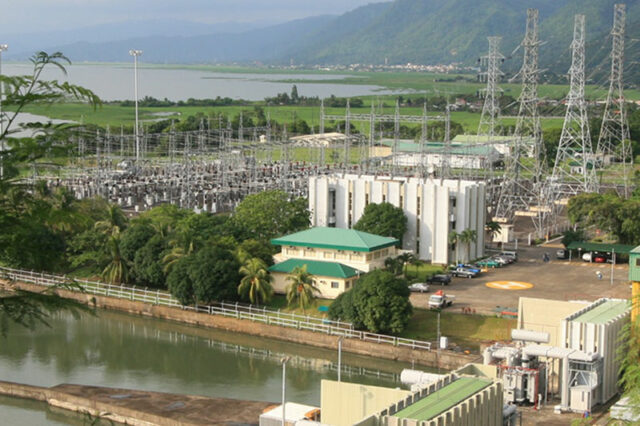
ABOITIZ-LED Thunder Consortium has secured approval from the Philippine Competition Commission (PCC) for the acquisition of the P36-billion Caliraya-Botocan-Kalayaan (CBK) hydroelectric power plant (HEPP) complex in Laguna.

The PCC greenlighted the consortium’s acquisition of the 797-megawatt (MW) complex from state-run Power Sector Assets and Liabilities Management Corp. (PSALM) following the July bidding, Aboitiz Power Corp. (AboitizPower) said in a regulatory filing on Monday.

The winning bidder, Thunder Consortium, comprises Aboitiz Renewables, Inc., Sumitomo Corp., and Electric Power Development Co.

Aboitiz Renewables holds AboitizPower’s investments and interests in various renewable energy projects, including geothermal, large hydro, run-of-river hydro, wind, battery energy storage systems, and solar projects.

The CBK complex includes the 39.37-MW Caliraya HEPP in Lumban, the 22.91-MW Botocan HEPP in Majayjay, and the 366-MW Kalayaan I and 368.36-MW Kalayaan II pumped-storage plants, all in Laguna.

The hydro assets are under a 25-year build-rehabilitate-operate-transfer agreement between CBK Power Co. Ltd. and the National Power Corp.

PSALM is targeting turnover of the power plant in February 2026.

AboitizPower Chief Financial Officer Juan Alejandro “Sandro” A. Aboitiz earlier said the consortium expects to close the financial deal before the end of the year.

“The expectation is that when the asset gets turned over to us, it’s contributing earnings to us immediately,” he said.

AboitizPower holds an attributable net sellable capacity of 5,284 MW as of May 2025, including 1,187 MW of renewable energy and 4,097 MW of thermal capacity.

The company aims to expand total capacity to 9.2 gigawatts by 2030, targeting a 50:50 mix of renewable and thermal energy. — Sheldeen Joy Talavera

NexGen unit plans $2.5-B wind farm investment

STOCK PHOTO | Image by Waldemar Brandt from Unsplash

AIRSTREAM Renewables Corp., a subsidiary of listed NexGen Energy Corp., is allocating $2.5 billion (P146 billion) to develop onshore wind farms with a total capacity of 1.7 gigawatts (GW).

The move follows the award of three wind energy service contracts from the Department of Energy (DoE), NexGen said in a stock exchange disclosure on Monday.

“Securing 1.7 gigawatts of new wind energy service contracts represents a major step forward in NexGen Energy’s growth strategy and materially strengthens our development pipeline,” said NexGen President Eric Peter Y. Roxas.

The wind projects include a 600-megawatt (MW) Pangasinan wind farm, a 600-MW Samar wind farm, and a 500-MW Nueva Ecija wind farm.

The Pangasinan Onshore Wind Project covers a land area of 13,770 hectares and will deliver electricity through the 230-kilovolt (kV) Labrador Substation of the National Grid Corp. of the Philippines (NGCP).

Spanning 16,929 hectares, the Samar Onshore Wind Project will be linked to the grid via NGCP’s 138-kV Victoria Substation.

The Nueva Ecija Onshore Wind Project covers 9,234 hectares and will transmit its output to NGCP’s 230-kV Sampaloc Substation.

Mr. Roxas said the three new onshore wind projects position the company as “one of the most competitive large-scale wind developers in the country.”

“We remain focused on disciplined execution, capital efficiency, and building high-quality renewable assets that will deliver strong returns for years to come,” he added.

Airstream owns, develops, and operates all wind energy projects of NexGen. It currently holds eight service contracts, with a pipeline of over 3 GW of onshore and offshore wind projects.

NexGen is a wholly owned subsidiary of Tiu-backed Pure Energy Holdings Corp., which has a development pipeline totaling over 3.3 GW of wind and solar projects.

Shares in the company declined 2.82% to close at P3.10 apiece. — Sheldeen Joy Talavera

Gov’t hikes award of T-bills on strong demand

BW FILE PHOTO

THE GOVERNMENT hiked the volume of Treasury bills (T-bills) it awarded on Monday as the offer was met with robust demand and all tenors fetched average yields below prevailing secondary market levels, as the market expects below-target November inflation that could cement prospects of another rate cut from the Bangko Sentral ng Pilipinas (BSP) next week.

The Bureau of the Treasury (BTr) raised P25 billion via the T-bills it auctioned off, higher than the P22-billion plan, as the offer was almost four times oversubscribed, with total tenders reaching P85.26 billion. This was also slightly higher than the P84.87 billion in bids recorded last week.

The Auction Committee made a full award as the papers were quoted at yields that were all lower than secondary market rates, the Treasury said in a statement.

Broken down, the government raised P7 billion as planned from the 91-day T-bills as the tenor was met with demand worth P29.815 billion. The three-month paper fetched an average rate of 4.812%, down by 3.7 basis points (bps) from 4.849% in the previous auction. Yields accepted were from 4.770% to 4.844%.

Meanwhile, the Treasury increased its award of 182-day debt to P10.5 billion from the P7.5-billion program as bids reached P29.75 billion. The strong appetite caused the BTr to double its acceptance of noncompetitive bids for the tenor to P6 billion, it said.

The average rate of the six-month T-bill went down by 4 bps to 4.93% from 4.97% last week. Tenders awarded carried yields from 4.89% to 4.965%.

Lastly, the BTr sold the programmed P7.5 billion in 364-day securities as bids for the tenor hit P25.695 billion. The one-year T-bill’s average yield was at 5.011%, inching up by 0.8 bp from 5.003% the previous week. Accepted rates were from 4.998% to 5.027%.

At the secondary market before Monday’s auction, the 91-, 182-, and 364-day T-bills were quoted at 4.882%, 5%, and 5.071%, respectively, based on PHP Bloomberg Valuation Service Reference Rates data provided by the Treasury.

The government fully awarded its T-bill offer as rates mostly moved sideways and saw “decent” demand, a trader said in a Viber message.

“Treasury bill average auction yields were again mostly slightly lower, as seen for most weeks over the past five months, ahead of the upcoming local inflation data on Dec. 5 that is expected to remain benign and even slightly slower versus 1.7% in October,” Rizal Commercial Banking Corp. Chief Economist Michael L. Ricafort said in a Viber message.

He said this would bolster expectations of another rate cut from the BSP next week, as signaled by monetary authorities recently.

A BusinessWorld poll of 15 analysts yielded a median estimate of 1.6% for November inflation, within the BSP’s 1.1% to 1.9% forecast for the month.

If realized, this would ease from the 1.7% clip in October and the 2.5% seen in November 2024. It would also be the slowest clip in three months or since the 1.5% in August and mark the ninth straight month that inflation fell below the central bank’s 2-4% annual target.

BSP Governor Eli M. Remolona, Jr. has said that another cut is possible at the Monetary Board’s Dec. 11 meeting, with further reductions until next year also on the table as they want to support the economy amid softening growth prospects.

The central bank has lowered benchmark borrowing costs by a total of 175 bps since it began its easing cycle in August 2024, with the policy rate now at an over three-year low of 4.75%.

Mr. Ricafort said that S&P Global Ratings’ move to affirm the Philippines’ investment-grade “BBB+” rating and its positive outlook last week has also provided a boost to market sentiment.

He added that increasing bets on a US Federal Reserve cut this month also helped bring yields down.

Markets widely expect a second straight reduction at the Fed’s Dec. 9-10 meeting, but the policy outlook for next year as the state of the world’s largest economy remains a mixed bag.

On Tuesday, the government will sell P35 billion in dual-tenor Treasury bonds (T-bonds), or P20 billion in reissued seven-year papers with a remaining life of two years and four months, and P15 billion in reissued 10-year debt with a remaining life of nine years and four months. This will be the BTr’s last bond auction this year.

The Treasury wants to raise P101 billion from the domestic market this month, or P66 billion through T-bills and P35 billion via T-bonds.

The government borrows from local and foreign sources to help fund its budget deficit, which is capped at P1.56 trillion or 5.5% of gross domestic product this year. — Katherine K. Chan

CPG says P1.6-B Barbados Tower nearly fully taken up

CENTURY-PROPERTIES.COM

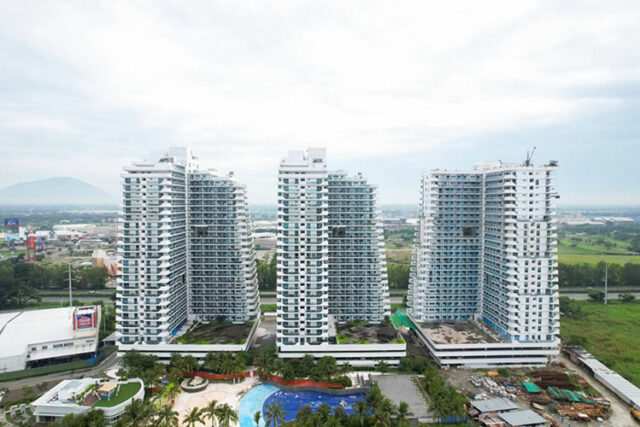
LISTED Century Properties Group, Inc. (CPG) said it has sold 99% of its units in its P1.6-billion Barbados Tower, its third high-rise building within the Azure North Estate in San Fernando, Pampanga, highlighting market demand for family-friendly residential enclaves.

The 820-unit tower, CPG’s third high-rise in the residential resort estate, brings Azure North’s total inventory to 2,426 units, the company told the stock exchange on Monday.

The developer also sold all 49 units in its Azure North Townvillas, CPG’s premium house-and-lot project within the estate. The project offers three- to four-storey houses with lot areas ranging from 69 square meters (sq.m.) to 133 sq.m.

Azure North Townvillas is expected to generate about P1.3 billion in revenues, with construction to be finished by 2028.

Also within the estate is the P1.2-billion Mykonos Tower, which has about 300 units and is expected to be completed by the end of 2027.

The mid-rise residential tower features studio units ranging from 26.34 sq.m. to 28.15 sq.m., and one-bedroom units sized 44 sq.m., with unit sizes larger than CPG’s Metro Manila condominiums.

The residential resort estate also includes a man-made beach lagoon, wave pool, and exclusive clubhouse.

The developer added that it is investing P215 million in the Azure North Waterpark, which will be completed by 2028.

Guests can enjoy water slides, a basketball court, children’s playground, and a pet park.

The 7.8-hectare Azure North Estate has attracted investors, particularly Filipinos working abroad.

“Our focus extends beyond construction — we’re building the foundation for a lasting community where families can flourish,” CPG President and Chief Executive Officer Jose Marco R. Antonio said.

He noted that CPG’s strategy is to “build communities that offer family-friendly environments with recreational opportunities for kids while also providing opportunities to generate rental revenue.”

CPG posted a 17% increase in its nine-month net income, reaching P2.1 billion from P1.8 billion last year.

Shares of CPG last closed on Nov. 28 at P0.64 per share. — Beatriz Marie D. Cruz

Siargao beyond the surf

MAGPUPUNGKO Rock Pools — BRONTË H. LACSAMANA

By Brontë H. Lacsamana, Reporter

WHEN people think of Siargao Island, they visualize foreigners flocking to the waves to surf in the day, then crowding the bars, mingling with locals and fellow travelers in the night.

While this image of Siargao is real, there’s actually more to the island than surfing and nightlife.

My first visit to Siargao, as part of sea travel company 2GO’s launch of the Manila-Siargao ferry route, showcased unforgettable natural wonders. From vast forest cover and seaside rock pools to unspoiled rivers and picturesque beaches, the trip only proved that there’s a serene, homey side to tourist destinations like Siargao that glam travelogue snippets on social media fail to capture.

At the port of General Luna, the coastal town that hosts Siargao’s hotspots ranging from beaches to surf to nightlife, we spoke with councilor Bingle Silvosa about the tourists on the island.

“We are recovering from [Typhoon] Odette back in 2021 and the series of typhoons we’ve been through. The entire Philippines is experiencing a slight downturn in tourist arrivals, but I hope by next year we come back stronger and better — not only Siargao, but the rest of the Philippines’ tourist destinations,” he told BusinessWorld.

Mr. Silvosa noted that the island is faring much better than it was three months ago, with more tourists coming from Europe. About 90% of tourist arrivals in Siargao ultimately stay in the municipality of General Luna.

He added that to maintain the island’s natural beauty, the local government is working hard to enforce its rules, such as the strict prohibition of single-use plastics.

“I think we are ready for the influx of tourists,” he said. “Of course we have safety nets in terms of environmental protection.”

ISLAND HOPPING
The mornings of our comfortable, two-night stay at the Rucksack Inn were interrupted by phone alarms indicating that we had to get up early to make the most of the sights. (If there’s a good, non-work-related reason to get up early, this was it!)

Our first stop was Guyam Island, a white-sand islet just a 10-minute motorboat ride from the main port. The crystal-clear waters are nice to wade in, but the real joy of this spot is the bucolic atmosphere. Because it’s so tiny, the only places where you can hang out are a few huts, a quaint bar, and a makeshift basketball court. The best way to while away the time here is to lounge under the shade of the verdant palm trees.

Our next stop, 15 minutes away on boat, was Naked Island, a 200-meter-long sandbar containing zero vegetation, hence the name. Because it’s just a strip of sand in the middle of the ocean, it attracts photographers and people who want to swim in the cool, aquamarine waters.

Our final stop, another 15 minutes away, was Dako Island, the biggest of the three destinations (the word dako means large). This was also where a lunch of grilled seafood was served on banana leaves, also known as a boodle fight. This island was the most scenic of the three, with white-sand beaches and green palm trees, and rock formations at one end with strategically placed huts overlooking the sea for photo opportunities.

With motorboats docked a few steps from the shores of these magnificent beaches, ferrying happy tourists to and from one island to the other, it’s easy to see why Siargao locals are protective of its natural beauty. If there’s one thing to note, the tour guides and boatmen were always alert about keeping trash away from the environment.

COCONUT VIEW DECK
About 17 kilometers (or 25 to 30 minutes) away from General Luna is the Coconut View Deck, or Coconut Plantation View Point. It’s not actually a deck per se, but an elevated roadside stretch overlooking a seemingly endless sea of palm trees.

Because of its location in the middle of Siargao Island, it is an easy stop since the cliffside road connects the popular coastal area and the northern part of the island. Locals say that it offers a lovely view of the sunset, the trees backed by a colorful sky as the sun dips towards the mountains, but we found that the view is just as lovely in the morning.

Here, you can find local photographers who offer a “human drone” service, which is done by asking the tourists to pose with the tree view as a backdrop and then the photographers run back and forth to mimic the aerial movements of a drone. The result is a lively panoramic shot that does kind of look like it was filmed by a drone camera.

MAGPUPUNGKO ROCK POOLS
Located on the eastern coast of Siargao, around an hour from town, the Magpupungko Rock Pools are a series of natural pools that emerge during low tide. The biggest tidal pool, just a short walk away from the main beach, has a massive rock that serves as a cliff-diving spot.

For those who want to lounge around in cool waters, this is the perfect place to do so. Some of the natural pools are shallow enough for kids, while others go down five feet, exactly for adults. The one with the large rock where people dive from goes as deep as 12 feet.

Because the beach is rocky and characterized by reefs and rock formations, it’s best to wear aqua shoes or water shoes to protect your feet, though many visitors simply walk to the area in slippers or sandals and take them off once in the pool.

With clear, aquamarine waters and sun-warmed rocks, this spot is both great for pictures and a relaxing place to unwind. Just don’t come during high tide, because the waves become too large to fully enjoy the spot.

SURF SPOTS
Though our trip was focused more on natural wonders beyond surfing, we were able to glimpse the untamed waves that made Siargao a hit among surfers from all over the world.

Cloud 9, just three minutes or a kilometer away from our hostel, is the heart of the surf scene. The waves attract a lot of surfers, but so does the wooden boardwalk that stretches out over the water for great sunset views and photo opportunities. Cafés and establishments with the fun island vibe make this a popular hangout spot, even for non-surfers.

Pacifico Beach, closer to the northeastern part of the island, is less well known with a more lowkey, chill atmosphere. It’s not as crowded, and the surf is supposedly friendlier for beginners, with vendors selling coconuts across the beach for people who want to lounge and watch the surfers do their thing.

MAASIN RIVER
You wouldn’t think that a random bridge on the roadside with a smattering of souvenir stalls across it would have a small path leading down to a serene riverside. Once there, the surroundings are surprisingly beautiful — lush mangroves lining a clean, calm river, with tourists ferried up and down on its gentle currents.

Maasin River offers a peaceful, 10-to-15-minute boat ride, with only the occasional dog barking or cock crowing interrupting the silence. Usually, only the boatman’s oars dipping into the water can be heard (unless you’re unlucky enough to be there with other groups of tourists shrieking and chattering away in other boats).

The endpoint of the ride is a quaint spring with a few stalls on the embankments. We didn’t get off here and instead rowed all the way back to the starting point, to fully bask in the quiet of a somewhat remote environment.

COCONUT COMBUT
Our final stop in the two-day tour was Coconut Combut, known as Siargao’s first paintball and gel blaster arena. It’s a brand-new attraction, hidden amongst the coconut trees that we glimpsed from the view deck earlier that morning.

Here, visitors can group together and engage in friendly matches in the outdoor arena. Afterwards, they can cool off at the café, which offers coffee and tea lattes and smoothies.

One of the co-owners is a laidback German named Milo, who first came to Siargao a few years back and has since fallen in love with the place.

“We built this for the locals, for people who might be looking for something new to do outside of the usual,” he told the visiting media. “It’s a difficult place to maintain, but it’s really our way of giving back to the community.”

He also runs the Latin American restaurant Cabrones, situated in Rucksack Inn where we were staying. The place hosts events almost nightly, like bingo nights and beer pong.

Rommel Tan-Abing, owner of Rucksack Inn Siargao, told BusinessWorld that it’s part of “the magic of the island” that people are helpful with each other’s businesses, endeavors, and journeys.

“All of us are on the same boat, so we go through the same challenges,” he explained. “For example, things like the fluctuation of electricity and limited internet connectivity are difficulties we all face.”

Throughout the trip, we experienced one power outage, during check-in. Meanwhile, stable internet seemed confined to the hotel or certain spots on the island. Some establishments, like Coconut Combut, offer Starlink internet.

As someone who had been visiting Siargao since 2018 and moved there in 2021, Mr. Tan-Abing said that the island has come a long way, but that its private sector and local government still have a lot to do to maintain responsible tourism growth.

“It’s not just about keeping tourist sites pristine, but also training our guides and workers. We should equip them with skills so that they can share the stories and history of this island,” he said.

Sea travel company 2GO launched its Manila-Siargao route in November. With a total travel time of 29 hours, the weekly service leaves Manila every Monday at 6:30 p.m. and arrives in Siargao at 11:30 p.m. on Tuesday. The ship then proceeds to Butuan and Ozamiz as per its usual route. The return trip departs Siargao every Wednesday at 2:30 a.m. and arrives in Manila at 7:30 a.m. on Friday.


DBP to ask for dividend, regulatory relief as it seeks to rebuild its capital

BW FILE PHOTO

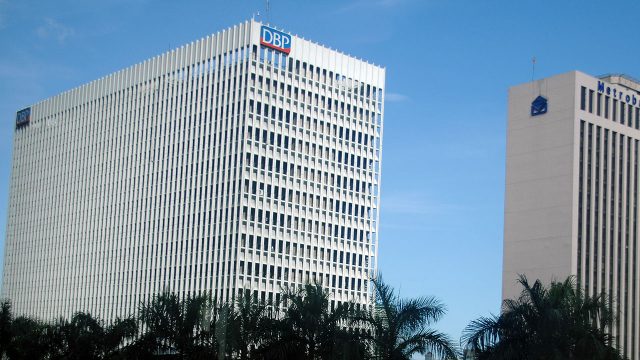
THE DEVELOPMENT Bank of the Philippines (DBP) is planning to seek dividend and regulatory relief again from the central bank to rebuild its capital, its top official said.

DBP President and Chief Executive Officer Michael O. de Jesus said the bank wants to recoup the seed capital it provided for Maharlika Investment Corp. (MIC).

“Our goal is to build up our capital,” he told reporters on the sidelines of an event on Thursday. “We’ve had dividend relief for the past maybe seven years.”

In 2019, DBP was exempted from remitting its dividend to the government for its 2017 earnings after its dividend rate was slashed to 0% from 50%.

It was likewise granted dividend relief for its 2022 income after President Ferdinand R. Marcos, Jr. signed an executive order as compensation for its contribution to the MIC.

Republic Act No. 7656 or the Dividends Law mandates government-owned and -controlled corporations to remit dividends equivalent to at least 50% of their earnings to the National Government.

“We need to build up as a bank. That’s why we’re asking (for) dividend relief, especially so we can recover,” he added. “Remember, the bank lost P25 billion to Maharlika. So, we need to build up our capital base.”

In September 2023, DBP injected P25 billion into the MIC for the sovereign wealth fund’s initial seed capital, while Land Bank of the Philippines (LANDBANK) contributed P50 billion.

According to Mr. De Jesus, DBP has about P97 billion in total equity, up from the around P80 billion it had three years ago.

The DBP chief said they are bullish about the MIC despite the slow progress of its investments.

“They have a long pipeline of investments. No investment yet. They took time to set it up and all that,” he said. “But they have good people in Maharlika. We’re confident it will do well.”

Mr. De Jesus said DBP will again request for dividend relief for the next five to seven years, including this year, as well as regulatory relief for 2025.

He added that they target to exit regulatory relief in two years.

In an earlier report, the International Monetary Fund called for the restoration of capital for DBP and LANDBANK after their contributions to the MIC.

The IMF noted the importance of capital restoration and exiting regulatory relief “as soon as possible.”

The Finance department has pushed for the amendments to DBP’s decades-old charter to strengthen its financial position and give it easier access to the capital markets.

Mr. De Jesus earlier said they could push for the passage of a new DBP charter in this Congress after the previous proposal approved by the 19th Congress was vetoed by Mr. Marcos in May.

The proposed charter amendments include provisions that would increase its capital stock to P300 billion from P35 billion to help finance its priority sectors, such as social infrastructure and small businesses, and allow it to offer up to 30% of its shares to the public, with the National Government mandated to own 70% of its capital stock at all times.

Several measures are now pending at the committee level at both the House and the Senate.

Fitch Ratings said in January that the charter changes could help support the state-run lender’s capital restoration following its contribution to the country’s sovereign wealth fund and boost its credit profile.

DBP’s net income fell by 51.77% year on year to P2.257 billion in the first nine months of 2025.

Mr. De Jesus said the bank’s net income might be cut by P1 billion to P2 billion by yearend due to higher provisioning and as the ongoing graft scandal has slowed down contractors’ repayments. Still, he sees DBP recovering by the first quarter of 2026. — Katherine K. Chan