Home Blog Page 24

What does China’s host bid mean for the High Seas Treaty?
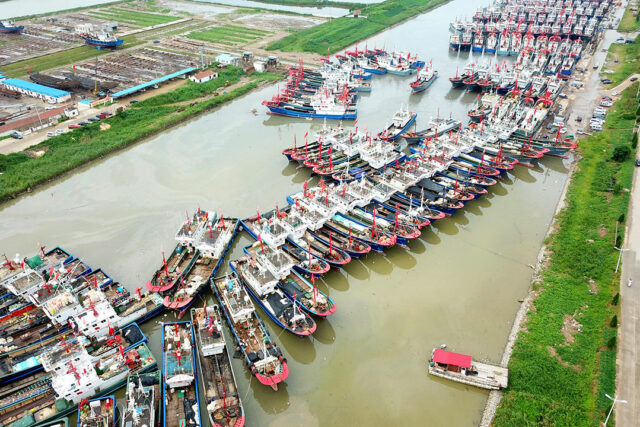
AERIAL VIEW of fishing boats coming together at Qingyu fishing port at Ganyu district, waiting for the end of 2019 closed fishing season, in Lianyungang, China. — REUTERS FILE PHOTO

By Philippe Le Billon and Zelda Ladefoged

Delegates are meeting in New York for the third session of the preparatory commission (PrepCom 3) on the Agreement on Marine Biological Diversity of Areas beyond National Jurisdiction (BBNJ), also known as the High Seas Treaty.

After nearly 20 years of negotiations, United Nations member states adopted the treaty in June 2023. When it opened for signatures that September, 67 countries signed immediately. In January 2026, Morocco and Sierra Leone then became the 60th and 61st states to ratify, triggering the treaty’s entry into force.

The treaty is now international law. At the time of writing, 145 countries have signed and 85 have ratified.
The third session of the preparatory commission must now work through how the treaty will actually function. A key question in corridor conversations is: who should host the secretariat?

Every international treaty needs an institutional home. The High Seas Treaty is no different. It requires a secretariat to co-ordinate between parties, service meetings, and manage information.

For months, Belgium and Chile were the only contenders, their bids quietly taking shape in the background of treaty negotiations. Then, in January 2026, China submitted a formal bid with Xiamen as the proposed host city. That announcement changed the optics of the negotiations.

THE GEOGRAPHY OF DIPLOMACY
Where that secretariat sits may be seen as an administrative question, a matter of office space and convenience. It is not.

The location of secretariats, and diplomatic venues in general, shapes how they function in practice. It influences who gravitates toward the institution and which delegations can afford to attend. It sways what issues get quietly elevated and what institutional culture takes root. Location is a form of proximity and proximity is a form of influence.

Belgium has put forward Brussels, pointing to its dense ecosystem of international organizations and more than 300 diplomatic missions.

Chile has offered Valparaíso on an equity argument: Latin America has never hosted a universal-membership environmental secretariat and the Global South deserves a seat at the table.

China’s late entry adds a strong contender to the process.

CONCERNS ABOUT CHINA’S INFLUENCE
China has more at stake in how the high seas are governed than almost any other state. It has the world’s largest distant-water fishing fleet and has faced sustained international criticism over illegal, unreported and unregulated fishing. It also holds more deep-sea mineral exploration contracts through the International Seabed Authority than any other nation.

It has been among the most assertive in defending its maritime claims, even when those claims have been rejected by international courts, including through declaring a “nature reserve” on the disputed Scarborough Shoal in the South China Sea.

Though fishing controversially remains largely outside its scope, the BBNJ agreement intervenes in key pressure points, most notably through enforceable marine protected areas and new environmental standards for activities that have historically escaped meaningful oversight.

For some observers, that combination makes the secretariat bid difficult to reconcile. Lyn Goldsworthy, a veteran Southern Ocean researcher at the University of Tasmania, has pointed to China’s reluctance over the creation of marine protected areas in the Antarctic high seas. “If they are in that influential [position],” she told Dialogue Earth, “they can slow things down.”

Analysts at India’s National Maritime Foundation have raised the further risk of what they call procedural drift, the idea that formally neutral administrative practices can quietly embed particular governance norms over time.

However, the case is less clear-cut than it looks.

GIVING CHINA A STAKE IN THE TREATY’S SUCCESS
Skepticism about China’s bid is understandable, but the case against it is weaker than it first appears. Begin with the international picture. Li Shuo, director of the China Climate Hub at the Asia Society Policy Institute, has described the bid as a “significant escalation” in China’s engagement with global governance, one that signals the Chinese want to play an active role in shaping international rules.

If China’s institutional credibility is visibly tied to BBNJ’s success, it has more reasons to want the treaty to function. China has ratified the agreement. It joined the Port State Measures Agreement, the principal instrument targeting illegal fishing, despite late accession and uneven implementation.

Its navy is the fastest-growing maritime force in the world. Its financial, infrastructural, and human capacity to run a serious international institution is not in question.

There is possibly an even more important dimension. Scholars focused on Chinese fisheries governance have documented the persistent tension between central government policy and the behavior of provincial authorities and distant-water operators, a gap that domestic regulation has struggled to close.

International treaty commitments can, in principle, function as a mechanism for central governments to exert leverage that internal channels cannot easily provide. Whether the BBNJ treaty might operate that way for China is an open question, but it is one worth taking seriously.

A China genuinely embedded in the framework may behave differently within it than a China left on the outside. The UN’s 30-by-30 target to protect 30% of the world’s oceans by 2030 depends heavily on what happens in the high seas. So does any serious effort to crack down on illegal fishing or establish enforceable marine protected areas in international waters.

None of this is a straightforward argument for or against China hosting. It is a narrower claim: that the case against it is weaker than it first appears because it assumes that Chinese involvement would inevitably hollow out the treaty’s environmental ambition. That assumption is not obviously correct.

What conditions that would make the treaty work rather than fail are not mysterious. The secretariat would need genuine independence in its leadership. Governance structures would need to be transparent and enforceable. The treaty culture would need to be robust enough to resist pressure from the host state and to be responsive to all parties. These are demanding conditions. They are also conditions being negotiated right now.

WHAT IS ACTUALLY AT STAKE
The formal decision on where to locate the secretariat will be taken at the first Conference of the Parties, expected in early 2027. The institutional architecture being built at PrepCom 3 will shape what kind of institution the secretariat becomes before that vote is ever taken.

The governance rules and independence provisions being drafted now will determine whether the hosting question is a story about institutional capture or about the diligent implementation of a treaty that covers nearly half the planet.

The BBNJ agreement is a test of something larger than ocean governance. It is a test of whether international institutions can still function as common ground as the United States withdraws from international organizations and treaties.

Where the secretariat sits is not a technicality. It is about whether the high seas remain a global common in practice, not just in name, through an institution operating with independence, credibility, and authority.


Philippe Le Billon is a professor in the Geography Department and School of Public Policy & Global Affairs at the University of British Columbia. Zelda Ladefoged is a Master’s student, Geography, at the University of British Columbia.

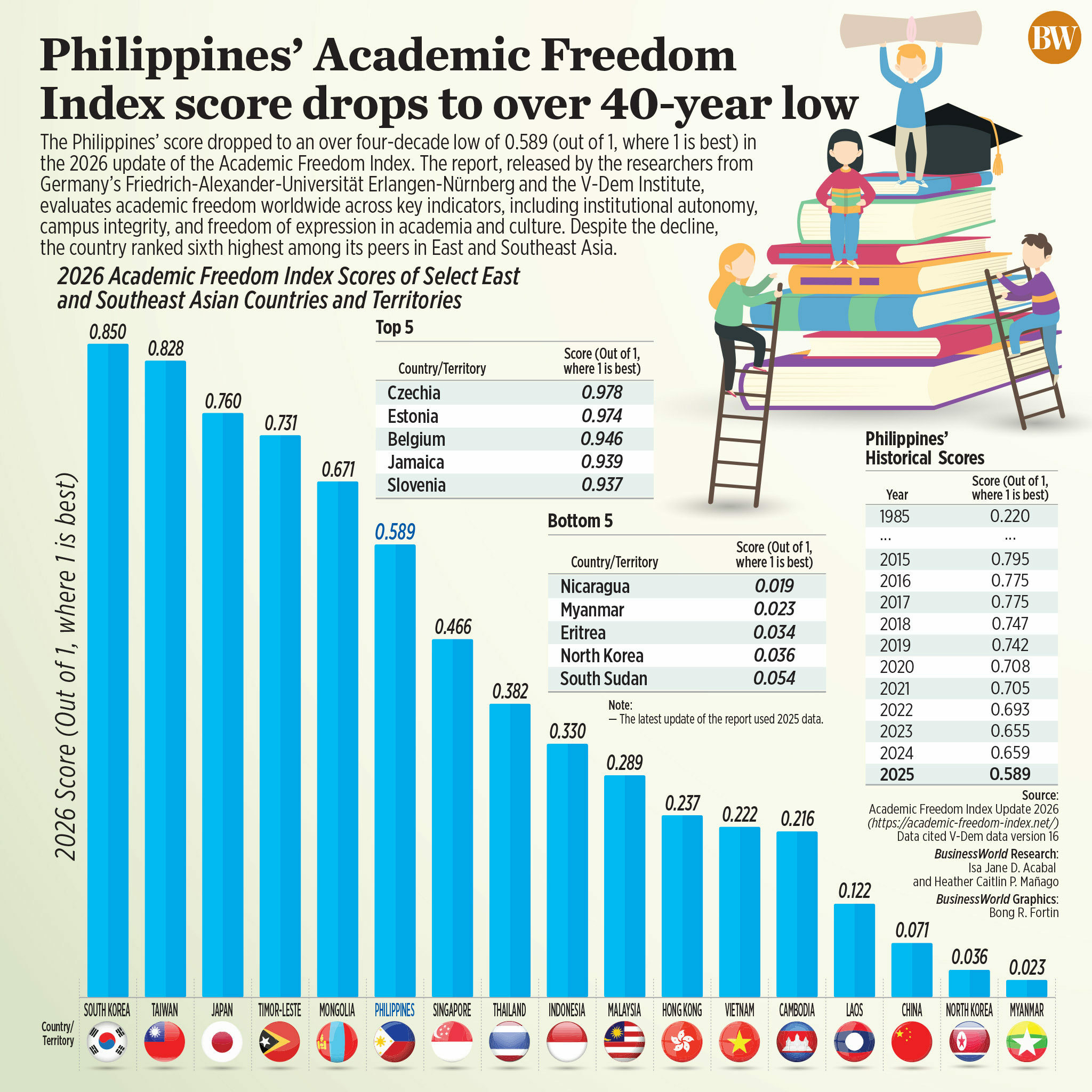
Philippines’ Academic Freedom Index score drops to over 40-year low

The Philippines’ score dropped to an over four-decade low of 0.589 (out of 1, where 1 is best) in the 2026 update of the Academic Freedom Index. The report, released by the researchers from Germany’s Friedrich-Alexander-Universität Erlangen-Nürnberg and the V-Dem Institute, evaluates academic freedom worldwide across key indicators, including institutional autonomy, campus integrity, and freedom of expression in academia and culture. Despite the decline, the country ranked sixth highest among its peers in East and Southeast Asia.

The multi-trillion-peso pivot: Calibrating the ‘Build Better More’ roadmap

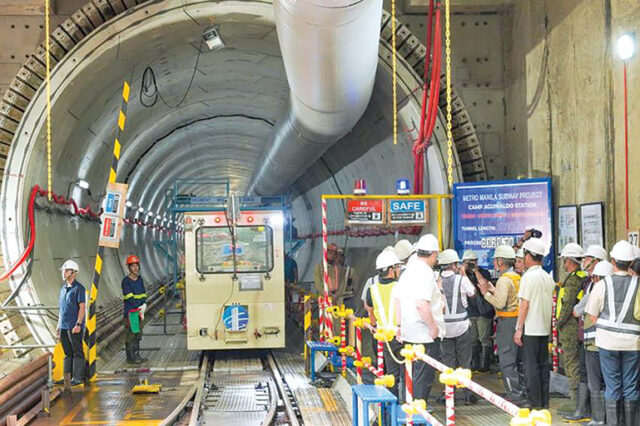
President Ferdinand R. Marco,s Jr. led the site inspection of the Metro Manila Subway Project at Camp General Emilio Aguinaldo on last July. — Photo from AFP.mil.ph

For decades, the Philippine economic narrative was one of the “missed connections” — a high-growth engine trapped in a low-gear logistics network. But as the first quarter of 2026 draws to a close, Metro Manila’s skyline and provincial corridors show developments.

The transition from the “Build, Build, Build” era to the current administration’s “Build Better More” program has evolved from a simple change in branding to a multi-modal strategy that is increasingly leaning on the private sector to bridge the nation’s P9.14-trillion infrastructure gap.

With a 2026 National Expenditure Program (NEP) earmarking P1.5 trillion (roughly 5.0% of the gross domestic product (GDP)) for infrastructure, the government is attempting a delicate balancing act: maintaining high-speed construction while navigating fiscal consolidation and renewed focus on transparency.

The PPP renaissance

The defining characteristic of the 2025-2026 infrastructure landscape is the resurgence of public-private partnerships (PPP). Following the full implementation of Republic Act No. 11966 (or the PPP Code), the pipeline of projects has elevated to higher levels.

According to the PPP Center, the project pipeline hit 251 projects valued at P2.81 trillion by last January. This marks a near-doubling of the pipeline from just two years ago. The shift is not merely quantitative; it is institutional.

The implementation of the PPP Code has served as a cornerstone for regulatory stability, addressing a long-standing demand from the private sector for greater predictability in long-term investments.

By institutionalizing a streamlined approval process for unsolicited proposals and offering a clearer definition of Material Adverse Government Action, the state has lowered the risk profile for high-impact ventures. This framework is credited with unlocking institutional capital that had been previously deterred by policy uncertainty.

A primary example is the Ninoy Aquino International Airport (NAIA) Modernization. Now into its rehabilitation phase under the San Miguel Corp.-led New NAIA Infrastructure Corp., the project serves as a litmus test for the government’s ability to hand over critical brownfield assets to private operators without the past legal entanglements.

Rail expansions

While aviation enhancements take place, the backbone of the “Build Better More” program remains the massive rail expansion aimed at decongesting the Greater Manila Area.

The Metro Manila Subway Project (MMSP), dubbed the “Project of the Century,” has seen a “banner year” in 2025 regarding right-of-way (ROW) acquisition. Transportation Acting Secretary Giovanni Z. Lopez reported last January that ROW acquisition for the subway had reached 90.76%, up from just 51% a year prior. This acceleration was attributed to the creation of the dedicated Right-of-Way and Site Acquisition (ROWSA) task force, which grew from 200 to 900 personnel to handle legal and social safeguards.

Though the full 33-kilomenter line is not expected to be fully operational until 2032, the Department of Transportation is eyeing partial operations for the East Valenzuela and North Avenue stations by 2028.

Parallel to the subway project is the North-South Commuter Railway (NSCR). The 147-kilometer elevated railway, stretching from Clark to Calamba, serves as a major example of connectivity developments. As of early 2026, the North Segment (Malolos to Clark) has cleared 56% of its land requirements. The government is currently in the process of bidding out the Operations and Maintenance (O&M) contract for the entire NSCR system, with an award expected by mid-2026 — another major PPP play that delegates technical efficiency to the private sector.

Regional dispersal

The 185 Infrastructure Flagship Projects (IFPs) currently on the Economy and Development Council’s list are notably more dispersed than previous iterations. While the National Capital Region accounts for a significant chunk of the value, 65% of the projects are region-specific or inter-regional.

In Central Visayas, the list grew to 11 flagship projects in 2025, including the Cebu Urban Mass Rapid Transit (UMRT) Central Line and the New Dumaguete Airport.

In Mindanao, the Davao City Bypass Construction Project and the Samal Island-Davao City Connector Bridge are moving toward critical construction milestones.

The prevailing strategy appears to be the creation of a national logistics network by connecting regional hubs. By lowering the cost of moving goods and people across the archipelago, the government can provide the physical foundation necessary to support the Ease of Doing Business Act.

Fiscal realities and ‘Governance Tax’

Despite the momentum, the path forward is not without friction. The Philippine economy faced a localized slowdown in the second half of 2025, with the GDP growth cooling to 5.1-5.3% as the country grappled with “governance concerns” and a corruption scandal that briefly paralyzed public construction in late 2025.

A World Bank 2026 report warns that sustaining growth will require “stronger execution of public investments and credible fiscal consolidation.” With the debt-to-GDP ratio still a point of concern for credit rating agencies, the government is increasingly looking toward the Maharlika Investment Fund (MIF), as well as official development assistance (ODA) from partners like the Japan International Cooperation Agency (JICA) and the Asian Development Bank (ADB), to supplement the national budget.

Furthermore, digital connectivity has become a priority. The 2026 budget allocates $1.53 billion for digital transformation, recognizing that physical roads and bridges are insufficient in a world where data is the primary commodity.

The road ahead

As the current administration enters the second half of its term, the focus is shifting from approving to delivering. The target of spending 5-6% of GDP on infrastructure annually remains the guiding principle. However, the true measure of success will be whether these projects can translate into a reduction in the country’s high logistics costs — currently among the highest in Southeast Asia.

By late 2026, the integration of the PPP Projects Dashboard with the Project Information and Management System is expected to allow for real-time monitoring of every major project — a move aimed at restoring investor confidence after the hurdles of 2025.

The Philippines is no longer just dreaming of a “Golden Age of Infrastructure.” It is paying for it, digging for it, and most importantly, systematically planning for it. Whether the momentum can survive the political cycles of the future remains to be seen, but for now, the gears of the “Build Better More” machine are turning faster than ever. — Krystal Anjela H. Gamboa

Trump tells farmers that tractor makers should lower prices

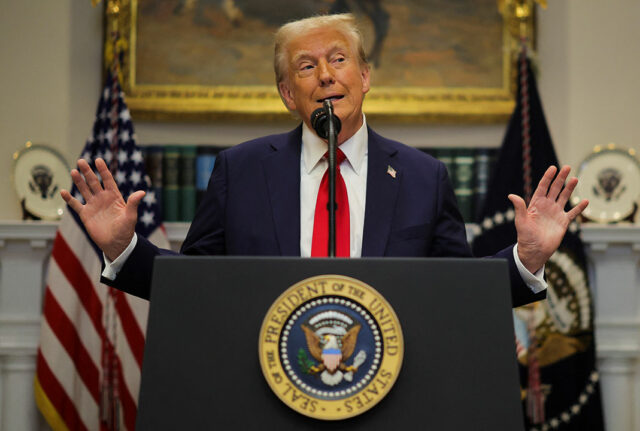
U.S. President Donald Trump delivers remarks at the Roosevelt room at White House in Washington, US, Jan. 21, 2025. — REUTERS

WASHINGTON — President Donald  J. Trump announced new measures on Friday to support US farmers who are reeling from the administration’s trade policies and the Iran war and suggested farm equipment makers cut prices — a call that sent their shares lower.

“I want John Deere and Case and all of — they’re great companies, Caterpillar… I want these companies to give it to you in the form of lower tractor and equipment costs,” Mr. Trump told hundreds of farmers and ranchers gathered at an event on the South Lawn of the White House.

Deere & Co. shares dropped 2% after the statement.

Case IH manufacturer CNH Industrial NV fell 1% while Caterpillar, Inc was down nearly 1.2% in late-session trading.

In a statement to Reuters, Deere said it will keep working with the Trump administration, lawmakers, producers and other stakeholders to ensure accuracy about its affordability, technology and repair policies, while collaborating with regulators to support farmers and keep US agriculture competitive.

Farm equipment maker AGCO Corp., which had one of its tractors parked on the South Lawn for the event, said it welcomed policies that helped reduce farmer costs and was committed to working with the administration.

CNH Industrial and Caterpillar did not respond to requests for comment.

Mr. Trump called for lower prices in an aside during a speech that otherwise focused on shoring up support among the Republican president’s loyal constituency of rural voters, who have backed Mr. Trump in all three of his presidential races.

For a fourth straight year, US crop producers are facing tight margins, high production costs and low commodity prices — and are struggling financially — despite near-record government payments.

The Trump administration is distributing $12 billion in aid to US farmers — a move that farm trade groups and agricultural economists have said is helpful in the short-term but will not fully compensate farmers for financial losses that have topped $30 billion in recent years.

On Friday, Mr. Trump said he would seek even more such aid for farmers from Congress. More than 50 farm-interest groups, such as the American Farm Bureau Federation, are urging Congress to approve additional aid in a military funding package.

The event happened as the administration finalized new biofuel blending mandates for US oil refiners, requiring them to mix more of the fuels made from corn and other agricultural products into the nation’s gasoline and diesel than initially proposed, in an apparent win for farmers.

Mr. Trump also said the US Small Business Administration would open up new loan guarantees for farmers and food suppliers.

Farmers are entering the critical spring planting season under a cloud of uncertainty as the US-Israeli war with Iran disrupts global trade, causing fertilizer and diesel costs to spike.

The long-term US trade relationship with China also remains unclear amid the ongoing trade war launched by Trump’s administration with the country, the world’s top soy importer.

Rural voters constitute a fifth of the US electorate, and they favored Mr. Trump by a two-to-one margin over Democrat Kamala Harris in the 2024 presidential election. — Reuters

Debt yields rise as mart bets on BSP tightening

By Heather Caitlin P. Mañago, Researcher

YIELDS on government securities (GS) traded at the secondary market closed mostly higher last week as investors priced in a potential rate hike from the Bangko Sentral ng Pilipinas (BSP) amid growing inflation concerns due to elevated global oil prices.

GS yields, which move opposite to prices, rose by an average of 2.62 basis points (bps) week on week, based on the PHP Bloomberg Valuation Service Reference Rates as of March 27 published on the Philippine Dealing System’s website.

At the short end, yields ended higher across all tenors, with the 91-, 182-, and 364-day Treasury bills (T-bills) rising by 0.41 bp, 11.14 bps, and 10.19 bps week on week to fetch 4.9854%, 5.0695%, and 5.1905%, respectively.

At the belly, rates of the two-, three-, four-, five-, and seven-year Treasury bonds (T-bonds) likewise went up by 1.14 bps (to 6.0153%), 6.17 bps (6.3277%), 8.9 bps (6.5457%), 11.68 bps (6.7081%), and 16.18 bps (6.9147%), respectively.

Meanwhile, the long end was mixed. Yields on the 20- and 25-year debt dropped by 24.04 bps to 7.0028% and 24.14 bps to 7.0041%, respectively, while the rate of the 10-year tenor rose by 11.22 bps to 7.0194%.

GS volume traded increased to P73.59 billion on Friday from P28.07 billion a week prior.

“Local yields continue to move higher as market participants slowly price in the possibility of a BSP rate hike following signals from Finance Secretary Go,” a bond trader said in an e-mail.

The trader added that while the BSP held rates steady during its off-cycle meeting on Thursday, the central bank’s decision to rule out a rate cut for its regular April meeting “only confirmed hawkish movements in domestic interest rates.”

“The lingering elevated levels of global crude oil prices continued to push yields higher amid growing upside risk to domestic inflation,” the trader said.

In a March 17 interview with Bloomberg TV, Finance Secretary Frederick D. Go said that “if the price of oil continues to persist at elevated levels, it is most likely that the Monetary Board will consider tightening in the next meeting.”

The BSP last hiked rates in October 2023.

The Monetary Board will hold its next regular rate-setting meeting on April 23. Last Thursday, the Monetary Board kept its policy rate unchanged at 4.25% during a surprise off-cycle review.

BSP Governor Eli M. Remolona, Jr. said they decided to stand pat as their growth outlook remains clouded and as emerging inflationary risks prove supply-driven, “for which monetary policy has limited effectiveness.”

Ruben Carlo O. Asuncion, chief economist at Union Bank of the Philippines, said that “the local fixed income market remains driven largely by global risk sentiment and oil-led inflation concerns rather than domestic policy signals.”

“While the BSP’s off-cycle meeting helped anchor near-term expectations by keeping rates unchanged, it did not reverse the broader repricing across the curve, which has been shaped by heightened geopolitical risks and elevated oil prices,” he said.

“Although easing Middle East hostilities and softer oil prices triggered pockets of bargain hunting, these were largely liquidity-driven rallies. The market continues to price in the risk of a short BSP tightening cycle, keeping the front end vulnerable, while the long end remains exposed to supply and fiscal risks — particularly amid discussions around suspending petroleum excise taxes.”

The trader said the GS market could move sideways in the coming days amid a shortened trading week.

“Market participants might remain cautious on fluctuating developments over the reported informal talks between the US and Iran,” the trader said.

“Overall, traders are expected to sell into strength, with GS yields likely to remain volatile and range-bound as investors monitor inflation data, oil price developments, and evolving signals from both the BSP and global central banks,” Mr. Asuncion added.

Bb. Pilipinas 2026 candidates announced

PRECIOUS Lara Quigaman, winner of Miss International 2005 and a former Bb. Pilipinas, served as the head of the panel of judges. — FACEBOOK.COM/BBPILIPINASOFFICIAL FILE PHOTO

THE 36 candidates of the Binibining Pilipinas 2026 beauty pageant were announced after a final screening on March 23.

The contestants were presented to the press right after the screening at the New Frontier Theater in Araneta City. The pageant is owned by the Araneta Group through Bb. Pilipinas Charities, Inc. (BPCI). The pageant currently sends its winners to Miss Globe and Miss International (which was first won in 1960 by Stella Marquez-Araneta, spouse of Araneta Group chair Jorge León Araneta).

Precious Lara Quigaman, winner of Miss International 2005 and a former Bb. Pilipinas, served as the head of the panel of judges during the screening, and is a member of the Executive Committee of BPCI. “We have a really good batch of ladies this year,” she said during a group interview. “They’re so articulate. They’re all so smart. I’m so proud of them.”

Asked what they were looking for when they were screening the candidates, Ms. Quigaman said, “Everyone’s obviously beautiful. We know that. But I told them I really wanted to see their ‘why.’ Why they’re joining Bb. Pilipinas. We really listened to their stories of why they’re here.

“A girl who embodies Bb. Pilipinas,” she said about the kind of beauty queen they’re looking for. “Someone who’s very helpful to their fellow women. Obviously, we want a Binibining who’s really smart, and full of integrity.”

As to what advice she can give the candidates, she said, “Just enjoy it. Then give it their all, and just be them(selves). Be the real them.” Joseph L. Garcia


The candidates are:

Britney Angel Rubino
Ma. Kathrina Pauline Cudia
Nathalie Magat
Elli Rose L. Elola
Jarina K. Sandhu
Joahnna Lee L. Ucol
Julie Mae P. Villanueva
Iris L. Oresca
Nicole Sobria
Christine Jorelle F. Usaraga
Alisa Keith D. Irugin
Zillani Eve P. Rojas
Juliane Raine Antonio
Kristeen Mia SJ. Lucero
Tracy Mae C. Sunio
Shara Maxine M. Barber
Ivy R. Padilla
Angelica Arwin C. Evora
Anjali C. Pradeep Kumar
Stacey C. de Ocampo
Samantha Marie B. Zabarte
Sasha-Juli Belle P. Lacuna
Kaye Pastelero
Anne Klein E. Castro
Camille Bernadette T. Martin
Mary Adeline C. Ramirez
Ain Niqyla S. Abad
Marinella JCatangay
Gwyneth Jemimah B. Chan
Pauline Thea Ann E. Ibuyan
Gwendoline Meliz F. Soriano
Arah Jasmin B. Reguyal
Georgette Nicole R. Coronacion
Patricia Lynn Beerda
Trisha Irish Marie N. Rosales
Mylene B. Manschus

DigiPlus eyes omni-channel setup

DIGIPLUS.COM.PH

LISTED digital gaming company DigiPlus Interactive Corp. is exploring expansion opportunities at New Coast Hotel, including an omni-channel operation integrating online and onsite gaming, as it finalizes its planned acquisition.

“[That means] that besides (what) we offer in the online space, we also want to convert them and offer more of the land-based entertainments. So, going through this process, we can increase the overall spending for our user as well as the retention. This will enhance our user engagement in the long term,” President Andy Tsui said at a briefing last week.

He said the expansion plan draws from models used in other jurisdictions.

“Whether it’s a land-based adding the online, or the online adding the land-based, eventually we’re seeing a benefit of providing them an omnichannel ecosystem,” Mr. Tsui said.

“So, we want to be a one-stop shop for them. So, instead of just focusing on the online, people may also choose to play land-based for their entertainment. We want to provide them a full ecosystem of digital as well as physical entertainments,” he added.

Mr. Tsui said implementation will depend on the completion of the New Coast Hotel acquisition. He added that the proposed hotel expansion plans will require approval from the Philippine Competition Commission (PCC), which may take six to nine months.

“So, I would think that the earliest time will be next year,” he said.

Last year, DigiPlus signed a convertible notes agreement that gives it the right to acquire a controlling stake in International Entertainment Corp. (IEC), which owns and operates New Coast Hotel Manila, an integrated hotel and casino complex.

The subscription for convertible notes totals HK$1.6 billion (around P12 billion) and will be issued in two tranches. The first tranche, worth HK$800 million, will be completed upon the satisfaction of customary conditions, while the second tranche will follow within three months, subject to mutually agreed terms.

Mr. Tsui said the New Coast Hotel acquisition is “going as planned,” with DigiPlus expecting to make the final convertible note payment to IEC by end-May or early June.

“We make the first payments of P6 billion in early March, and then the final payment will be made before the end of May or early June,” he said.

Under the agreement, DigiPlus has the option to convert the notes into shares to acquire about 53.89% of IEC’s issued capital stock at an agreed initial conversion price of HK$1 per share, with a 3% annual interest rate. If DigiPlus does not convert, the notes will be redeemable at 108% after five years.

IEC owns and operates New Coast Hotel Manila, previously known as New World Hotel Manila, with 96 gaming tables, 495 slot machines, and other gaming amenities as of November 2025. — Alexandria Grace C. Magno

On Q

No-nonsense SUV: The Audi Q5 is now available here, priced from P4.49 million. — PHOTO BY PABLO SALAPANTAN

All-new Audi Q5 makes PHL debut

THE AUDI Q5 is one of the more understated SUVs in its segment. But make no mistake, it’s one of the better ones. It has always been a no-nonsense example of a premium European SUV, and has rightfully enjoyed success in the Philippines sales-wise.

I’ve had the pleasure of reviewing the previous generation, and I can say that the Q5 should be known for punching above its weight and size class. An all-new model was introduced globally last year, and finally, the Philippines is getting it, too.

ALL-NEW PLATFORM
We’re no strangers to brands advertising a new car as “all-new,” but in reality is just a heavy rework of the older model. In the Q5’s case, this is a ground-up, brand-new, next-generation SUV. Interestingly, the Audi Q6 EV heralded the brand’s new Premium Platform architecture. The Q6 is the PPE (electric) while the Q5 is in the PPC (combustion).

Audi claims the PPC is a platform designed to maximize a longitudinal-layout, combustion-powered car. It has a new Electronic Architecture system that uses a high-performance electrical backbone, allowing the Q5 to have a “digital stage,” which can be seen in the interior, that now features curved LED displays, for the Philippine spec, though we won’t be getting the passenger side screen.

One claim to fame of any true Audi is the way it drives, regardless of the body type. The PPC platform makes the Q5 more rigid structurally, and uses stiffer axles for a much better steering feel and response. The suspension has also been reworked to offer better balance between sporty and comfort.

SUSTAINABLE FUN
Another feature of the PPC platform is that it’s an all-rounder and is future-proof, meaning that it can accommodate a variety of powertrains. There are even plans in the future for Audi to introduce a plug-in hybrid version.

For the Philippines, we get a 2.0-liter turbocharged in-line-four gasoline engine with a 48-volt battery pack. It makes 240hp and 340Nm of torque, and power is sent to the front wheels through a seven-speed transmission. The best thing about this powertrain is that it can run in full EV mode up to 28kph, which gives the Q5 coding exemption under EVIDA.

The Q5’s design has been skewed toward a more aggressive and sporty look. The front fascia is now more pronounced with a bigger grille and sharper lines and angles, as opposed to the older sculpted look.

Our local S-Line variant will have chrome-accented trims on the exterior, adding a bit of class to the otherwise sporty design. Overall, it looks very much like an Audi family member, but stands out just enough.

THE VARIANTS
The 2026 Audi Q5 will have two variants here, priced as follows: Audi Q5 Premium (P4.49 million) and Audi Q5 S-Line (P4.99 million). Initial stocks are set to arrive here in June or July.

War in the Middle East: Cushioning the impact on the country’s medicine supply

STOCK PHOTO | Image by Gstudioimagen1 from Freepik

A war thousands of kilometers away can quietly determine whether a patient in the Philippines receives life-saving treatment on time.

The ongoing conflict involving Iran, the United States, and Israel is not only a geopolitical crisis, it is a global supply chain shock with direct implications for medicine availability, cost, and access. Disruptions in key trade routes, rising fuel prices, and constrained logistics capacity are reverberating across sectors, including healthcare.

As the war in the Middle East enters its fifth week, timely and coordinated action will be critical to safeguard the country’s medicine supply.

One of the foremost recommendations put forward by Dr. Diana Edralin, president of the Pharmaceutical and Healthcare Association of the Philippines (PHAP), is the shift to a six-month national inventory buffer for essential medicines. Given the 12- to 24-month manufacturing lead times for many pharmaceutical products, proactive and synchronized planning is essential to prevent stockouts.

Immediate and accurate forecasting enables both government and industry to anticipate demand for essential medicines and vaccines, and to place orders early, before supply chains become constrained. By doing so, it helps prevent stockouts during periods of global disruption. In a conflict scenario, where shipping routes may be affected and fuel costs may spike, countries with strong forecasting systems are better positioned to secure supply in advance, while others may be left competing for limited stocks. Toward this end, a formal joint forecasting process for biologics and vaccines for 2026 and 2027 should be prioritized. Strengthened government-private sector collaboration will be key to mitigating risks and ensuring supply continuity.

The government may also consider institutionalizing a National Medicines Logistics Command Center to enable real-time data sharing across agencies and industry stakeholders. Such a platform can support more responsive decision-making and equitable allocation of limited supply. Lessons from the COVID-19 pandemic have shown that coordinated, whole-of-system approaches are critical in managing large-scale disruptions.

To help manage rising logistics costs, green-lane prioritization for pharmaceutical shipments and expedited cargo processing can reduce delays and demurrage charges. Policy options such as targeted tax relief may also be explored to offset increases in war risk insurance and air freight premiums.

Ensuring sufficient fuel supply is likewise critical. Approximately 800,000 liters per month are required to sustain the nationwide distribution of medicines and vaccines across the archipelago. Without reliable fuel access, supply availability at ports and warehouses may not translate into timely access for patients.

Policy predictability will also be important in supporting affordability. Expanding Value-Added Tax (VAT) exemptions for medicines can help cushion patients from rising global cost pressures.

The Universal Health Care (UHC) Act provides an opportunity to further strengthen resilience through pooled procurement. By aggregating demand for 2026 and 2027, the country can achieve economies of scale and improve negotiating leverage, helping to offset higher importation and logistics costs. In times of uncertainty, forecasting and pooled procurement serve as critical shock absorbers against supply disruptions and price volatility.

Pooled procurement harnesses the strength of collective buying power by consolidating demand across purchasers. This enables bulk purchasing and strengthens negotiating leverage, ultimately helping to reduce medicine prices even amid global inflation. Evidence shows that pooled procurement can lower overall pharmaceutical costs. In a war scenario, this approach becomes even more critical, as it helps offset rising logistics and production costs.

Ultimately, maintaining a stable medicine supply chain is not just a health concern as it is an economic and national security imperative. Reliable access to medicines sustains workforce productivity, supports disease control programs, and reduces avoidable healthcare costs. Conversely, supply disruptions can lead to treatment delays, poorer health outcomes, and higher long-term expenditures.

The war in the Middle East underscores how deeply interconnected health security is with global events. In this environment, sustained collaboration between the government and the private sector is essential. By aligning policy, planning, and operational capabilities, the Philippines can build a more resilient system, one that protects access to life-saving essential medicines and vaccines even amid geopolitical uncertainty.


Teodoro B. Padilla is the executive director of Pharmaceutical and Healthcare Association of the Philippines, which represents the biopharmaceutical medicines and vaccines industry in the country. Its members are at the forefront of developing, investing and delivering innovative medicines, vaccines, and diagnostics for Filipinos to live healthier and more productive lives.

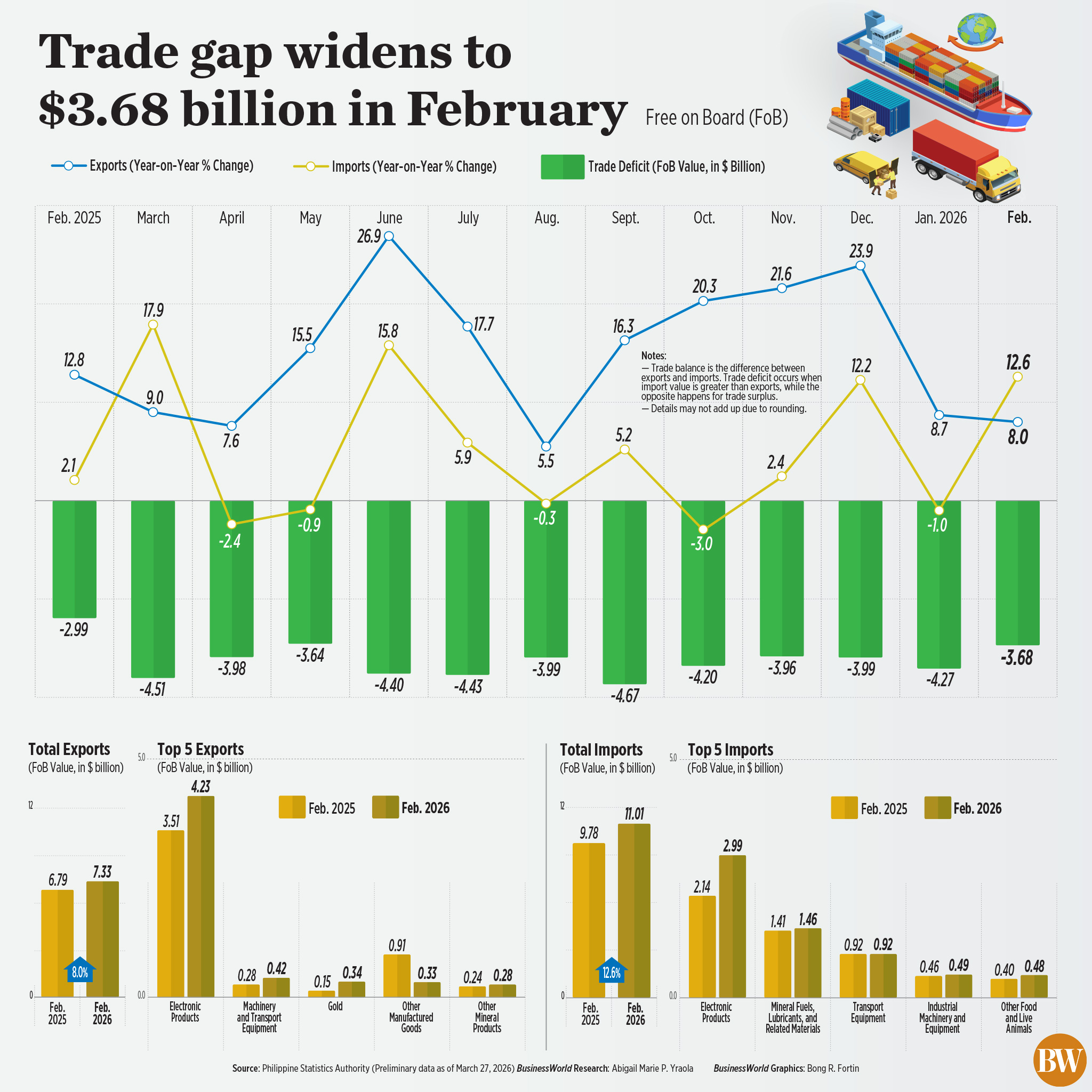
Trade gap widens to $3.68 billion in February

THE Philippines’ trade-in-goods deficit widened year on year in February as imports rose by double-digits while exports eased, the Philippine Statistics Authority (PSA) reported on Friday. Read the full story.

France to seek EU carbon tax suspension for fertilizer

A farmer prepares to use urea fertilizer in his cornfield in La Planche near Nantes, France, June 5, 2018. — REUTERS/STEPHANE MAHE

PARIS — France will ask the European Union (EU) to suspend the application of the bloc’s carbon border tax for fertilizers, in view of rising prices due to the Middle East war, Agriculture Minister Annie Genevard said.

Farmers around the world face rising fuel, gas and fertilizer prices due to supply disruptions caused by the month-old US-Israeli war on Iran. Growers in the EU blame the bloc’s carbon tax scheme, introduced in January, for further inflating fertilizer costs.

“On Monday I will be in Brussels to officially ask the (European) Commission to suspend the carbon tax on fertilizers, at least for the duration of this crisis,” Ms. Genevard told reporters during a visit to a farm in western France.

“This is not the time to increase fertilizer prices with the carbon tax.”

The EU’s agriculture ministers will hold a regular meeting on Monday.

The carbon border tax came into force on Jan. 1 and imposes CO2 emission fees on imports of steel, fertilizer and other goods to ensure they do not have an unfair advantage over products made in Europe.

The French government, which has faced regular protests from farmers in the past two years over grievances including red tape and declining farm income, had pushed the European Commission to exempt fertilizer from the carbon tax in January.

The EU has so far declined requests by France and other countries to suspend the levy on fertilizer. Member countries are negotiating an amendment that could allow temporary exemptions, though that process could take months.

European fertilizer producers oppose suspending the levy, arguing it helps protect local production from cheap imports.

France, the EU’s largest agricultural producer, earlier this week announced measures including loans and tax relief for farms struggling with mounting costs.

Ms. Genevard said further measures would be announced by the French government later Friday. — Reuters

BSP securities fetch higher rate

Bangko Sentral ng Pilipinas main office in Manila. — BW FILE PHOTO

THE BANGKO SENTRAL ng Pilipinas’ (BSP) short-term securities fetched a higher average yield on Friday, with the regulator capping its award even as the offer fetched ample demand.

The 28-day BSP bills drew P50.676 billion in bids, just above the P50-billion offering. This was also higher than the P42.501 billion in tenders for the P60 billion placed on the auction block on March 23.

This translated to a higher bid-to-cover ratio of 1.0135 times from 0.7084 previously.

However, the BSP accepted just P49.676 billion in tenders.

Accepted yields widened to the 4.3% to 4.6125% range from 4.4% to 4.6% in the previous auction. With this, the weighted average accepted rate of the 28-day bills increased by 3.35 basis points to 4.5191% from 4.4856%.

The BSP has not auctioned off the 56-day bills since Nov. 3.

The central bank uses the BSP securities and its term deposit facility to mop up excess liquidity in the financial system and to help guide short-term market yields towards its policy rate.

The BSP bills also contribute to improved price discovery for debt instruments while supporting monetary policy transmission.

The central bank began auctioning off short-term securities weekly in 2020, initially offering only a 28-day tenor and adding the 56-day bill in 2023.

BSP Deputy Governor Zeno Ronald R. Abenoja earlier said the central bank has reduced its issuance of short-term papers to enhance monetary policy transmission and encourage banks to better manage their liquidity.

As of mid-February, the central bank’s monetary operations have siphoned off P1.2 trillion in liquidity from the market. Of this, 28.5% was absorbed through BSP securities, while 44.4% were done through overnight reverse repurchase facility, and 9% from the term deposit facility. — Aaron Michael C. Sy