Home Blog Page 2383

Duplantis breaks own world record at Silesia Diamond League meet

SWEDEN’S Armand Duplantis broke his own pole vault world record when he cleared 6.26 meters at the second attempt at the Silesia Diamond League meeting Sunday.

Mr. Duplantis broke the world record for the 10th time, beating the 6.25 meters he cleared after retaining his Olympic gold medal in Paris earlier this month.

In Poland, he raised the bar to 6.26, having already clinched victory at 6.00 meters. The 24-year-old had brought the Stade de France crowd to their feet at the Paris Olympics when he broke the world record for a ninth time, and there was always the feeling that Mr. Duplantis was not done yet.

“This year I focused on the Olympics, the record just came naturally because I was in good shape,” Mr. Duplantis said. “So I am not surprised with the record today but I am thankful.”

On Wednesday, Mr. Duplantis cleared 6.15 to win in Lausanne but at the Silesia Stadium in Chorzow he had the bar raised to the world-record height and the Polish crowd waited with bated breath. His first effort was a poor one, perhaps lowering expectations, but then the Swede soared over to huge cheers from the spectators before racing to the track and falling to the ground.

“It almost feels weird and unnatural to get so much love and support from the crowds when I compete. I see that especially in Poland,” Mr. Duplantis said. “The energy in this stadium just keeps getting better every year. My first world record also came in Poland, indoors in Torun (in 2020), so I have great memories from here.”

Olympic silver medalist Sam Kendricks of the United States cleared 6.00 before failing at 6.08 to take second, with Paris bronze-medal winner Emmanouil Karalis of Greece finishing third, also clearing six meters.

The crowd had already witnessed Norwegian Jakob Ingebrigtsen shatter the long-standing 3,000 meter world record with a time of seven minutes 17.55 seconds to beat the record set by Kenya’s Daniel Komen in 1996 when he ran 7:20.67. Reuters

Norris wins Dutch GP to end Verstappen’s unbeaten home record

LANDO NORRIS — MCLAREN.COM

ZANDVOORT, Netherlands — McLaren’s Lando Norris ended Max Verstappen’s unbeaten home record with a commanding Dutch Grand Prix (GP) victory and second win of his Formula One career to breathe new life into the championship on Sunday.

Red Bull’s triple world champion finished 22.896 seconds behind, after seizing the lead at the start but being passed on the 18th of 72 laps, with Ferrari’s Charles Leclerc taking the chequered flag in third place.

It was the first time since the race returned to the calendar in 2021 that Mr. Verstappen had not triumphed at Zandvoort and extended his losing streak this season to five races.

His lead over Mr. Norris was cut to 70 points after 15 of a record 24 rounds, with McLaren also cutting Red Bull’s increasingly vulnerable advantage in the constructors’ championship to 30.

“It feels amazing. I wouldn’t say a perfect race because of lap one again, but it was still beautiful. The pace was strong, the car was unbelievable,” said Mr. Norris, who took his first win in Miami in May.

“I could push and get past Max. It was a straightforward race. Tough but enjoyable.”

Mr. Norris had started on pole position for the fourth time in his career and Sunday’s race on the breezy Dutch coast, in front of his rival’s Orange Army of fans, was the first time he had converted the advantage into victory.

It looked at the start that he might have thrown it away once again, the 24-year-old Briton making a sluggish start off the line as Mr. Verstappen hit the throttle and led decisively into turn one.

The McLaren clearly had the pace as well as the drag reduction (DRS) advantage, however, and after one probing attempt on lap 17, Mr. Norris went past down the inside at turn one and pulled steadily away.

Mr. Norris also took a bonus point for fastest lap with a final flourish and was voted Driver of the Day by fans.

“You always hope to do better. We had a good start and tried everything we could but it was clear we were not quick enough,” said Mr. Verstappen.

Mr. Norris’ teammate Oscar Piastri was fourth, ahead of Ferrari’s Carlos Sainz with Red Bull’s Sergio Perez sixth.

The Mercedes pair of George Russell and Lewis Hamilton finished seventh and eighth with Alpine’s Pierre Gasly ninth — and lapped — and Fernando Alonso taking the final point for Aston Martin. Reuters

Norway’s Ingebrigtsen smashes long-standing 3,000-meter record

NORWEGIAN Jakob Ingebrigtsen shattered the long-standing 3,000 meters world record at the Silesia Diamond League meet Sunday by more than three seconds.

Mr. Ingebrigtsen finished in a time of seven minutes 17.55 seconds, erasing the record set by Kenya’s Daniel Komen in 1996 when he ran 7:20.67 in Rieti, Italy.

It was the longest-standing men’s athletics world record in individual track events.

Mr. Ingebrigtsen’s previous best time over the distance came in September last year when he was nearly three seconds slower than Komen’s mark but he was a man on a mission in Silesia.

The 23-year-old Norwegian was in shock when he crossed the line and looked at his time, putting his hands on his head in disbelief.

Mr. Ingebrigtsen received a cheque for $50,000 and posed with it in front of the clock.

“It feels special, amazing. I was hoping to challenge the world record here, but based on my training, I can never predict exactly what kind of time I am capable of,” he said. “I would not have imagined I could run 7:17, though. At the beginning the pace felt really fast, but then I started to feel my way into the race and found a good rhythm.”

“(The) 3,000 is a tough distance. After four-five laps you feel the lactic acid, but you need to get going. The conditions were difficult with the heat today, but it is the same for everyone.”

Three days ago, the Norwegian had exacted a small measure of revenge over American Cole Hocker by winning the 1,500m in Lausanne in 3:27.83, two weeks after Hocker shocked the Olympic field to win gold in Paris.

In the 3,000, he finished ahead of a trio of Ethiopians, with Paris Olympics 10,000m silver medallist Berihu Aregawi second in a personal best and the third-fastest time in history (7:21.28).

Yomif Kejelcha was third.

“Now I want to challenge world records at all distances, but it is one step at a time,” Mr. Ingebrigtsen added. Reuters

PHL-Canada FTA goals include expanded chip, garment access

REUTERS

By Justine Irish D. Tabile, Reporter

THE PHILIPPINES will bat for liberalized trade in semiconductors, electronics, garments, and farm products in negotiating a free trade agreement (FTA) with Canada, an official said.

“We want to optimize (market access) for our semiconductor and electronics products and, of course, garments because we want to help our garment industry,” Trade Undersecretary Allan B. Gepty told BusinessWorld in chance remarks.

“Of course, for our agricultural products, we need to strengthen our competitiveness. There are a lot of agricultural products that have the opportunity to become high-value products,” he said.

These include cacao, coffee, chocolate, and processed foods like fruit cocktail, he added.

In talks with Canada, he said the Philippine objective is to negotiate for the highest level of trade liberalization for goods and services.

“They are strong in services like financial and business services; for goods, they are looking at agricultural goods,” he said.

A bilateral FTA with Canada is among those in the pipeline, along with pending FTAs with the United Arab Emirates, the European Union, and Chile.

The Philippines is also looking to accede to the Comprehensive and Progressive Agreement for Trans-Pacific Partnership, alongside ongoing negotiations for the ASEAN-Canada FTA, the Digital Economy Framework Agreement in ASEAN, and the upgrade of the ASEAN-China FTA and ASEAN Trading Goods Agreement.

“For the FTA with Canada, the talks are ongoing. We had a mapping exercise or stock-taking exercise wherein we talked about our interests and what the possible challenges that we would need to confront,” he said.

Asked to elaborate, he said: “Maybe it’s not really a big challenge for us. But it just so happened that there are new elements in an FTA. So, the consultation process needs to be intensified.”

On the progress of talks with Chile, he said the Philippines is awaiting word on the continuation of negotiations.

“We are conducting a joint study with Chile on a possible FTA. So, once they finish the study, we can, of course, push for an FTA,” he said.

“But we are very positive that there’s a great potential to strongly and, of course, closely collaborate with Chile, as it is one of our directives for us to establish a trading partner in Latin America,” he added.

Rice industry wants more say in review of tariff EO

REUTERS

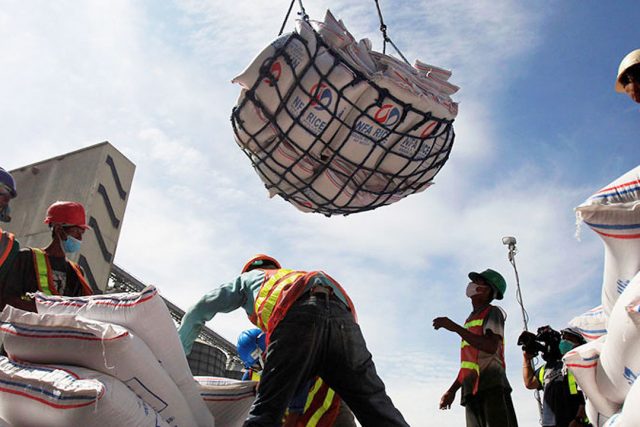
THE GOVERNMENT needs to improve industry representation in the review of Executive Order (EO) No. 62, which cut the tariff on imported rice to 15%, an industry group said.

“In reviewing EO 62, we hope that farmers, seed growers, millers, wholesalers, retailers, and importers” can take part, Philippine Rice Industry Stakeholders Movement (PRISM) Founder and Lead Convenor Rowena D. Sadicon told reporters on the sidelines of a rice forum last week.

EO 62’s new tariff setting is in force until 2028, subject to review every four months in the event of changes to global prices and supply.

“On our side, the stakeholders, we cannot really question (EO 62) because there is a reason for it. But it’s probably the execution and the timing,” Ms. Sadicon added.

Industry and farmer groups have questioned the validity of the EO, claiming lack of public consultation.

Agriculture Secretary Francisco P. Tiu Laurel, Jr. had said that a fall to the P45 per kilo price level for rice may remain likely by mid-October if foreign exchange rates and world market rice prices remain stable.

PRISM Co-Founder Orlando Manutag said Vietnamese traders have begun canceling contracts of Philippine rice importers as prices rise in Vietnam.

The difference in the Philippine contract and the Vietnam market price is “around $60 to $70 per metric ton (MT),” Mr. Manutag added.

“Our importers in June didn’t buy rice because they were waiting for the lower tariffs. When the importers started to buy, Vietnam raised prices,” he said.

Vietnam supplies the majority of the Philippines’ rice imports, accounting for 75.88% of all shipments as of Aug. 8, according to the Bureau of Plant Industry.  This was equivalent to 1.95 million MT, in the year to date.

“The government should intercede in this matter,” he added.

In January, the Philippines and Vietnam signed an agreement giving the Philippines a quota of between 1.5 and 2 million MT (MMT) of rice annually for five years.

Earlier, the US Department of Agriculture lowered its Philippine rice import forecast to 4.6 MMT this year due to weaker-than-expected purchases from Vietnam. — Adrian H. Halili

BIR confirms tax-free status of gymnast Yulo’s prize haul

CARLOS YULO — REUTERS

TWO-TIME Olympic gold medalist Carlos Edriel P. Yulo is exempt from paying taxes on the prizes and incentives he received after he won two events at the Paris games, the Bureau of Internal Revenue (BIR) said.

“The National Internal Revenue Code (NIRC) exempts Carlos Yulo from paying taxes for the prizes, awards, rewards, gifts, or donations he received. The BIR congratulates our two-time Olympic gold medalist for his performance in the 2024 Paris Olympics,” BIR Commissioner Romeo D. Lumagui, Jr. said in a statement.

Under Section 32(B)(7)(d) of the NIRC, prizes or rewards given to athletes who participated in both domestic and international competitions are exempt from income taxes.

Mr. Yulo is also covered by the Republic Act (RA) No. 10699 or the National Athletes and Coaches Benefits and Incentives Act, which classified his prizes as exempt from income tax, the BIR said.

Section 32(B)(3) of the NIRC also indicates that the value of property acquired by gift, bequest, devise, or descent are also excluded from gross income, shielding these assets from income taxes.

“The rewards, gift or donations (in any form) given to Mr. Yulo by private entities, or individuals clearly fall under this exemption. Therefore, Mr. Yulo need not declare these as part of his gross income, and he shall not be liable to pay any income tax thereon,” BIR said.

Earlier this month, Mr. Yulo won gold medals in the men’s floor exercise and men’s vault in the Paris Olympics.

Mr. Yulo’s cash prizes and incentives have been valued at over P100 million, according to reports.

These include prizes he is entitled to under law, such as the P20 million as prescribed by RA 10699, which provides for a P10-million cash gift for each Olympic gold medal earned. — Beatriz Marie D. Cruz

Meat imports rise 9.6% in first half

REUTERS

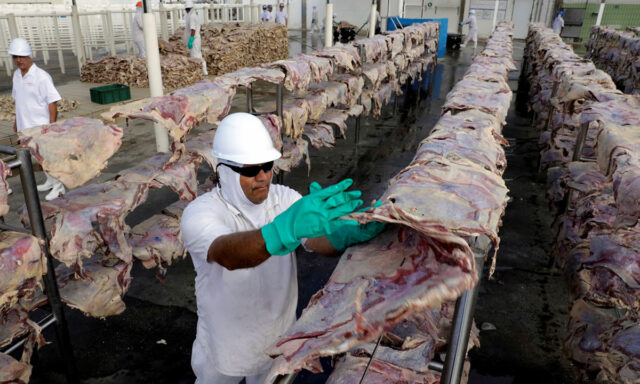
MEAT IMPORTS rose 9.64% by volume year on year in the first half, led by pork, chicken, and beef, the Bureau of Animal Industry (BAI) reported.

The BAI said imports amounted to 647.75 million kilograms during the first half. The June total rose 9.5% to 123.07 million kilos.

Shipments of pork, which accounted for 48.9% of meat imports overall, rose 10.7% to 316.99 million kilos during the period.

Spain supplied around 80.74 million kilos of pork, followed by Brazil (71.96 million kilos), and Canada (46.75 million kilos).

Chicken imports made up 34.3% of the total. Shipments increased 4.1% year on year to 40.37 million kilos.

Brazil remained the top supplier of chicken with shipments of 121.14 million kilos, followed by the US (67.48 million kilos), and Australia (9.17 million kilos).

Beef imports increased 29.3% to 84.92 million kilos during the six months, accounting for 13.1% of the meat import total.

Beef from Brazil amounted to 30.52 million kilos, followed by Australia (24.2 million kilos), and Ireland (7.7 million kilos).

Imports of turkey increased to 722,529 kilos from 112,923 kilos a year prior.

On the other hand, imports of lamb, duck, and buffalo meat declined in the first half.

Imports of buffalo dropped 8.7% to 23.1 million kilos.

Shipments of duck and lamb fell during the period by 47.4% to 85,854 kilos and 22.5% to 327,380, respectively. — Adrian H. Halili

TransCo says buffer fund for feed-in tariff ‘depleted’

STATE-RUN National Transmission Corp. (TransCo) said that the working capital allowance (WCA) or the buffer fund of the feed-in tariff allowance (FIT-All) system has been “depleted” following a suspension of collections.

Rogelyn T. Ronquillo, a manager with TransCo’s Regulatory Affairs Department, said TransCo needs to build up the buffer again, possibly via the proposed new FIT-All rate for 2025.

“On the increase in the FIT-All rate, one reason is that we have to establish the buffer fund which is fully depleted right this moment,” Ms. Ronquillo told BusinessWorld via text message.

The FIT-All is a uniform charge billed to on-grid electricity customers to support the development and promotion of renewable energy (RE). The WCA is part of the FIT-All and serves as buffer to address any default or delay in collections.

Payments are remitted to the FIT-All fund established and administered by TransCo. The fund goes towards paying eligible RE developers who have obtained fixed rates for electricity generated by their projects.

As the administrator, TransCo is tasked to file the rate application before the Energy Regulatory Commission (ERC) for setting the annual FIT-All rate.

For 2025, the state-run firm is seeking an increase to P0.1006 per kilowatt-hour (kWh) from the current P0.0838 per kWh to support RE plants registered under the current FIT system and the potential RE plants to be built under the Green Energy Auction.

Ms. Ronquillo said that the proposed FIT-All rate was computed based on the assumptions and formula provided by the ERC FIT-All guidelines.

“We assume a market price of P6/kWh and assuming this remains constant until 2025 and all other factors are constant, the computed FIT-All Rate will be enough for 2025,” she said.

TransCo said that the approval of the proposed 2025 FIT-All rate would allow it “to fulfill its duties and ensure timely payments of the FITs to FIT-eligible RE developers.”

“Currently, we only have the P3,500 maintaining balances of FIT-All accounts — this is because, the FIT-All rate was suspended for 14 months — and the new FIT-All rate was implemented in June 2024,” Ms. Ronquillo said.

Outstanding payables to FIT-All eligible RE developers amounted to P367 million as of Aug. 24, she said.

“For the remaining months of 2024, if the market price remains P6/kWh, the current rate can cope and pay the RE revenues,” Ms. Ronquillo said.

Earlier this year, the ERC decided to lift the 14-month collection suspension due to the projected deficit in the FIT-All Fund.

In a decision promulgated on March 20, the ERC authorized TransCo to collect a FIT-All equivalent to P0.0838 per kWh. This has increased from P0.0364 per kWh previously. — Sheldeen Joy Talavera

More investment urged to boost agri production

Farmers are seen in a rice field in Bustos, Bulacan, Oct. 17, 2023. — PHILIPPINE STAR/KJ ROSALES

By Adrian H. Halili, Reporter

THE Department of Agriculture (DA) needs to increase investment in research and development to make the Philippines self-sufficient in food.

“Invest in research and development as well as extension (RDE). This is often underinvested in, but we must do so as RDE is the means by which we improve productivity,” Geny F. Lapina, an agricultural economist at the Department of Agricultural and Applied Economics at the University of the Philippines Los Baños, said in an e-mail interview.

As domestic production cannot meet demand, the Philippines typically imports commodities like rice, meat, sugar, and dairy, among others.

“What needs to be improved is execution, monitoring, and strategic thinking. Much of what we do still leans more towards what is popular,” Mr. Lapina added.

He said that the effects of climate change on agricultural production warrants constant monitoring and evaluation of ongoing farm programs.

Droughts and dry spells, mainly due to El Niño, caused a drop in agricultural production during the first half of the year.

“In general, food will always be political. We need more leaders that can think strategically and rally the various competing interests in the food and agriculture sector,” he added.

He said that the Agriculture department remains subject to pressure from farmers and consumers.

“If they focus on consumers that translates to lower retail prices, then farmers complain. However, if they focus on producers and farmgate prices go up, then consumers complain,” Mr. Lapina added.

He said that too much of a burden is placed on the DA in terms of achieving food security.

He called for a “whole of government approach” in the various departments dealing with technology, infrastructure, trade policy, environment, and human health.

Mr. Lapina said food security has now become a much more complex challenge.

He added that nutrition should be part of the food security discussion, “given the rise of non-communicable diseases where the food we eat is one contributing factor.”

“There is also increasing recognition of the impact of food production on the environment,” he said.

All aboard: Revisiting TRAIN’s impact on individuals

One of the major divers of tax reform is Republic Act No. 10963, otherwise known as the Tax Reform for Acceleration and Inclusion (TRAIN) Law, signed in December 2017 and taking effect on January 1, 2018. The TRAIN Law’s promises and objectives were multifaceted.

Under the law, excise taxes were increased on automobiles, tobacco, and petroleum products to push for a sustainable future. Sweetened beverages were also slapped with excise taxes to combat diseases and health concerns stemming from excessive consumption.

Further, personal income tax brackets were revamped by removing the personal exclusions and lowering the graduated income tax rates — a radical change.

Revenue generated from TRAIN was used to fund big-ticket infrastructure projects and social programs such as unconditional cash transfers to those below the poverty line.

Since the law passed over six years ago, a global pandemic has overturned our lives, prices of basic goods and services have risen in an inflationary economy, war has broken out, and markets all over the world have experienced recession. Over six years have been spent on board this TRAIN. What has the effect been on the average Filipino as regards the lowering of personal income tax rates and the increase in excise taxes on fuels and sweetened beverages?

FIRST STOP: DISPOSABLE INCOME
Prior to TRAIN, individual income tax rates were set between 5% and 32% based on a graduated income table ranging from P10,000 to P500,000. Computing for individual income tax back then also included accounting for the number of dependents, which was at a maximum of P100,000 per individual. Under TRAIN, individual income taxes have been homogenized regardless of the individual’s civil status or number of dependents. As such, the individual income table was updated to between P250,000 and P8 million, while graduated income tax rates have been amended to between 0% and 35%, with changes in basic tax rates in two tranches — the first one in 2018 and the second in 2023. Mixed-income earners also got the option to pay taxes at 8% per year in lieu of the graduated income tax rates and business taxes under the new law, subject to certain conditions.

TRAIN increased the take-home pay for individuals and was touted as a progressive method of reducing income taxes for lower-income earners while increasing taxes for higher-income earners. With the higher disposable income for most individuals, it was predicted that demand for goods and services would increase since people would now have more money to spend. On the other hand, this new tax regime is meant to ease tax collection and enhance revenue generation.

A 2022 study by Feniz et al. for the Journal of Economics, Finance, and Accounting Studies found that TRAIN brought about a positive impact on buying power due to the increase in disposable income. The study even went on to say that the higher disposable income may increase potential savings, but they were unable to do so since the money intended for savings was spent to buffer increased household costs. The TRAIN Law had undesirable effects related to a stable and even worse living situation since the increase in income was countered by the increase in prices of goods and services.

As such, the gains earned from TRAIN have been offset by higher monthly expenses.

Further, an August 2019 analysis by Rappler showed that the added excise taxes may have a negative impact on minimum wage earners (MWEs) and those in the informal sector. Since MWEs are not taxed in the first place, the added excise taxes will deplete their disposable incomes even more.

While it is true that the TRAIN Law provided for a higher disposable income for individuals, the same was also offset by the rising prices of goods and services.

SECOND STOP: THE EXCISE TAX ON FUEL
The TRAIN Law also featured excise taxes on petroleum products, including an increase to P2.50-P6 per liter of diesel fuel (previously excise tax-free) and an increase to P7-P10 per liter of gasoline (previously at P4.35 per liter). The intended effect of these excise taxes is to promote more sustainable and environmentally friendly ways of motoring to make commuting a viable option.

We should remember, however, that fuel and coal are also used for commuting and for many other uses in our everyday lives. According to London-based think tank Ember, the share of coal in the Philippines’ power generation mix in 2023 was 61.9%, higher than the 59.1% posted in 2022. An October 2019 simulation by Castillo et al., published by the Philippine Institute of Development Studies (PIDS), found that poverty incidence increased when the prices of goods and services also increased due to the increase in the excise tax on fuel, with farming being affected the most. Further, the simulation also showed that the excise tax on fuel has contributed to a decline in employment, with the agricultural and industrial sectors being the most affected due to weaker economic activity.

In 2022, the Philippines also saw its highest spike in fuel prices, with diesel prices peaking at P84 per liter, with ripples continuing to be felt in 2023. Fuel price watchdogs and stakeholders have since requested the administration suspend the excise tax on fuels. Under Revenue Regulations No. 2-2018, the government has the power to suspend the scheduled increase in excise taxes when the Dubai crude oil benchmark hits $80 per barrel. The Department of Finance, however, has yet to implement a suspension, noting the P41.4 billion in foregone revenue that would otherwise go to social programs and infrastructure.

Since we are still largely dependent on coal, the excise tax on that fuel remains a big component of our spending. Consequently, the excise tax on other fuels may have a continued impact on poverty incidence, unemployment, and inflation.

THIRD STOP: SUGAR TAXES
The TRAIN Law also imposed an excise tax on sweetened beverages. Previously tax-free, a liter of beverage using caloric and non-caloric sweeteners may cost individuals an added P6, with beverages containing high fructose corn syrup costing at least P12 more. According to the World Bank, taxes on sweetened beverages may incentivize individuals and businesses alike to manufacture and consume more health-conscious products.

This was proven by simulation in a February 2019 study conducted by Saxena et al. for the US National Library of Medicine (NLM). According to the simulation, the excise tax on beverages could avert 913 deaths related to diabetes, 10,339 deaths from ischemic heart disease, and 7,950 deaths from stroke over 20 years and could potentially help the government save an estimated P31.6 billion in estimated healthcare costs.

However, a separate 2019 study conducted by Onagan et al. also published by the NLM found that average prices of sweetened beverages increased 16.6% in supermarkets, with carbonated non-alcoholic drinks having the highest spike at 21% during the first year of TRAIN’s implementation. To maintain sales, manufacturers have enhanced marketing measures and resorted to packaging products in smaller portions.

Ideally, when prices of goods increase, the demand for them decreases; such was the intended effect of the sugar tax. Recently, however, the Congressional Policy and Budget Research Department of the House of Representatives found that this intended effect did not exactly take place, noting a consumption growth rate for these products at 4.2% during the pandemic, accelerating to 4.4% in 2023. The think tank later went on to acknowledge that the health benefits intended by this sugar tax were only good for the short term.

In a country where sari-sari stores and ambulant food vendors never run out of sweetened beverages such as sodas and juices, raising excise taxes therefrom may contribute to a healthier Filipino. However, while sugary drinks have increased in price due to an increase in excise taxes, manufacturers have sold them in more affordable, albeit smaller, packaging, and consumers continue to patronize these products, especially when they are more affordable than healthier options.

WHERE IS THIS TRAIN HEADING?
The intentions of the legislature in implementing the TRAIN Law were promising. The law provided for progressive taxes on individuals; any collection therefrom, especially from new or added taxes introduced, would boost infrastructure projects and social programs, not to mention the intended effects of taxes on automobiles and tobacco that were not discussed in this article. Nonetheless, it is important for legislators and stakeholders alike to be in constant dialogue to discuss and revisit whether the intended effects have been met.

During these discussions, several questions may arise, such as:

How can we counter the inflationary impacts of rising fuel prices and goods when consumers are supposedly receiving more disposable income?

The answer may not emerge from a purely fiscal perspective. It may require government intervention to counter inflation — raising minimum wages, and raising interest rates to curb consumer spending. Price controls have been implemented in recent times. Nonetheless, inflation persists. In which case, social amelioration programs may be revisited to make them more inclusive of those greatly affected by inflation.

If fuel prices are so high, how about trying to commute?

This is easier said than done. In most cities, public transportation is difficult, especially with recent moves by the government to overhaul the jeepney industry. The answer may lie in providing more incentives to businesses and employers planning to set up in the countryside, a move introduced by the Corporate Recovery and Tax Incentives for Enterprises Law, whose effects we are yet to see. Moreover, if high fuel prices continue to haunt us, it is probably time to push for more sustainable and low-cost initiatives to power generation and consumption.

If sugary drinks are expensive, how about healthier options?

Again, easy to say, difficult to do. Since healthier food and drink options are only affordable to the middle class and higher, low-income earners have little to no option but to buy what is accessible, most of which are unhealthy. We may also need to revisit subsidizing healthy food and beverage products for those who need them, rather than giving them cash.

In recent years, we have seen more discourse on tax reform, but only among corporate and institutional taxpayers. Ultimately, it is impossible to discuss the effects of tax legislation without considering the economic impact on individuals. All of us citizens have no choice but to ride on TRAIN, yet it is also equally important to inform the train conductors — our legislators and leaders — where we wish to go. Are we aligned on the goal of making taxes more equitable for citizens and government, and will our travels bring us to inclusive economic empowerment?

Let’s Talk Tax is a weekly newspaper column of P&A Grant Thornton that aims to keep the public informed of various developments in taxation. This article is not intended to be a substitute for competent professional advice.


Joen Jacob G. Ramas is a manager of the Tax Advisory & Compliance division at Cebu office of P&A Grant Thornton, the Philippine member firm of Grant Thornton International Ltd.

pagrantthornton@ph.gt.com

China’s actions in South China Sea patently illegal — PHL Defense chief

X.COM/JAYTARYELA

CHINA’S actions in the South China Sea are “patently illegal,” the Philippines’ Defense chief said on Monday after a clash in disputed waters on Sunday over what Manila said was a resupply mission for fishermen.

“We have to expect these kinds of behavior from China because this is a struggle,” Defense Secretary Gilberto Eduardo C. Teodoro, Jr. told reporters. “We have to be ready to anticipate and to get used to these kinds of acts of China which are patently illegal as we have repeatedly said.”

The Chinese Embassy in Manila did not immediately reply to a Viber message seeking comment. Monday is a public holiday in the Philippines.

Manila’s South China Sea task force accused Chinese vessels near Sabina Shoal of ramming and using water cannons against a Philippine fishery vessel transporting food, fuel and medicine for Filipino fishermen.

The Chinese Coast Guard said the Philippine vessel “ignored repeated serious warnings and deliberately approached and rammed” China’s law enforcement boat, resulting in a collision.

Asked if the latest incident would trigger treaty obligations between the United States and the Philippines, Mr. Teodoro said: “That is putting the cart before the horse. Let us deter an armed attack, that is the more important thing.”

United States Ambassador to the Philippines MaryKay L. Carlson denounced the “unlawful and aggressive conduct” by the Chinese Coast Guard.

“Unsafe, unlawful and aggressive conduct by the PRC (People’s Republic of China) disrupted a legal Philippine mission, endangering lives — the latest in multiple dangerous actions by the PRC,” she said in an X post on Sunday evening. “We are steadfast in supporting our Filipino friends, partners and allies.”

“You can’t even trust them (China) to show simple decency,” Senator Juan Miguel F. Zubiri said in a statement. “We condemn this latest act of aggression displayed by China and protest their actions on Philippine territory.”

The government should continue fighting for Philippine sovereignty in the South China Sea and “uphold our territorial integrity and our right to our exclusive economic zone,” he added.

In a statement on Sunday afternoon, the country’s task force on the West Philippine Sea said Chinese maritime vessels blocked a humanitarian resupply mission by the Bureau of Fisheries and Aquatic Resources’ BRP Datu Sanday for Filipino fishermen.

European Union (EU) Ambassador to the Philippines Luc Veron on Sunday condemned what he called “dangerous maneuvers by the Chinese government naval assets.”

“The EU trusts that respect for international law including UNCLOS (United Nations Convention on the Law of the Sea) is essential in the South China Sea as anywhere else,” he said in a statement.

US officials including President Joseph R. Biden have reaffirmed Washington’s “ironclad commitment” to aid the Philippines against armed attacks on its vessels and soldiers in the South China Sea.

“Everybody is too focused on armed attack, let’s make ourselves strong enough so that does not happen,” Mr. Teodoro said.

FLARE TESTS
Also on Monday, the Philippine military said it had tested flares within the country’s exclusive economic zone in the South China Sea, days after urging China to “immediately cease all provocative and dangerous actions” after accusing it of deploying flares from China-occupied Subi Reef on Aug. 22 while a Manila aircraft was conducting patrols.

The same aircraft “faced harassment” from a Chinese jet fighter while it was conducting a surveillance flight near Scarborough Shoal on Aug. 19, the Philippines’ South China Sea Task Force said in a statement at the weekend.

Philippine military chief Romeo S. Brawner, Jr. said he was aboard a Philippine Air Force plane that practiced its flare capabilities on Friday.

“Our flares were working,” he told reporters on the sidelines of a ceremony for National Heroes’ Day in Taguig City.

Raymon M. Powell, a fellow at Stanford University’s Gordian Knot Center for National Security Innovation, said Subi Reef and other South China Sea features that China had converted into military bases have served as “key power-projection platforms” against its neighbors.

The Philippines should have paid “much more attention” to China’s reclamation and militarization of its features, he said in an X message.

“One reason China is able to threaten places like Pag-asa Island and Second Thomas Shoal and Sabina Shoal is because it can present its forces from these nearby bases,” he said.

Mr. Powell said Chinese President Xi Jinping’s assurance to former US President Barack Obama that they would not militarize the South China Sea had “served the purpose to buy China time to complete its project.”

The clash on Sunday has overshadowed efforts to rebuild trust and better manage disputes in the South China Sea after months of confrontations.

China claims sovereignty over nearly all of the South China Sea, including areas claimed by the Philippines, Taiwan, Malaysia, Indonesia, Vietnam and Brunei.

An international arbitral tribunal in 2016 ruled that China’s claim was illegal. — John Victor D. Ordoñez and Kyle Aristophere T. Atienza with Reuters

ASEAN alerted amid hunt for ex-Philippine mayor

PHILIPPINE STAR/JESSE BUSTOS

By Kyle Aristophere T. Atienza, Reporter

SOUTHEAST ASIAN NATIONS were on alert amid a Philippine hunt for a dismissed mayor accused of coddling illegal offshore gambling operations in the country, a senator said on Monday.

Senator Sherwin T. Gatchalian said he had talked with ambassadors from the Association of Southeast Asian Nations (ASEAN) and was informed that their authorities were on alert for dismissed Bamban Mayor Alice Guo.

“She will be nabbed in Indonesia,” the senator told reporters in Filipino. Ms. Guo fled the country and was believed to be hiding in Indonesia.

He said law enforcers in Indonesia were on alert so it would be difficult for her to leave. “It will be difficult for her to move now.”

Ms. Guo has been accused of coddling an illegal Philippine Offshore Gaming Operator (POGO) in Bamban, Tarlac, where she ran and won for the first time as mayor in 2022.

The POGO has been linked to human trafficking and scams. She’s facing an arrest warrant from the Senate for snubbing its hearings on her alleged POGO ties.

The Presidential Anti-Organized Crime Commission (PAOCC) on Saturday said Ms. Guo was likely headed for mainland Southeast Asia’s Golden Triangle, which spans the borders of Mekong River countries Laos, Thailand and Myanmar and is known for its weak law enforcement.

The triangle is widely known as a hub for organized crime, human trafficking and illicit trade.

The PAOCC said two of Ms. Guo’s companions — her sister Sheila and Cassandra Li Ong, the authorized representative of a POGO hub in Pampanga that was raided in June — were arrested in Indonesia last week and arrived in the Philippines on Aug. 22.

Sheila was turned over to the Senate on Monday, while Ms. Ong was in the custody of the House of Representatives. The two chambers are holding separate investigations of POGOs.

Ms. Guo’s escape was first revealed by Senator Ana Theresia “Risa” Hontiveros-Baraquel, citing immigration documents, at a hearing last week.

The PAOCC earlier said Ms. Guo, who has been identified by authorities as Chinese national Guo Hua Ping, arrived in Kuala Lumpur on July 18 from Denpasar, Indonesia via Batik Air 177. She arrived in Singapore from Kuala Lumpur via Jetstar Asia 686 on July 21, PAOCC spokesman Winston John R. Casio said in a Viber message.

She reached Batham, Indonesia on Aug. 18 from Singapore via ferry boat, he added, citing “our foreign counterparts’ immigration records.”

The Bureau of Immigration on Aug. 21 said Ms. Guo was still in Indonesia, almost a month after her departure from the Philippines.

Mr. Gatchalian earlier said it would be impossible for Ms. Guo to escape the country since one “can’t just walk into an airport undetected” nor can leave Philippine airports undocumented.

One has to pass through immigration and countless CCTVs, he added in a statement, noting that there should be traces of movement inside the airport all the way to her boarding the plane.

The Philippines and Indonesia have extradition treaties. They are also member-states of Interpol, along with Singapore and Malaysia.

Ms. Guo was also accused of spying for China, amid questions on her nationality and identity that all unfolded at Senate hearings. She has denied the allegations, maintaining that she’s a natural-born Filipino citizen.

The government has frozen her accounts over money laundering, tax fraud and human trafficking charges.

Her assets covered by a freeze order issued by the Anti-Money Laundering Council and affirmed by the Court of Appeals included 90 bank accounts that were registered with 14 financial institutions and that were under her name and her business partners, luxury vehicles and one helicopter, and a dozen real estate properties.

POGOs, which mainly cater to Chinese markets, have been a major headache for the government, so much so that Mr. Marcos ordered their ban in July.

Congress under his predecessor Rodrigo R. Duterte passed a law taxing POGOs to legalize them, despite concerns about their social costs. Chinese President Xi Jinping had asked him to ban them.

Mr. Marcos said in his third address to Congress in July that POGOs have been disguising themselves as legitimate entities, but their operations have ventured into illicit areas, linking them to financial scams, money laundering, prostitution, human trafficking, kidnapping, brutal torture and “even murder.”