Home Blog Page 2213

Senator pushes to keep US missile system in Manila amid Chinese ‘aggression’

US ARMY PACIFIC

MANILA should keep Washington’s midrange missile system left behind in April to keep Beijing at bay amid its aggressive actions in the South China Sea, a Philippine senator said on Thursday.

“I am in favor of retaining defensive missile systems in the Philippines as a deterrent for any future provocative actions,” Senator Juan Miguel F. Zubiri told a forum at the Senate.

“Remember, it’s a defensive weapon system, not an offensive system.”

He noted that investing in defensive and protective weapons systems aboveboard since the Constitution only bars procuring nuclear weapons for national defense.

Washington has no plans to withdraw its Typhon missile system from the Philippines and is studying its use in a regional conflict, Reuters earlier reported.

China and Russia have criticized the move, saying it could fuel an arms race in the region.

Manila is considering all security options that would deter Chinese aggression in the waterway amid the US keeping the missile system in the country, Defense Secretary Gilberto Eduardo Gerardo C. Teodoro, Jr. told reporters on Tuesday. 

The US Army flew the Typhon, which can launch missiles including SM-6 missiles and Tomahawks with a range exceeding 1,600 kilometers (994 miles), to the Philippines in April in what it called a “historic first” and a “significant step in our partnership with the Philippines.”

The Philippines is open to acquiring the Typhon midrange missile system, Agusan del Norte Rep. Jose “Joboy” S. Aquino II said last week, as he sponsored the 2025 budget of the Defense department.

Mr. Zubiri said missile systems would complement the radar systems given by Japan that would be detect attacks in the South China Sea.

“These radar systems are not enough since even if these allow you to see these attacks, we still need to defend ourselves,” he said in Filipino.

Senate President Francis “Chiz” G. Escudero earlier told foreign journalists that the chamber is planning to ratify Manila’s reciprocal access agreement with Tokyo before the year ends.

The military pact, which was signed in July, eases the entry of equipment and troops for combat training from Japan and to ensure stability in the region amid growing tensions with China.

The Philippines has a visiting forces agreement with the United States and Australia. Tokyo, which hosts the biggest concentration of US forces abroad, has a similar deal with Australia and Britain, and is negotiating another with France.

A United Nations-backed tribunal based in the Hague in 2016 voided China’s expansive claims in the South China Sea for being illegal, which Beijing has rejected.

“As long China is this provocative, then we welcome all the support because we cannot do this alone,” the ex-Senate president said. — John Victor D. Ordoñez


Newly ratified FTA, CREATE MORE to attract more Japanese, Korean investors — Zubiri 

THE PHILIPPINES is expected to see an uptick in investors from South Korea and Japan following the Senate’s concurrence in a free trade agreement (FTA) encouraging more of Seoul’s automakers to set up shop in the country, and the approval of a bill lowering taxes on foreign companies to 20% from 25%, according to a senator.

“This will pave the way for Korean companies to come into the Philippines to set up shop and would make it easier for Korean businessmen to get business visas under this agreement, meaning more jobs,” Senator Juan Miguel F. Zubiri, who heads the committee on economic affairs, told a forum at the Senate on Thursday.

The Senate on Monday concurred with the free trade agreement between the Philippines and South Korea, which will pave the way for increased exports of Philippine bananas and processed pineapples to Seoul.

Under the deal, the Philippines secured the elimination of 1,531 tariff lines on agricultural goods, of which 1,417 would be removed after the FTA enters into force.

It will also remove 9,909 tariff lines of industrial goods, 9,747 of which will be removed once the deal takes effect.

South Korean automakers are expected to benefit from the deal with the removal of the 5% import duties imposed on Korean-made automobiles. Tariffs on Korean electric and hybrid vehicles would also be eliminated within five years.

“Korean goods will be cheaper, but at the same time, our agricultural products will be more accessible in Korea… with less tariffs and less protectionist measures of the Korean government,” Mr. Zubiri.

Meanwhile, the senator said Japanese companies have shown interest in expanding their businesses in the Philippines due to streamlined tax incentives for export-oriented businesses proposed under the recently passed bill that provides export-oriented registered business enterprises (RBEs) with value-added tax zero-rating on essential services.

“Japanese companies that wanted to relocate, have said they wanted to expand here since the Bureau of Internal Revenue won’t have to charge them for local packaging,” said Mr. Zubiri, among the authors of the measure.

He earlier said Japanese companies threatened to leave the country after stalled Value-added tax (VAT) refund requests.

Congress earlier this month passed the Corporate Recovery and Tax Incentives for Enterprises to Maximize Opportunities for Reinvigorating the Economy (CREATE MORE) bill, which would set a local tax of 2% for RBEs based on gross income.

RBEs are provided with a 100% deduction on power expenses incurred in a taxable year, from 50% previously.

CREATE MORE will also grant RBEs with a capital stock of over P15 billion will be granted VAT zero-rating on local purchases, VAT exemption on imports, and duty exemptions on imports of capital equipment, raw materials, spare parts and accessories. — John Victor D. Ordoñez

AmCham bats for airport reform after VAT refund bill approval

STOCK PHOTO

By John Victor D. Ordoñez, Reporter

THE American Chamber of Commerce of the Philippines (AmCham) said the Philippines should pursue reforms and improvements to the country’s airports to boost tourism after the Senate approve a bill seeking a value-added tax (VAT) refund mechanism for nonresident tourists.

“A VAT refund (mechanism) for tourists has been successfully implemented in several countries so there is no reason it shouldn’t be successful in the Philippines if properly implemented,” Ebb Hinchliffe, AmCham’s executive director, said in a Viber message.

“However, AmCham has long pushed for airport reform which would have a much better impact on tourism.”

San Miguel Corp. took over operations of the Ninoy Aquino International Airport on Sept. 14 to work on improving the airport’s roads, terminal capacity and to upgrade the passenger experience.

“I think that (VAT refund mechanism) will boost tourism, but if corruption would happen it would be at the airport,” Senator Juan Miguel F. Zubiri said in mixed English and Filipino at a forum on Thursday.

The Senate on Monday approved on final reading a bill that seeks to establish a refund system for goods worth at least P3,000, which aims to boost visitor spending.

Senate Minority Leader Aquilino Martin D. Pimentel III had opposed the bill saying the country should focus on improving the tourist experience and infrastructure, adding that the system could lead to revenue leakages.

Citing a 2018 World Bank study, he said the Philippines has lost about P539 billion in potential revenue due to VAT leakages and exemptions.

Meanwhile, Mr. Zubiri said the government should ensure this refund mechanism won’t be abused since the measure could be prone to corruption.

“I was assured by Senator Sherwin T. Gatchalian, who is our ways and means chairman, that they put enough safeguards because unlike Japan, tourists won’t be able to buy from the point of origin (to avail of the refund) but only in the airport,” he said.

Nonresident tourists will only be entitled to the VAT refund if they buy the products from government-accredited stores within 60 days of their request.

Comelec to combat fake news

STOCK PHOTO | Image by memyselfaneye from Pixabay

THE Commission on Elections (Comelec) is prepared to protect the integrity of next year’s national polls despite threats of foreign interference, a top official of the polling body said on Thursday, citing an election resolution that would empower it to curb the spread of disinformation.

Comelec chief George Erwin M. Garcia said that a resolution providing regulatory guidelines on social media and artificial intelligence would be sufficient in combating disinformation from fake news peddlers.

He noted, however, that the National Security Council (NSC) is yet to meet with the election agency to discuss measures thwarting potential disinformation campaigns led by foreign actors.

“We will fight disinformation. We will fight fake news and other kinds of malicious information destroying the credibility of what we are doing here,” he told reporters after a forum.

“We have yet to receive formal communication from the National Security Council, but we know what they had stated before,” he added, referring to a warning from the security agency flagging potential foreign-led disinformation campaign on the 2025 polls.

NSC Assistant Director-General and spokesman Jonathan E. Malaya in a TV interview in March said the agency is “sounding the alarm” on possible attempts of foreign actors to influence the elections through disinformation and electronic interference. “It could be as subtle as troll farms or disinformation.”

Mr. Malaya did not immediately respond to a Viber message seeking comment. — Kenneth Christiane L. Basilio

Labor leaders still red-tagged

THE TAGGING of labor leaders and unionized workers as communists continues in the current administration, a move that has led workers to disaffiliate from their labor unions over fear, Human Rights Watch said on Thursday.

Human Rights Watch alleged that Filipino workers employed at companies located south of Philippine Island of Luzon have received threats from both police and military personnel, ranging from accusations of participating in the armed communist rebellion to harassment and intimidation.

“The Philippine government’s sinister and at times deadly practice of ‘red-tagging’ has become a serious threat to labor rights in the country,” Bryony Lau, deputy Asia director at Human Rights Watch, said in a report sent to BusinessWorld.

“President Ferdinand Marcos, Jr. should direct officials to end this abusive practice and ensure that government authorities uphold the rights of workers to organize and bargain collectively,” she added.

Red-tagging is the act of accusing an individual or organization of sympathizing with communism, prominently used against opposition figures in the Philippines.

It is a strategy used by the government against those perceived as “enemies of the state,” according to a dissenting opinion of Supreme Court Senior Associate Justice Marvic Mario Victor F. Leonen in a 2015 case. 

“It’s clear to us that the Philippine government is using red-tagging to prevent workers from organizing and unionizing,” Jerome M. Adonis, secretary general of labor group Kilusang Mayo Uno (KMU), said in the same report.

The act of state-sponsored red-tagging has led to two unions to disaffiliate from KMU and a reduction of unionized workers across the country, Kamz Deligente, deputy director of the Manila-based Center for Trade Union and Human Rights, said in the same report.

According to KMU data, 72 union leaders and members have been killed since 2016.

Mr. Marcos should disband the National Task Force to End Local Communist Armed Conflict (NTF-ELCAC), according to Human Rights Watch, noting it “has been at the forefront of red-tagging.” — Kenneth Christiane L. Basilio

BARMM lawmakers’ guide launched

@BANGSAMOROGOVT

COTABATO CITY — The Institute for Autonomy and Governance (IAG), with the help of the Australian government, launched on Wednesday a book on how members of the fledgling Bangsamoro parliament can perform well.

The 274-page “MP’s Little Green Book,” provides ideas on how members of the parliament in the Bangsamoro Autonomous Region in Muslim Mindanao (BARMM) can become efficient in discharging their functions as BARMM officials.

It was authored by Engineer Bai Intan Adil-Ampatuan, a member of the 80-seat Bangsamoro parliament and had served as regional planning director of the now defunct Autonomous Region in Muslim Mindanao, and Violeta T. Veloso, who had worked as a directorate staff in the House of Representatives.

“This book was based on my experiences as an appointed member of the Bangsamoro regional parliament for almost six years now,” said Ms. Adil-Ampatuan, a civil engineer by profession. The launch was held at the Pagana Convention Center in Cotabato City.

The Australian government channeled to the IAG, a partner of the Konrad Adenauer Stiftung of Germany, the funds for the initial production of hundreds of copies of the MP’s Little Green Book, virtually a manual for efficient performance of each member of the BARMM parliament. — John Felix M. Unson

44 withdraw rebel support in Ifugao

BAGUIO CITY — The military claimed that at least 44 self-confessed supporters of the Communist Party of the Philippines-New People’s Army (CPP-NPA) from Tukocan, Tinoc town in Ifugao, formally withdrew their support to the underground movement Tuesday at sitio Mugao, Barangay Impugong, also in Tinoc.

“The mass withdrawal of rebel supporters demonstrated a positive development for an insurgency-free Ifugao,” said Philippine army Major Anthony Pueblas, commander of the 1st Civil Relations Group of the Armed Forces of the Philippines based in Camp Aquino in Tarlac, the headquarters of the AFP’s Northern Luzon Command (Nolcom).

According to Mr. Pueblas, Ifugao “has been a stronghold of insurgency,” prompting the military to focus its efforts to flush out rebel influence in the province that has made significant milestones.

“The undertaking is a big step in the province’s quest for genuine peace towards development and progress as he urged the CTGs, supporters, and officials to work collectively for peace,” said.

Ifugao Governor Jerry U. Dalipog said “we will not allow the CTG to continue demeaning the peace that we aspire for, so we ought to condemn them.”

The governor urged all rebel supporters to join him and other Ifugao officials “commit themselves to moving forward in our quest for peace.” — Artemio A. Dumlao

Stocks rebound on dovish hints from BSP chief

BW FILE PHOTO

PHILIPPINE SHARES rebounded on Thursday, with the main index hitting a new over two-year high, after dovish comments from the Bangko Sentral ng Pilipinas (BSP) governor.

The Philippine Stock Exchange index (PSEi) jumped by 1.3% or 96.12 points to end at 7,458.74 on Thursday, while the broader all shares index rose by 0.97% or 38.46 points to 3,978.10.

Thursday’s close was the PSEi’s best finish in over 31 months or since it ended at 7,502.48 on Feb. 9, 2022.

“After a brief pullback on Wednesday, the local market bounced back this Thursday. Optimism was fueled by cues of possible rate cuts from the BSP,” Philstocks Financial, Inc. Senior Research Analyst Japhet Louis O. Tantiangco said in a Viber message.

The Monetary Board could slash rates by 50 basis points (bps) more this year via 25-bp cuts at its Oct. 17 and Dec. 19 meetings, BSP Governor Eli M. Remolona, Jr. said on Wednesday.

The BSP on Aug. 15 began its easing cycle with a 25-bp reduction, bringing its policy rate to 6.25% from the over 17-year high of 6.5%. This was the first time it cut rates in nearly four years.

If the Monetary Board delivers rate cuts worth 50 bps in its last two meetings, it would bring the benchmark rate to 5.75% by end-2024.

“Local shares recovered from a two-day slump, buoyed by the Asian Development Bank’s (ADB) decision to maintain its gross domestic product (GDP) growth forecast for the Philippines at 6% for 2024 and 6.2% for 2025,” Regina Capital Development Corp. Head of Sales Luis A. Limlingan said in a Viber message. “The ADB attributed this outlook to easing inflation and expected policy adjustments that could stimulate domestic demand.”

The multilateral bank’s Philippine GDP growth projection for this year is at the low end of the government’s 6-7% goal, while the forecast for 2025 is below its 6.5-7.5% target.

Philippine economic growth averaged 6% in the first half. To meet the lower end of the government’s target for the year, GDP must expand by 6% this semester.

Majority of sectoral indices closed higher on Thursday. Financials surged by 2.59% or 60.21 points to 2,384.69; holding firms rose by 1.07% or 67.08 points to 6,328.70; services went up by 0.94% or 21.03 points to 2,255.78; industrials climbed by 0.83% or 81.16 points to 9,821.05; and property inched up by 0.37% or 11.05 points to 2,988.45.

Meanwhile, mining and oil dropped by 0.34% or 30.19 points to 8,743.01.

“San Miguel Corp. was the day’s top index gainer, jumping 6.11% to P89.50. Semirara Mining and Power Corp. was at the bottom, falling 1.48% to P33.35,” Mr. Tantiangco said.

Value turnover rose to P12.53 billion on Thursday with 1.18 billion shares changing hands from the P8.05 billion with 1.07 billion issues traded on Wednesday.

Advancers outnumbered decliners, 111 to 80, while 61 names closed unchanged.

Net foreign buying surged to P4.79 billion on Thursday from P921.22 million on Wednesday. — R.M.D. Ochave

Peso down as market awaits Fed hints

BW FILE PHOTO

THE PESO declined anew against the dollar on Thursday amid bets on the US Federal Reserve’s next policy move.

The local unit closed at P55.965 per dollar on Thursday, weakening by 8.5 centavos from its P55.88 finish on Wednesday, Bankers Association of the Philippines data showed.

The peso opened Thursday’s session weaker at P56.05 against the dollar. Its intraday best was at P55.94, while its worst showing was at P56.09 versus the greenback.

Dollars exchanged went down to $1.37 billion on Thursday from $1.54 billion on Wednesday.

“The peso tracked the dollar’s recovery last night due to aggressive Fed bets and lower US PCE (personal consumption expenditure) expectations,” the first trader said in a phone interview on Thursday.

“The peso depreciated due to market caution ahead of key US economic data releases on durable goods and initial jobless claims overnight,” the second trader said in an e-mail.

For Friday, the second trader said the peso could recover amid a likely softer US PCE report and potentially dovish remarks from Fed Chair Jerome H. Powell.

The first trader sees the peso moving between P55.70 and P56.10 per dollar, while the second trader expects it to range from P55.85 to P56.10

The dollar held firm on Thursday following its sharpest rally since early June as traders looked ahead to speeches from key Federal Reserve policy makers later in the day for clues on the pace of interest rate cuts, Reuters reported.

The US currency rebounded strongly overnight from a more than one-year low to the euro and 2 1/2-year trough versus sterling.

While there was no obvious catalyst for the rebound, investors appeared to take a more nuanced view on just how aggressive future US rate reductions would be, with Fed speakers this week not presenting a unified view on the path forward.

Later on Thursday, Mr. Powell was set to give pre-recorded remarks at a conference in New York, where New York Fed President John Williams was also set to speak. Boston Fed President Susan Collins and Fed Governors Michelle Bowman and Lisa Cook were set to take to the podium at various other venues as well.

Traders still expect a second super-sized 50-basis-point rate reduction at the Fed’s next meeting in November, but the odds edged down to 57.4% from 58.2% a day earlier, according to the CME Group’s FedWatch Tool.

The dollar index, which measures the currency against the euro, sterling, yen and three other major peers, eased 0.10% to 100.84 as of 0444 GMT, following a 0.57% jump on Wednesday, its biggest one-day gain since June 7.

The yen hit a three-week low of 145.04 per dollar and last fetched 144.77. — A.M.C. Sy with Reuters

Bicam report raising RCEF allocation to P30B ratified

PHILIPPINE STAR/KRIZ JOHN ROSALES

By John Victor D. Ordoñez, Reporter

CONGRESS late Wednesday ratified the bicameral conference committee report on a bill seeking to raise the yearly allocation of the Rice Competitiveness Enhancement Fund (RCEF) to P30 billion from P10 billion until 2031.

The measure coming out of bicam, which harmonized Senate Bill No. 2779 and House Bill No. 10381, also requires the National Food Authority (NFA) must maintain a rice reserve equivalent to at least 15 days’ demand, according to the bicam report sent to BusinessWorld  on Thursday.

The measure would also give the Department of Agriculture (DA) the authority to sell NFA rice reserves in times of shortage and high rice prices to the Department of Social Welfare and Development (DSWD), Office of Civil Defense, local government units (LGUs), and the KADIWA network of stores that sell government-subsidized goods.

The measure amends the Rice Tariffication Law of 2019 or Republic Act No. 11203. RA 11203 opened up to private entities the rice import trade, which had previously been dominated by the NFA, which imported the grain via government-to-government deals. The private traders instead had to pay a tariff of 35% on their shipments of Southeast Asian grain. The tariff has since been reduced to 15% and applies to rice from all sources.

According to the bicam report, the Secretary of Agriculture will be given the authority to designate importing entities during times of “extraordinarily” high prices. The NFA remains barred from importing rice.

Under the reconciled version of the bill, the importing entity is required to ship rice at least cost following the conclusion of government-to-government supply agreements.

It also requires the DA to maintain a rice buffer fund of P5 billion during food security emergencies.

The P30-billion RCEF allocation will fund the development of high-quality inbred rice seed, the distribution of cash aid for farmers, and the construction of solar-powered irrigation systems and composting facilities.

Rice tariff collections amounted to about P30 billion last year, according to the Bureau of Customs.

The 2019 law also restricted the NFA to buying domestic grain to maintain an emergency reserve of rice for use during calamities.

Tourist spending to rise nearly 30% with VAT refund law in place — DoT

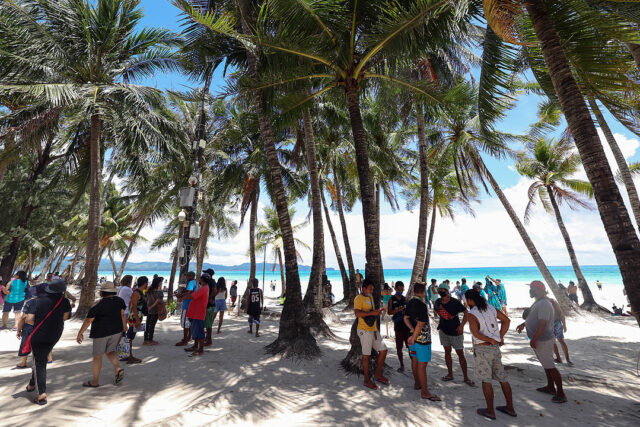
Tourists are seen at the beach of Boracay island, Aklan province. — PHILIPPINE STAR/KRIZ JOHN ROSALES

TOURIST spending is projected to increase 29.8% if the government passes the value-added tax (VAT) refund law for foreign tourists, according to the Department of Tourism (DoT).

In a statement on Thursday, the DoT expressed support for the passage of the refund legislation, which it called “a crucial milestone in enhancing the country’s appeal as a premier tourism destination, positioning the Philippines competitively among its regional neighbors.”

“The projected increase in tourist spending, as estimated by the House Committee on Ways and Means, represents a tremendous opportunity for growth in local businesses, especially micro, small and medium enterprises (MSMEs), and an increase in tourism employment,” it added.

On Monday, the Senate approved on final reading, Senate Bill No. 2415, which will allow tourists to claim VAT refunds on locally purchased goods worth at least P3,000.

A counterpart bill for the proposed measure was approved by the House of Representatives on March 6, 2023.

The measure is also seen as an opportunity to promote products such as Marikina shoes, barongs, and traditional weaves, it said.

“This initiative, coupled with ongoing improvements in our tourism infrastructure and innovative tourism programs, will elevate the overall travel experience for our visitors and encourage longer stays and return visits,” the DoT said.

At the 2024 Outstanding Filipino Retailers Awards Night late Wednesday, Philippine Retailers Association President Roberto S. Claudio said that the passage of the measure is being closely watched by the retail sector.

He said that the Philippines is the only country in Asia where tourists do not get VAT refunds.

“So, tourists never came to the Philippines to do their shopping. Shopping is the biggest expense of any tourist worldwide,” he said.

“This is one explanation why Thailand, Vietnam, and Singapore are getting more tourists than our country,” he added.

Hans Sy, executive committee chairman of SM Prime Holdings, Inc., said that the VAT refund scheme for tourists is a positive development for SM.

“I just hope that they can make it very easy and simple. If you go to Japan, outright, they do the discount there as long as you show your passport,” he said.

“I hope it won’t be like some other countries that make it almost impossible for you to get it … that’s why for us, in whatever we do, we make sure that everything is really done for (the customers),” he added.

He said he believes that technology will help make such measures easy to implement. 

“I actually could see the future with so many technology-aided things. To me, it’s also still a challenge because that’s going to really make the arena really competitive,” he added. — Justine Irish D. Tabile

DoF calls for action vs ASF, cites need to contain inflation

FREEPIK

GOVERNMENT agencies need to act in concert to contain African Swine Fever (ASF), including expediting the release of subsidies to aid in the vaccination effort, due to the urgent need to manage inflation, the Department of Finance (DoF) said.

In a statement posted on its Facebook page, the DoF said it called for measures to control ASF after the Economic Development Group and the Inter-Agency Committee on Inflation and Market Outlook discussed measures on Sept. 25 to contain inflation.

“To manage food inflation, the National Economic and Development Authority (NEDA) called on the implementing agencies to employ supply-augmenting programs and enforce disease control measures, including the rollout of ASF vaccines and the adoption of Integrated Pest Management technologies for sugar,” the DoF said in a statement.

During the meeting, the Department of Agriculture said it is looking at other means of toughening biosecurity measures against ASF.

Among the measures against non-food inflation, the Land Transportation Franchising and Regulatory Board said it wants to partner with major payment services providers to validate its master list of fuel subsidy beneficiaries. These beneficiaries will be eligible to buy cheap fuel to ease the pressure on the government to approve fare hikes. — Beatriz Marie D. Cruz