
How PSEi member stocks performed — October 18, 2024
Here’s a quick glance at how PSEi stocks fared on Friday, October 18, 2024.
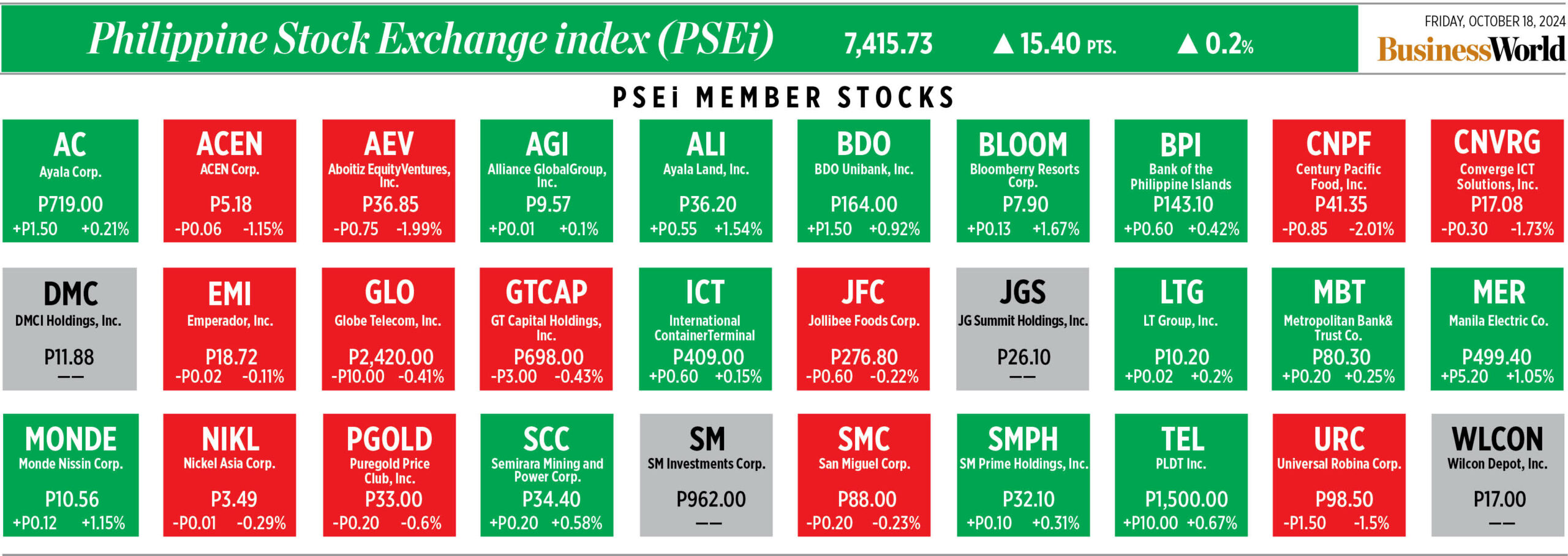

Here’s a quick glance at how PSEi stocks fared on Friday, October 18, 2024.

In the 2024 edition of Mercer CFA Institute’s Global Pension Index, the overall score of the Philippines improved slightly to 45.8 out of 100 from 45.2 recorded a year ago. However, this was below the 63.6 global average this year. The country’s retirement income system ranked the third worst among the 48 systems in the report. The index reviews the economies’ respective retirement income systems based on three weighted subindices: adequacy, sustainability, and integrity.


THE PESO could move sideways against the dollar this week as investors stay cautious amid the ongoing conflict in the Middle East ahead of the US presidential elections.
The local unit closed at P57.511 per dollar on Friday, strengthening by 28.9 centavos from its P57.80 finish on Thursday, Bankers Association of the Philippines data showed.
However, week on week, the peso declined by 30.6 centavos from its P57.205 finish on Oct. 11.
The peso rebounded against the dollar on Friday due to data showing slower-than-expected economic growth in China and after the Chinese government disclosed more details on its stimulus measures, a trader said by phone.
China’s economy grew at the slowest pace since early 2023 in the third quarter, and though consumption and factory output figures beat forecasts last month a tumbling property sector remains a major challenge for Beijing as it races to revitalize growth, Reuters reported.
Authorities have sharply ramped up policy stimulus since late September, but markets are waiting for more details on the size of the package and a clearer road map to put the economy back on a solid longer-term footing.
The world’s second-largest economy grew 4.6% in July-September, official data showed, a touch above a 4.5% forecast in a Reuters poll but below the 4.7% pace in the second quarter.
Officials addressing a post-data press conference on Friday expressed confidence the economy can achieve the government’s full year growth target of around 5%, underpinned by further policy support and another cut to the amount banks must hold in reserve.
On a quarterly basis, the economy expanded 0.9% in the third quarter, compared with a revised 0.5% growth in April-June, and below forecast of 1.%.
China has been grappling with deflationary pressures since early last year, and some economists see those strains deepening.
Policy makers, who have traditionally leaned on infrastructure and manufacturing investment to drive growth, have pledged to shift focus towards stimulating consumption.
The central bank in late September announced the most aggressive monetary support measures since the COVID-19 pandemic to support the property and stock markets.
The peso was also supported by the US calling for a ceasefire after the death of one of the Hamas leaders, the trader added.
Easing tensions in the Middle East also led to lower global crude prices, which helped prop up the peso, Rizal Commercial Banking Corp. Chief Economist Michael L. Ricafort said in a Viber message.
For this week, the trader said the peso could trade depending on developments in the Middle East.
An Israeli airstrike that hit several houses and a multi-storey residential building in Beit Lahiya town in northern Gaza on Saturday caused dozens of casualties, doctors and officials said, with rescue operations still underway, Reuters reported.
The Hamas media office said at least 73 people had been killed in the strike. No official casualty figures were immediately available from the health ministry however Medway Abbas, a senior health ministry official, said the figures were accurate.
However, the local unit may weaken if the possibility of Donald J. Trump winning the US presidential increases, the trader added.
Opinion polls indicate a likely close match between Mr. Trump and Vice-President Kamala Harris in the vote on Nov. 5. However, the odds have diverged on Polymarket, with Mr. Trump pulling strongly ahead at a 60% chance of winning versus Ms. Harris on 40%, Reuters reported.
The peso’s movement could also be affected by the US Federal Reserve’s Beige Book report to be released on Wednesday (Oct. 23), Mr. Ricafort said.
The trader sees the peso moving between P57.40 and P57.70 per dollar this week, while Mr. Ricafort expects it to range from P57.20 to P57.60. — A.M.C. Sy with Reuters

PHILIPPINE SHARES could climb further this week amid expectations of further interest rate cuts by the Bangko Sentral ng Pilipinas (BSP) and as investors anticipate the release of more corporate results.
On Friday, the main Philippine Stock Exchange index (PSEi) rose by 0.2% or 15.4 points to 7,415.73, while the broader all shares index went up by 0.13% or 5.28 points to 4,081.52.
Week on week, the PSEi climbed by 1.44% or 105.41 points from the 7,310.32 close on Oct. 11.
“Despite the BSP’s 25 basis points (bps) rate cut, local equities kept to its range [last] week, amid the start of third quarter earnings reporting season,” online brokerage firm 2TradeAsia.com said in a market note. “The decision was largely expected and did little to move markets into any bold action — a reminder that prices move proactively as they do reactively.”
“The local market is having a hard time getting past the 7,400-7,500 resistance range as the weakening of the peso together with offshore uncertainties weigh on sentiment. Consequently, the market is being hindered from continuing its bull run,” Philstocks Financial, Inc. Senior Research Analyst Japhet Louis O. Tantiangco said.
For this week, bargain hunting could cause Philippine stocks to rise, he said.
“The dovish monetary policy outlook of the Bangko Sentral ng Pilipinas is still expected to give the market support.”
The Monetary Board on Wednesday cut benchmark interest rates by 25 bps, as expected by 16 of 19 analysts in a BusinessWorld poll, as price pressures remain manageable. This brought its policy rate to 6%.
BSP Governor Eli M. Remolona, Jr. said they could cut benchmark rates by another 25 bps at their Dec. 19 meeting. He said they could slash rates by 100 bps in 2025, but prefer to take “baby steps” in their policy easing cycle.
“More catalysts could be needed, however, for the market to get past the 7,400-7,500 range. In line with this, investors are expected to look forward to the corporate sector’s third quarter reports. Upbeat corporate results are seen as one of the possible catalysts that could drive the market higher,” Mr. Tantiangco added.
Mr. Tantiangco put the PSEi’s support at 7,150.
“If the local market gets past and holds ground above the 7,400-7,500 range, next resistance is seen at 7,700,” he said.
Rizal Commercial Banking Corp. Chief Economist Michael L. Ricafort said in an e-mail that the market’s support is 7,050-7,260 and resistance is at 7,600-7,800.
For its part, 2TradeAsia.com placed the PSEi’s immediate support at 7,200 and resistance at 7,500-7,600.
“The final earnings season of the calendar year finally kicks off, with the banks opening with very good numbers, as expected of sectors with rate-sensitive top line drivers… Release of corporate guidance, both in earnings and capex (capital expenditures), heading into 2025 is also expected to stir up additional excitement in the short term,” it said. — R.M.D. Ochave

THE Bureau of Internal Revenue (BIR) said it will likely miss its P326.2-billion excise tax collection goal this year due to declining demand for tobacco products.
“The trend in tobacco consumption has been declining in the last 10 years. Tobacco excise is more than 40% of our excise tax take,” BIR Assistant Commissioner Jethro M. Sabariaga told BusinessWorld via Viber.
“You don’t see a lot of people smoking cigarettes these days. Even visually, you can confirm the shift in market demand,” Mr. Sabariaga said, noting that the collection growth in other excisable articles will not be enough to offset the decline in tobacco excise.
Excise taxes are imposed on the production, sale or consumption of a commodity. These include tobacco, alcohol, and non-essential goods.
Mr. Sabariaga noted that the public’s shift to vape products, an alternative to tobacco, has also been affecting the bureau’s excise tax take.
A single vape product is equal to one cigarette pack in excise taxes, but vape products often take longer to consume, he said.
“So, a cigarette smoker shifting to vape, who usually consumes 10 to 15 packs of cigarettes a month, will probably just buy one vape product for the month, or worse, one for two months,” Mr. Sabariaga said.
In a forum last month, BIR Commissioner Romeo D. Lumagui noted challenges in collecting excise taxes this year due to the ongoing trade of illicit products, especially tobacco.
The BIR lost around P7.2 billion in potential revenue from seized tobacco and vape products in the first half of 2024, he said earlier.
Congress has also yet to pass revenue generating measures that would help increase excise tax collections, Mr. Sabariaga said, citing the proposed taxes on single-use plastics, junk food, as well as the mining fiscal regime.
The Department of Finance has taken the position of not supporting new taxes while overhauling tax administration.
The BIR collected P194.93 billion in excise taxes in the eight months to August, down 3.08% from a year earlier.
This was also 37.73% below the P313.06-billion target for the first eight months.
Excise taxes collected in the first eight months accounted for around 59% of the full-year goal.
At the end of August, tobacco products generated P84.42 billion, accounting for 43.31% of the excise total.
This was followed by alcohol products with P74.32 billion, sweetened beverages P25.8 billion, mineral products P6.08 billion, and automobiles P4.05 billion.
The government also generated P164.82 million from non-essential goods, P88.04 million from petroleum products, and P12.54 million from cosmetic procedures.
In August, excise tax collections rose 4.88% year on year to P27.74 billion. This was well below the BIR’s P41.79-billion target for the month.
During the month, the government collected excise taxes amounting to P12.92 billion from tobacco products, or 46.57% of August collections.
Alcohol products generated P10.58 billion, followed by sweetened beverages with P3.15 billion.
Other excise taxes collected in August were generated by mineral products (P535.85 million), automobiles (P534.67 million), non-essentials (P16.59 million), petroleum (P2.98 million), and cosmetic procedures (P1.65 million).
In the first eight months, tax revenue collected by the BIR rose 12.55% to P1.92 trillion, representing 62.82% of the P3.055-trillion goal for the year. — Beatriz Marie D. Cruz

AT LEAST 105 renewable energy (RE) projects may be offered to new developers, with the Department of Energy (DoE) working on the cancellation of the original contract awards due to failure to meet project timelines.
“If any contracts are deemed non-performing, we will open them up for new developers who can effectively bring these projects into fruition,” Energy Undersecretary Rowena Cristina L. Guevara said in a statement on Sunday.
“This strategy not only accelerates the development timeline but also strengthens investor confidence in the country’s renewable energy goals,” she added.
Most of the contracts were awarded in 2017 and 2019, with the reasons for the delays including failure to secure rights or system impact studies indicating an inability to connect to the grid.
Of the total, 88 are either delayed in the pre-development stage or making no progress at all. They include 53 solar, 17 hydropower, 10 wind, five geothermal, and three biomass projects.
With at least 1,435 service contracts awarded as of June, the renewable energy industry is poised to introduce more than 156,700 megawatts (MW) of capacity. About 6,100 MW has been installed.
The government hopes to increase the share of RE in the generation mix to 35% by 2030 and 50% by 2040.
Ms. Guevara said the government is committed to “ensuring the efficient and timely execution of renewable energy projects by regularly assessing the progress of these projects and refining regulatory framework.”
In June, the DoE released the revised omnibus guidelines, which govern the award and administration of RE contracts and the registration of RE developers.
“This process helps to identify and filter out non-serious developers, paving the way for legitimate developers committed to constructing renewable energy projects efficiently,” the DoE said.
Under the revised guidelines, developers are required to obtain a certificate of authority (CoA) before signing an RE contract. This allows them to start permit processing, conduct surveys and pre-feasibility activities even before the official 25-year contract terms begin.
“By allowing these activities to take place earlier, developers can better prepare for project implementation and address potential challenges proactively,” the DoE said.
The CoA’s validity period depends on the project type, with offshore wind projects granted five years and biomass, geothermal, hydropower, ocean and onshore wind projects three years.
The certificates that will be granted for floating solar and land-based solar projects are valid for two years and one year, respectively.
The DoE is also streamlining the permit processes through its Energy Virtual One-Stop Shop System or EVOSS.
“These streamlined procedures are designed to promote investments in the renewable energy sector by reducing bureaucratic hurdles, and avoidance of service contract termination, ultimately supporting our country’s transition to a more sustainable energy landscape,” Ms. Guevara said. — Sheldeen Joy Talavera
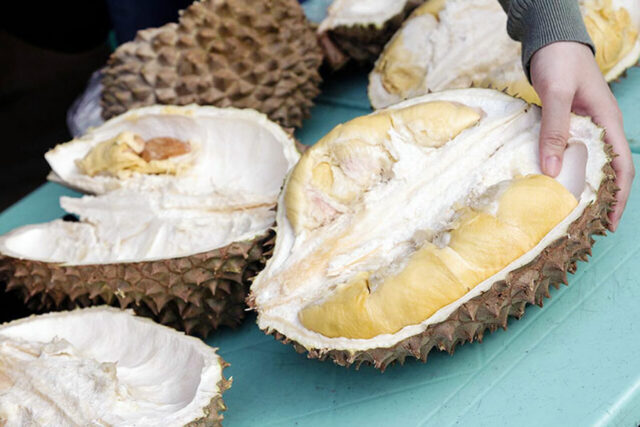
DAVAO CITY — Davao City Durian Industry Council President Emmanuel Belviz said on Friday that three exporters are awaiting the approval of their China Import Food Enterprise Registration (CIFER) prior to shipping frozen durian to China.
Mr. Belviz, owner of Belviz Farms, said the exporters awaiting CIFERs are Eng Seng Food Products, SQ Fresh Fruit Corp., and D’ Farmers Market Fruits and Pastries Center.
CIFER is a primary requirement for businesses seeking to export food products to China.
“China approved and allowed the export of frozen fruits just last month. Marami na tayong exporters na nag-apply… (Many exporters have applied),” Mr. Belviz said.
Mr. Belviz said Thailand is currently the biggest buyer of frozen durian. The Philippines has exported around 3.13 million kilograms of frozen durian to Thailand this year, followed by South Korea with 185,664 kilograms and Malaysia 25,650 kilograms.
“The exporters are holding out (to send more) after the season,” he said.
Meanwhile, for fresh durian, Mr. Belviz said in the nine months to September, Davao durian exports to China topped 9,295 metric tons (MT). Singapore took in 55.70 MT and Japan 184.25 kilograms.
“Durian season is still ongoing. We still have to harvest from high elevation areas like Tamayong and Sirib,” Mr. Belviz said.
He said China remains the most lucrative and biggest market for Davao durian.
In April 2023, the Department of Agriculture in Davao Region shipped 18 metric tons of durian to China following the signing of a bilateral agreement governing shipments of Philippine fresh durian to China. The deal was signed during the state visit of President Ferdinand R. Marcos, Jr. on Jan. 3, 2023.
Meanwhile, Mr. Belviz said the upcoming National Durian Industry Summit on Oct. 23-24 at the Grand Men Seng Hotel in Davao City is expected to address pressing issues for the Davao durian export trade.
Mr. Belviz said during the Business Matters media forum at Hukad, Abreeza Ayala Malls, that one of the issues exporters have encountered was rejection of durian shipments due to quality problems.
Mr. Belviz said the industry invited experts from Malaysia and Thailand to consult on boosting fruit quality.
Mr. Belviz added that the summit will also gather international speakers who will share best practices on durian production. — Maya M. Padillo
By Adrian H. Halili, Reporter
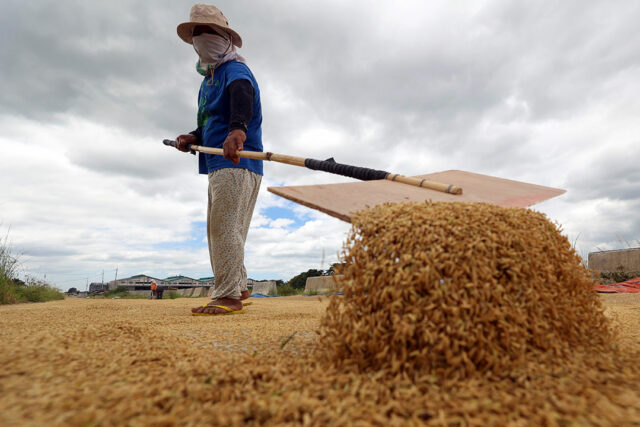
THE National Food Authority’s (NFA) new system for setting the purchase price for palay (unmilled rice) is supporting farmers as farmgate prices for the grain fall, analysts said.
University of Asia and the Pacific (UA&P) Center for Food and Agribusiness Executive Director Marie Annette Galvez-Dacul said that the government’s new price scheme is a relief to farmers struggling with weak prices offered by private traders.
The NFA set its buying price for palay at P23 to P25 per kilogram for the wet-season harvest.
“However, it may not fully cover rising expenses, especially for those affected by adverse weather,” Ms. Dacul said via Viber.
The average farmgate price for palay was P22.43 per kilogram in September, according to the Philippine Statistics Authority.
“It’s important to note that the NFA has limited procurement funds… and once these are used up, things will shift to a buyer’s market,” she added.
The NFA said last week that its procurement budget for unmilled rice for the remainder of the year has been set at P9 billion. Most of the allotment will go to meeting its palay inventory goals for the wet season.
The NFA is targeting palay inventory of 435,000 MT by the end of the year. It is required to maintain a rice reserve equivalent to about nine days’ demand.
“P23-35 per kilo is okay with farmers given that production cost is P16-17 per kilo,” Samahang Industriya ng Agrikultura Executive Director Jayson H. Cainglet said via Viber.
The DA has said that the new palay buying scheme will aid the government in taming rice prices.
“The NFA must procure at least 10% of the harvest to force traders into lowering their buying prices,” Mr. Cainglet said.
UA&P’s Ms. Dacul said traders might adjust their prices to stay competitive with the NFA’s new buying price.
“But not all may follow suit, as this will depend on factors like supply levels and the quality of palay,” she added.

MANILA International Airport Authority (MIAA) is seeking the assistance of the Asian Development Bank (ADB) to help define its role and functions as the sole regulator of the Ninoy Aquino International Airport (NAIA).
“This is what we are trying to clear up with the transaction analyst group at ADB. We want to define what we can and cannot do,” MIAA General Manager Eric Jose C. Ines said via telephone.
Earlier this month, the MIAA said that it is transitioning to a regulatory role and hopes to have an organizational structure proposal approved this year.
The New NAIA Infrastructure Corp. took over the operations and maintenance of NAIA on Sept. 14.
The proposed organizational structure is meant to streamline the operations of MIAA and will establish the framework for its regulatory functions, Mr. Ines said.
Last week, MIAA abolished 844 plantilla positions as it transitioned to its regulatory role following the turnover of NAIA operations and maintenance to the private operator.
MIAA clarified that the positions that were abolished had been rendered redundant, though employees of the operations group were absorbed by the private operator of NAIA. — Ashley Erika O. Jose

THE Department of Trade and Industry (DTI) said it partnered with its Japanese counterpart, the Ministry of Economy, Trade and Industry (METI), to accelerate the adoption of an electronic vehicle (EV) battery and charging system standard for the Philippines.
“International collaboration is essential in harmonizing EV battery standards, especially regarding safety,” Acting Trade Secretary Cristina A. Roque said in a statement over the weekend.
“With the growing consumer demand for EVs and our vision of establishing a more sustainable transportation system, the DTI under Bagong Pilipinas remains committed to ensuring that our EV industry meets the highest quality and safety standards,” she added.
Aside from making the market more competitive and sustainable, standardization is also expected to help attract investors.
Through the partnership, the DTI’s Bureau of Philippine Standards (BPS) and METI conferred to find ways to improve product quality in Philippine EVs and develop its battery industry, which included efforts to arrive at a single standard.
“We in the DTI-Fair Trade Group express our sincere appreciation to our Japanese partners for sharing valuable insights on the most recent technologies and strategies,” Assistant Secretary Agaton Teodoro O. Uvero said.
“This knowledge transfer will empower local manufacturers and industries and ultimately advance the Philippine EV sector,” he added.
The Electric Vehicle Industry Development Act tasks the BPS to develop and adopt standards for EV batteries and charging systems.
In a separate statement, the Philippine Exporters Confederation, Inc. (Philexport) said that the BPS is also soliciting recommendations on textile standards.
“In a notice, the BPS identified five international standards on textiles published by the International Organization for Standardization (ISO) that are intended for adoption as Philippine National Standards (PNS),” Philexport said in a statement over the weekend. — Justine Irish D. Tabile
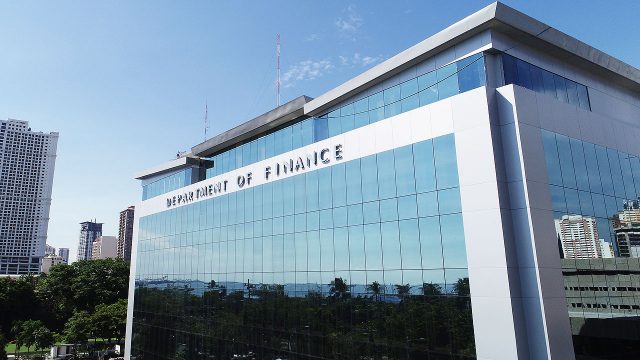
LONG-RUNNING concerns about red tape and value-added tax (VAT) refunds stand a good chance of being addressed by the proposed amendments to the Corporate Recovery and Tax Incentives for Enterprises (CREATE) Act, according to analysts.
Calixto V. Chikiamco, an economist, said that the CREATE law introduced issues that need to be fixed via amendment.
CREATE “did not result in increased foreign investments and, in fact, dampened them,” he said, citing the ASEAN Investment Report 2024.
“That is why Congress is trying to remedy the situation by passing CREATE MORE to address the issues that investors are raising, from the bureaucracy involved in getting approvals from the Fiscal Incentives Review Board (FIRB) to the value-added tax rebate,” he said via Viber.
The report cited the challenges faced by multinational enterprises in obtaining VAT refunds, with the cumbersome process blamed for the scaling down of some multinational operations.
However, Mr. Chikiamco said that these issues could be resolved through the passage of the CREATE MORE or the CREATE to Maximize Opportunities for Reinvigorating the Economy bill.
Congress passed the CREATE MORE bill in September, which will grant registered business enterprises (RBEs) a VAT zero rating on local purchases, a VAT exemption on imports, and duty exemptions on imports of capital equipment, raw materials, spare parts, and accessories.
Under CREATE MORE, the government plans to establish an enhanced VAT refund system that grants refunds of creditable input taxes within 90 days from the filing of applications.
The bill also tasks the Department of Finance with establishing a VAT refund center to handle the electronic processing and granting of refunds or creditable input taxes.
Rizal Commercial Banking Corp. Chief Economist Michael L. Ricafort said the bill will help bring about greater certainty and improve the investment climate for RBEs.
“That would make foreign investors more decisive about locating in the Philippines,” he said via Viber.
However, he said that the government should also work on further easing the cost of doing business, reducing electricity costs, keeping regulations stable and predictable, enhancing the dispute resolution process, and improving infrastructure.
The CREATE MORE bill also proposes to put into law the increased threshold for investments that investment promotion agencies (IPAs) can approve on their own authority.
Under the bill, IPAs such as the Board of Investments and Philippine Economic Zone Authority will be given back the power to offer incentives for projects worth up to P15 billion, without needing to go up to the FIRB. — Justine Irish D. Tabile

THE GOVERNMENT has added 23 projects with a combined value of P66.54 billion to the public-private partnership (PPP) pipeline, the PPP Center said.
The latest additions bring the number of PPPs in the pipeline to 173, valued at P3.17 trillion as of Oct. 16, according to a document released to reporters over the weekend.
Of the 23 new projects, 10 are national-level while 13 are local. Seven of the 23 projects are solicited.
New additions to the list include the modernization of the Air Traffic Service and Air Navigation Service, estimated to cost P29.82 billion.
Also included in the list is the Department of Finance’s Electronic Invoicing and Tax Engine Systems Project, which seeks to improve value-added tax collections. The project costs around P9.6 billion.
Other new PPP projects on the list include the Iloilo Bulk Water Supply Project (P8.45 billion); a hydroelectric power project in Nueva Ecija (P7.21 billion); the Marinduque Decarbonization project (P4.24 billion); the Nuclear Medicine Research and Innovation Center (P2.2 billion); and a government housing program in San Juan City (P1.47 billion).
Other proposed PPP projects include an P800-million waste management project in Quirino province; the P790-million South-Luzon Integrated Terminal Exchange Project; the P730 million Pampanga Dialysis Centers Project; the P360-million hemodialysis center in Isabela province, and the P320-million digitalization project of the Philippine Retirement Authority.
Also added to the pipeline were the digitalization of traffic systems in Cavite and Butuan; a food and drug license and clearance system; the adoption of a solar photovoltaic system at the Mariano Marcos State University; and the improvement of a hospital in Nueva Ecija.
The center has yet to finalize the estimated value of five solicited PPP projects — the Cavite Bulk Water Supply project, the modernization of the Poro Point Seaport in La Union, a housing program in Oriental Mindoro, and Education department infrastructure projects.
On the other hand, the government delisted 12 PPP projects, of which nine are national and three local.
These included the Metro Cebu Expressway (P94.07 billion) and the P45.15-billion redevelopment of the Manila Seedling Site.
It also delisted a P4.34-billion project seeking to improve of the Philippine Identification System, which has been suffering delays in printing the national identification cards.
Also removed from the list were the P390-million Road Transport IT Infrastructure project Phase II; the P180-million underground cabling project in Bacolod City; and the P20-million Smart City ICT project in New Clark City.
Delisted projects with no estimated cost include the Pangasinan-Nueva Ecija Expressway; Dingalan-Capas-Botolan Expressway; Mindoro-Batangas Super Bridge; Pacific Eastern Seaboard Expressway Infanta-Atimonan Segment; and a city college canteen and criminology firing range in San Jose del Monte, Bulacan. — Beatriz Marie D. Cruz
