Home Blog Page 2116

Philippine banks continue to miss MSME lending quota

PHILIPPINE banks continued to fall short of the mandated quota for small business loans in the first half, data from the central bank showed.

Loans extended by the banking industry to micro, small and medium-sized enterprises (MSME) had reached P488.13 billion as of end-June, accounting for only 4.52% of their total loan portfolio of P10.8 trillion, well-below the required 10% quota.

Banks must allot 10% of their loan portfolio for small businesses under the Magna Carta for MSMEs.

Under the law, 8% must go to micro and small enterprises, while 2% must go to medium-sized businesses.

As of end-June, lending to micro and small enterprises stood at P196.834 billion, equivalent to 1.82% of their total loan portfolio and well below the 8% quota.

Loans for medium enterprises hit P291.296 billion, accounting for 2.7% of their total credits and exceeding the 2% quota.

Universal and commercial banks released P134.095 billion in loans to micro and small enterprises in the first semester, or 1.35% of their total loans.

Big banks’ loans to medium enterprises stood at P235.814 billion, or 2.38% of their total lending.

Thrift banks extended loans worth P24.604 billion to micro and small enterprises or 3.74% of their portfolio, while their loans to medium enterprises hit P35.532 billion, equivalent to 5.39% of their total lending.

Meanwhile, rural and cooperative banks exceeded the quota for lending to MSMEs. They extended loans to micro and small enterprises worth P37.884 billion, equivalent to 17.61%.

They also released loans to medium enterprises worth P19.923 billion or 9.26%.

Loans granted by digital banks to the micro and small enterprise sector stood at P250 million in the first half, accounting for 1.41% of their total credits.

They disbursed P30 million to medium enterprises, equivalent to 0.16% of their portfolio.

During the coronavirus pandemic, the Bangko Sentral ng Pilipinas (BSP) allowed banks to count MSME loans as alternative reserve compliance with the reserve requirements to help support the sector.

The relief measure expired on June 30, 2023. However, it was extended to thrift banks and rural and cooperative banks until Dec. 31, 2025. — Luisa Maria Jacinta C. Jocson

Ayala Corp. share price up after planned follow-on offering

AYALA Corp. was among the most actively traded stocks last week amid the approval of its planned follow-on offering (FOO) by the market operator, following a treasury share sale and market sentiment from the US central bank interest rate cut.

Ayala Corp. was the seventh most actively traded stock last week, with a total of 2.58 million shares worth P1.8 billion having exchanged hands from Sept. 23 to 27, according to data from the Philippine Stock Exchange (PSE).

Its shares closed at P692 apiece on Friday, up 0.3% week on week. Since the start of the year, the stock increased by 1.6% from P681 per share.

“Ayala Corp. became one of the most actively traded stocks this week due to its high-profile financial activities and strategic announcements. The company disclosed its plans to raise P15 billion through an FOO shortly after it successfully generated P2.21 billion from a treasury share sale,” Toby Allan C. Arce, head of Sales Trading at Globalinks Securities and Stocks, Inc., said in an e-mail.

Mr. Arce added that the disclosure created significant interest in the market, as investors sought to capitalize on Ayala Corp.’s plans to bolster its capital and to be used for expansion and other corporate activities.

“These developments were seen as a sign of Ayala’s strategic financial management, driving up its liquidity and making it one of the week’s top-traded stocks,” added Mr. Arce.

Last week, the PSE approved Ayala Corp.’s application for the reissuance from treasury of up to 7.5 million Class B preferred shares to cover the planned FOO.

The conglomerate foresees having P14.89 billion in net proceeds if the oversubscription is fully exercised, which will be utilized for the redemption of the P15-billion Class B preferred shares callable on Nov. 29.

The FOO consists of a base offer of up to five million shares or P10 billion, with an oversubscription option for 2.5 million shares or P5 billion, both priced at P2,000 per share, based on Ayala Corp.’s prospectus dated Sept. 25.

Ayala’s consolidated revenues rose by 8.7% to P92.67 billion in the second quarter, bringing its top line in the first half to P179.44 billion, growing by 9.6%.

The conglomerate’s attributable income in the April-to-June quarter rose by 12.5% to P9.21 billion from P8.19 billion in the same period last year.

In the first semester, net income attributable to the owners of the parent company inched up by 21.1% to P22.29 billion from P18.41 billion a year ago.

Mr. Arce said that the company is poised to perform relatively well, especially if the proceeds from the FOO are deployed effectively toward growth opportunities.

“Given its strong portfolio in infrastructure, real estate, and other sectors, the Philippine conglomerate could continue to post solid revenues, especially with signs of recovery in various industries post-pandemic. However, external economic factors such as inflation and interest rates may temper this growth, making the outlook moderately positive but still subject to external risks,” added Mr. Arce.

He projected the full-year 2024 net income to reach P45.9 billion.

“Overall market sentiment lifted Ayala Corp. as the United States Federal Reserve (US Fed) started cutting interest rates. This is bullish news for the PSE Index, lifting all sectors, especially the financial and property sectors,” Mercantile Securities Corp. Head Trader Jeff Radley C. See said in a Viber message.

“Investors will likely see capital raising due to the strong performance of the market,” Mr. See added.

Headline inflation averaged 3.6% in the first eight months of the year, slower than the 6.6% recorded in the same period last year.

Inflation data for September will be released on Oct. 4 by the Philippine Statistics Authority.

The Monetary Board cut rates by 25 bps, bringing the benchmark rate to 6.25% from the over 17-year high of 6.5%.

In a Reuters report, the US Fed cut its policy rate to the 4.75%-5% range, delivering a bigger-than-usual half-of-a-percentage-point cut. In addition to approving the half-percentage-point cut, Fed policy makers projected the benchmark interest rate would fall by another half of a percentage point by the end of this year, a full percentage point next year, and half of a percentage point in 2026, though they cautioned that the outlook that far into the future is necessarily uncertain.

Looking forward, Mr. Arce said that the stock’s performance could see fluctuations depending on investor response to its capital-raising initiatives and broader market trends.

“In the short term, a range-bound movement is anticipated unless there’s a significant macroeconomic development or news event that influences market sentiment,” Mr. Arce added.

Mr. Arce pegged Ayala Corp.’s stock at an immediate support of around P656 per share and resistance of P735 per share.

Mr. See expects Ayala Corp.’s stock to move sideways to down as investors will experience profit taking in the short term.

He gave support levels at P660 apiece and P630 apiece, while the resistance level is at P720. — Lourdes O. Pilar


Agriculture groups urge White House action ahead of possible ports strike

REUTERS

CHICAGO/WASHINGTON — Nearly 200 agriculture organizations urged the White House to address key US agricultural supply chain issues in the face of a potential port strike on the East and Gulf Coasts that could begin Tuesday.

The groups said the industry is facing “imminent and severe shipping disruptions” from a potential work stoppage, snarled rail lines and historically low river levels backing up grain barge shipments and impacting trade with Mexico, according to a letter reviewed by Reuters.

The groups asked the federal government to direct the US Army Corps of Engineers to dredge the lower Mississippi River to maintain 12-foot-deep channels, and step in to reopen the movement of grain by rail from the US to Mexico.

They also asked the Transportation department to consider issuing an emergency hours of service waiver for truck drivers at East and Gulf Coast ports.

The letter, from a wide cross-section of the nation’s food and farm supply chain, said such disruptions are already happening ahead of a potential Oct. 1 strike at ports that handle roughly half of the country’s ocean trade, including consumer staples like coffee, meat and eggs.

On Thursday, employers negotiating a labor contract at East and Gulf Coast ports filed an unfair labor practice complaint against the union, saying those leaders refuse to resume talks ahead of the threatened strike.

The US Maritime Alliance (USMX) said it filed the complaint with the National Labor Relations Board, due to the repeated refusal of the International Longshoremen’s Association (ILA) to return to the bargaining table.

The six-year master contract between USMX and the ILA expires Monday and the two sides appear to be deadlocked on wage issues.

Friday’s missive underscores the growing worry among the nation’s agricultural sector. US farmers are beginning to harvest what is expected to be a record soy and large corn crop, at a time when global supplies are already hefty and prices are hovering near four-year lows.

The letter also comes just two days after some of the same organizations asked the Biden Administration to take action to avert the potential labor strike, in order to prevent damage to US agriculture and the economy.

“These disruptions will have a ripple effect across the entire United States” unless the government takes action, the letter said.

The White House did not immediately comment.

Meanwhile, low water conditions on interior rivers have led to barges running aground along a key stretch of the lower Mississippi River and forcing barges to carry lighter loads, just as the busiest US grain export season gets underway. — Reuters

Q&A: ‘This is a game-changer’

UAAGI Chief Marketing Executive and Senior Vice-President Lyn Buena

Two executives of UAAGI sound off on the BAIC B30e Dune

By Kap Maceda Aguila

THERE’S GOOD reason the BAIC B30e Dune was unveiled in a highly visible, public manner. It’s expected to be BAIC Philippines’ volume seller — the entry point to its stable of SUVs positioned as capable off-roaders. The BAIC B30e Dune is priced at P1.588 million for the 4×2 variant and P1.888 million for the 4×4.

After the public reveal of the BAIC B30e Dune at the Main Atrium of SM Mall of Asia, members of the press, including this writer, spoke to two United Automotive Asia Group, Inc. (UAAGI) executives about the vehicle. Here are excerpts.

What do we need to know about the BAIC B30e Dune?

LYN BUENA: Well I think, first and foremost, this is a vehicle that exudes two things, beauty and ruggedness. In addition, it is also very, very capable. It’s something that you could take onto rough terrain, and it’s something that you could sport around the city. And to top all that, it has a hybrid engine, so there’s a lot of fuel efficiency.

CHRIS YU: It is a hybrid off-road SUV, which is very distinct for our market. It’s powered by a dual electric motor powertrain and supported by a gasoline generator — one of the few cars with both a front axle electric motor and a rear axle motor. The front motor has 130kW and the rear axle has 55kW. It’s also supported by a gasoline generator. And when you are in full acceleration mode, all three motors, both electric motors and the gasoline engine, work together to propel the car forward with 403hp and 685Nm of torque which is, I think, is class-leading for this particular segment. So we’re very happy about that.

LYN BUENA: Customers who will buy the BAIC B30e Dune, as with our other vehicles, will get a five-year bumper-to-bumper warranty, and they also have access to 24/7 roadside assistance and a 24/7 hotline.

This will be competing in a segment with many established players. What do you think are the standout qualities in the BAIC B30e that will allow it to carve out its niche?

LYN BUENA: Well, I think this car is going to be a game-changer for that segment. As you said, it’s very competitive, but we feel that we have something that exudes both power and capability. Of course, aside from the hybrid engine which will make coding-exempt, it has good looks as well. We feel it has an edge in the market because it’s also competitively priced and it’s chock full of features. It also has a lot of cargo space.

We’re familiar with the traditional hybrids where the internal combustion engine is the default mover, which then is supplemented by an electric motor. In the case of the Nissan Kicks e-Power, it’s the other way around. What’s the case in the BAIC B30e Dune?

CHRIS YU: The BAIC B30e Dune actually combines the best of all worlds — all hybrid worlds. It’s able to run on pure EV mode at both city speeds and highway speeds, whereas other cars limit the EV mode to only city speeds. The B30e can go up to 90kph in pure EV mode with the engine not running; it will only turn on when charging the battery. It will also turn on when you go at cruising speed more than 90kph, over long periods of time. At that speed, the gasoline engine is actually more efficient than the electric motors.

(In effect), it combines the traditional hybrid powertrain, where the electric motors support the engine… and more modern technology, where the electric motors are the primary propulsion, and then the engines there to support electric motors. In Launch Mode, which is where you step on the brake and gas pedals together, and you let go of the brake, it uses all three power systems to push the car forward.

What’s the difference between the 4×2 and 4×4 variants?

CHRIS YU: The have a very similar setup as the same gasoline generator. The only difference is that the 4×2 only has one electric motor which is in the front axle, while the 4×4 has two electric motors, one in the front and one in the rear… It’s all-wheel drive so it shifts power, depending on the need.

Do you see a lot of demand for hybrids?

LYN BUENA: Yes, there is a growing demand for something that will be capable — something that will also deliver fuel efficiency.

Style (09/30/24)


Lulu Tan-Gan for Red Charity Gala 2024

THIS YEAR’s Red Charity Gala has Lulu Tan-Gan as the featured designer. The gala will be held at Shangri-La The Fort, Bonifacio City, on Oct. 22. Launched in 2009 by Tessa Prieto and Kaye Tinga, the Red Charity Gala was organized for the benefit of the Assumption HS 81 Foundation, Hope for Lupus Foundation and the Philippine Red Cross. For more than a decade, the gala has been a platform for many renowned local fashion designers to exhibit their best collections. These include Dennis Lustico, Furne One, Michael Cinco, Cary Santiago, Ezra Santos, Jojie Lloren, Lesley Mobo, Chito Vijandre, Joey Samson, Rajo Laurel, and Ivarluski Aseron. Now on its 13th year, it will put the spotlight this time on Lulu Tan-Gan, the country’s Queen of Knits. For this year’s gala, the prolific designer will showcase her latest collection named “Crafting Fashion,” exhibiting her expertise in the use of piña while combining her penchant for ethnic prints and patterns to promote materials and designs from the diverse heritage of Luzon, Visayas, and Mindanao. Ms. Tan-Gan is also known for promoting Filipino fashion abroad, particularly in France. From 1992 to 2005 she organized the participation of Philippine entries to the Concours International Des Jeunes Createurs de Mode. From 2012 to 2013, she became one of the members of the Board of Alliance Francaise de Manille where she actively collaborated with French and Filipino artists for design activities, shows, and events. In July 2003, she was awarded the Chevalier D’Arts et Lettres (Order of the Arts and Letters) by the French Minister of Culture and Communication, recognizing her significant contributions to the arts, literature, or the propagation of these fields. For inquiries on the gala, contact Maggie Gineta at 0917-832-5570 and follow Red Charity Gala on Instagram (@redcharitygala).


Old Navy resurrects ’90s hits

THE iconic American brand is taking it back to 1994 with a Limited-Edition Product Drop, Campaign, and 1990s Throwback Party. Old Navy is one of North America’s largest apparel brands, with more than 1,200 company-owned and franchise stores. “To mark our 30th year, we’re celebrating our heritage while creating new history and reasserting our place in culture,” said Haio Barbeito, CEO of Old Navy, in a press statement. “At Old Navy, it’s not just about the fashion, but the joy we experience in it,” said Zac Posen, Chief Creative Officer, Old Navy, in a same statement. “If we look back at the ’90s, it was a moment of moving from possibilities to reality, the juxtaposition of pop culture meeting indie culture, meeting hip hop. It was a time that allowed people to express themselves and their self-identity — and that’s what the team has re-created with the ’94 Reissue collection. Come play and reimagine style with us.” The limited edition collection modernizes Old Navy’s ’90s designs: from baby tees, baggy jeans, and cargos, to matching tracksuits, and bucket hats. The collection, which launches on Oct. 4, offers nearly 200 styles for the entire family (across men’s, women’s, kids, toddler, and baby categories) and will be available in Old Navy One Ayala, Bonifacio High Street, and on oldnavy.com.ph.


HOKA organizes Speed Camp

HOKA organized a Speed Camp, bringing together members of the HOKA Running Club and participants from the HOKA Trilogy. The event included targeted lectures, drills, and exercises designed to improve form and enhance overall running efficiency. Leading the camp was athlete and coach Emerson Obiena, who emphasized the importance of sprint drills and proper technique in boosting speed. “Sprint drills can significantly improve a runner’s time. For a lot of these runners, understanding the importance of proper execution was a game-changer,” explained Mr. Obiena. The camp also gave participants the chance to experience HOKA’s Mach X 2, the latest iteration of HOKA’s propulsive plated daily trainer, which builds on the fast and smooth ride of the original Mach X but in a lighter package. Drawing inspiration from the race-ready geometry of HOKA’s Cielo X1, the Mach X 2 features an extra-resilient PEBA-topped midsole and an enhanced rocker profile for a more aggressive toe-off. Its extended Pebax plate provides added support and propulsion. The Mach X 2, is now available for purchase at HOKA stores in One Ayala Mall, GH Mall, SM Aura, and Ayala Malls Manila Bay, as well as Planet Sports Asia Trinoma, Planet Sports Galleria Cebu, Planet Sports Clark City Front Mall, Runnr BGC, Planet Sports Ayala Center Cebu, and online at HOKA.com.


Decathlon PHL opens new doors in Binondo

DECATHLON has opened its 12th store in the Philippines following its latest one-stop concept, Decathlon Binondo Connect. “Decathlon Philippines’ Binondo Connect opening represents a great opportunity for Decathlon to be close to our customers, and links to our goal of being everywhere we can be accessible for sport lovers everywhere,” Benoit Gauthier, regional manager of Decathlon Philippines was quoted as saying in a press release. “Adding a new Connect store in this multicultural area makes so much sense for us in terms of accessibility: we are, indeed, following our purpose to move the people though the wonders of the sport. This place will help us not only in our growth strategy in the country, but also to spread the passion for sports through the passion of our teammates while providing our customers convenient means for them to experience great-value, quality, and innovative sports products through our stores.” Decathlon customers can sign up for their membership program where they can earn points, redeem points for vouchers, while enjoying up to two-years warranties and 365-day refunds and exchange on most items. Members also get access to Decathlon playgrounds in flagship stores, invitations to sports events, and more member-only promos and exclusives in stores or when shopping on the Decathlon app. Decathlon Binondo Connect is at Level 2, Lucky Chinatown, Reina Regente St., Binondo, Manila City, Metro Manila. Customers can also shop online at www.decathlon.ph.

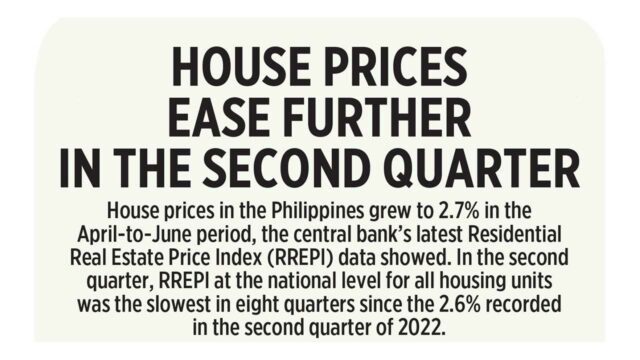
House prices ease further in the second quarter

House prices in the Philippines grew to 2.7% in the April-to-June period, the central bank’s latest Residential Real Estate Price Index (RREPI) data showed. In the second quarter, RREPI at the national level for all housing units was the slowest in eight quarters since the 2.6% recorded in the second quarter of 2022.

House prices ease further in the second quarter

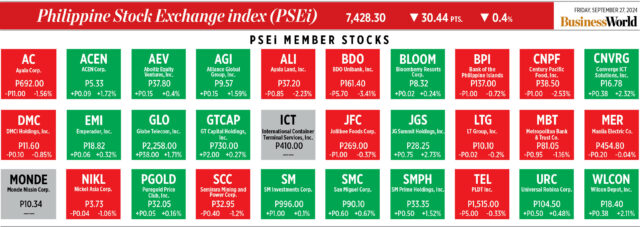
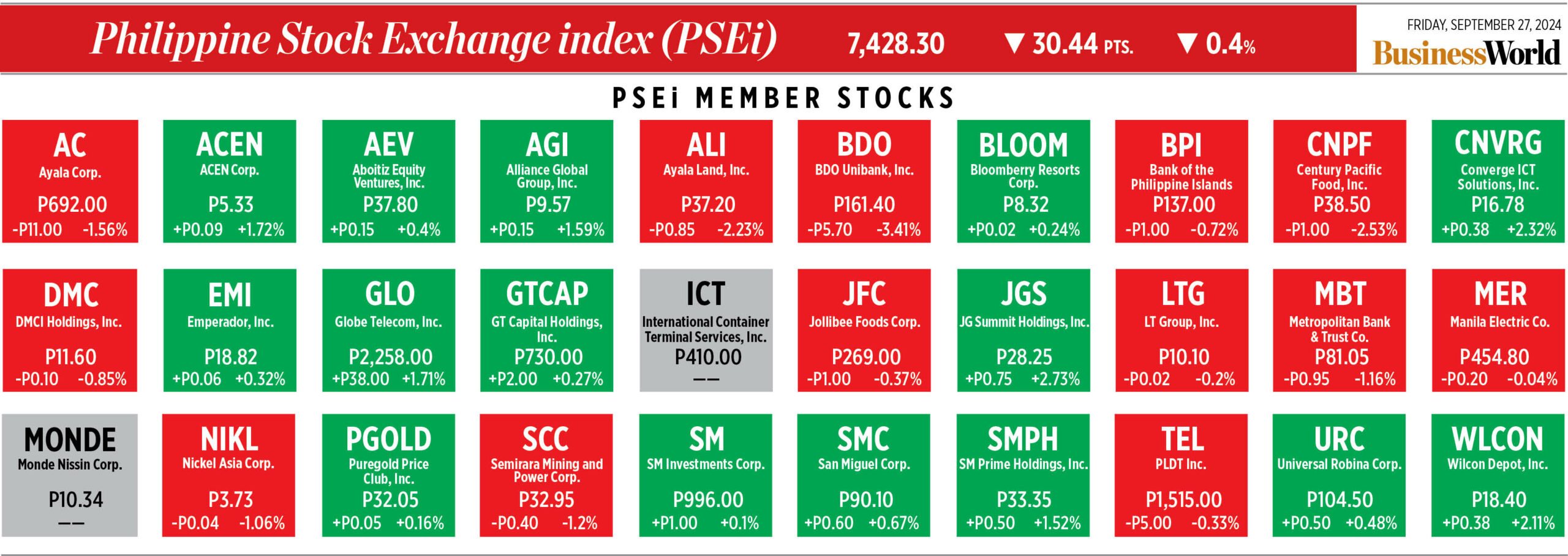
How PSEi member stocks performed — September 27, 2024

Here’s a quick glance at how PSEi stocks fared on Friday, September 27, 2024.


Peso may move based on inflation numbers

BW FILE PHOTO

THE Philippine peso would likely be range-bound against the dollar this week, analysts said, as the market awaits inflation data releases both at home and in the US.

It closed at P56.077 a dollar on Friday, weakening by 11.2 centavos from its close on Thursday, according to Bankers Association of the Philippines data posted on its website. Week on week, the peso likewise sank by 38.7 centavos from its P55.69 finish on Sept. 20.

The peso traded sideways against the dollar on Friday after the US economic growth report came out steady from the previous period, Robert Dan J. Roces, chief economist at Security Bank Corp., said in a Viber message.

“Also, risk-supportive sentiment from China stimulus measures may be met by month- or quarter-end dip buying interests,” he added.

The third-quarter report dampened expectations of a rate cut by the US Federal Reserve and led to a weaker dollar, Michael L. Ricafort, chief economist at Rizal Commercial Banking Corp., said in a Viber message.

Mr. Roces noted that this week, the peso would likely move depending on the US consumer price index (CPI) report for August.

Mr. Ricafort said the foreign exchange market would also look at Philippine inflation data due for release on Friday.

Inflation likely eased to 2.5% in September, according to the median estimate of 15 analysts in a BusinessWorld poll, from 3.3% in August and 6.1% a year ago. This could be the slowest in nearly four years.

Mr. Ricafort expects the peso to trade from P 55.75 to P56.25 a dollar this week. — Aaron Michael C. Sy

PSEi may advance on more upbeat Q4 outlook

REUTERS

By Revin Mikhael D. Ochave, Reporter

PHILIPPINE STOCKS could sustain their climb on dovish policy forecasts and a more positive outlook by businesses and consumers for the fourth quarter (Q4), analysts said.

“Bulls lined up at the local equity market, fueled by the Federal Reserve’s 50-basis-point (bp) rate cut last week and the Bangko Sentral ng Pilipinas (BSP) chief’s comments of potentially two more rate cuts this year,” online brokerage 2TradeAsia.com said in a market note.

On Friday, the main Philippine Stock Exchange Index (PSEi) dropped by 0.4% or 30.44 points to 7,428.30, while the broader all-share index shed 0.19% or 7.67 points to 3,970.43.

Week on week, the PSEi gained 2.43% or 175.98 points from the 7,252.32 close on Sept. 20 for a four-week rally.

Philstocks Financial, Inc. Senior Research Analyst Japhet Louis O. Tantiangco said in a Viber message the market could improve on expected rate cuts.

“While we may see episodes of profit taking this week as the market is technically overbought based on its relative strength index, the general direction of the bourse is still projected to be upwards,” he said.

“Optimism towards the dovish monetary policy stance both here and abroad is expected to help in sustaining the market’s movement,” he added.

Investors may also digest the BSP’s latest confidence surveys, which showed that both consumers and businesses are optimistic for the next quarter and next twelve months, Mr. Tantiangco said.

On Friday, a BSP survey showed that the overall confidence index of consumers improved to 0.7% for the fourth quarter from -0.4%, signaling a more positive outlook due to expectations of higher wages and more sources of income.

A separate BSP poll also showed that the confidence index of companies rose to 56.8% for the last quarter of 2024 from 43.4%, led by the expected stronger demand during the holidays and slower inflation.

On Wednesday, BSP Governor Eli M. Remolona, Jr. hinted that the central bank could reduce interest rates by 50 bps more this year.

The central bank began its easing cycle In August after lowering the target reverse repurchase rate by 25 bps to 6.25%, the first time in nearly four years.

Michael L. Ricafort, chief economist at Rizal Commercial Banking Corp., in an e-mail said the market’s immediate support is 7,060 to 7,220, while the resistance is 7,552.2 to 7,800.

“The underlying momentum for 1.5 months already remains intact for as long as it remains above the immediate support at 6,810-6,935 levels,” he added.

2TradeAsia.com pegged the market’s immediate support at 7,100 and resistance at 7,500.

“The additional liquidity from the reserve requirement ratios plus policy rate cuts should help the PSEi’s ambition to get past 7,500,” it said. “There is historical selling pressure around the benchmark’s current trading range, but the yield curve steepening and disinverting should support more consistent inflows as the appeal for bills and short-term income securities evaporate relative to riskier assets.”

Mr. Tantiangco estimated the market’s support at 7,400 and resistance at 7,700.

“Investors are also expected to look towards the upcoming S&P Global Philippines Manufacturing Purchasing Managers’ Index and the September inflation data for further clues on the local economy,” he added.

Manila pushes for rules-based order, peaceful resolution of disputes at UN

UN PHOTO

MANILA’s top envoy in his speech before the United Nations General Assembly (UNGA) pushed for the peaceful and diplomatic resolution of territorial disputes, particularly in the South China Sea, citing the importance of upholding a rules-based international order.

“Despite irresponsible and dangerous actions against our legitimate activities within our own waters and Exclusive Economic Zone, the Philippines remains committed to diplomacy and other peaceful means to settle disputes,” Philippine Foreign Affairs Secretary Enrique A. Manalo told the Assembly, according to a  copy of his speech, dated Sept. 29, which was sent to reporters via WhatsApp on Sunday.

“We will abide by the UN Charter and the Manila Declaration on the Peaceful Resolution of Disputes in asserting our sovereignty, sovereign rights and jurisdiction in the South China Sea.”

The Chinese Embassy in Manila did not immediately reply to a Viber message seeking comment.

The Philippines and China have resumed diplomatic talks on how to ease tensions in the waterway, even as both sides insisted on upholding their sovereign rights over features in the South China Sea.

Manila and Beijing have traded accusations of intentional ramming of each other’s vessels in a series of clashes last month, just after reaching a pact on resupply missions to a beached Filipino naval ship at Second Thomas Shoal.

Mr. Manalo earlier said Manila does not want to gang up against China with the international community in raising the territorial dispute to the UN’s main policy-making body.

The Chinese Foreign Ministry has said Manila and its allies ganging up on Beijing would only worsen tensions and destabilize the region.

“We do not accept narratives depicting the South China Sea as a theater of major power rivalry because they all ignore what is an essential truth: all states in this region have a right to determine their own destiny and secure their own future,” Manila’s Foreign Affairs secretary said in his speech.

Tensions between the Philippines and China have worsened in the past year as Beijing continues to block resupply missions to Second Thomas Shoal, where Manila has a handful of troops stationed at a beached vessel.

China and Russia have also criticized the United States’ move to keep its Typhon missile system in the Philippines as it risks fueling an arms race in the region.

Reuters reported Chinese Foreign Minister Wang Yi said the US deployment of intermediate-range missiles in the Philippines “undermines regional peace and stability.”

Mr. Wang said the deployment “is not in the interests of regional countries.”

The US Army flew the Typhon, which can launch missiles including SM-6 missiles and Tomahawks with a range exceeding 1,600 kilometers (994 miles), to the Philippines in April in what it called a “historic first” and a “significant step in our partnership with the Philippines.”

Philippine Defense Secretary Gilberto Gerardo C. Teodoro, Jr. has said Manila has the right to beef up its deterrent posture amid China’s aggressiveness in the South China Sea. The Philippines is also open to acquiring the Typhon midrange missile system, Agusan del Norte Rep. Jose “Joboy” S. Aquino II said last week, as he sponsored the 2025 budget of the Defense department.

The Philippines, southern neighbor to Taiwan, which Beijing claims as its own territory, is an important part of US strategy in Asia and would be an indispensable staging point for the military to aid Taipei in the event of a Chinese attack.

Mr. Wang said exchanges and cooperation between China and South Korea have become more active this year, Reuters reported.

Manila and Beijing on July 2 reached a “provisional arrangement” for Philippine resupply missions to Second Thomas Shoal, which the Philippines calls Ayungin.

The UN-backed Hague Permanent Court of Arbitration in 2016 voided China’s claim over the waterway for being illegal. Beijing has ignored the ruling.

About $3 trillion worth of trade passes through the South China Sea annually, and it is believed to be rich in oil and natural gas deposits, apart from fish stocks.

Philippine President Ferdinand R. Marcos, Jr. said in his third address before Congress that his government would continue to find ways to de-escalate tensions in contested areas in the waterway “without compromising our position and our principles.”

Mr. Manalo earlier said the Philippines is gearing up for its chairmanship of the Association of Southeast Asian Nations, where it seeks raise its maritime dispute with China.

“The future of the Asia-Pacific is being shaped not by one or two powers, but by all states therein,” the country’s top diplomat told the UN General Assembly.  “ASEAN exemplifies the agency of states working together in fashioning multilateral approaches and solutions to present-day challenges.” — John Victor D. Ordoñez with Reuters

House risks lawsuit in ‘unconstitutional’ 2025 budget amendments

BW FILE PHOTO

By Kenneth Christiane L. Basilio, Reporter

THE HOUSE of Representatives may have violated a Philippine Constitution provision disallowing amendments on bills passed on final reading, analysts said, which could open the chamber to potential lawsuits that could derail the government’s spending plan next year.

The chamber approved House Bill (HB) No. 10800, the General Appropriations Bill, on final reading last week. It contains the proposed P6.352-trillion national budget for next year.

The House adopted committee amendments to the spending plan during plenary deliberations while deferring proposed individual reallocations to a later date to meet its self-imposed September deadline.

“The House can’t. There is no precedent to allow this unconstitutional and illegal act,” Michael Henry Ll. Yusingco, a constitutionalist and senior research fellow at the Ateneo Policy Center, said in a Facebook Messenger chat, referring to the House’s creation of a “small committee” tasked to approve and resolve individual amendments to the chamber-approved national budget.

“The House transgression can be challenged in the [Supreme Court],” he added, noting the Senate could still correct the chamber’s “foul play” on the proposed budget, making it valid.

The 1987 Philippine Constitution states that “no amendment… shall be allowed” after a measure’s last reading, according to Sec. 26 of the charter.

“It can be challenged before the Supreme Court for being constitutionally infirmed, since this is an indication that Congress exceeded the exercise of its constitutional mandate,” Ephraim B. Cortez, president of National Union of Peoples’ Lawyers, said in a Viber message.

The chamber created a small committee to resolve individual amendments to the General Appropriations Bill on second reading, a move meant to expedite the budget bill’s confirmation. The committee received proposed changes to the measure from congressmen until last week Friday, two days after its third reading approval.

“It should receive and resolve individual amendments approved during the plenary debate on second reading. If it inserts amendments not approved during the second and third readings, that is illegal and unconstitutional,” Mr. Cortez said.

“The small committee cannot exercise an authority that the plenary cannot exercise as well. It was already passed on third reading, it can no longer be amended,” he added.

The office of Party-list Rep. Elizaldy S. Co, who heads the House appropriations committee, did not immediately respond to a Viber message seeking comment.

Lawmakers during the budget bill’s plenary debates signaled their intention to increase funding to certain government agencies without specifying how much should be augmented.

The move by congressmen to tackle proposed reallocations in a committee instead of the plenary “undermines the transparency of the budget process,” Mr. Yusingco said, noting it to be a violation of public trust.

The House also fast-tracked the budget’s approval with blessing from President Ferdinand R. Marcos, Jr. after he certified as urgent the proposed spending plan, allowing the chamber to do away with the constitutionally prescribed three-day interval for second and third reading approval of bills.

The government certifies as urgent the budget bill yearly “as a matter of practice,” said Mr. Cortez.

“There is a sense of urgency, of course, but this is not the kind contemplated by the Constitution to warrant the skipping of the three-day reading requirement,” Mr. Yusingco said.

The President has the ability to certify as urgent the approval of certain measures “to meet a public calamity or emergency,” Sec. 26 of the Constitution read.

LNG a viable transition fuel to RE, economists say

BW FILE PHOTO

By John Victor D. Ordoñez, Reporter

LIQUEFIED natural gas (LNG) is a viable transition fuel to clean energy but may lead to the Philippines’ dependence on imports and environmental damage as the country seeks local gas reserves to boost its power generation capacity, economists said.

“The downside of LNG is that Malampaya gas field is running out of gas and we have to be dependent on imports,” Calixto V. Chikiamco, president of Foundation for Economic Freedom, said in a Viber message. “Also, it’s still carbon and emits pollution into the atmosphere.”

He said the government must craft energy policies that balance out the flaws and strengths of renewables, coal, and natural gas.

The Philippines is hard-pressed to find other sources of indigenous energy as the Malampaya gas field, which supplies a fifth of the country’s power requirements, nears depletion.

The gas field is expected to run out of easily recoverable gas using current techniques by 2027.

At the Senate plenary, lawmakers are deliberating on a bill seeking to promote the production of indigenous natural gas and LNG, which the government sees as a transition fuel towards adopting more renewable energy (RE) sources.

The Philippines plans to raise the share of RE in the country’s energy mix to 35% by 2030 and to 50% by 2040 from the current 22%.

Energy Undersecretary Sharon S. Garin earlier told senators that Manila is trying to encourage more battery systems companies to do business in the country to meet its RE goals.

LNG EXIT
“The government should determine exit periods for LNG plants similar to its mandate on coal-fired power plants,” Terry L. Ridon, a public investment analyst and convenor of the think tank InfraWatch PH, said in a Facebook Messenger chat.

“It should nonetheless be pointed out that LNG plants, in the context of the climate crisis, produce significant emissions which threaten the future of the planet.”

In April, Philippine President Ferdinand R. Marcos, Jr. said his government is looking into exploring gas reserves in nonconflict areas within the country’s exclusive economic zone in the South China Sea in a bid to expand its energy and boost the country power generation capabilities.

PXP Energy Corp.’s exploration work at Reed Bank, another potential source of gas in disputed waters, remained suspended due to tensions with China.

China claims more than 80% of the South China Sea, seen as a substantial source of oil and gas deposits and where over $3-trillion worth of trade pass through each year.

Energy Undersecretary Rowena Cristina L. Guevara has said the DoE plans to hold two green energy auctions before the end of the year, offering geothermal, pump-storage hydro and impounding hydro projects.

“The country should strive for a mix, and not dependent on any one fuel source,” Mr. Chikiamco said.

“Each of these energy sources have their advantages and disadvantages and therefore to achieve energy security and environmental conservation.”