Home Blog Page 1970

US Navy confirms ‘routine’ Taiwan Strait transit

EN.WIKIPEDIA.ORG

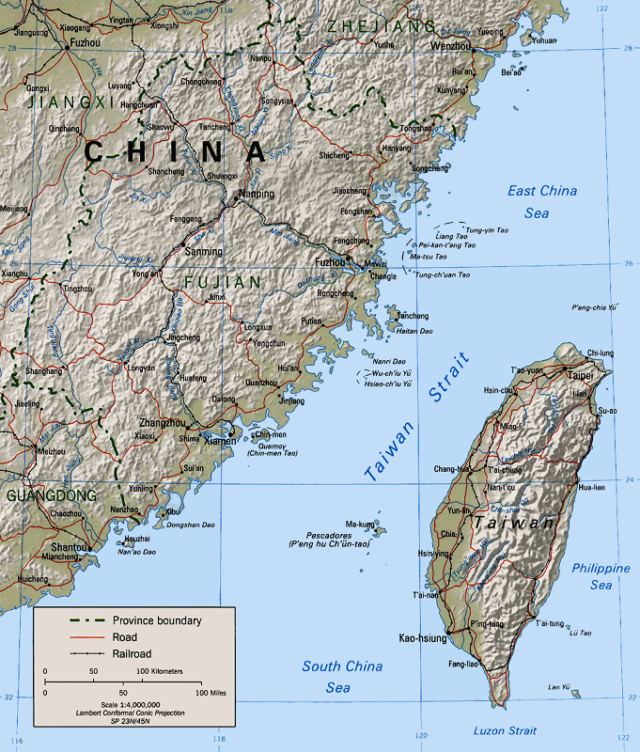
WASHINGTON – The U.S. Navy confirmed on Tuesday two of its ships carried out a Taiwan Strait transit, calling it routine despite an angry reaction from Beijing.

The Navy said the vessels were the Arleigh Burke-class guided-missile destroyer USS Ralph Johnson and Pathfinder-class survey ship USNS Bowditch. The ships carried out a north-to-south transit February 10-12, it said.

“The transit occurred through a corridor in the Taiwan Strait that is beyond any coastal state’s territorial seas,” said Navy Commander Matthew Comer, a spokesperson at the U.S. military’s Indo-Pacific Command.

“Within this corridor all nations enjoy high-seas freedom of navigation, overflight, and other internationally lawful uses of the sea related to these freedoms.” — Reuters

Germany’s trade surplus with US reaches new record

FREEPIK

BERLIN, – Germany’s trade surplus with the United States reached a record level last year, data from the statistics office showed, as countries wait to learn how U.S. President Donald Trump will impose tariffs on imported goods.

Germany’s trade surplus with the U.S. expanded to 70 billion euros ($72 billion) in 2024, well above the previous record of 63.3 billion euros reported for the full year 2023.

“It would be hard to imagine worse timing,” said Holger Goerg, from the Kiel Institute for the World Economy (IfW).

Trump substantially raised tariffs on steel and aluminum imports on Monday to 25% “without exceptions or exemptions”. The White House on Tuesday declined to comment on the German trade surplus.

German Chancellor Olaf Scholz said the European Union was still awaiting formal notice of any new tariffs but that any such move would be met with retaliatory measures.

The increase in trade surpluses could reverse, Mr. Goerg said, if Mr. Trump imposed new tariffs on German imports, a measure the U.S. president says would boost U.S. manufacturing.

Damon V. Pike, a trade specialist and principal with the U.S. division of global accounting firm BDO International, said Trump had long been frustrated by Germany’s longstanding reliance on exports and failure to pump up domestic demand.

“He’s talked about that, how he’s sick of these persistent trade deficits with the European Union,” he said, noting that Trump had already flagged plans to put tariffs on EU imports as early as next week.

Germany, Europe’s biggest economy, was last year the only G7 country to post a contraction for two consecutive years. A trade conflict with the U.S., its main trading partner, would deliver a big hit to output.

German exports to the U.S., led by cars and pharmaceutical goods, increased by 2.2% year-on-year to a record 161.3 billion euros in 2024, consolidating the U.S. position as the top buyer of goods “Made in Germany”.

Imports from the U.S. fell by 3.4% to 91.4 billion euros last year.

Mr. Goerg said the U.S. trade deficit reflected a lack of international competitiveness of U.S. goods, which will not be solved by tariffs.

“On the contrary, I would assume that this would have a negative impact on the U.S. export performance,” Mr. Goerg said.

The situation is completely different in trade in services, where the U.S. has a strong export surplus, including to the EU and Germany, he noted. “Mr. Trump should include that in his calculations,” Mr. Goerg said. — Reuters

Elon Musk’s US Department of Defense contracts

ELON MUSK — REUTERS

Elon Musk’s companies have a variety of contracts with the U.S. Department of Defense, highlighting the growing relationship between the tech entrepreneur’s ventures and the U.S. military. The contracts include:

SpaceX: Provides launch services to the DoD, including the launch of classified satellites and other payloads. SpaceX’s CEO Gwynne Shotwell has said the company has about $22 billion in government contracts. The vast majority of that, about $15 billion, is derived from NASA.

– SpaceX’s biggest Pentagon contracts include the $733 million National Security Space Launch contract awarded in October to lift satellites into orbit. The company has been tapped for more Pentagon launch contracts potentially worth hundreds of millions of dollars more.

Starlink: The satellite-based internet service, which falls under the SpaceX umbrella, has been used by the Pentagon to provide connectivity in remote and austere environments. Starlink’s commercial broadband service has some 7,000 satellites in orbit.

– In 2023, the Pentagon awarded SpaceX a contract worth about $23 million to use Starlink to support military operations in Ukraine through mid-2024.

– Starlink has had contracts with Special Operations Command, the Air Force, Army and other parts of the Pentagon.

Starshield: Though not broken out in government contracting, this satellite unit of SpaceX is similar to its commercial Starlink business but designed for government national security programs. While details of the program are scarce, it is believed to have more secure communication pathways for classified information. Starshield has a contract with at least one intelligence agency believed to be worth billions of dollars, Reuters has reported.

VALUE OF CONTRACTS
The total value of Mr. Musk’s companies’ contracts with the DoD is estimated to be in the billions of dollars, but the true figure cannot be determined since many of them are classified. The contracts demonstrate the growing importance of private sector technology companies in supporting U.S. military operations and national security initiatives. —Reuters

How technology is used to scout professional athletes

Sports technology is used nowadays to, among others, help teams prepare for games and develop players.

Samantha Woosnam, Senior Rights and Partnership Manager of Sportradar, talks more about such technologies.

Interview by Patricia Mirasol
Video by Jayson Mariñas

Philippines nears exit from watchdog’s dirty money ‘gray list’

BW FILE PHOTO

The Philippines may be removed from a global dirty-money list as early as next week, a potential boost to the Southeast Asian nation following a reform push to counter money laundering and terrorist-financing risks.

An on-site visit last month by a team from the Paris-based Financial Action Task Force noted significant progress, according to people familiar with the matter. That means the Philippines could come off the watchdog’s so-called gray list on the final day of the FATF plenary on Feb. 21, said the people, who requested anonymity as the deliberations are private. No final decisions have been made.

A spokesperson for the FATF declined to comment.

“The signals are good, so I’d say our chances are better than 50%,” central bank Governor Eli Remolona, who chairs the nation’s Anti-Money Laundering Council, said in a text message on Tuesday.

A removal from the gray list would make it easier and cheaper for Filipinos working overseas to send money home — a key driver of domestic consumption in one of Asia’s fastest-growing economies — and would facilitate other cross-border transactions.

A significant majority of the FATF’s members must vote that the Philippines has made sufficient progress for it to be taken off the list. Just a few votes to the contrary — some members have more sway than others — could result in it remaining on the list, the people said. Members include individual countries like the US and China as well as regional bodies such as the European Commission.

The Philippines landed on the gray list in June 2021 after the FATF cited deficiencies in the country’s efforts to combat illicit finance. Since then, the government has worked to boost the nation’s supervision of risk-based anti-money laundering as well as countering terrorist and proliferation financing.

An exit from the list follows the government’s crackdown on Chinese-focused online casinos that Philippine President Ferdinand Marcos Jr. said engaged in money laundering and financial scamming. They were banned by the government from January.

The Bangko Sentral ng Pilipinas has moved to enhance money service business supervision and the effectiveness of targeted financial sanctions for terrorist and proliferation financing. The nation’s Securities and Exchange Commission has required companies to declare beneficial ownership in their general information sheets, data that’s also made available to the Bureau of Internal Revenue and law enforcement agencies.

Other reforms implemented include enhanced use of financial intelligence and an increase in investigations and prosecutions of money-laundering and terrorist-financing cases.

“Going forward, keeping up with evolving FATF requirements will be important in the context of the next mutual evaluation in 2027,” the International Monetary Fund said in its December 2024 report, adding that reforming the country’s bank secrecy law will strengthen its anti-money-laundering policies. – Bloomberg

PHL faces risks from Trump tariff threat

A “tariff” sign is displayed on a laptop screen and an American flag displayed on a phone screen are seen in this illustration photo taken in Krakow, Poland on Feb. 1, 2025. — JAKUB PORZYCKI/NURPHOTO VIA REUTERS CONNECT

THE PHILIPPINES is among the economies in Asia that may be at risk from spillover effects of US President Donald J. Trump’s plan to impose reciprocal tariffs on trade partners, analysts said.

Nomura Global Markets report noted that emerging Asian economies have higher tariff rates on US exports, “thus at risk of higher reciprocal tariffs.”

“Over 90% of the exports of India, the Philippines, Thailand and China (destined for the US) have higher relative tariff rates and are therefore most at risk of higher reciprocal tariffs,” Nomura Global Markets Research said in a report.

Data from Nomura showed that 100% of Philippine exports to the US could be subject to higher tariffs, representing 2.6% of gross domestic product (GDP).

Mr. Trump on Monday said he would announce plans to impose reciprocal tariffs on other countries over the next two days, Reuters reported.

Mr. Trump made the statement after signing two proclamations ending all exclusions on steel and aluminum tariffs first imposed during his first term and raising duties on both metals to 25%. (Read related story In latest trade war salvo, Trump raises tariffs on aluminum, steel imports.)

Mr. Trump said he was also looking at tariffs on cars, semiconductor chips and pharmaceuticals.

Reciprocal tariffs would mean the US will impose the same tariff rate on imports from other countries as other countries impose on US exports.

Leonardo A. Lanzona, an economics professor at the Ateneo de Manila University, said “tit-for-tat” policies can “trigger disruptions in the global supply chains, thereby resulting in higher prices for all traded goods and services.”

“Since China is a major supplier of intermediate goods and consumer products for the Philippines, any disruption or increase in prices due to tariffs or retaliatory policies could lead to higher production costs for Philippine businesses,” he said in an e-mail.

“This, in turn, may contribute to inflation or force companies to look for alternative (and possibly more expensive) suppliers,” he added.

China is usually the Philippines’ biggest source of imports, while the United States is the country’s top destination for exports.

“In addition, the United States is a key market for Philippine exports. If trade tensions between the US and China slow down the US economy or lead to broader global economic uncertainty, demand in the US could weaken,” Mr. Lanzona said.

“This would negatively affect Philippine exporters, especially in sectors like electronics, garments and agricultural products,” he added.

Nomura said it is unclear whether Mr. Trump would slap higher reciprocal tariffs per sector or across the board.

“If Trump takes a sectoral approach, then even countries with lower weighted average tariff rates could be subject to higher tariffs in specific sectors,” Nomura said.

“We expect Asian economies to step up their negotiations with Mr. Trump,” it added.

Nomura data showed the Philippines had a 3.3% weighted average effective tariff on US exports to the Philippines versus the 1.4% tariff rate on Philippine exports to the US.

The bulk of Philippine exports to the US are machinery and electronics, accounting for 67% of total exports.

Nomura noted that most developing Asian economies impose higher tariffs on agricultural products and transportation.

However, Philippine exports of agricultural and transport products to the US are much lower than its neighbors, accounting for 0.2% and 0.1% of gross domestic product (GDP), respectively.

Nomura noted sectors with higher relative tariff rates include plastic and rubber for the Philippines and footwear and miscellaneous manufacturing for Thailand.

It said Thailand is seen to be the “biggest loser” in Southeast Asia amid its high exposure to agriculture and transport.

“Thailand’s exports of agricultural products to the US comprise 0.8% of Thai GDP and transport products comprise another 0.5%.”

Meanwhile, Indonesia, Malaysia and Vietnam are seen to be in the “middle of the pack,” while the least exposed economies in the region are Singapore and South Korea.

Mr. Lanzona said the government needs to adopt strategies to cushion the economy from shocks stemming from the tariff regime, such as negotiating trade agreements, providing support for affected industries or investing in domestic production.

“More importantly, by promoting products that can be produced locally, the country may lessen its reliance on imported inputs — particularly from nations like China — thereby reducing exposure to external trade disruptions,” he said.

“Strengthening domestic production can help create more robust, locally controlled supply chains that are less susceptible to international tariff disputes or global market fluctuations.”

FX PRESSURES
Meanwhile, ANZ Research in a separate report flagged the impact of tariff policies on currencies in Asia.

“Barring any near-term relief rally in Asia’s local markets, the risk of trade tariffs will continue to hang over Asian economies,” it said.

“Market stress is visible in increased demand for FX (foreign exchange) hedges and safe-haven assets. Asia FX will remain the vulnerable link in an environment of rising trade tension and weakening domestic growth impulse,” it added.

ANZ said currencies are the “main transmission channel to watch” as currencies in the region are vulnerable to a China-US trade war.

“The resulting risk-off tone from increased trade tension would also be supportive of safe-haven demand for the US dollar. In our view, no Asia FX markets would be meaningfully spared in a US-China trade war,” it added.

The peso closed at P57.845 against the dollar at end-2024, depreciating by P2.475 or 4.28% from its end-2023 finish of P55.37. — Luisa Maria Jacinta C. Jocson


PHL urged to pursue critical mineral deal with United States

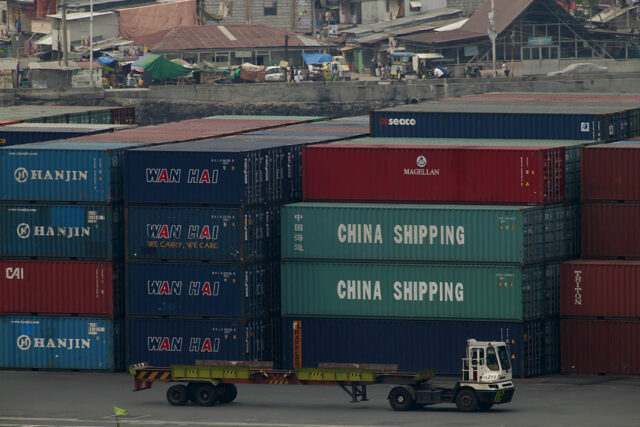
Container vans are seen inside the Manila South Harbor, Metro Manila. — REUTERS

By Justine Irish D. Tabile, Reporter

THE PHILIPPINES should pursue a sectoral agreement with the United States with a focus on critical minerals, even as it hopes to forge a free trade agreement (FTA) under President Donald J. Trump’s administration.

“We do have a good chance of being able to pull that (FTA), but I think it would have to be sectoral. It can’t be the entire free trade agreement,” said Jose Manuel D. Romualdez, Philippine ambassador to the US, at the US-Philippines Society press briefing on Tuesday.

“We’ve had some discussions during the first Trump administration on how we would proceed on the FTA, but that obviously was abbreviated, and so we have a chance now to renew that,” he added.

Mr. Romualdez said the idea was floated during his talks with former US Commerce Secretary Wilbur L. Ross, Jr.

“His advice to me was for us to pursue a sectoral type of FTA, like for instance in minerals, which we can offer the US, and then on the aspect of other areas where we can also be helpful, like semiconductors,” he said.

“While the US is trying to bring all of that back into the US, we are one of seven countries that have been identified as trusted allies of the US. So, we can be a recipient of some of that semiconductor industry that’s being moved out of China,” he added.

Asked why critical minerals should be a priority, Mr. Romualdez said this is an area where the Philippines and the US could mutually benefit from.

“It’s one of our natural resources, and part of our wealth. And we could get better prices for nickel, for instance, if we were able to process it here,” he said.

More than 90% of Philippine nickel exports go to China, Mr. Romualdez said.

“They get the entire thing, and they even dictate prices. So, we want to change that. We’ve been pursuing the critical minerals agreement with the US, even during the Biden administration, and we will pursue it even more vigorously this time,” he added.

Earlier this year, the Philippine Department of Trade and Industry said the country would double efforts to secure an FTA with the US.

“The Philippines needs the FTA with the US, and equally important is that the partners within the region, like Japan and South Korea, need us to have an FTA with the US,” said Trade Undersecretary Ceferino S. Rodolfo.

“This is so they can secure a non-China supply chain for certain critical industries, including our minerals for batteries,” he added.

The Philippines is the biggest exporter of nickel ore concentrate, accounting for more than one-fourth of the global supply. Of the country’s total nickel ore concentrate exports, over 98% go to China, while 1% go to Japan. 

Rene D. Almendras, a member of US-Philippines Society, said that the Philippines should push for a sectoral agreement focusing on critical minerals as it will benefit provincial areas. 

“A revitalized mining industry will benefit rural and provincial areas that have been neglected in the past. So, if we’re able to revive that industry, then the benefits will be very, very good in the areas where we most need it,” he said.

“The geographic location of those mines and hopefully those processing facilities will spur development in those areas where it is badly needed. And the Marcos administration is doing a really good job trying to decentralize the economy,” he added.

However, Mr. Almendras said the Philippines would have to first address potential investors’ concerns over power supply.

Aside from a sectoral FTA, Mr. Romualdez said there is a good chance that the US Generalized System of Preferences (GSP) would be reauthorized by the US Congress.

“[There is] a very good chance, actually. There are so many other countries who are working to get that GSP… In the US Congress, while they all agree that the GSP should be given to the Philippines, there’s some issues that each senator or a congressman would like to insert or they would like a bargaining chip,” he said.

“But we’re confident that we will be able to pass it through within this coming Congress.”

The Philippines was a beneficiary of the US GSP, which eliminated duties on about 5,000 or 47% of the total US tariff lines.

However, the Philippines’ eligibility for the US GSP benefits expired on Dec. 31, 2020, which meant Philippine exports to the US that were previously duty-free under the preferential scheme are now subject to most-favored-nation tariffs.

While active, the Philippines was the fifth-largest beneficiary of the US GSP with about $1.6 billion in duty-free exports in 2020. This made up 10% of the total US GSP imports, which amounted to $16 billion.

Earlier this month, the Philippine Exporters Confederation, Inc. lobbied for the reauthorization of the US GSP, saying that it could increase exports, especially of hard goods, by 5-10% this year.

Meralco power rates up in Feb.

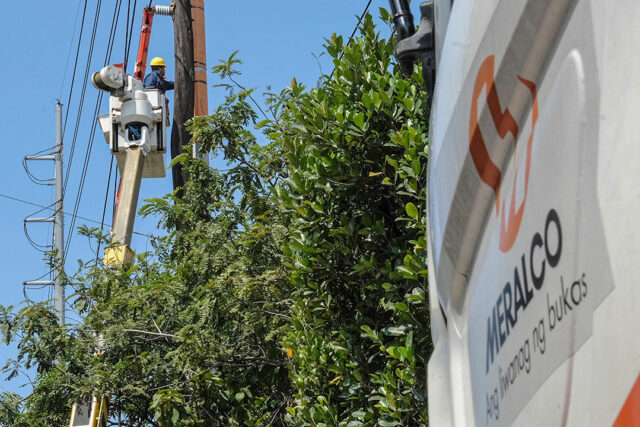
A lineman is working on an electric pole in Ermita, Manila. Manila Electric Co. (Meralco) is raising rates this month. — PHILIPPINE STAR/RYAN BALDEMOR

By Sheldeen Joy Talavera, Reporter

CUSTOMERS of Manila Electric Co. (Meralco) face higher bills as the power distributor is set to raise rates for February due to higher generation charge.

The overall rate will climb by P0.2834 per kilowatt-hour (kWh) to P12.0262 per kWh in February from P11.7428 per kWh in January, the company said in a statement on Tuesday.

This will translate to an upward adjustment of around P57 in the total electricity bill of residential customers with a consumption of 200 kWh. Those consuming 300 kWh, 400 kWh and 500 kWh will have to pay an additional P85, P114 and P144, respectively, this month.

Meralco attributed the increase in the overall electricity rate to the generation charge, which rose by P0.3845 per kWh due to higher costs from independent power producers (IPP) and power supply agreements (PSA).

IPP charges increased by P0.8355 per kWh due to lower average plant dispatch, a weaker peso and higher liquefied natural gas terminal fees imposed by First Gas Sta. Rita and Sta. Lorenzo.

Charges from the PSAs also climbed by P0.0837 per kWh.

Meralco said the peso depreciation affected 97% of IPP costs and 61% PSA costs that were dollar-denominated.

The local unit closed at P58.365 a dollar on Jan. 31, weakening by 52 centavos from its P57.845 finish on Dec. 27.

However, these higher costs were offset by the P3.005-per-kWh drop in charges from the Wholesale Electricity Spot Market (WESM). The average and peak demand in the Luzon grid both declined, offsetting the impact of the increase in the average capacity on outage.

IPPs, PSAs and WESM accounted for 29%, 43% and 28%, respectively, of the power distributor’s total energy requirement for the period.

On other components, the transmission charge dipped by P0.0013 per kWh as lower ancillary service charges mitigated the impact of the first of the three monthly collections for the recovery of costs of reserve market suppliers.

The Energy Regulatory Commission (ERC) directed the recovery of the remaining 70% of the reserve market settlement fees incurred in March last year. It will be billed to customers over three months beginning this month.

Taxes and other pass-through charges rose by P0.1289 per kWh, reflecting the impact of higher ERC-approved universal charge for missionary areas of P0.0171 per kWh.

“This month’s rates also reflected a one-time downward rate adjustment of P0.2264 per kWh and another downward adjustment of P0.0023 per kWh, both related to regulatory reset fee adjustments, also ordered by the ERC,” Meralco said

The company reiterated that pass-through charges for generation and transmission are paid to the power suppliers and the grid operator, respectively, while taxes, universal charges, and Feed-in Tariff Allowance are all remitted to the government.

Meralco’s distribution charge has not moved at P0.0360 per kWh since August 2022.

PROPOSED REFUND
Meanwhile, the power distributor is proposing to refund about P19 billion in compliance with the ERC order in December that declared July 2022-June 2025 as a lapsed period that is part of its regulatory reset process.

Meralco wants to implement the refund over 36 months equivalent to P0.19 per kWh for residential customers.

“We filed it early this February and we’re ready to implement it as soon as the ERC approves it. The earliest that we might be able to implement it might be March or April, but we will wait for the ERC directive,” Lawrence S. Fernandez, Meralco vice-president and head of utility economics, said at a briefing.

The company earlier said there was “no completed rate reset” during the period which was supposedly under the fifth regulatory period.

The total proposed amount covers the difference between Meralco’s actual weighted average tariff and the last approved rate of P1.35 per kWh for Meralco from July 2022 to December 2024.

The rate reset process is usually a “forward-looking” exercise that requires the regulated entity to submit forecasted expenditures and proposed projects for the ERC to review and adjust rates.

Meralco’s controlling stakeholder, Beacon Electric Asset Holdings, Inc., is partly owned by PLDT Inc. Hastings Holdings, Inc., a unit of PLDT Beneficial Trust Fund subsidiary MediaQuest Holdings, Inc., has an interest in BusinessWorld through the Philippine Star Group, which it controls.

Philippines’ ranking inches up in global corruption perceptions index

PHILIPPINE STAR/EDD GUMBAN

THE PHILIPPINES saw a slight improvement in its ranking in a global corruption perceptions index by Transparency International, although its score remained well below the global average.   

In the watchdog’s 2024 Corruption Perceptions Index (CPI), the Philippines ranked 114th out of 180 countries with a score of 33 out of 100, up a spot from 115th last year.

This was the Philippines’ best ranking since 2018 when it ranked 99th.

Philippines' Perceived Corruption Rank Improves In 2024However, Manila’s score of 33 is below the global average of 43, and the Asia-Pacific region’s average of 44. A score of 0-9 means “highly corrupt,” while a score of 90-100 means “very clean.”

The Philippines lagged most Asia-Pacific countries in the index, which ranked countries and territories according to the levels of public-sector corruption perceived by experts and businesspeople.

Singapore ranked third in the global index and first in the Asia-Pacific region with a score of 84.

Other Asia-Pacific economies that scored higher than the Philippines in the index include Japan (71), Taiwan (67), South Korea (64), Malaysia (50), Timor-Leste (44), China (43), Vietnam (40), Indonesia (37), Nepal (34) and Thailand (34).

Manila got the same score as Laos and Mongolia, and was higher than Cambodia (21), Myanmar (16) and North Korea (15).

In a statement, Transparency International regional advisers for Asia-Pacific Ilham Mohamed, Yuambari Haihuie and Urantsetseg Ulziikhuu said the index showed governments in the region are “still failing to deliver on anti-corruption pledges” amid a climate crisis.

“After years of stagnation, the 2024 average score for the region has dropped by one point to 44. This is especially devastating considering corruption’s detrimental impact on climate change — the biggest challenge humanity faces,” they said.

“Corruption obstructs environmental policy, hijacks climate financing and hinders the enforcement of regulations and policies, leaving the most vulnerable with little recourse.”

Countries in the Asia-Pacific region were prone to the misuse and theft of funds meant for climate financing programs, Transparency International said in the report.

“The Philippines can improve its standing in the CPI if both the executive and legislative branches of government become transparent in the allocational and use of public funds,” I-Lead Executive Director Zyza Nadine M. Suzara said in a Viber message.

She said the Executive needs to provide more spaces for public participation in procurement, budgeting and auditing and for Congress to make bicameral conference committee meetings open and transparent to curb misuse of state funds.

“We must strengthen political and government institutions. This may also mean modernizing the processes and mechanisms of our institutions through lessening institutional delays and digitalizing processes,” Arjan P. Aguirre, who teaches political science at the Ateneo de Manila University, said in a Facebook Messenger chat.

John Paolo R. Rivera, a senior research fellow at the Philippine Institute for Development Studies said in a Viber message that a better ranking in the corruption perceptions index “signals stronger governance.”

“(This) could attract more foreign direct investments, particularly in infrastructure, technology and climate-related projects. Companies assess corruption risks when entering markets,” he said.

He cited the need for the government to boost efforts to cut bureaucratic red tape and to enforce tougher anti-bribery laws to boost investor confidence.

Leonardo A. Lanzona, who teaches economics at the Ateneo, said the Philippines moving up a notch in the corruption index is unlikely to influence investor confidence.

“In fact, the lack of a more notable improvement can worsen the situation,” he said in a Facebook Messenger chat. “For economic conditions to improve, the country should exhibit sustained political will, strong leadership and active participation and influence from all sectors of society.”

Transparency International said two-thirds of the countries on the index had a score of below 50.

“The international community and every nation must make tackling corruption a top and long-term priority. This is crucial to pushing back against authoritarianism and securing a peaceful, free and sustainable world. The dangerous trends revealed in this year’s Corruption Perceptions Index highlight the need to follow through with concrete action now to address global corruption,” Francois Valerian, chair of Transparency International, said.

Denmark had the highest score (90) among 180 countries in the corruption index for the seventh straight year, followed by Finland (88), Singapore (84) and New Zealand (83).

Countries experiencing conflict and weak democratic institutions had the lowest scores. South Sudan (8) ranked last, followed by Somalia (9) and Venezuela (10). — J.V.D. Ordoñez

Meralco eyes P215-B capex for 2026–2029

PHILIPPINE STAR/JESSE BUSTOS

MANILA ELECTRIC Co. (Meralco) is proposing a capital expenditure of approximately P215.36 billion for its regulatory period spanning 2026–2029.

Meralco plans to invest P34.39 billion in 2026, P59.50 billion in 2027, P57.91 billion in 2028, and P64.56 billion in 2029, based on its filing with the Energy Regulatory Commission (ERC) published in a newspaper on Feb. 7.

The power distributor said it aims to augment the capacity of its network, relocate assets required for the implementation of government infrastructure and third party-initiated projects, purchase non-network assets necessary for the efficient operation of the electric distribution system, and deploy automation and technology projects.

Meralco is also proposing an annual revenue requirement (ARR) totaling P393.18 billion, with P81.85 billion for 2026 and rising to P114.62 billion by 2029. The ARR refers to the amount the company needs to generate per year to cover its operating and maintenance expenses.

Meralco said that its proposed ARR is partly based on a proposed weighted-average cost of capital of 14.6%, considering the recommendations of global economic consulting firm NERA Economic Consulting, Inc.

At the same time, the power distributor is seeking approval for an annual maximum average price of P1.6871 per kilowatt hour (kWh) for 2026, P1.6899 per kWh for 2027, P1.6894 per kWh for 2028, and P1.6872 per kWh for 2029.

In a stock exchange disclosure on Monday, Meralco confirmed its application filed with the ERC but clarified that the application has not yet been formally docketed and remains subject to approval.

Meralco’s proposal is part of its new application for its fifth regulatory period (5RP), covering the period 2026–2029, which was adjusted from July 1, 2025–June 30, 2029.

Under the Electric Power Industry Reform Act of 2001, or EPIRA, the ERC is mandated to establish and enforce a methodology for setting transmission and distribution wheeling rates for a distribution utility.

Regulated entities such as Meralco are subject to performance-based regulation, wherein they are required to undergo a rate reset process prior to the start of the next regulatory year.

The rate reset process is usually a forward-looking exercise that requires the regulated entity to submit forecasted expenditures and proposed projects for the ERC to review and adjust rates.

At present, Meralco is proposing a refund of around P19 billion in compliance with the order from the ERC last December that declared July 2022–June 2025 as a “lapsed period.”

The ERC has acknowledged that certain years within Meralco’s original 5RP have already lapsed, given the need to address “the complex legal challenges involved, along with prior actions of various stakeholders.”

The commission is targeting completion of Meralco’s 5RP reset within the first half of 2025.

Meralco’s controlling stakeholder, Beacon Electric Asset Holdings, Inc., is partly owned by PLDT Inc. and Hastings Holdings, Inc. — a unit of the PLDT Beneficial Trust Fund subsidiary MediaQuest Holdings, Inc. — which has an interest in BusinessWorld through the Philippine Star Group, which it controls. — Sheldeen Joy Talavera

PSEi seen reaching 7,600 level this year

PHILIPPINE STAR/KRIZ JOHN ROSALES

THE PHILIPPINE Stock Exchange Index (PSEi) could reach 7,600 this year, driven by improving economic conditions and a positive market outlook, according to First Metro Securities Brokerage Corp.

The brokerage’s broader target range for the PSEi this year is 6,600 to 8,600, First Metro Securities said in an e-mail statement on Tuesday.

Factors that could drive market momentum include the possible reduction of stock transaction taxes, which could boost market liquidity, an upgraded credit outlook, and higher domestic consumption ahead of the midterm elections, First Metro Securities said.

“We believe the market is positioned for a turnaround,” First Metro Securities First Vice-President and Equity Research Division Head Reuben Mark A. Angeles said during the brokerage’s recent Trader’s Playbook 2025 online market briefing.

“With inflation easing, economic data improving, and monetary policy becoming more accommodative, the business cycle is shifting from a slowdown to early recovery,” he added.

On Tuesday, the PSEi fell by 0.81% or 49.37 points to 5,987.75. This was the PSEi’s lowest close in 14 months, since the 5,973.78 finish on Oct. 31, 2023.

The broader All Shares Index likewise declined by 0.28% or 10.24 points to 3,607.03.

The PSEi closed 2024 in negative territory as the main index dropped by 0.15% or 10.23 points to 6,528.79.

Year-on-year, the PSEi’s 2024 close was higher by 1.2% or 78.75 points from its 6,450.04 finish in 2023, marking the first time the bellwether index closed higher since 2019.

First Metro Securities said it sees emerging structural growth opportunities with the Luzon Economic Corridor, which positions Clark, Pampanga, as a future economic hub.

It added that investment themes for 2025 include early-cycle recovery, midterm election plays, greater artificial intelligence (AI) adoption, and companies positioned to benefit from AI-driven efficiency gains.

“Despite global uncertainties, First Metro Securities believes the Philippines remains resilient due to its domestically driven economy, ample reserves, and strong geopolitical ties with the US. While Trump’s policies introduce some risks, many of these concerns have already been priced into valuations,” it said.

Ser Percival K. Peña-Reyes, director of the Ateneo Center for Economic Research and Development, said at the briefing that the country’s gross domestic product growth could reach 6% this year, supported by improving fundamentals.

However, he warned that sustained growth should come from “meaningful investments rather than short-term election-driven spending.”

“We want spending to have a lasting impact, creating jobs and strengthening industries rather than fueling temporary consumption,” he said.

Mr. Peña-Reyes added that the country’s inflation rate is expected to remain within the Philippine central bank’s 2-4% target range.

First Metro Securities offers equity brokerage services and solutions to individuals and corporations. It is backed by First Metro Investment Corp. and Metropolitan Bank & Trust Co. — Revin Mikhael D. Ochave

World War II through the eyes of an unsung hero

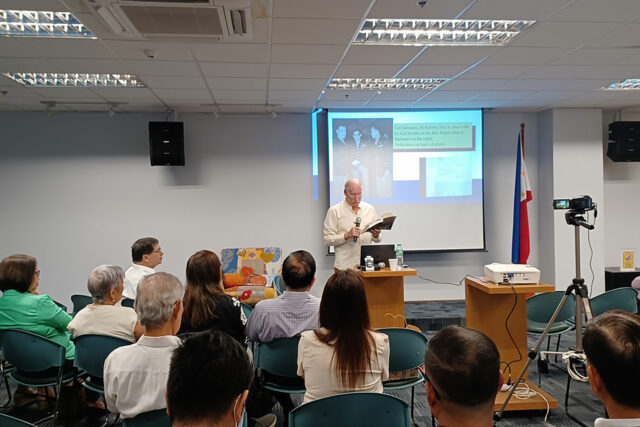
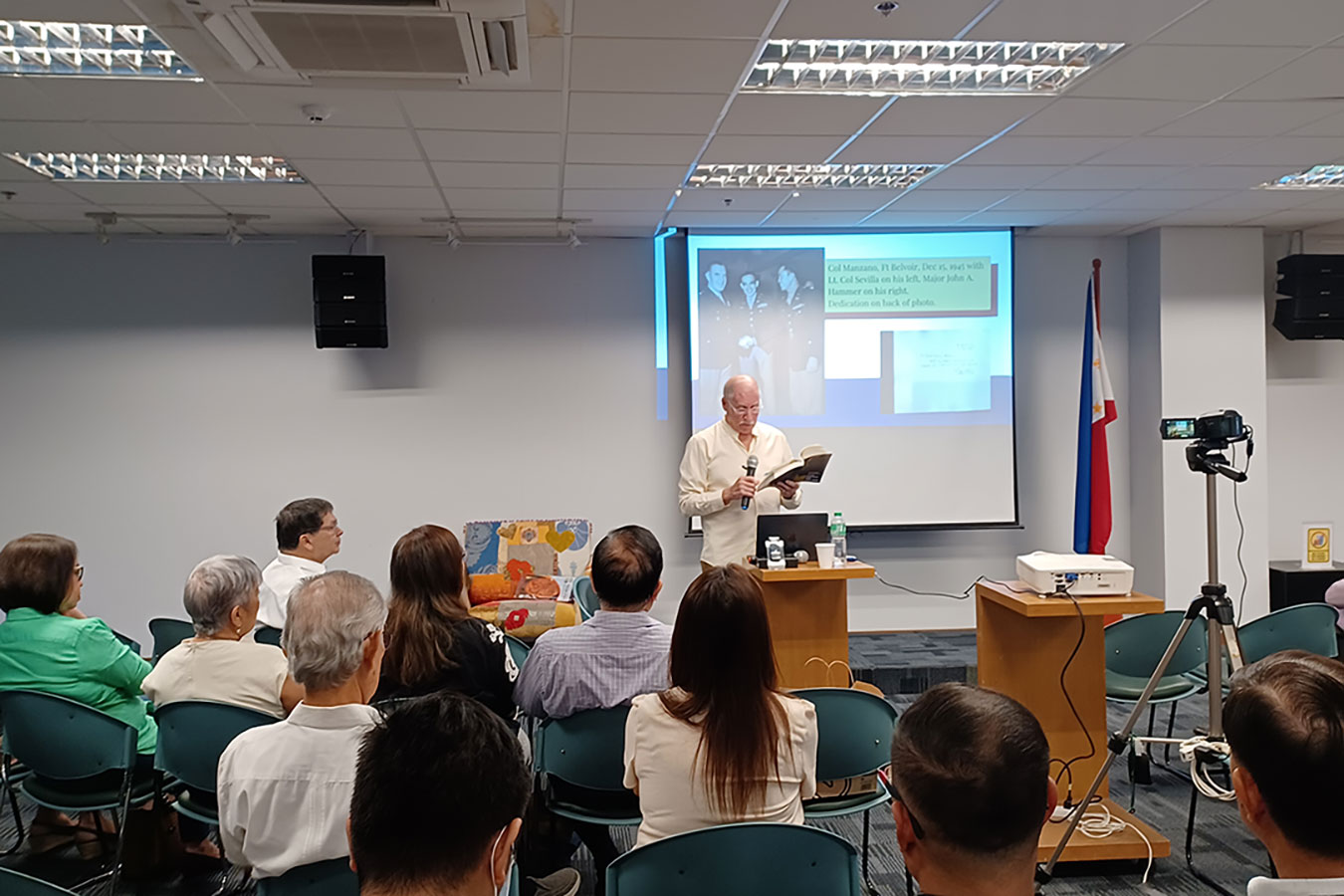
CRAIG SCHARLIN at the book launch at the Ortigas Foundation Library.

COLONEL Narciso L. Manzano was the highest-ranking Filipino officer in the US Army under the command of General Douglas MacArthur.

During World War II, he led and was involved in multiple battles and intelligence operations, like the blowing up of the bridge in Calumpit, Bulacan, the defeat at the Battle of Bataan, and the resistance movement that sprang up against Japanese invaders. All this he did as a professional soldier who rose to field officer rank through merit, without having graduated from any military academy. Unfortunately, despite his numerous military achievements and strong reputation among MacArthur and his staff officers, his exploits have been seldom reported in detail outside of the US Army.

This is now being corrected through the publication of a book.

American author Craig Scharlin, who worked closely with Manzano as his secretary and personal assistant, has woven together the Colonel’s accounts of his life before and during the war for his new book, The Manzano Memoirs: The Life and Military Career of Colonel Narciso L. Manzano.

“This book is a compilation of three memoirs that I discovered many years after Colonel Manzano passed away. We didn’t know they existed for a long time,” Mr. Scharlin said during the book’s launch at the Ortigas Foundation Library on Feb. 6.

The book blends the three memoirs: one written by Colonel Manzano in 1948 which was initially handwritten on yellow lined pad paper; another that had been typed out in 1984 when he was already a retired colonel and real estate developer; and the last one by his son, Jaime Manzano, who had written about his family. At the book launch, Mr. Scharlin read a passage on Colonel Manzano’s childhood in Atimonan, Quezon, before he joined the army and became an integral part of the country’s defense campaign.

During the launch, Mr. Scharlin noted that the colonel often gave input that was not listened to by MacArthur’s officers, including about the Battle of Manila (whose 80th anniversary falls this month).

“I know this is a controversial issue with the World War II experts, but Manzano had specific intelligence that the Japanese, if given the opportunity, would have retreated from that. Now, for the first time, people can read that Colonel Manzano said this,” he said.

“Filipinos suffered having to fight a war under the auspices of the Americans. They’re never given the opportunity to fight their own battles, and Colonel Manzano spent his whole war career fighting the war violently, gallantly, and heroically, but always under the shadow of the Americans. General MacArthur, General Willoughby, and General Whitney were always above him, keeping him from making the war probably more successful than it was,” Mr. Scharlin explained.

He added that he had met Mr.  Manzano in 1975, when the colonel was already retired and speaking out against the Marcos dictatorship, which he “took very personally.”

“Manzano fought throughout the entire war and put his life — and the lives of all the men and women who served under him — on the line, and many died. And so he took it as sort of a personal affront that Marcos again took away the freedom of Filipinos,” said Mr.  Scharlin.

Dr. Ricardo T. Jose, war historian and professor emeritus at the University of the Philippines, told BusinessWorld that this marks “the first time many details of the resistance movement are published” — especially with regard to the internal battle that Filipino officers like Mr. Manzano had to fight within the US army headquarters.

In his foreword, he details how Mr. Manzano was “a professional caught in between these different wars and between powerful and clashing individuals.”

“It is high time that the story of this Filipino hero is told, in his own words. It’s a story that we can all learn from,” said Mr. Jose.

The Manzano Memoirs: The Life and Military Career of Colonel Narciso L. Manzano is published by the Ateneo de Manila University Press. It is available at the Ateneo University Press Bookshop in Bellarmine Hall, and its official Lazada and Shopee stores, for P650 (paperback) and P1,850 (hardcover). — Brontë H. Lacsamana