Home Blog Page 1961

Water interruption to hit NAIA T3
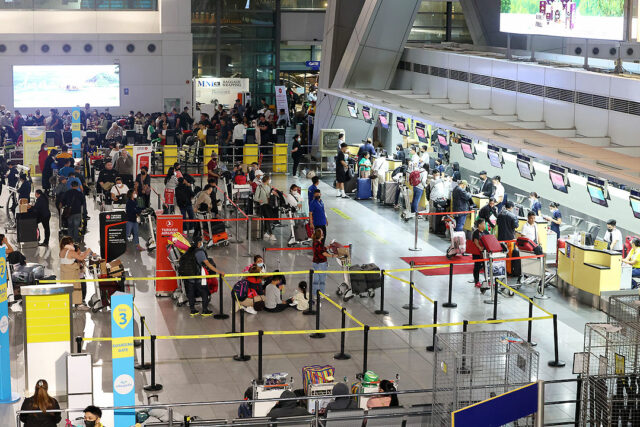
NINOY AQUINO INTERNATIONAL AIRPORT (NAIA) Terminal 3 — PHILIPPINE STAR/MIGUEL DE GUZMAN

NEW NAIA Infra Corp. (NNIC), the private operator of the Ninoy Aquino International Airport (NAIA), is now preparing for a planned water service interruption by Maynilad Water Services, Inc. affecting the operations of Terminal 3 (T3).

In a media release on Thursday, NNIC said the scheduled water interruption will last for 16 hours starting 2 p.m. on Friday (Nov. 1) until 6 a.m. on Saturday (Nov. 2) due to maintenance and repair activities at Maynilad’s Putatan Treatment Plant.

NNIC said it has already prepared a contingency plan to ensure uninterrupted water supply at Terminal 3 throughout the duration of Maynilad’s maintenance and repair activities.

NNIC will utilize existing water reserves from the terminal’s water tanks which have a combined capacity of 3.2 million liters, the company said, adding that Maynilad is also on standby to provide water trucks for resupply if needed.

The airport operator said water containers will also be placed in washrooms throughout the terminal.

Last week, Terminal 1 of NAIA also experienced water service interruption after its main water pipe was damaged. NNIC also anticipates passenger influx for the All Souls’ Day and All Saints’ Day.

The Civil Aviation Authority of the Philippines said previously that it is expecting air travelers to increase by 10% from the 2.1 million passengers during this period.

Metro Pacific Investments Corp., which has a majority stake in Maynilad, is one of three Philippine units of Hong Kong-based First Pacific Co. Ltd., the others being Philex Mining Corp. and PLDT Inc.

Hastings Holdings, Inc., a unit of PLDT Beneficial Trust Fund subsidiary MediaQuest Holdings, Inc., has an interest in BusinessWorld through the Philippine Star Group, which it controls. — Ashley Erika O. Jose

Secure power in disasters, NEA told

CAIQUE NASCIMENTO-UNSPLASH

A PHILIPPINE senator on Thursday called on the National Electrification Administration (NEA) to ensure electric cooperatives comply with national standards and assessments on supplying enough power around the country during natural disasters such as typhoons.

In a statement, Senator Sherwin T. Gatchalian, who is the vice-chairperson of the committee on energy, said NEA should strictly enforce the Electric Cooperatives Emergency and Resiliency Fund (ECERF) law, which requires cooperatives to conduct risk assessments and emergency response plans during these calamites

“The ECERF was put in place as a ready fund that can be tapped by electric cooperatives or faster restoration of electricity and power facilities damaged by natural calamities,” he said.

The Philippine Atmospheric, Geophysical and Astronomical Services Administration (PAGASA) on Wednesday said Kong-rey, locally named Leon, has strengthened into super typhoon as it moved closer to Batanes province in northern Philippines.

NEA earlier sought P200 million to implement ECERF next year to ensure the steady supply of power generated by co-ops.

“Given that the Philippines is among the countries most vulnerable to climate change risks and natural disasters, ECs need to develop their resilience to prevent power interruption or at least shorten the period of such incidents during and after calamities,” said Mr. Gatchalian, the main author of the ECERF law. — John Victor D. Ordoñez

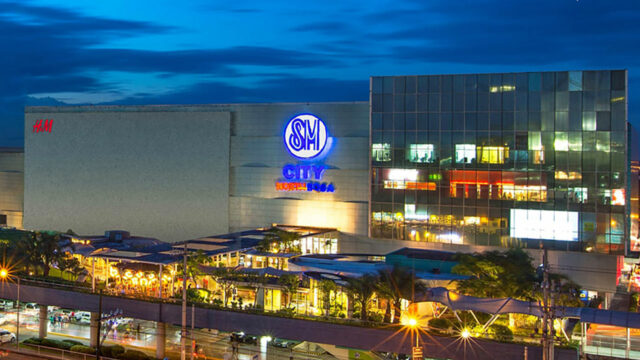
100 SM volunteer teams mobilized

SMSUPERMALLS.COM

SM, through its department store chain SM Store, recently mobilized 100 volunteer teams in its retail network to distribute items to communities as part of its corporate social responsibility day.

SM said 75 teams from SM Store and 25 teams from various retail affiliates participated in various activities that reached over 100 beneficiaries, including public schools supported by the SM Foundation, UNICEF Philippines, World Vision, Good Neighbors Philippines, and other local organizations.

“This initiative underscores the company’s commitment to volunteerism and community support, engaging employees to make a meaningful impact in the lives of those in need,” SM said in an e-mailed statement on Thursday.

The volunteers distributed items such as school kits, shoes, hygiene kits, and food packs.

SM Retail has engaged its employees in social responsibility programs, with a focus on supporting underprivileged Filipino students. These initiatives include reading sessions, classroom repainting, and community outreach.

SM Store is a department store chain that offers menswear, womenswear, children’s wear, beauty products, stationery, electronic gadgets, snacks, toys, and hardware. It also provides services such as bills payment, ticketing, remittance, and currency exchange.

SM Investments Corp. is the Sy family’s listed holding company that has businesses in retail, banking, and property. Some of its companies include BDO Unibank, Inc., China Banking Corp., and SM Prime Holdings, Inc. — Revin Mikhael D. Ochave

P1.2-B projects flagged for delays

PHILIPPINE STAR/ MICHAEL VARCAS

THE Commission on Audit (CoA) has flagged the provincial government of Camarines Norte over delays in the completion of its infrastructure projects worth P1.25 billion, depriving its constituents of the supposed benefits of the civil works.

State auditors said that 10 infrastructure projects funded through loans from state-owned banks and the province’s development fund were still in the process of being constructed despite lapsing the target completion dates, with some projects being delayed by as much as two years.

“[An] evaluation of the submitted Accomplishment Report of the PEO (Provincial Engineering Office) disclosed that at least 10 infrastructure projects funded in prior years in total amount of P1,252,396,936 were not completed within the target completion dates as stipulated in its respective contract agreements,” part of the CoA report stated.

“The delay ranges from 287 to 838 calendar days beyond the original contract or expiry dates,” it added.

The Provincial Government of Camarines Norte did not immediately respond to an e-mail seeking comment, but noted in the report that “efforts are being exerted… to fast-track and monitor all ongoing projects.”

State auditors urged the provincial government to ensure the completion of the projects and levy sanctions against the contractors handling the delayed works. — Kenneth Christiane L. Basilio

19 dead in Maguindanao clash

COTABATO CITY — Up to 19 gunmen were killed in a series of gunfights between two armed Moro groups, locked in a land dispute, in Barangay Kilangan in Pagalungan, Maguindanao del Sur on Wednesday.

Officials of the Maguindanao del Sur Provincial Police Office and the Army’s 6th Infantry Division said on Thursday that the two groups are squabbling for ownership of vast swaths of agricultural lands in Sitio Gageranin, an interior area in Barangay Kilangan.

Major Gen. Antonio G. Nafarrete, commander of the Army’s 6th Infantry Division, said that he has directed the 602nd Infantry Brigade to help local officials and the police reposition the two groups away from Kilangan to enable religious and traditional Moro leaders to settle the conflict. — John Felix M. Unson

Benguet hospital gets new dialysis machines, dental chair

BAGUIO CITY — The Benguet General Hospital received two new dialysis machines and a dental chair in celebration of its 53rd founding anniversary.

Benguet Rep. Eric Go Yap made the donation in the hopes the government hospital will further improve its services and advance health care services in his home province.

Mr. Yap said, “providing better healthcare facilities and accessible medical services is essential to uplift the welfare of Benguet residents.”

He added, “with these additional dialysis machines and dental chair, (such new hospital equipment) bring quality and accessible health care to the province.” — Artemio A. Dumlao

P1-M shabu confiscated in Lanao del Sur

PHILSTAR FILE PHOTO

COTABATO CITY — Anti-narcotics agents seized P1 million worth of shabu after a gunfight with dealers they were supposed to entrapped in a secluded area in Wao, Lanao del Sur on Wednesday.

Gil Cesario P. Castro, director of the Philippine Drug Enforcement Agency-Bangsamoro Autonomous Region in Muslim Mindanao (PDEA-BARMM) told reporters on Thursday that they were to entrap a dealer named Paulo at Barangay Kili Kili East in Wao, but the operation turned haywire when his armed companions, positioned as lookouts, opened fire when they sensed he was to sell shabu to law-enforcement operatives.

Paulo and his companions managed to scamper away after trading shots with PDEA-BARMM agents and a joint police-Army team that helped carry out the entrapment operation that went awry.

Mr. Castro and his subordinate-agents had seized the P1 million worth shabu left by the group in the spot where the supposed trade-off was to take place.

Barangay leaders and municipal officials in Wao had assured help in filing corresponding criminal cases in absentia against Paulo and his companions, now subject of a joint manhunt by the Lanao del Sur Provincial Police Office and units of the Army’s 103rd Infantry Brigade. — John Felix M. Unson

Peso strengthens on inflows ahead of long weekend

BW FILE PHOTO

THE PESO strengthened against the dollar on Thursday amid the seasonal increase of remittances ahead of the long weekend and expectations of softer US personal consumption expenditures (PCE) price index data.

The local unit closed at P58.10 per dollar on Thursday, rising by 13 centavos from its P58.23 finish on Wednesday, Bankers Association of the Philippines data showed.

The peso opened Thursday’s session slightly stronger at P58.20 against the dollar. Its intraday best was its closing level of P58.10, while its worst showing was at P58.275 versus the greenback.

Dollars exchanged went up to $1.3 billion on Thursday from $1.24 billion on Wednesday.

The local currency was supported by the seasonal increase of remittances ahead of the long All Saints’ and Souls’ Day weekend, Rizal Commercial Banking Corp. Chief Economist Michael L. Ricafort said in a Viber message.

“The peso appreciated due to anticipated month-end flows and expectations of softer US PCE inflation report tonight,” a trader said in an e-mail on Thursday.

The yen traded in a narrow range on Thursday after the Bank of Japan (BoJ) left ultra-low interest rates unchanged, while the US dollar consolidated ahead of jobs data later this week and the US presidential election next week, Reuters reported.

The Japanese currency has taken a beating, down around 6% for the month as the dollar and US Treasury yields have hovered around their highest since July.

Japan’s political shake-up has only added to the yen’s woes, heightening uncertainty about the country’s fiscal and monetary policy outlook.

The BoJ stood pat on Thursday, as expected, and signaled the need to scrutinize global economic developments, highlighting its focus on risks to a fragile domestic recovery in deciding when to next tighten policy.

The yen fluctuated before gaining after the BoJ’s decision. It was last up 0.38% at 152.83, keeping close to 153 per dollar.

Analysts are divided over the prospect of additional interest rate hikes by yearend, putting the focus on BoJ Governor Kazuo Ueda’s post-meeting briefing for clues on the pace and timing of further increases.

The dollar held steady ahead of the US PCE price index for September on Thursday and the closely watched nonfarm payrolls report on Friday. Economists polled by Reuters estimate 113,000 jobs were added in October, although the number could be lower due to recent hurricanes.

But the jobs report may find itself overshadowed in the run-up to the presidential election on Tuesday.

Some investors have been putting on trades betting Republican candidate Donald Trump will win, helping to lift the greenback and US Treasury yields, although he is still neck and neck with Vice-President Kamala Harris in several polls.

The dollar index, which measures the currency against six major rivals, was flat at 104.1. It is set for its biggest monthly gains against peers since April 2022.

The euro edged down 0.03% to $1.0852 after rising as high as $1.0871 on Wednesday.

Sterling stood at $1.2956, down 0.04% so far on the day.

Elsewhere, the Australian dollar slid 0.05% to $0.65749 after domestic retail sales numbers for September missed estimates, inching up just 0.1%. Analysts had looked for a gain of 0.3% in September. — AMCS with Reuters

Index sinks to 7,100 level before long weekend

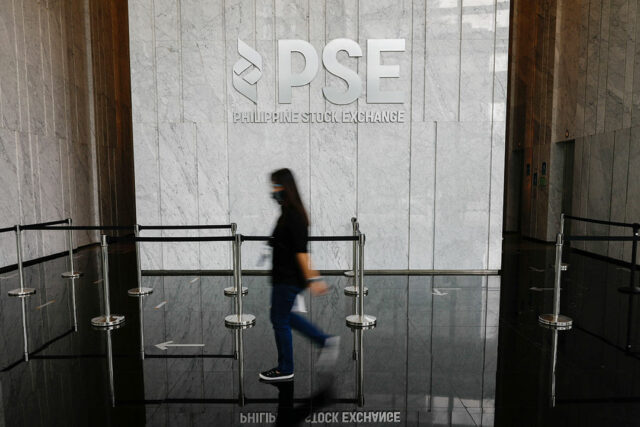
The lobby of the Philippine Stock Exchange in Taguig City, Sept. 30, 2020. — REUTERS

THE BENCHMARK INDEX sank to the 7,100 level on Thursday on profit taking ahead of the long weekend and following the release of data showing that the government’s outstanding debt reached a new record high at end-September.

The Philippine Stock Exchange index (PSEi) fell by 1.88% or 137.28 points to close at 7,142.96 on Thursday, while the broader all shares index dropped by 0.98% or 39.37 points to end at 3,957.21.

This was the PSEi’s lowest close in more than six weeks or since it ended at 7,104.20 on Sept. 16.

“The local market declined this Thursday as investors took a cautious stance ahead of the long weekend. The peso’s weakness and the negative spillovers from Wall Street weighed on today’s trading,” Philstocks Financial, Inc. Senior Research Analyst Japhet Louis O. Tantiangco said in a Viber message.

“The PSEi corrected lower amid some healthy profit-taking ahead of the long Undas holiday weekend and a day after the outstanding National Government debt posted a new record high,” Rizal Commercial Banking Corp. Chief Economist Michael L. Ricafort said in a Viber message.

Philippine financial markets are closed on Friday (Nov. 1) for All Saints’ Day.

The National Government’s outstanding debt rose to a fresh high of P15.89 trillion as of end-September, the Bureau of the Treasury (BTr) reported on Wednesday.

Data from the BTr showed that outstanding debt jumped by 2.2% from P15.55 trillion as of end-August.

Year on year, the debt stock increased by 11.4% from P14.27 trillion a year ago.

“Philippine shares ended the last trading session in the red as investors absorbed a wave of earnings reports and awaited additional results of other companies,” Regina Capital Development Corp. Head of Sales Luis A. Limlingan said in a Viber message.

The market declined as investors preferred to stay on the sidelines before the Nov. 5 US presidential election, he added.

Majority of sectoral indices closed lower on Thursday. Financials dropped by 2.7% or 64.87 points to 2,331.87; services went down by 2.43% or 54.19 points to 2,171.59; holding firms decreased by 1.47% or 90.23 points to 6,036.90; and industrials retreated by 0.8% or 80.26 points to 9,850.61.

Meanwhile, mining and oil climbed by 0.43% or 37.67 points to 8,654.31, and property rose by 0.06% or 1.81 points to 2,793.57.

“Wilcon Depot, Inc. was the top index gainer, jumping 3.87% to P16.10. International Container Terminal Services, Inc. was the worst index performer, plunging 4.58% to P396,” Mr. Tantiangco said.

Value turnover declined to P5.43 billion on Thursday with 803.18 million shares traded from the P5.5 billion with 742.78 million issues that changed hands on Wednesday.

Advancers outnumbered decliners, 97 against 88, while 56 names closed unchanged.

Net foreign selling rose to P1.31 billion on Thursday from P600.04 million on Wednesday. — R.M.D. Ochave

PHL poised for ‘takeoff’ driven by reforms, services — HSBC

Graduates attend the commencement ceremony in this photo taken on Aug. 1, 2024. — PHILIPPINE STAR/EDD GUMBAN

THE Philippine economy is expected to “take off” due to the strengths of its labor force, the pursuit of key reforms, and continued growth in its services exports, HSBC Global Research said in a report.

“The Philippines is reaping the rewards of two decades of hard-earned reform. From liberalization, fiscal, and institutional reform, we think the Philippines has one of the strongest reform narratives in ASEAN, giving the economy the stability it needs for take-off,” HSBC economist for ASEAN Aris D. Dacanay said.

Mr. Dacanay said the Philippines has “laid a solid fiscal and economic foundation that could finance the long-term investments needed to lift its economic potential.”

It cited reforms such as the Rice Tariffication Law, the Public Service Act, and the recent 12% value-added tax (VAT) on digital services.

“These reforms have given the economy the space and resources to respond accordingly and mitigate the impact of these shocks,” he added.

“While most ASEAN states are experiencing declining tax revenue collections relative to their GDP, the Philippines has improved the efficiency of its revenue base.”

The Treasury reported that revenue in the nine-month period rose 16.04% to P3.29 trillion, exceeding the P3.15-trillion target for the period by 4.53%.

“This increase in revenues has allowed the Philippines to invest in its long-term potential — which it did. While some ASEAN states are shifting their public expenditure from investments to consumer subsidies and welfare, the Philippines is boosting its economic potential through infrastructure and physical capital.”

HSBC also noted the country’s favorable demographics.

“Reforms have built the launchpad for takeoff, but demographics is the economy’s fuel. The Philippines has achieved over and above the tailwinds, with the labor market performing better than what the demographic trend would suggest.”

It expects the Philippines’ share of the working age population to peak in 2035, the latest among other ASEAN countries, which would make its demographic tailwind “long-lasting.”

“Across ASEAN, the Philippines has the most favorable demographics. From 2025 to 2035, the Philippines’ working-age population is projected to grow by as much as 15%, which will be the fastest pace in the region.”

“This demographic dividend should, in turn, boost GDP per capita and increase the absolute savings available for further investment,” it added.

HSBC expects the average incremental saving in the economy to rise by $17.7 billion annually until 2029.

Meanwhile, HSBC also noted the opportunity of services exports.

“Apart from strength in numbers, the Philippines has found a niche in exporting ‘light-asset’ services,” it said.

“In the age of digitalization, this serves as a window of opportunity for the Philippines. The advancement of the digital space has made services more tradable, unlocking the potential for services to expand to larger markets and grow. If international transport has led to a surge in manufacturing, data is the service sector’s cargo ship to the world.”

“Services exports have surpassed overseas remittances as the main driver of the Philippine economy’s current account, despite the continued growth in overseas remittances,” it said.

“From physically exporting labor to exporting services… digitalization has helped move the Philippines up the global value chain. And with the currents of the world pointing towards services, the Philippines, among ASEAN, is in the best position to catch the wave, in our view.” — Luisa Maria Jacinta C. Jocson

Gov’t agencies singled out for ‘excellent’ EoDB compliance

BW FILE PHOTO

THE Anti-Red Tape Authority (ARTA) said it conferred “excellent” ratings on 64 agencies for their compliance with the Ease of Doing Business (EoDB) Law, while noting the large number of compliance laggards subject to review of their processes.

Late Wednesday, ARTA announced the results of the Report Card Survey (RCS) 2.0, which evaluates agencies’ compliance with the law and singles out obstacles preventing access to government services.

The survey, which was conducted between November 2023 and May 2024, indicated that 7% of the 860 government offices surveyed posted scores of between 95% and 100%, demonstrating their “exceptional compliance and service delivery standards.”

It was the first time for ARTA to issue an “excellent” rating since the first edition of the report card in 2020.

However, the survey also found that 311 agencies (36%) scored below 75%, indicating the need to conduct a review of their compliance with the requirements set under the law.

Some 83 agencies (10%) were given a rating of 75% to 79.99%, 105 agencies (12%) scored between 80% and 84.99%, 81 (9%) were given ratings between 85% and 89.99%, and 96 (11%) scored 90-94.99%.

Despite the large-scale rollout, only 740 offices, or 86% of the 860 agencies, were successfully surveyed, resulting in 120 agencies not being fully assessed due to incomplete data.

“While many agencies have demonstrated excellence, there remains significant potential for growth, especially among those that need thorough reviews or improvements in compliance and service delivery,” ARTA Secretary Ernesto V. Perez said.

“The insights gained from the RCS serve as a crucial guide for both recognizing outstanding service and addressing the gaps that persist in public sector performance. Together, these initiatives can drive the continuous improvement of government services towards a Bagong Pilipinas,” he added.

For National Government agencies, the Department of the Interior and Local Government Region IV-A (Calabarzon) was given the highest rating of 100.64% out of 296 surveyed offices. It was followed by Department of Labor and Employment (DoLE) Region I (Ilocos), which scored 100.33%.

Completing the top 5 best performing National Government agencies were the Department of Social Welfare and Development Field Office 12 (99.74%), DoLE Regional Office 11 (99.33%), and the Department of Health Davao Center for Health Development (98.79%).

Meanwhile, the City Government of Imus, Cavite (94.95%); Municipal Government of Santo Domingo, Ilocos Sur (93.2%); City Government of Legazpi, Albay (91.1%); Municipal Government of Salay, Misamis Oriental (90.7%); and Provincial Government of South Cotabato (90.3%) were the top scorers out of the 200 local government units surveyed.

Of the 194 government-owned or -controlled corporations surveyed, Land Bank of the Philippines Cauayan and Talibon Branches received the highest ratings of 100.02% and 99.11%, respectively.

Completing the top 3 were the Philippine Economic Zone Authority-Cluster 2 Joint PEZA Customs Clearance Office – Davao which had a rating of 99.04%.

Among state universities and colleges, the highest scorers were Nueva Ecija University of Science and Technology – Main Campus (97.9%), Tarlac State University – Main Campus (93.76%), and Cavite State University – Main Campus (93.52%).

The Vicente Sotto Memorial Medical Center (97.42%) and Bayawan Water District (99.26%) were recognized as the top scorers out of 25 government hospitals and 50 local water districts, respectively. — Justine Irish D. Tabile

Philippines batting for chapter on MSMEs in free trade deal with European Union

REUTERS

THE PHILIPPINES is proposing a chapter on micro, small and medium enterprises (MSMEs) in its free trade agreement (FTA) with the European Union (EU), the Philippine Exporters Confederation, Inc. (Philexport) said.

In a statement on Thursday, Philexport said the MSME provision became apparent as the Department of Trade and Industry (DTI) sought industry input on the Philippines-EU FTA, the ASEAN Digital Economy Framework Agreement (DEFA), and the World Trade Organization (WTO) E-Commerce Joint Statement Initiative.

“In all the trade negotiations, the Philippine negotiating team always tries to include MSMEs in the discussions,” Philexport said, citing Trade Undersecretary Allan B. Gepty.

“The Philippines has always been a strong advocate of including an MSME chapter in the agreement. In all fora, whenever there is an opportunity, we make sure that there is always an element, provision, or, better, a chapter involving MSMEs,” it added.

The chapter on the MSME aims to ensure that both parties are aware of the role of MSMEs in global trade and the need for technical assistance and capacity-building.

According to Philexport, the Philippines hopes to conclude the FTA talks by 2026 to avoid any disruptions in its trade privileges once the Philippines loses its eligibility for the EU Generalized Scheme of Preference Plus.

“The next rounds of negotiation will be held in February, June, and October … 2025 is crucial as they hope to finish as many provisions as they can next year for the targeted conclusion of deliberations by 2026,” it added.

The proposed elements of the FTA include trade in goods, rules of origin, customs and trade facilitation, trade remedies, technical barriers to trade, sanitary measures, services and investment, digital trade, government procurement, intellectual property, and competition, subsidies, and state-owned enterprises;

MSMEs, energy and raw materials, trade and sustainable development, sustainable food systems, transparency and good regulatory practices, dispute settlement, initial, general, final, and institutional provisions, and exceptions.

The EU is expected to negotiate for maximum access for almost all of its products, particularly meat, other agricultural products, electronics, and automotive products, while the Philippines will also be pushing for the maximum access for its agricultural exports.

Meanwhile, Mr. Gepty consulted industry on the ASEAN DEFA, which is aimed at accelerating digital economy transformation.

According to the DTI, ASEAN DEFA “is a comprehensive agreement on e-commerce and digital economy, encompassing not only traditional areas of cross-border e-commerce and customs duties but also data flows and cybersecurity, payments, paperless trading, digital ID, competition, talent mobility, and other emerging topics like AI and block chains.”

Negotiations for the agreement started in September 2023 and are targeted to conclude next year.

The DTI also sought comments on the WTO E-Commerce Joint Statement Initiative, which aims to establish global digital trade rules to reap the benefits and opportunities provided by e-commerce. — Justine Irish D. Tabile