Home Blog Page 179

Metallic mineral output hits record P301 billion in 2025

OCEANAGOLD.COM

METALLIC MINERAL production last year rose 18.2% to a record P301.32 billion, driven by a sharp increase in gold prices.

Citing preliminary data, the Mines and Geosciences Bureau said gold accounted for 54.33% of the value of metallic production despite a decline in volume.

Gold production slipped 8.8% year on year to 26,325 kilos. However, higher global prices lifted the total value of gold output by 29.6% to P163.7 billion.

Gold prices averaged $3,442 per troy ounce in 2025, up 44.14% from a year earlier, according to the World Bank.

“The rally in recent months has been driven largely by investment demand, supported by a combination of geopolitical tensions, macroeconomic concerns, and heightened policy uncertainty, reinforced by a weaker dollar and recent US monetary policy easing,” the World Bank said in an October outlook report.

Silver production fell 17.5% last year to 44,599 kilos. However, higher prices drove the total value of silver output to P3.11 billion, up 7%.

Global silver prices averaged $39.8 per troy ounce last year, up 40.64%, according to the World Bank.

“Silver prices have also risen to record levels, reflecting the metal’s dual roles as a safe-haven asset and a key input in fast-growing renewable energy applications,” the World Bank said.

Meanwhile, the nickel ore output rose 5.6% to 37.81 million dry metric tons (DMT). The value of nickel production grew 18.2% to P69.36 billion.

The World Bank said global nickel prices averaged $15,162 per metric ton (MT) last year, 9.83% lower.

Copper concentrate production declined 9.7% to 231,885 DMT. Copper output in metal equivalent fell 13.3% to 46,084 MT.

Firmer copper prices helped cushion the impact on overall value. The total value of copper output slipped 2.2% to P26.63 billion.

The World Bank said global copper prices averaged $9,947 per MT, 8.81% higher. — Vonn Andrei E. Villamiel

Iran crisis seen highlighting need for diversified trade, energy sources

Smoke rises after reported Iranian missile attacks, following strikes by the United States and Israel against Iran, in Manama, Bahrain, February 28, 2026. — REUTERS/STRINGER TPX IMAGES OF THE DAY

THE ATTACKS on Iran by the US and Israel highlights the need to minimize the potential for trade disruption and widening the trade deficit by broadening the lineup of countries the Philippines trades with, analysts said.

“Any escalation that disrupts Middle East supply or raises risk premiums can push oil prices higher, increasing our import bill, widening the trade deficit, and adding inflation pressure,” Philippine Institute for Development Studies Senior Research Fellow John Paolo R. Rivera said via Viber.

To mitigate the impact of the Iran crisis in particular, the Philippines must not be overly dependent on Middle Eastern supply subject to being choked off in a crisis, he said.

“This development underscores the importance of trade diversification and energy resilience, and maintaining macroeconomic buffers to absorb external shocks,” Mr. Rivera said.

The trade-in-goods deficit narrowed 17.8% year on year to $4.05 billion in January. It has been in deficit for over a decade, or since the $64.95-million surplus posted in May 2015.

Foreign Buyers Association of the Philippines (FOBAP) President Robert M. Young said the group is factoring in delays and canceled shipments as a result of the Iran crisis.

“Some of FOBAP members’ raw material suppliers come from the Middle East and Arab states, such as Turkey, India, and Pakistan,” he said via telephone.

“We are expecting delays or cancellation of shipments due to the potential imposition of embargoes.”

“Wars have devastating economic effects, such as the disruption of markets and an increase in risk and uncertainty,” he said.

George N. Manzano, associate professor at the University of Asia and the Pacific, said the impact of the Iran crisis on the Philippines will be indirect.

“We don’t trade much with Iran, relative to other countries,” he said via Viber, but added heightened uncertainty in global trade could hurt the Philippines’ flow of foreign investment and shipping movements, apart from the most immediate impact on oil prices, he said.

“Any escalation of the conflict can push global oil prices and since the Philippines is a net oil importer, that may lead to higher inflation,” he said via Viber.

Headline inflation picked up to 2% in January from 1.8% in December 2025.

The Bangko Sentral ng Pilipinas projects inflation to accelerate between 2.3% and 3.1% in February, caused by higher fish, rice, and fuel costs.

Mr. Rivera added that slower trade and growth globally could dampen domestic demand and raise production costs.

“If global growth softens, demand for Philippine exports, especially electronics and services, could moderate,” he said.

The crisis could also weaken investor sentiment in the Philippines as companies turn cautious, Mr. Rivera added. — Beatriz Marie D. Cruz

Customs sees port cargo flow improving with consultations

ICTSI.COM

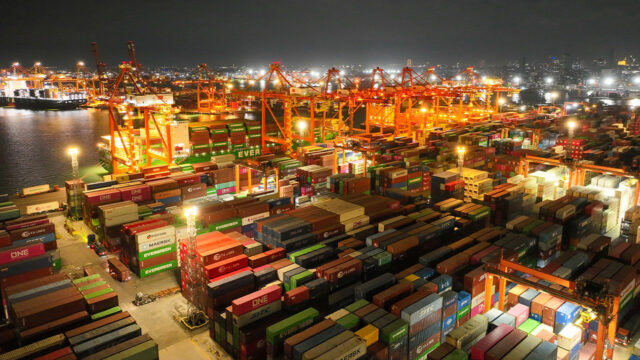
THE Bureau of Customs (BoC) has proposed regular coordination meetings with port users and key government agencies to ensure improved cargo flow at the Manila ports.

In a Facebook post, the bureau said that it met with agencies and port users “to align strategies, strengthen coordination, and support seamless cargo flow at the Manila International Container Port and the Port of Manila.”

“The objective of the meeting was to sustain efficient port operations through early coordination, shared planning, and practical data-driven solutions that support both government oversight and industry operations,” the BoC said.

It added that the consultation process helps anticipate potential pressures and ensures that systems and processes remain responsive and effective.

During the meeting, the participants discussed how to strengthen planning and forecasting and streamline implementation of customs rules such as the dwell time rule and cargo release procedures.

“Commissioner Ariel F. Nepomuceno also proposed the conduct of regular coordination meetings among concerned agencies and industry representatives to continuously identify emerging issues and implement timely measures when necessary,” it said.

“He underscored that efficient port operations are a shared responsibility that require close collaboration, transparency, and prompt action,” it added.

Through these dialogues, the BoC aims to enhance yard management, streamline cargo release procedures, ensure the consistent application of policies, and reinforce contingency planning.

“The BoC remains committed to safeguarding trade facilitation, supporting economic growth, and delivering responsive and effective public service,” it added. — Justine Irish D. Tabile

Service sector continues to dive formal employment

PHILIPPINE STAR/RUSSELL A. PALMA

THE NUMBER of workers in formal employment — those employed by establishments with 10 or more workers — numbered 6.14 million in August 2024, the Philippine Statistics Authority (PSA) said.

Citing the Integrated Survey on Labor and Employment (ISLE), the PSA said services remain the main engine of job creation, accounting for 72.4% of the total, or approximately 4.45 million workers. Industry accounted for 24.6% (about 1.51 million), with agriculture, forestry, and fishing took up the remaining 3%, or 182,799 employees, according to the highlights of the 2023/2024 ISLE Module on Employment of Specific Groups of Workers and Establishments’ Profile: August 2024, made public on Feb. 26.

Among establishments with 20 or more workers — a metric used for comparability with previous survey rounds — employment grew 2.8% between 2022 to 2024, equivalent to an increase of 150,842 workers to 5.52 million. Administrative and support service activities posted the largest headcount with 1.38 million workers (22.5%), followed by manufacturing with 1.13 million (18.5%) and wholesale and retail trade with 0.93 million (15.1%).

Employment remained heavily concentrated in the National Capital Region, which had 2.45 million workers, or 39.8% of the total. Calabarzon (Cavite, Laguna, Batangas, Rizal, and Quezon) and Central Visayas were also among the leading employers with one million (16.3%) and 568,625 (9.3%), respectively. — Erika Mae P. Sinaking

PFRS 18: Confidently navigating changes in financial reporting

(First of two parts)

IN BRIEF:

• The new IFRS 18 standard, effective Jan. 1,  2027, will transform financial statement presentations by mandating a structured approach to income and expenses, enhancing clarity and comparability for users.

• Key changes include defined categories for income and expenses, the introduction of new subtotals like operating profit or loss, and stricter presentation and disclosure requirements to improve transparency in financial reporting.

• Companies will need to adapt their reporting systems and engage with stakeholders to ensure compliance and effectively communicate their financial performance under the new standard.

In 2027, users of financial statements will encounter a transformative shift in how companies present their financial performance. The new standard, IFRS 18 Presentation and Disclosure in Financial Statements, issued by the International Accounting Standards Board (IASB) in April 2024, is set to replace the existing IAS 1 Presentation of Financial Statements.

In the Philippines, this standard was adopted as PFRS 18, which will be effective for periods beginning on or after Jan. 1, 2027. This change is not merely a compliance exercise; it represents a fundamental rethinking of how financial performance is communicated to stakeholders.

Financial reporting standards provide a framework that helps organizations present their financial performance in a manner that is understandable to users, including investors, regulators, and analysts. The introduction of PFRS 18 aims to enhance these qualities, addressing existing challenges and improving the overall quality of financial reporting.

PFRS 18 introduces several significant changes that will reshape the structure of the statement of profit or loss. These changes are designed to enhance clarity and comparability across entities, making it easier for users to assess financial performance.

New structure for statement of profit or loss and defined categories: At its core, the statement of profit or loss provides a window into how an entity has translated its strategy into financial results. However, the existing practice for preparing the statement of profit or loss allows for significant variability in how amounts are reported. To improve the structure of the statement of profit or loss, PFRS 18 requires companies to classify income and expenses into one of five distinct categories: operating, investing, financing, income taxes, and discontinued operations. This classification aims to provide users with a clearer understanding of the sources of income and expenses.

Introduction of new subtotals: The standard introduces two new subtotals — operating profit or loss and profit or loss before financing and income taxes — which means that certain subtotals will soon become more visible and comparable across companies. Together with the new categories, these new subtotals will create a more structured narrative, allowing users to better understand operating results, evaluate investment impacts and see the cost of financing.

Management-defined performance measures (MPMs): PFRS 18 requires entities to disclose MPMs within their financial statements, providing insight into how management views the financial performance of the entity.

Enhanced disclosure requirements: The standard imposes stricter disclosure requirements, ensuring that descriptions and labels used in financial statements faithfully represent the characteristics of items presented and disclosed. This ensures that users have access to relevant information about the measures used to assess performance.

ADDRESSING CURRENT GAPS IN FINANCIAL REPORTING
The existing standard, PAS 1, requires the presentation of profit or loss but does not require any specific subtotals, leading to inconsistencies and a lack of comparability. For instance, the commonly used term operating profit lacks a standardized definition across different entities. This results in varying interpretations and calculations, making it challenging for users to compare financial information between companies, even those operating within the same industry.

To address these issues, PFRS 18 requires companies to classify income and expenses into one of five categories:

Operating: Includes income and expenses arising from the entity’s main business activities, such as the revenue from the sale of products and services, and all items not required to be classified in any of the other categories.

Investing: Typically includes income and expenses from cash and cash equivalents and income from rental properties and dividends from financial instrument investments that are not part of the entity’s main business activities. It also includes the share of earnings and losses from equity-accounted investments.

Financing: Covers income and expenses related to liabilities arising from transactions involving only the raising of finance, such as bank loans, and interest expenses like interest expense on lease liabilities.

Income Taxes: Includes all income tax-related expenses and income recognized in profit or loss.

Discontinued Operations: Includes income and expenses from operations that have been discontinued.

Together, these five defined categories do not just reorganize line items on the statement of profit or loss. Instead, they also introduce greater discipline into how financial performance is framed and presented by sharpening the distinction between the main business activities of the entity and its ancillary activities.

CLARIFYING SPECIFIED MAIN BUSINESS ACTIVITIES
There have been concerns that when applying the general requirements for classifying income and expenses, certain entities need to classify the income and expenses from their main business activities in categories other than the operating category. In response, PFRS 18 introduces the concept of specified main business activities. Under PFRS 18, entities need to assess if they have a specified main business activity of investing in assets (e.g., investment property companies) and/or providing financing to customers (e.g., banks).

Consider a bank, XYZ Bank, which invests in financial assets like bonds and shares. Under PFRS 18, if XYZ Bank determines that investing in such financial assets is a main business activity, it can classify the interest and dividend income that they generate in the operating category, providing a clearer picture of its financial performance.

Similarly, consider a real estate entity, ABC Company, which invests in non-financial assets like land and buildings that are classified as investment properties. Under the new standard, ABC Company can classify rental income from those properties and certain expenses like depreciation expense in the operating category if it assesses that investing in such assets is a specified main business activity. This classification helps users easily identify the core business activities of the entity.

With PFRS 18 now anchoring the classification requirements to an entity’s specified main business activities, what will qualify as “operating” will no longer simply be a matter of preference, but of whether an item of income or expense arises from what an entity is really doing at its core.

IMPROVING COMPARABILITY THROUGH DEFINED SUBTOTALS
In order to improve comparability across financial statements, PFRS 18 introduces two new defined subtotals:

Operating Profit or Loss: This comprises all income and expenses classified in the operating category, providing a clear view of the profitability of the core business operations.

Profit or Loss Before Financing and Income Taxes: This includes operating profit or loss along with all income and expenses classified in the investing category. It offers insight into the overall profitability, allowing users to analyze and compare performance before considering financing costs and tax implications. It will also provide an opportunity for analysts and investors to compare the results of operations of entities independent of how they finance their operations.

The introduction of these defined subtotals enhances the ability of users to compare financial performance across different entities. For instance, investors can more easily assess the operating performance of companies within the same industry, leading to more informed investment decisions.

Given the potential changes to how subtotals are calculated under PFRS 18 compared to their legacy definitions, entities also need to consider the impact on how key performance indicators are currently measured and evaluated. There may also be potential impact on the terms and provisions of contracts, management incentive structures and covenants that are currently tied to those subtotals.

COMPLIANCE BEYOND NUMBERS
While the changes introduced by PFRS 18 focus on improving the presentation of financial statements, they also require companies to evaluate their reporting systems. This may involve redesigning charts of accounts, recategorizing certain items, and modifying existing controls.

The shake-up in financial reporting that PFRS 18 brings may also change the way entities currently tell their story. This means that companies should consider engaging early with analysts, investors, creditors, regulators and other stakeholders to discuss how the new standard will affect their financial reporting.

These changes mean companies must ensure that existing policies, processes and governance structures can accommodate the new requirements and deliver the enhanced transparency that the new standard requires.

In the second part of this article, we will discuss how, under PFRS 18, Management-Defined Performance Measures (MPMs) will soon move to the financial statements, along with the enhanced guidance on disclosures of financial information and the implications for companies as they prepare for its implementation.

This article is for general information only and is not a substitute for professional advice where the facts and circumstances warrant. The views and opinions expressed above are those of the authors and do not necessarily represent the views of SGV & Co.


Aris C. Malantic is the financial accounting advisory services (FAAS) leader of SGV & Co, and Dwayne G. Ignacio is a FAAS senior manager from SGV & Co.


DLSU extends unbeaten run for solo lead of women’s volleyball

DLSU LADY SPIKERS — UAAP/NEO GARCIA

Games on Wednesday
(Smart Araneta Coliseum)
9 a.m. – UE vs NU (Men)
11 a.m.– Ateneo vs FEU (Men)
1 p.m. – UE vs NU (Women)
3 p.m. – Ateneo vs FEU (Women)

DE LA Salle University (DLSU) kept mastery of Ateneo de Manila University (ADMU), 25-14, 21-25, 25-15, 25-17, and stretched its unbeaten run to four games for a solo lead in the UAAP Season 88 women’s volleyball on Sunday at the Smart Araneta Coliseum.

The DLSU Lady Spikers, still without ace player Shevana Laput due to illness, dropped a set for the first time this season but still took care of business in one hour and 44 minutes.

It’s the 17th straight win for the Lady Spikers over the ADMU Blue Eagles, last tasting a defeat against their archrivals in Season 79 (2017), to snatch solo leadership halfway through the two-round prelims.

Middle blocker Lilay del Castillo broke out with a career-best 18 points on seven hits, three aces and eight blocks — the most for any Lady Spiker since Celine Hernandez’ nine in 2007 — to step up big time for Ms. Laput, who missed the game for the second straight match.

Ms. Laput was sidelined in La Salle’s sweep of University of the Philippines (UP), which in turn pulled the rug from under the reigning champion National University (NU) on Saturday that gave way for the Lady Spikers’ rise to the top. UP and NU share the second spot at 3-1.

Ms. Castillo’s strong showing complemented Angel Canino and Amie Provido with 21 and 17 points, respectively, underscoring the depth of coach Ramil de Jesus’ charges even without Ms. Laput.

Eshana Nunag quarterbacked La Salle’s offense with 19 sets plus three blocks but the spikers from Taft are still far from being contented, especially after relaxing in the second for their first taste of set defeat.

Ateneo remained in the hunt for a breakthrough win, falling to 0-4 despite the efforts of Ana Hermosura and JLo Delos Santos with 18 and 15 points, respectively, entering another tough duel against Far Eastern University on Wednesday at the same venue. — John Bryan Ulanday

Lady Altas blast Lady Bombers in straight sets in NCAA Season 101 women’s volleyball tournament

UNIVERSITY OF PERPETUAL HELP LADY ALTAS — FACEBOOK.COM/NCAA.ORG.PH

Games on Tuesday
(San Andres Gym)
9 a.m. – CSB vs SSC-R (Men/Women)
2 p.m. – AU vs SAN BEDA (Women/Men)

UNIVERSITY of Perpetual Help System Dalta regained its winning form after it downed Jose Rizal University, 25-14, 25-22, 25-20, on Sunday in NCAA Season 101 women’s volleyball at the San Andres Gym.

Charisse Mae Enrico led the way with 15 points while Cyrille Joie Almeniana and Camille Bustamante scattered 13 hits apiece as the Lady Altas hiked their record to 9-2.

It eased the sting from the Las Piñas-based school’s 25-20, 25-16, 25-19 defeat to College of St. Benilde on Friday.

The Lady Bombers dropped to 2-9.

In the other match, San Beda University edged Emilio Aguinaldo College, 25-22, 25-13, 26-24, to likewise improve to 9-2.

The Lady Generals slumped to 0-11. — Joey Villar

‘Are you a dog or a cat?’ Welcome to the National Football League Scouting Combine in Indianapolis

OVER the next four days in Indianapolis, 319 elite prospects will sprint, jump, lift weights and field bizarre questions at the National Football League (NFL) Scouting Combine, a televised audition before league decision-makers and a media throng rivaled only by the Super Bowl.

It just may be the most unforgiving job interview in sports.

Before top draft-eligible college players even get a chance to showcase their talents to all 32 NFL clubs through a variety of drills, they are measured and weighed, the latter while wearing nothing more than a pair of shorts, and undergo a battery of medical exams as doctors and trainers seek to assess injury risk.

“The joke is that if you are not injured before you come to the combine you might well be after 15 doctors pull on your limbs,” famed US sports agent Leigh Steinberg, best known as the inspiration for Tom Cruise’s character in the film “Jerry Maguire,” told Reuters.

PIVOTAL STEP IN JOURNEY TO NFL
The combine is a pivotal step in the journey from amateur athlete to professional, providing NFL teams with one of the best opportunities to evaluate prospects prior to the April 23-25 NFL Draft in Pittsburgh where the first overall pick could sign a life-changing four-year contract in the $50-million range.

And so this week the players will try to boost their draft stock with strong results in a variety of tests, including the 40-yard dash that is the marquee event of the week as prospects sprint at top speed with their future careers and earnings hanging in the balance.

Among the other events are vertical leaps, broad jumps, 225-pound bench press and position-specific drills.

“The testables are relied on to assess players, even though they don’t always correlate with game performance,” said Steinberg, who estimates he has been to about 40 combines in his career.

“With all the money that’s spent on this astounding event, it doesn’t reliably predict on-field performance as much as people think.”

BRADY UNDERWHELMED IN 2000 COMBINE
One prime example of that resurfaces every February when a photo from the 2000 NFL Scouting Combine circulates online. It features an expressionless Tom Brady, looking nothing like the seven-time Super Bowl champion he would become, standing in nothing more than a loose pair of shorts beside an easel with his name on it.

“Did they stop taking these photos after mine?” Brady once joked on Instagram along with two laughing emojis.

Brady had an underwhelming combine and less than two months later was selected 199th overall by the New England Patriots in the sixth round, but despite starting his career as a backup he enjoyed a decorated 23-year career and is widely considered the greatest quarterback of all time.

BIZARRE QUESTIONS THE NORM
Players at this week’s combine will also have meetings with teams where bizarre questions are the norm and one wrong answer can potentially tank your draft stock.

“One time a player said one of the questions he was asked was: ‘Are you red or are you blue?’ Another one was: ‘Are you a dog or are you a cat?’” said Steinberg, who has represented the first overall NFL Draft pick eight times.

Despite all the attention on the field, some of the most important conversations at this week’s combine won’t happen on the field but rather in nearby bars, inside dark steakhouses and in passing whispers between scouts and agents.

“The action is taking place… in hotel bars and hotel lobbies, there’s a high degree of schmoozing going on,” said Steinberg, whose book The Comeback: A Playbook for Turning Life’s Setbacks into Victories is being released on March 24.

“And agents are trying to figure out from interacting with teams who is interested in a draftee, who has interest and to try to assess that.” — Reuters

Luka Dončić has happy birthday as Lakers crush Golden State Warriors

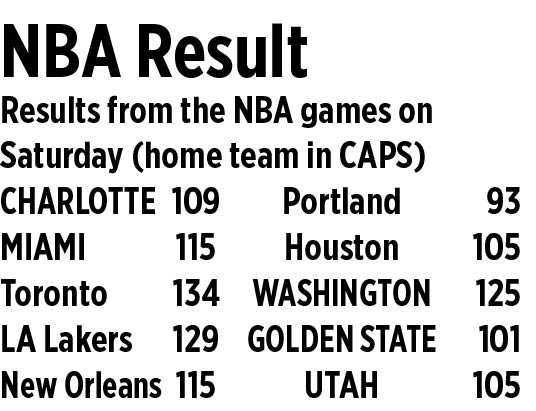
LUKA DONČIĆ celebrated his 27th birthday with 26 points, eight assists and six rebounds to lead the Los Angeles Lakers to a 129-101 rout of the Golden State Warriors on Saturday in San Francisco.

Los Angeles came into the Bay Area on a three-game losing skid but rebounded emphatically. The Lakers surrendered the game’s first two points, then went on to score the next 10 en route to a lead they never relinquished.

Dončić set the pace for the Los Angeles offense, shooting nine of 17 from the field, including four of nine from 3-point range. He knocked down consecutive triples to open the second half, then connected on another pair minutes later as part of a 16-9 surge.

Dončić scored 16 points in a third quarter that effectively snuffed any hope of a Golden State rally.

The Warriors showed signs of life in the second quarter when they trimmed what had been a 23-point deficit to 12 points on the strength of a 15-2 spurt. Gary Payton II scored six of his 12 points off the bench during the run.

Twelve was as close as Golden State came the rest of the night. The Los Angeles lead steadily ballooned throughout the second half behind five Lakers scoring at least 15 points.

LeBron James shot 4 of 6 from 3-point distance and 7 of 13 from the floor overall en route to 22 points. James also flirted with a triple-double, adding a game-high nine assists and seven rebounds.

Austin Reaves scored 18 points for Los Angeles and Luke Kennard came off the bench to connect on 4-of-7 3-point attempts on his way to 16 points. Jake LaRavia dropped in 15 points in reserve duty.

Golden State, meanwhile, had just one scorer with more than 12 points: Gui Santos, who finished with 14.

Moses Moody scored all 12 of his points on 4-of-10 3-point shooting. De’Anthony Melton added 10 points and Al Horford scored eight points off the bench. — Reuters

OKC-Denver clash

The Nuggets’ late-season slog with the Thunder was bound to be confrontational: The protagonists have already traded a seven-game Western Conference semifinal and multiple hard-fought matches over the last year. Yet nothing in their common history in recent memory quite prepared hoops habitués for the chippy overtime thriller over the weekend. When the battlesmoke cleared, the defending champions eked out a 127-121 victory that could very well have gone another way and ultimately held significance beyond the final outcome.

At one point in the set-to, the Nuggets led by as many as 16 points and looked poised to stave off a resurgent Thunder. Shai Gilgeous-Alexander, back from injury with 36 points, paced a comeback, while the visitors leaned on Jamal Murray’s 39-point outburst and Nikola Jokić’s triple-double (23 points, 17 rebounds, 14 assists). In any case, the game’s defining moment came not in the final bucket or in a late defensive stop, but in a confrontation borne of frustration and borderline tactics.

With just over eight minutes left in the fourth, Jokić was jogging upcourt when Luguentz Dort, known for his suffocating defense and borderline physicality, stuck out his right leg, sending the Nuggets’ three-time Most Valuable Player awardee to the floor. The bench cleared, emotions flared, and a midcourt scrum had referees reviewing the incident. Fittingly, the instigator was assessed a Flagrant 2 foul and ejected.

Jokić’s reaction (a chest bump followed by an animated confrontation) was as revealing as the act that provoked it. “It’s an unnecessary move and a necessary reaction,” he said afterward, framing his response as instinctive, protective of himself and, no doubt, reflective of the competitive stakes at play. “I think there’s not supposed to be those things on a basketball floor,” he added, highlighting the manner in which certain aggressive gambits, even in the National Basketball Association’s modern era of loose cannons, cross an unseen line.

The incident likewise crystallized a broader narrative. Despite a predilection to outscore or outmaneuver rather than do battle in and through the trenches, the Nuggets had to confront the physicality that defines the Thunder’s brand of basketball. Head coach David Adelman acknowledged Jokić’s frustration, noting that big men invariably feel the brunt of contact that goes uncalled away from the basket. And, he suggested, this is true even for those who command as much attention as a seven-foot superstar.

For the Thunder, the ejection of Dort, whose reputation as a rugged defender precedes him, was both punitive and indicative of the league’s ongoing struggle to balance extremely physical defense with player safety. As crew chief James Williams noted, the contact was “unnecessary and excessive with a high potential for injury.” Which was true, to be sure. That said, also true was the ruling’s seeming departure from the norm; such borderline-dirty plays typically slip through the cracks.

For the record, it was Gilgeous-Alexander’s return and the Thunder’s depth that sealed the win in overtime. If nothing else, the result reminded all and sundry on whose mantel the Larry O’Brien Trophy resides. For the Nuggets, meanwhile, the loss exposed a concerning trend since Jokić’s return from injury: They have been horrendous in clutch situations.

Still, the lingering image from Paycom Center wasn’t that of a buzzer-beater or a clutch defensive stand. It was that of Jokić, mouth open in anger, standing toe-to-toe with Dort. And in a league that markets precision and flair, it was a grim reminder that, all too often, the game boils down to primal reactions and territorial pride.


Anthony L. Cuaycong has been writing Courtside since BusinessWorld introduced a Sports section in 1994. He is a consultant on strategic planning, operations and human resources management, corporate communications, and business development.

More strikes aimed at Iran after US, Israeli assault kills supreme leader

A WOMAN reacts as people gather at the Enghelab Square, after Iran’s Supreme Leader Ayatollah Ali Khamenei was killed in Israeli and US strikes on Saturday, in Tehran, Iran, March 1, 2026. — MAJID ASGARIPOUR/WANA (WEST ASIA NEWS AGENCY) VIA REUTERS

TEL AVIV/DUBAI — Israel said it launched another wave of strikes on Iran on Sunday, as Iranians grappled with uncertainty after the killing of their supreme leader in US and Israeli strikes that threaten to destabilize the wider Middle East.

Hours after both nations said an airstrike killed Ayatollah Ali Khamenei in the military campaign to overthrow the government of the Islamic Republic, its state media confirmed the 86-year-old leader’s death on Saturday.

Several loud blasts were heard for a second day on Sunday in the area of regional business hub Dubai and over Qatar’s capital of Doha, witnesses said, after Iran launched retaliatory strikes on the neighboring Gulf states in response to the strikes.

Iran, which has said it would target US bases if attacked, hit a range of other targets, keeping the major oil-producing Gulf on edge.

Air raid sirens sounded repeatedly across Israel early on Sunday, with a series of explosions heard in Tel Aviv as Israel’s sophisticated air defense system sought to intercept the latest Iranian offensive.

There was no immediate report of damage or injuries.

TRUMP SAYS STRIKES AIM TO END IRAN THREAT
US President Donald J. Trump said the air strikes aimed to end a decades-long threat from Iran and ensure it could not develop a nuclear weapon.

He sought to justify a risky gambit that seemed to contradict his professed opposition to American involvement in complex overseas conflicts.

“This is not only Justice for the people of Iran, but for all Great Americans, and those people from many Countries throughout the World, that have been killed or mutilated by Khamenei and his gang of bloodthirsty THUGS,” Mr. Trump wrote on Truth Social.

Mr. Trump and his close ally, Israeli Prime Minister Benjamin Netanyahu, told Iranians the attacks offered them a rare chance to topple their clerical leaders.

The leadership had already been under pressure from an economy hammered by sanctions, protesters who proved ready again to take to the streets despite fierce crackdowns and regional proxies severely weakened by Israeli attacks.

Israel and the United States timed the attacks to coincide with a meeting of Mr. Khamenei and his top aides, said two US sources and a US official familiar with the matter.

Mr. Khamenei was working in his office at the time of Saturday’s attack, state media said. It also killed his daughter, grandchild, daughter-in-law and son-in-law.

Experts said that while the deaths of Mr. Khamenei and other Iranian leaders would deal the country a major blow, it would not necessarily spell the end of Iran’s entrenched clerical rule or the Revolutionary Guards’ sway over the population.

Mr. Trump evoked the 1979 storming of the US embassy in Tehran, when Iranian student activists in coordination with radical clerics took 52 American hostage for 444 days, demanding the extradition of the deposed shah from the United States.

Israel’s military said it targeted Iran’s ballistic missile and air defense systems with strikes on Sunday morning.

Iran’s armed forces would soon retaliate again with their biggest offensive against US bases and Israel, the elite Islamic Revolutionary Guard Corps vowed in a statement on Sunday.

Iran responded to Saturday’s initial attacks by launching hundreds of missiles and drones targeting US troops and cities in Israel and Arab countries allied with Washington, prompting widespread cancellations of Middle East flights.

The Pentagon said there were no US deaths or injuries.

IRAN POUNDS KEY REGIONAL FACILITIES
Major Middle Eastern airports, including Dubai, the world’s busiest international travel hub, were shut on Saturday after Iran’s missile retaliation unleashed one of global aviation’s most severe disruptions in years.

Dubai’s landmark Burj Al Arab hotel and the airport, which handles more than 1,000 flights a day, were damaged in an overnight attack on sites across the Arab Gulf states that also hit airports in Abu Dhabi and Kuwait.

On Saturday, Tehran warned that it had closed the Strait of Hormuz, the narrow conduit for about a fifth of global oil consumption, raising expectations of a sharp jump in oil prices.

OPEC+ major oil producers are set to meet on Sunday and may consider a larger-than-planned output increase as several tanker owners, oil majors and trading houses suspended energy shipments through the Strait.

After Israel pounded Iran in a 12-day air war in June, joined by the United States, both warned they would strike again if Tehran persisted with nuclear and ballistic missile programs.

Hundreds of civilians were killed and injured in the US and Israeli strikes, Iran’s ambassador to the United Nations, Amir Saeid Iravani, told an emergency meeting of the United Nations Security Council on Saturday.

Mr. Iravani called Iran’s retaliatory attacks a matter of self defense, saying the bases of hostile forces were legitimate military targets.

Witnesses said some Iranians took to the streets in Tehran, the nearby city of Karaj and the central city of Isfahan to celebrate after reports of Mr. Khamenei’s death.

Videos posted on social media, which Reuters was unable to immediately verify, also showed celebrations elsewhere. — Reuters

US-Iran strikes unleash travel chaos as airlines cancel flights

STOCK PHOTO | Image by L.Filipe C.Sousa from Unsplash

DUBAI — Major Middle Eastern airports, including Dubai, the world’s busiest international travel hub, were shut on Saturday after US and Israeli strikes on Iran and Iranian missile retaliation rippled through the region, unleashing one of the most severe disruptions to global aviation in years.

Dubai’s international airport, which handles more than 1,000 flights a day, sustained damage during an overnight Iranian retaliatory attack on sites across the Arab Gulf states, while Abu Dhabi and Kuwait’s international airports were also hit.

Major regional gateways including Dubai, Doha and Abu Dhabi were closed as countries across the Middle East shut their airspace following the strikes and Iran’s retaliation. Flight maps showed skies over Iran, Iraq, Kuwait, Israel and Bahrain virtually empty, while airlines across Europe and the Middle East announced sweeping cancellations.

Dubai and neighboring Doha sit at the crossroads of east‑west air travel, funneling long‑haul traffic between Europe and Asia through a tightly scheduled network of connecting flights. Any prolonged shutdown of its airports ripples far beyond the region, forcing airlines worldwide to reroute or cancel services.

“The scale of these hubs today is just so enormous. You will have hundreds of thousands of people being stuck in wrong parts of the world without any certainty as to when they can move,” said UK-based aviation analyst John Strickland.

“It hits at so many levels. There is the immediate issue of what happens today and the ricochet effect of how long this persists,” Mr. Strickland added, noting that major Gulf airlines, like Emirates and Qatar Airways, are also among the world’s biggest cargo operators.

Dubai Airports suspended all flights at Dubai International and at Al Maktoum International until further notice, urging passengers not to travel.

AIRSPACE COULD BE CLOSED FOR ‘SOME TIME’
The US and Israel launched their most ambitious attack on Iran in decades on Saturday, killing Iran’s Supreme Leader Ayatollah Ali Khamenei and prompting Iran to retaliate with missile and drone attacks, sharply raising the risk of a broader Middle East conflict.

“Passengers and airlines can expect airspace to be shut for quite some time,” said Eric Schouten, head of aviation security advisory Dyami.

Airlines canceled on Saturday about half of their flights to Qatar and Israel and about 28% of their flights to Kuwait, after the United States and Israel launched strikes on Iran, according to preliminary Cirium data. In total, about 24% of flights to the Middle East were canceled, the data showed.

The region has become more important for global aviation since the Russia-Ukraine war forced airlines to avoid both countries’ airspace.

Conflict zones add to operational risks, raising fears of accidental shootdowns and lengthening routes, which increases fuel costs.

PASSENGERS STRANDED ACROSS EUROPE
Students travelling from Paris to Dubai said their college trip was abandoned. “We still have some students that went there earlier, and they’re stuck in Dubai, and we don’t know when they’ll be able to come back,” said Benjamin Gnatek.

At Charles de Gaulle airport, Thai-bound traveler Roman Simon said his onward flight via Doha was canceled. “Now, we’re trying to find a solution to still make our trip to Thailand,” he told Reuters.

At Doha’s Hamad International Airport, gates were nearly empty as stranded passengers queued to make hotel arrangements, a Reuters witness said.

As countries in the region closed their airspace, aircraft were forced to divert around Larnaca, Jeddah, Cairo and Riyadh. Flightradar24 briefly went down due to surging demand.

The European Union’s aviation regulator EASA on Saturday recommended its airlines stay out of the airspace affected by the ongoing military intervention. — Reuters