Home Blog Page 1738

OP backs plan to let NFA buy 20% of local rice

PHILIPPINE STAR/EDD GUMBAN

THE PRESIDENTIAL Palace on Wednesday backed the Department of Agriculture’s (DA) call to Congress to allow the National Food Authority (NFA) to buy 20% of local rice supply to address the high prices of grain.

“It would be good to give the NFA authority again because it lost its power to import rice,” Presidential Communications Office (PCO) Undersecretary Clarissa A. Castro told a news briefing on Wednesday.

“Currently, everything the NFA and DA do must go through the LGU (local government unit), as farmers cannot directly address their needs.”

Agriculture Secretary Francisco P. Tiu Laurel, Jr. said in a statement on Tuesday urged the government to allow the NFA to buy about 20% of local supply to move the needle on rice prices and to influence the market.

“I hope Congress will revisit the Rice Tariffication Act to address this and grant the NFA proper authority,” Ms. Castro said.

The DA in February declared a food security emergency on rice, the latest effort by the government to lower the cost of the staple grain.

This allows the agency to release rice buffer stocks held by the NFA to stabilize prices and ensure that rice, a staple food for millions of Filipinos, remains accessible to consumers. — John Victor D. Ordoñez

Marcos won’t abolish NTF-ELCAC — Malaya

THE COUNTRY’S anti-communist task force on Wednesday said President Ferdinand R. Marcos, Jr. does not plan on abolishing the body as he still sees the need to stop “terrorist activities” of communist groups.

This comes after Gabriela Partylist Rep. Arlene G. Brosas called on the President to abolish the task force citing cases of red-tagging and harassment.

“I am sorry to relay the bad news to them that the President made it clear today that he will never abolish the NTF-ELCAC (National Task Force to End Local Communist Armed Conflict),” Jonathan E. Malaya, assistant director general of the National Security Council and the chairman of the task force told a news briefing.

He said the President ordered the Department of Budget and Management to allocate an additional P5 million for the task force’s village development project which would provide livelihood programs, education and healthcare services affected by communist conflict.

“We thank the President for his 100% support to the NTF-ELCAC and we commit to his directive to continue our efforts to finally end communist armed conflict in this country within his term,” Mr. Malaya said. — John Victor D. Ordoñez

LTFRB orders ride-hailing apps, operators to equally share fare discount

PHILIPPINE STAR/RYAN BALDEMOR

THE Land Transportation Franchising and Regulatory Board (LTFRB) has ordered transport network companies (TNCs) and operators of transport network vehicle service (TNVS) to equally absorb the 20% fare discounts for persons with disabilities (PWDs), senior citizens, and students.

In a memorandum dated March 19, signed by LTFRB Chairperson Teofilo E. Guadiz III, the LTFRB said fare discounts mandated by law and other regulations will not be passed on to drivers by TNVS operators and other transport network vehicle services, beginning April 7.

It said TNVS operators and TNCs will have to equally share the mandated fare discounts.

“The Board resolves as it hereby resolved that the 20% discount availed of by passengers with fare privileges shall be shared by the TNC and TNVS operators strictly,” LTFRB said.

In January, the LTFRB said it is set to release a memorandum ordering TNCs to shoulder the 20% fare discount privileges, following a series of Senate hearings which found that TNCs passed on the bigger portion of the discount to drivers.

LTFRB had also convened a dialogue with 19 TNVS platforms operating in the country to ensure compliance with fare discount mandates for senior citizens, PWDs, and students.

This came after reports of noncompliance with the Expanded Senior Citizens Act and the Magna Carta for Disabled Persons, which entitle seniors and PWDs to 20% fare discounts, as well as reported violations of similar guidelines for students. — Ashley Erika O. Jose

Criminal charges sought vs Filipinos spreading pro-China narratives

VECTORJUICE-FREEPIK

THE NATIONAL Bureau of Investigation (NBI) should file criminal raps against Filipinos spreading pro-China narratives following the agency’s move to investigate vloggers linked to disinformation campaigns, a congressman said on Wednesday.

In a statement, Zambales Rep. Jefferson F. Khonghun called on the NBI to file cyber libel, espionage, sedition, and terrorism charges on individuals spreading pro-China propaganda and disinformation.

“If their actions cross the line into aiding the enemy, spreading disinformation, or sabotaging national interest, they must be held criminally liable,” Mr. Khonghun added.

The NBI said earlier that they are investigating about 20 vloggers linked to spreading disinformation.

The congressman had called these Filipinos wumaos, a Chinese phrase referring to individuals paid to post pro-government propaganda.

Wumaos are not just online trolls. They are dangerous enablers of foreign aggression,” he said.

Mr. Khonghun added that these individuals have been defending Chinese incursions, downplaying harassment of Filipino fishermen, and attacking the Armed Forces and the government on online platforms.

“The government cannot allow Filipino citizens to act as mouthpieces for a foreign power, especially as tensions in the West Philippine Sea (South China Sea) escalate,” he said.

Last week, House lawmakers conducted their third tri-committee hearing to tackle the rising threat of online disinformation and fake news, which seeks to hold accountable persons deliberately spreading disinformation. — Adrian H. Halili

176 more OFWs from Myanmar return

DMW FACEBOOK PAGE

AN ADDITIONAL 176 overseas Filipino workers (OFWs), victims of human trafficking in Myanmar, arrived in Manila on Wednesday morning, the Department of Migrant Workers (DMW) said.

The victims arrived at Ninoy Aquino International Airport Terminal 1 in Pasay City aboard a government-chartered flight through the coordinated efforts of the Philippine Embassy, Office of the Police Attaché, and the Migrant Workers Office in Bangkok.

Each victim received P50,000 in financial assistance from the DMW AKSYON Fund and P10,000 from the Overseas Workers Welfare Administration.

Immediate medical and psychosocial services were also provided by the Department of Health and the Department of Social Welfare and Development.

Additionally, the DMW will offer legal assistance and reintegration support, including upskilling programs through the Technical Education and Skills Development Authority, to help victims reintegrate into society.

The government recently repatriated a total of 206 Filipino victims from Myanmar’s scamming hubs, with 59 more expected to return soon.

Many of the victims were recruited through platforms such as WhatsApp, Facebook, and Telegram under the guise of customer service roles, only to be forced into online scams.

Authorities reported that traffickers often use backdoor routes from Zamboanga to Sabah or third-country entry schemes in Southeast Asian nations, where Filipinos can enter without a visa. — Chloe Mari A. Hufana

PHL joint drills with US could raise tensions, former lawmaker says

PHILIPPINE STAR/ WALTER BOLLOZOS

A FORMER CONGRESSMAN on Wednesday disapproved of the Philippines’ involvement in joint exercises with the United States, citing that it would only raise tension in the region.

“The Balikatan and Salaknib exercises are not about defending the Philippines; they are about projecting US power in the region,” former Bayan Muna Rep. Carlos Isagani T. Zarate said in a statement.

Mr. Zarate added that these exercises undermine the Philippines’ sovereignty and expose it to “heightened geopolitical tensions,” particularly in the South China Sea.

“The presence of foreign troops and the conduct of war games on Philippine soil are an insult to our people and a direct threat to our peace and security,” he said.

Manila and Beijing have repeatedly clashed in the South China Sea, with both sides accusing each other of raising tensions.

A United Nations-backed tribunal based in The Hague in 2016 voided China’s claims to more than 80% of the waterway, for being illegal.

Amid the increasing tensions with Beijing in the South China Sea, the Philippines has been seeking more foreign defense deals with countries like the US, Australia, Japan, and Canada.

Mr. Zarate added that the resources being used for the military exercise should instead go to funding poverty alleviation, healthcare, and education.

“The Marcos Jr. administration’s eagerness to participate in these war games reveals a dangerous lack of independent foreign policy and a willingness to sacrifice our national interests for the sake of US patronage,” he said.

The Philippines and the US Army are conducting a three-week joint military exercise, mainly focusing on territorial defense and commanding large-scale deployments of forces. About 5,000 soldiers from the Philippine Army and the US Army Pacific will participate in the drills. — Adrian H. Halili

Expanding micro-credential use in tech-voc program pushed

EXPANDING the use of micro-credentials in technical-vocational education and training (TVET) could equip Filipino workers with in-demand skills and address the country’s persistent job-skills mismatch, the Philippine Business for Education (PBEd) said on Wednesday.

“As companies shift toward skills-based hiring, micro-credentials offer a faster and more efficient way to equip Filipinos with the specific competencies employers need,” PBEd Executive Director Justine B. Raagas said in a statement.

“They can help Filipinos close skills gaps, move forward in their careers, and find better job opportunities in today’s changing workforce,” she added.

A study titled “Examining the Microcredentialing Landscape in the Philippines,” supported by the Australian Government’s A Future That Works program, highlighted micro-credentials’ potential to enhance employability and address skills gaps.

However, the study emphasized the need for clearer systems, stronger coordination, and wider recognition across sectors, particularly from the private sector.

The Technical Education and Skills Development Authority (TESDA) formalized the adoption of micro-credentials through TESDA Circular No. 077-2024, issued on March 14.

The circular allows learners to earn certifications for specific skills, enabling them to upskill and reskill without completing an entire course.

After pilot tests in Metro Manila and Regions 3, 4-A, 7, 10, and 11, TESDA is preparing for full-scale implementation nationwide. — Chloe Mari A. Hufana

Imported rice MSRP declining to P45 per kilo at end of March

PHILSTAR FILE PHOTO

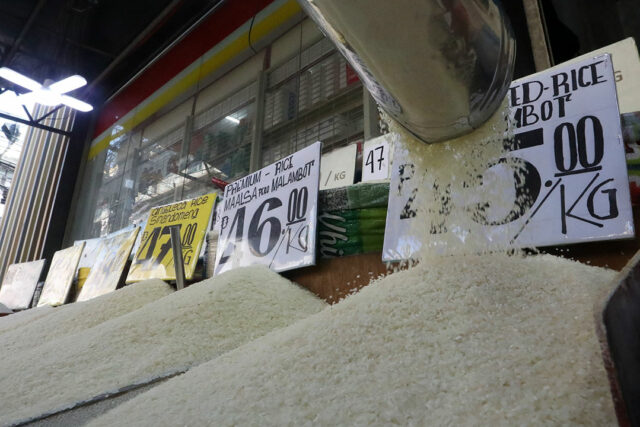
THE Department of Agriculture (DA) said on Wednesday it will reduce the maximum suggested retail price (MSRP) for imported rice to P45 per kilo on March 31, citing declining global rice prices.

The DA said in a statement that the lifting of India’s year-long ban on the export of non-basmati white rice has pushed global rice prices to their lowest levels in over two years.

Some rice varieties are now priced below $380 per metric ton, it said.

“At this level, the retail price of imported rice has now decreased by P19 per kilo compared to its price before we implemented the MSRP on Jan. 20,” Agriculture Secretary Francisco Tiu Laurel, Jr. said.

The lowering of the MSRP has raised concerns among farmers that the farmgate price of palay (unmilled rice) will fall further, as traders grow reluctant to carry domestic rice because of competition from cheaper imports.

The DA said before the MSRP was imposed, imported rice was selling for P64 per kilo “despite global rice prices softening, tariff reductions, and a stronger peso.”

The agency first implemented the MSRP for imported rice on Jan. 20 at initial setting of P58 per kilo. It was further lowered to P52 on Feb. 15, and to P49 on March 1.

The DA said earlier this month it will likely lower the MSRP at the end of March if the current trend in world rice prices persists and the peso remains strong.

Prior to the MSRP reduction to P49 on March 1, the price of rice from Vietnam with 5% broken-grain content had fallen to $490 per MT, about $200 cheaper compared with December, according to the DA.

Vietnam is the Philippines’ main overseas rice supplier.

The landed cost of imported rice in March for the DT8 variety was P32-34 per kilo, according to Food Terminal, Inc.

The DA in January declared a national rice emergency, citing an “extraordinary” spike in the price of the staple grain despite lower tariffs on imports.

Food security emergency declarations are a power given to the DA by Republic Act 12708 or the Agricultural Tariffication Act, which would trigger the release of rice reserves from National Food Authority (NFA) warehouses to stabilize prices.

Inflation eased to 2.1% in February from 2.9% in January as rice inflation dropped to 4.9%, the sharpest decline since April 2020.

The Federation of Free Farmers (FFF) said on Tuesday that some farmers are selling freshly harvested palay for as little as P14 per kilo.

FFF National Director Raul Q. Montemayor said the situation of palay farmers will worsen if the government continues to impose reduced tariffs on rice imports.

Issued on June 20, 2024 Executive Order No. 62 reduced the tariffs for all rice imports to 15% from the 35% rate charged to grain from Southeast Asia.

“The strategy largely failed as importers and traders pocketed most of the savings from the tariff cuts instead of passing them on to consumers,” the FFF said.

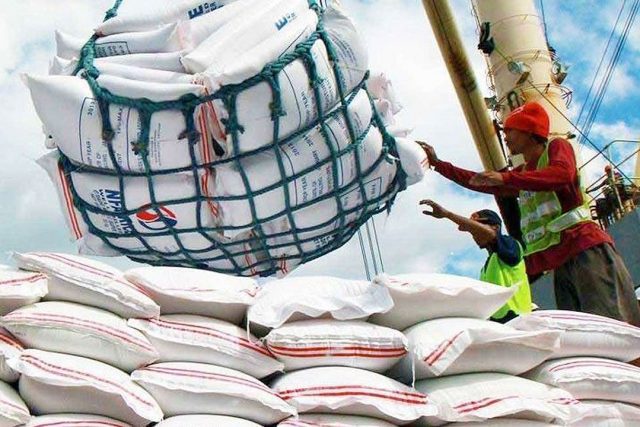
Rice imports hit an all-time high of nearly 4.7 million metric tons (MT) in 2024 in response to a shortfall in domestic stocks and the resulting high prices.

In mid-January, Mr. Laurel said the government does not plan to resort to imports to bring down rice prices, which he blamed on profiteering.

The FFF noted that while inflows seem to have slackened in the first quarter of 2025, international prices have significantly declined, with the landed cost of Vietnam rice with 5% broken content amounting to just over P24 per kilo this month.

“Palay traders are probably anticipating that the prices of imported rice will continue to fall, so they are playing safe by buying low from farmers,” FFF Board Chairman Leonardo Q. Montemayor said.

The Tariff Commission on March 28 will hear a petition by FFF to restore rice import tariffs to 35% for Southeast Asian grain.

The FFF has also asked the commission to impose a 50% tariff on grain from all other countries of origin.

The FFF argued that restoring the 35% rice tariff will not unduly raise rice prices given the downtrend in import prices.

Rice imports fell 46% year on year to 641,000 MT in the year to date ending March 13.

The FFF, meanwhile, said the NFA remains unable to absorb the domestic harvest due to congestion in its warehouses, lack of drying and other post-harvest facilities, and limited procurement budget.

The NFA earlier this month said it is undertaking a P10-billion modernization program aimed at enhancing rice storage, building new rice mills, and upgrading drying facilities to improve the rice harvest recovery rate. — Kyle Aristophere T. Atienza


Major food hubs to rise in Clark, Quezon

BFCT BAGSAKAN FACEBOOK PAGE

THE Department of Agriculture (DA) said on Wednesday it plans to build major food hubs in Clark and Quezon province next year to help stabilize produce prices.

One of the hubs will be constructed on 30–50 hectares in the Clark complex in Central Luzon, Agriculture Assistant Secretary Arnel V. de Mesa told reporters.

The proposed Clark hub will be the main distribution center for produce from the north of Luzon.

The Quezon food hub will rise on 20-30 hectares, Mr. De Meza said.

He said President Ferdinand R. Marcos, Jr. approved the proposals in a meeting with agriculture officials on Tuesday.

“Yesterday, we were in Malacañang and the President initially agreed on these concepts,” Mr. De Mesa said.

The Philippines is adopting the practice from Thailand, which has about 20 major food hubs of 50 to 80 hectares each.

Agriculture Secretary Francisco Tiu Laurel, Jr. wants the food hubs to incorporate cold storage facilities, Mr. De Mesa said.

The DA earlier this month sent a delegation to Thailand led by Mr. Laurel to explore best practices in farming, product development, and agricultural supply chain management. — Kyle Aristophere T. Atienza

NLEX reopens all Marilao northbound lanes

FACEBOOK.COM/NLEXEXPRESSWAYS

NLEX CORP. said it reopened all four northbound lanes of the Marilao segment of North Luzon Expressway following emergency repairs.

“While all lanes are now passable, supporting steel poles will remain on the lanes to allow concrete curing of the bridge. With this development, traffic flow in Marilao Northbound is expected to improve and normalize in the next few days,” NLEX, a unit of Metro Pacific Tollways Corp. (MPTC), said in a statement on Thursday.

NLEX had closed two northbound lanes at Marilao after the Marilao Interchange bridge was struck by an 18-wheeler truck on March 19.

The repair was originally scheduled for completion by March 28, NLEX said, adding that the company accelerated repairs with round-the-clock work.

On Sunday, NLEX announced that it was temporarily waiving tolls on the northbound segment of the expressway from Balintawak to Meycauayan starting March 24 to provide relief to motorists.

MPTC is the tollways unit of Metro Pacific Investments Corp., one of the three key Philippine subsidiaries of Hong Kong’s First Pacific Co. Ltd., alongside Philex Mining Corp. and PLDT Inc.

Hastings Holdings, Inc., a unit of PLDT Beneficial Trust Fund subsidiary MediaQuest Holdings, Inc., holds a majority stake in BusinessWorld through the Philippine Star Group, which it controls. — Ashley Erika O. Jose

Crackdown looms for improperly documented PWD transactions

PHILSTAR FILE PHOTO

THE Bureau of Internal Revenue (BIR) reminded businesses granting discounts to persons with disabilities (PWDs) of the requirement to record the information of customers presenting their cards.

“BIR will strictly implement existing laws and regulations to ensure compliance. Businesses must follow the prescribed guidelines, including checking the physical PWD IDs and recording the information before granting discounts,” it said via Viber on March 21.

“While businesses may not have direct access to verify IDs in real time, the BIR can cross-check the ID details against official records from the National Council on Disability Affairs (NCDA),” it added.

Senator Sherwin T. Gatchalian has estimated that fake PWD cards resulted in P88 billion in foregone taxes in 2023.

In a separate statement on Wednesday, BIR Commissioner Romeo D. Lumagui, Jr. affirmed that all tax privileges given by law to PWDs will be honored.

“However, the BIR will be strict with businesses which do not even follow the basic documentation and procedural requirements under Revenue Regulation No. 5-2017,” he added.

This refers to the rules and regulations implementing the Republic Act No. 10754, which expands benefits and privileges to PWDs such as the minimum 20% discount and value-added tax exemption.

The law allows establishments granting discounts to PWDs for goods and services to claim these discounts as tax deductions.

The BIR reminded businesses that each transaction must be properly documented, including duly-issued invoices reflecting the discount granted.

These documents should also bear the name of the PWD and their ID number.

Mr. Lumagui urged the public to report the manufacture, printing, sale, and use of fake IDs, with violators subject to prosecution for tax evasion.

“The sale and use of fake PWD IDs is not only tax evasion, it is also an act of disrespect against legitimate PWDs,” Mr. Lumagui said.

The Department of Social Welfare and Development said on March 21 that the pilot test of the unified Identification system for PWDs will start in July. — Aubrey Rose A. Inosante

BSP seen cutting rates by as much as 100 bps

BW FILE PHOTO

THE Bangko Sentral ng Pilipinas (BSP) is expected to further lower interest rates this year by as much as 100 basis points (bps) amid easing inflation, analysts said.

“We expect inflation in the Philippines to remain low, which will open the door for the central bank to cut interest rates further over the coming months,” Capital Economics said in a report.

“Our forecast for a further 100 bps of cuts this year makes us more dovish than the consensus.”

The BSP last month opted to keep its key rate steady at 5.75% amid global trade uncertainties. It had delivered a total of 75 bps worth of rate cuts in 2024.

However, BSP Governor Eli M. Remolona has said monetary authorities remain in an easing cycle, signaling the possibility of a 25-bp cut at the Monetary Board’s meeting on April 10.

“The central bank left interest rates unchanged at its February meeting, but we expect them to resume their easing cycle soon given the subdued outlook for inflation,” Capital Economics said.

“Inflation sits comfortably within the BSP’s 2-4% target range, and is likely to remain low over the coming quarters.”

Capital Economics projects inflation to average 3.2% this year and 2.9% in 2026.

The central bank’s baseline forecasts for inflation are 3.5% for 2025 to 2026. Accounting for risks, inflation could hit 3.7% in 2026.

Headline inflation slowed to 2.1% in February, bringing average inflation to 2.5% in the first two months.

Economic output is also expected to be supported by further monetary easing, Capital Economics said.

“On the plus side, consumption growth should remain robust over the forecast period, helped by a combination of lower inflation and interest rate cuts.”

“However, the boost from strong consumption will be offset by tighter fiscal policy. Debt shot up during the pandemic and the government is trying to bring it down steadily.”

Capital Economics also noted that the economy is unlikely to be significantly impacted by US tariff policies.

“A key uncertainty over the coming year is whether and to what extent Donald Trump follows through with his threats to impose tariffs and clamp down on immigration,” it said.

“The Philippines is a relatively closed economy and so less vulnerable than other parts of the region to tariffs. However, Trump’s deportation plans could affect remittances from the US to the Philippines, which are equivalent to around 3.5% of the country’s GDP.”

Meanwhile, S&P Global Ratings economist for Asia-Pacific Vishrut Rana separately said he expects the BSP to cut by 50 bps this year.

“For the Philippines, we see the policy rate ending up at 5.25% towards the end of this year, and 4.5% next year,” he said on Money Talks with Cathy Yang on One News on Wednesday.

“So, still a little bit more aggressive than the Fed, but not highly increased relative to the US interest rates also,” he added.

Mr. Rana said the central bank will consider weaker-than-expected growth in its policy decisions.

“For the Philippines, what we see is that in the latter half of 2024, we saw some softening of domestic activity, particularly domestic demand.”

S&P sees growth expanding by around 6% this year.

“In that environment, inflation still remains very much under control. So, the BSP has flexibility to ease interest rates,” Mr. Rana said.

“On the other hand, the capital flow environment is still quite uncertain. There’s still capital outflow pressures. The currency has been broadly stable. But the BSP will not want to move too quickly to avoid the risk of triggering capital outflows, particularly while the US Fed and interest rates remain relatively elevated.” — Luisa Maria Jacinta C. Jocson