Home Blog Page 1685

Will Catholic cardinals pick another outsider like Francis to be pope?

CARDINAL Konrad Krajewski and Cardinal Luis Antonio Tagle leave along with other Cardinals after attending Vespers prayers at the Basilica of Saint Mary Major (Santa Maria Maggiore), in Rome, Italy, April 27, 2025. — REUTERS

VATICAN CITY — When Cardinal Jorge Bergoglio was elected in 2013 as Pope Francis, he was a near total Vatican outsider. He had never been a Vatican official, instead spending decades in local ministry. And he came from Argentina, the first pope from the Americas.

As the world’s Catholic cardinals meet this week to discuss who should succeed Francis, the deliberations may boil down to a simple choice:

Do they want another outsider? Or is it time now for an insider, someone more familiar with the Vatican’s arcane ways of operating?

“Pope Francis… shifted the Church’s attention to the outside world,” said John Thavis, former Rome bureau chief for the Catholic News Service, who covered three papacies.

“Some cardinals will now be tempted to pick an insider, someone with the skills to manage church affairs more carefully and quietly than Francis did.”

Francis, who died on April 21 aged 88, focused much of his papacy on outreach to places where the Church was not traditionally strong.

Many of his 47 foreign trips were to countries with small Catholic populations, such as South Sudan, Iraq and the United Arab Emirates, and he was especially committed to Catholic-Muslim dialogue.

He was also known for giving freewheeling press conferences, where no topics were off the table and the pope might respond to a query with an unexpected quip.

Asked about the Catholic ban on birth control in 2015, Francis reaffirmed the ban but added that Catholics don’t have to have children “like rabbits.”

The late pope’s unusually open style attracted criticism from some Catholics, but also global interest. His funeral on Saturday and a procession through Rome to his burial place at the Basilica of St. Mary Major attracted crowds estimated at more than 400,000.

German Cardinal Reinhard Marx, one of the leading Catholic prelates in Europe and once a senior adviser to Francis, said the cardinals who will meet in a secret conclave to elect his successor would not be looking for a “functionary.”

“We do not need a manager,” Marx told reporters. “What’s essential is that it be a courageous person… People around the world need to be comforted, lifted up.”

Other cardinals are expressing sharp disagreement.

“We need to give the Church back to the Catholics,” Italian Cardinal Camillo Ruini told the Corriere della Sera newspaper.

Ruini, who is 94 and too old to enter the conclave, said Francis sometimes appeared to favour those who were distant from the Church, “at the expense” of devout faithful.

Others argue that it is precisely a more managerial pope that is needed at this time to tackle the Church’s financial woes, which include a widening budget shortfall and growing liabilities for its pension fund.

CARDINALS’ SPEECHES
The cardinals are meeting daily this week to discuss general issues facing the 1.4-billion-member Church before those under the age of 80 enter the conclave on May 7.

As they meet in what are called “general congregations,” individual prelates can offer speeches to give their vision for the future of the global faith.

In 2013, Bergoglio, then archbishop of Buenos Aires, offered a short reflection at one such meeting, saying the Church needed to do a better job of opening itself up to the modern world. This, by many accounts, proved decisive for his election.

“Bergoglio gave the speech which led the cardinals to believe that the Holy Spirit had made its choice,” said Austen Ivereigh, a biographer of Francis who also wrote a book with the pope in 2020.

“The choice that (Bergoglio) gave them, and the proposal for what the next pope should do, just struck them very, very forcefully,” said Ivereigh.

It remains to be seen whether any cardinal can give such a compelling speech this week.

Francis made a priority of appointing cardinals from countries that had never had them, such as Myanmar, Haiti and Rwanda, and many of the roughly 135 cardinals expected to enter the conclave do not know each other well.

They may be looking at Francis as a model and choose another outsider. Or they may look at Francis’ own predecessor, Pope Benedict XVI — a consummate insider who worked as a senior Vatican official for nearly two decades before becoming pontiff.

Mr. Thavis said he thought the large crowds who came to mourn Francis might affect the cardinals’ decision.

“The cardinals witnessed an outpouring of love and respect for Francis,” he said. “It’s one more reason why the ability to connect with people will weigh more than managerial skills as they make their choice.” — Reuters

EU’s von der Leyen invites scientists, researchers to make Europe their home

A EUROPEAN UNION’S flag flutters outside the European Commission headquarters in Brussels, Belgium, Oct. 15, 2020. — REUTERS

BRUSSELS — European Commission President Ursula von der Leyen on Tuesday invited scientists and researchers from the world over to make Europe their home when the Trump administration is threatening to cut federal funding for Harvard and other US universities.

They have been in the administration’s crosshairs, mainly over how they handled pro-Palestinian rallies against Israel’s war in Gaza that roiled campuses last year, but also over issues like diversity, equity, inclusion (DEI) programs, climate initiatives and transgender policies.

“Controversial debates at (European) universities are welcome. We consider freedom of science and research as fundamental,” Ms. Von der Leyen said in Valencia at the 2025 Congress of the conservative European People’s Party, the largest of the European Parliament.

“Not only because it is a core value for us but also because this is how excellence and innovation thrive,” she said.

“This is why Europe is open to the best and brightest. This is why we will make proposals to help them ‘Choose Europe’. Because we want scientists and researchers from all over the world to make Europe their home — and to make Europe the home of innovation again.”

Harvard scientist Donald Ingber said earlier this month he knew of post-doctoral applicants who are now turning down research positions in the US that they had accepted because they are afraid to live in America as foreigners. They are turning to China or Europe to carry out their work.

During her speech, Ms. Von der Leyen sought to contrast the 27-nation European Union with the US by touting it as a role model for fair and rules-based international trade.

After weeks of threats, President Donald J. Trump announced on April 2 a series of broad “reciprocal tariffs” on goods imported to the United States from most other countries. They included a 20% tax on European Union (EU) imports that was later lowered to 10% under what he called a 90-day pause following a rout in US stock markets.

The Trump administration’s tariff policy — which it says aims to tackle unfair trade practices and re-shore manufacturing — has exacted a major toll on companies, forcing many to cut spending, upending supply chains and making it hard to plan beyond the immediate term.

“Global markets are shaken by the unpredictable tariff policy of the US administration. US tariffs on the rest of the world are at their highest in a century,” Ms. Von der Leyen said.

“But in every crisis there is also an opportunity (…) Now the world of trade is turning towards us (…) They all want to deal with us. Because we are fair, reliable and we play by the rules. So let us stay the course, cool-headed and united. Because that is who we are. That is the European way of trade.” — Reuters

As Singapore heads into election, politicians showcase musical chops

REUTERS

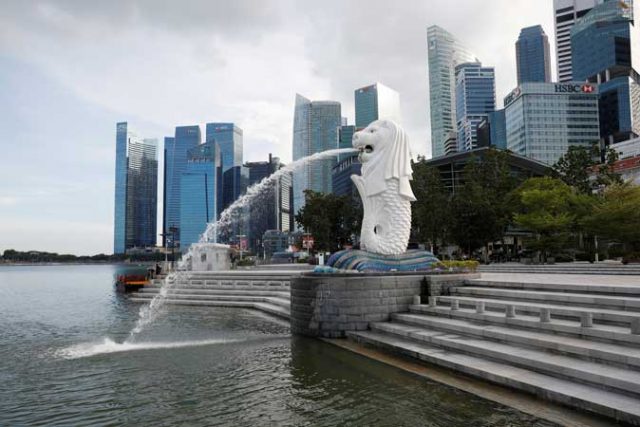
SINGAPORE — A curious election campaign trend has emerged in Singapore as the country gears up for its May 3 poll: candidates showcasing their musical chops, or lack of talent, on social media clips.

The displays of musical talent range from clips of opposition star candidate Harpreet Singh playing the saxophone for local broadsheet The Straits Times, to others beatboxing and belting out songs in dialect or giving an awkward rendition of the earworm APT Korean song.

One candidate, Samuel Lee of the small People’s Power Party, has become a meme thanks to his self-written tune, badly sung, about looking left and right to find a career path.

Some clips are freshly shot this election season as candidates are introduced to media or speak at rallies, others are older clips resurfacing of Singapore’s guitar-playing Prime Minister Lawrence Wong on stage with a local band, or the leader of the opposition Pritam Singh singing at his party’s Lunar New Year celebration.

“They want to be relatable, but it won’t work,” said political scientist Walid Jumblatt Abdullah from Nanyang Technological University.

“These silly Tiktok videos, these music videos, aren’t exactly the best way to appear relatable,” said Mr. Walid. “Just speaking like a normal human being, that would make them appear for more relatable.”

Voters, he said, are more discerning and would pay more attention to parties’ and candidates’ credibility and what they say about causes that matter to voters.

The election comes amid a deteriorating economic outlook, due to US tariffs, with the government warning of a possible recession. Bread and butter issues still matter most to the 2.76 million voters.

It is the first electoral test for Mr. Wong, who took over from long-time premier Lee Hsien Loong last year as leader of the People’s Action Party (PAP), which has ruled the city-state of 6 million people since independence in 1965.

According to an April poll by Blackbox Research of 1,506 people, Singaporeans gave the government the lowest scorecard ratings for its handling of the cost of living (52%), sales tax (55%), inequality (57%), car prices (58%) and housing affordability (59%).

However, the PAP is almost certain to win most seats in the election, with candidates fielded in all 33 constituencies for 97 seats in parliament.

Crucially, the PAP will be looking at its popular vote. The PAP’s share of the popular vote fell to 61% in 2020 from 70% in 2015. If it sees another decline and its main opposition the Workers’ Party build on its record 10 seats in 2020, it could be interpreted as a sign the PAP’s grip on power is weakening. — Reuters

Harvard antisemitism and Islamophobia task forces find widespread fear, bigotry

JEWISH AND MUSLIM students at Harvard University faced bigotry and abuse as the Massachusetts campus was roiled by protests last year, according to two reports released on Tuesday that found many felt shunned by peers and professors for expressing political beliefs.

Harvard and other universities face extraordinary pressure from US President Donald J. Trump’s administration over allegations of antisemitism and leftist bias. The reports, jointly amounting to more than 500 pages, were the result of two task forces Harvard set up a year before Mr. Trump took office, one on combating antisemitism and anti-Israel bias, the other on combating anti-Muslim, anti-Arab, and anti-Palestinian bias.

Harvard President Alan Garber wrote in a letter accompanying the reports that they included “searing personal accounts” drawn from about 50 listening sessions with about 500 students and employees.

He wrote that Harvard would do more to teach its students how to have “productive and civil dialogue” with people from different backgrounds and would promote “viewpoint diversity.”

The task forces recommended that Harvard review its admissions, appointments, curriculum, and orientation and training programs, as well as change its disciplinary processes. They also encouraged more classroom teaching about “Israel/Palestine and the Israeli-Palestinian conflict.”

Mr. Garber wrote that Harvard will begin a research project on antisemitism and support “a comprehensive historical analysis” of Muslims, Arabs, and Palestinians at the university. He said the school would also make its disciplinary processes more effective and efficient.

The Trump administration has demanded that Harvard work to reduce the influence of faculty, staff and students deemed activists, as part of a crackdown on what it says is antisemitism that erupted on college campuses in 2023 after the Palestinian militant group Hamas’ attack on Israel and subsequent war in Hamas-controlled Gaza. It also urged Harvard to audit departments to ensure “viewpoint diversity” and take other steps.

The administration froze $2.2 billion in grants, most of it for medical and scientific research, following Harvard’s denunciation of its demands as an unconstitutional attempt to control the school, and Harvard sued.

BULLYING, REPERCUSSIONS
Both Harvard task forces conducted an online joint survey last year, gathering 2,295 responses from students, faculty and staff.

The survey found 47% of Muslim respondents and 15% of Jewish respondents did not feel physically safe on campus compared to 6% for Christians and non-believers, while 92% of Muslims and 61% of Jews felt there were academic or professional repercussions for expressing their political beliefs.

According to the task force on antisemitism, in late 2023 the campus became to many “what appeared to be a space for the unfettered expression of pro-Palestinian solidarity and rage at Israel – a rage that many Jewish and especially Israeli students felt was directed against them as well.”

Many Jewish or Israeli students reported being bullied or ostracized for their actual or assumed support for Israel or Zionism, or found themselves accused of supporting genocide. 

A smaller group of anti-Zionist Jewish students who joined some of the pro-Palestinian and anti-Israel protests said they felt shunned by Jewish campus groups.

The task force on anti-Muslim bias said Arab-American students reported being called “terrorist, baby-killer, towelhead and antisemite” after they wore a keffiyeh to show solidarity with Palestinians.

Asked about the two reports, Harrison Fields, a Trump spokesman, said: “Universities’ violation of federal law, due to their blatant reluctance to protect Jewish students and defend civil rights, is unbecoming of institutions seeking billions in taxpayer funds.”

Mr. Fields did not comment on the findings by Harvard’s anti-Muslim bias task force.

In a statement, the Council on American Islamic Relations’ research and advocacy director Corey Saylor said his Muslim advocacy group stood by its designation of Harvard as hostile to Muslims, Arabs and Palestinians.

“If the university actually acts on its task force’s report to improve academic freedom, free expression, and address the rampant anti-Palestinian racism and Islamophobia that have been downplayed or outright ignored in public discourse, this may indicate that it is time to change that designation,” Mr. Saylor said.

Vlad Khaykin, an executive vice president with the Simon Wiesenthal Center, a Jewish human rights organization, sharply criticized how long it took Harvard “to even begin an honest reckoning” of antisemitism on campus, adding it “is not merely negligent — it is a disgrace of historic proportions.”

“Sadly, this is symptomatic of a broader trend we are seeing across academia,” Khaykin said. “Harvard is both a symptom and a progenitor of the problem, providing the imprimatur of academic legitimacy to naked antisemitism.” — Reuters

A water park’s peak season

Family outings and corporate team-building activities are the turf of water parks, especially during the summer months.

Interview by Patricia Mirasol
Video editing by Arjale Queral

US states sue to block Trump from dismantling AmeriCorps

U.S. President Donald Trump — REUTERS/LEAH MILLIS/FILE PHOTO

Democratic-led states filed a lawsuit on Tuesday alleging the Trump administration had effectively dismantled AmeriCorps by abruptly canceling grants and cutting 85% of the workforce of the federal agency for national service and volunteering.

In a lawsuit filed in federal court in Baltimore, 24 Democratic-led states and the District of Columbia argue that Republican President Donald Trump does not have the authority under the U.S. Constitution to gut AmeriCorps, which was created by Congress.

The move to eliminate the agency’s grants and cut its workforce is part of an unprecedented push by Mr. Trump and the Department of Government Efficiency championed by his billionaire adviser Elon Musk to shrink the federal government’s spending and workforce.

AmeriCorps has a roughly $1 billion budget and had more than 500 employees when Trump took office.

Its grants fund local and national organizations that offer community services related to education, disaster preparedness, conservation and more.

Its programs place more than 200,000 volunteers nationally to help provide services ranging from assisting with after-school programs to delivering meals to seniors to responding to local disasters.

When wildfires struck the Los Angeles area earlier this year, AmeriCorps members helped distribute supplies and support families.

California Attorney General Rob Bonta, who is co-leading the lawsuit, in a statement accused DOGE of “dismantling AmeriCorps without any concern for the thousands of people who are ready and eager to serve their country — or for those whose communities are stronger because of this public service.”

White House spokesperson Anna Kelly said in a statement that AmeriCorps had failed eight consecutive audits and identified over $45 million in improper payments in 2024 alone.

“President Trump has the legal right to restore accountability to the entire executive branch,” Kelly said.

In February, Mr. Trump signed an executive order directing federal agencies to plan to reduce the size of their workforces and prepare to initiate mass layoffs.

Since then, AmeriCorps has placed at least 85% of its employees on administrative leave and notified them they would be terminated effective June 24.

Last week, the agency began issuing notices that it was terminating nearly $400 million worth of AmeriCorps grant programs, which support volunteer and service efforts. Grant cancellations and program termination notices were sent to 1,031 programs, the lawsuit said.

The lawsuit, which is co-led by the attorneys general of California, Delaware and Maryland, alleges the administration had violated the separation of powers under the U.S. Constitution by frustrating its ability to administer grants appropriated by Congress or carry out statutory duties. — Reuters

‘Victory of justice over tyranny’, Vietnamese celebrate 50 years since end of Vietnam War

A VIETNAMESE naval soldier stands guard at Thuyen Chai island in the Spratly archipelago, Jan. 17, 2013. — REUTERS

HO CHI MINH CITY – Thousands of Vietnamese celebrated the 50th anniversary of the end of the Vietnam War on Wednesday, in what the country’s communist leader said was a “victory of justice over tyranny”.

Celebrations culminated in a grand parade in Ho Chi Minh City with thousands of marching troops and an air show featuring Russian-made fighter jets and helicopters, as Vietnamese waved red flags and sang patriotic songs.

The historic anniversary commemorates the first act of the country’s reunification on April 30, 1975 when Communist-run North Vietnam seized Saigon, the capital of the U.S.-backed South, renamed Ho Chi Minh City shortly after the war in honor of the North’s founding leader.

“It was a victory of justice over tyranny,” To Lam, Vietnam’s Communist party chief and the country’s top leader, said on Wednesday, citing one of Ho Chi Minh’s mottos: “Vietnam is one, the Vietnamese people are one. Rivers may dry up, mountains may erode, but that truth will never change.”

The fall of Saigon, about two years after Washington withdrew its last combat troops from the country, marked the end of a 20-year conflict that killed some 3 million Vietnamese and nearly 60,000 Americans, many of them young soldiers conscripted into the military.

“Communist troops rolled into the South Vietnamese capital virtually unopposed, to the great relief of the population which had feared a bloody last-minute battle,” said a cable from one of the Reuters reporters in the city on the day it fell.

The cable described the victorious army as made up of “formidably armed” troops in jungle green fatigues but also of barefoot teenagers.

Those events were seared into many memories by the images of U.S. helicopters evacuating some 7,000 people, many of them Vietnamese, as North Vietnamese tanks closed in. The final flight took off from the roof of the U.S. embassy at 7:53 a.m. on April 30, carrying the last U.S. Marines out of Saigon.

The formal reunification of Vietnam was completed a year later, 22 years after the country had been split in two following the end of French colonial rule.

VIETNAM-US TIES
Vietnam and the United States normalized diplomatic relations in 1995 and deepened ties in 2023 during a visit to Hanoi by former U.S. President Joe Biden.

“The United States and Vietnam have a robust bilateral relationship that we are committed to deepening and broadening,” a spokesperson for the U.S. Mission in Vietnam said on Wednesday.

That bond is however now being tested by the threat of crippling 46% tariffs on Vietnamese goods that Biden’s successor, Donald Trump, announced in April.

The tariffs have been largely paused until July and talks are underway. But if confirmed, they could undermine Vietnam’s export-led growth that has attracted large foreign investments.

Washington sent Susan Burns, its consul general in Ho Chi Minh City, to represent the country at the parade.

At the celebrations for the 40th anniversary no U.S. official was present.

France, which also lost a war in Vietnam, sent a minister to last year’s celebrations of the 70th anniversary of the end of the battle of Dien Bien Phu, when French colonial rule collapsed.

While Hanoi has re-established relations with the United States, it has maintained close ties with Russia, which is its top supplier of weapons.

Vietnam has also nurtured closer relations with northern neighbor China despite a complex history involving several conflicts and a rivalry in the disputed South China Sea.

China is now a major investor in its economy and the source of many of the components that are used in products that are then exported to the U.S.

Underlining the warming ties, a contingent of 118 Chinese troops was expected to march alongside Vietnamese soldiers and policemen “to honor the international support Vietnam received during its struggle for independence,” according to state media. — Reuters

North Korea conducts first test firing of its new warship’s weapons system

KCNA VIA REUTERS

SEOUL – North Korea earlier this week conducted the first test-firing of the weapons system of the new “Choe Hyon-class” warship it recently unveiled, state media KCNA reported on Wednesday.

Cruise and anti-air missiles were launched and artillery fired as part of the test-firing attended by leader Kim Jong Un and senior officials, the report said.

The time has come for North Korea’s navy to choose to accelerate nuclear armament for maritime sovereignty and for the sake of national defense, Mr. Kim was quoted as saying.

The intelligence agencies of South Korea and the U.S.were closely monitoring North Korea’s shipbuilding activities, an official at Seoul’s defense ministry said.

More work might be needed before the new naval destroyer could take to the sea under its own propulsion, said 38 North, a think tank focusing on North Korea, noting a satellite image of tug boats nudging the ship back towards a floating drydock.

“The use of tugboats to move the ship into place and back again could indicate the lack of a functioning propulsion system,” the think tank said.

North Korean state media on Saturday revealed the 5,000-tonne warship that it said was equipped with the “most powerful weapons.”

Mr. Kim, in a speech from the launch reported by KCNA, said the warship would be handed over to the navy and go into service early next year.

The “Choe Hyon-class” ship was named after anti-Japanese revolutionary fighter Choe Hyon, according to KCNA. — Reuters

Starbucks to beef up store staffing, go slow on automation rollout

HENRY & CO.—UNSPLASH

Starbucks will invest more in staffing and less on equipment, including an automation system that it previously touted, CEO Brian Niccol said on Tuesday, breaking with a wider industry trend to rely more on technology for store operations.

Mr. Niccol said additional staffing was critical to improving the customer experience – his main objective since assuming leadership in September.

“Over the last couple of years, we’ve been removing labor from the stores, I think with the hope that equipment could offset the removal of the labor,” Mr. Niccol said in an investor call. “What we’re finding is that wasn’t an accurate assumption with what played out.”

On Tuesday, Starbucks reported North American same-store sales fell 1% for the fiscal second quarter ended March 30, worse than the 0.24% drop estimated by analysts in an LSEG poll. The company said sales in Canada returned to growth in the quarter.

Margins at Starbucks have shrunk for five straight quarters, falling 590 basis points in the second quarter reported on Tuesday.

Starbucks increased its staffing levels at five stores as a pilot since Mr. Niccol took the helm. By May, between 1,500 and 2,000 U.S. stores will have increased headcount, with around 3,000 by the end of the year.

The increased labor will add to costs, Mr. Niccol said.

“We’re banking on some growth to come with the investment in the labor and the store experience.”

Starbucks will pull back from a deployment of its Siren system, a suite of tech and equipment rolled out in 2022 intended to streamline drink-making.

As recently as October, the company had slated the system for a widespread roll-out, according to executives on its earnings call. Then by January, executives said it would only be deployed to the top-quartile of stores by sales volume.

On Tuesday, Mr. Niccol said the Siren system would only be installed in “very targeted” stores, such as those with high drive-through customer volumes and overall sales.

The move cuts against the trend of other large restaurant companies, which have announced significant new investments in technology. For example, Chipotle’s CEO, who succeeded Mr. Niccol when he left the fast food chain, said in February the company would continue efforts at kitchen automation with an eye toward possibly cutting labor costs. — Reuters

Rubio says concrete Ukraine proposals needed now, or US will step back

MARCO RUBIO — REUTERS FILE PHOTO

WASHINGTON – U.S. Secretary of State Marco Rubio said on Tuesday that now is the time for concrete proposals from Moscow and Kyiv to end the war in Ukraine and warned that the U.S. will step back as a mediator if there is no progress.

At a later United Nations Security Council meeting, U.S. diplomat John Kelley blamed Russia for the continuing bloodshed, saying it had “regrettably” carried out high-profile strikes “causing needless loss of life, including of innocent civilians.”

“Right now, Russia has a great opportunity to achieve a durable peace,” Mr. Kelley said, while adding that the burden for ending the war rests with Russia and Ukraine.

“It is up to the leaders of both these countries to decide whether peace is possible. If both sides are ready to end the war, the United States will fully support their path to a lasting peace,” he said.

State Department spokeswoman Tammy Bruce cited Mr. Rubio as saying that the time had been reached at which “concrete proposals need to be delivered by the two parties on how to end this conflict.”

“How we proceed from here is a decision that belongs now to the President. If there is not progress, we will step back as mediators in this process,” Ms. Bruce told a regular news briefing, referring to President Donald Trump, who has sought to secure a deal to end the conflict, but made clear his impatience.

Both Kyiv and Moscow have sought to show Mr. Trump they are making progress towards his goal of a rapid peace deal after repeated U.S. threats to abandon its peace push, but at the United Nations both blamed each other for continuing the war.

Russian President Vladimir Putin on Monday declared a three-day ceasefire from May 8-10 to mark the 80th anniversary of the victory of the Soviet Union and its allies in World War Two.

Ukraine has questioned why Moscow would not agree to Kyiv’s call for a ceasefire lasting at least 30 days and starting immediately.

US WANTS ‘DURABLE’ CEASEFIRE
Ms. Bruce told reporters the U.S. was seeking a “complete, durable ceasefire and an end to the conflict” not a “three-day moment so you can celebrate something else.”

Since taking office in January, Mr. Trump has upended U.S. policy toward the war, pressing Ukraine to agree to a ceasefire while easing pressure on Russia, although his irritation with Russia has appeared to grow.

Ukrainian and European officials pushed back last week against some U.S. proposals on how to end the war, making counterproposals on issues from territory to sanctions, according to the full texts of the proposals seen by Reuters.

U.N. political affairs chief Rosemary DiCarlo told the Security Council recent intensified efforts to bring the parties to negotiations “offer a glimmer of hope for progress towards a ceasefire and an eventual peaceful settlement.”

She noted Russia’s announcement of the May truce, but added that hostilities had continued during Holy Week, with both sides accusing each other of violations, despite a 30-hour Easter truce Russia announced on April 19.

She also noted that during a previous 30-day moratorium on strikes against energy infrastructure announced separately by Russia, Ukraine and the U.S., such attacks had persisted.

At the Security Council, France and Britain praised U.S. mediation, while criticizing Russia, which launched a full-scale invasion of its neighbor in 2022.

Jean-Noel Barrot, France’s minister for Europe, said Kyiv had demonstrated goodwill and called Putin the sole obstacle to a ceasefire by seeking Ukraine’s “capitulation.”

Russia’s U.N. ambassador, Vasily Nebenzya, rejected allegations that Russian forces had targeted civilians and accused Ukraine of using civilians or human shields by positioning air defenses in heavily populated areas.

He accused Kyiv of recklessly rejecting balanced U.S. peace proposals and targeting Russian civilians, while saying it was increasingly difficult for Western backers of Ukrainian President Volodymyr Zelenskiy’s government to conceal its “brutal, misanthropic and Nazi essence.”

Mariana Betsa, a Ukrainian deputy foreign minister, told the Security Council Russia wants Ukraine to surrender and Kyiv could not accept peace at any cost. She said Ukraine would never recognize any temporarily occupied territories of Ukraine as Russian, including Crimea, which Russia has held since 2014. — Reuters

NEO from the Inside-Out: Built by People, for People

Two/NEO in BGC

Today, office buildings represent living ecosystems where people work, collaborate, and grow. As cities evolve and businesses demand more from their spaces, developers are reimagining offices not only as places to work, but as environments that support broader goals. At the heart of this vision is a powerful connection between sustainability, innovation, and resilience, three forces shaping the future of how we design, manage, and experience spaces. 

At NEO, our portfolio is designed for long-term value and tenant well-being, We integrate sustainability, innovation, and resilience as core principles throughout buildings and services.

Gie Garcia, Co-Managing Director and Chief Sustainability Officer, receives the WELL Leadership Awards from the International WELL Building Institute.

Sustainability lays the foundation

As we champion green building practices, understanding that sustainable design is essential. From energy-efficient systems to biophilic design and sustainable materials, NEO’s developments reduce environmental impact while providing healthier, more inspiring spaces for their occupants. Sustainability reflects a long-term mindset, one where buildings are built not just for today, but for generations to come.

Innovation drives progress

Technology empowers today’s buildings to be smarter and more responsive. NEO ensures its properties enhance convenience, safety, and operational efficiency. Innovation enables us to create spaces and places that adapt to the evolving needs of the modern workforce, wellness integration, and connectivity that support our tenant community’s needs,” Carlo Rufino, co-managing director at NEO, said.

Carlo Rufino, Co-Managing Director with NEO Team, receiving NEO’s WiredScore Portfolio Award certificate

Resilience ensures that these spaces endure

In an era of increasing environmental, social, and technological disruption, resilience is essential. At NEO, we design and manage our buildings to withstand challenges, whether caused by natural disasters, health crises, or shifts in how people work. A resilient building is physically durable and operationally agile, maintaining service, safety, and comfort even during periods of uncertainty.

What truly binds these three pillars together is people

Behind every sustainable initiative, every innovation, and every resilience strategy at NEO are individuals, a dedicated community of property managers, engineers, cleaners, security personnel, and concierge teams. They are the ones who define and uphold the experience within our buildings. Their commitment to operational excellence and tenant well-being transforms buildings from static structures into dynamic communities.

The NEO team received PHILCERT training from the Philippine Green Building Council.

An office building is a place where people work, connect, and live a part of their lives. It is managed by a community that cares for the environment, embraces innovation, and prioritizes safety and service for everyone within its walls. Their vigilance ensures safety, their responsiveness builds trust, and their passion drives continuous improvement.

“For developers and managers like us, recognizing this human layer is critical. Building a resilient, sustainable, and innovative development does not end at construction. It extends to nurturing the community that operates it – investing in their growth, empowering their leadership, and promoting a shared sense of purpose in every part of the building’s daily life,” Gie Garcia, co-managing director and chief sustainability officer, said.

The NEO Streetdance Competition in 2024

In the future of real estate, sustainability, innovation, and resilience are interconnected, people-powered principles that together create spaces where businesses can grow, communities can flourish, and cities can thrive: a vision that NEO proudly brings to life every day.


Spotlight is BusinessWorld’s sponsored section that allows advertisers to amplify their brand and connect with BusinessWorld’s audience by publishing their stories on the BusinessWorld Web site. For more information, send an email to online@bworldonline.com.

Join us on Viber at https://bit.ly/3hv6bLA to get more updates and subscribe to BusinessWorld’s titles and get exclusive content through www.bworld-x.com.

Philippines condemns killing of veteran journalist

STOCK PHOTO | Image by kjpargeter from Freepik

MANILA – The killing of a veteran Filipino journalist in his home was a “heinous act” that was being investigated by police, the Philippines’ Presidential Task Force on Media Security said on Wednesday.Juan “Johnny” Dayang, 89, who served as president emeritus of the Publishers Association of the Philippines Inc, was shot by an unidentified assailant in his home in the central province of Aklan on Tuesday night, and died before reaching the hospital, the task force said.

“We are closely coordinating with all concerned agencies to ensure the immediate resolution of this case,” Jose Torres Jr., the task force’s executive director, said in a statement.

“We stand in solidarity with the media community as we mourn the passing of Dayang, a figure regarded as a pillar of Philippine journalism whose contributions greatly enriched our democratic discourse,” Torres added.

Despite a media environment that ranks as one of the most liberal in Asia, the Philippines is one of the world’s most dangerous places for journalists, particularly in its provinces.

More than 200 journalists have been killed in the country since democracy was restored in 1986, according to the National Union of Journalists of the Philippines, including 32 in a single incident in 2009.

“The death of Dayang represents a significant loss to the Philippine media and political landscape,” the Publishers Association said in a statement on its Facebook page.

Dayang served as mayor of Kalibo, his hometown, from 1986 to 1987. — Reuters

ADVERTISEMENT
ADVERTISEMENT