Home Blog Page 167

Trump demands others help secure Strait of Hormuz; Japan and Australia say no plans to send ships
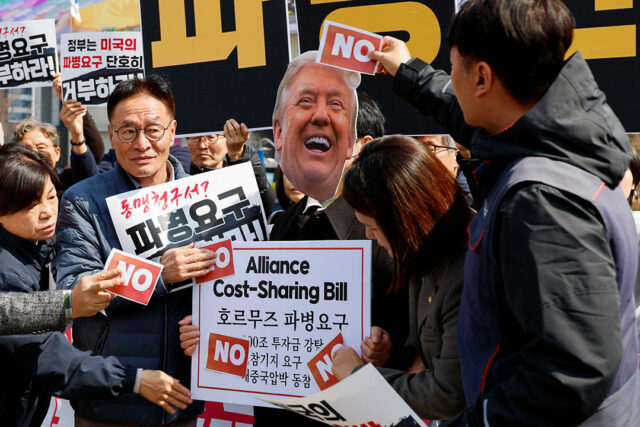
ACTIVISTS PLACE “No” stickers on a sign held by a person wearing a cutout mask depicting US President Donald J. Trump during a rally against the US demand for South Korea to deploy troops to the Strait of Hormuz, outside the US embassy in Seoul, South Korea, March 16, 2026. — REUTERS/KIM SOO-HYEON

TOKYO/PALM BEACH, Florida — US President Donald J. Trump’s demands for a coalition to help reopen the Strait of Hormuz appeared to fall on deaf ears on Monday as allies Japan and Australia said they were not planning to send navy vessels to the Middle East to escort ships through the vital waterway.

With the US-Israeli war on Iran creating turmoil across the Middle East and shaking up global energy markets in its third week, Mr. Trump on Sunday insisted that nations relying heavily on oil from the Gulf have a responsibility to protect the strait through which 20% of the world’s energy transits.

Markets in Asia reacted cautiously, with Brent crude LCOc1 rising more than 1% above $104.50 and regional share markets mostly weaker amid concerns about the risk to Middle East oil facilities and after Mr. Trump’s request for allies to get more involved.

“I’m demanding that these countries come in and protect their own territory because it is their territory,” Mr. Trump told reporters aboard Air Force One on the way from Florida to Washington. “It’s the place from which they get their energy.”

Mr. Trump said his administration has already contacted seven countries but did not identify the countries. In a weekend social media post, he hoped China, France, Japan, South Korea, Britain and others would participate.

Japanese Prime Minister Sanae Takaichi, a staunch Mr. Trump supporter, said on Monday her country, constrained by its war-renouncing constitution, has no plan to dispatch naval vessels to escort ships in the Middle East from where it gets 95% of its oil.

“We have not made any decisions whatsoever about dispatching escort ships. We are continuing to examine what Japan can do independently and what can be done within the legal framework,” Ms. Takaichi told parliament.

Australia, another key Indo-Pacific security ally to the US that also relies heavily on fuels made with Middle Eastern crude, said it will not send naval ships to assist in reopening the strait either.

“We know how incredibly important that is, but that’s not something that we’ve been asked or that we’re contributing to,” Catherine King, a member of Prime Minister Anthony Albanese’s cabinet, said in an interview with state broadcaster ABC.

TRUMP MAY DELAY BEIJING VISIT WITHOUT CHINA SUPPORT
Mr. Trump told the Financial Times on Sunday he was expecting China to help unblock the Strait before his scheduled meeting with Chinese President Xi Jinping in Beijing at the end of this month and might postpone his trip if it did not provide assistance.

“I think China should help too because China gets 90% of its oil from the Straits,” Mr. Trump said. “We may delay,” he said in reference to his visit if China did not offer support in the Gulf.

The Chinese foreign ministry did not immediately respond to a Reuters request for comment.

Mr. Trump also ratcheted up pressure on European allies to help protect the Strait, warning that the North Atlantic Treaty Organization faces a “very bad” future if its members fail to come to Washington’s aid.

European Union (EU) foreign ministers will discuss on Monday bolstering a small naval mission in the Middle East but are not expected to decide on extending its role to the choked-off Strait of Hormuz, diplomats and officials say.

British Prime Minister Keir Starmer discussed the need to reopen the Strait with Mr. Trump, and with Canadian Prime Minister Mark Carney, a Downing Street spokeswoman said on Sunday, while South Korea has said it would carefully review Mr. Trump’s request.

Global air travel remains severely disrupted due to the Iran war which has closed or restricted key Middle Eastern hubs including Dubai, Doha and Abu Dhabi, forcing airlines to cancel thousands of flights and stranding tens of thousands of passengers.

Supplies of jet fuel are also becoming a concern, with authorities in Vietnam warning the country’s aviation industry to prepare for potential flight reductions from April after China and Thailand halted exports of jet fuel due to the Iran war.

DRONES CAUSE FIRE, DISRUPT TRAFFIC AT DUBAI AIRPORT
The disruption to energy markets caused by the Iran war is an “abject lesson” in the risks of relying on fossil fuels, according to the United Nations (UN) climate secretary.

“Fossil fuel dependency is ripping away national security and sovereignty, and replacing it with subservience and rising costs,” Simon Stiell, executive secretary of the UN Framework Convention on Climate Change, will tell EU officials and government ministers at an event in Brussels on Monday.

Although some Iranian vessels have continued to pass and a few ships from other countries have successfully made the crossing, the passage has been effectively closed for most of the world’s tanker traffic since the United States and Israel attacked Iran on Feb. 28.

Israel continued to launch strikes on Iran as well as Lebanon and Gaza, targeting militants from the Iran-backed Hezbollah and Hamas. The Israeli military said on Monday its troops had begun limited ground operations against positions in southern Lebanon held by Hezbollah.

Despite repeated claims from US authorities to have destroyed Iran’s military capabilities, drone attacks continued to threaten Gulf states on Monday.

Dubai authorities said they had contained a fire but temporarily suspended flights at the airport after a drone attack hit a fuel tank. Saudi Arabia intercepted 34 drones in its eastern region in one hour, state media said. No injuries were reported in either incident.

US officials responding to economic uncertainty over high oil prices predicted on Sunday that the war on Iran would end within weeks and that a drop in energy costs would follow, despite Iran’s assertion that it remains “stable and strong” and ready to defend itself.

Mr. Trump, who threatened more strikes on Iran’s main oil export hub Kharg Island over the weekend, has said previously that Iran wants to negotiate and that the US was talking to Iran, but Iranian Foreign Minister Abbas Araghchi earlier on Sunday disputed that claim.

“We have never asked for a ceasefire, and we have never asked even for negotiations,” Mr. Araghchi told CBS’ Face the Nation program. “We are ready to defend ourselves for as long as it takes.” — Reuters

South Korea to lift coal cap, boost nuclear output amid Iran crisis, ruling party says

STOCK PHOTO | Image by Vitamin from Pixabay

SEOUL — South Korea’s ruling Democratic Party said on Monday that the government will lift limits on coal-fired power generation capacity and raise nuclear power plant utilization to as high as 80% as part of an energy response to the Middle East crisis.

Lawmakers in the party’s Middle East crisis economic response task force said in a briefing the measures are aimed at stabilizing energy supply and prices as oil and gas shipments to South Korea have been blocked by tensions in the Strait of Hormuz.

South Korea relies almost totally on imports for its energy, buying about 70% of its oil and 20% of its liquefied natural gas (LNG) from the Middle East, according to Korea International Trade Association data.

The government would prioritize managing LNG supplies by increasing coal and nuclear output while reducing reliance on LNG-fired power generation, Democratic Party lawmaker Ahn Do-geol said.

Limits capping coal power output at 80% of installed capacity would be lifted from Monday, Mr. Ahn said, while maintenance work at six nuclear reactors would be completed early to boost nuclear utilization from the high-60% range to 80%.

South Korea on Friday introduced a gasoline price cap at 1,724 won ($1.15) per liter. It will adjust these prices every two weeks to reflect changes in global oil prices.

Mr. Ahn said gasoline and diesel prices on Sunday had fallen by 58 won and 77 won per liter, respectively, since the price cap was implemented.

SUPPLEMENTARY BUDGET
A supplementary budget would be drawn up by the end of this month and submitted to parliament, Mr. Ahn said. The extra budget is expected to include compensation for refiners linked to the fuel price cap, energy voucher payments, logistics cost support for exporters, and expanded investment in renewable energy.

Democratic Party leader Jung Chung-rae said in a separate party meeting on Monday that it would fast-track passage of the extra budget proposal within 10 days after it is submitted.

The budget ministry said there had been no decision yet on a specific date for a supplementary budget but would prepare one as soon as possible.

The ruling party and government were also considering designating the Yeosu petrochemical complex as a special industrial crisis response zone, said Mr. Ahn.

Shortages of raw materials such as aluminum, sulfur and naphtha were severe, and that supply disruptions and price spikes for naphtha — 25% of which is imported from the Middle East — could force petrochemical companies to cut production, he said.

To address this, the government would freeze exports of domestically produced naphtha at last year’s levels and seek alternative import sources, Mr. Ahn said.

The task force also agreed to double the ceiling on export vouchers usable for international transport costs to 60 million won and to introduce emergency logistics support vouchers for exporters to the Middle East, providing 10 million won each to 1,000 companies, Mr. Ahn said. Reuters

China’s economy builds early momentum in 2026 as risks mount

REUTERS

BEIJING — China’s factory output growth quickened in January-February while retail sales rebounded, in a steady start to the year for an economy confronting multiple challenges including the fallout from the US-Israeli war against Iran.

Industrial output rose 6.3% from the same period in the previous year, the National Bureau of Statistics (NBS) data showed on Monday, up from the 5.2% growth clocked in December. It beat a 5% expansion forecast in a Reuters poll and marked the quickest growth since September last year.

The figures follow data showing China’s exports blew past forecasts in the first two months, powered by surging artificial intelligence‑related technology demand that also lifted upstream manufacturing.

“While risks to the outlook have increased amid geopolitical tensions and disruptions to global trade and energy markets, the latest figures indicate that China entered the year with a firmer growth footing than previously thought,” said Hao Zhou, chief economist at Guotai Junan International.

Retail sales, a gauge of consumption, jumped 2.8%, quickening from the 0.9% pace in December for their biggest gain since October last year. Analysts had expected a 2.5% growth.

The strong impetus was driven in part by the country’s longest Lunar New Year holiday in February. The festivities helped boost total tourism spending by almost 19% from the same holiday period last year, which was one day shorter.

But domestic tourism spending per trip dipped 0.2%, suggesting consumers remain cautious.

Data from earlier last week, for instance, showed passenger vehicle sales at home tumbled 26% year on year in January-February, hurt by the end of a tax break and scaled-back government subsidies for electric vehicles.

China combines January and February data releases to smooth out distortions from the festival holidays, which can fall in either month.

Monday’s data provided another encouraging sign for policymakers as an unexpected upturn in investment took some of the sting off the challenge of a protracted downturn in the critical property sector.

Fixed asset investment, which includes property and infrastructure investment, expanded 1.8% in the first two months, versus expectations for a 2.1% drop. It fell 3.8% in 2025, the first annual drop in about three decades.

Infrastructure investment, in particular, grew 11.4%, as policy support including a new financing tool from banks to fund key investment projects started to take effect.

The overall data, while showing some positive momentum, still suggest a wide gap between robust external demand and sluggish household consumption that analysts warn could hamper China’s long-term growth prospects. Last week’s lending data pointed to a continued slump in household borrowing.

Also, worryingly for income generation, the survey-based nationwide jobless rate rose to 5.3% in the first two months from December’s 5.1%, the NBS data showed.

“It cannot be ruled out that domestic demand data in March will still face downward pressure,” said Zhaopeng Xing, senior China strategist at ANZ, though he added that the overall data do not support an interest rate cut in the near term.

WAR IMPACT TO START FEEDING THROUGH IN COMING MONTHS
At the annual parliament meeting that closed last week, policymakers set this year’s economic growth target at 4.5%-5%, down from last year’s “around 5%.” The target was met in 2025 largely on the back of a record trade surplus of just over $1 trillion, deepening unease among China’s trading partners.

Analysts say China faces significant challenges as it tries to foster sustainable longer-term growth.

While the government pledged a “notable” lift in household consumption, it spelled out a few measures to suggest a turn toward aggressive demand‑side reforms.

The Middle East conflict adds fresh uncertainty as it drives up energy prices and rattles global trade, raising the stakes for US President Donald J. Trump’s late-March trip to Beijing to meet President Xi Jinping.

“The turmoil in the Middle East is set to show its impact on the global economy in coming months… I expect policymakers to respond through fiscal policy, if necessary,” said Zhiwei Zhang, chief economist at Pinpoint Asset Management.

“The market will focus on the upcoming meeting between the Chinese and American leaders. While China will likely purchase more goods from the US to mitigate the trade imbalance, the war in the Middle East has made the meeting complicated.” Reuters

British teens resist Australian-style social media ban

ARPAD CZAPP-UNSPLASH

LONDON — British teenagers, like their peers abroad, have a conflicted relationship with social media.

They know it can feed them a diet of “brain rot” content that keeps them glued to their phones while making money for big tech. Yet it is central to their lives, and many do not think it is the government’s job to ban it. Britain, like other countries in Europe and beyond, is considering ways to restrict social media after becoming increasingly aware of the risks to children. It could follow Australia in imposing a ban for under-16s.

The government has asked “everyone with a view” to contribute to a public consultation, which closes in May.

Young people aged 16 to 18 at one south London school said Snapchat, Instagram and TikTok helped them socialize, make new connections and learn about the world.

But there were downsides: the platforms sometimes left them unhappy or exhausted, vulnerable to bullying and harmful content, and they knew the apps were designed to keep them scrolling.

GLUED TO PHONES FOR HOURS A DAY
“During the summer, I’d spend around eight hours a day on just TikTok,” said Awand Khdir, 17, who added there was little else to do on that platform besides scrolling. “But now it’s more like three or four hours. It’s still not good.”

“Doom scrolling is an issue on its own, but… the content that you see sometimes, especially on TikTok, there’s a lot of dodgy stuff.”

TikTok, Instagram and Snapchat pointed to the safety, privacy and security features they have for teenage users.

Snapchat has age-specific protections for 13 to 17-year-olds, including making the account private by default and no access to public profiles for younger teens.

Instagram Teen Accounts offers a sensitive content control setting and the platform offers supervision tools for parents and guardians.

TikTok’s teen accounts set an automatic screen time limit of 60 minutes and users are prompted to switch off after 10 p.m., according to a spokesperson. TikTok also age-restricts content that may not be suitable for teens.

But the young people Reuters interviewed said they were able to get round controls.

While many parents and politicians back a ban, some psychologists and researchers say there is no proof that it would work.

Research Professor Amy Orben from the University of Cambridge said the impact of social media was far from uniform, stressing that while some teens face significant risks, for many others, the platforms serve as a valuable means of connection.

“The online world, like the offline world, is very complex and its impacts will be very dynamic,” she said.

Sumiksha Senthuran, 16, said “mindlessly scrolling” was a good contrast to the stress of revision for exams.

Elizabeth Alayande, 17, said social media could help build confidence and identity. “You can express yourself by posting videos or just relating with other people… and I don’t think it’s the biggest waste of time if you spread it out evenly with other priorities,” she said. But the teenagers had been exposed to distressing content and online abuse.”Sometimes it’s quite negative because all you see is bad stuff… it’s quite tiring,” said Teyanna Charley, 17. Vish Ragutharan, 16, who has created his own blog about film, agreed. He said his posts could attract negative as well as positive responses, which was a “real disadvantage.”

Some of the students were fed content about body image.”When you see other girls on TikTok, you kind of want to look like them. And that’s really crushing people’s self-esteem,” said Joelle Azebaze Ayangma, 18.

DIFFICULTY OF ENFORCING A BAN
Despite knowing of the risks of social media, the pupils were mostly opposed to a ban.

Ali Raza, 16, uses apps to communicate with family abroad. Dua Arshia, 16, said restrictions could push young people towards platforms “where there’s more dangerous things,” and Leah Osando, 17, said enforcement would be difficult.

“Even if children get banned… they’ll go onto the dark web or use a VPN (virtual private network),” said Ms. Osando. Some teenagers also described the risk of not recognizing ever more sophisticated artificial intelligence-generated content. Three experts, all of whom have advised lawmakers on children’s internet safety, said there was no clear evidence that bans work.

One-fifth of Australian teenagers under 16 were still using social media two months after the ban, industry data showed, raising questions about the effectiveness of platforms’ age-gating methods.

The experts said pressure should be placed on social media companies to build safer platforms, as algorithm-driven feeds become increasingly addictive and, in some cases, direct children towards pro-anorexia or self-harm videos.

“These are commercial platforms,” Ms. Orben said. “They are designed to harness attention, and… young people are increasingly saying that they struggle to get off.”

Professor Julia Davidson, an expert in child online safety from the University of East London, said for children over 13, it may already be too late. British regulator Ofcom in 2022 said six in 10 children aged eight to 12 had social media profiles, despite many platforms requiring users to be at least 13.

“How are we going to enforce a ban with 14 and 15-year-olds who have grown up with it and built extensive networks?” she said.

Professor Sonia Livingstone, leader of the Digital Futures for Children center at the London School of Economics, said policymakers risked reaching for the wrong solution, with a ban seen as “a very blunt hammer to crack a nut.”

She said politicians should demand “safety by design… without eliminating children’s access to the digital world, which is what they want and have a right to.”

She said the government’s focus should be on how it tackles big tech, suggesting they take a “divide and conquer” approach. “Why don’t we say: Snapchat is the one where the randomers can get in touch with you. Instagram is the one where you can see the self-harm content. And TikTok is the one that wants you on so long that you can never get to sleep or do your homework,” she said. — Reuters

AI deployment for organizations still shallow – Philippine AI Report

STOCK PHOTO | Image by DC Studio from Freepik

Nearly all organizations in the Philippines, about 92%, used artificial intelligence (AI) in some form in 2025, but deployment remains shallow, with the majority still at the pilot stage due to talent scarcity and concerns over security and privacy, according to the Philippine AI Report 2025.

The report was produced by Swarm, a global AI consultancy firm, which surveyed 175 organizations across the technology, financial services, healthcare, and retail sectors. It also covered manufacturing, government, education, and nonprofit organizations, making it the largest published survey of enterprise AI adoption in the country to date, the report said.

Among its key findings is that AI has moved from theory to practice for most organizations in the country. Over 92% of Philippine organizations have used AI in some form over the past year, while 8% said they did not use AI at all.

“The prevailing mindset is now one of active experimentation, with AI increasingly viewed as necessary to remain competitive,” the report said.

Despite organizations experimenting with AI, adoption in the country remains shallow, with a striking 65% of organizations still at the pilot phase, or proof-of-concept stage, testing solutions in controlled environments or small-scale trials.

Only a smaller share have moved to full production deployment, the report said.

“The concentration at proof-of-concept reveals the central tension in Philippine AI adoption: enthusiasm has outpaced execution. Organizations have demonstrated they can launch pilots. The question is whether they can operationalize them,” the report said.

Other AI initiatives by organizations include AI application development for products at 47%, end-user AI enablement through training and onboarding at 41%, internal tooling development at 36%, applied AI development at 30%, fundamental AI research at 28%, vendor evaluation at 27%, and large-scale integration of third-party AI services at 25%.

AI strategy among organizations also showed strong backing from executives, with 61% of respondents saying C-suite executives directly lead AI initiatives.

Despite organizations’ high interest and executives’ strong support for AI, structural challenges hamper the country from scaling beyond pilots.

Talent scarcity tops the list, with 57% of organizations reporting a shortage of AI-skilled personnel, such as data scientists, AI engineers, and technically trained staff.

This skills gap stalls projects and limits the full use of AI tools, as teams struggle with technical roadblocks and business managers sometimes lack understanding of AI capabilities.

Security and privacy concerns follow closely at 40%, as companies remain cautious about feeding sensitive data into AI systems, particularly through third-party cloud services, due to fears of breaches or compliance violations.

Other barriers mentioned were unrealistic expectations (36%), internal development hurdles (34%), concerns about tool quality (28%), IT-business misalignment (26%), employee resistance (24%), and additional challenges such as regulatory hurdles, data gaps, or insufficient executive buy-in (13%).

To address the talent shortage, the study recommended upskilling existing employees.

Organizations are advised to dedicate the majority of AI resources to people and processes, following a 10-20-70 model: 10% for algorithms, 20% for technology, and 70% for workforce development, to accelerate adoption.

Immediate talent gaps can also be addressed through targeted hiring or partnerships with universities, AI consultancies, or technology providers. The study noted that only 12% of Philippine organizations currently have an AI compliance or governance officer.

It also suggested organizations align with national frameworks such as the Philippine Skills Framework for Artificial Intelligence (PSF-AAI), which defines AI-related job roles, required skills and competencies, and career pathways while helping companies access government-supported training and upskilling programs.

Lastly, the report said addressing the AI talent gap requires collective action across industries.

It encouraged organizations to participate in industry working groups developing AI skills standards and to support scholarships, bootcamps, and training programs to expand the talent pool.

Companies that invest in developing the broader AI ecosystem can also build early relationships with emerging talent before competitors.

The Philippine AI Report 2025 aims to understand the current level of AI adoption among local enterprises and what organizations need to do to scale its use.

“We started this research because we wanted to understand what AI adoption actually looks like in the Philippines and have data to back it,” said Tim Santos, project lead of the report.

He added that while global studies track adoption curves and investment trends, they do not capture the country’s nuances, such as how companies make decisions, the availability of talent, and the return-on-investment requirements that shape implementation timelines.

The report seeks to give business leaders the evidence they need to plan the next steps for AI adoption. — Edg Adrian A. Eva

Vietnam braces for flight cuts from April after China, Thailand ban jet fuel exports

STOCK PHOTO | Image by Toomas Tartes from Unsplash

HANOI — Vietnamese authorities have warned the country’s aviation industry to prepare for potential flight reductions from April after China and Thailand halted exports of jet fuel due to the Iran war, increasing the likelihood of shortages.

Vietnam imports more than two-thirds of its jet fuel needs, with 60% coming from China and Thailand, according to documents from the aviation regulator and importers seen by Reuters.

“There are risks of jet fuel shortages for Vietnamese airlines from the beginning of April and the following months,” the Civil Aviation Authority of Vietnam said in a March 9 document sent to the ministry in charge of transport.

It said airlines should review their plans, especially for domestic routes, and instructed airport operators to prepare additional parking space for Vietnamese carriers.

Vietnam has also seen reduced supplies from Singapore, the document showed.

In separate documents viewed by Reuters, major importers Petrolimex and Skypec said they could only guarantee jet fuel supplies for March. Skypec urged the regulator to restrict air transport to essential domestic routes if the conflict drags on.

All documents were issued after China urged its refiners not to agree to new exports early this month but preceded a hard ban on refined fuel exports from March 11. Thailand banned exports of refined oil products, including jet fuel on March 6 to all countries except Myanmar and Laos.

The regulator, the ministry and the two importers did not respond to Reuters requests for comment. Vietnam’s top airlines Vietnam Airlines  and VietJet declined to comment.

DIPLOMATIC EFFORTS MADE
Vietnam was the third-largest buyer of aviation kerosene from China last year after Australia and Japan, according to Chinese customs data.

The Southeast Asian country has taken up the issue with both China, its main supplier, and Thailand.

On Sunday, Foreign Minister Le Hoai Trung asked his Chinese counterpart Wang Yi for close coordination “to ensure energy security,” in a meeting in Hanoi that had been long planned, according to the Vietnamese government’s news portal.

A Chinese foreign ministry spokesperson told reporters on Monday that Beijing stood ready to boost cooperation with Vietnam and other countries to jointly tackle energy security issues.

On Friday, Prime Minister Pham Minh Chinh asked Thailand to help address the shortage during a meeting with the Thai ambassador in Vietnam, state media reported.

The foreign ministries for Vietnam and Thailand did not immediately respond to requests for comment.

Vietnam’s aviation authority recommended that Hanoi should seek to import from other places, citing South Korea, Japan, Brunei and India as potential sources, but it also said that “in the current context it is difficult to find new suppliers.”

It added that Vietnam’s two refineries are under pressure to expand production of other oil products, making it hard for them to increase jet fuel output.

Even if supply stabilizes, soaring fuel prices are disrupting the industry, it also warned, noting many routes would become unprofitable.

Petrolimex and Skypec also flagged that the spike in jet fuel prices has meant they are quickly reaching limits on credit lines and urged banks to offer more flexible financing until market conditions normalise, the documents showed.

Front-month jet fuel paper swaps in Singapore on a cost and freight basis are trading at around $157 a barrel, more than one-and-a-half times higher than pre-conflict levels, LSEG pricing data shows. — Reuters

DepEd to construct over 1000 climate-resilient facilities

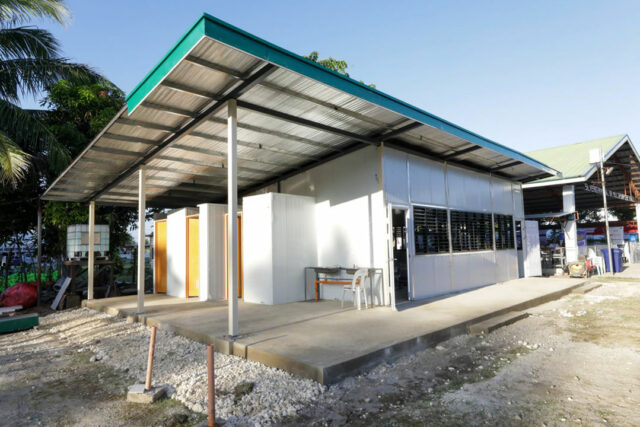
A sample unit of a Learning Continuity Spaces (LCS) facility. — DEPED

The Department of Education (DepEd) said on Monday that it aims to construct 1,380 Learning Continuity Spaces (LCS) facilities units nationwide to help address damaged classrooms and learning disruptions caused by natural disasters.

“This project reflects the marching orders of President Marcos to ensure that no Filipino learner is left behind, even in the face of the most challenging calamities,” Education Secretary Juan Edgardo “Sonny” M. Angara said in a statement.

Data from DepEd showed that over 10,700 schools nationwide were damaged from June to October 2025, with a total estimated loss of P29.5 billion in school properties due to earthquakes, typhoons, and other calamities.

The damage has disrupted classes for more than 1.1 million learners across the country, which pushed schools to adopt various class modalities.

About 10,448 damaged schools implemented modular distance learning, 4,319 applied blended learning, 522 utilized flexible learning options, and 414 adopted online distance learning.

DepEd noted that the initiative to establish climate-resilient facilities came after the 6.9 magnitude earthquake in Bogo City in September last year, which affected classes for 90 students. In the same month, Typhoon Opong disrupted classes of 270 students in Masbate.

To promote continuous learning, the newly turned-over LCS facilities in Bogo City and Masbate are equipped with solar-powered setups and internet connectivity, ensuring schools can resume after the event of natural calamities.

“By integrating solar power and digital tools into these temporary spaces, we are not just rebuilding classrooms, but building a more resilient future for our children,” Mr. Angara said.

Each LCS facility takes two weeks to install, allowing schools to recover swiftly.

“The initiative also serves as a direct response to the President’s directive to slash the national classroom shortage through the use of fast-tracked, disaster-resilient infrastructure,” the DepEd said.

The country’s current classroom backlog stands at 165,443, and could further worsen by 2028 due to aging facilities.

Citing data from DepEd, the Second Congressional Commission on Education (EDCOM 2) said that about 122,518 classrooms have already exceeded the standard 25-year design life, and 51,222 classrooms are expected to be condemned by 2028. — Almira Louise S. Martinez

At the Confluence: Ascott Philippines reveals exciting plans for 2026

Confluence: Where Worlds Meet, Journeys Begin

The series of announcements at this year’s Mingle with Ascott includes new developments, this year’s campaign theme, and more

The Ascott Limited Philippines, a globally recognized leader in serviced residences and hospitality, unveiled its bold strategic roadmap for 2026 at the annual Mingle with Ascott event on Feb. 26 at Centro De Turismo, Intramuros.

More than a gathering, Mingle with Ascott has become the brand’s signature platform to connect with corporate partners, media, and Ascott Star Rewards (ASR) members. It is here that Ascott Philippines shares portfolio updates, unveils new initiatives, and reinforces its vision for the future of hospitality in the country.

The Ascott Limited Philippines’ General Managers and Property Leaders

This year’s highlight was the launch of the new campaign theme, “At the Confluence.” Inspired by the Philippines’ role as a meeting point of cultures, the theme reflects Ascott’s identity as a brand where diverse people, stories, and experiences merge — creating a vibrant space where worlds meet and journeys begin.

The campaign theme came to life with a touch of nautical elegance at the 2026 Mingle with Ascott. Drawing inspiration from the porcelain treasures of the San Diego shipwreck — a 17th-century merchant vessel later transformed into a Spanish flagship — the venue was reimagined with modernized line art depicting iconic Filipino scenes, cultural landmarks, and Ascott properties.

Confluence of Flavors curated by the Culinary Team of Citadines Bay City Manila led by Executive Sous Chef Teddy Castro

Centro De Turismo’s own storied past, rooted in the San Ignacio Church’s neoclassical design, provided a fitting backdrop for the evening. Guests savored canapés and cocktails curated by the culinary team of Citadines Bay City Manila, while Quartet Manila set the tone with live music. Adding a cultural flourish, a Baybayin calligrapher engaged attendees in interactive artistry, complemented by bespoke cocktails co-created with Destileria Limtuaco and offerings from Philippine Airlines.

Beyond the evening’s elegance, the highlight was Ascott Philippines’ unveiling of its 2026 development roadmap. Guests were introduced to a series of exciting openings and transformations that signal the brand’s continued growth across the country:


  • Somerset Valero Makati Designed with comfort, mindfulness, and sustainability in mind, the newest Somerset property in Makati is now on soft opening, and is positioned close to every need. There are several major malls within a one-km radius, and not too far away are Rockwell Center and Poblacion, where one can enjoy whimsical cafès during the day and explore bars, clubs, and speakeasies at night to experience its vibrant nightlife. A few minutes’ drive away is Bonifacio Global City, an integral hub for trade, lifestyle, and entertainment. The property is also just 8km away from Ninoy Aquino International Airport, and approximately a 20-minute drive through the Skyway.
  • Reopening of Joy~Nostalg Hotel and Suites as Ascott Ortigas Manila Joy~Nostalg Hotel and Suites began its transformation in mid-January. When it reopens by the fourth quarter of the year, it will be known as Ascott Ortigas Manila. The planned transformation allows for the thoughtful refresh of rooms, public spaces, and food and beverage offerings — enhancing every detail to deliver an even more refined and elevated guest experience.
  • Somerset Gorordo Cebu Close to Cebu Business Park, the 155-unit Somerset Gorordo Cebu is set to open in the second half of the year. It will be Ascott’s second serviced residence in the city after Citadines Cebu City. Guests at Somerset Gorordo Cebu can choose from studios, one-bedroom or dual-key two-bedroom apartments. Facilities include a swimming pool, gymnasium, function rooms, as well as a residents’ lounge.
  • Oakwood IT Park Grand Gateway Cebu Ascott Philippines further expands its portfolio with the first Oakwood property outside Metro Manila. Developed in partnership with Grand Land, part of the esteemed Gaisano Grand Group of Companies, the Oakwood IT Park Grand Gateway Cebu is set to become the largest property under Ascott’s management in the Philippines. It will feature 400 well-appointed rooms, modern upscale amenities, and a variety of customizable function spaces to meet the evolving needs of Cebu’s vibrant MICE (Meetings, Incentives, Conferences, and Exhibitions) market.
  • Groundbreaking of Balai Dajao by Preference Hotels and Citadines Paragon Davao The forthcoming retreat in Siargao is the pioneering project of Preference Hotels with Ascott Limited Philippines. Set to open in 2028 following its groundbreaking ceremony, Balai Dajao will introduce 60 suites and villas, designed to offer a fresh take on luxury living, celebrating both comfort and culture. Citadines Paragon Davao, the Ascott Limited’s first upcoming property in dynamic Davao City, will also help define presence in the growing Mindanao region.
Confluence Cocktails Co-created by the mixologists of Ascott Bonifacio Global City in partnership with the Bar Masters of Destileria Limtuaco

Beyond property developments, Ascott Philippines also unveiled its refreshed roster of food and beverage outlets, underscoring its commitment to lifestyle-driven hospitality. At Ascott Bonifacio Global City, guests can now enjoy Scott’s, Scott’s Corner, and the Al Fresco Pool Bar. Citadines Bay City Manila highlights the scenic Bay City Café, while Citadines Amigo Iloilo presents the Bugsay Pool Bar. Meanwhile, Citadines Roces Quezon City elevates dining in Metro Manila’s largest city with Alejo Restaurant and Bar alongside Aqua at 8th, and Citadines Bacolod City shines with a diverse lineup including Pureza Lobby Lounge, Fuego Bar + Lounge, Namit, Tam-is, and Adlao Pool Bar. Then, Somerset Alabang Manila is set to debut The Veranda and Soluna this year. Adding to the excitement, Ascott Star Rewards (ASR) members were given even more reason to celebrate: exclusive discounts of up to 20% across all F&B outlets nationwide, valid for all membership tiers and applicable to buffets, à la carte menus, and non-alcoholic beverages. This initiative reinforces Ascott’s promise of value, community, and elevated guest experiences.

Baybayin Calligraphy Artist Taipan Lucero

More than the announcements, Mingle with Ascott 2026 was a celebration of culture, creativity, and community. Guests indulged in an exquisite spread prepared by the culinary team of Citadines Bay City Manila, led by Executive Sous Chef Teddy Castro, whose canapés beautifully reflected the confluence of local flavors and global inspiration. Refreshing cocktails, co-created by mixologists from Ascott Bonifacio Global City and the bar masters of Destileria Limtuaco, added a spirited touch to the evening. Artist Taipan Lucero engaged attendees with a live Baybayin calligraphy session, while raffle prizes — including accommodation vouchers and round-trip flights courtesy of Philippine Airlines’ Mabuhay Miles — brought excitement and joy. To close the celebration on a sweet note, Citadines Roces Quezon City delighted guests with artisanal chocolate pralines, given as thoughtful giveaways that symbolized the diversity and harmony across Ascott’s brand portfolio.

The team of Citadines Quezon City also prepared an assortment of delectable pastries for the “2026 Mingle with Ascott” event. Served were baked delicacies in different shapes, colors, and flavors, representing the diversity of Ascott brands — each one unique yet unified in delivering a distinguished brand of hospitality.

To celebrate the launch of Ascott Philippines’ “At the Confluence” campaign for 2026, guests were introduced to a special year-long accommodation discount, further reinforcing the tagline “Where worlds meet, journeys begin.”

Islands and Cities

One Country. Two Worlds. Endless Stories

Up to 50% Off on your next adventure with Ascott

Ascott Philippines invites travelers to experience the nation’s beautiful duality — its dynamic urban centers and its tranquil island escapes. With exclusive rates for members, Ascott encourages guests to discover the cosmopolitan energy of Manila alongside the cultural richness of Cebu, Iloilo, and Bacolod. Each destination offers a distinct world, yet all belong to one country, united under Ascott’s vision of boundless journeys and shared stories.

Booking Period: Feb. 27-March 7 only

Valid for stays until Feb. 27, 2027

Promo Code: ISLANDSCITIES26

Book your stay via:

Website: https://www.discoverasr.com/en/offers/islands-and-cities

Telephone: +63 8550-3200

Email: enquiry.philippines@the-ascott.com

DTI Fair Trade Permit No. FTEB-250034 Series of 2026.

Enjoy an Ascott experience at a special price at Ascott Bonifacio Global City and Ascott Makati. Meanwhile, Citadines developments that offer promo rates include Citadines Amigo Iloilo, Citadines Bacolod City Studio, Citadines Bay City Manila, Citadines Benavidez Makati, Citadines Cebu City, Citadines Roces Quezon City, and Citadines Salcedo Makati. To indulge in Somerset’s family-friendly living, book a residence at Somerset Alabang Manila, Somerset Central Salcedo Makati, Somerset Valero Makati, and Somerset Millennium Makati. Lastly, enjoy lyf at lyf Cebu City and lyf Malate Manila.


Spotlight is BusinessWorld’s sponsored section that allows advertisers to amplify their brand and connect with BusinessWorld’s audience by publishing their stories on the BusinessWorld Web site. For more information, send an email to online@bworldonline.com.

Join us on Viber at https://bit.ly/3hv6bLA to get more updates and subscribe to BusinessWorld’s titles and get exclusive content through www.bworld-x.com.

Former French President Sarkozy’s appeal against conspiracy conviction opens

STOCK PHOTO | Image from Freepik

PARIS — Former French President Nicolas Sarkozy is due to appear in court on Monday to appeal a conviction for criminal conspiracy over attempts to procure campaign funds from Libya, for which he received a five-year jail sentence last year.

It made Mr. Sarkozy the first post-war president of France to be imprisoned – a stunning downfall for a man who led the country from 2007 to 2012. He was incarcerated in October at La Sante prison in Paris and was freed three weeks later, after a court agreed to release him under judicial supervision, which included a ban on leaving France.

Mr. Sarkozy’s conviction capped years of legal battles over allegations that his successful 2007 election campaign took millions in cash from Libya during the rule of late dictator Muammar Gaddafi.

Mr. Sarkozy, who has always denied the charges, was accused of making a deal with Mr. Gaddafi in 2005, when he was France’s interior minister, to obtain campaign financing in exchange for supporting the then-isolated Libyan government on the international stage.

Judges said there was no proof that Mr. Sarkozy made such a deal with Mr. Gaddafi, nor that money that was sent from Libya reached Mr. Sarkozy’s campaign coffers, even if the timing was “compatible” and the paths the money went through were “very opaque”.

But they said Mr. Sarkozy was guilty of criminal conspiracy between 2005 and 2007 for having let close aides get in touch with people in Libya to try and obtain campaign financing.

“The fight against corruption is not just a matter of integrity: it is a prerequisite for protecting the rule of law and maintaining effective democracy,” said rights groups Sherpa, Anticor and Transparency International France in a statement on Friday.

Mr. Sarkozy’s lawyer Christophe Ingrain said he had no comment ahead of the appeal trial opening. — Reuters

Pag-IBIG Fund Central Luzon housing fair in Pampanga to feature over 20,000 homes

More than 20,000 affordable housing units across Central Luzon will be made available to aspiring homeowners during the Pag-IBIG Regional Housing Fair for Central Luzon, to be held on March 18 and 19 in Pampanga, including homes with monthly payments as low as P3,411 under the government’s Expanded Pambansang Pabahay para sa Pilipino Program.

The two-day event, to be held at the LausGroup Event Centre, is being organized by Pag-IBIG Fund in partnership with the Department of Human Settlements and Urban Development. More than 40 developers and housing agencies are expected to join, allowing prospective buyers to explore thousands of house-and-lot and socialized housing options from across the region in one venue, with on-site assistance for housing loan applications.

Department of Human Settlements and Urban Development Secretary and Pag-IBIG Fund Board Chairman Jose Ramon P. Aliling said the housing fair supports the government’s continuing push to make decent and affordable housing more accessible to Filipinos.

“Through the Expanded Pambansang Pabahay para sa Pilipino Program, we are making homeownership more accessible to more Filipino families. By bringing developers, financing institutions and government agencies together in one venue, the Pag-IBIG Housing Fair gives aspiring homeowners an easier way to explore affordable options that match their needs and financial capacity. This initiative supports the directive of President Ferdinand R. Marcos Jr. to help ensure that every Filipino family has access to safe, decent and affordable housing,” Mr. Aliling said.

The fair will feature socialized housing units from participating developers with monthly payments as low as P3,411 through the Expanded 4PH Program’s 3% subsidized interest rate, allowing families earning at least P11,443 a month to qualify for a housing loan. Selected house-and-lot units priced at up to P1.8 million will also be offered by participating developers at a promotional 4.5% interest rate, with monthly payments starting at P9,120.

Pag-IBIG Fund Chief Executive Officer Marilene C. Acosta said the event marks the start of a broader effort to bring housing opportunities closer to members across the country.

“This Central Luzon Housing Fair is the first in a series of regional housing fairs that Pag-IBIG Fund will hold to bring housing opportunities closer to our members. By bringing together housing units from across the region in one venue and pairing them with affordable Pag-IBIG housing loan terms, we are helping make homeownership more accessible to Filipino workers and their families under the Marcos Administration’s Expanded Pambansang Pabahay para sa Pilipino Program, or Expanded 4PH,” Ms. Acosta said.

“With our Lingkod Pag-IBIG team on site to provide end-to-end assistance, from initial inquiry to housing loan guidance, members can more easily explore their options and take concrete steps toward owning a home,” she added.

Apart from housing projects offered by participating developers, Pag-IBIG Fund will also feature over 3,000 acquired assets at discounted prices, along with promotional offers from participating developers.

The fair is open to the public free of charge starting at 8 a.m. on both days. Attendees are encouraged to bring one valid ID and proof of income, such as a recent payslip or income tax return, for initial on-site evaluation.

Interested participants may also pre-register through the link available on Pag-IBIG Fund’s official social media pages.


Spotlight is BusinessWorld’s sponsored section that allows advertisers to amplify their brand and connect with BusinessWorld’s audience by publishing their stories on the BusinessWorld Web site. For more information, send an email to online@bworldonline.com.

Join us on Viber at https://bit.ly/3hv6bLA to get more updates and subscribe to BusinessWorld’s titles and get exclusive content through www.bworld-x.com.

Middle East war disrupts pharma air routes, risks cancer drugs supply

REUTERS

LONDON — War in the Middle East is disrupting the flow of critical medicines to the Gulf, imperilling supply routes for cancer drugs and other treatments that require refrigeration and forcing companies to reroute flights and find overland access into the region, industry executives said.

The conflict, sparked by US and Israeli attacks on Iran two weeks ago and broadened by Iranian strikes around the region, has knocked out key air transit hubs and closed shipping routes, snarling the movement of goods for many products from medicines to food and oil.

While there are few signs yet of major shortages, that could change if the conflict drags on, some executives said. The Gulf relies heavily on imports and some medicines have short shelf lives and need strict cold-chain storage, making lengthy overland shipping less practical.

Executives at Western drugmakers said they were seeking alternative routes into the Gulf and trucking some drugs overland from airports like Jeddah and Riyadh in Saudi Arabia. Other options were Istanbul and Oman.

Major airports in the region including Dubai, Abu Dhabi and Doha have been closed due to strikes by Iran in response to US and Israeli attacks. Dubai and Doha are major cargo hubs linking Europe with Asia and Africa, with airlines Emirates and Etihad and logistics firms such as DHL handling temperature-sensitive drugs that must be kept within a narrow range to remain safe and effective.

Wouter Dewulf, a professor at the Antwerp Management School, cited industry data showing over a fifth of global air cargo — the main route for critical or life-saving drugs and vaccines — are exposed to Middle East disruption.

One executive cautioned that alternative “cold-chain corridors”, or temperature-controlled routes used for sensitive medicines, could not be set up overnight and were not always available.

Another pharmaceutical company executive said it had set up internal teams to prioritize patient-critical shipments, including of cancer treatments, and warned some temperature-controlled shipments could miss connections unless proper storage and handling were secured.

A medical device company executive said the first step was to map shipments already in transit or ready to depart, then decide which pallets needed to be diverted and whether new shipments had to be planned.

The executive, who like others spoke on condition of anonymity to discuss internal operations, said some Europe-Asia cargo that typically move through Dubai or Doha airports was being rerouted via China or Singapore. Sea routes were not practical due to longer journey times, as well as closure of the critical Strait of Hormuz by Iran.

“If you have an urgent surgery with a patient waiting for treatment, you have to choose the faster mode of transport,” the executive said.

HOSPITALS COULD RUN LOW WITHIN WEEKS
Prashant Yadav, senior fellow for global health at the Council on Foreign Relations, said stocks of short shelf-life, temperature-sensitive and more expensive medicines were usually around three months, with cancer drugs, particularly monoclonal antibodies, among those at highest risk.

Delays in delivery of oncology medicines can have dire consequences for patients, who might be forced to restart a course of therapy, or see their cancer worsen.

The disruption was already a problem for some companies, Mr. Yadav said, with some customers warning they could run low on supplies within four to six weeks if things did not improve.

Over 100 pharma and logistics industry participants joined a webinar last week hosted by Pharma.Aero, a life sciences logistics group, to discuss the Gulf crisis and its supply-chain and transport implications.

INDUSTRY IS COPING FOR NOW
Some logistics providers say the industry is coping for now. Dorothee Becher, in charge of air logistics for healthcare at freight company Kuehne+Nagel, said carriers were flying into Jeddah, Riyadh and Oman and using land routes to reach final markets.

“I do not see any risk yet that the inventory would go dramatically down,” she said, adding that healthcare cargo was being prioritized.

But keeping shipments moving was a constant battle.

Doaa Fathallah, chief operating officer at biopharma logistics company Marken, said cold-chain cargo was getting through, but only with round-the-clock re-routing as airspace restrictions shifted rapidly.

The re-routing means longer transit times and higher fuel costs, driving up transportation fees, she said, as well as use of dry ice to keep medicines cold.

The risks rise for the industry if the disruptions persist, executives said, as supplies in the Gulf and Asia run low.

Shipping snags could also affect products that pose indirect risks to drug supplies including shortages of vial stoppers, IV bag plastics, and items needed for packaging.

“It’s not always a shortage of the medicine itself,” said David Weeks, who follows the supply chain industry for ratings agency Moody’s. “In some cases, it’s the little stopper on the vial where the dosage is extracted.” — Reuters

Philippines rejects Beijing’s claim to sovereignty over entire South China Sea

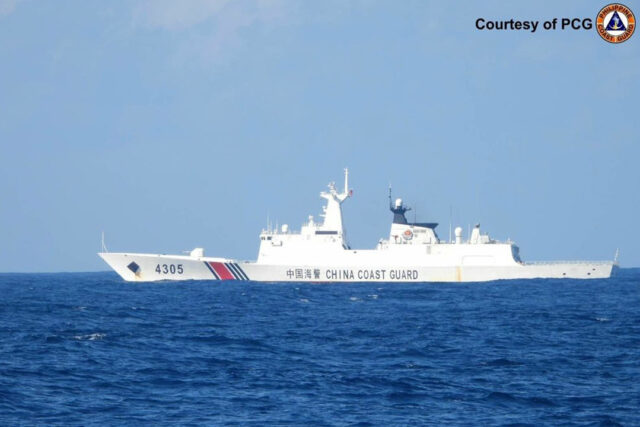
THIS PHOTO taken by the Philippine Coast Guard (PCG) shows one of the two Chinese coast guard vessels shadowed by the BRP Cabra about 26 nautical miles (48.15 kilometers) east of Scarborough Shoal, Nov. 23, 2025. — PCG

MANILA — The Philippines said on Monday it rejected Beijing’s assertion of sovereignty over the entire South China Sea, disputing a claim by China’s embassy that a Filipino diplomat had once conceded the disputed Scarborough Shoal was not part of Philippine territory.

“China must be reminded that maritime and territorial claims are subject to established international legal procedures and dispute settlement mechanisms, not through unilateral proclamations or social media posts,” Philippine foreign ministry spokesperson Rogelio Villanueva told a briefing.

Mr. Villanueva said the Philippines had “indivisible, incontrovertible and longstanding sovereignty” over Scarborough Shoal and the islands Manila holds in the Spratly archipelago.

The remarks are the latest in a war of words between Philippine officials and the Chinese embassy in Manila. The Chinese embassy in Manila said on Tuesday that China “has never laid claim” to the entirety of the South China Sea as its territory.

“The Philippine side’s deliberate distortion of China’s position is unconstructive and has no merit,” embassy spokesperson Ji Lingpeng said in a statement posted on social media.

The Philippines and China both lay claim to the Scarborough Shoal, which is effectively under Beijing’s control through continuous deployment of its coast guard. Sovereignty over the atoll has never been formally established.

STRATEGIC SHOAL
Mr. Villanueva was responding to a weekend social media post by the embassy that said a former Philippine ambassador had told a German radio station that Scarborough Shoal did not fall within Manila’s territory.

Located 200 kilometers(124 miles) off the Philippines and inside its exclusive economic zone, the strategic shoal is located close to major shipping lanes and is coveted for its fish stocks and a turquoise lagoon that provides safe haven for vessels during storms.

“Sovereignty is not merely claimed, it is exercised,” Mr. Villanueva said.

The Philippines and China have been locked in a series of maritime confrontations in recent years, with the Philippines accusing Beijing of aggressive actions inside its EEZ.

Those include water-cannoning and interference in resupply missions to Philippine-held features that Manila has often called “dangerous maneuvers”. China has insisted its coast guard has acted professionally to defend what is its territory.

The Philippines won a landmark case at the Permanent Court of Arbitration in 2016 that found China’s sweeping claim of sovereignty in the South China Sea had no basis under international law, a decision that Beijing continuously rejects. — Reuters