
End-March 2025 PHL Debt-to-GDP ratio soars to 62%, highest since 2005
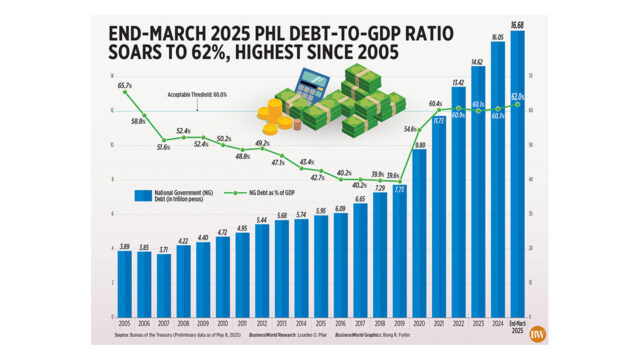
NATIONAL GOVERNMENT (NG) debt as a share of gross domestic product (GDP) rose to 62% at the end of the first quarter, the highest in 20 years. Read the full story.

NATIONAL GOVERNMENT (NG) debt as a share of gross domestic product (GDP) rose to 62% at the end of the first quarter, the highest in 20 years. Read the full story.

Why do people travel? (Or daydream about it when physical travel is not possible?)
One needs to shift to low gear and shut out everything familiar. Leisure travel rejuvenates the body and energizes the spirit. Crossing time zones is a delightful but exhausting exercise.
Geographical distance makes one shed the city skin and crusty attitude. Perspective improves in a different environment. Problems seem diffused and recede into the background. Worries melt away as the mind recharges in a stress-free mode.
One blinks to experience other facets of nature — the seasons in a temperate zone.
Retracing the old paths, one feels a spark. The earth-tugging ache blends with the novelty of a new vibe. It is rediscovering the past and seeing it with a new pair of eyes in a dreamy light.
The vibrant city, with its two mountains, is more alluring than ever. The iconic landmarks — the famous basilica, a work in progress with its surreal organic towers and the rainbow-stained glass windows, the Medieval cathedral in the Gothic barrio, the fantasy park, the wide avenidas, paseos and rotundas with sparkling fountains that glow after a downpour. Walking in the rain is always refreshing. It makes one feel light-hearted.
The elegant villa, isolated on a hill with a panoramic view, was a second home. Surrounded by flowering trees and insulated from distractions and outsiders, it was a place for study and to learn about the old world, its different cultures. The student needed to grow up, and to sprout the wings of independence. It was a big challenge to be transplanted at a young age and to adjust — at the beginning.
But it opened the mind to knowledge and brought wonderful changes through new friendships that bridged countries and cultures.
Many years later, the old bonds remain as the friendships have been rekindled and nourished.
The third home was a different villa with towering cypress trees on one hill of the eternal city. It offered exciting academic challenges, and new travel and artistic adventures. The historical place had basilicas, museums, majestic gardens with countless fountains and umbrella pine trees, a piazza with an obelisk, stately monuments and ancient ruins. The images and feelings of that year are forever etched in the mind and heart.
The years fly by quickly. One keeps returning to the past haunts — during the seasons of spring and autumn. Despite time and distance, the enchantment and deep attachment linger.
One shifts to another time zone at a mountain retreat. What could be more exhilarating than ascending to the peak in a cable car and being on top of the world? A place filled with pure snow and intricate snowflakes.
A passing light shower glazes the lush forest and meadows.
Raindrops glisten like icicles on the dark boughs of fir, pine, and birch trees.
Mist surrounds the mountains and the valleys. The scene is frozen in a time bubble.
The aroma of fresh pine wafts through the thin air. Oxygen is abundant and it pierces the nostrils and lungs. One inhales its pristine sweetness and is quickly intoxicated.
To bask in the golden sunshine with the breathtaking splendor of the mountain is a soulful experience.
The mental cobwebs melt away.
An eagle soars with the wind. It circles above and crosses to the next mountain. Fresh powder snow dusts the peak.
The sky becomes an infinite canvas as it turns vermilion, russet, and lavender. The sun dips into the horizon. One can hear the dramatic music of Beethoven’s violin concerto. An eclectic audience is enthralled by the music. During the final movement, light raindrops fall in a natural rhythm accelerating to a stirring crescendo. Symphonic music and a dramatic curtain call at sunset.
Twilight comes in shades of indigo, purple, and dark blue.
Soon it is nightfall. Only the sound of crickets, a rustling breeze, and the gurgling brook echo through the trees.
The crescent moon and stars slowly peek through the thinning clouds. At midnight, it is so quiet that one can almost hear the rocks grow.
At dawn, the sky is powder blue, dotted with delicate drifting white puffs. The pine scent mingles with the dew-kissed lawn. The lilting melody in the distance is water tripping over rocks of the stream.
At thousands of feet above sea level, the view is spellbinding and inspiring.
The splendid canvas of nature would be a creative challenge to interpret.
How can a human paint the perfect landscape? Only the Divine Artist can create it with celestial strokes and cosmic colors.
High above the world, one can understand why the mystics and the world-weary seek refuge atop a peak. Serenity provokes deep thought and meditation. One feels so close to heaven that one can see a glimpse of infinity.
Maria Victoria Rufino is an artist, writer and businesswoman. She is president and executive producer of Maverick Productions.

I urge my fellow citizens to participate in the Philippine national elections by wisely casting your votes for candidates who share your values and will advocate for national issues important to you. It is our right and responsibility as citizens to elect officials who will guide our country toward a more equitable future. After all, in the words of Thomas Jefferson, “We do not have a government by the majority. We have government by the majority who participate.”
In previous columns, I have discussed the tremendous economic opportunity in the Philippines, with our young, growing population driving consumer spending for the next 40 to 50 years. At the same time, we continue to face global macroeconomic headwinds. In the 2024 World Competitiveness Ranking by the Institute of Management Development, the Philippines ranked 52nd out of 67 economies and 13th out of 14 Asia-Pacific economies. The time is now for our leaders and future leaders to implement policies and mechanisms to help the Philippines navigate these volatile times and become more globally competitive.
First and foremost, economic growth must be inclusive and broad-based so that all sectors of society will benefit. Inclusive growth directly tackles poverty reduction by creating better economic opportunities that translate into a stronger, more vibrant economy. The Philippine Development Plan 2023-2028 highlights this importance; however, an April 2025 survey of the Social Weather Stations showed that self-rated poverty rose, with 15.5 million families estimated to be self-rated poor. This is 15.5 million families too many, and we must elect a government that works for all Filipinos instead of the interest of a select few.
Second, good governance, transparency, and honest officials are vital in creating a stable business environment and attracting local and foreign investment. These reduce the risk of corruption that takes funds away from important projects that benefit society and instead enriches only a few. FINEX and other organizations like the Makati Business Club and the Management Association of the Philippines signed a statement calling for a transparent and accountable budget process in response to what President Marcos called a “sub-optimal” 2025 National Budget. The bicameral committee reduced allocations for programmed, priority projects of the government, instead reallocating funds to lower value local infrastructure projects and types of unconditional cash transfers. These projects are rife with corruption and enable pork barrel politics. The budget must be safeguarded, especially funds for essential public services such as healthcare and education. We must elect officials who uphold the standards of integrity, candidates who are beyond reproach, and candidates who have not had allegations of graft or corruption levied against them.
Department of Budget and Management (DBM) Secretary Amenah Pangandaman was the keynote speaker at a FINEX General Membership Meeting. She shared the DBM’s plans to ensure accountability in budget disbursements while inviting FINEX to participate in the Philippine Open Government Partnerhsip. She also stated that transparency and accountability are at the forefront of the DBM’s Agenda for Prosperity.
We also have to continue improving the ease of doing business to make the Philippines a competitive destination for investment. In 2023, the World Bank ranked the Philippines 95th out of 190 in terms of ease of doing business. Government reforms, such as the Ease of Doing Business and Efficient Government Service Delivery Act of 2018 and the formation of the Anti-Red Tape Authority, are steps in the right direction, especially as excessive bureaucracy also incentivizes corruption to facilitate transactions.
My economic wishlist is much longer and centered on electing public servants who will authentically serve the public. It includes developing long-term solutions to our energy and water problems, strengthening our agricultural sector, making our education system more globally competitive, incentivizing foreign investment, and negotiating trade agreements with like-minded partners. The task is daunting; we need the right leaders to get us there. Your vote is key in electing our leaders, so participate by voting wisely and supporting candidates who will work for the best interest of our nation.
The views expressed herein are his own and do not necessarily reflect the opinion of his office as well as FINEX.
EJ Qua Hiansen is the CFO of PHINMA Corp. and president of the Financial Executives Institute of the Philippines.

ST TELEMEDIA Global Data Centres (STT GDC) Philippines is confident about the continued growth of data centers in the country as more businesses transition to cloud-first policies, according to its chief executive officer (CEO).
“In the Philippines, data center customers are predominantly still in the financial services sector, telecommunications, information systems-intensive applications, and the hyperscalers,” STT GDC Philippines President and CEO Carlomagno E. Malana said during the company’s “Practical Insights” event on Thursday.
“When you look at these enterprises and organizations, they all have a cloud-first policy now because it’s the most efficient way to harness, compute, and store resources,” he added.
A 2023 survey commissioned by Alibaba Cloud showed that approximately 85% of businesses in the Philippines are expected to transition to the cloud by the end of the year.
The rise in cloud adoption, coupled with the increasing use of agentic artificial intelligence, is driving the growth of data centers as companies continue to expand their IT infrastructure.
Mr. Malana also highlighted the opportunity for the Philippines to capture demand for data centers, citing the land and power constraints in more established markets like Singapore.
“Singapore is a city with a very small land footprint, so they have a problem with space and power allocation,” Mr. Malana said.
“Essentially, that’s caused other countries to become more viable for data centers, like Malaysia, Thailand, Indonesia, and the Philippines.”
Currently, the Philippines has a total data center capacity of 215 megawatts (MW), with 1,505 MW in the pipeline, according to Leechiu Property Consultants.
STT GDC Philippines, a joint venture between Globe Telecom, Inc., Ayala Corp., and ST Telemedia Global Data Centres, operates seven data centers in the country with a combined IT load of 150 MW.
The company expects to complete two new data centers — the 124-MW STT Fairview and 6-MW STT Cavite 2 — this year, with a combined investment of up to $1.56 billion.
“Data center costs are calculated by dollars per megawatt. The usual figure you hear ranges from somewhere around $11 to $12 million per megawatt — it can be a little bit less or more,” Mr. Malana said.
STT GDC is also working on completing the design for phase two of the STT Fairview data center by the end of this year. The Quezon City-based facility will be developed in four phases. — Beatriz Marie D. Cruz
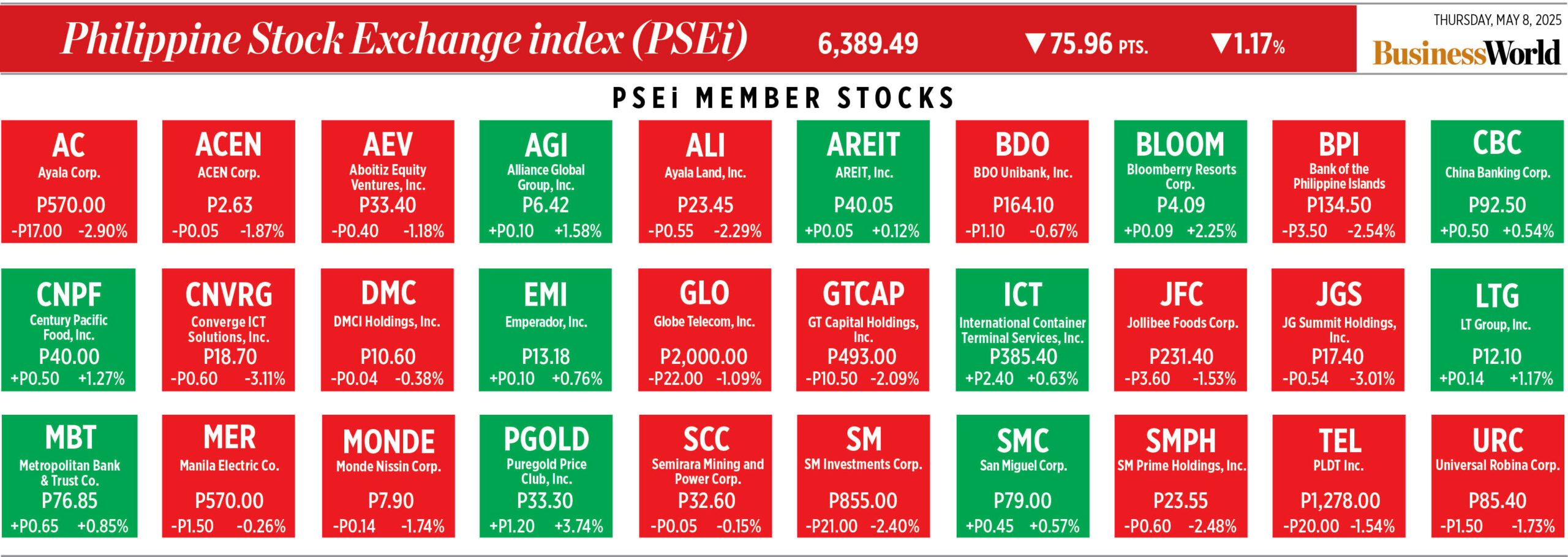
Here’s a quick glance at how PSEi stocks fared on Thursday, May 8, 2025.


By Kenneth Christiane L. Basilio, Chloe Mari A. Hufana and Adrian H. Halili, Reporters
SENATORIAL candidates in this year’s Philippine midterm elections will prioritize small business development, while cushioning local industries from a looming global trade war that puts economic growth, jobs and wages at risk.
They also vowed to push more jobs and measures that would boost food security amid rising global prices.
 “The solution to that is jobs, jobs, jobs,” former Senator and pound-for-pound boxing camp Emmanuel “Manny” D. Pacquiao, who is running for a Senate seat on May 12, told BusinessWorld in Filipino. “I will push for massive investments in public infrastructure especially in rural areas and support programs for micro, small and medium enterprises (MSME).”
“People need livelihoods, not just dole-outs,” he said in a Viber message.
The government of President Ferdinand R. Marcos, Jr. has missed growth targets in the past two years, with economic output expanding by 5.5% in 2023 — below the 6-7% — and 5.6% in 2024, falling short of the 6-6.5% goal.
Mr. Marcos will enter the second half of his term this year, three years after pledging to revive an economy weakened by the COVID-19 pandemic, subdued consumption and lower farm output.
The Philippines is also under pressure to boost intra-regional trade as US President Donald J. Trump’s tariffs increasingly jam the wheels of a global economy that for decades had been oiled by predictable free trade.
BusinessWorld sought the comments of the top 18 senatorial bets in mid-April on key economic issues, but only Mr. Pacquiao, Las Piñas Rep. Camille Villar-Genuino, former Senator Panfilo M. Lacson and Party-list Rep. Erwin T. Tulfo replied.
“One of my top priorities will be to drive inclusive economic growth by empowering MSMEs,” Mr. Lacson said in a Viber message. “They are struggling due to limited access to capital, red tape and rising costs.”
MSMEs account for more than 99% of all businesses in the Philippines, generate 67% of the country’s total employment and contribute about 40% to gross domestic product (GDP), according to the United Nations Development Program.
Mr. Lacson said he would push measures that would simplify business rules, provide tax incentives and ease access to MSME loans.
Meanwhile, Ms. Villar said she would file bills that seek to boost the agriculture, manufacturing and service sectors, while reforms in business regulation and good governance would help attract investments.
“The country needs to focus on three critical areas — enhancing competition and global integration, investing in skills and strengthening institutions,” she added.
Mr. Tulfo said he would propose measures that would expand irrigation systems and support the construction of post-harvest facilities and extend assistance to local producers especially during crises.
“We will push for the effective implementation of the Ease of Doing Business law in the country so more investments will enter the country to generate more jobs for Filipinos,” he added.
NO NEW TAXES
All four candidates were reluctant to raise or introduce new taxes, focusing instead on improving tax collections.
“The government should first address the leakages in tax administration,” said Mr. Lacson, who championed the campaign against pork barrel funds when he was still a senator, before these were voided by the Supreme Court for being illegal. He vowed to strictly oversee the government budget if elected senator.
Finance Secretary Ralph G. Recto last week said the government was not looking to impose new taxes after the state met its revenue goals. The government collected P931.5 billion in revenue in the first three months.
Mr. Tulfo said he plans to oversee the implementation of the Ease of Paying Taxes Law, ensuring it is properly enforced to enhance revenue collection without introducing new taxes.
“I’m for tax implementation and honest tax collection, and going after those who evade taxes,” Ms. Villar said.
“I do not want to add more burden on the poor,” Mr. Pacquiao said. “Before discussing new taxes, we must first eliminate corruption and enhance tax collection efficiency.”
The senatorial candidates also vowed to file measures that would protect local industries and promote industry diversification amid US President Donald J. Trump’s sweeping reciprocal tariffs.
The Philippines should develop its domestic industries to cushion itself from global economic uncertainties, they said.
“We really must strengthen domestic production and commerce by supporting our local producers and MSMEs,” Mr. Tulfo said.
He said he would gather relevant agencies such as the Trade and Agriculture departments to devise a strategy that would cushion exporters from the looming global trade war.
“If we have reliable commerce in the country, we can replicate it by diversifying our exports to other countries,” he added.
Mr. Pacquiao said there’s a need to invest in industries the Philippines is strong at, such as agriculture, digital services and the creative industries.
“I will support trade diversification and push for better trade deals with the Association of Southeast Asian Nations (ASEAN) and Asia-Pacific nations to lessen reliance on US-China markets,” he added.
The government should prioritize the passage of a bill diversifying the country’s trade and investment partners, Mr. Lacson said. “Trades from undertapped regions like Southeast Asia, Africa and Europe should be incentivized through simplified export procedures, reduced tariffs and trade agreements,” he added.
“Before allowing measures that would free up trade restrictions, we should ensure that our own products are globally competitive,” Mr. Lacson said.
Ms. Villar said the Corporate Recovery and Tax Incentives for Enterprises to Maximize Opportunities for Reinvigorating the Economy (CREATE MORE Act) would “strengthen our ability to attract investors looking to expand or relocate to the Philippines, given the relatively lower tariffs imposed on our exports to the United States.”
Mr. Pacquiao and Mr. Lacson also cited the need to promote renewable energy such as solar, wind, and nuclear power.
The boxing champ said the country should seriously consider setting up nuclear power plants to support industry and household power needs.
Fiber optic technology could revolutionize power transmission by ensuring faster, more efficient and stable energy distribution across the region, he added.
“Unlike traditional copper wiring, fiber optics minimizes energy loss, reduces maintenance costs and improves overall power infrastructure resilience,” he said, adding that the country should upgrade its fiber optic networks nationwide to ensure connectivity.
ELECTRICITY PRICES
Mr. Lacson said access of Filipino farmers to alternative energy sources should be improved, while tax incentives should be given to renewable energy generation companies.
“Lawmakers can also use their oversight powers to look into whether existing laws on electric cooperatives are being implemented properly,” he said. “The Senate should move for an audit of all add-on charges on electric bills, such as contract costs, universal charges and system losses.”
Mr. Lacson also proposes to put a cap on system losses, which are passed on to consumers, to lower electricity prices.
“Since consumers bear the brunt, power generation companies tend to become lax in rendering services. Thus, in effect, we consumers are rewarding them for not doing their job,” he added.
Mr. Lacson said changes to the Electric Power Industry Reform Act should include transparency in power supply agreements between distribution and generation companies to prevent pass-on costs detrimental to the public.
Ms. Villar plans to cut the “excessively high 15% weighted average cost of capital,” which she said raises electricity costs.
She also wants to review all “unfair and fraudulent contracts, power shortages and delayed transmission projects that directly affect consumers.”
Meanwhile, Mr. Pacquiao and Mr. Tulfo want to amend the Rice Tariffication law.
“Support local production,” Mr. Pacquiao said. “I will push for the review of the Rice Tariffication law and give more subsidies to our rice farmers.”
Mr. Tulfo said restoring the power of the National Food Authority to buy and sell rice “will pave the way for cheaper options and competition,” as traders and middlemen continue to manipulate farmgate and retail prices.
Ms. Villar, whose mother was the principal of the Rice Tariffication law, said she would push the appointment of an official responsible for keeping rice prices stable.
“I am for the designation of a rice czar who will complement the Agriculture secretary in efforts to maintain the price of rice,” she said. “He will also manage the sustainability of rice in the market.”
“I will file a ‘Farmer First’ law — more budget for irrigation, mechanization and farm-to-market roads,” Mr. Pacquiao said. “We need food terminals and cold storage facilities so that farmers don’t lose money.”
Ms. Villar said that she would support state efforts to modernize agriculture by mechanizing farm processes, improving farm and post-harvest infrastructure, enhancing logistics and adopting science-based strategies.

By Ashley Erika O. Jose, Reporter
BROWNOUTS have been a recurring problem for the Philippines during summer, and Monday’s midterm elections won’t be spared from a looming power interruption that threatens their integrity, according to climate scientists.
“Although elevated electricity demand during the summer contributes to power supply issues experienced during these months, forced outages of baseload power plants have constantly exacerbated the situation,” said Jephraim C. Manansala, chief data scientist at Manila-based think tank Institute for Climate and Sustainable Cities (ICSC).
The Luzon and Visayas grids are projected to run out of adequate power reserves this year, while the Mindanao grid is expected to keep normal reserves this summer, he told BusinessWorld in an interview.
“Power plant outages especially unplanned ones, and plants running at a derated capacity could severely disrupt the balance between supply and demand, significantly hindering the grid’s ability to meet the country’s growing energy needs, especially during peak demand hour,” Mr. Manansala said.
In 2024, NGCP recorded 16 red alerts and 62 yellow alerts. This year, the Luzon grid has only been placed under yellow alert on March 5, according to the NGCP website.
Senator Sherwin T. Gatchalian has urged the National Grid Corp. of the Philippines (NGCP) and Department of Energy (DoE) to ensure enough electricity supply in the summer months, particularly this month as Filipinos vote for a new set of congressmen, half of the 24-member Senate and thousands of local officials on May 12.
Gerry C. Arances, executive director at the Center for Energy, Ecology and Development (CEED), blames the country’s continued reliance on coal for its power supply instability.
“Coal and gas plants going on unscheduled outages and triggering red and yellow alerts is the direct result of dependence on fossil fuels,” he said in a text message.
The Philippines is heavily reliant on fossil fuels, with coal accounting for more than 60% of its power mix. Natural gas and oil-based sources also contribute significantly. While the country is rich in renewable energy resources like geothermal and biomass, their use is less extensive.
Energy Secretary Raphael P.M. Lotilla earlier said the country might be in a better situation this year because several power projects are coming online and newly energized transmission lines could deliver more output.
On Monday, he said there would be stable and reliable power supply on May 12.
“We’d like to assure everyone that the Energy Task Force on Elections is doing its best to ensure unimpeded power supply during the election period,” Energy Undersecretary Felix William B. Fuentebella said in a statement.
He said generating companies have committed to avoid unplanned outages during the elections.
He added that there had been issues or concerns about the power lines in the Visayas and Mindanao. “But as a whole, on the demand and supply outlook, it is stable.”
“Although we are preparing for any eventual outages, we have tapped the NGCP and distribution utilities to check potential load side particularly in the canvassing centers,” he added.
‘ON THEIR TOES’
Mr. Manansala said unplanned power outages beyond the conservative assumptions could further deplete reserve levels, increasing the risk of grid instability.
This year, the DoE projects peak demand at 14,769 megawatts (MW) for Luzon, 3,111 MW for the Visayas and 2,789 MW for Mindanao. If realized, these will surpass last year’s peak demand of 14,016 MW for Luzon, 2,681 MW for the Visayas and 2,577 MW for Mindanao.
“The DoE, Energy Regulatory Commission and other power authorities need to be on their toes in ensuring that generation companies and service providers deliver stable electricity, considering projections that warn of potential yellow alerts in May,” Mr. Arances said.
Any power player that triggers a power outage should be penalized, he added.
“The reality of perennial power outages, however, goes well beyond May,” he pointed out. “We would be gambling on the integrity of our election every single time unless we address the root cause — grave dependence on coal and gas power plants, which are the main culprit to power unreliability due to their vulnerability to forced shutdowns, especially in the summer.”
The recurring issue of power supply deficiency highlights the vulnerability of the grid system, which is centralized and heavily reliant on baseload plants such as coal and natural gas, ICSC said in a report.
It said the government should focus on energy efficiency and conservation to ensure adequate power supply in the summer.
Consumers also play a critical role in demand-side management by adopting energy efficiency and conservation practices, it said.
Measures such as shifting energy-intensive activities to nonpeak hours, upgrading to efficient technologies and adopting energy-saving habits in homes and workplaces could significantly alleviate grid strain, it added.
Romil Hernandez, director for energy policy at ICSC, said the Luzon power grid might be placed under yellow alert this month, but the likelihood of a red alert is unlikely until June or after the election period.
“In the Visayas, tight supply is also expected in June,” he said in a Viber message. “Mindanao, on the other hand, is expected to have normal reserves and could export power to the Visayas.”
“Like in previous years, no major planned maintenance outages are scheduled in the second quarter, but even if power supply during the elections falls within the normal operating margin, vigilance is necessary to manage unplanned outages,” he added.

By Adrian H. Halili, Reporter
THE ARMED Forces of the Philippines (AFP) on Thursday condemned the “aggressive and unsafe” maneuvers of two Chinese navy ships and a Chinese Coast Guard vessel near a disputed shoal in the South China Sea.
“The Armed Forces of the Philippines (AFP) expresses its serious concern over these irresponsible actions by Chinese maritime forces,” it said in a statement. “Such threatening and provocative conduct can lead to misunderstanding that may escalate tensions and impact regional stability.”
The AFP said that BRP Emilio Jacinto (PS35) on Monday encountered People’s Liberation-Army Navy vessels Jiangkai II-class frigates (Type 054A) with bow numbers 554 and 573, and a Chinese Coast Guard vessel with bow number 5403 that proceeded to conduct “aggressive and unsafe” maneuvers 11.8 nautical miles (21.9 kilometers) southeast of Scarborough Shoal.
“The Chinese frigate BN 554 was documented tailing PS35 at close range, while BN 573 dangerously crossed its bow in a high-risk maneuver that created the danger of collision,” it said. “China Coast Guard vessel 5403 also attempted to obstruct PS35’s navigational path.”
The Philippine vessel was conducting a routine maritime patrol alongside vessels from the Bureau of Fisheries and Aquatic Resources and Philippine Coast Guard when the incident happened.
Named after a British ship that was grounded on the atoll nearly three centuries ago, Scarborough Shoal is one of the most contested maritime features in the South China Sea, where Beijing and Manila have repeatedly clashed.
“These reckless actions not only posed a direct threat to the safety of navigation of PS35, but also violated the International Regulations for Preventing Collisions at Sea,” the AFP said.
The Chinese Embassy in Manila did not immediately reply to a Viber message seeking comment.
China disputed the Philippine account, accusing Manila’s vessel of “attempting to invade” Beijing’s territorial waters, Colonel Tian Junli, a spokesman for the Southern Theater Command, said in a statement.
“(Scarborough Shoal) is China’s inherent territory,” he said. “We urge the Philippine side to immediately cease its infringement, provocation and distorted speculation.”
“Theatre troops are on high alert at all times, resolutely defending national sovereignty, maritime rights and interests, and resolutely maintaining peace and stability in the South China Sea region,” he added.
Separately, Senate Majority Leader Francis N. Tolentino called on the Department of Foreign Affairs (DFA) to file a diplomatic protest against China.
“I call once again on the DFA to lodge a strong diplomatic protest and urge our allies and international partners to stand with the Philippines in condemning this latest provocation,” he said in a statement.
He added that Beijing’s actions were reckless and dangerous and a “blatant violation of international maritime norms and an affront to Philippine sovereignty.”
Mr. Tolentino said China’s continued presence and intimidation tactics in the South China Sea are a clear disregard of the rule of law and an attempt to undermine peace and security.
Josue Raphael J. Cortez, a diplomacy instructor at De La Salle-College of St. Benilde’s School of Diplomacy and Governance, said the Philippines should continue to undertake patrols in the South China Sea to protect the country’s rights.
“Joint patrols can also be undertaken alongside like-minded nations,” he said in a Facebook Messenger chat. “Although this may alarm China, in light of all these incidents, a collective action to respond is certainly necessary.”
He added that diplomatic protests are no longer a viable option for the Philippines since China continues to ignore them. “Therefore, we must rethink our response to these threats, without of course simply turning to the use of hard power.”
Philippine-China ties have worsened in recent years due to repeated encounters between their coast guard ships in the South China Sea over competing claims on the Spratly Islands and Scarborough Shoal, among other sea features.
China claims more than 80% of the South China Sea based on a 1940s map, which a United Nations-backed arbitration court in The Hague voided in 2016 for being illegal. Other countries like Brunei, Indonesia, Malaysia, and Vietnam also have claims in the disputed waterway.

THE COMMISSION on Elections (Comelec) on Thursday dismissed vote-buying charges against a Marcos-backed senatorial candidate for insufficient evidence.
In a May 7 letter signed by Vice-Chairman Teofisto E. Elnas, Jr., a Comelec committee said Las Piñas Rep. Camille Villar-Genuino had “satisfactorily explained” the circumstances surrounding the alleged election offense.
“Upon evaluation of the evidence gathered, the undersigned deems the same insufficient to proceed with the filing of a complaint for election offense and/or a petition for disqualification,” he said.
Ms. Villar, who is seeking to replace her mother Cynthia in the Senate, welcomed the decision.
“I assure everyone that I am running on a clean platform, pursuing only my advocacies that aim to make lives better for Filipinos,” she said in a statement.
The Comelec committee acted on an anonymous complaint that included a Facebook video posted on Feb. 16 showing Ms. Villar on stage while local candidates allegedly raffled off cash prizes for the audience.
Ms. Villar clarified that the event took place on Feb. 9, two days before the official campaign period, adding that that she was just a guest at the event.
She is among 14 senatorial bets deemed to have a statistical chance of winning on May 12, based on a Pulse Asia survey released on Monday.
President Ferdinand R. Marcos, Jr. skipped her name in the last two campaign sorties but mentioned her again in an endorsement speech at an election rally in Bulacan province on May 7.
Vice-President Sara Duterte-Carpio, whose family is in a bitter quarrel with the Marcoses, has also endorsed Ms. Villar for senator, apart from presidential sister and re-electionist Senator Maria Imelda “Imee” R. Marcos. — Chloe Mari A. Hufana

PHILIPPINE President Ferdinand R. Marcos, Jr., has approved the National Action Plan for Unity, Peace and Development, the country’s “strategic blueprint” to end communist insurgency and armed conflict and achieve peace.
Signed by Executive Secretary Lucas P. Bersamin on May 2, Memorandum Circular No. 83 mandates the adoption of the blueprint, which outlines strategies to advance the whole-of-nation approach in addressing the root causes of insurgency.
The National Task Force to End Local Communist Armed Conflict (NTF-ELCAC) will monitor and evaluate the implementation of the programs under the plan and submit annual reports to the Office of the President through the Office of the Executive Secretary. — Chloe Mari A. Hufana

THE DEPARTMENT of Education (Deped) plans to roll out its revised Senior High School (SHS) curriculum for the 2026-2027 school year.
“We will be rolling out the pilot study for this coming school year, but we would like to see the full rollout happen by the next school year,” Education Undersecretary Malcolm S. Garma told a Senate hearing on Thursday.
He said the agency would pilot the curriculum in 727 schools nationwide starting June. He added that 567 public schools and 160 private schools would participate in the program.
Senator Sherwin T. Gatchalian called on the DepEd to include more schools in rural areas in the pilot program.
“The problem of rural and urban areas are wildly different in terms of specialization and materials,” Mr. Gatchalian said. “There are only 20 [schools from rural areas] out of the 727. That might not be a good representation of the pilot implementations. It should be 50-50.”
DepEd has reduced the educational tracks for senior high school to two — academic and technical-professional — from the previous four (academic, technical-vocational-livelihood, sports, and arts and design).
It also cut the number of core subjects to five from 15. The five subjects are Effective Communications, Life Skills, General Mathematics, General Science Study of Philippine History and Society. — Adrian H. Halili
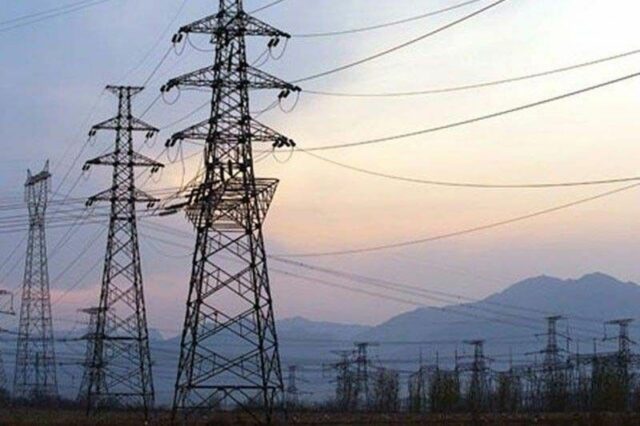
THE NATIONAL Grid Corp. of the Philippines (NGCP) has suspended all maintenance activities until Monday as part of contingency measures for the May 12 midterm elections.
The suspension for maintenance and construction activities started on Monday, NGCP said in a statement on Thursday, noting that construction and noncritical maintenance activities near substations and transmission lines had been suspended from May 5 until May 16.
“NGCP is strictly following its contingency measures and coordinating with concerned groups to ensure a power interruption-free election, especially during the crucial periods prescribed by the Commission on Elections,” it added.
Maintenance works and construction activities in substations and within 300 meters of energized power lines were also suspended from May 5 to May 16. — Ashley Erika O. Jose
