Home Blog Page 1576

ERC delays ruling on 19 NGCP AS agreements

JUDGEFLORO

THE Energy Regulatory Commission (ERC) said it has put on hold until March decisions on several ancillary service procurement agreements (ASPA) submitted by the National Grid Corp. of the Philippines (NGCP) and its potential suppliers.

“Given the pending issues that needed to be addressed, the matter has been deferred for further deliberation,” the ERC said in a notice of commission action posted on its website.

Among the 19 ASPAs pending ERC decision are NGCP deals with Masinloc Power Partners Co. Ltd., a unit of San Miguel Global Power Holdings Corp.; Ingrid Power Holdings, Inc., an arm of ACEN Corp., and Aboitiz Power Corp.’s Therma Luzon, Inc.

These ASPAs were signed in the wake of a competitive bidding exercise in 2023.

ASPA suppliers are on standby to provide power to the grid when regular sources prove inadequate. They are intended to stabilize the supply available to the grid.

Asked to comment, ERC Chairperson and Chief Executive Officer Monalisa C. Dimalanta said some data remains pending from the technical team before deliberations can wrap up.

“We will finalize this early March,” she said.

Ms. Dimalanta said that the delays will have no impact on the reliability of power services.

“We do not see the deferral affecting power reliability since we have good level of reserves also available on the Reserve Market at this time,” she said.

The reserve market allows the system operator to buy power reserves from the wholesale electricity spot market — the trading floor for electricity — to meet the reserve requirements of the energy system.

Reserves are needed to maintain balance in the power system to ensure normal frequency and voltage levels in response to demand changes, variability of renewable energy, and a possible loss of a large generating unit.

Last year, the ERC capped the price for the power reserve market at P25 per kilowatt-hour.

The full commercial operations of the reserve market started in January 2024. — Sheldeen Joy Talavera

PHL Gen Z hotel spending averages $50 per day — Agoda

PHILSTAR FILE PHOTO

TRAVEL booking service Agoda said 57% of Generation Z travelers prefer to keep accommodation costs to $50 per person per night.

“This trend underscores a shared commitment to affordable travel without compromising on experiences,” Agoda said.

The digital platform also noted that 22% of Gen Z relies on social media in planning travel, particularly TikTok.

Some 17% say they consult travel blogs and vlogs, with millennials more likely to rely on personal recommendations from family and friends.

Agoda also noted the rise of last-minute bookings among Gen Zs, with one in seven booking accommodations less than a week in advance. One in eight Gen Z travelers also book last-minute flights. 

“Filipino Gen Z travelers are demonstrating a strong appetite for discovery, with a preference for spontaneity, and affordable yet meaningful travel experiences,” Michael Hwang, country director for the Philippines in Agoda, was quoted in a statement.

“These behaviors are reinforcing Gen Z travelers’ need for flexibility and digital-first experiences.”

The Gen Z Travel survey was conducted via Agoda’s platform between Jan. 10 and 31. It compiled answers of over 15,000 participants from the Philippines, Indonesia, India, Malaysia, Thailand, Vietnam, Japan, Hong Kong, South Korea, Singapore, and Taiwan. — Beatriz Marie D. Cruz

NU guns for 2-0 start vs rebuilding Blue Eagles

NATIONAL UNIVERSITY LADY BULLDOGS — UAAP/JOAQUI FLORES

Games on Wednesday
(Filoil EcoOil Centre)
9 a.m. – Ateneo vs NU (Men)
11 a.m. – Ateneo vs NU (Women)
3 p.m. – UP vs FEU (Men)
5 p.m. – UP vs FEU (Women)

POLAR opposites attract as reigning champion National University (NU) shoots for a fiery 2-0 bid against the rebuilding Ateneo de Manila University side, fresh from a debut meltdown, to run away from the pack in the UAAP Season 87 women’s volleyball on Wednesday at the Filoil EcoOil Centre in San Juan.

The Lady Bulldogs are coming off an impressive 3-0 win against rival De La Salle University, needing only 90 minutes to kick off their title retention bid on a high while the Blue Eagles wasted a 2-0 lead opposite the Adamson University Lady Falcons.

And as expected, NU, led by the lethal duo of Season MVP Bella Belen and Finals MVP Alyssa Solomon looms to prevail anew at 11 a.m. after the duel of their men’s teams at 9 a.m. Opening-day victors University of the Philippines and Far Eastern University also clash at 3 p.m. (men’s) and 5 p.m., (women’s), respectively.

“Any opponent, on the lower or higher rank, we are one point at a time,” said coach Sherwin Meneses, a winner in his UAAP return with the powerhouse Lady Bulldogs this time.

Mr. Meneses, a former coach in his alma mater Adamson, was gifted by the NU an easy 25-23, 25-21, 25-18 win over La Salle, considered as its biggest challenge in back-to-back goals.

Against Ateneo, the concurrent mentor of PVL dynasty Creamline is not keen on displaying any inch of complacency.

Ateneo, for its part, will have some business to settle after failing to complete a supposedly flying debut, on top of a leg injury suffered by seasoned spiker Geezel Tsunashima.

The Blue Eagles surrendered a 25-21, 20-25, 12-25, 15-25, 12-15 loss at the hands of the vastly improved Lady Falcons, led by super rookie Shaina Nitura who smashed the UAAP debut record with 33 points.

Coming back from that one, however, would not be an easy nut to crack, especially at the jaws of the mighty Lady Bulldogs. — John Bryan Ulanday

Sabrina Ionescu is coming to Manila

WNBA CHAMPION Sabrina Ionescu of New York Liberty, an Olympic gold medalist who still holds the record for most career triple doubles across the US NCAA, is coming to Manila.

She is a gamechanger, reinventing what’s possible for female athletes in life and sport. She’s a pioneer, creating space for girls to follow in her footsteps. And she’s a role model, inspiring the next generation to dream big, then do everything it takes to turn those dreams into reality.

Ahead of Sabrina’s campaign to defend her first WNBA title, she’s embarking on her first Asia tour, visiting China and the Philippines to share this message of empowerment with young hoopers and further introduce herself to the global basketball community.

“I’m excited to connect with basketball fans across Manila, Guangzhou and Hong Kong, especially young hoopers. You can feel their passion for the game, even from New York,” says Sabrina. “Together we will celebrate the game, and I hope we inspire each other to achieve our dreams with dedication, commitment and hard work.”

Sabrina will spend the first part of her tour in Manila, an international hoops hub with a longstanding connection to Nike basketball. She starts off with a visit to Nike Fort in Bonifacio Global City on March 10 for a panel talk with fellow Nike athletes and coaches at 3 p.m. The panel will talk about breaking barriers and defying stereotypes so hoopers can realize their dreams and inspire the next generation. During her stay, Sabrina will also lead a basketball clinic at The Courtyard, launch a Nike Sabrina 2 collaboration, and participate in an electrifying showcase with some of the Philippines’ best professional and collegiate players at the famed Araneta Coliseum.

At the Big Dome, Sabrina will get to experience up close how Pinoy hoopers play the game. She will take part in an exhibition game and do a 3-point shootout challenge on March 11 at 4 p.m. Filipino basketball fans are invited to register at https://www.nike.com/ph/basketball to witness and be part of the 2025 Sabrina Manila Tour: Craft the Future Showcase. Like Sabrina, female hoopers can break out of the mold, break barriers, achieve their dreams and inspire the next generation. Tickets to Craft the Future are FREE and will be available, first-come-first-served.

Sabrina will then continue to Guangzhou, China, where she will meet local athletes and visit some of their most hallowed courts — hosting a grassroots basketball camp for girls and sharing her messages of empowerment with female hoopers.

She will conclude her tour in Hong Kong, China, by getting a crash course in local hoops culture, experiencing street basketball in a local neighborhood and visiting two schools to help students learn to break through barriers in life and sport.

Gilas’ Doha trip designed to get feel of action at FIBA Asia Cup

THERE were hard lessons learned from the Qatar trip that Gilas Pilipinas hopes will serve it well moving forward.

The Nationals absorbed two blowout losses to Lebanon (54-75) and Egypt (55-86) and would have gone winless in the Doha Invitational Cup if not for a come-from-behind 74-71 opening victory over host Qatar.

“Bottom line is, we were not happy with our play,” coach Tim Cone told The STAR as he assessed the team’s performance against three tough Arab teams in three consecutive nights.

“We maybe bit off more than we could chew with this Doha trip. We didn’t respond well to the adversity of the long trip and the three games in a row. We were sluggish throughout and our usual ball movement was lacking.”

But Mr. Cone stressed this Middle East gig was designed to enable the Philippine squad to get a feel of what awaits in the FIBA Asia Cup to be held in Jeddah, Saudi Arabia in August.

And in this aspect, it was productive.

“We did achieve the goal of playing the Middle Eastern teams and seeing the problems they present. They were physical and we’ll need to adjust to that physicality in the future. We wanted this trip to be hard and perhaps it was a little harder than we anticipated,” he said.

After the Doha trip, the Nationals returned to Manila on Monday night for an overnight “homecoming.” Then on Tuesday, Justin Brownlee and Co. packed their bags again, this time heading to Chinese Taipei for their road assignment in the third window of the FIBA Asia Cup Qualifiers. The unbeaten Filipinos shoot for Win No. 5 against the Taiwanese (1-3) on Thursday night in the continuation of Group B hostilities. From Taipei, they fly to New Zealand afterward for what’s expected to be a grudge match against the Tall Blacks (3-1) on Sunday in Auckland.

“Now we move on to the real games, the ones that count. We’ll see if this experience (in Doha) helped us for our window,” said Mr. Cone.

Gilas, which is grappling with the absence of injured Kai Sotto, received a frontline boost with veteran Japeth Aguilar rejoining the team for Qualifiers after missing the Qatar trip.

“Japeth is on the trip to Taiwan,” said Mr. Cone. — Olmin Leyba

PHL men’s curling team gets added bonus of $5,000 each

THE Philippine men’s curling team of Marc and Enrico Pfister, Christian Haller, Alan Frei and Benjo Delarmente received an additional bonus of $5,000 each, or P291,000, for their historic Asian Winter Games gold medal in Harbin, China last week.

It came from the Philippine Olympic Committee (POC) after its president, Abraham Tolentino, personally handed the bonus on Monday before the squad left for Switzerland to resume training.

“The incentive may not be in parallel with their effort and dedication — and even the expenses they personally incurred — but it’s one small way for the POC to show its gratitude to the team,” said the Tagaytay City mayor.

It was apart from the P2 million, or P500,000 each of the squad members will get from government via the expanded National Athletes Incentives Act.

This came after Philippine Sports Commission (PSC) Chair Richard Bacmann vowed full support of the Filipino curlers as well as the whole winter sports teams that funded itself in Harbin and in their preparation leading up to it.

“The PSC remains committed to expand the necessary support for winter sports and provide appropriate programs that will be delivered within the grassroots level to sustain the achievements we attained and the growing dynamics of our local sports scene, making us equipped for greater challenges ahead,” said Mr. Bachmann.

Mr. Tolentino also vowed to ask no less than President Ferdinand R. Marcos, Jr. himself if they meet to help the national winter games team as they eye a breakthrough medal in the Winter Olympics in Italy next year.

Winter sports disciplines have yet to receive regular funding from government because they are still relatively new.

“The path to Milano Cortina has become clearer, and on to our goal of a first Winter Olympics medal,” said Mr. Tolentino. — Joey Villar

All-Star Game MVP Curry

It was probably only fitting that Stephen Curry walked away with the Kobe Bryant Trophy following a sterling showing in the final of the 2025 National Basketball Association All-Star Game the other day. After all, the festivities throughout the weekend were held in familiar confines. He certainly wanted to give the 17,539-strong Chase Center crowd cause to celebrate as he made up for a pedestrian showing in the Round of Four. Three of his four field goals were, naturally, from three-point territory: a one-leg runner to start an 11-0 blitz for the OGs after tipoff; a nonchalant pull-up from half court; and a trademark look-away to all but ensure victory.

Interestingly, fellow OGs starter Jayson Tatum could well have brought home the hardware with an even more impressive 15 points off six-of-seven shooting from the field, including three of four from beyond the arc. Eight of the aforementioned 11 points were his, as was the dunk to bookend the 41-25 shellacking. Not that he cared about the recognition in an exhibition; he had already claimed it in 2023, and, insofar as snubs go, his limited role in Team USA’s march for the gold at the Paris Olympics was far more egregious.

That said, Curry happily accepted the Most Valuable Player award — in part because he did play well enough to earn it, and in larger measure because he knew his second in four years was also likely his last. He was among the OGs for a reason; at 36, he understood that he was getting closer to retirement. And, to be sure, he enjoyed not just playing, but being instrumental in the outcome. Forget the stress-free atmosphere; his competitiveness compelled him to be at his best — and, in the process, to win.

This time next year, the format for the All-Star Game will most assuredly feature more tweaks. As entertaining as the proceedings the other day may have been, the experience was uneven at best. The marquee names, Curry included, seemed inclined to exert more effort on both ends of the court, but the truncated length of the set-tos tempered the pluses — not to mention highlighted the sheer number of disruptions due to sponsorship obligations. All the same, it was an improvement that heralded the promise of better things to come.


Anthony L. Cuaycong has been writing Courtside since BusinessWorld introduced a Sports section in 1994. He is a consultant on strategic planning, operations and human resources management, corporate communications, and business development.

Delta plane flips upside down on landing at Toronto airport

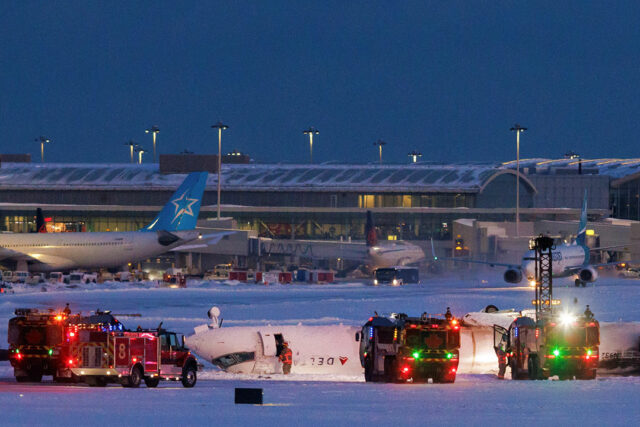
EMERGENCY RESPONDERS operate around a plane on a runway after a plane crash at Toronto Pearson International Airport in Mississauga, Ontario, Canada on Feb. 17, 2025. — REUTERS

TORONTO — A Delta Air Lines regional jet flipped upside down upon landing at Canada’s Toronto Pearson Airport on Monday amid windy weather following a snowstorm, injuring 18 of the 80 people on board, officials said.

Three people on flight DL4819 from Minneapolis-St. Paul International Airport suffered critical injuries, among them a child, a Canadian air ambulance official said, with 15 others also immediately taken to hospitals.

Some of the injured have since been released, Delta said late on Monday.

The US carrier said a CRJ900 aircraft operated by its Endeavor Air subsidiary was involved in a single-aircraft accident with 76 passengers and four crew members on board.

The 16-year-old CRJ900, made by Canada’s Bombardier and powered by GE Aerospace engines, can seat up to 90 people. At least one of the two wings was no longer attached to the plane, video showed after the accident.

Canadian authorities said they would investigate the cause of the crash, which was not yet known.

Passenger John Nelson posted a video of the aftermath on Facebook, showing a fire engine spraying water on the plane that was lying belly-up on the snow-covered tarmac.

He later told CNN there was no indication of anything unusual before landing.

“We hit the ground, and we were sideways, and then we were upside down,” Mr. Nelson told the television network.

“I was able to just unbuckle and sort of fall and push myself to the ground. And then some people were kind of hanging and needed some help being helped down, and others were able to get down on their own,” he said.

WEATHER CONDITIONS
Toronto Pearson Airport said earlier on Monday it was dealing with high winds and frigid temperatures as airlines attempted to catch up with missed flights after a weekend snowstorm dumped more than 22 cm (8.6 inches) of snow at the airport.

The Delta plane touched down in Toronto at 2:13 p.m. (1913 GMT) after an 86-minute flight and came to rest near the intersection of runway 23 and runway 15, FlightRadar24 data showed.

The reported weather conditions at time of the crash indicated a “gusting crosswind and blowing snow,” the flight tracking website said.

Toronto Pearson Fire Chief Todd Aitken said late on Monday the runway was dry and there were no crosswind conditions, but several pilots Reuters spoke to who had seen videos of the incident pushed back against this comment.

US aviation safety expert and pilot John Cox said there was an average crosswind of 19 knots (22 mph) from the right as it was landing, but he noted this was an average, and gusts would go up and down.

“It’s gusty so they are constantly going to have to be making adjustments in the air speed, adjustments in the vertical profile and adjustments in the lateral profile,” he said of the pilots, adding that “it’s normal for what professional pilots do.”

Investigators would try to figure out why the right wing separated from the plane, Mr. Cox said.

Michael J. McCormick, associate professor of air traffic management at Embry-Riddle Aeronautical University, said the upside-down position made the Toronto crash fairly unique.

“But the fact that 80 people survived an event like this is a testament to the engineering and the technology, the regulatory background that would go into creating a system where somebody can actually survive something that not too long ago would have been fatal,” he said.

Three previous cases of planes flipping over on landing involved McDonnell Douglas’s MD-11 model. In 2009, a FedEx freighter turned over on landing at Tokyo’s Narita airport killing both pilots. In 1999, a China Airlines flight inverted at Hong Kong, killing three of 315 occupants. In 1997, another FedEx freighter flipped over at Newark with no fatalities.

AIRPORT DELAYS
Flights have resumed at Toronto Pearson, but airport president Deborah Flint said on Monday evening there would be some operational impact and delays over the next few days while two runways remained closed for the investigation.

She attributed the absence of fatalities in part to the work of first responders at the airport.

“We are very grateful that there is no loss of life and relatively minor injuries,” she said at a press conference.

The Transportation Safety Board of Canada (TSB) said it was deploying a team of investigators, and the US National Transportation Safety Board said a team of investigators would assist Canada’s TSB.

Global aviation standards require a preliminary investigation report to be published within 30 days of an accident.

Japan’s Mitsubishi Heavy Industries, which closed a deal to buy the CRJ aircraft program from Bombardier in 2020, said it was aware of the incident and would fully cooperate with the investigation.

The crash in Canada followed other recent crashes in North America. An Army helicopter collided with a CRJ-700 passenger jet in Washington, DC, killing 67 people, while at least seven people died when a medical transport plane crashed in Philadelphia and 10 were killed in a passenger plane crash in Alaska. — Reuters


Thailand proposes tough safeguards for local gamblers in casino plan

BANGKOK — Thailand has proposed tough entry requirements for local punters in casinos as it plans to build a major gaming industry to boost tourism, new draft regulation released on Monday showed, which could potentially dent investor interest.

Thai nationals must have at least 50 million baht ($1.5 million) in fixed deposits for at least six months to be able to enter casinos, according to the draft issued by the Office of the Council of State, which governments consult on legal issues, policy and appointments.

The requirements, which also include an entry fee capped at 5,000 baht, will effectively block large swathes of the population, where per capita gross domestic product is about $7,300, according to government data.

Most forms of gambling are illegal in Thailand but illicit betting is rife. Domestic casino players were seen as an important draw for foreign investors, who are closely watching details of the draft law, analyst say.

A Citi report late last year estimated that about half of people age 20 and more in Thailand could be casino players, providing a base for the country to potentially become the world’s third largest gambling destination.

An entry fee as high as 5,000 baht would restrict casino access to upper middle class and wealthier Thai individuals, said Daniel Cheng, a gaming consultant based in Singapore.

“A further 50 million baht bank deposit requirement would render Thai casinos no better than foreigner-only regimes like South Korea’s,” he said.

Fresh public hearings for the new draft law will be held between Feb. 15 and March 1. After they conclude, the draft law must be approved by Cabinet before being sent to Parliament for deliberation.

Thailand allows gambling in state-controlled horse racing, the lottery and betting on some sports, such as boxing.

Several countries in Southeast Asia have legalized casinos, but only a few like wealthy Singapore has been successful in drawing global giants such as Las Vegas Sands Corp. on the back of robust regulations.

The Thai government, led by the populist Pheu Thai party, hopes to attract at least 100 billion baht ($3 billion) in new investment, for an annual boost to foreign arrivals by 5% to 10% and generate revenue of more than 12 billion baht a year.

Another restriction was that the casino area may only occupy up to 10% of the entire complex space, the draft showed.

Tourism is a key driver of Southeast Asia’s second-largest economy. This year, the government expects 38 million foreign arrivals, closing in on its pre-pandemic record of nearly 40 million tourists.

But an opinion poll last month found that most Thais oppose the casino plan, and some political parties argue that building a gambling industry would worsen social problems. — Reuters

Indonesia amends mining law to boost access, support processing

REUTERS

JAKARTA — Indonesia’s parliament on Tuesday passed a bill to revise the country’s mining law, aimed at boosting development of domestic mineral processing industries and regulating mining access for small businesses and religious groups.

The amendment seeks to encourage participations of smaller-scale firms in mining sectors and to ensure ore supply security for mineral processing industries, as resource-rich Indonesia seeks to further develop its domestic metals sector.

Indonesia is a major coal exporter and has rich deposits of tin, copper and bauxite, among other metals. It is the world’s largest source of nickel.

The amended mining law enables priority access for mining concessions for companies that aim to build processing facilities, taking into account the size of their investment, the value addition and job creation.

Religious groups, through a business unit under their control, and small- to medium-sized businesses will also be allowed priority access to certain mining areas.

In the past, such priority access has only been given to state-owned companies.

Universities were previously included in the parties allowed for priority access, but were later removed.

Instead, priority will be given to certain government-controlled or private businesses to manage a mining area for the benefit of the universities, such as for research and scholarship funds.

“This amendment is in line with the government’s aspiration to reform governance of mineral and coal mining,” Energy and Mineral Resources Minister Bahlil Lahadalia told parliament after a plenary vote that passed the bill. 

The law revision was also to satisfy a 2021 constitutional court order to revise a number of articles related to mining that the court said were unconstitutional. — Reuters

China snow village apologizes for using fake cotton snow

REUTERS

HONG KONG — A tourist village in China’s southwestern province of Sichuan famed for its scenic snow landscape said it was sorry for using cotton wool and soapy water to create fake snow after online criticism from visitors went viral.

In a post on its official Wechat account on Feb. 8, the Chengdu Snow Village project said during the Lunar New Year holiday at the end of January, the weather was warm and the snow village did not take shape as anticipated.

China is facing hotter and longer heat waves and more frequent and unpredictable heavy rain as a result of climate change, the country’s weather bureau has warned.

“In order to create a ‘snowy’ atmosphere the tourist village purchased cotton for the snow…but it did not achieve the expected effect, leaving a very bad impression on tourists who came to visit,” the Chengdu Snow Village project said in the statement.

After receiving feedback from the majority of netizens, the tourist area began to clean up all the snow cotton.

The village said it “deeply apologizes” for the changes and that tourists could get a refund. The site has since been closed.

Photos on Wechat showed large cotton wool sheets strewn about the grounds, only partially covering leafy areas. A thick snow layer appeared to blanket the houses in the zone but as you got closer, it was all cotton, said one netizen. 

“A snow village without snow,” said another user.

“In today’s age of well-developed internet, scenic spots must advertise truthfully and avoid deception or false advertising, otherwise they will only shoot themselves in the foot.” — Reuters

Taiwan eyes multibillion-dollar arms purchase from US

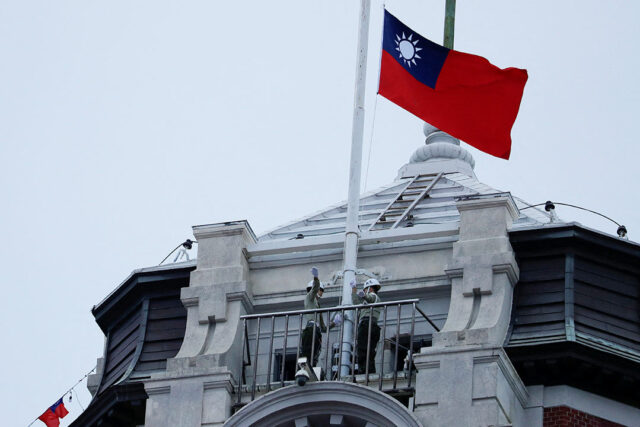
Honor guards raise a Taiwanese flag at the Presidential Palace in Taipei, Taiwan Oct. 10, 2023. — REUTERS

WASHINGTON/TAIPEI — Taiwan is exploring buying arms worth billions of dollars from the United States, sources briefed on the matter said, hoping to win support from the new Trump administration as China continues to apply military pressure on the island.

Three sources familiar with the situation, speaking to Reuters on condition of anonymity given the sensitivity of the situation, told Reuters that Taiwan is in talks with Washington.

The package is meant to demonstrate to the United States that Taiwan is committed to its defense, one of the sources said.

A second source said the package would include coastal defense cruise missiles and HIMARS rockets.

“I would be very surprised if it was less than $8 billion. Somewhere between $7 billion to $10 billion,” the source added.

The White House did not immediately respond to a request for comment. However, US national security adviser Mike Waltz has said he wants to speed delivery of weapons to Taiwan.

Taiwan’s Defense ministry declined to comment on specific purchases but said it is focused on building its defenses.

“Any weaponry and equipment that can achieve those goals for building the military are listed as targets for tender,” it said.

China claims democratically governed Taiwan as its own territory and has never renounced the use of force to bring the island under its control. Taiwan strongly objects to China’s sovereignty claims and says only the island’s people can decide their future.

TRUMP-TAIWAN RELATIONS
US President Donald Trump unnerved chip powerhouse Taiwan on the election campaign trail by saying the island stole American semiconductor business. This month, he threatened tariffs on chip imports.

But his administration maintained diplomatic support for the Chinese-claimed island.

Mr. Trump and Japanese Prime Minister Shigeru Ishiba issued a joint statement on Feb. 7 opposing any attempt to change the current situation in the Taiwan Strait through force or coercion. The US State Department also removed language on its website that it does not support Taiwan independence, a move praised by the island’s government. China has urged the US to “correct its mistakes.”

Taiwan plans to propose a special defense budget that prioritizes precision ammunition, air-defense upgrades, command and control systems, equipment for the reserve forces and anti-drone technology, a third source familiar with the matter said.

During his 2017-2021 term, Mr. Trump established regular arms sales to Taiwan, including multibillion-dollar deals for F-16 fighter jets. The Biden administration continued these sales, though often with smaller price tags.

Taiwanese officials see encouraging signs from Mr. Trump’s administration even as tariff threats weigh on that optimism.

Taiwan does not believe Mr. Trump is looking to make a “grand bargain” with Chinese President Xi Jinping to sell out Taiwan’s interests, one of the sources said. Mr. Trump is more concerned with putting tariffs on semiconductors, the source said. — Reuters