Home Blog Page 1575

EJ Obiena misses World Indoor Athletics

REUTERS

FILIPINO STAR pole-vaulter EJ Obiena will not be able to make the cut to the World Indoor Athletics Championships set from March 21 to 23 in Nanjing, China.

But expect the World No. 4 to return with a vengeance in the upcoming outdoor season.

“With limited time to return this indoor season, my results have been far from consistent,” said Mr. Obiena via his social media accounts. “Even though there is still time to qualify for the World Indoor Champion-ships, there are no more competitions left for me to participate in.”

“With this, I would inevitably miss the championships,” he added.

The standard qualification clearance is 5.85 meters (m) and the deadline for it is Sunday.

Mr. Obiena is set to compete in the Mondo Classic scheduled next week in Uppsala, Sweden where he would come face-to-face with the sport’s mightiest of all — Armand Duplantis.

The 29-year-old Asian champion and record-holder did try but his best was only 5.8 m in a meet in Torun, Poland where he ended up with the gold.

Mr. Obiena vowed to give it his all in the outdoor season.

“I will hence prioritize and prepare for the outdoor competition. This is when I would represent the country in the World Championships, Asian Championships and the SEA Games,” he said.

“The key is to go into the outdoor season healthy and ready to compete at the highest level.” — Joey Villar

Down 15, Cavs surge past Bulls for 11th straight win

FREEPIK

DONOVAN MITCHELL scored 28 points and Jarrett Allen notched a 25-point, 17-rebound double-double as the visiting Cleveland Cavaliers rallied to defeat the Chicago Bulls 139-117 on Tuesday for their 11th straight victory.

NBA-leading Cleveland, which boasts three double-digit winning streaks this season, moved to 41 games over .500.

Zach Collins scored four straight points for the Bulls to tie the game at 107 with 7:04 to go. Cleveland responded with a 14-0 run that featured six points from Allen and five from Javonte Green.

Chicago lost for the ninth time in 11 games but remained 2 1/2 games ahead of Brooklyn and Philadelphia for the No. 10 seed in the Eastern Conference and the final spot in the East play-in tournament.

Mitchell returned after missing Sunday’s home win against Portland due to rest. He led seven Cavaliers in double figures. Darius Garland contributed 19 points and seven assists, Ty Jerome added 16 points and Max Strus, Sam Merrill and Green chipped in 11 apiece.

Coby White paced Chicago with 25 points while Collins (20 points, 12 rebounds) and Jalen Smith (13 points, 11 rebounds) registered double-doubles. Talen Horton-Tucker scored 22 points while Matas Buzelis added 17.

Despite a depleted rotation whose absences included Nikola Vucevic (right calf strain), Josh Giddey (left quad contusion), Patrick Williams (right quad tendinosis) and Kevin Huerter (right knee sprain), the Bulls built a 15-point lead midway through the first half.

A J Smith trey put Chicago ahead 46-31 before the Cavaliers scored 26 of the next 38 points to close within 58-57 at the break. Garland connected on a pair of 3s in the last 35 seconds of the half.

Allen had 10 points and eight rebounds in the first half. Horton-Tucker (14 points) and White (10) led a balanced attack for the Bulls.

Cleveland continued its recent stranglehold against Chicago, clinching the season series with its third victory in as many games with an April 8 meeting in Cleveland remaining. The Cavaliers have won 10 of their past 11 games against the Bulls.

Evan Mobley (rest management) was out for Cleveland. — Reuters

Trump vows more tariffs, dividing Republicans

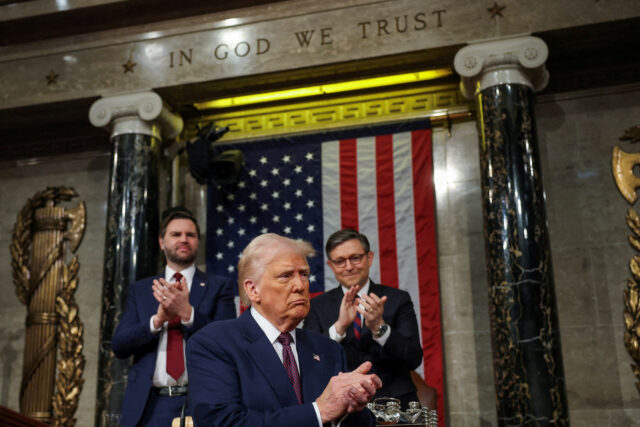
WASHINGTON, DC - MARCH 04: U.S. President Donald Trump addresses a joint session of Congress at the U.S. Capitol on March 04, 2025 in Washington, DC. Win McNamee/Pool via REUTERS TPX IMAGES OF THE DAY

WASHINGTON — A triumphant President Donald Trump told Congress on Tuesday that “America is back” after he reshaped US foreign policy, ignited a trade war and ousted tens of thousands of government workers in six tumultuous weeks since returning to power, drawing jeers from some Democrats who walked out in protest.

The primetime speech, his first to Congress since taking office on Jan. 20, followed a second day of market turmoil after he imposed sweeping new tariffs against Mexico, Canada, and China.

At 100 minutes, the speech was the longest presidential address to Congress in modern US history, according to The American Presidency Project.

World leaders were watching Mr. Trump’s speech closely, a day after he paused all military aid to Ukraine in a stark reversal of US policy. The suspension followed an Oval Office blowup in which Mr. Trump angrily upbraided Ukrainian President Volodymyr Zelensky in front of TV cameras.

The pause in aid to Ukraine has threatened Kyiv’s efforts to defend against Russia, which launched a full-scale invasion three years ago, and further rattled European leaders worried that Mr. Trump is moving the US too far toward Moscow.

Mr. Trump devoted only a few minutes of his speech to foreign policy. He signaled a willingness to press ahead with the minerals deal with Ukraine that was set aside after last week’s disastrous White House meeting.

“Simultaneously, we’ve had serious discussions with Russia and have received strong signals that they are ready for peace,” Mr. Trump said. “Wouldn’t that be beautiful?”

And he repeated his promises — though without adding detail — to bring peace to the Middle East and expand the Abraham Accords, deals signed during his first term that established relations between Israel and some of its Arab neighbors.

While Mr. Trump has appeared to fault Ukraine for starting the war, a new Reuters/Ipsos poll found 70% of Americans — including two-thirds of Republicans — say Russia was more to blame.

Mr. Trump vowed to balance the federal budget, even as he urged lawmakers to enact a sweeping tax cut agenda that analysts say could add more than $5 trillion to the federal government’s $36-trillion debt load. Congress needs to raise the nation’s debt ceiling later this year or risk a devastating default.

The speech shared some of the hallmarks of Trump’s campaign rallies. Mr. Trump repeatedly assailed his Democratic predecessor Joseph Biden, attacked immigrant criminals as “savages” and promised to ban what he called “transgender ideology,” all while peppering his remarks with exaggerated or false claims.

DEMOCRATIC PROTESTS
“To my fellow citizens, America is back,” Mr. Trump began to a standing ovation from fellow Republicans. “Our country is on the verge of a comeback the likes of which the world has never witnessed, and perhaps will never witness again.”

Democrats held up signs with messages like “No King!” and “This Is NOT Normal,” and about half the Democrats had walked out by the end of the speech.

One Texas congressman, Al Green, was ordered removed after he refused to sit down.

Mr. Trump, a political brawler by nature, reveled in the disagreements.

“I look at the Democrats in front of me, and I realize there is absolutely nothing I can say to make them happy or to make them stand or smile or applaud,” he said after Mr. Green’s ejection.

The speech took place in the House of Representatives, where lawmakers huddled in fear for their lives four years ago while a mob of Trump supporters ransacked the Capitol in an unsuccessful effort to overturn Mr. Biden’s 2020 victory over the then-incumbent Mr. Trump.

The lawmaker Democrats chose to give their rebuttal speech, moderate US Senator Elissa Slotkin, invoked an iconic Republican president in criticizing Mr. Trump.

“As a Cold War kid, I’m thankful it was Reagan and not Trump in office in the 1980s. Trump would have lost us the Cold War,” Ms. Slotkin, a former CIA analyst who won election in Michigan in November even as Mr. Trump car-ried her state, said, referring to President Ronald Reagan. “Donald Trump’s actions suggest that, in his heart, he doesn’t believe we are an exceptional nation.”

MORE TARIFFS COMING
Mr. Trump praised billionaire businessman Elon Musk and his Department of Government Efficiency, which has downsized more than 100,000 federal workers, cut billions of dollars in foreign aid and shuttered entire agencies.

The president credited Mr. Musk with identifying “hundreds of billions of dollars of fraud,” a claim that far exceeds even what the administration has claimed so far. Mr. Musk, seated in the gallery, received ovations from Republicans.

Mr. Trump reiterated his intention to impose additional reciprocal tariffs on April 2, a move that would likely roil financial markets even more.

“Other countries have used tariffs against us for decades, and now it’s our turn to start using them against those other countries,” he said.

On this point, many Republicans remained seated, a signal of how Mr. Trump’s tariffs have divided his party.

Mr. Trump’s 25% tariffs on Mexico and Canada, two of the country’s closest allies, and an additional 10% on Chinese imports deepened investor concerns about the economy. The Nasdaq Composite is down more than 9% from its record clos-ing high on Dec. 16.

Mr. Trump, who has often taken credit for market increases, did not mention this week’s downturn. He also barely addressed stubbornly high costs, blaming Mr. Biden for the price of eggs and saying he would bring down inflation via increased energy production.

Just one in three Americans approve of Mr. Trump’s handling of the cost of living, according to the Reuters/Ipsos poll, a potential danger sign amid worries his tariffs could increase inflation.

Mr. Trump called on Congress to pass a sweeping $4.5 trillion plan that would extend his 2017 tax cuts, tighten border security and fund massive deportations.

Mr. Trump noted that his administration had already launched a border crackdown, citing February’s record-low total of 8,300 migrant arrests at the US-Mexico border. Those arrests are often used as a proxy to estimate illegal crossings. — Reuters


Trudeau dismisses ‘very dumb’ tariffs, says Trump wants to ruin Canadian economy

PHILIPPINE STAR/KRIZ JOHN ROSALES

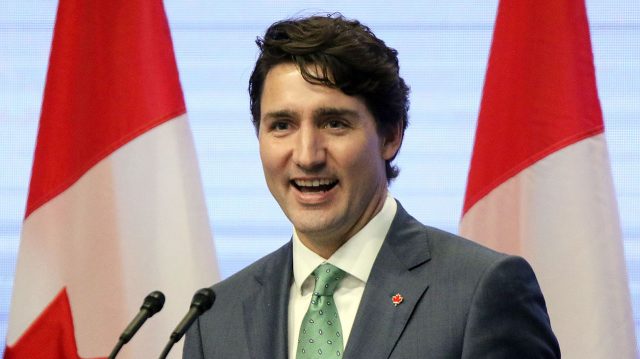
OTTAWA — Prime Minister Justin Trudeau told US President Donald Trump on Tuesday that his tariffs on Canadian imports were “a very dumb thing to do” and said Ottawa was striking back immediately at its closest ally.

Mr. Trudeau, who is stepping down at the end of the week, also accused Mr. Trump of wanting to ruin the Canadian economy. Speaking hours after Mr. Trump launched a trade war against Mexico and Canada, Mr. Trudeau announced immediate 25% tariffs on C$30 billion worth of US imports. If need be, Canada will target another C$125 billion worth in 21 days’ time, he said.

“There is absolutely no justification or need whatsoever for these tariffs,” Mr. Trudeau told reporters, adding that Canada would challenge the US measures at the World Trade Organization and through a US-Mexico-Canada trade agreement already in place.

“Canadians are reasonable and we are polite, but we will not back down from a fight, not when our country and the well-being of everyone in it is at stake,” he said.

Mr. Trump responded by saying the Canadian retaliatory tariffs would be met with immediate reciprocal tariffs of the same size.

Mr. Trump has accused Canada of failing to do enough to stem the flow of the deadly fentanyl opioid and its precursor chemicals into the US, an argument Mr. Trudeau called “completely bogus, completely unjustified, com-pletely false.”

Mr. Trudeau’s relations with Mr. Trump, which have never been warm, deteriorated in recent months after the president repeatedly talked of Canada becoming the 51st US state and mockingly referred to Mr. Trudeau as its “governor” rather than prime minister.

Mr. Trump says he is unhappy with the trilateral US-Mexico-Canada trade deal that he signed in his first term. Mr. Trudeau played down the idea of opening talks ahead of a review scheduled for 2026.

“Given that he is choosing to want to ruin the Canadian economy, I don’t know whether to bring forward negotiations, given the situation of such bad faith that we’re in,” said Mr. Trudeau, who warned Canadians that tough times were coming.

Economists say Canada, which sends 75% of all exports to the United States, will plunge into a recession unless the tariffs are lifted quickly.

Mr. Trudeau said Americans would suffer as well, given how tightly the two economies are connected, and he referred to a Wall Street Journal editorial in late January that said Mr. Trump would be launching “the dumbest trade war in history” if he went ahead with tariffs.

“It’s not in my habit to agree with the Wall Street Journal, but Donald, they point out that even though you’re a very smart guy, this is a very dumb thing to do,” said Mr. Trudeau, who will step down as prime minister after the ruling Liberal Party chooses a new leader on Sunday.

The Canadian government will help by expanding employment insurance benefits and giving direct support to businesses, he said.

Finance Minister Dominic LeBlanc told the country’s premiers in a virtual meeting later in the day that he will soon announce an initial package of support to mitigate the impact of US tariffs on Canadian workers, families and businesses, Mr. Trudeau’s office said in a readout of the meeting.

Mr. Trudeau and the premiers also discussed ways to reduce internal trade barriers and labor mobility within Canada, according to the readout.

ALCOHOL OFF SHELVES
Mr. Trump’s unprecedented actions threaten to severely damage relations between the three trading partners.

Mr. Trudeau said Canada would also look at non-tariff measures but did not answer directly when asked whether Ottawa might curb exports of crude oil or potash.

“Our focus has to be on getting these tariffs lifted as quickly as possible,” he said.

The US-Mexico-Canada Agreement, which was forged under Mr. Trump during his first term in the White House and which updated the North American Free Trade Agreement, allows for duty-free trade between the three countries. The pact carries provisions for rules of origin for autos and auto parts and steel-intensive products, among others, and also allows for exceptions related to security.

Canada’s two most populous provinces, Quebec and Ontario, are taking US alcohol off the shelves of provincially run liquor stores.

Ontario Premier Douglas Ford said if US tariffs persisted, the province would also impose a 25% surcharge on electricity exports to New York, Michigan, and Minnesota.

“We need to make sure America feels the pain,” he said.

Tensions are so high that Canadian sports fans have begun booing US teams at ice hockey games.

“We’re going to choose to try to buy Canadian products and forgo bourbon and other classic American products. And yeah, we’re probably going to keep booing the American anthem,” Mr. Trudeau said.

“But let me tell Americans, we’re not booing you, we’re not booing your teams, we’re not booing your players. We’re booing a policy that is designed to hurt us. And we’re insulted and we’re angry … we’re going to fight and we’re going to win.” — Reuters

Taiwan turns to companies in Ukraine for China contingency planning

Traffic moves by the Lunar New Year market on Dihua Street in Taipei, Taiwan January 21, 2025. REUTERS/Ann Wang

TAIPEI — Taiwan is learning from companies in Ukraine which continue to operate during the country’s fight against Russia, a senior Taiwan official told Reuters on Wednesday, as the island speeds up contingency planning amid heightened Chinese threats.

China claims democratically governed Taiwan as its own territory, despite the objection of the government in Taipei, and has ramped up its military pressure against the island in recent years, including holding several rounds of major war games.

“We hope to learn from Ukraine’s first-hand experiences — how private companies helped build the resilience of its government and society during wartime,” said a senior Taiwan security official, who requested anonymity due to the sensitivity of the matter.

The official pointed to companies in Ukraine including Uber and Microsoft which continued to provide critical services.

Among the ideas Taiwan is taking inspirations from Ukraine for include how to incorporate supermarkets into the government’s supply distribution network and utilizing taxi services for medical emergencies such as blood donations when the health system is overwhelmed.

The official said the government was working to connect companies in Taiwan with their counterparts in Ukraine in order to help Taiwan firms quickly boost their contingency planning.

“We have the will to fight, and now we must also look closely into our will to prepare,” the official said. Taiwan is revamping its air-raid alert and shelter systems, taking into account lessons by northern European countries and Baltic states, the official added.

A closed-door workshop on preparations including stockpiling and civil defense training was held in Taipei this week, which was attended by Taiwan security officials and senior diplomats from countries including the US, Japan, and Australia.

Andy Hunder, who heads the American Chamber of Commerce in Ukraine and is a speaker at the workshop, told reporters the Taiwan government must establish backup online systems, pointing to Russian cyber attacks aimed at paralyzing Ukraine infrastructure before the first missile attacks. — Reuters

“What we have seen is that during World War Two, the safest place for critical infrastructure was down in the tunnels. Today, the safest infrastructure is in the clouds,” Mr. Hunder said, adding payment services such as Master-card and Visa continued to operate and ensured financial stability.

“Technology, banking, food, delivery, retail – how do you keep the economy running?” he said when asked how the Taiwan government should prepare itself. — Reuters

Trump to the people of Greenland: ‘We will make you rich’

WASHINGTON — US President Donald Trump reiterated his interest in acquiring Greenland in his address to Congress on Tuesday, painting a picture of prosperity and safety for the “incredible people” of the island, an autonomous territory of the kingdom of Denmark.

“We will keep you safe, we will make you rich, and together, we will take Greenland to heights like you have never thought possible before,” Mr. Trump said.

“It’s a very small population, a very, very large piece of land, and very, very important for military security,” he added.

Opinion polls suggest that most Greenlanders oppose joining the US, although a majority favor eventual independence from Denmark.

Even before starting his second term as president, Mr. Trump said he hoped to make Greenland a part of the United States, even though NATO ally Denmark says it is not for sale.

Greenland’s strategic location and rich mineral resources could benefit the US. It lies along the shortest route from Europe to North America, vital for the US ballistic missile warning system.

“We need it really for international world security,” Mr. Trump said.

In his speech, Mr. Trump said he had a message for the people of Greenland. “We strongly support your right to determine your own future, and if you choose, we welcome you into the United States of America,” Mr. Trump said.

He said his administration was “working with everybody involved” to try to get Greenland, but also added, “I think we’re going to get it, one way or the other, we’re gonna get it,” to laughter from his fellow Republicans in the House of Representatives chamber.

Mr. Trump’s interest in Greenland has invigorated that country’s independence movement, sparking calls for swift secession discussions with Denmark, its former colonial ruler.

But Greenland’s ruling Inuit Ataqatigiit party has said it will not rush an independence vote through after a March 11 general election, cautioning about possible economic and welfare implications.

“The future of Greenland is really for the people of Greenland to decide,” Denmark’s United Nations Ambassador Christina Markus Lassen told reporters on Monday. “Independence is possible and they have the right to self-determination.”

Ms. Lassen said Denmark agreed with the Trump administration that in the current geopolitical environment there was a need to look at further strengthening security around the Arctic and “that’s something we’ve been working together with NATO and the US on for a while.”

“We have a very close transatlantic bond with the United States. We’ve been working very closely with the US on security matters related to Greenland and the Arctic for decades,” she said. — Reuters

What are Southeast Asia’s scam centers, and why are they being dismantled?

REUTERS

SCAM CENTERS that operated along the Thai-Myanmar border for years have drawn fresh attention after the high-profile abduction and release of a Chinese actor in Thailand.

The incident sparked a multi-national effort among Thailand, China and Myanmar to dismantle the centers in a network of scam compounds across Southeast Asia.

Criminal gangs have trafficked hundreds of thousands of people to such centers to help generate illicit revenues running into billions of dollars a year, the United Nations says.

WHAT ARE THEY?
Scam centers, particularly those in Cambodia, Laos and Myanmar run illegal online schemes to defraud people.

Scammers often reach out to victims on social media and messaging applications to build online relationships before luring them into making fraudulent investments, such as in cryptocurrencies, a scheme commonly known as “pig butchering.”

Money laundering and illegal gambling operations are also run from some sites, analysts say.

The main focus of the current crackdown is Myanmar’s Myawaddy region, along the Thai border, where scam centers often enjoy the protection of armed groups such as the Karen National Army (KNA) and the Democratic Ka-ren Buddhist Army (DKBA).

WHEN DID THEY START?
Scams in the region originated from loosely regulated casinos and online gambling, beginning in the 1990s and gathering pace in the 2000s, the United States Institute of Peace (USIP) says.

Shwe Kokko, a major scam compound in Myawaddy, was set up in 2017 by the Hong Kong-registered Yatai International Holdings Group and the precursor of the KNA, then under control of the Myanmar military, and advertised as a casino destination, USIP said in 2020.

The company has denied involvement in any criminal activities, including human trafficking.

Scamming operations in Myanmar’s borderlands have expanded significantly in the last few years.

A think tank, the Center for Strategic and International Studies, said criminal groups sought new sources of profits when the lockdowns and strict border controls brought by the COVID-19 pandemic prevented gamblers from traveling.

“Many repurposed the facilities into cyber-scamming compounds,” it added.

WHO OPERATES THEM?
Criminal networks primarily originating from China are known to operate scam centers and, in Myanmar’s Myawaddy region, armed groups such as the KNA also support operations, USIP says.

Some foreigners brought out of Myawaddy say coercion and torture are rife in the scam compounds.

Junta-aligned groups also ran or supported such centers along Myanmar’s northern border with China, much to Beijing’s frustration. Some were caught up in fighting as anti-junta rebels launched the “Operation 1027” offensive in 2023.

A 2023 Reuters investigation traced at least $9 million linked to “pig butchering” scams to an account registered to a well-connected representative of a Chinese trade group in Thailand.

WHAT IS THE LATEST CRACKDOWN?
Some regional nations have stepped up efforts to break up the compounds. Thailand has cut power, fuel and internet links to areas in Myanmar linked with scam centers.

The current crackdown was triggered by the January abduction of Chinese actor Wang Xing in Thailand, which set off a social media uproar in his home country.

Though he was later found in Myawaddy and swiftly sent home, the incident sowed concern in Thailand, where Chinese visitors are critical to the lucrative tourism industry.

Inside Myanmar, the junta has detained more than 3,700 foreign nationals related to scam centers since the end of January with more than 750 sent home, state media say.

Last month, China flew home some 200 citizens from Thailand’s city of Mae Sot, which borders Myawaddy. About 7,000 people, most of them Chinese nationals extricated from scam compounds are still sheltering in camps run by the KNA and DKBA.

The Thai crackdown has also widened to Cambodia, where authorities rescued more than 215 people from a scam compound. — Reuters

Whisper it and it’s back: Recession risk creeps onto markets’ radar

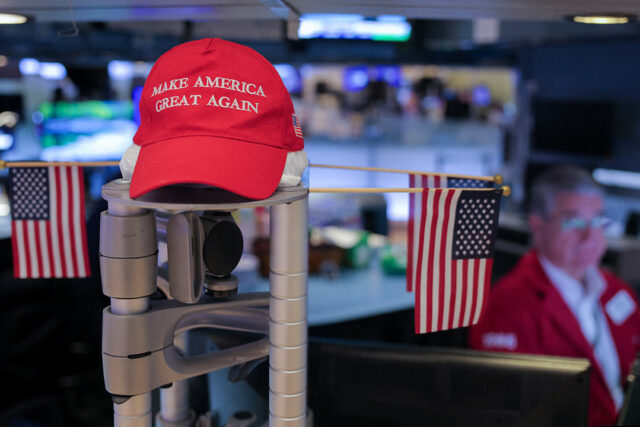
A “Make America Great Again” hat is seen on display on the trading floor at The New York Stock Exchange. — REUTERS

LONDON – Global growth concerns have shot back onto the radar of financial markets as weakening US economic data and growing trade tensions hurt consumer confidence and business activity.

Although recession is not the base-case scenario for economists, given underlying US resilience, recent data has unnerved investors and US President Donald Trump’s new 25% tariffs on Mexico and Canada are exacerbating growth concerns.

A shift in the mood music is apparent across markets.

Oil prices are at their lowest since October, stocks from New York to Tokyo are retreating from recent multi-year highs and two-year US Treasury yields are at their lowest since October as bond investors see increased chances of near-term rate cuts.

“One thing is essential for an economy and that’s confidence, which has taken a hit,” said Francois Savary, chief investment officer at Genvil Wealth Management, referring to weakening U.S. consumer and business sentiment.

“I don’t think it’s (recession) a done deal but it’s a reason why we have decided to decrease (US) equity exposure.”

US consumer confidence in January slumped the most in 3-1/2 years, retail sales dropped by the most in nearly two years, and Monday’s manufacturing activity data showed big falls in new orders and employment.

“We don’t think we will see a (US) recession but we do see a modest growth slowdown,” said Joost van Leender, senior investment strategist, at Van Lanschot Kempen Investment Management in Amsterdam, adding consumers were feeling uncertain about “chaotic” US policy.

Van Leender said he had trimmed U.S. equity holdings in late January and is overweight Treasuries as yields are likely to fall as the economy decelerates.

Highlighting the change in fortunes, the Atlanta Fed’s GDPNow model estimate for annualised growth this quarter on Monday fell to -2.8% from +2.3% a week ago.

Analysts stress that recent U.S. data is likely to have been skewed by one-off factors such as cold weather, and strong imports in the case of the Atlanta Fed’s model. But they also note that a trade war means focus is quickly shifting from inflation to the growth risks from U.S. tariffs.

China has responded to a doubling of duties on Chinese goods to 20% with additional tariffs of 10%-15% on certain U.S. imports from March 10. Europe is also in the firing line for higher U.S. tariffs, and trade-vulnerable auto stocks dropped 4% on Tuesday after the tariffs on Mexico and Canada, where many cars for the U.S. market are made.

Morgan Stanley estimates that the new U.S. tariffs on China, Mexico and Canada could shave 0.7-1.1 percentage points off U.S. economic growth in coming quarters, deliver a 2.2 to 2.8 percentage point hit to Canadian growth, and push Mexico into recession.

Canadian Chamber of Commerce CEO Candace Laing warned that US tariff policy was forcing Canada and the U.S. toward “recessions, job losses and economic disaster”.
“Time to add a new word to the dictionary, ‘Trumpcession’, SEB economist Marcus Widén said in a note.

RATE CUT PRESSURE
The Canadian dollar and Mexican peso briefly hit one-month lows on Tuesday. Notably, the dollar, which has generally benefited from trade tensions, has also weakened as U.S. growth worries weigh.

Some reckon the U.S. economy could be at risk from a worrying mix of sluggish growth and relentless inflation.

Analysts said a trade war keeps pressure on central banks globally to keep cutting rates to shore up growth. Traders are now pricing in 75 basis points of U.S. rate cuts by year-end versus just one cut in mid-January when data was strong.

After ending February with their biggest monthly drop since late 2023, 10-year U.S. Treasury yields are eyeing 4%

“The bond market is moving towards pricing a soft patch and maybe a recession,” said Forvis Mazars chief economist George Lagarias.

The European Central Bank is tipped to cut rates again on Thursday and Morgan Stanley said it expects another cut in April as economic data and inflation weaken.

Even if U.S. economic data improves, analysts said the cloudier outlook was reason enough to remain cautious on equities.

Hedge funds that had snapped up global equities have fled bullish bets and put on wagers that stocks would decline, a Goldman Sachs note on Monday showed.

Consumer discretionary stocks, an economic bellwether and indicator of shoppers’ purchasing power for nice-to-have products, was the worst-performing U.S sector last month, the note showed.

Friday’s closely-watched U.S. jobs report takes on additional significance with growth risks in focus.

“This economic cycle is consumption-led and can only die with the labour market,” said Lombard Odier’s chief economist Samy Chaar. “The Fed has to be very mindful of that.” — Reuters

Philippine inflation slows more than expected in February as rice prices drop

Rice prices are expected to further go down as lower tariffs take effect. — PHILIPPINE STAR/KJ ROSALES

MANILA – Philippines’ annual inflation eased more than expected in February, driven largely by slower increases in food and utility costs, the statistics agency said on Wednesday, likely giving the central bank room to resume cutting interest rates.
The consumer price index (CPI) rose 2.1% in February, coming in below the 2.6% median forecast in a Reuters poll and the previous month’s 2.9% rate.

Last month’s print, which fell closer to the low end of the central bank’s 2.0% to 4.0% target, marks the slowest annual increase since September, when inflation stood at 1.9%.

The Philippine central bank unexpectedly kept its key interest rate steady in February after three consecutive 25-basis-point cuts in previous reviews, citing uncertainties over global trade policies, but said it remained on an easing cycle.

“More benign inflation near the lower end of the central bank’s inflation target would support monetary easing, possible 25 basis points rate cut as early as the April meeting,” Michael Ricafort, chief economist at RCBC bank, said on social media website X.
Core inflation, which excludes volatile food and energy prices, also eased to 2.4% in February, down from 2.6% in January.

Food inflation saw a notable slowdown, easing to 2.6% in February from 4.0% in January. That was driven by a 4.9% drop in rice inflation, the steepest decline since April 2020, when prices of the national staple fell by 5.7%.

The Philippines, among the world’s largest rice importers, declared a food security emergency last month to bring down the cost of rice, which it said has stayed elevated despite lower global prices and a reduction in rice tariffs in 2024. — Reuters

UM launches Full Color Media proposition and philosophy

UM, a global media agency network of IPG Mediabrands, today launched its new ‘Full Color Media’ proposition and philosophy.

Designed to revolutionize the way marketers build brands in the era of AI, Full Color Media heralds a new set of behaviors, approach and products across UM’s global network — embedding a growth mindset across the organization.

“Full Color Media is an omni-channel planning proposition designed to combat the existential threat of brands becoming bland. It unlocks the power of human ingenuity in a world where AI’s normative mechanic threatens not just a race to the bottom, but a race to the mean. To win the growth race for our valued clients, we need strategies that ‘Stand Against Bland,” said Susan Kingston-Brown, Global Brand President, UM.

“This new approach seamlessly blends the visibility of high-quality media impact with the vibrancy and variability of smaller, deeper touchpoints, creating a spectrum of media stories that come together to drive brand growth,” she continues. “In a world dominated by algorithm-driven media, it challenges outdated linear models and black-and-white decision-making to drive real ‘difference’ and brand growth.”

“UM’s Full Color Media envisions to help our clients stand out in a competitive marketplace through groundbreaking ideas, media creativity, and relentless pursuit for innovations,” said Tricia Camarillo-Quiambao, CEO, IPG Mediabrands Philippines and UM Business Lead. “We are excited to roll out this new bold proposition and stand against bland, as we continue to futureproof and adapt to the evolving needs of our clients and our industry.”

Full Color Media is underpinned by a groundbreaking body of custom research on brand building in the era of AI. Conducted with over 10,000 brands and with 5 million data points, the research culminated in a bespoke ‘Brand Patterns’ marketing theory and proprietary model designed to grow and differentiate brands.

UM’s new model and research builds a clear understanding of the complex pattern of a brand, with insights into how to apply ‘difference’ and the ‘variance’ of that brand successfully. This deeper understanding means that AI learns more effectively, driving increased marketing efficacy.

“Before we push the AI button, we must understand exactly what differentiates a brand so that we can train that AI to work effectively for us and make a Stand Against Bland,” continued Ms. Kingston-Brown. “Brand patterns enable us to understand the complexity, nuances and uniqueness of every brand — allowing us to elevate and distinguish them within their category — ensuring our communications deliver a disproportionately positive effect in market.”

The Research

Working in partnership with Associate Professor of Marketing Felipe Thomaz, Saïd Business School, University of Oxford, UM analyzed a data set of over 10,000 brands for the last three years to identify how unique networks of brand associations and behaviors called “Brand Patterns” drive brand growth, defined as Purchase Intent and Consideration.

The research revealed that brands are not purely funnel-based but reflect complex, unique and differentiating patterns. Every brand has its own unique, nuanced pattern informed by the interdependency and synergy of metrics across three essential components, the “3-Vs”:

  • Visibility: includes metrics like Attention and Ad Awareness that cultivate distinctiveness and is the main driver of brand growth (64%).
  • Vibrancy: measured through metrics like Social Engagement, Buzz and Word of Mouth, delivers brand relevancy through its connection with culture, and is an important accelerator of growth (11%).
  • Variability: containing metrics like Positive Impression and Quality, is key for incremental growth (25%) and differentiation by generating customer intrinsic value.

“As we studied whether brands were using suitable go-to-market strategies, we found that even though all brands have unique patterns, they are often using similar media strategies, meaning they are not making the most of their Brand Pattern,” said Mr. Thomaz. “According to our research, Brand Patterns can provide marketers with new insights to illuminate their differentiated path to brand growth.”

Brand Pattern Growth Model & Key Insights

Observing unique patterns and driver relationships across the data set, structural modeling approaches were used to create the quantified Brand Pattern Model.

“With the level of computational power and data at our fingertips today, there is a huge opportunity to go beyond simplified marketing models like the funnel,” said Dan Chapman, Global Chief Strategy Officer, UM. “We need a model that embraces complexity and leverages pattern recognition to define and quantify the unique nature of each brand. Our findings demonstrate that understanding and exploiting what makes a brand different is the number one driver of brand growth. This will only become more important as AI become more pervasive.”

The model defines the relationships between the 3-Vs and their subcomponents and predicts key drivers of brand growth, taking into account the multiplier effects between brand metrics. For example, when Vibrancy metrics consistently operated with positivity, Visibility metrics performed exponentially. In many cases, ‘earned’ functioned as a catalyst to drive improved ‘paid’ media effectiveness.

Looking across a variety of geographies, sectors and brands, the research uncovered core insights, including:

  • In the US, Visibility is an important driver in the Payments Services and Credit Cards category, but brand growth was more likely to be driven by Variability than the category average. Despite this, most brands in the category use Visibility-led strategies with video being the #1 choice in the media mix.
  • For the Alcoholic Drinks sector in Australia, Visibility was crucial for beer brands, pointing to a well-supplied category. However, for other alcohol like wine and spirits, Variability was a far more important driver of growth.
  • In Mexico, the Cereals, Chocolate and Biscuits category, key drivers of incremental growth are Vibrancy and Variability. Larger brands showed a far greater contribution to growth from these factors.
  • For British Health and Beauty brands, Variability drove around 30% of brand growth.

“These deep category insights will allow us to look at any brand in and assess not only its key growth drivers, but also how it interacts within its category and within the wider cultural spectrum. We can then build nuanced solutions to grow that brand and give it more powerful resonance in the world,” says Mr. Chapman.

“What I love most about Full Color Media is that it’s all fueled by our people; their deep understanding of human behavior and exceptional ability to uncover insights from the data and the world around them. It’s this combination of human intelligence and data that brightens our approach, transforming ordinary interactions into memorable, full-color experiences,” concludes Ms. Kingston-Brown.



Spotlight is BusinessWorld’s sponsored section that allows advertisers to amplify their brand and connect with BusinessWorld’s audience by publishing their stories on the BusinessWorld Web site. For more information, send an email to online@bworldonline.com.

Join us on Viber at https://bit.ly/3hv6bLA to get more updates and subscribe to BusinessWorld’s titles and get exclusive content through www.bworld-x.com.

Japan defense budget prioritizes quality over GDP ratio, spokesperson reacts to Trump aide

 – Japan’s defense buildup prioritizes quality over the size of its budget, a top government spokesperson said on Wednesday, in response to calls by one of U.S. President Donald Trump’s aides to ramp up defence spending to counter China.

“What we think important is the substance of defence capabilities, not the volume or GDP ratio,” Chief Cabinet Secretary Yoshimasa Hayashi told a regular press conference, explaining Japan’s effort to raise defence budgets to be over 2% of the country’s gross domestic product in fiscal year 2027.

Mr. Hayashi’s comments came after Elbridge Colby, a Trump nominee as a top Pentagon policy advisor, admonished Taiwan and Japan for acting too slowly to raise defense spending. – Reuters

China monitored Philippine supply run to grounded warship on disputed shoal

BRP SIERRA MADRE, a marooned transport ship which Philippine Marines live in as a military outpost, sits on the disputed Second Thomas Shoal, part of the Spratly Islands in the South China Sea. — REUTERS

 – The Chinese coast guard on Wednesday said it monitored a Philippine civilian boat delivering daily provisions to the “illegally grounded” warship at the disputed Second Thomas Shoal on Tuesday.

China and the Philippines claim the territory and frequently clash in its surrounding waters.

The resupply missions for soldiers aboard the grounded naval vessel were previously a significant cause of tension between the two countries until they reached a provisional agreement in July on such missions, signaling a de-escalation of tensions.

In January, they also agreed to seek common ground and find ways to cooperate despite their territorial disagreements.

China urges the Philippines to honor its commitments, stop hyping up incidents in the area and work with China to manage the maritime situation, the coast guard said in a statement on Wednesday.

The Philippines armed forces said it completed a routine troop rotation and resupply mission to the BRP Sierra Madre warship stationed at the shoal, “in resolute commitment to maintaining its presence and operational readiness in the West Philippine Sea”.

The armed forces carried out the mission with the Philippine coast guard which was “completed with no untoward incident”.

China has expansive territorial claims in the South China Sea that overlap with the exclusive economic zones of Brunei, Indonesia, Malaysia, the Philippines and Vietnam.

In 2016, an international arbitral tribunal ruled China’s claims, backed by its historical maps, have no basis under international law – a ruling China does not recognize. – Reuters