Home Blog Page 1536

Gov’t procurement law IRR due next week

BW FILE PHOTO

THE Department of Budget and Management said the new government procurement law’s implementing rules and regulations (IRR) will be released next week, having been approved by the procurement board’s technical experts.

The IRR was approved at a meeting led by the Government Procurement Policy Board’s (GPPB) Technical Support Office on Tuesday, it said in a statement on Feb. 4.

“The GPPB approved it yesterday afternoon. We’ll just clean it up, polish it, and then it will be published on Monday. You will see it on our website on Monday,” Budget Secretary Amenah F. Pangandaman said on the sidelines of the 2025 Open Government Partnership Asia and the Pacific Regional Meeting.

Ms. Pangandaman, who also serves as the GPPB chair, said this will help departments and agencies enhance their budget utilization and deter corruption.

“The procurement law signed by President Ferdinand R. Marcos, Jr. in July 2024 is now hailed as the biggest anti-corruption measure in the country’s recent history,” she said.

Ms. Pangandaman said the law sets up an online marketplace where agencies may directly procure supplies and equipment from vetted suppliers.

The data on transactions will be disclosed at all stages of procurement, from planning to contract implementation.

One of the provisions of the IRR allows live streaming of procurement proceedings, she added. — Aubrey Rose A. Inosante

Auto body industry seeks more funding for PUV modernization

DOTR PHOTO

THE Automotive Body Manufacturers Association of the Philippines (ABMAP) has asked the government to prioritize and provide more funding for the stalled Public Utility Vehicle (PUV) Modernization Program.

“ABMAP is urgently calling on the government to secure additional funding and prioritize the program, which is critical not only for modernizing dilapidated, polluting, and unsafe jeepneys but also for revitalizing the automotive industry,” the group said in a statement on Wednesday.

According to reports, the Development Bank of the Philippines and Land Bank of the Philippines have hit their lending limits for the program.

“The PUV Modernization Program is a transformative project that addresses multiple national issues — public safety, environmental sustainability, and economic growth,” ABMAP Executive Director Edgar Manuel said. 

“It is disheartening to hear that funding has run dry, especially when we are on the brink of realizing its immense benefits. We urge the government to act swiftly and allocate the necessary resources to keep this program alive,” he added.

According to the group, the PUV modernization program is expected to directly support 10,000 employees of vehicle producers and parts manufacturers and indirectly support 20,000 others connected to the auto parts manufacturing industry.

“Modern PUVs are not just about improving public transport; they are about creating opportunities for manufacturers and workers,” Mr. Manuel said.

“With locally produced vehicles adding 50% local value, every modern PUV supports our domestic supply chain, reduces reliance on imported parts, and strengthens the economy,” he added.

ABMAP estimates that at least 100 modern jeepneys could generate up to P125 billion in economic activity on top of reducing fuel consumption and lowering operating costs.

The group proposed that the government explore alternative funding mechanisms via partnerships with private sector institutions and international development agencies.

“We need a collective effort to secure the necessary funding and keep the momentum going. The future of our public transport system and the automotive industry depends on it,” Mr. Manuel said. — Justine Irish D. Tabile

Fishport landed volume falls 12.09% in 4th quarter

PHILIPPINE STAR/ MICHAEL VARCAS

THE catch landed at regional fishports declined 12.09% by volume year on year during the fourth quarter, according to the Philippine Fisheries Development Authority (PFDA).

In a report, the PFDA said the landed catch was 126,903.94 metric tons (MT).

On a quarter-on-quarter basis, fish volumes fell 1.8% compared with the 129,227.5 MT catch in the third quarter.

The PFDA added that the daily average of fish unloaded dropped 12.1% year on year to 1,379.39 MT. The average was 1.79% lower than a quarter earlier.

Commercial fishing was banned in several major fisheries starting in the fourth quarter, according to the Bureau of Fisheries and Aquatic Resources.

Fishing bans were in force in Northern Palawan, Ilocos, Negros Occidental, Capiz, and Cebu during the fourth quarter of the year.

Republic Act No. 8550 or the Fisheries Code imposes a three-month closed fishing season to repopulate certain fish species. The season typically ends during the first two months of the following year.

Vessel arrivals fell to 18,391, against the year-earlier 23,986.

The PFDA added that it completed the rehabilitation of regional fish ports in Davao and Sual, Pangasinan.

In a separate briefing, Agriculture Assistant Secretary and Spokesperson Arnel V. de Mesa said that fish production in the coming month is expected to recover with the resumption of fishing activities.

“Fishing is doing well now; our (fishing) areas are open again. We’re expecting our fishery sector to recover,” Mr. De Mesa added.

In 2024, fisheries production dropped 8.5%, reversing the 1.5% growth recorded in the prior year, according to the Philippine Statistics Authority. Total fisheries volume fell to 1.07 million MT from 1.17 million MT in 2023. — Adrian H. Halili

Targeted support, not P200 wage hike — business groups

PHILIPPINE STAR/ANDY ZAPATA JR.

BUSINESS GROUPS batted for targeted support for small businesses in place of the proposed P200 wage increase, saying that an across-the-board wage hike could have “devastating effects” on the economy.

“While we recognize the need for fair wages and improved working conditions for employees, we believe that the proposed P200 across-the-board wage increase is neither feasible nor beneficial in the current economic environment,” they said in a statement dated Feb. 4.

They said Congress should propose targeted measures that address poverty and inequality.

These include “providing more support for micro, small and medium enterprises (MSMEs), strengthening social safety nets for workers, and improving access to education and skills training to help workers secure better paying, sustainable jobs,” the business groups said.

The House Committee on Labor approved last week a bill that would grant a P200 across-the-board wage increase for private-sector workers.

“We call on the committee to reconsider the potential adverse effects of this proposal on businesses, workers, and the economy as a whole,” the groups said.

“Rather than hastily passing blanket wage increases, we advocate for a more comprehensive, consultative approach that balances the needs of workers with the realities faced by employers, especially considering the current policies affecting the business landscape,” they added.

The groups said that the blanket wage increase will potentially burden businesses operating on slim margins, exclude informal workers, and result in wage distortion and higher prices for goods and services.

In particular, the groups said that businesses, especially MSMEs, are already struggling due to rising operational costs, and lack the financial flexibility to absorb increases in labor costs.

It added that the penalties of up to P100,000, imprisonment, and double indemnity for unpaid benefits place a heavy compliance burden on employers, especially for MSMEs that lack the resources to ensure full compliance.

“The risk of criminal liability and hefty fines, especially during times of economic hardship, could further discourage business growth and the creation of new jobs,” they said.

“The heavy penalties may inadvertently create an adversarial relationship between employers and employees, rather than fostering collaboration and mutual benefit,” they added.

The wage increase is also expected to make large enterprises, especially those in manufacturing, retail, and services, less competitive due to the substantial increase in labor costs.

“An increase of P200 per day for all workers will strain their financial capacity and could result in delayed investments, reduced hiring, and potentially even job cuts as companies are forced to streamline operations,” they read.

The joint statement was signed by the Employers Confederation of the Philippines, the Philippine Chamber of Commerce and Industry, the Philippine Exporters Confederation, Inc., the Philippine Hotel Owners Association, and the Philippine Association of Legitimate Service Contractors, Inc.

Other signatories were the Philippine Retailers Association, the Federation of Filipino Chinese Chambers of Commerce and Industry, the Philippine Constructors Association, Inc., the People Management Association of the Philippines, and the Semiconductor and Electronics Industries in the Philippines, Inc. — Justine Irish D. Tabile

SC rules in favor of shipping firm in VAT case

PHOTO BY MIKE GONZALEZ

THE Supreme Court (SC) ruled in favor of Dohle Shipmanagement Philippines Corp. (Dohle) in a value-added tax (VAT) case, in which it clarified the prescriptive periods for filing VAT refund claims with the Bureau of Internal Revenue (BIR).

In a decision publicized on Feb. 5, 2025, and written by Associate Justice Alfredo Benjamin S. Caguioa, the SC’s Third Division affirmed that for VAT refund claims filed before June 11, 2014, the 120-day period for the BIR to resolve a claim starts when the taxpayer determines that its submission of documents is complete.

For claims filed before June 11, 2014, the 120-day period begins when the taxpayer files a complete claim or indicates no further documents will be submitted.

If the BIR requests additional documents, the taxpayer has 30 days to comply, and the 120-day period starts upon submission or after the 30 days.

Moreover, if the BIR does not notify the taxpayer of incomplete submissions, the 120-day period starts when the taxpayer voluntarily submits additional documents.

The administrative claim must be filed within two years from the end of the taxable quarter.

Meanwhile, for claims filed between June 11, 2014, and Dec. 31, 2017, the 120-day period starts when the complete claim is filed.

Taxpayers also cannot submit additional documents.

The administrative claim must be filed within two years from the end of the taxable quarter.

For claims filed beginning Jan. 1, 2018, the BIR has 90 days to resolve the claim from the date of filing with complete supporting documents.

The BIR will not request additional documents as incomplete claims will be rejected outright.

The administrative claim must be filed within two years from the end of the taxable quarter or the issuance of tax clearance when a business ceases operations.

The case stemmed from Dohle, which sought a refund for unutilized input VAT for 2012. Dohle filed its administrative claim with the BIR on March 31, 2014, and submitted additional documents on July 28, 2014.

According to the 1997 Tax Code, the BIR has 120 days to decide on an administrative claim from the date the taxpayer submits complete documents.

If the BIR denies or fails to act on the claim, the taxpayer has 30 days to file a judicial claim with the Court of Tax Appeals (CTA). This is known as the 120+30-day rule.

The BIR argued that the 120-day period started when Dohle filed its initial claim on March 31, 2014, making Dohle’s judicial claim, filed on Dec. 23, 2014, too late. 

It also argued that BIR’s Memorandum Circular 49-2003 requires any additional documents to be submitted within 30 days of the initial filing.

However, both the CTA and the SC ruled in favor of Dohle, saying that the 120-day period began on July 28, 2014, when Dohle submitted additional documents.

The SC said the 120 days are intended to benefit taxpayers, ensuring the BIR acts on claims.

It also said the 30-day period for submitting additional documents only applies when the BIR determines the initial submission was incomplete.

In Dohle’s case, the additional documents were submitted voluntarily, making the 120-day period begin on that date. — Chloe Mari A. Hufana

BCDA signs new deals with former John Hay operator’s leaseholders

CAMP JOHN HAY — BW FILE PHOTO

THE Bases Conversion and Development Authority (BCDA) said it signed lease agreements with sub-lessees of CJH Development Corp. (CJHDevCo) for Forest Estates, Country Homes, Golf Estates, and Forest Cabins in Camp John Hay.

“Following the Supreme Court’s final ruling allowing BCDA to recover the Camp John Hay property, the BCDA has signed over 40 new residential agreements with sub-lessees of CJHDevCo,” the state-owned agency said.

“BCDA has also been in talks with other stakeholders to come up with fresh term sheets for their residential leases in Camp John Hay,” it added.

BCDA President and Chief Executive Officer Joshua M. Bingcang said that he expects to finalize and sign agreements with the other residential leaseholders in the coming days.

“We want to assure all stakeholders that BCDA is here to help facilitate this transition of management in Camp John Hay. As we move forward, our focus now for Camp John Hay is to create a future that benefits everyone,” he said. 

“With the support of our private partners and the Baguio City government, we are working to improve facilities and services, protect the natural environment of the area, create employment opportunities, and ultimately, empower the community,” he added.

The BCDA took over Camp John Hay after the Supreme Court issued a final resolution allowing the recovery of the 247-hectare property from CJHDevCo.

The order covered all land and improvements in the property, whether they are held by CJHDevCo and its subsidiaries or affiliates or occupied by other parties claiming rights under them.

“The BCDA is set to conduct a review of Camp John Hay’s over 25-year comprehensive master plan to align it with the United Nations’ Sustainable Development Goals,” it said.

Under the master plan, the BCDA aims to replicate the successes of Bonifacio Global City in Taguig and New Clark City in Tarlac in implementing infrastructure projects and attracting high-impact investments. — Justine Irish D. Tabile

PhilRice in tieup to cut rice-farm emissions

Farmers inspect rice crops affected by floods in La Union in this Oct. 12, 2021 file photo. — PHILIPPINE STAR/MICHAEL VARCAS

THE Philippine Rice Research Institute (PhilRice) said it has entered into a partnership with a Japanese agriculture technology firm to reduce rice-farm emissions.

In a statement, PhilRice said that it signed a Memorandum of Agreement with Sagri Co., Ltd., and the National Irrigation Administration (NIA) for a project seeking to reduce methane emissions in rice farming and provide carbon credits to rice farmers.

“This initiative brings cutting-edge Japanese agri-tech to the Philippine rice sector, allowing us to optimize water management, reduce greenhouse gas emissions, and generate economic benefits through carbon credits,” Project Lead Kristine S. Pascual said.

A pilot farm will be set up in Sto. Domingo, Nueva Ecija.

“The research project will utilize Japan’s satellite-based big data, artificial intelligence, and machine learning technology to monitor methane reduction through the Alternate Wetting and Drying (AWD) irrigation method,” PhilRice added.

PhilRice said the project will compare AWD to conventional continuous flooding this dry season.

According to the agreement, PhilRice will provide technical expertise, while NIA will identify project areas, schedule irrigation, and offer technical support to farmer participants.

Sagri will oversee data analysis, predictive modeling, and remote sensing in collaboration with PhilRice.

Ms. Pascual added that the project will use on-the-ground and remote sensing approaches to validate AWD’s effectiveness in reducing methane emissions.

“By integrating Sagri’s satellite-based water level detection and carbon credit monitoring system, the research project aims to come up with a robust methodology that can be integrated with the Joint Credit Mechanism (JCM) methodology, a program that promotes low-carbon technologies in partner countries including the Philippines,” she said.

Through the JCM, the Philippines can harness international collaboration, access cutting-edge technology, and obtain funding to speed up the adoption of AWD. — Adrian H. Halili

ID, please

Strolling through the mall one afternoon, I came across a cafe with a poster outside bearing signage that the cafe was “deaf-friendly” in large text. It felt good to be reminded that there are still some things right in this world. The incident also highlighted the strides we are making in creating an inclusive society. Like many other things, this is a product of efforts to lobby for awareness and support the needs of Persons with Disabilities (PWDs).

A key aspect of this progress is the government’s commitment to protecting the rights of PWDs. Republic Acts 9442 and 10754, known as The Magna Carta for Persons with Disability and An Act Expanding the Benefits and Privileges of Persons with Disability, respectively, provide substantial tax benefits. These laws grant PWDs a 20% discount and exemption from 12% value-added tax on certain goods and services from various establishments, including hotels, restaurants, theaters, drugstores, medical services, domestic travel, and funeral services.

To avail of the benefits, PWDs must present any of these IDs as proof of entitlement to PWD discounts and privileges: 1) ID issued by the Persons with Disability Affairs Office (PDAO) or the City or Municipal Social Welfare and Development Office (CSWDO or MSWDO) of the place where the person with disability resides; 2) passport of the person with apparent disability; or 3) ID issued by the National Council on Disability Affairs (NCDA). The same benefits and privileges are available to Filipinos who hold foreign passports but are registered as dual citizens and Filipinos who have re-acquired their Filipino citizenship through Republic Act No. 9225 or the Citizenship Retention and Re-acquisition Act of 2003.

According to the NCDA, there are 1.9 million registered PWDs as of Jan. 8, 2025. That’s approximately 1.6% of the population. Just a few, if you think about it. Unfortunately, some individuals have taken advantage of the system by distributing counterfeit PWD IDs to those looking to illegitimately access the above-mentioned benefits. In 2024, both the Bacolod City and Cebu City governments discovered and confiscated numerous fake PWD IDs. The National Government has lost significant revenue due to VAT exemptions and discounts given to unqualified individuals, estimated at P88.2 billion in 2023 according to a recent BIR statement.

The misuse of fake PWD IDs contributes to the challenges faced by businesses and requires vigilant efforts to maintain the integrity of the system. Business owners, who are legally obligated to provide discounts, are heavily affected as these affect their top line, and consequently, their profit margins. Other consumers may also eventually be affected, as businesses may increase their overall prices to improve their profits, ensure that their businesses stay afloat, and help sustain their employees’ livelihoods. In its official statement, the Restaurant Owners of the Philippines emphasized that “Every fraudulent discount comes directly out of a restaurant’s pocket, cutting into already thin margins… it’s a financial hit that can mean the difference between survival and closure.”

Most importantly, it undermines the benefits intended for legitimate PWDs, disrespecting and financial harming those who genuinely need the support.

From a tax standpoint, PWD discounts are treated by businesses as a deduction from their gross income. These discounts should also be properly reflected in the invoices issued by the establishments. It is crucial that businesses keep a record of the discounts granted, including the relevant details of customers who are PWDs, including their identification numbers. Failure to do so exposes the businesses to potential disallowance of deductions for income tax, and deficiency VAT. In such cases, the businesses are effectively taxed on the discounts which they are required to give under the law.

At worst, the current tax rules also provide that, upon filing of an appropriate complaint, and after due notice and hearing, the proper authorities may also cause the cancellation or revocation of the business permit, permit to operate, franchise and other similar privileges granted to any business entity that fails to abide by the provisions of the law and regulations.

Clearly, there is a lot at stake, and the use of fraudulent IDs has significant consequences.

On a positive note, the Department of Social Welfare and Development (DSWD) and the NCDA announced that they have begun pilot-testing the unified identification system in January and it is expected to be rolled out nationwide by July 2025. The system aims to curb the misuse of PWD IDs through a centralized database. The DSWD and NCDA, in partnership with local government units (LGUs), will manage the unified ID system for PWDs. Bona fide PWDs will be issued a physical ID (a PVC card) with RFID technology and a digital ID (accessible through a mobile app or web portal) with QR codes for easy verification. This is a welcome development which I hope will be swiftly and appropriately implemented, to prevent further victims of fake PWD IDs.

Looking at our neighboring countries, similar models are being implemented. For instance, Singapore’s Singpass system is a comprehensive digital ID system that includes PWD IDs, and appears to be stricter as it uses biometric data and cryptographic keys to ensure secure identification and prevent fraud. India’s Aadhaar system assigns a unique identification number to each citizen, including PWDs, and uses biometric data such as fingerprints and iris scans to verify identity and prevent duplication. Estonia’s e-Residency program provides digital IDs with advanced encryption and secure authentication methods, integrated with various public and private services to ensure that PWD IDs are secure and easily verifiable. Adopting these advanced security measures can help the Philippines enhance the reliability and security of its PWD ID system, ensuring that benefits reach those who truly deserve them. The creation of the unified ID system is a significant step closer to achieving a more reliable and secure system for PWDs.

As we continue to strive for an inclusive society, it is crucial that we protect these benefits from abuse. By doing so, we honor the spirit of the laws designed to uplift PWDs and reinforce our collective commitment to a fair and just society.

The views or opinions expressed in this article are solely those of the author and do not necessarily represent those of Isla Lipana & Co. The content is for general information purposes only, and should not be used as a substitute for specific advice.


Frenz Angelie B. Hechanova is a manager at the Tax Services department of Isla Lipana & Co., the Philippine member firm of the PwC network.

frenz.angelie.hechanova@pwc.com

+63 (2) 8845-2728

Hamas official says Trump’s remarks about taking over Gaza could ignite the region

PHOTO SHOWS a Palestinian looking at the site of an Israeli strike on a mosque, amid the conflict between Israel and the Palestinian Islamist group Hamas, in Rafah in the southern Gaza Strip on Feb. 12, 2024. — REUTERS

CAIRO — Hamas official Sami Abu Zuhri said on Wednesday that US President Donald Trump’s remarks about taking over the Gaza Strip are “ridiculous” and “absurd” and could destabilize the Middle East.

“Trump’s remarks about his desire to control Gaza are ridiculous and absurd, and any ideas of this kind are capable of igniting the region,” Mr. Abu Zuhri told Reuters.

Mr. Trump said the US would take control of the war-ravaged Gaza Strip and develop it economically after Palestinians are resettled elsewhere, actions that would shatter decades of US policy toward the Israeli-Palestinian conflict and infuriate Arab states.

Trump unveiled his surprise plan, without providing specifics, at a joint press conference in Washington on Tuesday with visiting Israeli Prime Minister Benjamin Netanyahu.

Saudi Arabia rejects any attempts to displace the Palestinians from their land, Saudi Arabia’s foreign ministry said in a statement on Wednesday.

The announcement on Gaza followed Mr. Trump’s shock proposal earlier on Tuesday for the permanent resettlement of the more than two million Palestinians from Gaza to neighboring countries, calling the enclave — where the first phase of a fragile Israel-Hamas ceasefire and hostage release deal is in effect — a “demolition site.”

Trump urged for Jordan, Egypt and other Arab states to take in Gazans, saying Palestinians there had no alternative but to abandon the coastal strip, which must be rebuilt after nearly 16 months of a devastating war between Israel and Hamas militants.

A UN damage assessment released in January showed that clearing over 50 million tons of rubble left in Gaza in the aftermath of Israel’s bombardment could take 21 years and cost up to $1.2 billion. — Reuters

Trump administration puts on leave USAID staff globally in dramatic aid overhaul

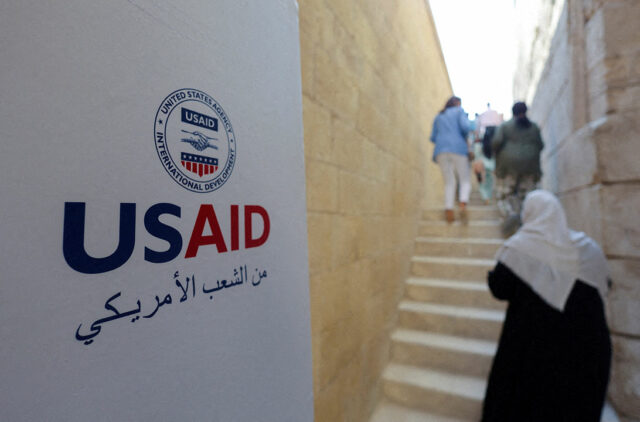
Visitors walk up a stair during the opening of the restoration project at the historic Bimaristan Al-Muayyad Sheikh, one of the oldest hospitals following extensive renovations carried out in partnership between Egypt’s Tourism and Antiquities Ministry and the United States Agency for International Development (USAID) in Old Cairo, Egypt Aug. 18, 2024. — REUTERS

WASHINGTON — The Trump administration on Tuesday announced that it was going to put on leave all directly hired employees of the US Agency for International Development (USAID) globally and recall thousands of personnel working overseas.

“On Friday, Feb. 7, 2025, at 11:59 pm (EST) all USAID direct hire personnel will be placed on administrative leave globally,” said an announcement on the USAID web site, which has been down since the weekend.

Some personnel “responsible for mission-critical functions, core leadership and specially designated programs” were excepted from the move, it said.

USAID’s workforce totals more than 10,000, with about two-thirds of that staff serving overseas, according to the Congressional Research Service (CRS). The agency has more than 60 country and regional missions.

For USAID staff overseas, Washington was preparing a plan in coordination with the State Department and would pay for the return travel of personnel to the United States within 30 days, the announcement said. It added that the USAID leadership was going to consider case-by-case exceptions based on personal hardship or concerns over mobility and safety.

“Thank you for your service,” the announcement finished.

The shocking overhaul, which risks upending the lives of thousands of staff and their families, comes as President Donald Trump moves merge USAID, Washington’s primary humanitarian agency that distributes billions of dollars worth of aid abroad, with the State Department and effectively dismantle the agency as an independent entity.

On Monday, Secretary of State Marco Rubio told reporters he was now the acting head of USAID, calling the agency “completely unresponsive” and accusing staff there of being “unwilling to answer simple questions” about programs.

He informed Congress in a letter of the looming reorganization of the agency, saying some parts of USAID might be absorbed by the State Department and the remainder may be abolished.

But because Congress established USAID as an independent establishment within the executive branch, the President does not have the authority to abolish it without congressional authorization, according to a CRS report this week.

TURMOIL
Hundreds of USAID programs covering lifesaving aid across the globe came to a halt after Mr. Trump on Jan. 20 ordered a freeze of most … foreign aid, saying he wanted to ensure it is aligned with his “America First” policy. He tasked billionaire Elon Musk, who has falsely accused USAID of being a “criminal” organization, with scaling down the agency.

The announcement on the USAID website went online hours after State Department officials were told by Peter Marocco, a Trump appointee who was on Monday tasked with overseeing the agency’s operations, that all USAID staff and their families should be recalled, sources said.

Tuesday night’s announcement caps nearly two weeks of mayhem at the agency, where dozens of staff at the headquarters in DC were put on leave and hundreds of internal contractors were laid off. Implementing partners of USAID are facing financial trouble on the back of stop-work orders from the State Department.

Waivers have been issued for some emergency life-saving assistance.

In fiscal year 2023, the United States disbursed $72 billion of aid worldwide on everything from women’s health in conflict zones to access to clean water, HIV/AIDS treatments, energy security and anti-corruption work. It provided 42% of all humanitarian aid tracked by the United Nations in 2024.

The funding, less than 1% of the United States’ total budget, is instrumental in Washington’s effort to build alliances around the world, reinforce its diplomacy and counter the influence of adversaries such as China and Russia in the developing world. — Reuters

India’s Finance ministry asks employees to avoid AI tools like ChatGPT, DeepSeek

The logos of Microsoft Corp. and OpenAI, as well as the ChatGPT 4 name, are seen in this photo illustration. — PHOTO ILLUSTRATION BY JONATHAN RAA/NURPHOTO VIA REUTERS CONNECT

NEW DELHI — India’s Finance ministry has asked its employees to avoid using artificial intelligence (AI) tools including ChatGPT and DeepSeek for official purposes, citing risks posed to confidentiality of government documents and data, an internal department advisory showed.

Countries like Australia and Italy have placed similar restrictions on the use of DeepSeek, citing data security risks. Reports of the advisory surfaced on social media on Tuesday, ahead of a scheduled visit to India by OpenAI chief Sam Altman on Wednesday, when he is also due to meet the IT minister.

“It has been determined that AI tools and AI apps (such as ChatGPT, DeepSeek, etc.) in the office computers and devices pose risks for confidentiality of (government) data and documents,” said the advisory by the Indian Finance ministry dated Jan. 29.

Representatives for India’s Finance ministry, ChatGPT-parent OpenAI and DeepSeek did not immediately respond to requests for comment.

Three finance ministry officials said the note was genuine and the note was issued internally this week.

Reuters could not immediately confirm whether similar directives have been issued for other Indian ministries.

OpenAI is facing heat in India due to a high-profile copyright infringement battle with the country’s top media houses, and has said in court filings that it does not have its servers in the country and Indian courts should not hear the matter. — Reuters

Singapore says visitor arrivals rise 21% in 2024

PEOPLE view the Rain Vortex indoor waterfall from a glass-bottomed bridge at Changi Jewel Airport in Singapore on March 7, 2020. — REUTERS

SINGAPORE — Singapore recorded a 21% increase in international visitor arrivals to 16.5 million last year, the highest number since the COVID pandemic, and the tourism board said it expected further growth this year.

Arrivals in 2025 were expected at between 17 million and 18.5 million, the Singapore Tourism Board (STB) said in a statement on Tuesday, continuing the recovery towards 2019’s pre-pandemic peak of 19.1 million visitors.

The STB said it expected tourist spending in 2024 to be at the upper end of its forecast of S$27.5 billion to S$29.0 billion ($20.3 billion to $21.4 billion), after spending of $$22.4 billion over the first nine months of last year.

If the forecast is realized, tourism receipts would reach a record, surpassing spending of $27.7 billion in 2019.

Mainland China, Indonesia and India were the top markets for arrivals in 2024, while visitors from mainland China, Indonesia, and Australia were the top sources of spending, the STB said.

Changi Airport had a total international seat capacity of over 41 million, which was a 98% recovery to pre-pandemic 2019, the board said. — Reuters