Home Blog Page 1496

Yields on term deposits rise amid weak demand

BW FILE PHOTO

YIELDS on the Bangko Sentral ng Pilipinas’ (BSP) term deposits inched higher on Wednesday as the offer went undersubscribed due to uncertainty here and abroad.

Total demand for the term deposit facility (TDF) of the central bank amounted to P122.771 billion on Wednesday, well below the P200-billion offering and the P202.697 billion in bids for a P220-billion offer a week ago. The BSP awarded just P115.771 billion in papers to cap the rise in yields.

Broken down, tenders for the seven-day papers reached P61.127 billion, lower than the P90 billion placed on the auction block as well as the P87.456 billion in bids for a P110-billion offering seen in the previous week. The central bank accepted only P59.127 billion in tenders.

Accepted yields ranged from 5.74% to 5.79%, a slightly wider band compared with the 5.74% to 5.78% seen a week ago. With this, the average rate of the one-week term deposits edged up by 0.89 basis point (bp) to 5.7668% from 5.7579% previously.

Meanwhile, the 14-day papers fetched bids amounting to P61.644 billion, below the P110-billion offer and the P115.241 billion in tenders for the same offer volume a week ago. The BSP made a P56.644-billion award of the two-week papers.

Tenders accepted carried rates from 5.748% to 5.79%, also narrower than the 5.7% to 5.79% range seen last week. This caused the average rate of the two-week papers to go up by 0.28 bp to 5.7723% from 5.7695% in the prior auction.

The BSP has not auctioned off 28-day term deposits for more than four years to give way to its weekly offerings of securities with the same tenor.

Both the TDF and BSP bills are used by the central bank to mop up excess liquidity in the financial system and to better guide market rates.

TDF yields were higher amid uncertainties here and abroad, Rizal Commercial Banking Corp. Chief Economist Michael L. Ricafort said in a Viber message.

At home, political noise related to former President Rodrigo R. Duterte’s arrest are keeping investors on wait-and-see mode “as a matter of prudence if there would be risk of massive protest rallies or any form of destabilization from the important priorities of the government,” Mr. Ricafort said.

Mr. Duterte, who led the Philippines from 2016 to 2022, was arrested on charges of crimes against humanity. He faced the International Criminal Court (ICC) in a pre-trial session last week.

He could become the first former Asian head of state to stand trial at the ICC.

Meanwhile, markets are also awaiting developments in the Trump administration’s tariff policies, with concerns of a trade war causing global yields to rise recently.

US President Donald J. Trump still intends for new reciprocal tariff rates to take effect on April 2, the White House said on Tuesday, despite earlier comments from Treasury Secretary Scott Bessent that indicated a possible delay in their activation, Reuters reported.

“The intent is to enact tariffs on April 2,” the official said when asked to clarify Mr. Bessent’s comments that countries would get an opportunity to avoid higher tariffs by reducing their own trade barriers.

“Unless the tariff and non-tariff barriers are equalized, or the US has higher tariffs, the tariffs will go into effect,” the White House official said.

Mr. Bessent told Fox Business Network’s Mornings with Maria program that Mr. Trump on April 2 would give trading partner countries a reciprocal tariff number that reflects their own rates, nontariff trade barriers, currency practice and other factors, but could negotiate to avoid a “tariff wall.”

His remarks were taken to mean that while the proposed duties would be announced on April 2, their implementation could be delayed to allow time for negotiations. But the White House official said any such deals would need to be negotiated in advance to avoid the new tariffs.

The dueling comments illustrate the developing nature of Mr. Trump’s new reciprocal tariffs just two weeks out from the April 2 activation deadline.

Financial markets have become increasingly nervous about the impact of Mr. Trump’s tariffs and retaliation from trading partners will have on inflation and economic growth.

“The TDF average auction yields were slightly higher since they were already almost the same as the key BSP overnight (one-day) rate of 5.75%, as there must be some slight premium for seven-day and 14-day tenors to become more attractive in siphoning off some peso liquidity in the financial system,” Mr. Ricafort added.

Recent dovish signals from the BSP chief helped cap the increase in term deposit rates, he said.

BSP Governor Eli M. Remolona, Jr. last week said a rate cut is still “on the table” at the Monetary Board’s meeting on April 10, signaling “a few more” rate cuts for the rest of the year.

The BSP last month unexpectedly paused its easing cycle amid global uncertainties, keeping the policy rate at 5.75%. — Luisa Maria Jacinta C. Jocson with Reuters

AI governance framework dev’t is a must for enterprises, Boomi says

BW FILE PHOTO

By Cathy Rose A. Garcia, Editor-in-Chief

GOVERNANCE is key for enterprises looking to incorporate artificial intelligence (AI) in their operations, according to US-based integration and automation company Boomi.

David Irecki, Boomi chief technology officer for Asia-Pacific and Japan, said more businesses are adopting AI and AI agents, which brings challenges for security and compliance.

“AI governance will be forming a much bigger part of the AI conversation with businesses,” he said in an interview with BusinessWorld last week.

Mr. Irecki noted that last year, many organizations have been laying the groundwork and putting in frameworks around how AI should be useful for their businesses, implementing data management strategies to understand the data quality across their organizations.

“Research analysts tend to say between 60% and 70% of an organization’s data is dark. It’s siloed. So, if you’re thinking for AI, it needs access to data, but it also needs data liquidity. Because of these silos, how can you use a technology like Boomi to connect all these systems together and to get AI the right data at the time?” Mr. Irecki said.

“I see 2025 as companies being able to now really use AI and challenge it, and see what outcomes they get, and hopefully if they do really well with it, the next challenge will be AI governance, which we’re getting ready for,” he added.

Mr. Irecki said a governance framework allows enterprises to essentially register their AI agents and observe them.

“(First, you) register all the agents within your organization and understand what do you have, what is operating,” Mr. Irecki said.

“(It will) provide observability… What data are they (AI agents) accessing? What are the results because as a business the last thing you want is for one of your employees to upload data that they shouldn’t or for the AI to provide data that it shouldn’t.”

Boomi has already deployed over 25,000 AI agents for its customers. It recently launched AI Studio that provides organizations with a secure and vendor-agnostic way to design, govern, and orchestrate AI agents.

It also provides full AI agent lifecycle management in order to ensure integration, governance and control.

Meanwhile, Boomi is seeing increasing interest from enterprises in the retail, insurance and hospitality sectors in the Philippines.

“For us, the year’s been very fruitful in the Philippines, especially if I pick out three sectors. Retail, insurance and hospitality have been areas we’ve been getting customers in,” Mr. Irecki said.

He said enterprises want to get a better understanding of their customers to eventually drive more revenue.

For instance, retail enterprises that use Boomi can have a chatbot that can be augmented with AI.

“The AI is able to provide better recommendations and better support. And the reason being because if an organization has used a technology like Boomi to provide that foundation, the AI is now able to be connected to your systems, so it understands the customer,” Mr. Irecki said.

Asked what the main challenges to greater AI adoption for enterprises in the Philippines are, Mr. Irecki said it all comes back to data.

“For here in the Philippines specifically, it’s those legacy systems, the data silos, it’s the skills, and it’s just general infrastructure and internet connectivity,” he said.

For enterprises embarking on an AI-driven digital transformation, Mr. Irecki said putting in an ethical framework first is key.

“Understanding your data, proving its quality and its liquidity, is key because those two things set the foundation for AI. But equally, you don’t necessarily have to do a ‘big bang’ approach,” he said.

Enterprises should also consider if the cost of running AI solutions is worth the efficiency gains.

Building better schools

DPWH.GOV.PH

With former Senator Sonny Angara now leading the Department of Education, he is well-positioned to advocate among his former colleagues in the House and the Senate to improve public elementary and high school buildings.

Although the Philippines already has the National Building Code, drafting a separate, specialized building code specifically for public schools can significantly enhance infrastructure standards. This dedicated school building code would better consider the nation’s unique conditions: our archipelagic geography, two-season climate, location within the Pacific Ring of Fire, and vulnerability to frequent typhoons and floods.

Primarily, building standards must account for each school’s specific location. Schools situated in remote hinterlands will naturally require different construction standards than those in urban areas. Every school building should adapt uniquely to its environment.

The government faces considerable challenges in constructing safe, resilient, and sustainable school buildings. Now is the optimal time to review current construction standards and push for nationwide educational infrastructure capable of withstanding severe climate conditions.

The Philippines faces numerous geographic and climatic vulnerabilities. The country regularly experiences over 20 typhoons annually (often accompanied by flooding), storm surges, landslides, and earthquakes. Clearly, existing building standards need updates to incorporate modern technologies and materials capable of enduring extreme weather events.

Policymakers should collaborate with experts and review recent research alongside international best practices. Structural integrity assessments must explicitly address extreme scenarios such as super typhoons like Yolanda, intense monsoon rains, and significant seismic activity.

Key technical considerations should include: elevating buildings or using amphibious structures to mitigate flood risks; reinforcing roofing to withstand winds of at least 350 kilometers per hour; engineering foundations specifically for landslide- or earthquake-prone areas.

Obviously, no single standard fits every location. Policymakers must distinguish between requirements for regular public elementary and high schools, particularly those located in rural areas, versus those in urban or more accessible settings. Similarly, standards for campuses dedicated to higher education should also vary.

Urban schools, especially in cities where local governments can allocate larger budgets, may adopt advanced systems such as earthquake isolation, integrated solar power, sophisticated ventilation, and extensive rainwater harvesting systems.

Conversely, regular public schools in remote areas should prioritize practicality, affordability, and sustainability. Such structures must make extensive use of locally sourced and indigenous materials like bamboo, adobe, and reinforced concrete.

However, all schools, regardless of location, should share common standards to meet specific objectives: energy efficiency, effective ventilation, adaptability during pandemics (like COVID-19), climate resilience, cost-effectiveness, and ease of rebuilding or replacement after disasters.

Regional innovations like bamboo-reinforced concrete used successfully in Indonesia and floating school structures in Bangladesh offer excellent examples. Partnering with international institutions such as the Asian Development Bank (ADB) and the World Bank can accelerate research and assessment, enhancing the transfer of technology, funding, and expertise.

Given our numerous rural and island-based communities, construction logistics are crucial. Modular construction techniques, which enable rapid deployment and easier repairs or replacements after disasters, can be particularly beneficial.

One practical approach involves constructing building components in regional work yards that have better access to construction materials, water, electricity, and heavy equipment. Once constructed, these prefabricated modular components can then be transported and quickly assembled at school sites.

Energy efficiency and sustainability must also be central priorities. Policymakers should mandate solar energy due to the country’s abundant sunlight, reducing dependency on unstable power grids and significantly lowering operational costs. Similarly, requiring rainwater harvesting and grey water recycling systems in all public schools effectively addresses water scarcity, especially during dry periods.

Lifecycle costs must also be considered. Although climate-resilient buildings typically require higher initial investments, these costs are justified by lower maintenance expenses, longer lifespan, and reduced operational expenses.

To ensure financial sustainability, policymakers should earmark a portion of revenues from tobacco and alcohol taxes to finance educational infrastructure projects. These “sin taxes” already fund healthcare initiatives, making their extension to educational projects both logical and practical.

While engaging international partners like ADB and the World Bank is not strictly necessary, their involvement can significantly bolster efforts. These organizations offer valuable technical assistance, funding opportunities, and knowledge that support resilient and sustainable infrastructure projects.

Additionally, regular inspections, maintenance, and upgrades should be mandated. Constructing better schools serves little purpose without proper long-term maintenance. Clear accountability among local governments, school administrators, and the Department of Education ensures sustained school safety, infrastructure integrity, and climate adaptability.

In 2023, the Department of Education reported a shortage of approximately 91,000 classrooms. By 2024, the education budget rose to P924.7 billion, further increasing to P1.053 trillion in 2025. Yet, despite these increases, current allocations remain insufficient to fully address the infrastructure gap.

Only by thoroughly reviewing and revising government standards for school buildings can we establish structures that are robust, innovative, and sustainable. This comprehensive review should begin with a nationwide needs assessment that accurately determines the existing condition of school infrastructure, the number of classrooms needed, and region-specific requirements, particularly for areas prone to natural disasters.

With the guidance of scientists and researchers, the Philippines can implement building codes mandating climate-resilient designs, elevated structures for flood mitigation, reinforced materials for high wind resistance and seismic stability, and efficient drainage systems.

Policymakers must actively encourage the use of indigenous materials like bamboo and adobe, which are sustainable, economical, and culturally appropriate. Collaborating with international partners can introduce advanced construction methodologies, enhancing durability and resilience.

Public-Private Partnerships (PPPs) can further mobilize resources for school infrastructure projects, while international development partners provide technical and financial assistance. Additionally, Corporate Social Responsibility (CSR) initiatives from private corporations, incentivized through tax breaks, can provide supplementary funding.

Local Government Units (LGUs) should also allocate portions of their budgets to educational infrastructure, particularly in underserved rural areas. Engaging local communities in the planning and construction processes ensures infrastructure meets local needs and cultural preferences. Community involvement promotes ownership and encourages residents to maintain facilities long-term.

We had high hopes after devastating typhoons like Ondoy, Pepeng, and Yolanda. Initially, we believed these experiences would push us toward building better and more resilient infrastructure. However, those promises faded. Now, perhaps, focusing specifically on building better school facilities can help reignite these aspirations and lead to lasting improvements.


Marvin Tort is a former managing editor of BusinessWorld, and a former chairman of the Philippine Press Council

matort@yahoo.com

URC sets sights on volume, market share recovery

URC.COM.PH

UNIVERSAL ROBINA CORP. (URC) is targeting volume and market share recovery this year, its president said.

“We’re looking very much forward to a strong volume recovery and market share recovery,” URC President and Chief Executive Officer Irwin C. Lee said during the Money Talks with Cathy Yang program on One News Channel on Wednesday.

In 2023, URC’s net income fell 2% to P12.5 billion due to lower profit from its sugar and renewables segment. Sales, however, grew 3% to P161.9 billion on higher volume across all divisions.

Mr. Lee said the company will focus on expanding its Philippine business, which accounts for over 70% of revenue, while strengthening its presence in Southeast Asia. 

“Our businesses have been very strong in all the ASEAN countries. We’ve seen high single-digit to double-digit growth in Malaysia, Thailand, Vietnam, and Indonesia. The Philippines has been more of a drag, but now we’re seeing a bit of a turn. Cautious optimism is growing, and sentiments are improving with inflation easing slightly,” he said. 

“We will devote significant attention to the Philippines, sustain growth momentum in ASEAN, and drive volume recovery in the country,” he added.

Mr. Lee also said URC’s exit from the China market will be completed this year.

“We’re well on track. We’ve made all necessary announcements in China, and we’re working with regulatory authorities. The wind-down process is ongoing and will likely take the rest of the year to complete. China was not a major operation for us,” he said. 

In August last year, URC announced its exit from China, where it produces cereals and snacks. The company said the move would allow it to redeploy resources to higher-growth markets in the region. 

Meanwhile, Mr. Lee expects an income boost from the May midterm elections.

“Elections have always provided a lift for us. We’re, of course, banking on some of that lift this year,” he said.

On Wednesday, URC shares rose 2.15% or P1.60 to P75.90 apiece. — Revin Mikhael D. Ochave

Barako coffee wins award from Paris

L-R: FOUNDER of the Coffee Heritage Project and co-founder of the Biyaya Sustainable Living Festival Rich Watanabe, the winners of the Gourmet Medal for the Hors Categories Niña Guinto and Martin Macalintal, and AVPA’s Philippe Juglar

THE AWARDING of international medals for local coffee growers and a new prize specifically created for a Batangas-grown coffee opened the Biyaya Sustainable Living Festival. The awards were given on the festival’s first day, March 14.

The Biyaya Festival, which ended on March 16, is an expanded version of the Manila Coffee Festival, and honored besides coffee, traditional handicrafts, textiles, and other local arts. A section of the festival, which was held in Parqal Mall in Parañaque, showed paintings, pottery, and traditional tattoo artists; another section was devoted to supernatural beliefs.

Richard Watanabe, founder of the Coffee Heritage Project and co-founder of the Biyaya Sustainable Living Festival said in a speech, “This festival was borne out of a simple but powerful idea: that the artisans, farmers, and craftsmen of the Philippines are not just producers of goods. They are artists, cultural bearers, entrepreneurs, and individuals. Their work is woven into the very fabric of our identity.”

“Our purpose is to have local growers in charge of developing locally roasted coffee to be recognized at an international level,” said Philippe Juglar in a speech. Mr Juglar is the president of the Paris-based Agence pour la Valorisation des Produits Agricoles (Agency for Valorization of Agricultural Products or AVPA). AVPA is a non-governmental, non-profit organization composed of producers and taste enthusiasts that provides certifications, training, and support for local growers worldwide. AVPA also holds contests for the best in their class for coffee, chocolate, tea, and edible oils. More than 700 producers from around the world participate in AVPA contests every year, according to its website.

The awards that were won last year were awarded in the Philippines last week by Mr. Juglar.

There were four awards given this year: Rebecca Gacayan from Sultan Kudarat won the Gourmet Medal from the Café Ronds Category, honoring well-balanced coffee, while George Dapliyan from Sagada won the Gourmet Bronze Medal for the Acidulé Floral category, recognizing coffees with bright acidity and delicate floral notes. Andrew and Mary Tomeg, and Filipa Villicana, also from Sagada, won the Silver for the same category.

Finally, Martin Macalintal and Niña Guinto of Batangas won the Gourmet Medal for the Hors Categories, created specifically for the Barako coffee given its uniqueness as an entry. “To obtain this level of quality requires years and years of effort,” said Mr. Juglar.

SWEET COFFEE
The coffee industry in Batangas was started in the 1700s by Spanish friars but was expanded in the next century through the estate of the Kalaw-Katigbak family (which was also honored during the festival). Barako, the coffee varietal grown there, belongs to the Liberica species of coffee, as opposed to the more mainstream Arabica. Mr. Macalintal said in a speech, “From a micro farm in Alitagtag, Batangas, here we are. We’re going to conquer the world.”

He discussed the qualities of his prize-winning coffee with BusinessWorld. He said that Ms. Guinto had submitted their coffee for judging by the AVPA in a previous contest, and the organization deemed it too sweet and suspected cheating. Scientists were brought to their small 200-tree farm to investigate, only to find out that bordering properties planted with sugarcane contributed to the coffee’s terroir.

“There was no cheating. There was inherent sugar or sweetness in the coffee,” he said. “It’s very fruity, but at the same time, you have the tanginess and acidity of Liberica.”

The small farm began as a plot of about 3,000 square meters. “Now that I know the quality of what we can make out of the land, then I’m going to start to expand,” said Mr. Macalintal. — Joseph L. Garcia

Philippines: Balance of Payments (BoP) Position

THE PHILIPPINES’ balance of payments (BoP) position swung to a surplus in February, the Bangko Sentral ng Pilipinas (BSP) said on Wednesday. Read the full story.

Philippines: Balance of Payments (BoP) Position

Indonesia takes currency, market measures after rupiah and shares fall

REUTERS

JAKARTA — Indonesia’s financial services regulator has allowed listed companies to buy back their stocks without shareholders’ approval, while the central bank conducted “bold” currency intervention to calm markets, officials said on Wednesday.

The moves came after the main stock index fell as much as 7.1% on Tuesday, pressured by concerns over the government’s policy, fiscal position and growth prospects.

The index recovered by around 1% as of 0430 GMT Wednesday after the announcement. The rupiah, however, extended losses, falling by as much as 0.7%, despite Bank Indonesia’s (BI) intervention.

The currency was hit by spillover impact from Tuesday’s drop in the stock market as well as global factors including US trade policy, expectations around the Federal Reserve’s meeting this week and tensions in the Middle East, BI’s Director of Monetary and Securities Asset Management Fitra Jusdiman told Reuters.

“BI has and will continue anticipatory, mitigatory responses to ensure stability in the rupiah exchange rate, maintain FX (foreign exchange) supply-demand, including by intervening in a bold and measured way,” he said.

The financial regulator’s new buyback rules are effective for six months and are intended to shore up market confidence, said Inarno Djajadi, chief regulator for the capital market at the Indonesia Financial Services Authority.

“We hope to give a positive signal that companies have good fundamentals, to provide market confidence to investors as well as give flexibility to listed companies to conduct corporate actions to reduce share volatility,” Inarno told a press conference.

Satria Sambijantoro, head of research at Bahana Securities, said cash-rich companies whose share prices are undervalued may opt to use the opportunity to reduce public holdings.

In past episodes of stock market plunges, state companies were among those which conducted buybacks to prevent further falls.

State-controlled banks last month announced plans for buybacks.

Iman Rachman, chief executive of the Indonesia Stock Exchange, said Tuesday’s index drop has not affected the pipeline for initial public offerings.

BI was due to hold a press conference on its monetary policy review later in the day. Most economists polled by Reuters expected BI to keep rates unchanged to prioritize rupiah stability, although a significant minority expected a 25-bp rate cut.

“Moves in local financial markets… create a headache for the central bank,” said Capital Economic’s Chief Emerging Markets Analyst William Jackson.

“While low inflation and slower economic growth should set the stage for another interest rate cut… concerns about the currency… may prompt it to act more cautiously and leave rates unchanged.”

CONCERNS OVER POLICY, POLITICS
Analysts id the market sell-off was triggered by several factors.

Those include an increase in the state’s role in Southeast Asia’s largest economy under President Prabowo Subianto, management of state companies, the set up of new sovereign wealth fund Danantara, rising risk of fiscal deterioration and speculation over the resignation of respected Finance Minister Sri Mulyani Indrawati, which she has since denied.

Of particular concern to investors was a government plan to have the military play a wider role in state institutions, which could allow armed forces personnel to serve in more civilian positions, said head of Indonesia research at Macquarie Capital Ari Jahja.

Parliament is set to pass contentious revisions to the military law on Thursday. 

Appearing alongside financial regulators at Wednesday’s press conference, lawmaker Budi Djiwandono said no active military personnel would be placed in state-owned companies. Djiwandono is deputy head of the parliamentary committee overseeing the deliberation of the military law revisions and Prabowo’s nephew.

Foreign investors, who make up around 40% of Indonesia’s stock market participants, recorded net sales of around 2.49 trillion rupiah ($150.68 million) on Tuesday. — Reuters

Google’s $32-billion deal for Wiz accelerated under Trump, sources say

REUTERS

NEW YORK — Less than a year after Google’s plans to acquire Israeli cybersecurity firm Wiz fell apart, executives were able to ink a deal in a flurry of negotiations after US President Donald J. Trump was sworn into office just eight weeks ago.

Google sweetened its original offer for $23 billion in July to $32 billion, making it one of the largest tech deals ever, and dramatically upped the breakup fee to more than $3.2 billion, people familiar with the agreement said. But the real closer for Wiz and Google executives was the change at the White House that brought with it the prospect of a friendlier antitrust review under Trump, these people said.

Google made another pass last fall while Wiz considered a potential initial public offering, these people said. While negotiations continued sporadically over several months, executives started meeting regularly to hammer out details of a deal after Mr. Trump’s Jan. 20 inauguration and appointment of key antitrust officials in his administration, these people said.

Fazal Merchant also joined Wiz as its new Chief Financial Officer in January, while the company was still weighing a potential initial public offering. Merchant played a major role in shaping the deal, along with CEO Assaf Rappaport, helping to get it across the finish line, one of the people said. Google’s cloud chief Thomas Kurian was also a key architect of the agreement, two people said.

SWEETENED DEAL
Wiz executives found it hard to turn down Google’s revised offer, which valued the cybersecurity startup 39% higher than the earlier bid, and also included a higher reverse breakup fee of more than $3.2 billion, or over 10% of the deal value, payable to Wiz if the deal falls through, the sources said.

Google sees the premium as justified given Wiz’s 70% annual revenue growth and over $700 million in annualized revenue, according to a source familiar with the discussions.

Reverse termination fees, more commonly referred to as breakup fees, are paid by buyers to compensate target companies when deals fall apart due to regulatory reasons.

Such a high breakup fee is not common in corporate dealmaking in the United States, even though such fees have been on the rise in recent years as regulatory threats to large deals have increased globally. According to a study by law firm Fenwick & West, which reviewed deals worth at least $1 billion that were signed in 2023, breakup fees on an average ranged between 4% and 7% of the overall transaction value.

It is not clear if Google and Wiz approached US antitrust authorities prior to the signing of the deal.

Some companies have preemptively briefed US antitrust watchdogs to warm them up before signing a deal. For instance, in 2023, Tempur Sealy sought the blessing of the US Federal Trade Commission before signing a $4-billion deal to acquire Mattress Firm.

Wiz executives were wary after seeing Adobe’s attempted $20-billion takeover of Figma fall apart due to antitrust scrutiny in late 2023, two people said. Google is also currently battling two US Department of Justice lawsuits over its domination of online search and another about ad technology.

Google had offered to pay Wiz a breakup fee of about $2 billion at the time — a sum that Wiz felt was not high enough for them to undertake the risk of signing the deal, the sources said.

Some of Wiz’s largest venture-capital backers were worried that then-Federal Trade Commission Chair Lina Khan would tank the deal, the sources said.

Mr. Trump’s appointment of Andrew Ferguson to chair the FTC and Gail Slater to helm antitrust reviews at Justice also gave executives at both companies more confidence in a smoother regulatory review, people familiar with the deal said.

Google, Wiz, the White House, and Justice officials did not immediately respond to requests for comment.

Bank of America advised Google on the deal, while Goldman Sachs advised Wiz. Reuters

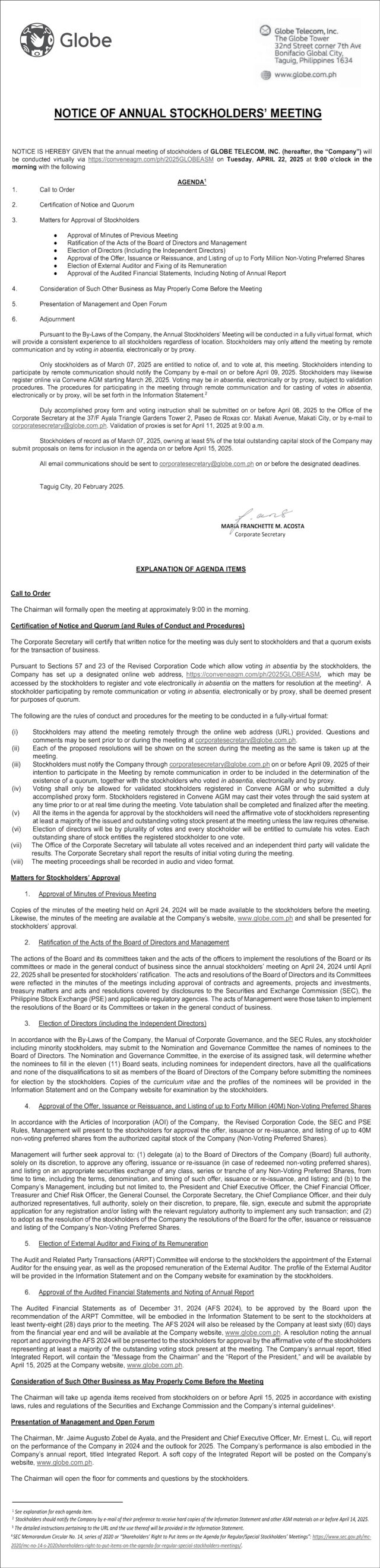
Globe Telecom, Inc. to conduct 2025 Annual Meeting of Stockholders virtually on April 22


Click to enlarge


Spotlight is BusinessWorld’s sponsored section that allows advertisers to amplify their brand and connect with BusinessWorld’s audience by publishing their stories on the BusinessWorld Web site. For more information, send an email to online@bworldonline.com.

Join us on Viber at https://bit.ly/3hv6bLA to get more updates and subscribe to BusinessWorld’s titles and get exclusive content through www.bworld-x.com.

Towards a flat income tax of 10% to 15%

An interesting study was released recently by the Congressional Planning and Budget Research Department (CPBRD) of the House of Representatives entitled “Progressivity, Fairness, and Efficiency: An Evaluation of the Impact of the TRAIN Law on the Distribution of the Income Tax Burden,” CPBRD Policy Brief No. 2025-04. The authors were David Joseph Emmanuel Barua Yap, Jr., Edrei Y. Udaundo, and Jubels C. Santos.

The old name of the CPBRD was the Congressional Planning and Budget Office (CPBO) and I worked there from 1991-1999.

Among the study’s findings were that the tax share of the top earners — those who earned at least P1.35 million in 2017 and P1.43 million in 2023 — increased from 72.4% (P183 billion) to 88.1% (P258 billion) under the Tax Reform for Acceleration and Inclusion (TRAIN) Law of 2017. See this report about it in BusinessWorld by Kenneth Basilio, “Flat tax seen easing burden on top earners — think tank” (March 18).

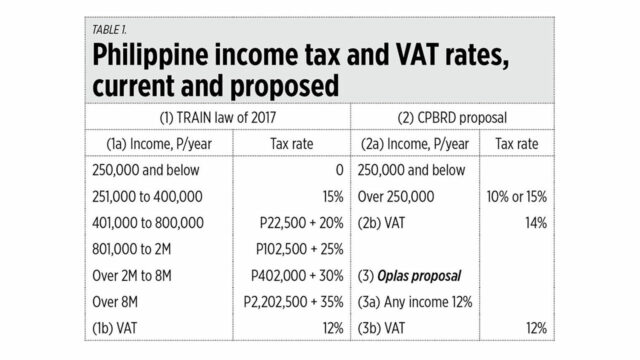
Among the recommendations of the CPBRD paper are that there should be a flat income tax of 10% to 15%, VAT should be hiked from 12% to 14%, and that there be a 10% reduction in government bureaucracy.

I support these suggestions except the value-added tax (VAT) hike to 14%. Currently our 12% VAT is among the highest in Asia, with most of our neighbors having VAT or sales taxes of 7-10%.

In the accompanying table I summarized the existing and proposed tax rates, including my own proposal. An income tax cut often leads to a broader tax base because those who evade paying income taxes at 20% to 35%, or who downscale their declared income to avail of lower tax rates, will be encouraged to declare their real income and pay only 10% to 15%.

I think a flat 12% national income tax regardless of income level will attract more people to be more honest about their real income. Then we can allow the local government units (LGUs) to impose their own income tax.

The CPBRD paper also proposes a spending cut, which is among my favorite advocacies. They estimate that a 10% reduction in the government payroll would save taxpayers some P160 billion, equivalent to half of the 2023 income tax take.

I checked the reactions to the report of two officials in charge of taxation and spending. Department of Finance (DoF) Secretary Ralph G. Recto said that: “We are committed to maximizing tax administration efficiency and ensuring a progressive tax system. Right now, our priority is to collect what is already on the table by accelerating digitalization and closing tax loopholes. By doing so, we can maximize revenue collections without placing an additional burden on our people through new taxes.

“One of the critical mandates of the DoF is to ensure that economic growth is inclusive and equitable by providing more government assistance to those who are in greater need. This can only be done through a progressive tax system, wherein higher-income brackets can contribute more, enabling the government to provide more public services and support to vulnerable sectors.”

Meanwhile, Budget Secretary Amenah F. Pangandaman was happy that the National Government Rightsizing Program (NGRP) was mentioned in the study as they really intend to streamline and make public spending more efficient and not wasteful.

OK then, Secretaries Recto and Pangandaman.

I hope that some legislators someday will be bold enough to push for a flat income tax 10% to 15%. My idea is to have a flat 12% national income tax, then allow the LGUs to impose their own income tax, encourage more devolution of functions to LGUs and then they will have social services competition, infrastructure competition, and peace and order competition among themselves.

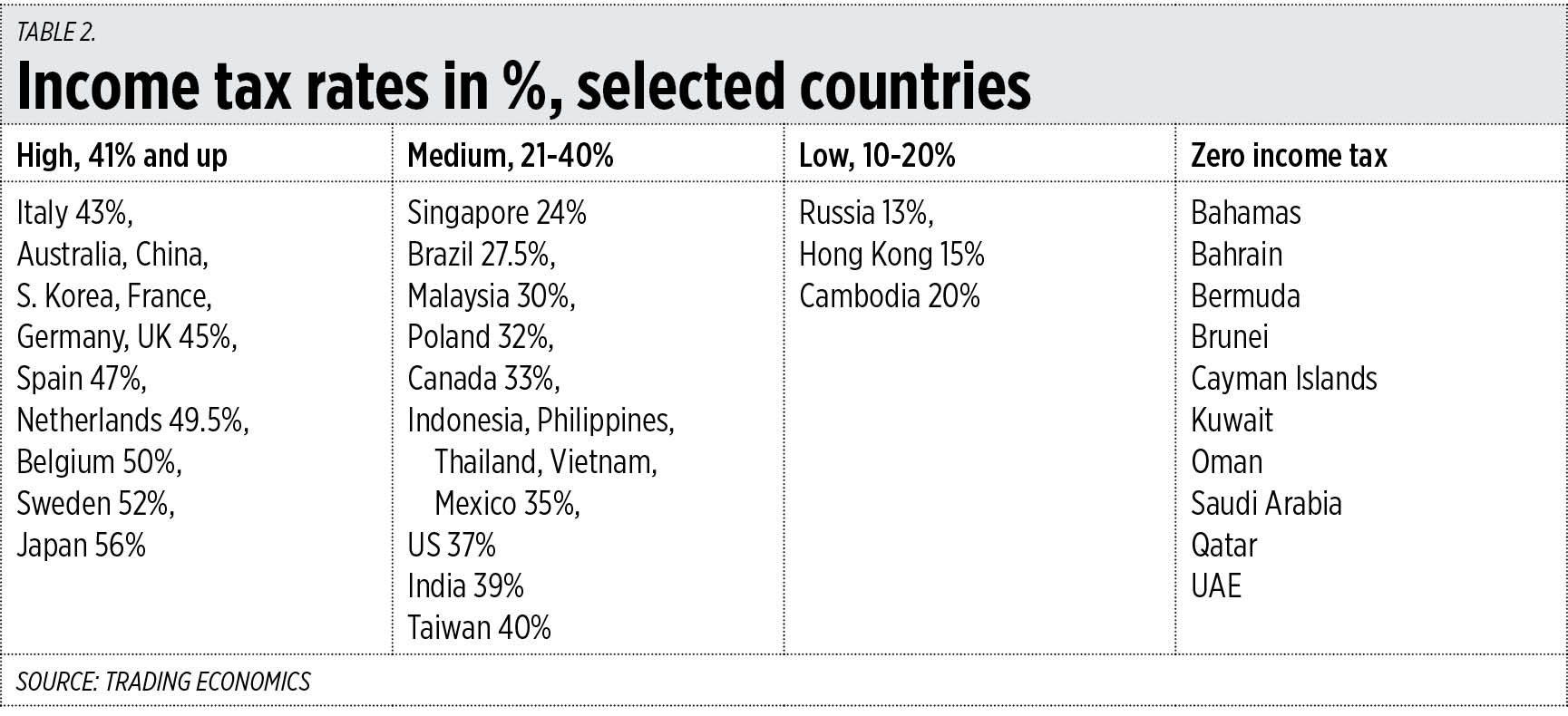
Currently 10 countries and territories have zero income tax. Bless them (see Table 2).


Bienvenido S. Oplas, Jr. is the president of Bienvenido S. Oplas, Jr. Research Consultancy Services, and Minimal Government Thinkers. He is an international fellow of the Tholos Foundation.

minimalgovernment@gmail.com

Vitarich partners with NOVOGEN for NOVOgen White hen distribution

VITARICH CORPORATION FACEBOOK PAGE

LISTED feed manufacturer Vitarich Corp. (VITA) has partnered with French breeding company NOVOGEN for the exclusive distribution of NOVOgen White hens.

VITA said it finalized the partnership in Clark, Pampanga, on Monday.

NOVOGEN’s products are sold in more than 50 countries, with global sales increasing annually, particularly in Asia.

“We use various tools to select and improve the products generation after generation: a mix of traditional and innovative environments, genomic research, RFID technology, and artificial intelligence,” NOVOGEN Chief Executive Officer Mickael Le Helloco was quoted as saying in a statement.

“Thanks to the implementation of these tools in research and development, we have been able to speed up yearly genetic progress by 2.5 times compared to the rate observed 10 years ago,” he added.

VITA said NOVOgen White hens can lay efficiently for over 100 weeks, producing up to 470 eggs per cycle — extending laying cycles beyond other breeds.

Compared to other breeds, NOVOgen White hens have better feed conversion, requiring less feed per egg, reducing production costs, and maximizing profits, the company added.

The hens also produce strong, uniform eggshells with a gradual increase in egg weight until the end of the production cycle, minimizing losses from breakage.

“They perform well and can realize their production potential under the most varied conditions, including the tropical climate of the Philippines,” VITA said.

VITA said customers will receive expert technical and marketing support, including guidance on housing, nutrition, and layer business management, as well as supply chain support for sourcing high-quality feeds and medications.

“They can also get assistance with laboratory tests for the quality of water, feeds, and raw materials,” the company said. — Kyle Aristophere T. Atienza

Auto Sales (February 2025)

NEW VEHICLE SALES jumped by an annual 2.9% in February, the slowest growth in five months amid a decline in passenger car sales, according to a joint report by the Chamber of Automotive Manufacturers of the Philippines, Inc. (CAMPI) and the Truck Manufacturers Association (TMA). Read the full story.

Auto Sales (February 2025)