Home Blog Page 130

Cebu Pacific reviews fuel costs, routes amid rising oil prices

CEBUPACIFICAIR

BUDGET CARRIER Cebu Pacific said it is reviewing jet fuel costs and network strategies to cushion the impact of rising global fuel prices despite growth in passenger volume.

“[W]e remain cognizant of the ongoing crisis and uncertainty in the Middle East, and the impact of sharply increasing fuel prices on our business,” Cebu Pacific Chief Executive Officer Michael B. Szücs said in a statement last week.

For the first two months of the year, Cebu Pacific logged 5.07 million passengers, up 7% from 4.74 million in the same period in 2025.

Domestic passengers accounted for the majority of the total at 3.74 million, while international passengers reached 1.33 million during the period.

“Our operating fundamentals — including our robust domestic network, modern fuel-efficient fleet, and low-cost structure — provide us relative advantages as we navigate these headwinds. We will continue to review pricing and network strategies to ensure we minimize the negative impact of the higher fuel prices,” Mr. Szücs said.

Cebu Pacific said its fuel-efficient fleet gives the airline some advantage in navigating challenges from rising global fuel costs.

The airline operates Airbus NEO aircraft, which are known for enhanced fuel efficiency. These represent the latest generation of Airbus planes designed to be highly compatible with sustainable aviation fuel (SAF).

According to monitoring by the International Air Transport Association (IATA), jet fuel prices rose 58.4% week on week to $157.41 per barrel as of March 6. On a yearly basis, jet fuel prices increased by 74.8%, data from the airline trade association showed.

On Friday, the Department of Transportation (DoTr), together with the Civil Aviation Authority of the Philippines (CAAP) and the Civil Aeronautics Board (CAB), ordered the reduction of passenger service charges, or terminal fees, for all government-operated airports in the country.

The Transportation department said the initiative aims to ease a possible increase in airfares as jet fuel prices climb. Based on its recent monitoring, jet fuel prices nearly doubled to $188.20 per barrel as of March 9 from $90.87 per barrel on Feb. 19.

Last year, CAAP approved the collection of new passenger service charges and other fees for all CAAP-operated airports.

Under Memorandum Circular 019-2025, CAAP raised terminal fees to P900 for international flights from P784. For domestic flights, the terminal fee is set at P350 if the passenger departs from an international airport. It is set at P300 for departures from a principal class 1 airport, P200 from a principal class 2 airport, and P100 for departures from community airports.

CAB has also shortened the evaluation period and implementation of the fuel surcharge to 15 days from one month to ensure that jet fuel prices are reflected more quickly and allow passengers to book tickets at more affordable prices.

The passenger fuel surcharge has remained at Level 4 since January. At Level 4, the surcharge ranges from P117 to P342 for domestic flights and from P385.70 to P2,867.82 for international flights originating from the Philippines. — Ashley Erika O. Jose

All things great and Filipino

JOSEPH L. GARCIA

(that you can customize this month)

SPATIO, Robinsons Retail’s concept in its Opus mall, is positioning itself as the new place to get your artisanal Filipino hit. If you regret missing something at the big artisanal fairs in the country (for example, Habi, ArteFino, and MaArte), you’re bound to find them at Spatio, all year round.

This March though, they’re launching the Made For You campaign featuring Filipino brands that can offer customization services. These include charms and trinkets from Studio MG.88, Style Isle, and Casa Inez, and custom engraving in brooches and necklaces from Alchemista. Piesa introduces a jewelry making experience inspired by halo halo. Viajecito also invites guests to mix and match bags and straps, allowing shoppers to create combinations that match their own style. Stations include Vesti, where guests can customize their own bag, and Boop MNL, which offers scarves for dogs and cats that can be personalized with the names of the pets.

Chief among these brands is the limited time only customization services by Revibe Culture. The brand takes a clothing base, then adds upcycled touches from damaged designer goods. This is one of the latest brands to join Spatio’s permanent display (more on them in the sidebar).

Martin de Leon, deputy general manager for Spatio, told BusinessWorld what they look for in a local brand. “It depends on the category and the mix that we already have. If they can fill in a gap — of course, it’s a given that the branding has to be strong; the products that they carry have to meet a certain standard.”

According to him, they currently have 300 local brands in the store, a jump from 30 when they first opened in 2024. Of course, he says, they have international brands too (we saw some at their beauty selection on the third floor, but these share space with a large display of local beauty brands). “We deliberately placed them right beside each other,” he said. “I feel like the consumer behavior has really shifted. There’s really more support towards local brands. They see that the quality that we have to offer, and also in terms of design, is really at par with international brands,” he said.

“That’s pretty much the goal of Spatio. It’s to provide a home and opportunity for local brands to thrive, and also to promote their creativity — to promote the country, pretty much.”

The beauty and the problem of artisanal craft is that no two items are ever the same — it becomes a problem when one thinks of the consistency needed in commercial operations in mall stores such as Spatio. “I think a lot of the brands are already starting to experience the possible long-term volume that this platform can provide,” said Mr. De Leon. “They’re already incorporating planning in terms of their production and also capacity.”

Asked if Spatio’s Filipino-forward model can be replicated in other locations, he said, “Definitely, that’s something that’s in the works.”

“There’s definitely opportunity for that in the future,” he said. “We’re seeing a lot of growth from this particular store.”

Mr. De Leon noted that the Spatio platform gives something more concrete to many young brands, as opposed to their usual strategy of going online, or appearing only in pop-ups. “There are a lot of brands who are already reaching out, because they want to be able to introduce their brands in a different format,” he said. “There’s really that opportunity for them to really engage and see the products up close,” he said about the customer.

“We want to grow the brands. We want to groom them, and we want to make sure that we can sustain the business,” he said. “Hopefully, the plans will push through in terms of possibly expanding the brands beyond just this location.”

Spatio is also offering exclusive in-store promotions throughout March. From March 13 to 31, shoppers using their BPI credit cards (Visa Signature, Amore Platinum Cashback, and Robinsons Cashback Card) with a minimum spend of P10,000 can receive a P1,000 Spatio gift certificate for their next lifestyle purchases. Guests can also enjoy a special offer with GoTyme Bank: shoppers who use their GoTyme Card with a minimum purchase of P3,000 will receive a free GoTyme umbrella or tote bag. Spatio also rolled out special rewards for Go Rewards members this past weekend. — Joseph L. Garcia

Staying afloat: How banks weather turbulence as flood control scandal tests governance

PHILIPPINE STAR/WALTER BOLLOZOS

By Abigail Marie P. Yraola, Deputy Research Head

PHILIPPINE economic activity and infrastructure were thrown into disarray after a multibillion-peso flood control scandal erupted in late 2025, which dampened investor sentiment and stalled key infrastructure pipelines.

The banking sector was not spared from this graft controversy as it may await potential challenges such as returning to the Financial Action Task Force’s (FATF) gray list.

Despite the noise and shocks that rocked the local economy during the period, financial institutions have navigated through these choppy waters stronger than expected and managed to stay afloat.

In response, the banking sector’s approach to corruption and governance risks may be noted through implementation of stringent regulatory controls, advanced internal monitoring systems and strategic risk management to ensure financial stability.

The central bank firms its view that the Philippine banking system remains stable and that this financial resilience mirrors strong balance sheet growth, solid profitability, and prudent credit practices.

The Bangko Sentral ng Pilipinas (BSP) said that it monitors indicators of financial soundness such as credit growth, asset quality, liquidity measures, capital adequacy, and profitability to assess the overall financial condition of Philippine banks.

“The BSP also conducts regular stress testing exercises to assess the financial resilience of individual banks and the banking system against shocks or adverse scenarios,” the central bank said in an e-mail interview.

STEERING THROUGH CHOPPY WATERS
Asia United Bank Corp. (AUB)President Manuel A. Gomez said that the market views the public infrastructure and flood control disruptions as compounded threats.

“[These act] as both a macroeconomic drag that dampens investor sentiment and a structural risk to financial stability due to the alarming potential of the Philippines returning to the FATF gray list,” he said in an e-mail interview.

Nicholas Antonio T. Mapa, chief economist at Metropolitan Bank & Trust Co., said that the central bank is committed to ensuring financial market stability as this is one BSP’s key pillars of central banking.

“BSP continuously monitors banks as well as conditions in the financial market. Of late they have announced some adjustments to their liquidity management tools,” he said in an e-mail.

BSP’s role is crucial as it serves as an anchor in the financial system through calibrated monetary policy and strengthened supervision.

Banks adjusting their risk capacity amid political uncertainty should be anchored on institutionalized governance, management systems, and internal controls, Development Bank of the Philippines (DBP) President and Chief Executive Officer Michael O. de Jesus said in an e-mail.

“The Bank (DBP) remains proactive in ensuring that its risk capacity remains resilient through periodic review of its risk appetite, capital and risk management limits, and various risk monitoring tools,” he said.

For the Philippine National Bank (PNB), banks are adjusting their Anti-Money Laundering (AML) risk capacity by reassessing their exposure to increased financial crime risks, such as corruption, bribery, and the misuse of public funds.

“The Bank (PNB) adopts necessary additional controls to address the heightened risks through enhanced due diligence, more conservative onboarding decisions, and enhanced transaction‑monitoring controls, among others,” PNB said in an e-mail interview.

It added that the adjustments help ensure that banks remain resilient and compliant as political instability raises the likelihood of financial crime threats.

For AUB’s Mr. Gomez, banks manage their risk capacity by maintaining disciplined underwriting standards, building a high-quality asset base, running stress tests under adverse governance/policy scenarios, and maintaining robust contingency plans and governance controls.

Mr. Gomez also emphasized that on a macroeconomic level, banks monitor inflation trends, the central bank’s policy rate adjustments, and the momentum of public infrastructure spending are some reforms that could stabilize the banking sector.

On the other hand, he added that at the institutional level, banks can stabilize their operations by diversifying fee income which will help reduce reliance on volatile or extraordinary market gains.

“Financial institutions closely monitor core business expansion, such as the growth in commercial lending, which indicates that business confidence has returned to pre-pandemic levels,” he said.

‘GRAY LIST’ RETURN RISKS
The ongoing graft controversy with flood-control projects puts the country at risk of being placed back in the FATF’s “gray list,” BSP Governor Eli M. Remolona, Jr. said during a media information session held earlier in February.

The country needs to reinforce its defenses to avoid being included by the global financial crime watchdog, especially if this graft controversy shows systemic failures.

In February 2025, the country exited the FATF’s list of jurisdictions under increased monitoring for dirty money risks.

Back in June 2021, the Philippines was put under increased monitoring as the financial crime watchdog identified deficiencies in the country’s measures against anti-money laundering/counter terrorism financing activities.

The Anti-Money Laundering Council (AMLC) said that countries included in the FATF gray list is a burdensome process for banks and other financial institutions.

“This process discourages correspondent banking relationships and international financial flows into the country,” it said.

The cost of being included in the FATF’s gray list may harm the investment climate of the country. It may lead to increased compliance burdens, hinder lower cost cross-border transactions and may diminish financial transparency.

Additionally, it may increase monitoring requirements for foreign banks which may result to higher fees and may negatively impact on overseas workers relying on remittances, among others.

It could also lead to lower investor confidence and reduction in foreign direct investments and may lower capital inflows.

Mr. Gomez of AUB said that this scandal showed that traditional, institution-level AML monitoring often fails to detect procurement-related fraud.

Corrupt syndicates, he said, used “ghost projects” and fragmented their transactions to evade compliance teams.

He stressed that “to address these gaps, regulatory bodies are pushing for cross-institution intelligence sharing and the BSP has enforced stricter protocols on large cash withdrawals to ensure enhanced due diligence is applied automatically.”

For PNB, the unusually large cash withdrawals and suspicious cash flows exposed potential weaknesses in customer due diligence, transaction monitoring, and compliance with reporting obligations.

To address these weaknesses, financial institutions must adopt stronger AML controls to prevent similar failures, it said.

It highlighted that financial institutions are expected to enhance customer due diligence, particularly for high-risk clients and politically exposed people as well as strengthen transaction monitoring to detect unusual cash flows and repeated large-value withdrawals.

PNB also noted that these institutions should strictly comply with the timely reporting of suspicious transactions, especially when accounts linked to public funds show red flags and improve negative news screening and risk reviews.

The bank highlighted that the Philippine government has taken a series of coordinated actions to address issues pertaining to corruption while the AMLC rolled out efforts supporting the government’s asset-recovery drive.

“Together, these actions reflect a multiagency push to strengthen controls over public infrastructure spending,” PNB said.

For AUB, progress must be measured based on FATF-aligned statistics, particularly the number of successful corruption case filings, secured convictions, recovered taxpayer funds, and the transparent resumption of suspended public infrastructure projects.

“For financial institutions, the critical benchmark is the successful deployment of advanced data intelligence and network-level analytics,” Mr. Gomez said.

He also stressed that true progress will be achieved when the banking system can proactively detect and block high-risk public procurement anomalies, assuring stakeholders of fortified resilience against systemic vulnerabilities and illicit exploitation.

CALMING THE WATERS
Countermeasures to shield or stabilize balance sheets from the risks associated with the corruption mess include banks focusing on “sustainable, volume-led growth” by aggressively deploying funds into core commercial lending rather than high-risk sectors, AUB’s Mr. Gomez said.

“From a regulatory standpoint, authorities are aggressively freezing illicit assets, the AMLC has secured freeze orders on thousands of accounts and properties.”

For the central bank, it has implemented structural regulatory reforms that have strengthened the banking system.

These reforms have raised prudential standards, improved governance and risk management frameworks, sharpened supervisory tools, and aligned practices with the best global practices.

“The BSP leverages its supervisory and regulatory oversight to assess emerging balance sheet risks,” the central bank said.

It emphasized that the approach is preventive and structural, aimed at identifying affected exposures and ensuring that any governance weaknesses or integrity concerns do not escalate into broader financial stress.

Additionally, the central bank’s policy on large-value cash transactions strengthens transparency and traceability of higher-risk cash activities, reinforcing banks’ obligations under the AML/counterterrorism financing framework.

“By tightening reporting standards and enhancing risk-based monitoring of unusually large or structured cash movements, the BSP helps prevent the misuse of the financial system for illicit purposes,” it said.

These countermeasures reduce vulnerabilities that could undermine institutional resilience and public confidence.

The central bank also emphasized that it remains committed to safeguarding financial stability through a calibrated supervisory approach and targeted regulatory policy reforms.

Its current priority regulatory policies are anchored on two pillars: fostering resilience and sustaining relevance.

“These reforms ensure that the banking sector remains sound and stable, relevant, and adaptive to support sustainable and inclusive economic growth.”

For PNB, the BSP recalibrates its policies by implementing strict controls on high-value cash transactions through BSP Circular No. 1218 (Regulation on large value cash transactions) issued in September 2025 in response to heightened risks associated with money laundering and corruption.

“This regulation limits cash withdrawals and similar payouts to P500,000 per customer per banking day unless supported by enhanced due diligence.”

It added that the policy mandates that large value payouts must be conducted through traceable, noncash channels.

In late February, the central bank issued Circular No. 1230, increasing the cash withdrawal threshold to P1 million from P500,000 to focus on higher-risk activity while streamlining the process for legitimate and normal cash transactions, including recurring ones.

“The increase follows consultations with banks and industries, which showed a large number of legitimate cash transactions above the original threshold. These covered payouts, such as payroll, loans, and project-based disbursements,” the BSP said in a press release.

For Mr. Gomez, BSP is sustaining a deliberate monetary easing cycle to offset the economic drag caused by recent governance fallouts and delayed public infrastructure spending from a macroeconomic stimulus perspective.

He added that with the Monetary board reducing its key policy rates, this should lower system-wide borrowing costs, support domestic demand, and catalyze economic growth, provided inflation trajectories remain manageable.

The BSP lowered policy rates by 25 basis points (bps) to 4.25% for a sixth straight meeting in its February policy meeting.

This was the lowest in over three years or since the 3.75% in August 2022.

Since its easing cycle in August 2024, the central bank has lowered interest rates by a total of 225 bps, including five straight 25-bp reductions in 2025.

“The BSP is recalibrating by carefully tightening and sequencing macro prudential measures,” said Mr. Gomez.

He added that by communicating clear, transparent policy horizons and reinforcing stringent liquidity and capital adequacy standards, the BSP ensures that institutions maintain the necessary buffers to absorb potential shocks.

STAYING AFLOAT
For DBP’s Mr. de Jesus, strengthening capital adequacy and liquidity, enhancing risk management, diversifying portfolios, and balancing the need for confidentiality and transparency are crucial strategic thrusts for financial institutions.

These can improve money laundering detection capabilities and, in turn, boost consumer trust and confidence in the banking system.

For Mr. Gomez, banks should adopt execution-focused strategies prioritizing disciplined growth, strong funding fundamentals, and diversified recurring income streams.

“Investing in scalable digital platforms helps capture retail growth and improve operational efficiency. Furthermore, institutions must deploy advanced, network-level anti-money laundering intelligence capable of detecting fragmented syndicates to protect the financial system from illicit exploitation,” he said.

The BSP-supervised financial institutions can safeguard the financial system by reinforcing sound governance and risk culture, observing prudent risk-taking, and strengthening operational and cyber resilience.

“Institutions that consistently invest in these fundamentals, while maintaining solid capital and liquidity buffers, are better equipped to absorb shocks and continue supporting households and businesses, even during periods of stress,” the BSP said.

These efforts are complemented by the BSP’s ongoing surveillance, which includes regular stress testing exercises, enhanced supervisory monitoring, and prudential policy enhancements.

“The BSP stands ready to implement appropriate measures, as needed, to help mitigate potential shocks, support market confidence, and promote overall financial stability.”


Gov’t debt yields rise on oil surge, ME war

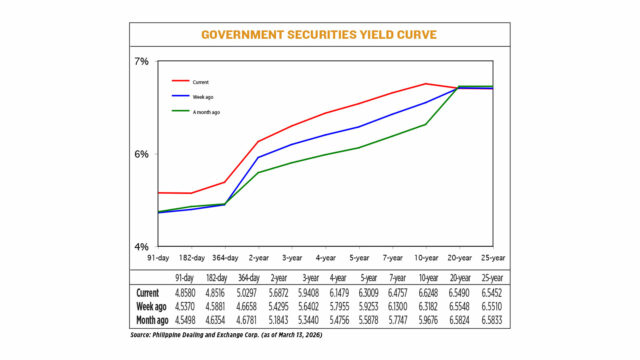
YIELDS on Philippine government securities rose in the secondary market last week as higher global oil prices and escalating war in the Middle East dampened investor sentiment and fueled concerns about inflation.

Analysts said the jump in crude prices, which briefly pushed benchmarks above $100 per barrel, raised worries about rising energy costs and their potential impact on domestic price pressures. The developments prompted investors to demand higher yields on government debt.

Government securities yields, which move opposite to prices, climbed across most tenors as traders reduced exposure to longer-duration bonds.

Lodevico M. Ulpo, Jr., vice-president and head of fixed income strategies at ATRAM Trust Corp., said geopolitical headlines from the Middle East drove market sentiment for much of the week.

Headlines from the Middle East significantly influenced market sentiment as missile attacks from Iran pushed oil prices higher, raising concerns about inflation risks, he said in a Viber message.

The environment prompted investors to trim holdings of longer-term debt securities, while some offshore accounts also contributed to selling pressure.

A bond trader said the rise in local yields reflected elevated global oil prices and the risk that higher fuel costs could feed into domestic inflation.

The trader added that recent adjustments in local fuel prices have also reinforced concerns about price pressures, raising the possibility that the central bank may need to keep monetary policy tight to prevent inflation from exceeding its target.

Michael L. Ricafort, chief economist at Rizal Commercial Banking Corp., said the climb in yields followed the spike in global crude prices, which have reached some of their highest levels in more than three years.

Higher energy costs could slow economic growth and push inflation higher, he said.

In the primary market, demand for government securities also showed signs of caution.

The Bureau of the Treasury partially awarded its latest offering of seven-year Treasury bonds after bids came in below expectations. The government raised less than the programmed amount as investors sought higher yields.

Mr. Ulpo said the softer demand reflected investors’ cautious stance toward longer-duration bonds amid geopolitical risks and volatile oil prices.

“The softer demand reflects the market’s cautious stance toward duration amid elevated geopolitical risks and rising oil prices,” he said.

Developments overseas also influenced market expectations. While the US signaled that tensions with Iran could ease sooner than expected, concerns about disruptions to oil shipments through the Strait of Hormuz have persisted, keeping energy markets on edge.

Meanwhile, recent US inflation data came largely in line with expectations, reinforcing views that the US Federal Reserve might keep interest rates steady in the near term.

Still, analysts said markets remain sensitive to geopolitical developments that could affect energy prices and global inflation trends.

For the coming week, investors are expected to watch the government’s planned offering of longer-term bonds, which could provide a clearer gauge of market appetite for duration amid continued uncertainty.

Market participants are also expected to monitor signals from the Federal Reserve and key economic data releases that could shape expectations for global interest rates. — Abigail Marie P. Yraola

Converge sees minimal impact from Middle East crisis

CORPORATE.CONVERGEICT.COM

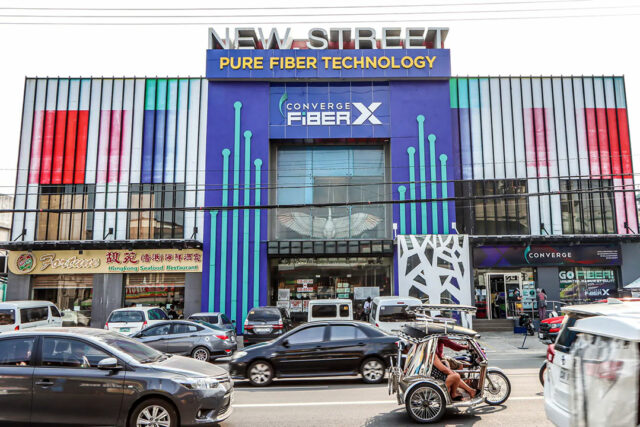
CONVERGE ICT Solutions, Inc. said it expects the ongoing Middle East crisis to have minimal impact on its business in the short term, while noting that it may recalibrate plans if the situation persists.

“As a matter of fact, it is quite something that we immediately discuss. We have determined that in the short term, the impact would only be minimal,” Converge Chief Operating Officer Benjamin B. Azada said in an online media briefing on Friday.

Converge said rising global fuel prices could affect some of its operations because the company still uses internal combustion engine vehicles for installation and repair work.

However, the company said many vehicles in its fleet are now electric and hybrid, which could help cushion the impact of higher fuel costs.

“But having said that, that is a very small part of our cost base, of our operating expenses. So, in the short-term, [we see] minimal impact but obviously for the longer-term if this crisis continues, we have to see how it is going to impact in terms of customer demand,” he said, adding that the company would have to assess its offerings to ensure they remain affordable as any impact on the broader economy affects customer demand.

Converge is expanding its network in the Visayas and Mindanao by rolling out nearly one million ports this year.

For 2026, the company has earmarked P23 billion in capital expenditure (capex), which will mainly fund network expansion.

“We are investing heavily in our network expansion as we push harder for visibility in Visayas and Mindanao. At the same time, we are ramping up our Enterprise business amid increasing demand for quality connectivity and innovative solutions from enterprises of all sizes,” Converge Chief Executive Officer Dennis Anthony H. Uy said.

The listed fiber provider said it will focus its expansion on Western Visayas and Northern Mindanao, with more than 100,000 ports expected to be ready for service this year.

These newly rolled out ports will serve Capiz, Samar, Bukidnon, Davao de Oro, and Sultan Kudarat, the company said.

Converge is targeting revenue growth of 8% to 10% this year, driven by strategic network expansion into underserved markets in the Visayas and Mindanao.

The listed fiber internet provider reported net income of P11.86 billion for 2025, up 9.7% from P10.81 billion in the previous year.

Total revenues rose 10.24% to P44.77 billion from P40.61 billion in 2024, mainly supported by growth in its residential business, according to its regulatory filing. — Ashley Erika O. Jose

Revibe Culture: Your old finds made new

INSTAGRAM.COM/REVIBE.CULTURE

THRIFTING is becoming a trend among fashionistas on a budget, hoping to score designer goods at a fraction of the cost. It can’t be avoided that secondhand goods can come with some tears or dents and dings, but Revibe Culture, the latest brand to join Opus Mall’s Spatio, embraces the damage and turns them into something new.

Started by Bianca Sato in 2018, at first the brand would sell vintage luxury brands. In 2022, at the tail end of the COVID-19 pandemic, Ms. Sato shifted to upcycling much of their stock. Some couldn’t be sold anymore due to their condition, so she ripped them up and sewed them anew.

They were offering customization services during a visit at their Spatio display on March 13 (a promo that will run until the end of the month): bring a garment and any “patches” that you want (they also have their own), then these will be combined in a chimera, a pastiche, that one could wear.

The reworked clothes cost upwards of P9,000. Some really premium items can cost up to P15,000 — think an ex-Prada mesh vest torn up and combined with an old Levi’s jacket. She gets past intellectual property laws so long as she never declares them to be official collaborations — but their work has gotten them attention from big brands already. She says they have had an official collaboration with Nike, patching up their old clothes, and with local brand DBTK.

Other premium items include boots combined with torn-up Louis Vuitton bags, jeans with a ripped ex-Fendi item, and an ex-Carhartt sweater patched up with an old and worn Vivienne Westwood bag. She’s essentially delaying a designer item’s trip to the landfill (or wherever damaged designer goods go to die) and giving them a second life.

“We can create something new, exclusive for you,” she told BusinessWorld. “Fashion is evolving.”

For inquiries, visit them at Spatio every weekend until March 31, or at their Instagram page, @revibe.culture.

Spatio is found inside the Opus Mall, Bridgetowne Destination Estate, Bridgetowne Blvd. corner C-5, Quezon City. — Joseph L. Garcia

Unchained by CADENA: How a blockchain system could relieve the banking sector of corruption woes

FREEPIK

By Matthew Miguel L. Castillo, Researcher

TUNING IN to local news in the late months of 2025 would have had you skimming through scoops on the exposed corruption mess of flood control funds.

The previous BusinessWorld quarterly banking report showed a finer strike the mess had dealt, revealing a dip in the Philippine banking sector’s performances in total assets and total loans.

The Bangko Sentral ng Pilipinas (BSP) said in an e-mail interview that the scenario showed how disruptions in public infrastructure projects could strain contractors and businesses with bank loans — jeopardizing loan repayment performance as a result.

Pointing fingers flew, and accusatory bombs landed, hearing after hearing, as public outrage continued to escalate in the streets and social media alike.

Amid the chaos and frustration over the lack of developments on the chase came the demand for changes in the system plagued by loopholes exploited by thieves whose trails could not be traced.

A proposed fix to the problem was raised last November as Senator Bam Aquino filed Senate Bill 1506 — the Citizens Access and Disclosure of Expenditures for National Accountability (CADENA) Act, to boost transparency, accountability, and good governance of the state’s handling of public funds.

In December, the bill pushed through its third and final reading in the senate; its counterpart in the House of Representatives (House Bill No. 6761) stays pending at the committee level.

If enacted, the potential law will provide CADENA as a publicly accessible portal to all public budget data required under it.

The portal’s namesake, cadena — Filipino for “chain” — is a sly nod to the blockchain system underpinning its rollout.

TRIED AND TESTED
Henry R. Aguda, secretary of the Department of Information and Communications Technology (DICT), compared a blockchain’s function to that of a series of ledgers that keeps track of transactions.

“Every blockchain is, at its simplest, a ledger. And every ledger is, at its simplest, a story,” he said in his 2021 book entitled Opening the Archipelago: The Story of Blockchain in the Philippines authored with Cathy Bautista Casas and Nathan J. Marasigan.

Paul Soliman, cofounder and chief executive officer of BayaniChain, Inc. (BYC), said in a Viber message that CADENA will allow auditors, regulators, and the public “to confirm that a document [of a transaction] or event exists, has not been altered, and has occurred at a specific time.”

He established BYC after seeing that trust issues surrounding audit trails, document integrity, and reconciliation could be solved through the technical provisions of blockchain ledgers.

Mr. Soliman, who has studied and applied blockchain technology since 2016, reviewed and refined the bill in its second reading as a selected member of a convened technical working group.

The central bank said that the recent corruption scandal highlighted the needs of “transparency in company ownership, strong transaction monitoring, and better information systems,” which could be solved by CADENA.

“Blockchain introduces a new paradigm: a shared, immutable ledger where records cannot be altered without leaving a trace,” said Mr. Soliman.

DATA CHAINMAIL
Mr. Aguda explains in his 2021 book that the blockchain system works through a cycle of matching and verifying data blocks through unique cryptographic signatures.

These signatures, called hashes, are spread across multiple “nodes of the network” — allowing independent checking in different sources for a claim to be unanimously confirmed as true.

Mr. Soliman added that documents and fiscal events could be assigned their own hashes placed on a blockchain ledger, changing how they could be trusted and checked.

This achieves three things: transparency, immutability, and veracity.

He said that the provision of transparency would allow independent verification without exposing sensitive information.

Immutability, on the other hand, would be given to documents by denying verification of an altered document with a mismatched hash.

While veracity may be improved by ensuring data integrity through mathematical means of verifying each hash on top of classic institutional assurance.

“[This] creates a verifiable audit layer above government systems […] strengthening trust in how public funds are tracked and reported,” Mr. Soliman said.

Mr. Aguda’s book supports this, saying that each hash is “inextricably linked to all that came before and after it, allowing for one to trace a way back to the genesis — the very first block — from any point in the chain.”

POTENT LINKAGE
The BSP said that universal and commercial banks (U/KBs) face exposure to public project dependencies, stress scenarios involving project suspensions and regulatory disruptions which they must regularly assess in operations.

Section 4 of the bill says that its coverage extends to public-private partnerships (PPP) involved in utilizing, disbursing, and accounting for public funds through national government agencies.

This shows that CADENA brings the promise of helping to monitor and flag rising anomalies among private companies connected with government projects that hold funds in banks.

In simpler terms, the bill’s provisions could render U/KBs as its passive beneficiaries — preventing them from facing shocks rooted in PPP corruption.

“From a financial stability and anti-money-laundering and combating the financing of terrorism (AML/CTF) standpoint, CADENA could help reduce opportunities for misuse of public funds before such risks reach the financial system,” the BSP said.

However, Mr. Soliman said that banks could also play a critical role in the potential law’s implementation.

He said that banks could “integrate their settlement records with blockchain verification layers for stronger auditability,” being at the “intersection of financial transactions and institutional trust.”

He added that this would entail banks providing transaction validation data on government financial flows and participating in verification nodes in the network government finance framework.

“Private entities […] could contribute independent attestations, validation checkpoints, or monitoring analytics that enhance oversight and public confidence,” he added, saying that  blockchain systems support “multi-stakeholder validation models.”

“This would create stronger alignment between fiscal records and financial settlement systems,” said Mr. Soliman.

In line with this, the BSP said that U/KBs could proactively improve data quality and “enhance AML/CTF safeguards” to face corruption shocks.

“The [flood control mess] also underscored the need to continually strengthen training and internal controls for branch frontliners to ensure the timely identification, escalation, and reporting of unusual transactions,” the central bank said.

BINDING ELEMENTS
Mr. Soliman said that implementation of CADENA would go through a “phased rollout approach.”

The pilot stage would be operational at around six to 12 months from its enactment, focusing on establishing the internal integrity of the system.

“This stage validates the technical architecture, governance model, and verification mechanisms,” he said.

However, he added that full nationwide implementation would take longer as it would entail coordinated integration among government systems, financial institutions, and regulatory frameworks.

The bill states that full government implementation is expected to take place around three years after it takes effect.

All government entities will be mandated to record and publish to CADENA all data from documents on the National Government budget.

The government agencies involved in its proposed process of disclosing public budget data and their respective functions are also discussed in the bill.

The DICT will handle a dedicated program management office for CADENA and will serve as the secretariat for the National Budget Transparency and Accountability Council (NBTAC).

The NBTAC will be comprised of members from the Department of Budget and Management, Commission on Audit, the Department of Justice, and the Department of Finance.

It will be responsible for monitoring, maintaining, and implementing the law — ensuring its promised provisions are delivered and outlined purposes fulfilled.

Considering this model, Mr. Soliman said that the main challenges facing the potential law’s effectiveness in the current set-up are institutional rather than technological.

He first cited system interoperability as a possible obstacle, as “government agencies operate different legacy systems.”

Digital governance frameworks also need improvement, as execution will need clearer standards on data ownership, validation, and disclosure.

Furthermore, he said that technical teams and policy stakeholders would need to build their capacities in handling distributed systems.

Lastly, he said that regulatory clarity must also be put in mind as findings and records in the system “must align with legal frameworks for audit and compliance.”

For Mr. Soliman, the daunting scope and challenges of CADENA can be managed with coordinated policy and technical planning.

DOWN THE LINE OF SUCCESS
Mr. Soliman said that the CADENA Act will face the reality of expansion if it passes into law nationwide.

He said that the proposed system would need to be incapacitated and carefully designed in several areas to handle this.

First, he mentioned that the governance of the network must be carefully defined to clarify those responsible for operating validation of nodes and decision making.

He also highlighted the importance of having data disclosure boundaries to ensure transparency without compromising sensitive fiscal information.

Furthermore, he also said that integration standards must be set to make sure different systems in government and finance could interact with the blockchain layer.

And lastly, he added that operational resistance must be strengthened to maintain redundancy and disaster recovery across the network.

“These considerations are not weaknesses [in the system] but part of responsible system design when building national-scale digital infrastructure,” he said.

Tala Philippines targets sustained loan growth

ANASTASIA NELEN–UNSPLASH

TALA Financing Philippines, Inc. expects to sustain strong loan growth this year as demand for unsecured lending remains robust among consumers facing rising living costs and weak income growth, its top executive said.

“We target loan growth of about 30% to 40% year on year,” Moritz Gastl, general manager at Tala Philippines, told BusinessWorld on the sidelines of an event late on Thursday.

The digital lending platform, which provides small unsecured loans through its mobile app, expects its customer base to expand significantly over the next few years. Tala serves about 3.7 million users and aims to increase this to 6-7 million by 2027, he said.

Demand for short-term cash loans is expected to remain strong as many consumers in lower-income segments continue to face financial pressure.

Mr. Gastl said the firm’s core customer base — largely composed of lower-income households — continues to struggle with stagnant wages even as the cost of goods and services remains elevated.

“There’s a lot of pressure on consumers because while inflation is not that high, for our customer base, their income isn’t going up commensurately,” he said. “As a result, there’s even more demand for cash, in particular unsecured loans.”

He added that loan demand could continue to rise over the next couple of years as households cope with higher prices and global economic uncertainties that may push costs higher.

Despite the strong outlook for lending, Tala said it plans to maintain a measured pace of expansion to protect the quality of its loan portfolio.

Mr. Gastl said the company is focused on ensuring that borrowers have the capacity to repay their loans as it expands its customer base.

“We need to make sure that customers are able to take on credit and are able to pay us back,” he said.

He noted that the firm’s nonperforming loan ratio remains within a range comparable to levels seen in the traditional banking sector.

Tala also expects lending conditions to improve as credit infrastructure in the Philippines continues to develop.

Mr. Gastl said broader access to credit data could allow lenders to assess borrowers more accurately and extend financing to previously underserved segments while managing risks.

He cited the role of the Credit Information Corp. in expanding the availability of borrower data, which could help financial institutions detect fraud and make more informed lending decisions.

“Once it becomes easier to get access to data, once it’s easier to figure out whether someone is fraudulent or not, at that point we can decide better if we should lend to certain customers or not,” he said.

Tala said it intends to continue expanding its digital lending platform while keeping growth sustainable as demand for small consumer loans rises in the country. — Aaron Michael C. Sy

ICTSI shares fall on Middle East conflict

ICTSI.COM

By Heather Caitlin P. Mañago, Researcher

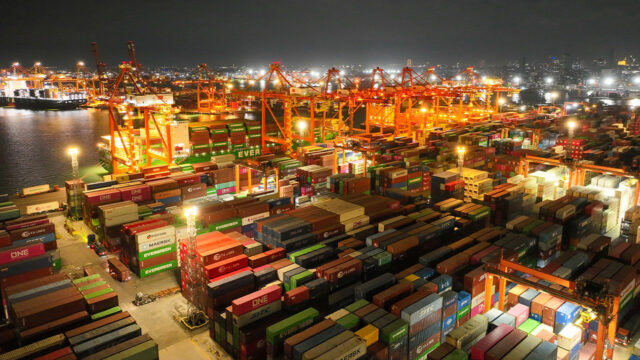
SHARES OF RAZON-LED International Container Terminal Services, Inc. (ICTSI) fell last week as the escalating conflict in the Middle East raised investor concerns, overshadowing the port operator’s record earnings for 2025.

Data from the Philippine Stock Exchange (PSE) showed that ICTSI was the most actively traded stock last week, with 11.34 million shares worth P7.97 billion traded from March 9 to 13.

ICTSI closed at P685 per share, down 4.6% from the previous Friday’s close of P718. The stock underperformed the services sector’s 3.7% decline and the Philippine Stock Exchange index’s (PSEi) 4.1% contraction.

Year to date, however, the stock has risen by 20.8%, outperforming the services sector’s 14.3% growth and the PSEi’s 0.1% increase.

Analysts said the decline was mainly driven by concerns over operational disruptions at ICTSI’s Basra terminal in Iraq.

“The decline was mainly driven by investor concerns over geopolitical risks affecting ICTSI’s Basra Terminal in Iraq,” Wendy B. Estacio-Cruz, head of equity research at Unicapital Securities, Inc., said in an e-mail.

She noted that the conflict has resulted in “zero volume projections” for the facility, which is “estimated to reduce consolidated EBITDA (earnings before interest, taxes, depreciation, and amortization) by around 4-5% monthly while the disruption persists.”

Chinabank Research shared a similar view, stating that the decline “could be attributed to escalating conflict in the Middle East, which raises the risk of operational disruption — particularly at its Iraq terminal — given the effective closure of the Strait of Hormuz.”

The Strait of Hormuz has been closed since Feb. 28 after coordinated US and Israeli strikes on Iran. In response, Iran barred vessel passage and reportedly deployed naval mines in the waterway.

ICTSI’s Basra Gateway Terminal (BGT), located at the Port of Umm Qasr, is Iraq’s largest port and a key hub for international trade.

It is the country’s only terminal operating to international standards, equipped with advanced technology and Iraq’s largest quay cranes capable of handling 12,000-TEU (twenty-foot equivalent unit) vessels and specialized oil-and-gas cargo.

These geopolitical risks dampened the otherwise positive sentiment generated by ICTSI’s 2025 annual report released on March 4.

For full-year 2025, ICTSI posted a 23% increase in attributable net income to $1.05 billion from $849.80 million in 2024.

Gross revenue rose 17.88% to $3.23 billion from $2.74 billion a year earlier.

Capital expenditures, excluding capitalized borrowing costs, totaled $650.44 million, with funds directed toward ongoing expansions in Mexico, the Philippines, the Democratic Republic of Congo, and Brazil.

For 2026, ICTSI plans to allocate approximately $740 million, mainly for the Phase 3B expansion at Contecon Manzanillo S.A. in Mexico; expansions at the Manila International Container Terminal, Mindanao Container Terminal, and South Luzon Container Terminal in the Philippines; upgrades at ICTSI Rio in Brazil; and various equipment acquisitions, upgrades, and maintenance initiatives.

“Despite these strong results, ICTSI’s share price still declined week-on-week as investors focused more on near-term risks associated with the Basra terminal disruption, which overshadowed the positive earnings performance,” Ms. Estacio-Cruz said.

Chinabank Research said that while the record financial performance initially lifted sentiment, “investor attention quickly shifted to concerns over how the ongoing Middle East conflict could weigh on this year’s profit outlook.”

Looking ahead, investors are expected to remain focused on developments in the Middle East.

Ms. Estacio-Cruz said market participants will likely monitor “the company’s ability to offset the Basra disruption through stronger yields, supported by tariff increases and favorable rate adjustments.”

Chinabank Research added that investors “should continue to monitor geopolitical developments, as these can significantly influence broader market sentiment.”

The brokerage pegged the stock’s support at P660 and resistance at P730.

Fascist theocracies at war

SMOKE AND DUST rise after an Israeli strike on Beirut’s southern suburbs, March 2, 2026. — REUTERS/MOHAMED AZAKIR

Leaving aside the USA for a moment, to firstly focus on Israel and Iran: the ongoing war has the awful stink of religious zealotry.

Wiping out the demonic Other — in this case, an entire modern nation on either side, and the talk is of total annihilation — has the odor of a malignancy metastasizing inside two monotheisms.

To be accurate: the leadership of Iran and Israel profess to relatively new, 20th Century strains of ancient world religions, and commit their entire populations to mega death matches. These new strains ironically idealize what is believed to be the original teaching and guidance.

Zionism, Israel’s presently dominant political ideology, holds faith in the immutability of a Promised Land, which must be kept at whatever cost to both enemy and faithful. Ownership of the Land of Israel is divinely ordained — the land complexly overlapping with Palestine, not a small complication. Meanwhile, the now dominant strain of Iran’s Shīʿa Islam is fixed on martyrdom and, effectively, a cult of death.

Both these Judaic and Islamic sub-cultures mobilize holy zealotry in the secular domains of governance, economics, social relations, and conduct in war.

Still, it is, of course, the political economy of oil that fueled this present and other wars in the Middle East since the 20th Century. And since then, anything global spinning out of the enmity between Iran and Israel owes, too, to petrodollar flows. The flows themselves have a violent dynamic (which deserves another column).

What is important for now is clarity about how intensely these flows of the modern politics of oil are admixed with cruel versions of divine power. About how ferociously these secular-religious amalgams saturate virtual and actual wars.

MARTYRDOM, AMPLIFIED
The horrendous, in other words, is a daily experience; vicariously or in the flesh.

The estimated 30,000 Iranian protestors seeking a secular state, gunned down a month ago by Iran’s Islamic Revolutionary Guard Corps: these dead are alive in global pro- and anti-democracy debates. Too, talk continues and remains strident about the Israel Defense Forces visiting brutality on Gaza residents. Mass starvation and bomb runs on hospitals and schools add up to the numbness uniquely produced by Israeli relentlessness.

The detonation point for recent events — the Oct. 7, 2023, Hamas attack on Southern Israel that killed 1,195 Israeli civilians and military personnel, and on the 8th, the following day, the Hezbollah escalation of hostilities — reverberates, continuously for now, in all media platforms.

Hamas, Iran’s surrogate (as are the Hezbollah of Lebanon and the Zaydi Shīʿa Houthis of Yemen), exalt explosive martyrdom to drive political projects. It is not beneath them to use both legacy media and digital social networks to amplify and weaponize these blasts into kingdom come.

And while it is difficult to parse the religious, cultural, economic, political, and historical dimensions of any war, the Iran/Israel collision does lend itself to a good gist. It is one which is not offensive to most Jews and Muslims: that this is a war between theocratic fascists, who whip up base emotions in the name of the sacred.

Which is not to picture all Israelis and Iranians and their surrogates as zombies allowing themselves to be aroused to sacred perdition. It bears saying, over and over, that Judaism is not synonymous with Zionism. Christian Zionists exist, among other caveats.

It bears saying, over and over, that Islam is not synonymous with the Ayatollahs’ rearticulation of Shīʿa Islam — the revolutionary ideological formation originally called Khomeinism, built on the velayat-e faqih as structure of government — even if the recently deceased Shaheed Ayatollah Imam Khamenei opposed Sunni-Shīʿa division.

And it bears saying, over and over, that the United States’ present leadership brings the third monotheism into the ongoing war, in the form of its own nasty, homegrown subculture. White Christian nationalism parlays a similar harkening to an imagined original form of monotheistic belief.

THE OTHER CULT
Of US President Donald Trump, a Christian nationalist said that this one head of state is “… anointed by Jesus to light the signal fire in Iran to cause Armageddon and mark his return to earth.” The group maintains that “America was founded as a Christian nation.” Both assertions fly in the face of the US Constitution.

The American leaders who staged the opening strike at Iran spouted macho froth about Holy War. Fired by hubris to begin with, Trump’s administration started to blow $1 billion a day on Iran-bound missiles that were downed by drones that cost only $20 thousand each. Expensive, warmongering Christianity is also the height of impudence.

The core fuel is the white (white hot!) supremacist version of Christianity that revels in big exploding weaponry. That is to say, the biggest penises ever.

The term toxic masculinity — now the globally shared description of Trumpian attitude — is more apt than first meets the eye. This version of the Jesus religion seems like over-performed patriarchy, a culture shared by all three Abrahamic religions, Judaism, Islam, and Christianity. But this US machismo of King Kong size (though not King Kong’s heart) in the Christian nationalists’ warmonger act is entirely new, 21st Century chest-thumping to thunder the willingness to move fast to endgame.

Nuclear endgame, hence true Apocalypse. Humanity has never been closer to global destruction as now.

Significantly, the US cannot appeal to a true grievance. It neither endured imperialist oppression (as Iran did) nor a holocaust (as the Jews did). In the case of white Christian nationalist US leadership and about half its population, the historical driver for its behavior is unthinking proclivity to trigger regime change, to invigorate white projection on the world stage.

The US forgets that regime change by imperial fiat — beginning with the MI6- and (the new birthed) CIA-staged removal of Iran’s democratically elected Prime Minister Mohammed Mossadegh in 1953 — inevitably presaged increasingly bigger wars through the last and present centuries.

Last week’s failed attempt by the US in Iran and successfully in Venezuela earlier are only the latest exercises of decapitation as foreign policy.

And then, when imagined as newfangled Crusades (as the tattoos on the torso and arms of US Defense Secretary Pete Hegseth assert), the present war mangles all sense of the sacred in Christianity into penis worship. Yes, there is religious ecstasy involved.

It is revolting, malefic, sexualized Christianity getting off on the thrill of Holy War.

FEELING THE END
Religion gone awry replaces foreign policy and an international rule of law in the currently unfolding, totally needless catastrophe. It is not a clash of civilizations (not that the 1992 book by Samuel Huntington, Clash of Civilizations, was ever taken seriously in academia). The three monotheisms are not homogenous within themselves.

What’s going on is definitely not a tripartite war involving violent differences amongst the three patriarchal, Abrahamic religions.

This war is far too complicated to encourage sweeping anti-Semitism, or Islamophobia, or wholesale anti-Christianity. Observe that the Saudis like it that Israeli and the US attacked Iran. Most of the Arab Gulf States also support weakening the Hezbollah. Christians in general are cool about Jews and Muslims; and vice-versa, notably in democratic communities.

Iran thinks nothing of bombing the Arab Gulf states. Israel thinks nothing of killing Lebanese and Gaza Christians, together with everyone else in its way. And President Trump has no qualms about wasting Iran’s pro-democracy citizens and its own soldiers.

Meanwhile Israeli Prime Minister Benjamin Netanyahu, playing on President Trump’s egomania, succeeded in commencing the realization of his 40-year desire to collapse the whole Arab region. That is, realizing his own violent egomania. And both Netanyahu and Trump have an antagonist in Iran’s 200,000-strong Revolutionary Guard and its ayatollahs, who should be regarded by the world as equally egomaniac as a collectivity.

Asked when the war will end, President Trump said “When I feel it… in my bones.”

After killing nearly 200 schoolgirls and causing the largest disruption of oil production in history, after giving beneficial space for Russia and China and causing the displacement of 500,000 people from South Lebanon, and after causing global defocusing on continuing Israeli depredation on Gaza — within just two weeks — everything comes home to his own utterly ignorant whim.

Yes, this is theocracy. But the “theo” dimension, expressed in politics of death, is best described as malignancies. President Trump gives himself a God-the-Father power beyond all accountability, sustained by a malevolent version of Christianity. So does Prime Minister Netanyahu. Ditto the malignancy in Judaism. So did the deceased Ayatollah Khamenei, atop the malignancy engineered in Shīʿa Islam.

These fascists exercise a theocratic politics, pervaded by poisonous machismo, that is now threatening the survival of humanity.


Marian Pastor Roces is an independent curator and critic of institutions. Her body of work addresses the intersection of culture and politics.

Baby product line provides gentle care

PEABOOBABY.COM

Bea Borres channels motherly love into business

IT’S a tough job, caring for newborns and infants who still have delicate skin. They can’t use the same products as older kids and adults because of the harsh chemicals that could do more harm than good.

To address this concern, Bea Borres, a celebrity content creator and new mother, launched Peaboo Baby, a new line of vegan, toxin-free baby items on March 8 in Quezon City.

The event showcased products like body wash, soothing cream, baby wipes, and hair oil, all designed for the safe use of newborn babies. Ms. Borres had begun working on the business during her pregnancy last year after consulting with fellow young mothers. She gave birth to her daughter, Hope, in December.

“I really had doctors involved, and asked my tito (uncle) who’s also in business,” she told BusinessWorld. “And he told me that baby products need to be gentle and safe. You can’t just put anything on a baby. So, I really wanted to make sure everything was gentle and truly safe for babies.”

Aside from being safe for infants, the products can be used by their parents as well — which she found by testing them on herself. “I actually personally use it, especially the lotion because it smells so good. And I really love lotions,” she said.

“Ever since I was young, my mom taught me to always keep my skin hydrated. I also use the vegan baby cream on myself, and the wipes,” said Ms. Borres.

AS A SINGLE MOM
The usefulness of the Peaboo Baby products reflects not just the love and care of the business owner, but also her practicality.

At the launch, Ms. Borres talked about the struggles of balancing being a mom and her content creator job, as well as now having a business. This meant her showbiz career, including guest appearances on TV, has taken a backseat.

Bago kayo maging (Before you become a) single mom, dapat talaga ay may pera kayo (you should really have money),” she explained.

Having such a public life doing content online, she noted the importance of protecting her child from the criticism she faces every day. “I can handle it. But if they bash my child, I won’t be able to take it. That will destroy my world. It’s just so scary to post your baby online,” she said.

Ms. Borres gave birth to her daughter in December but didn’t announce her motherhood until January. She has no plans yet to bring her baby to any big event.

IDEATION AND DEVELOPMENT
During the product launch, Ms. Borres detailed how every crucial detail for each baby product required painstaking deliberation.

While the brand name, Peaboo Baby, was not their first choice, “It was the cutest name! Also, when you play with a baby, you say ‘Peekaboo, peekaboo!’” she said. They landed on the specific variation, Peaboo, as a nod to the nickname she gave to her baby during pregnancy — her “pea.” “It’s very catchy. I learned in business school that names must be catchy. So, Peaboo Baby.”

As for developing the products themselves, Ms. Borres explained how the process was difficult purely because of the many possibilities.

“I’m very, very indecisive. Honestly, it’s so easy to reject something,” she said. “When you smell it or feel it on your skin, you can easily say, ‘ay, ayaw ko iyan (oh, I don’t like that).’” However, most of the time, the difficulty came from choosing between two very good scents. “I think that was the hardest part for me, deciding on that final, final choice.”

Peaboo Baby offers toxic-free, vegan products, ranging from lotion and wipes to citronella patches and moisturizing cream. The wipes come in varieties: the Travel Pack Baby Wipes and the Strawberries and Cream Wipes, both priced at P139. Meanwhile, the vegan moisturizing cream, face and body cream, soothing cream, and body lotion are P189 apiece.

The vegan body wash costs P339 while the cleansing water retails for P369. The brand also offers package deals, most notably one priced at P2,400 for the full collection.

But on March 17, the full collection will be available for just P999 on TikTok Live.

“I want to keep on producing relevant products and essentials even for moms. I want to see my products on the shelves of big stores, where moms can see and grab them,” Ms. Borres told BusinessWorld.

As for her baby, she has one wish: “I want her to grow up grounded.”

The Peaboo Baby line is available exclusively on the brand’s TikTok Shop. — Bronte H. Lacsamana

How a scandal broke Philippine investor confidence

TIRACHARDZ/FREEPIK

A FORMER accountant who invested her savings after being laid off in late 2024 pulled out of the market entirely in early 2026 amid the shakeup seen in last year’s markets.

“It is the realization of how its volatility can ruin your investment in a flash, especially when funds are placed in stocks or balanced equity pools,” said the former multinational bank employee, who requested anonymity.

The Philippine Stock Exchange (PSE) index closed 2025 at 6,052.92 on Dec. 29, down 7.3% or 475.87 points from its end-2024 level of 6,528.79. On Nov. 14, the PSE index plunged to 5,584.35, its weakest close in nearly five and a half years, or since the 5,570.22 close on May 28, 2020.

By comparison, the Standard & Poor’s 500 (S&P 500) index rose by 22.6% to 6,845.49 points by its final trading day on Dec. 31, 2025 from the same day in 2024.

Her experience reflects a broader flight to safety that swept through Philippine wealth management in 2025. The Philippine economy has been through a great upset, since President Ferdinand R. Marcos, Jr. said that about 6,000 flood control projects estimated to be worth P350 billion launched since 2022 were anomalous.

TURMOIL
The flood-control project scandal’s damages were seen not just in poor infrastructure. It dragged the Philippine economy to a 3% growth in the fourth quarter of 2025, the slowest pace since the 3.8% contraction in the first quarter of 2021 during the coronavirus pandemic, data from the Philippine Statistics Authority (PSA) showed.

Full-year growth settled at 4.4%, the weakest in five years outside the pandemic-induced 9.5% contraction in 2020 and missed the government’s 5.5%- 6.5% target.

Approved foreign investments in the Philippines plunged by 50.1% year on year to P272.38 billion in 2025, the sharpest fall in five years, according to the PSA. This was the steepest drop in foreign investments since the 71.3% decline recorded during the pandemic in 2020.

Even the Bangko Sentral ng Pilipinas (BSP) delivered a surprise rate cut in October, slashing by 25 basis points to bring the key rate to 4.75%. The Monetary Board said the outlook for domestic economic growth had weakened, reflecting in part the impact on business confidence of governance concerns about public infrastructure spending.

“Across our businesses, we saw a noticeable shift towards liquidity and flexibility,” Philippine National Bank (PNB) said in an e-mailed response. “Clients whose risk appetite was already tempered by interest rate volatility and geopolitical uncertainty became even more allocation-conscious.”

Joaquin Rossano U. Veluz, a client portfolio manager at Sun Life Investment Management and Trust Co., said investor confidence dropped sharply during the period.

“A lot of investors became quite risk-averse in their choice of investments,” Mr. Veluz said in a Teams video call. “Many are prioritizing money market and short-term, capital preservation-type products.”

About 90% of Sun Life’s assets under management in unit investment trust funds (UITFs) are parked in money market products, Mr. Veluz said. The corruption scandal that erupted in the second half of 2025 prompted many investors to park funds in cash, money market funds, and short-duration bonds.

“Many households chose to park funds in cash, money-market funds and short-duration bonds rather than commit to longer-dated instruments,” PNB added.

The former accountant said the market’s poor performance fundamentally changed her saving habits.

“Instead of putting my money into high-earning stock-equity investments, including insurance products with market exposure, I will consider investing in vacant land/lots and perhaps gold, if feasible,” she said. “These are assets that appreciate over time.”

Not all investors fled, however. An investment banker at a multinational firm who requested anonymity saw opportunity in the downturn, investing in stocks he assessed as undervalued during 2025.

“Now is a good time to purchase companies at a huge discount from intrinsic value,” the investment banker said. “Many companies are even trading at below book value.”

While he was able to beat the market last year — losing just 3% over the 10% crash starting from when he started going long — he said that the blue-chip stocks he bought continue to be undervalued today.

“I bought at the absolute bottom, and then it just stayed there.”

COMMON PITFALLS
Wealth managers identified emotional decision-making as the primary risk facing investors during periods of market stress.

“The greatest risk we observe is emotional decision-making,” PNB said. “Sensational headlines can trigger panic selling or excessive defensiveness, both of which undermine long-term returns.”

Mr. Veluz said the most dangerous mistake he observes among Filipino investors is the absence of clear financial goals.

“When you ask them why they invest, they don’t know,” he said. “Because investing for retirement is entirely different from investing for a goal that’s three to five years away.”

The lack of planning distorts decision-making and leaves investors vulnerable to market swings, he added.

“Not having a plan or a goal distorts your decision-making and leaves you without a clear sense of how to approach investing,” Mr. Veluz said.

Beyond the absence of goals, Mr. Veluz identified two other common mistakes: lack of discipline and susceptibility to investment fads.

“Whatever is trending, everyone wants in,” he said. “Right now, it’s probably gold and tech. Even if, first, your risk profile doesn’t fit that type of investment, and second, if your current portfolio is small, do you really want to allocate a substantial portion to an illiquid instrument?”

The flood control scandal, which involved billions of pesos in alleged corruption, left many investors questioning whether saving made sense at all. The former accountant said she has lost faith in investing in local publicly listed companies entirely.

“There was this relationship manager of a major bank who gave advice never to invest in the local publicly listed companies,” she said.

“It’s quite disheartening, to be honest,” Mr. Veluz said. “But we advise our clients to focus on what they can control — and that is how much they save and where they invest those savings.”

PNB emphasized that consistent contributions compound over time regardless of political or economic turbulence.

“The scandal underscored the importance of anchoring saving on personal goals rather than on circumstances beyond one’s control,” the bank said. “We remind clients that they save and invest to secure their family’s future and their own, not to endorse institutions.”

LOOKING AHEAD
For clients specifically worried about corruption-driven volatility, PNB emphasized the importance of assessments.

“Before recommending specific instruments, we undertake a thorough client suitability assessment of each client’s goals, time horizon, sophistication, and risk tolerance,” the bank said.

For conservative investors, PNB said it emphasizes government securities and investment-grade corporate bonds to provide regular income and principal stability.

“Diversified fixed income funds can further spread risk across sectors and maturities,” the bank added.

When corruption shocks coincide with other economic pressures, the bank advised measured adjustments.

“When corruption-related shocks coincide with inflation, currency weakness or other macroeconomic pressures, the instinct may be to overhaul the entire portfolio,” PNB said. “We counsel against drastic shifts.”

Mr. Veluz said wealth managers are steering clients toward diversified portfolios with increased global exposure.

“Since the local market is affected by corruption and weakened investor confidence, we always advise our clients to take a more holistic, diversified approach to their portfolios,” he said. “Number one: you have to get global exposure.”

He said Filipino investors are beginning to appreciate the need for diversification after the Philippine market’s poor performance relative to global markets in recent years.

“From 2005 to 2015, the Philippine market returned around 18–19%,” he said. “But from 2015 to 2025, that flipped. The Philippine market was flat to negative. The global market was around high double digits.”

Asset managers have responded by rolling out more products that give Filipinos exposure to global funds, increasingly offering them in pesos to reach a wider investor base.

“Before, a lot of these funds were only available in US dollars,” Mr. Veluz said. “Now they’re offering them in peso and through more channels.”

He added that diversifying to offshore markets actually lowers portfolio volatility.

“The S&P 500 companies are actually higher quality than local PSE index (PSEi) names,” Mr. Veluz said. “So by diversifying some of that local exposure, you’re actually lowering your volatility.”

On emergency fund targets, PNB said the traditional benchmark of six to twelve months of essential expenses remains prudent, with the exact target adjusted for job stability and number of dependents.

“There is no universal formula for emergency funds because incomes and spending patterns vary widely,” the bank said. “Nevertheless, rising inflation and market volatility call for deeper liquidity buffers.”

Mr. Veluz said his firm recommends three to six months of monthly income set aside in highly liquid instruments.

“But I think the reality is that Filipino households and investors still want guaranteed-type returns and guaranteed-type products,” he said. “A lot of them are in money market, time deposits, and current account savings accounts.”

The former accountant said she still believes in saving despite current economic conditions, but through more traditional vehicles.

“It may be wiser to place excess funds in more traditional investment vehicles such as money‑market funds, bonds, raw land, or even gold,” she said.

The investment banker took the opposite view.

“I suggest investing instead of saving,” he said. “Again now is a great time to accumulate assets at high discounts to intrinsic value.”

Despite the challenges of 2025, wealth managers see potential for recovery in 2026, provided certain conditions are met.

“The PSEi has a chance to perform well,” Mr. Veluz said. “Why? Because the peso has started to appreciate.”

He said foreign investors may return to bargain hunt given how low valuations have become compared to regional neighbors.

“Whether foreign flows actually return will still depend on how the economy and the country perform,” Mr. Veluz said. “We need to see a swift recovery, or at the very least, a stabilization of gross domestic product.”

The missing link remains government spending and resolution of the corruption issue, he added.

“There needs to be some semblance of accountability — that people will face consequences for this corruption,” Mr. Veluz said. “That would hopefully unlock a virtuous cycle: consumers start spending again, businesses start looking at expansion and hiring, and investors begin to feel that the worst is over.”

The former accountant called for an independent watchdog group outside the control of politicians or big companies that could check, investigate, and stop suspicious activities immediately.

“Violators will then be caught early and not years later when the damage is already done,” she said. “But for it to work, whistleblowers must be fully protected so insiders can safely report wrongdoing without fear of losing their jobs or being harassed.”

The investment banker disagreed on the need for new regulations.

“The laws and rules and regulations are robust enough to prevent scandals and fraud,” he said. “The institutions are strong in a vacuum. But the problem is that the people running them are not incorruptible nor infallible.”

For investors navigating the current environment, both wealth managers emphasized the importance of staying disciplined and maintaining a long-term perspective.

“Long term investors who stay invested through volatility historically fare better than those who jump in and out of markets,” PNB said.

Mr. Veluz said the key message for 2026 is simple.

“They should focus on staying the course and staying diversified,” he said. — Pierce Oel A. Montalvo