Home Blog Page 1240

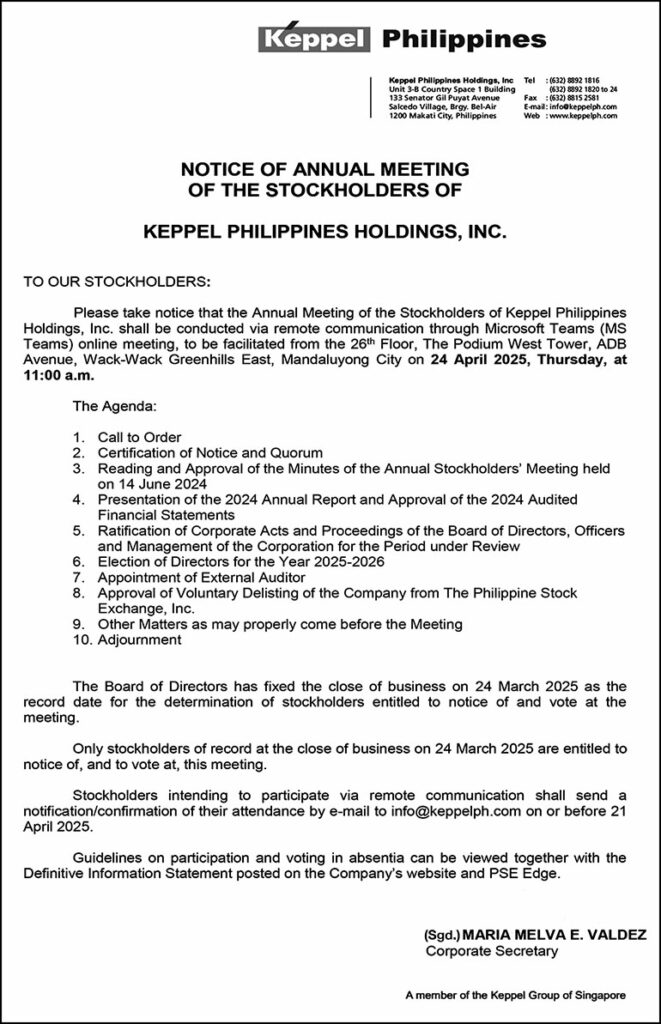
Keppel Philippines Holdings, Inc. to conduct Annual Stockholders’ Meeting on April 24 via remote communication


Spotlight is BusinessWorld’s sponsored section that allows advertisers to amplify their brand and connect with BusinessWorld’s audience by publishing their stories on the BusinessWorld Web site. For more information, send an email to online@bworldonline.com.

Join us on Viber at https://bit.ly/3hv6bLA to get more updates and subscribe to BusinessWorld’s titles and get exclusive content through www.bworld-x.com.

Australia central bank holds rates as it frets over trade war risk

REUTERS

SYDNEY — Australia’s central bank on Tuesday left its cash rate steady as widely expected but took a small step towards further easing in a policy meeting dominated by risks of a global trade war.

Wrapping up its April policy meeting, the Reserve Bank of Australia (RBA) held interest rates steady at 4.1%, having just cut them by a quarter point in February for the first time in over four years.

Markets had seen scant chance of a further easing this week given policy makers had emphasized that they needed to be certain core inflation was under control before acting again.

“Monetary policy is well placed to respond to international developments if they were to have material implications for Australian activity and inflation,” the board said in a statement.

The statement also dropped an explicit reference to being cautious about cutting rates again, in a slightly dovish tone. It also omitted a sentence that upside risks to inflation remain.

Governor Michele Bullock, in the post-decision press conference, said the board did not discuss a rate cut this time, and the slightly dovish turn in the statement did not open the door to an easing in May.

“We still think there is tightness in the labor market, so at the moment it seems prudent to wait and get a bit more data, a bit more information about labor market and inflation to make sure.”

The Australian dollar perked up 0.3% at $0.6262, while the three-year bond futures held steady at 96.31. Swaps moved around after the RBA decision and implied a 60% probability of a rate cut at the next policy meeting in May.

The recent flow of data has printed largely in line or slightly weaker than expected. A benign inflation reading for February has raised hopes that the quarterly price data due at the end of the month would be tame enough for the RBA to move in May.

There are two monthly job reports due before the May meeting.

“We view the statement as providing the Board a degree of optionality regarding future monetary policy moves,” said Adam Boyton, head of Australian economics at ANZ, who is forecasting just one more rate cut in August.

“However, greater market instability and global policy uncertainty could see additional (and earlier) RBA easing.”

Earlier in the day, data showed retail sales rose a modest 0.2% in February, underscoring consumer demand remained tepid.

The steady decision means the center-left Labor government won’t get a rate cut boost in polling ahead of a general election on May 3. Prime Minister Anthony Albanese is struggling in polls over the high costs of living and housing.

The central bank has pushed back against easing expectations after the rate cut in February, which already lifted housing prices to a record last month.

GLOBAL UNCERTAINTIES
Australia’s economy has moved past its worst, with consumer spending picking up amid lavish government tax cuts. However, the outlook has been clouded by the specter of a global trade war as US President Donald J. Trump imposes a blitz of tariffs on trading partners and is set to announce reciprocal tariffs imminently.

Australia is a major exporter of resources to China and tariffs on the world’s second-biggest economy’s goods could hinder growth there and its demand for commodities.

The Federal Reserve has taken a cautious approach to further rate cuts due to concerns Mr. Trump’s policies will stoke inflation, though investor anxiety over a possible US recession has also risen in recent months.

Ms. Bullock said the central bank is speaking to its peers in other central banks, particularly small and open economies to make sense of what’s going on and what can be expected over the next year.

“There is a lot more uncertainty introduced in the international context. What it means for us is not 100% clear. We’re cautious. We are going to wait,” said Ms. Bullock.

The RBA added the overseas developments will have an adverse effect on global activity and Australia is vulnerable given its reliance on world trade. Much will depend on China’s response to the US tariffs, Ms. Bullock said.

However, the implications on prices is less clear, with the RBA saying that inflation “could move in either direction.” — Reuters

Reevaluating a decade of competition law

It has been almost a decade since the passage of Republic Act No. 10667 or the Philippine Competition Act, the country’s primary competition law regulating anti-competitive practices aimed at upholding the constitutional prohibition against monopolies and combinations in restraint of trade.

Since its establishment in 2016, the Philippine Competition Commission has reviewed over 293 M&A transactions with an aggregate value of more than P5.49 trillion. Despite several years of enforcement and the hundreds of transactions reviewed, whether upon notification or motu proprio, the Philippine’s antitrust authority continues to face challenges.

NEED FOR UNIFIED IMPLEMENTING MERGER GUIDELINES
Over the years, the PCC has issued various guidelines and notes seeking to clarify transactions not covered by the PCA, assessment of merger control, computation of thresholds, process for filling out and filing notifications and merger review process of the Mergers and Acquisitions Office, among others. While these efforts have been crucial in addressing the gaps in the PCA and its implementing rules and regulations, there remains a need for unified implementing guidelines codifying the PCC’s issuances to streamline efficiencies and facilitate mandatory notifications and/or requests for confirmation of noncoverage therefrom.

LIMITED CAPACITY OF THE PCC
The PCC may have limitations in its capacity to effectively investigate and resolve complex competition cases. For example, the PCC recently released a market study that emphasizes the need for stronger domestic capacities involving competition issues in digital markets. Having only been established nine years ago, and with big and startup tech companies tapping into the Philippine market, comprehensive guidelines regulating competition concerns involving the digital economy and addressing abuse of market dominance issues will ensure that the Philippines’ primary antitrust authority keeps up with the challenges brought by modern technology.

CHALLENGES IN ENFORCEMENT
It is said that one cannot escape the long arm of the law. Section 3 of the PCA provides that the PCA applies not only to persons or entities engaged in any trade, industry and commerce within the Philippines, but also to “international trade having direct, substantial and reasonably foreseeable effects on trade, industry, or commerce in the Philippines, including those that result from acts done outside the Republic of the Philippines.” As such, offshore transactions may fall within the PCC’s ambit if such transaction has direct, substantial and reasonably foreseeable effects on trade, industry, or commerce in the Philippines.

It is well settled that any decision issued without jurisdiction is void and can never become final, and “any writ of execution based on it is likewise void.” Under the 2017 PCC Rules of Procedure, the PCC may acquire jurisdiction over a person by service of summons and voluntary appearance. For foreign corporations not registered in the Philippines, a summons may be served: “(1) on its officers or agents in the Philippines; (2) through the appropriate court in the foreign country with the assistance of the Department of Foreign Affairs; (3) by publication once in a newspaper of general circulation in the country where the respondent may be found and in such places as the PCC may order, posting the summons on the PCC website, and serving a copy thereof by registered mail at the last known address of the respondent; (4) by facsimile or any recognized electronic means that could generate proof of service; or (5) by such other means as the PCC may, in its discretion, direct.”

In principle, the foregoing provisions on service of summons should allow the PCC to catch those who violate the PCA and relevant issuances, but this may require local presence, sophisticated systems, or close coordination with the pertinent government agencies. Nevertheless, while the PCC may acquire jurisdiction over entities overseas through service of summons following the modes provided under its rules and regulations, enforcement, including imposition of penalties, if any, is a different matter and may prove difficult, especially if the parties do not have a local presence.

While the country has come a long way in leveling the playing field for market players in the country, efforts are needed to ensure effective implementation of a framework envisioned to promote competition and achieve the objectives of the PCA. n

The views and opinions expressed in this article are those of the author. This article is for general informational and educational purposes only and not offered as and does not constitute legal advice or opinion.


Justine A. Navarro is a senior associate of the Corporate and Special Projects Department of the Angara Abello Concepcion Regala & Cruz Law Offices (ACCRALAW).

janavarro@accralaw.com

(632) 8830 8000

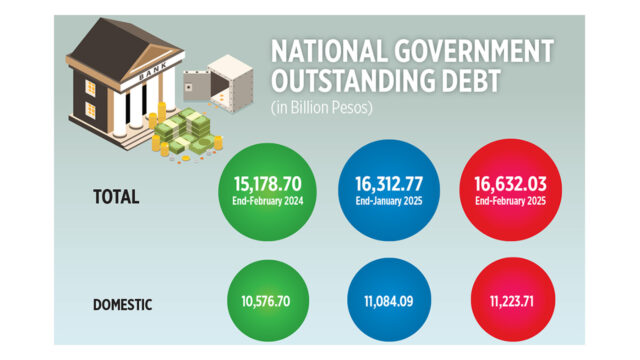
National Government outstanding debt

THE NATIONAL Government’s (NG) outstanding debt rose to a fresh high of P16.63 trillion as of end-February, the Bureau of the Treasury (BTr) reported. Read the full story.

National Government outstanding debt

SEC signs beneficial ownership data sharing deal with DBM

BW FILE PHOTO

THE Securities and Exchange Commission (SEC) has signed a data-sharing agreement on beneficial ownership data with the procurement service of the Department of Budget and Management (PS-DBM) to help combat illegal activities.

Under the agreement, the corporate regulator will provide PS-DBM with access to the beneficial ownership information of SEC-registered corporations, allowing real-time risk assessments and integration of the data into the procurement systems, the SEC said in an e-mailed statement on Tuesday.

The two agencies signed the data-sharing agreement on March 14, which aims to improve due diligence measures and create an open and competitive business environment.

“Access to beneficial ownership data is critical in achieving the goals of open government principles,” SEC Chairperson Emilio B. Aquino said in his opening remarks during the event.

“By ensuring that government agencies, particularly those involved in procurement, have access to comprehensive information on corporate ownership structures, we enhance the ability of public institutions to scrutinize contracts, detect conflicts of interest, and prevent illicit financial flows,” he added.

Beneficial owners refer to natural persons who own or exercise ultimate effective control over a corporation, as they may directly or indirectly have voting powers or influence over transaction decisions.

Meanwhile, the SEC said the data-sharing agreement builds on the country’s recent exit from the grey list of global money-laundering and terrorist financing watchdog, the Financial Action Task Force (FATF), in February.

The FATF removed the Philippines from its list of jurisdictions under increased monitoring for dirty money after an on-site visit. The country had been on the grey list for over three years, or since June 2021.

The SEC has signed similar data-sharing agreements with 21 other law enforcement agencies and authorities to provide access to relevant beneficial ownership information.

“Access to this data empowers civil society organizations and investigative bodies to track and analyze corporate affiliations in government contracts, ensuring that public funds are allocated transparently and equitably,” Mr. Aquino said.

“This aligns with global best practices in open contracting and public finance management, reinforcing our commitment to a governance framework that upholds fairness and accountability,” he added.

Corporations are required to declare their beneficial owners in their general information sheets submitted to the corporate regulator under SEC Memorandum Circular No. 15, issued in 2019.

Those who fail to disclose the information will face penalties for non-disclosure and false disclosure of beneficial ownership information. — Revin Mikhael D. Ochave

Britain to return artwork stolen by Nazis to Jewish family

A 17TH-CENTURY painting looted by the Nazis in 1940 from a Jewish art collector in Belgium will be returned to his descendants after spending three decades in a London gallery, the British government said on Saturday.

Samuel Hartveld and his wife were among those escaping Nazi persecution when they left Antwerp, leaving behind a number of belongings including the oil-on-canvas work Aeneas and his Family Fleeing Burning Troy.

But, following a review by a British advisory body that looks into claims of Nazi theft, the government ordered the painting to be returned to Hartveld’s heirs and great-grandchildren.

The 1654 artwork by English painter Henry Gibbs depicts the mythological story of Aeneas, a Trojan hero, escaping with his family after the Greeks invade Troy using the trickery of the Trojan Horse.

Bought by London’s Tate Britain gallery in 1994, the painting will change hands once again after the independent Spoliation Advisory Panel approved its repatriation following a review that began last May.

The 10-member panel was set up in 2000 to consider claims from anyone of lost cultural property during the Nazi era that is now in a British public collection.

“The property, library and the paintings in (Hartveld’s) gallery were looted as an act of racial persecution,” the panel said in its recommendation, adding that the legal and moral arguments for returning the painting were “obvious.”

A 2009 law allows British institutions to return objects related to the Holocaust and the Nazi era, if the arts minister agrees with the panel’s recommendation. But other laws forbid Britain’s biggest museums from permanently returning objects, many of which have long faced foreign repatriation demands on the grounds they were looted or forcibly taken during British colonial rule. — Reuters

PHL, Hong Kong central banks to boost cooperation

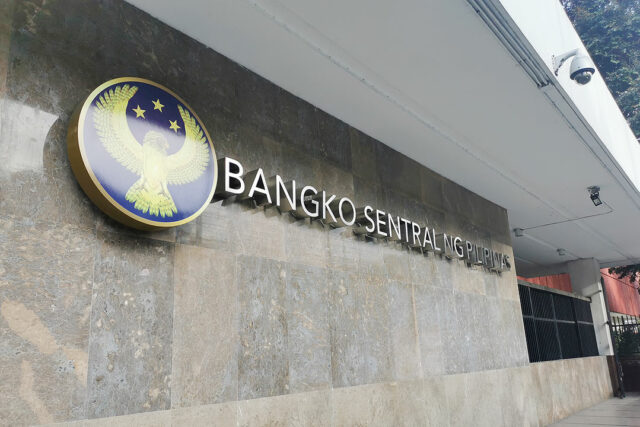
Bangko Sentral ng Pilipinas main office in Manila. — BW FILE PHOTO

THE BANGKO SENTRAL ng Pilipinas (BSP) and the Hong Kong Monetary Authority (HKMA) are looking to strengthen their cooperation on various areas of central banking.

BSP Governor Eli M. Remolona, Jr. and HKMA Chief Executive Eddie Yue on March 28 led a high-level bilateral meeting to exchange views, the Philippine central bank said in a statement late on Monday.

“The BSP and HKMA also explored potential collaborative activities moving forward, to further broaden and enhance their longstanding cooperation and bilateral ties,” it said.

The bilateral meeting was hosted by the BSP.

“Officials from the two institutions discussed and shared insights on capital market development, digital payments and connectivity, digital banking, and sustainable finance,” the BSP said.

“In particular, the meeting covered issues such as bond market and ecosystem; multilateral digital payment projects; cybersecurity risk management and consumer protection; digital financial literacy; climate risk stress testing and other green finance initiatives,” it added. — A.M.C. Sy

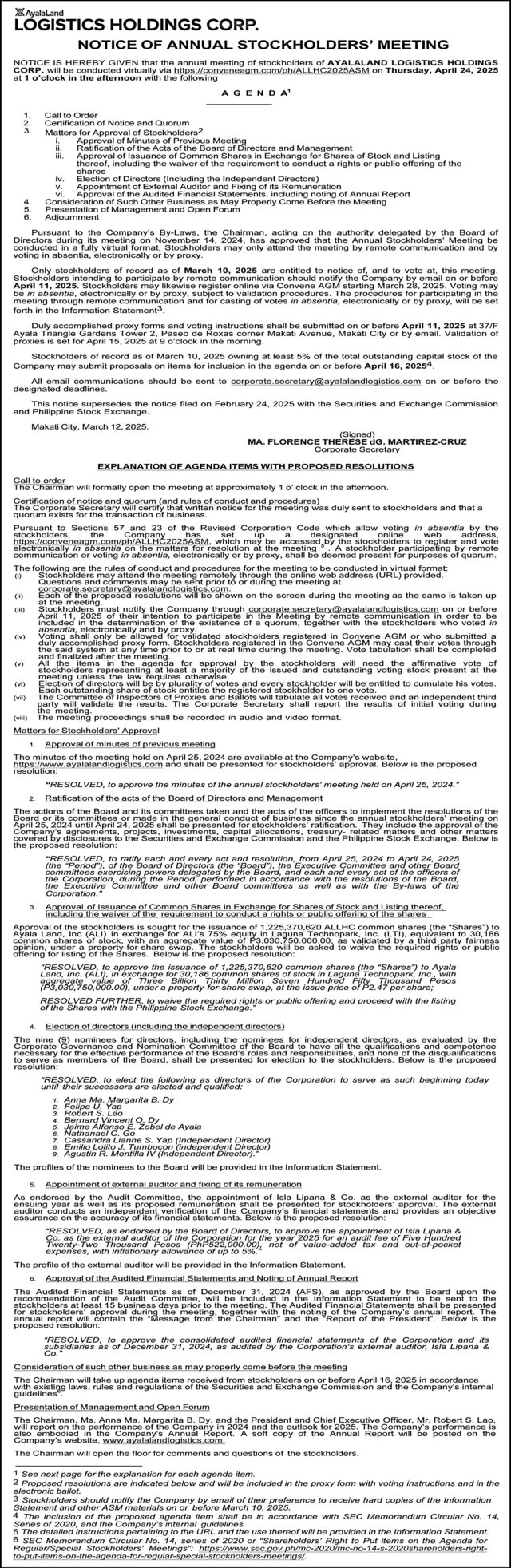
AyalaLand Logistics Holdings Corp. to hold 2025 Annual Stockholders’ Meeting virtually on April 24


Spotlight is BusinessWorld’s sponsored section that allows advertisers to amplify their brand and connect with BusinessWorld’s audience by publishing their stories on the BusinessWorld Web site. For more information, send an email to online@bworldonline.com.

Join us on Viber at https://bit.ly/3hv6bLA to get more updates and subscribe to BusinessWorld’s titles and get exclusive content through www.bworld-x.com.

AREIT, Inc. to conduct 2025 Annual Meeting of Stockholders virtually on April 24


Spotlight is BusinessWorld’s sponsored section that allows advertisers to amplify their brand and connect with BusinessWorld’s audience by publishing their stories on the BusinessWorld Web site. For more information, send an email to online@bworldonline.com.

Join us on Viber at https://bit.ly/3hv6bLA to get more updates and subscribe to BusinessWorld’s titles and get exclusive content through www.bworld-x.com.

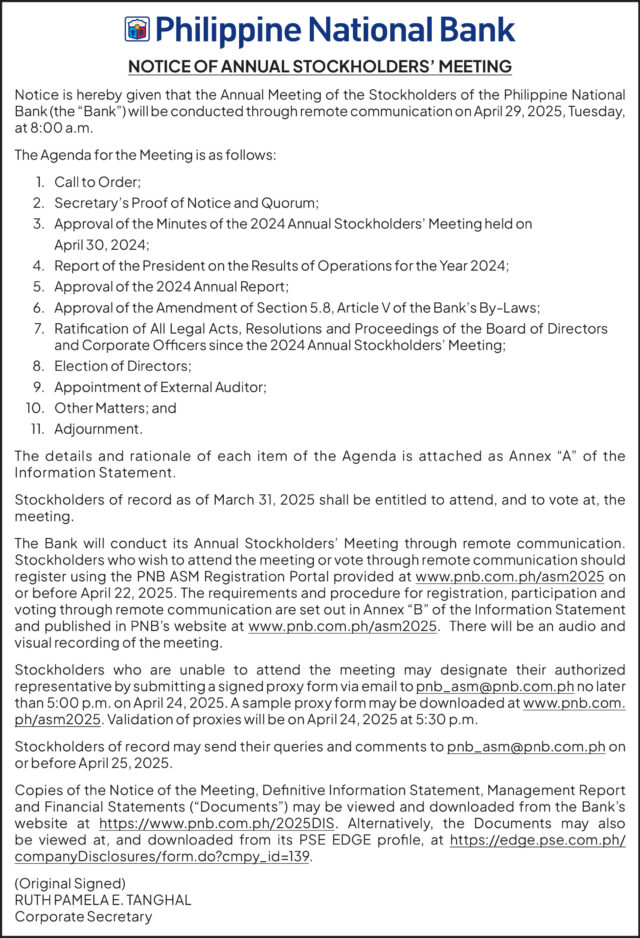
PNB to hold 2025 Annual Meeting of Stockholders on April 29 through remote communication


Spotlight is BusinessWorld’s sponsored section that allows advertisers to amplify their brand and connect with BusinessWorld’s audience by publishing their stories on the BusinessWorld Web site. For more information, send an email to online@bworldonline.com.

Join us on Viber at https://bit.ly/3hv6bLA to get more updates and subscribe to BusinessWorld’s titles and get exclusive content through www.bworld-x.com.

PSEi may drop as US rolls out reciprocal tariffs

BW FILE PHOTO

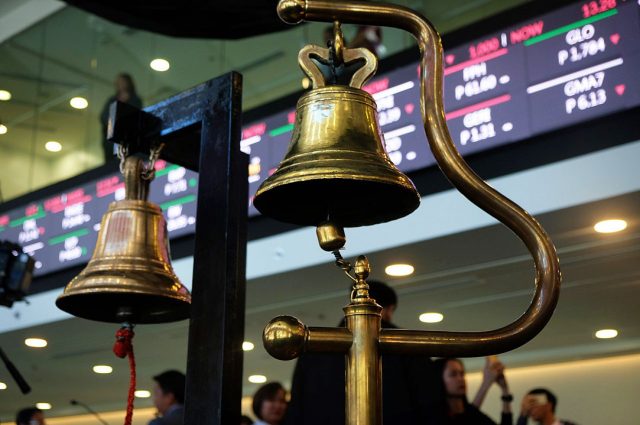
PHILIPPINE SHARES could drop when trading resumes on Wednesday as global markets brace for the unveiling of the Trump administration’s planned reciprocal tariffs.

On Monday, the benchmark Philippine Stock Exchange index (PSEi) rose by 0.54% or 33.28 points to 6,180.72, while the broader all shares index increased by 0.29% or 10.93 points to 3,677.88.

Philippine financial markets were closed on Tuesday in observance of Eid’l Fitr.

“We expect the broader market to trade cautiously with a downward bias, as several key economic and market-moving events unfold. Notably, ‘Liberation Day’ on April 2, when US President Donald J. Trump is set to announce reciprocal tariffs, could introduce additional volatility,” DragonFi Securities, Inc. Equity Research Analyst Jarrod Leighton M. Tin said in a Viber message.

“For ‘Liberation Day,’ investors are hopeful that Trump’s reciprocal tariffs will be moderate, as harsher measures could heighten concerns about US stagflation.”

Asian equities rose on Tuesday following Wall Street’s overnight gains as markets awaited details of Mr. Trump’s reciprocal tariffs, Reuters reported.

Regional stocks found some respite on the first day of April after being battered in March by worries that Mr. Trump’s trade war could trigger stagflation or even a US recession.

Investors are nervously awaiting April 2, a day Mr. Trump has dubbed “Liberation Day,” when he has promised to unveil a massive reciprocal tariff plan.

Meanwhile, the release of March Philippine inflation data on April 4 (Friday) could help boost market sentiment, Rizal Commercial Banking Corp. Chief Economist Michael L. Ricafort said in a Viber message.

“Inflation could slightly ease, and that could support possible 25-basis-point local policy rate cut on April 10,” Mr. Ricafort said.

Headline inflation likely settled within 1.7% to 2.5% last month, the Bangko Sentral ng Pilipinas said on Monday. If realized, this would be slower than the 3.7% inflation print in March 2024.

A BusinessWorld poll of 18 analysts conducted last week yielded a median estimate of 2% for the March consumer price index.

Mr. Tin added that other market catalysts for this week include Philippine labor data and a scheduled speech by US Federal Reserve Chair Jerome H. Powell.

“Despite market uncertainty and a general downward bias, we see strong opportunities in defensive sectors. Investors are likely to seek stability in sectors that hedge against uncertainty, including utilities real estate investment trusts, telecommunications, and even gold miners,” he said. “In this uncertain landscape, defensive positioning remains key.”

Mr. Ricafort put the PSEi’s support at 6,000 and minor resistance at 6,275-6,530. — Revin Mikhael D. Ochave with Reuters

USTR says PHL agri tariffs ‘inhibit’ US farm exports

REUTERS

By Justine Irish D. Tabile, Reporter

THE tariffs set by the Philippines on farm commodities have served to “significantly inhibit” US agricultural exports, the Office of the US Trade Representative (USTR) said in a report.

The USTR made the assessment in the 2025 National Trade Estimate (NTE), which it submitted on Monday to US President Donald J. Trump and Congress, ahead of a White House announcement on the tariffs it plans to impose on its trading partners.

Mr. Trump has indicated his intention to impose “reciprocal tariffs,” charging trading partners tariffs equivalent to what US exports are levied.

The Philippine practice of periodically reviewing its import tariffs on rice following Executive Order (EO) No. 62 is generating “market uncertainty,” the USTR added.

Citing the order signed by President Ferdinand R. Marcos, Jr. on June 20, 2024, the USTR said that EO 62 gives the Philippine government flexibility in the face of changes in the economic environment, but also raises uncertainty in terms of “whether the rice tariff rate will be extended or modified.”

EO 62 modified the tariff schedule for various products until 2028 to augment supply, manage prices, and address inflationary pressures.

EO 62 extends the lower tariffs imposed on imported pork and mechanically deboned meat at 15% within the minimum access volume (MAV) quota and 25% for shipments exceeding the quota; and on corn at 5% within the quota and 15% beyond it. The import duty on rice was set at a uniform rate of 15%, subject to a review every four months starting July 7, 2024.

“No American president in modern history has recognized the wide-ranging and harmful foreign trade barriers American exporters face more than President Trump,” US Trade Representative Jamieson Green said in a statement.

“Under his leadership, this administration is working diligently to address these unfair and non-reciprocal practices, helping restore fairness and put hardworking American businesses and workers first in the global market,” he added.

According to the NTE, the Philippines’ average most favored nation (MFN) applied tariff rate was 6% in 2023, averaging 9.6% for agricultural products and 5.5% for non-agricultural products, representing a decline from 2022 levels, according to the NTE.

“Under the MAV system, the Philippines has scheduled tariff-rate quotas on select agricultural products, including sugar, corn, coffee and coffee extracts, potatoes, pork, and poultry products, with in-quota tariffs ranging from 30% to 50%,” according to the NTE.

The report also found that the Philippine government distributed the initial allocation of the 2024 MAV in tranches, which caused “uncertainty for importers” and is contrary to the allocation method set out by an administrative order.

“In 2024, the distribution also commenced approximately one month later than the prescribed period under the Administrative Order No. 1 (1998), and the last tranche was released on Aug. 15, 2024,” it added.

The NTE is an annual report submitted to the US President and Congress by March 31 that details foreign trade barriers faced by US exporters and USTR’s efforts to reduce those barriers.

Aside from tariff barriers, the report also outlines non-tariff barriers, technical barriers, and sanitary and phytosanitary barriers, services barriers, and investment barriers, among others.

“The findings of the 2025 NTE underscore President Trump’s America First Trade Policy and the President’s 2025 Trade Policy Agenda,” the USTR said.

Citing President Trump’s 2025 Trade Policy Agenda, Philippine Trade Undersecretary Allan B. Gepty noted that Philippine and US trade policy align with or complement each other in many aspects.

“Notably, the US emphasizes the value and importance of security, which is also aligned with our priorities. In terms of trade, the Philippines is a strong advocate of a strategic trade regime where we regulate trade in dual goods or strategic goods,” he said via Viber message.

He said that it’s Philippine policy to prevent the proliferation of weapons of mass destruction, maintain international peace and security, and promote economic growth by facilitating trade and investment.

“It is also important that we ensure that the international supply chain is stable and secure,” he said.

“For example, the implementation of the country’s Strategic Trade Management Act has facilitated the execution of multiple contracts regarding intangible transfers of nuclear technology from US companies to Philippine business process outsourcing firms,” he added.

“On agriculture, noting US interest to export agricultural products, it may be worth noting that the US is the country’s major source of agricultural products, accounting for around 20%. This means that the US is a reliable partner of the Philippines even in food security,” he added.

“In sum, there is an imperative need to pursue stronger Philippine-US economic relations not only to boost the respective production capabilities of the two economies fueled by innovation but also to ensure a stable and secure supply chain,” he added.