Home Blog Page 1173

How Trump’s trade war has evolved in three months

REUTERS

US PRESIDENT Donald J. Trump’s tariff decisions since he took office on Jan. 20, from imposing sweeping duties to abruptly pausing some of them, have shocked financial markets and sent a wave of uncertainty through the global economy.

Here is a timeline of the major developments:

Feb. 1 — Mr. Trump imposes 25% tariffs on Mexican and most Canadian imports and 10% on goods from China, demanding they curb the flow of fentanyl and illegal immigrants into the United States.

Feb. 3 — Mr. Trump suspends his threat of tariffs on Mexico and Canada, agreeing to a 30-day pause in return for concessions on border and crime enforcement. The US does not reach such a deal with China.

Feb. 7 — Mr. Trump delays tariffs on de minimis, or low-cost, packages from China until the Commerce department can confirm that procedures and systems are in place to process them and collect tariff revenue.

Feb. 10 — Mr. Trump raises tariffs on steel and aluminum to a flat 25% “without exceptions or exemptions.”

March 3 — Mr. Trump says 25% tariffs on goods from Mexico and Canada will take effect from March 4 and doubles fentanyl-related tariffs on all Chinese imports to 20%.

March 5 — The president agrees to delay tariffs for one month on some vehicles built in Canada and Mexico after a call with the chief executive officers of General Motors and Ford and the chairman of Stellantis.

March 6 — Mr. Trump exempts goods from Canada and Mexico under a North American trade pact for a month from the 25% tariffs.

March 26 — Mr. Trump unveils a 25% tariff on imported cars and light trucks.

April 2 — Mr. Trump announces global tariffs with a baseline of 10% across all imports and significantly higher duties on some of the US’s biggest trading partners.

April 9 — Mr. Trump pauses for 90 days most of his country-specific tariffs that kicked in less than 24 hours earlier following an upheaval in financial markets that erased trillions of dollars from bourses around the world.

The 10% blanket duty on almost all US imports stays in place.

Mr. Trump says he will raise the tariff on Chinese imports to 125% from the 104% level that took effect a day earlier. This pushes the extra duties on Chinese goods to 145%, including the fentanyl-related tariffs imposed earlier.

April 13 — The US administration grants exclusions from steep tariffs on smartphones, computers and some other electronics imported largely from China.

April 22 — The Trump administration launches national security probes under Section 232 of the Trade Act of 1962 into imports of both pharmaceuticals and semiconductors as part of a bid to impose tariffs on both sectors.

May 4 — Mr. Trump imposes a 100% tariff on all movies produced outside the US.

May 9 — Mr. Trump and British Prime Minister Keir Starmer announce a limited bilateral trade agreement that leaves in place 10% tariffs on British exports, modestly expands agricultural access for both countries and lowers prohibitive US duties on British car exports.

May 12 — The US and China agree to temporarily slash reciprocal tariffs. Under the 90-day truce, the US will cut the extra tariffs it imposed on Chinese imports to 30% from 145%, while China’s duties on US imports will be slashed to 10% from 125%.

May 13 — The US cuts the low value de minimis tariff on China shipments, reducing duties for items valued at up to $800 to 54% from 120%. — Reuters

LGUs’ ban on mining ruled unconstitutional

FREEPIK

By Kyle Aristophere T. Atienza, Reporter

LOCAL government units (LGUs) are prohibited by the Constitution and a 1995 law from declaring blanket bans on mining, the Supreme Court (SC) ruled.

The ruling nullified a 25-year moratorium on large-scale mining by Occidental Mindoro and the municipality of Abra de Ilog in that province, which was found to have violated Republic Act (RA) No. 7942 or the Philippine Mining Act of 1995.

It stemmed from a case filed by Agusan Petroleum and Mineral Corp., which argued that the ban violated its exclusive rights to mine in Mamburao and Abra de llog under a government-approved Financial or Technical Assistance Agreement (FTAA).

The ordinances interfered with the State’s ownership and control over the exploration, development, and use of mineral resources, Agusan Petroleum also argued.

RA 7942 prescribes environmental safeguards that render a total ban unnecessary, it added.

Occidental Mindoro brought the case to the SC after a regional trial court declared the ordinances void.

The province argued that the ordinances were a valid exercise of its police power since their purpose was to protect the environment and the lives and safety of its residents.

The SC said large-scale mining and exploration of mineral resources are legal under the Constitution and the Philippine Mining Act of 1995, adding that it is the State’s duty to promote such activities “to support national development, while also ensuring environmental protection and safeguarding the rights of affected communities.”

Local ordinances are not considered “laws” that can bar mining activity under Section 19 of RA 7942, according to the ruling.

The power of LGUs to issue ordinances comes from Congress, and interpreting “laws” to include local ordinances would, in effect, allow LGUs to override Congressional authority to regulate mining, it said.

RA 7942 gives LGUs the power to approve or deny individual mining applications based on their effects on the environment, livelihoods, and land rights.

“However, the law does not authorize them to impose a blanket ban on all large-scale mining in their area,” the court said.

“Each mining application must be evaluated on a case-by-case basis,” it added.

The High Court noted that all mining applications must undergo environmental impact assessments, which include prior consultation with LGUs.

PAGCOR remits P12.67-B dividend to Treasury

PHILSTAR FILE PHOTO

THE Philippine Amusement and Gaming Corp. (PAGCOR) said it remitted P12.67 billion worth of dividends to the Bureau of the Treasury (BTr).

In a statement on Wednesday, PAGCOR said the dividend is equivalent to 75% of its earnings last year.

“Our 75% dividend remittance is in line with Finance Secretary Ralph Recto’s directive to government-owned and -controlled corporations (GOCCs) to advance an additional 25% dividend to support government spending,” PAGCOR Chairman and Chief Executive Officer Alejandro H. Tengco said.

Republic Act No. 7656 or the Dividends Law requires government companies to remit dividends equivalent to at least 50% of their earnings.

Mr. Tengco turned over the dividends check to Deputy National Treasurer Eduardo Anthony Mariño at the PAGCOR Corporate Office in Pasay City.

“This substantial dividend contribution will go a long way in boosting our fiscal resources and furthering the administration’s development agenda,” Mr. Mariño said. — Aubrey Rose A. Inosante

37 generating firms cited for not disclosing fuel costs

THE Energy Regulatory Commission (ERC) said it has issued show-cause orders to 37 generation firms for failing to disclose their fuel costs, which the regulator uses to validate the reasonableness of their generation charges.

In a statement on Wednesday, the ERC said the power firms were singled out for allegedly “failing to act on ERC’s letter-orders issued between December 2022 and March 2024.”

The orders required the submission of complete sets of fuel cost data and documents covering the period from January to October 2022 “to ensure that only reasonable and justifiable fuel expenses are charged to consumers in the exercise of its regulatory mandate.”

Among the firms issued show-cause orders were subsidiaries of San Miguel Corp. (SMC), Aboitiz Power Corp. (AboitizPower), and DMCI Power Corp.

SMC units Masinloc Power Partners Co. Ltd., San Miguel Energy Corp., SMC Consolidated Power Corp., and San Miguel Consolidated Power Corp. were served show-cause orders.

The ERC also sought explanations from AboitizPower units Therma Luzon, Inc., Toledo Power Corp., GNPower Dinginin, Ltd. Co., and GNPower Mariveles Energy Center, Ltd. Co.

The DMCI Power subsidiary DMCI Masbate Power Corp. (DMPC) was also issued the order.

SMC and AboitizPower have yet to release statements on the matter.

DMCI Power and DMPC said they have yet to receive the show-cause orders but are “in the process of verifying from their records the alleged non-compliance with the ERC directive.”

“We remain fully committed to regulatory compliance and transparency in our operations and will cooperate with the ERC to address the matter accordingly,” they said.

The ERC directed the generation firms to submit the required documents and a verified explanation within 15 days from receipt of the decision.

Power generators were asked to explain why no administrative penalty should be imposed on them. The ERC is authorized to seek such disclosures by the Electric Power Industry Reform Act.

“The ERC continues to conduct rigorous fuel audits to make sure that only fair and reasonable costs are being charged by our regulated entities. We owe it to consumers to protect them from unnecessary charges and ensure that they’re not paying more than they should for electricity,” ERC Chairperson and Chief Executive Officer Monalisa C. Dimalanta said.

“We likewise remind gencos (generation companies) to fully cooperate and comply with these requirements, so we can uphold transparency and deliver power at the least cost possible,” she added. — Sheldeen Joy Talavera

Addressing teaching quality is first job in reforming education, says World Bank

PHILSTAR FILE PHOTO

THE GOVERNMENT needs to focus on improving teaching quality and make up for school days lost to weather disturbances as the immediate priorities in improving literacy and educational outcomes, the World Bank said.

“I would think that the low-hanging fruit (include) focusing on the quality of the teaching profession,” according to Zafer Mustafaoğlu, World Bank country director for the Philippines, Malaysia, and Brunei.

At a briefing on Wednesday, Mr. Mustafaoğlu was responding to a query by Secretary Arsenio M. Balisacan of the Department of Economy, Planning, and Development, who noted the “sad state” of literacy in the Philippines.

According to the 2024 Functional Literacy, Education, and Mass Media Survey, about 90% of Filipinos aged five years or older were found to have had a basic standard of literacy.

Mr. Mustafaoğlu said: “We have to look at the overall teaching system, teaching methods, and again, one important part is class size and the continuity of schooling days,” he said.

In November, the World Bank approved a $500-million package to finance the construction of climate-resilient schools in a program known as the Infrastructure for Safer and Resilient Schools Project.

Mr. Mustafaoğlu added that the government should also address the school days lost to excessive heat or flooding.

About 53 teaching days were lost in school year 2023-2024 as teachers performed non-teaching tasks and also due to climate-related disruptions, according to a preliminary finding from the Second Congressional Commission on Education and the Philippine Institute for Development Studies.

In a report last year, the World Bank said education systems in lowest-income countries remain the most vulnerable to the climate crisis with 18 school days lost annually on average, compared to 2.4 days in wealthier nations. — Aubrey Rose A. Inosante

NGCP notified of ERC decision on rate reset, still awaiting copy

THE National Grid Corp. of the Philippines (NGCP) said it is taking a “wait-and-see” approach to the fifth rate reset round as it has yet to receive a final copy of the regulator’s review of the fourth regulatory period (4RP).

“The fifth regulatory period is delayed. It has been filed with the ERC (Energy Regulatory Commission), and we await that,” NGCP Spokesperson Cynthia P. Alabanza said in a briefing on Wednesday.

“Then, perhaps after that regulatory period, for the sixth, perhaps we can start considering it as forward-looking. But we do plan to make the appropriate filings for the sixth regulatory period which will begin in 2028,” she added.

Last month, the ERC said that it has completed the deliberations on NGCP’s 4RP, covering the 2016 to 2022 period.

However, Ms. Alabanza said that the grid operator has only received a notice of the decision and not the official copy.

“We need to assess the issuance as a whole to be able to see whether that will be supportive of the infrastructure requirements of the country or not,” Ms. Alabanza said.

Hearings are ongoing for the 5RP, covering 2023-2027, she said.

Under the Electric Power Industry Reform Act, the ERC is tasked with establishing a methodology for setting transmission and distribution wheeling rates. The rates must be set in a way that allows the recovery of “just and reasonable costs and a reasonable return on rate base” to enable the entity to operate viably.

The rate reset process is usually a forward-looking exercise that requires the regulated entity to submit forecast expenditures and proposed projects over a five-year regulatory period. The ERC assesses the actual performance of the entity and adjusts rates as needed.

Julius Ryan D. Datingaling, head of business and regulatory development at NGCP, said average transmission rates declined 28.45% to P1.0904 per kilowatt-hour (kWh).

Ancillary services charges decreased 36.07% to P0.5175 per kWh, while transmission wheeling rates — what NGCP charges — fell 16.35% to P0.4605 per kWh.

“For the May 2025 electric bill of the end consumers, NGCP charges only 46 centavos per kWh for the delivery of its services,” Mr. Datingaling said. — Sheldeen Joy Talavera

John Hay Mile Hi property offered for redevelopment

FACEBOOK.COM/CAMPJOHNHAYPH

THE Bases Conversion and Development Authority (BCDA) said on Wednesday that it is auctioning a lease and redevelopment contract for the 6,647 square-meter Mile Hi commercial center in Camp John Hay.

“This strategic redevelopment of Mile Hi underscores our commitment to unlocking the full potential of Camp John Hay,” BCDA President and Chief Executive Officer Joshua M. Bingcang said. 

“By attracting private sector investment and creating new commercial opportunities, we are not only enhancing the camp’s appeal as a premier destination but also generating employment and stimulating economic activity,” he added.

The project covers the redevelopment of the property into an “eco-hostel with upscale retail and dining spaces.”

“The 25-year lease agreement allows for the restoration, renovation, and upgrading of the Mile Hi property into a modern commercial hub while preserving its historical essence and promoting environmental sustainability,” the BCDA said.

“This initiative is projected to attract a significant influx of tourists and further solidify Camp John Hay’s position as a leading leisure destination,” it added.

After issuing the terms of reference and bid documents on Wednesday, the BCDA said the pre-bid conference has been scheduled for May 19.

The deadline for submission of eligibility documents and financial proposals is June 19, and a Notice of Award is expected to be issued by July 28.

The signing of the lease contract is scheduled for 30 days after the issuance of the Notice of Award.

“The Mile Hi project builds on the BCDA’s strong track record in Camp John Hay, where over P1 billion in investments has been generated since the property’s recovery,” the BCDA said. — Justine Irish D. Tabile

Vietnam cracks down on IP theft, transshipment amid US tariff talks

REUTERS

HANOI — Vietnam’s Prime Minister Pham Minh Chinh on Wednesday urged the country’s anti-counterfeit task force to devise new ways to fight fake goods, trade fraud and smuggling, the government said in a statement.

The pledge came as Vietnam is in talks to avoid crippling US tariffs, offering Washington multiple measures to address longstanding concerns, including on intellectual property (IP) breaches and transshipment of Chinese goods through the country.

Internal documents reviewed by Reuters showed the government last month instructed officials to step up the fight against counterfeits, digital piracy, and the transshipment of Chinese goods to the US, which Vietnamese officials often refer to as trade fraud.

The government said fraud also was widespread and increasing on online platforms, noting recent cases of fake milk, food and supplement products had “seriously affected people’s health and social order.”

The government said 1,100 cases of counterfeit and intellectual property violations; 25,100 cases of trade and tax frauds and 8,200 cases of smuggling contraband and prohibited articles had been detected this year. There were no comparative figures in the statement.

“The situation of smuggling and illegal cross-border transportation of goods remains complicated,” the government said.

“Domestically, the production and trade of counterfeits, poor-quality goods and goods of unknown origin is openly widespread, and is on the rising trend on e-commerce environment on a large scale and for a long time, directly affecting people’s health,” the government said.

On Tuesday, the Ministry of Public Security said police arrested the former head of the Ministry of Health’s food safety department in a fake supplement production and trading case.

Nguyen Thanh Phong was accused by police of taking bribes since 2016 to issue quality certificates to nine companies that produced counterfeit supplements, the ministry said. — Reuters

Fil-Chinese biz chamber backs 99-year land leases

THE Federation of Filipino Chinese Chambers of Commerce and Industry, Inc. (FFCCCII) called on the incoming Congress to pass a measure that will extend foreign investors’ land leases to 99 years.

“This is not a mere policy change — it is a major strategic leap to position the Philippines as an exemplar of stability and innovation in ASEAN and Asia, an ideal investment haven,” FFCCCII President Victor Lim said.

“We urge Congress to act swiftly; our economic future hinges on this decision. It will be good for foreign investment,” he added.

According to Mr. Lim, the passage of the bill will align the country’s policies with the 95- to 99-year leases of Singapore, Malaysia, and Indonesia, and exceed Hong Kong’s and Shenzhen’s 50-year leases.

“Adopting 99-year leases aligns the Philippines with progressive regional leaders and signals long-term security and investor confidence — critical for attracting billion-dollar, multi-generational business ventures,” he said.

He said allowing a 99-year lease will remove barriers to financing large-scale projects, which will facilitate investments in semiconductor plants, electric vehicle factories, agro-export zones, renewable energy farms, smart cities, and global-scale food processing, among others.

“Existing investors will expand operations, while new entrants — attracted by terms rivaling Singapore and Shenzhen — will bring cutting-edge innovation and global supply chains,” he said. — Justine Irish D. Tabile

Soon taking effect: The 12% VAT on digital services

As the digital economy continues to expand, governments worldwide are adapting their tax systems to keep pace. The Philippines is no exception. Starting on June 2, digital services consumed within the country will be subject to a 12% Value-Added Tax (VAT), following the signing of Republic Act (RA) No. 12023 and its implementing rules. This landmark legislation targets non-resident digital service providers (NRDSPs), bringing previously untaxed online transactions into the formal tax system.

From streaming subscriptions and cloud storage to online advertising and software services, this VAT imposition will affect a wide range of services used by individuals and businesses alike. Consumers may have to pay higher prices; meanwhile, foreign digital service providers face new registration, reporting, and compliance obligations in the Philippines.

In this article, I will discuss the key features of RA No. 12023 and its implementing rules, and what this means for local consumers, businesses, and non-resident service providers.

UNDERSTANDING THE LEGAL FRAMEWORK
RA No. 12023 was introduced to impose VAT on digital services consumed within the Philippines. This forward-thinking measure aims to create a level playing field for both domestic and foreign digital service providers while harnessing the immense revenue potential of the growing digital economy.

The Bureau of Internal Revenue (BIR) issued Revenue Regulations (RR) No. 3-2025, RR 14-2025, and Revenue Memorandum Circular (RMC) No. 47-2025, outlining the implementing rules for the registration and compliance requirements for NRDSPs.

In a nutshell, “digital services,” as defined by RR 3-2025, are those supplied over the internet or other electronic networks, where the service is primarily automated. RMC No. 47-2025 further clarifies that only those specified digital services under the law are subject to VAT.

Digital services will start being subject to VAT on June 2. Those who do not register by June 1 may incur penalties and at worst, face potential suspension of their business activities, thus, serving as a crucial compliance deadline for NRDSPs.

REGISTRATION, INVOICING AND VAT REMITTANCE
For NRDSPs, this new VAT regime comes with crucial registration and reporting obligations. The BIR has introduced the VAT on Digital Services (VDS) Portal, which serves as the primary platform for NRDSPs to register, file VAT returns, and remit VAT on taxable digital transactions within the Philippines. Until the portal is fully operational, providers are required to use the Online Registration and Update System (ORUS) to register. Alternatively, those with a local representative can register manually with Revenue District Office No. 39 – South Quezon City.

RA 12023 also outlines the VAT treatment for different transaction types, with distinct responsibilities for Business-to-Business (B2B) and Business-to-Consumer (B2C) interactions. In B2B transactions, the Philippine-based business consumer or buyer is responsible for accounting and remitting the 12% VAT under a reverse charge mechanism using BIR Form No. 1600-VT. The VAT remitted using this form may then be applied as input VAT credit by the Philippine business consumer. Conversely, in B2C transactions, the NRDSP is directly liable for the VAT and must file and remit it through the VDS Portal. The BIR has not required a specific format for NRDSP invoices, but they must include key details: the date of the transaction, transaction reference number, identification of the buyer (including the TIN, if applicable), a brief description of the transaction, and the total amount, including VAT. In the RMC, however, the BIR introduced some flexibility on the invoice amount.  If the NRDSP cannot include the VAT amount on the invoice, it must include a note indicating that the local business buyer is responsible for accounting and remitting the VAT.

CHALLENGES AND PRACTICAL IMPLICATIONS
The implementation of VAT on digital services presents significant challenges for NRDSPs. These providers must review and possibly adjust their invoicing systems to comply with the new Philippine requirements. For B2B transactions, NRDSPs will need to clearly indicate on their invoices that the local buyer is responsible for VAT while for B2C transactions, they will need to ensure that VAT is either included as a separate line item or stated as part of the total amount.

Another challenging point is the requirement for NRDSPs to file tax returns with the BIR even if they are only engaging in B2B transactions, where the VAT remittance obligation already falls on the Philippine consumer. While I can appreciate that the goal is enable the BIR to collect information on the total digital services transactions in the Philippines to ensure accurate compliance and monitoring, this seems like something that can still be accomplished by imposing a less onerous reporting obligation on the NRDSPs. Something like a summary list of sales that local VAT taxpayers are filing may be considered.

On the other hand, Philippine business consumers face increased compliance burdens due to the VAT on digital services. These businesses must ensure accurate VAT calculations, proper documentation, and timely remittance of VAT to the BIR. Smaller enterprises, especially, may face difficulties in managing these added requirements, adding to their overall compliance costs. Furthermore, businesses unfamiliar with the reverse charge VAT system may be caught off guard by their obligation to self-assess and remit VAT on imported digital services, further complicating their operational and financial processes.

As a consumer, I’m already feeling the impact of recent price hikes announced by some well-known NRDSPs. While the VAT increase may seem small on a per-transaction basis, it accumulates over time, making subscriptions and online purchases noticeably more expensive. Consequently, I’ve become more discerning about the services I subscribe to and carefully consider what I can do without.

Amid the unofficial and partial results of the recent elections, there’s a prevailing sense of cautious optimism that the BIR will live up to its commitment, “Sa tamang buwis, pag-asenso’y mabilis.” The expectation is that as the government increases tax collection efforts, citizens will see tangible improvements in public services and infrastructure. While the immediate impact of VAT may be an added financial burden, there’s hope that these efforts will contribute to broader economic growth and, ultimately, help enhance our quality of life.

The views or opinions expressed in this article are solely those of the author and do not necessarily represent those of Isla Lipana & Co. The content is for general information purposes only, and should not be used as a substitute for specific advice.


Elinelle D. Saldaña is a senior associate at the Tax Services department of Isla Lipana & Co., the Philippine member firm of the PwC network.

elinelle.d.saldana@pwc.com

Stocks down on profit taking after two-day climb

BW FILE PHOTO

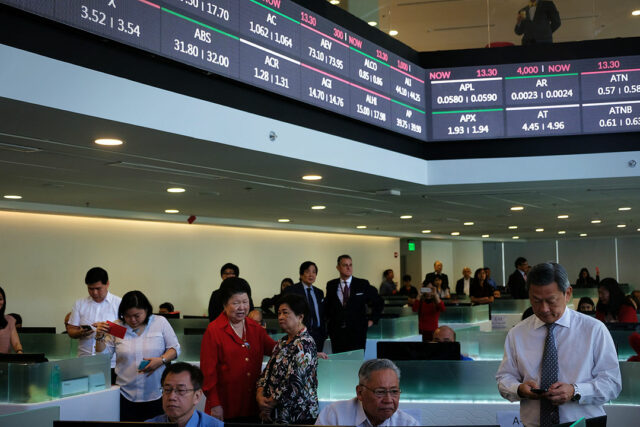
PHILIPPINE STOCKS slipped on Wednesday as investors booked profits from the market’s two-day climb and monitored the release of corporate results.

The Philippine Stock Exchange index (PSEi) inched down by 0.22% or 15.01 points to close at 6,551.81, while the broader all shares index declined by 0.16% or 6.45 points to 3,798.88.

“The PSEi closed in the negative this Wednesday. The local market declined as investors decided to take profits following a two-day rally,” Philstocks Financial, Inc. Senior Research Analyst Japhet Louis O. Tantiangco said in a Viber message. “Investors are also trading cautiously while moving through the first-quarter corporate results.”

“Philippine shares declined as investors locked in gains from the previous session’s rally,” Regina Capital Development Corp. Head of Sales Luis A. Limlingan said in a Viber message.

The index opened Wednesday’s session at 6,558.56, slightly lower than Tuesday’s close of 6,566.82, which was an over four-month high. It climbed to a peak of 6,591.94 during the day but failed to hold on to its gains, closing near its intraday low of 6,550.06.

“The PSEi corrected slightly lower, considered healthy profit-taking, after gaining for most days over the past three weeks… after the dollar-peso exchange rate corrected for the second straight day…,” Rizal Commercial Banking Corp. Chief Economist Michael L. Ricafort added in a Viber message.

The peso closed at P55.855 against the dollar on Wednesday, down from Tuesday’s finish of P55.795, data from the Bankers Association of the Philippines’ website showed.

The majority of sectoral indices closed lower on Wednesday. Holding firms went down by 1.53% or 84.91 points to 5,449.32; financials decreased by 1.02% or 25.86 points to 2,495.62; industrials sank by 0.51% or 47.52 points to 9,190.62; and mining and oil declined by 0.47% or 44.04 points to 9,211.29.

Meanwhile, property rose by 2.89% or 65.47 points to 2,329.60 and services went up by 0.49% or 10.56 points to 2,139.87.

“Aboitiz Equity Ventures, Inc. was the day’s index leader, jumping 9.56% to P37.25. Monde Nissin Corp. was at the bottom, plunging 9.75% to P7.13,” Mr. Tantiangco said.

Value turnover increased to P9.5 billion on Wednesday with 1.56 billion shares traded from the P8.89 billion with 1.16 billion issues exchanged on Tuesday.

Decliners bested advancers, 114 versus 82, while 46 names were unchanged.

Net foreign buying surged to P356.25 million on Wednesday from P54.62 million on Tuesday.

Mr. Ricafort put the PSEi’s support at 6,275-6,385 and major resistance at 6,705-6,915.

Meanwhile, MSCI’s broadest index of Asia-Pacific shares outside Japan rose 1.4% on Wednesday, while Japan’s Nikkei 225 dipped 0.1%, Reuters reported.

US stock futures were flat after the S&P 500 moved into positive territory for the year on Tuesday. — R.M.D. Ochave with Reuters

Peso weakens as market sees June BSP cut

IIIJAOYINGIII-PIXABAY

THE PESO depreciated against the dollar on Wednesday amid expectations of another rate cut by the Bangko Sentral ng Pilipinas (BSP) next month.

The local unit closed at P55.855 per dollar on Wednesday, weakening by six centavos from its P55.795 finish on Tuesday, Bankers Association of the Philippines data showed.

The peso opened Wednesday’s session stronger at P55.75 against the dollar. It dropped to as low as P55.95, while its intraday best was at P55.63 versus the greenback.

Dollars exchanged increased to $1.92 billion on Wednesday from $1.89 billion on Tuesday.

“The peso weakened amid growing expectations of a potential BSP rate cut in June,” a trader said in an e-mail.

BSP Governor Eli M. Remolona, Jr. told Bloomberg last week that the central bank could cut borrowing costs by 75 basis points (bps) more this year as inflation continues to slow.

Last month, the Monetary Board slashed benchmark rates by 25 bps to bring the policy rate to 5.5%. Its next meeting is on June 19.

The peso dropped even as the US dollar was generally weaker against Asian currencies on Wednesday amid higher global crude oil prices and easing expectations of a recession after the US and China agreed to cut tariffs for 90 days, Rizal Commercial Banking Corp. Chief Economist Michael L. Ricafort said in a Viber message.

For Thursday, the trader said the peso could recover “as the likely contraction in US retail sales report might support further depreciation of the greenback.”

The trader expects the peso to move between P55.70 and P55.95 per dollar on Thursday, while Mr. Ricafort sees it ranging from P55.75 to P55.95. — A.M.C. Sy