Home Blog Page 1007

Meralco moves to lower smart meter prices

PHILSTAR FILE PHOTO

MANILA ELECTRIC Co. (Meralco) said it is exploring measures to lower the cost of smart meters under its advanced metering infrastructure (AMI) program, which aims to cover its eight million customers within its franchise area.

“Hopefully, we can do that,” Ronnie L. Aperocho, executive vice-president and chief operating officer of Meralco, told reporters on Tuesday when asked if the AMI program will cover all eight million customers.

Under the AMI program, Meralco plans to deploy 3.27 million smart meters between 2025 and 2029.

“We have to spread out the rollout. We are looking at ways to reduce the cost of smart meters,” he said.

The Energy Regulatory Commission (ERC) earlier said it is carefully evaluating the program due to its high cost.

“We are hoping it will be finally approved before the fifth regulatory reset. We hope there will be a decision by July,” Mr. Aperocho added.

The program also supports initiatives such as net metering and time-of-use tariffs, delivering additional customer benefits by improving energy consumption awareness and reducing response times to outages.

AMI refers to an integrated system of smart meters, communication networks, and implementation systems that enable two-way communication between utilities and customers.

Smart meters are digital devices that enable electricity consumers to monitor their power usage in real time.

The smart meter rollout is part of Meralco’s proposed P215-billion capital expenditure plan for the fifth regulatory period, covering 2026 to 2029.

Meralco completed its pilot test for postpaid smart meters on Dec. 9, 2024, with 5,248 active customers as of yearend. The company implemented a phased approach to onboard customers and collect extensive data across different areas, customer segments, and seasonal variations.

Meralco’s controlling stakeholder, Beacon Electric Asset Holdings, Inc., is partly owned by PLDT Inc.

Hastings Holdings, Inc., a unit of PLDT Beneficial Trust Fund subsidiary MediaQuest Holdings, Inc., has an interest in BusinessWorld through the Philippine Star Group, which it controls. — Ashley Erika O. Jose
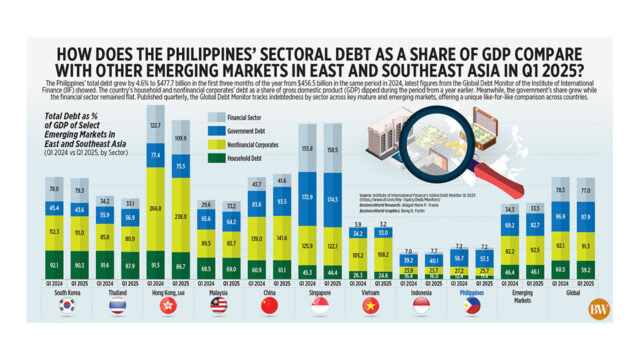
How does the Philippines’ sectoral debt as a share of GDP compare with other emerging markets in East and Southeast Asia in Q1 2025?

The Philippines’ total debt grew by 4.6% to $477.7 billion in the first three months of the year from $456.5 billion in the same period in 2024, latest figures from the Global Debt Monitor of the Institute of International Finance (IIF) showed. The country’s household and nonfinancial corporates’ debt as a share of gross domestic product (GDP) dipped during the period from a year earlier. Meanwhile, the government’s share grew while the financial sector remained flat. Published quarterly, the Global Debt Monitor tracks indebtedness by sector across key mature and emerging markets, offering a unique like-for-like comparison across countries.

How does the Philippines’ sectoral debt as a share of GDP compare with other emerging markets in East and Southeast Asia in Q1 2025?

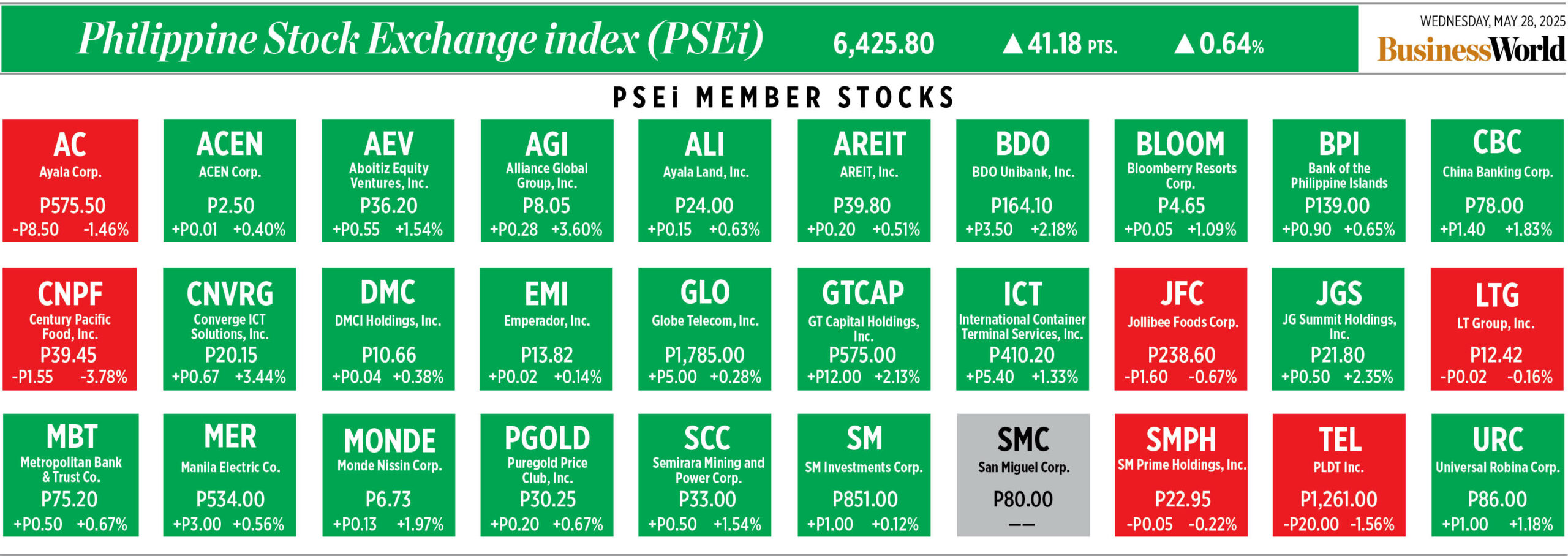
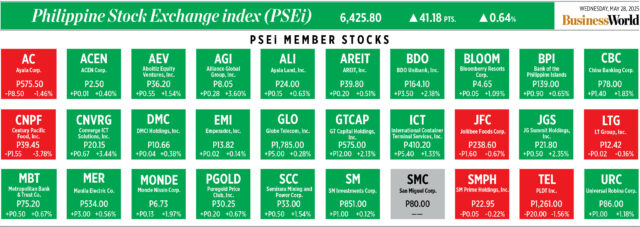
How PSEi member stocks performed — May 28, 2025

Here’s a quick glance at how PSEi stocks fared on Wednesday, May 28, 2025.


PHL, Indonesia lagging region in decarbonization efforts — WB

PIXABAY

THE PHILIPPINES and Indonesia are falling behind in the effort to decarbonize East Asia and the Pacific due to their continued reliance on dirty energy, the World Bank (WB) said in a report.

The bank said these two countries should consider removing fossil fuel subsidies and implementing carbon taxes or green subsidies. 

In its “Green Technologies Decarbonizing Development in East Asia and Pacific” report, the bank said progress toward decarbonization in the region has been uneven, but carbon intensity in most economies has declined due to the improved energy efficiency.

“This progress, however, has been partially offset by countries such as Indonesia and the Philippines, whose energy mix has become dirtier,” it said.

Philippine greenhouse gas emissions amounted to 204.33 teragrams of carbon dioxide equivalent in 2020, down 12.3% from 2015 levels.

However, the Philippines still relies heavily on fossil fuel for power generation.

The Philippines hopes to increase the share of renewable energy in its power generation mix to 35% by 2030 and to 50% by 2040.

The World Bank also noted Vietnam’s increasing carbon intensity, but its energy efficiency has not improved in the past decades. 

Meanwhile, China saw the biggest improvement in emission intensity, but the surge in its total emissions showed that “output growth fueled by dirty sources far outpaced the economy’s decarbonization process.”

The World Bank urged economies to move away from distortionary policies, such as fossil fuel subsidies and barriers to trade and investment.

“Complementary measures — such as assistance for low-income beneficiaries of fuel subsidies and retraining for workers in fossil fuel industries — would enhance the economic benefits and reduce the political difficulty of reforms,” it said.

In 2024, private investment in green projects declined 12% to $1.28 billion.

The report said additional investment in solar and wind energy projects was offset by the drop in waste management and green cement projects.

In the SEA-6 (Southeast Asia-6), composed of Thailand, Malaysia, Singapore, Indonesia, the Philippines, and Vietnam, the Philippines accounted for only 16% of total investment.

The bank also touted the “win-win” potential of addressing domestic market failures. These include imperfect information, which limits green credit, and lack of coordination, which limits investment in green infrastructure.

It urged economies to “induce the adoption of not-yet-viable technologies” through carbon taxes or green subsidies.

“How far the region is willing to go in this respect depends on commitments already made as well as the benefits they receive in return, through emission cuts, assistance, and technology transfers by the rest of the world,” it said.

Congress in February approved House Bill No. 11375 on second reading. The bill establishes a carbon pricing framework for companies. — Aubrey Rose A. Inosante

Exports starting to be disrupted by trade uncertainty — Airspeed

REUTERS

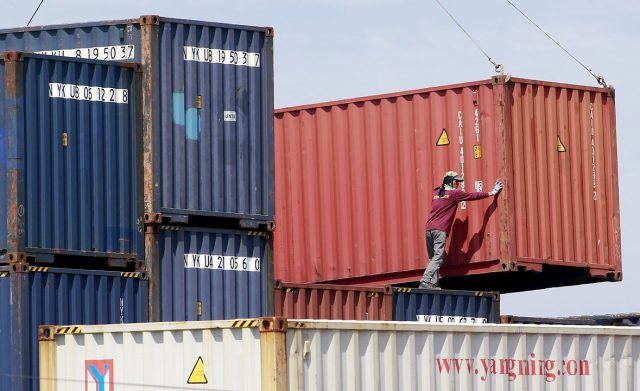
SOME Philippine export orders are currently on hold as buyers await US tariff developments, the parent company of logistics firm Airspeed International Corp. said.

“The US tariffs have really affected the ASEAN region because the tariffs are not yet stabilized and we are still in the 90-day grace period,” Rosemarie P. Rafael, chairperson and president of AIC Group of Companies Holding Corp., told reporters on Tuesday.

“The buyers, as we see, are on hold. They really do not know if they are really going to push ahead with the orders, which affects our outbound trade,” she added.

In particular, she said that some orders of furniture from Cebu and garments have been on hold since March.

The US imposed reciprocal tariffs on most of its trading partners last month, with the Philippines assigned a 17% tariff.

The reciprocal tariffs have since been suspended, with most countries being charged 10% in the interim.

“There are not a lot of sailings going out, especially from China,” Ms. Rafael said.

She noted the emergence of “blank sailings,” where container ships skip scheduled stops because they do not expect to take on loads that would justify the journey.

“It is very difficult because they need to go through some transit points, and the US is basically raising charges on shipments of Chinese origin,” she said.

“These challenges can be overcome by looking at other markets. But the mood right now is to wait and see,” she added.

For the Philippines, she said other export destinations could be developed in the Middle East, Africa, and elsewhere in Asia.

“There are so many markets that have remained untapped because our major partner is really the US. So this is, to me, an opportunity… people can really look to build other markets,” she added.

She said the impact is much more severe in manufacturing exporters like Vietnam, Cambodia, and Thailand.

“What we are trying to look at is how to collaborate with the ASEAN region as the bloc is considered the world’s fifth-largest economy,” she said.

“Looking at what we have, it is a big market in itself,” she said, adding that the region “needs to work together and collaborate and not compete because our products can be complementary.”

She said the region is hoping for successful tariff negotiations with the US, “because it is not only China that is affected but also other countries that export manufactured goods.”

She said international movements, particularly for export shipments, have slowed by around 10%, while domestic movements remain strong.

Asked how much growth the company is expecting this year, she said that the domestic market is stable and is projected to register 5-10% growth. — Justine Irish D. Tabile

Gastronomy tourism declared new focus area for attracting visitors

BAGUIO CITY PUBLIC MARKET FACEBOOK PAGE

THE Department of Tourism (DoT) said on Wednesday that it is seeking to establish the Philippines as a food and gastronomy destination within Southeast Asia.

Tourism Undersecretary Verna C. Buensuceso said at the launch ceremony for the gastronomy tourism roadmap that the program will tout the Philippines’ “culinary diversity and local produce.”

The roadmap includes strategies for creating food-focused tourism experiences to increase awareness of and recognition for Filipino food.

Tourism Secretary Ma. Esperanza Christina Garcia Frasco said the launch marks gastronomy tourism’s formal incorporation in the National Tourism Development Plan (NTDP).

“For the first time, gastronomy has been formally incorporated in the NTDP, not as an afterthought, but as a central pillar of our tourism strategy,” she said.

“It is not a top-down plan; it is a bottom-up strategy created in partnership with the people who know our food best,” she added.

In parallel, the DoT also launched its Market Tourism Product Development Program, which aims to transform public markets into destinations.

“Our markets are not merely venues for commerce and trade; they are our cultural landmarks. In Baguio, our pilot program has proven how a public market can become both a heritage site and an economic engine, and now we are ready to take this nationwide,” Ms. Frasco said. 

She said market tourism as a sub-product of gastronomy tourism took in ideas and contributions of culinary tourism advocates and the academic community.

“We will have market tours, and various places will now have an opportunity to become tourism destinations. We will give out handbooks to our local government units, which will serve as a guide on how to develop their markets into tourism circuits,” she said. — Justine Irish D. Tabile

PSE index back above 6,400 on bargain hunting

BW FILE PHOTO

PHILIPPINE STOCKS rebounded on Wednesday to snap a two-day losing streak, with the index returning above the 6,400 line, as market participants bought bargains.

The bellwether Philippine Stock Exchange index (PSEi) rose by 0.64% or 41.18 points to 6,425.80, while the broader all shares index improved by 0.47% or 17.56 points to 3,753.10.

“The local market bounced back as investors hunted for bargains after two straight days of decline,” Philstocks Financial, Inc. Senior Research Analyst Japhet Louis O. Tantiangco said in a Viber message. “The positive spillovers from Wall Street’s overnight performance also helped in Wednesday’s session.”

“Philippine shares tracked US’ performance, gaining 0.64%, as investors’ risk appetite recovered on the tariff pause. Wall Street was in the green following news on the postponement of 50% tariff on the EU (European Union),” Regina Capital Development Corp. Head of Sales Luis A. Limlingan said in a Viber message.

Wall Street surged on Tuesday as investor risk appetite was buoyed by US President Donald J. Trump’s latest tariff respite and an unexpected jump in consumer confidence, Reuters reported.

The S&P 500 is now within 3.6% of its record closing high reached on Feb. 19, having plunged as much as 18.9% below that level in the wake of Mr. Trump’s erratic tariff announcements, which have whipsawed markets for much of the President’s second term.

In the latest move, the President backed down from his 50% tariff threat against the European Union, delaying its implementation until July 9 to allow for negotiations between the White House and the 27-nation bloc. The move prompted Brussels to prepare for trade negotiations.

The Dow Jones Industrial Average rose 740.58 points or 1.78% to 42,343.65; the S&P 500 gained 118.72 points or 2.05% to 5,921.54; and the Nasdaq Composite gained 461.96 points or 2.47% to 19,199.16.

Back home, all sectoral indices closed in the green on Wednesday. Financials rose by 1.46% or 35.03 points to 2,427.87; services went up by 0.76% or 16.28 points to 2,143.68; industrials climbed by 0.28% or 25.14 points to 8,890.88; holding firms increased by 0.26% or 14.64 points to 5,461.9; property added 0.25% or 5.71 points to end at 2,255.06; and mining and oil inched up by 0.02% or 1.94 points to 9,790.77.

“Alliance Global Group, Inc. was the day’s index leader, climbing 3.6% to P8.05. Century Food Pacific, Inc. was the main index laggard, falling 3.78% to P39.45,” Mr. Tantiangco said.

Value turnover increased to P6.3 billion on Wedneday with 601.1 million shares traded from the P5.13 billion with 639.26 million issues exchanged on Tuesday.

Advancers bested decliners, 118 versus 80, while 48 names were unchanged.

Net foreign buying stood at P687.36 million on Wednesday, a reversal of the P55.76 million in net foreign selling on Tuesday. — Revin Mikhael D. Ochave with Reuters

Job listings point to strong demand for accounting, infotech workers

ACCOUNTING and information technology (IT) roles dominated the job postings in the year to date, online employment portal Jobstreet said on Wednesday.

In a statement, Jobstreet by SEEK said that 11.81% of all job postings during the early part of 2025 involved accounting roles.

Job postings for Information and Communication Technology roles accounted for 11.41% of the total, while job ads for sales positions made up 10.1% of available jobs.

IT and sales “have consistently been among the most sought-after by employers. With many companies actively looking for talent in IT and sales, both remain top in-demand jobs,” Jobstreet added.

It said sales, marketing and communications roles were the biggest movers during the period, with employers seeking to fill positions as the overall economy grew.

In the first quarter, gross domestic product grew 5.4%, against the 5.9% posted a year earlier, the Philippine Statistics Authority reported.

Jobtreet said call center and customer service positions accounted for 9.98% of job postings, followed by manufacturing, transport and logistics (8.12%), administration and office support (6.43%), retail and consumer products (5.40%), human resources and recruitment (5.09%), and engineering (4.74%). 

“This surge in job availability is especially timely as the country welcomes a new batch of graduates into the workforce,” it added.

The 2024 to 2025 school year is scheduled to end by June, with thousands of graduates from senior high school or college expected to join the workforce.

The online job portal said that it is now averaging about 130,000 job posts per month on its AI-powered platform.

“We believe that everyone deserves access to a job. Our goal is to empower every individual and help bridge the gap in unemployment by connecting them with the right opportunities,” Jobstreet Head of Marketing Joey Yusingco said. — Adrian H. Halili

Peso climbs as trade jitters ease

PHILIPPINE STAR/WALTER BOLLOZOS

THE PESO rebounded against the dollar on Wednesday amid easing trade tensions between the United States and the European Union (EU).

The local unit closed at P55.475 versus the dollar, strengthening by 8.5 centavos from its P55.56 finish on Tuesday, Bankers Association of the Philippines data showed.

The peso opened Wednesday’s session almost flat at P55.55 against the dollar. Its worst showing was at P55.64, while its intraday best was its closing level of P55.475 versus the greenback.

Dollars exchanged went down to $1.8 billion on Wednesday from $1.9 billion on Tuesday.

“Initially, the pair went to a high of P55.64, tracking the dollar’s recovery following easing trade tensions overnight. But some defensive trading ahead of the Federal Open Market Committee minutes pushed the pair to a low of P55.475,” a trader said in a phone interview.

The dollar was firmer on Wednesday but remained under pressure as the US and EU continue their trade negotiations, Rizal Commercial Banking Corp. Chief Economist Michael L. Ricafort said in a Viber message.

For Thursday, the trader expects the peso to move between P55.30 and P55.70 per dollar, while Mr. Ricafort sees it ranging from P55.35 to P55.55.

Japan’s yen was steady on Wednesday as ructions in the bond market kept the spotlight on the fiscal health of major economies, while the dollar was firm due to upbeat consumer confidence data and hopes for more US trade deals, Reuters reported.

The yen slid slightly at 144.14 per dollar after dropping 1% on Tuesday following a report by Reuters that Japan will consider trimming issuance of super-long bonds after a sharp rise in yields in recent weeks.

The yen has gained nearly 9% so far in 2025 due to broad dollar weakness and safe-haven flows as investors flee US assets in the wake of the erratic trade policies under President Donald J. Trump that have roiled markets.

The dollar index, which measures the US currency against six rivals, was last 0.08% higher at 99.608 but is down 8% for the year as investors look for alternatives to US assets.

The euro was broadly flat at $1.1321 after dropping 0.5% on Tuesday as a bout of dollar buying swept the markets amid signs of possible trade deals and data showing US consumer confidence in May was much better-than-expected.

Still, new orders for key US-manufactured capital goods plunged by the most in six months in April as the flip-flopping tariff salvos take a toll on the economy and businesses, data showed on Tuesday.

“More positive data surprises are needed to rebuild confidence in US growth, and deficit worries aren’t disappearing anytime soon,” ING FX strategist Francesco Pesole wrote in a note.

“When adding the themes of de-dollarization and Trump’s plans for a weaker dollar in the longer run, we still think the greenback rallies can fade from here.”

The dollar was also supported by Mr. Trump’s decision to delay higher tariffs on the European Union over the weekend.

EU officials have asked the bloc’s leading companies and chief executive officers for details of their US investment plans, two sources familiar with the matter told Reuters, as Brussels prepares to advance trade talks with Washington.

Sterling last bought $1.3504 but stayed close to the three-year high touched on Monday.

Investors will watch out for the April personal consumption expenditures report — the Federal Reserve’s preferred inflation gauge — on Friday that could help gauge the impact of Mr. Trump’s trade policies. — Aaron Michael C. Sy with Reuters

IT, tech, software firms dominate Kalibrr’s 2025 Top 50 employers list

INFORMATION TECHNOLOGY (IT), technology, and software companies dominated the list of the Top 50 Employers in the Philippines for 2025, according to Kalibrr, a job-hunting platform. 

Kalibrr Marketing Supervisor Zarah P. Lim told BusinessWorld that the IT, tech, and software industries secured spots on the list were Accenture, Likha-iT, Inc., SafetyCulture Philippines, Inc., SlideGenius APAC, Inc., Sprout Solutions, ThinkBit, Ylopo LLC, 2x (Straightarrow Corporation), Eskwelabs (EdTech), Bukas, and Maya Philippines, Inc.

Ms. Lim said Kalibrr compiled the list by surveying jobseekers and human resource professionals on the platform.

The platform now has over 8 million registered users in the Philippines.

“We asked respondents to rate all the companies they have worked for, both past and present, as well as companies they know through industry experience, friends, or family,” Ms. Lim said.

“Each company was rated based on five key factors — how happy employees are, whether they feel valued, if there are opportunities for learning and growth, how proud they are of their company and team, and whether they would recommend the company to others.”  

She added that all these factors were given equal weight, along with data from third-party sources.

Banking and financial services companies that made the list were COL Financial Philippines, Metrobank, Rizal Commercial Banking Corp., UnionBank, and PwC AC Manila.

Marketing, media, and advertising industries on the list were Netflix, Ogilvy, Gigil, Financial Times, Kadence International, and Get Hooked.

Fast-moving consumer goods and retail companies on the list were Ginebra San Miguel, Nestlé Philippines, Inc., Monde Nissin, L’Oréal, 3M, Adidas, IKEA, Levi’s, Love, Bonito, and Remedy.

“The Kalibrr Top 50 is our way of saying these are the employers doing it right. These are the companies that care. And these are the opportunities that can change lives,” Ms. Lim said.

“It is meant to be a trusted guide. With so many companies out there, it can be hard to know which ones truly care about their people.” — Edg Adrian A. Eva

Meralco sees new DoE leadership advancing nuclear development

PNRI.DOST.GOV.PH

MANILA Electric Co. (Meralco) is confident that the government’s nuclear energy ambitions will advance under the new interim Energy Secretary Sharon S. Garin, who had formerly overseen nuclear energy policy for the department.

“I think with her at the helm, we can be on top of our nuclear agenda,” Ronnie L. Aperocho, Meralco executive vice-president and chief operating officer, told reporters on the sidelines of the company’s annual stockholders’ meeting.

Ms. Garin, who was appointed office in charge of the Department of Energy (DoE), headed its nuclear energy division in her former position as Undersecretary.

Former Secretary Raphael P.M. Lotilla was transferred to the Department of Environment and Natural Resources after President Ferdinand R. Marcos, Jr. revamped his cabinet last week.

“(Ms. Garin) is on top of the nuclear energy agenda. Although we have not discussed it yet, we think that it will be at the top of her agenda. And then with the opening of the next Congress, we hope that nuclear will be the priority,” Mr. Aperocho said.

The DoE expects to start feeding nuclear energy into the grid by 2032. For now, it is occupied with complying with international nuclear safety standards.

Meralco is hopeful that the bill seeking to establish an independent nuclear energy regulator will obtain Senate approval when Congress returns in June.

Under the Philippine nuclear energy roadmap, the government has set a target of 1,200 megawatts (MW) of nuclear capacity by 2032, scaling up to 2,400 MW by 2040 and 4,800 MW by 2050.

By 2025, the nuclear legal and regulatory framework are expected to be in place.

Meralco’s controlling stakeholder, Beacon Electric Asset Holdings, Inc., is partly owned by PLDT Inc.

Hastings Holdings, Inc., a unit of PLDT Beneficial Trust Fund subsidiary MediaQuest Holdings, Inc., has an interest in BusinessWorld through the Philippine Star Group, which it controls. — Ashley Erika O. Jose
Rice tariffs up 12.5% in 2024; 2025 funding for RCEF in doubt

BW FILE PHOTO

RICE IMPORTS in 2024 amounted to 4.8 million metric tons (MMT), generating tariffs of P34.23 billion, up 12.57%, the Department of Agriculture said.

Agriculture spokesman Arnel V. de Mesa told BusinessWorld that tariff collections were strong in the first quarter of 2024, hitting P11.66 billion, up 53.23%.

Subsequent quarterly collections were P11.85 billion in the second quarter of 2024, P4.18 billion in the third quarter of 2024, and P6.52 billion in the fourth quarter of 2024.

Collections weakened year on year in the latter half of 2024, with an 80.93% decline posted in the third quarter and a 33.50% fall in the fourth quarter.

Import volumes were tracking lower in the first quarter of 2025, for which data were available only until March 13. Imports to that date totaled 641,000 MT, well behind the year-earlier pace, when first quarter import volumes totaled nearly 1.2 MMT.

Raul Q. Montemayor, national manager of Federation of Free Farmers, said he doubted whether tariff collections this year will raise the P30 billion required by law to support the Rice Competitiveness Enhancement Fund (RCEF), due to the decline in rice imports.

“As of April 2025, total imports amounted to 1.5 MMT, and tariff collections were only P6.2 billion,” he said via Viber.

The Bureau of Plant Industry reported that rice imports as of May 22 totaled 1.7 MMT. The year-earlier total for the first five months had been 2.15 MMT.

Mr. De Mesa, speaking at a briefing on Wednesday, said the government expects favorable weather conditions this year, reducing demand for imports.

RCEF is a component of the Rice Tariffication Law of 2019. The initial P10 billion worth of annual funding to modernize the rice industry was increased to P30 billion by an amendment in 2024.

“We were informed today that when the amendment was enacted in December 2024, all excess tariff collections in 2023 and 2024 that were unused reverted to the national treasury,” Mr. Montemayor said, citing communications with government officials.

“A new special account will be set up from scratch for tariff collections starting 2025.”

He noted that for 2025, only P10 billion was so far appropriated by Congress for the RCEF, with the balance of P20 billion to be sourced from unprogrammed funds.

Samahang Industriya ng Agrikultura Executive Director Jayson H. Cainglet said rice import duties in 2024 could have totaled P50 billion if the rice import tariff had not been reduced to 15% in July 2024.

The government lowered tariffs on rice imports from 35% originally and applied the new rate to grain from any source market. The original 35% rate had applied to rice from Southeast Asia. The 15% rate is subject to review every four months.

“Rice farmers urgently need cash because of declining palay farmgate prices this harvest, which were as low as P11-15 per kilo,” Mr. Cainglet said.

“Farmers have already started their preparations for the next planting season.”

Of the P30-billion allocation for RCEF, P6 billion is earmarked for rice seed, P9 billion for farm mechanization, and P15 billion for extension and training programs, financial assistance, credit, soil improvement, solar-powered irrigation systems, and water impounding projects. — Kyle Aristophere T. Atienza