Yields on government debt go up as central bank tightens stance
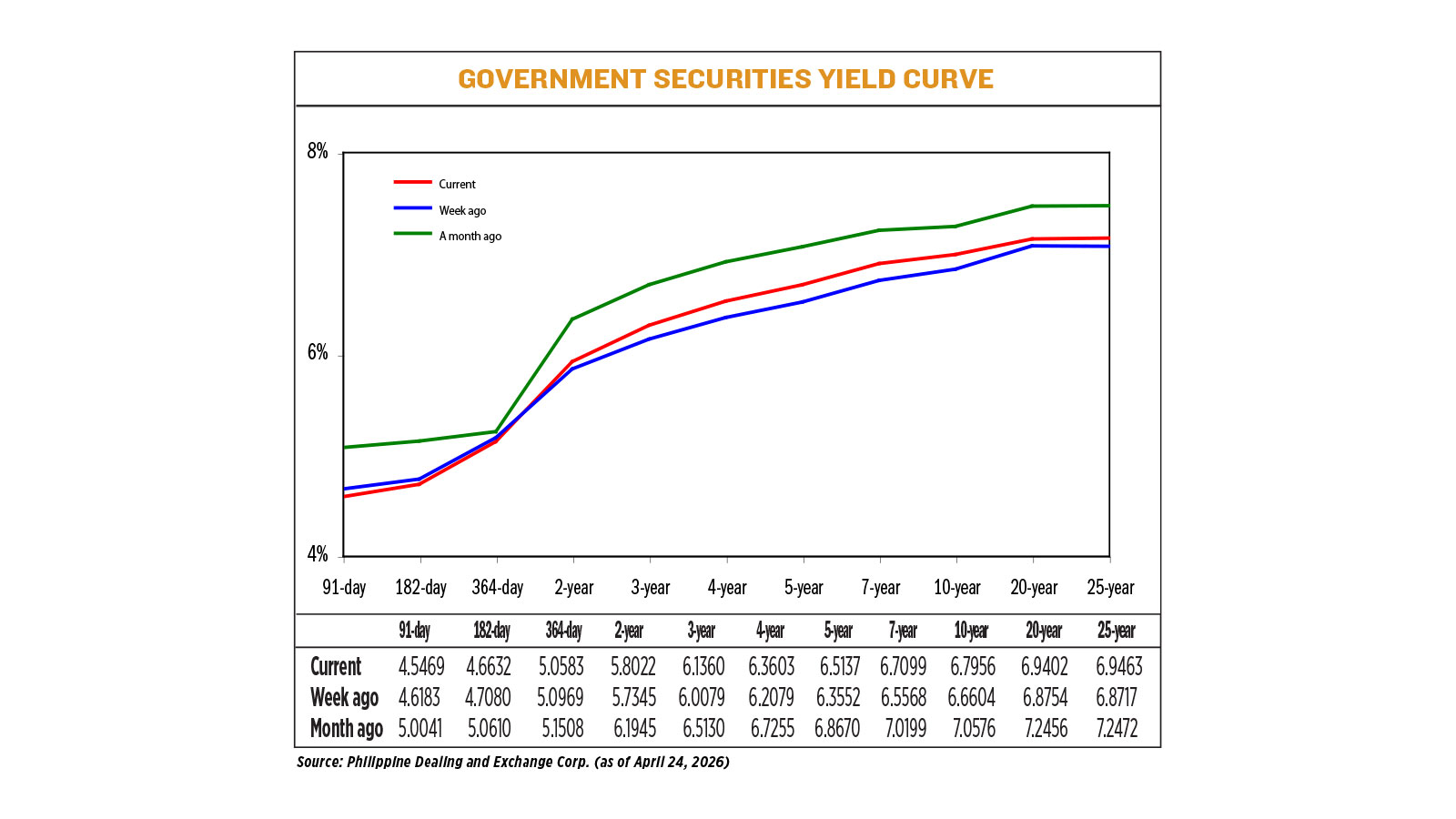
YIELDS on government securities (GS) traded at the secondary market closed mostly higher last week after the Bangko Sentral ng Pilipinas’ (BSP) delivered its first interest rate hike in over two years.
GS yields, which move opposite to prices, went up by an average of 7.09 basis points (bps) week on week, based on the PHP Bloomberg Valuation Service Reference Rates as of April 24 published on the Philippine Dealing System’s website.
At the short end of the curve, rates went down across the board. The 91-, 182- and 364-day Treasury bills (T-bill) dropped by 7.14 bps, 4.48 bps, and 3.86 bps week on week to fetch 4.5469%, 4.6632%, and 5.0583%, respectively.
Meanwhile, all yields at the belly and the long end ended higher week on week. Rates of the two-, three-, four-, five-, and seven-year Treasury bonds (T-bonds) rose by 6.77 bps (to 5.8022%), 12.81 bps (6.136%), 15.24 bps (6.3603%), 15.85 bps (6.5137%), and 15.31 bps (6.7099%), respectively.
The 10-, 20-, and 25-year bonds went up by 13.52 bps, 6.48 bps, and 7.46 bps to yield 6.7956%, 6.9402%, and 6.9463%, respectively.
GS volume traded reached P28.51 billion on Friday, lower than the P42.76 billion recorded a week earlier.
“The BSP’s 25-basis-point hike to 4.5% clearly marked a pivot from easing to preemptive response to inflation, and the bond market adjusted accordingly,” Jonathan L. Ravelas, a senior adviser at Reyes Tacandong & Co., said in a Viber message.
“We saw yields move higher for longer tenors and the short tenors moved lower, with the curve steepening as investors priced in the risk that this won’t be a one-off move.”
Lodevico M. Ulpo, Jr., vice-president and head of fixed income strategies at ATRAM Trust Corp., said the upward adjustment in the BSP’s inflation forecasts and its hawkish policy guidance pushed up yields at the belly and long end.
“The hawkish tone from BSP Governor Eli M. Remolona, Jr. was not fully reflected in prior pricing, prompting a broad selloff in the latter part of the week. At the same time, the BSP’s upward revision of its 2026 inflation forecast to 6.3%, above the target band, added further pressure on bonds. This reinforced the bearish momentum.”
“The decline in short-end yields was largely driven by flush liquidity conditions from recent maturities, which supported demand for the front end of the curve,” he added.
On Thursday, the BSP’s policy-setting Monetary Board raised the target reverse repurchase rate by 25 bps to 4.5%, marking its first hike since October 2023.
This effectively ended an easing cycle that cut the benchmark rate by 225 bps starting in August 2024.
Mr. Remolona signaled more further tightening ahead via “a succession of modest rate hikes” as they try to quell spiraling prices due to the Iran war as the global oil shock pushes up inflation expectations.
The BSP now sees inflation breaching their 2%-4% tolerance band in 2026 and 2027. For this year, it expects the consumer price index (CPI) to average 6.3%, significantly higher than the earlier 5.1% forecast.
This comes as elevated oil prices amid conflict drove headline inflation to a near two-year high of 4.1% in March, bringing the three-month average to 2.8%. Mr. Remolona said the CPI could breach 5% for the rest of the year.
For 2027, the BSP also raised its projection to 4.3% from 3.8% previously.
“Beyond policy, higher global oil prices due to Middle East tensions, elevated US Treasury yields, and a worsening inflation outlook all kept local GS yields under upward pressure,” Mr. Ravelas added.
Mr. Ulpo said that while the announcement of Philippine government bonds’ inclusion in the JPMorgan GBI-EM Global Diversified Index supported market sentiment early on Thursday, it was quickly overshadowed by the Monetary Board’s rate hike later in the day.
For the coming week, he said further forward guidance from the BSP and external developments could affect yields.
“In the near term, the curve is likely to remain reactive to external drivers, particularly geopolitical developments and movements in global oil prices, both of which feed directly into inflation expectations and global rate direction.”
Mr. Ravelas said trading will likely remain cautious and range-bound, with a continued upward bias at the front end on monetary policy bets.
Mr. Ulpo added that traders will also monitor the Bureau of the Treasury’s dual-tranche bond offering on Tuesday.
“The auction outcome should provide clearer direction on investor appetite and could set the tone for broader curve movements in the coming sessions.” — Heather Caitlin P. Mañago