NCR economy grows 4.4% in 2025, weakest in 5 years
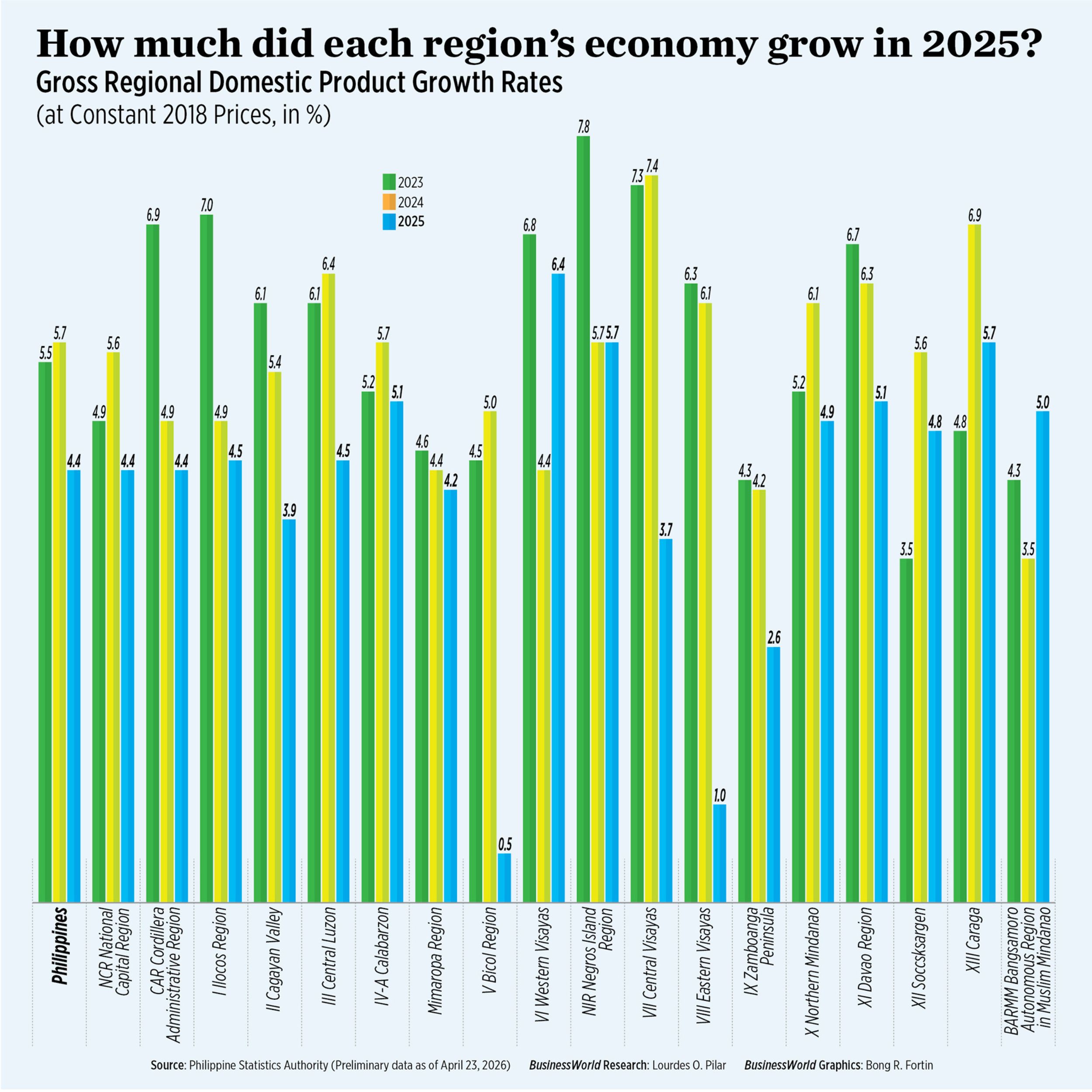
GROWTH in Metro Manila’s economic output slowed to a five-year low of 4.4% in 2025, dragged down by the flood control scandal and severe weather effects, the Philippine Statistics Authority (PSA) reported on Thursday.
Citing preliminary results, the PSA said the National Capital Region’s (NCR) economic output slowed from a 5.6% expansion in 2024.
In 2020, at the height of the pandemic, the NCR economy contracted 10%.
The NCR’s economic growth was in line with the revised 4.4% national gross domestic product (GDP) in 2025.
At constant 2018 prices, NCR economic output amounted to P7.24 trillion in 2025, against P6.94 trillion in 2024.
“NCR’s slower growth picture mainly reflected losses in economic confidence and dynamism following severe weather and the flood control scandal,” Marco Antonio C. Agonia, an economist at the University of Asia and the Pa-cific, said in an e-mailed response to questions.
Mr. Agonia noted that, with the other regions, economic growth eased as spending appetite among households and firms weakened.
“The NCR remains the country’s primary services hub, accounting for about 41% of total services output nationwide, which makes overall growth highly sensitive to changes in household demand, business activity, and urban services,” Union Bank of the Philippines Chief Economist Ruben Carlo O. Asuncion said via Viber.
“Growth was further tempered by weaker investment conditions during the year, as capital spending declined, limiting spillover effects to construction, real estate‑related activity, and supporting services,” Mr. Asuncion added.
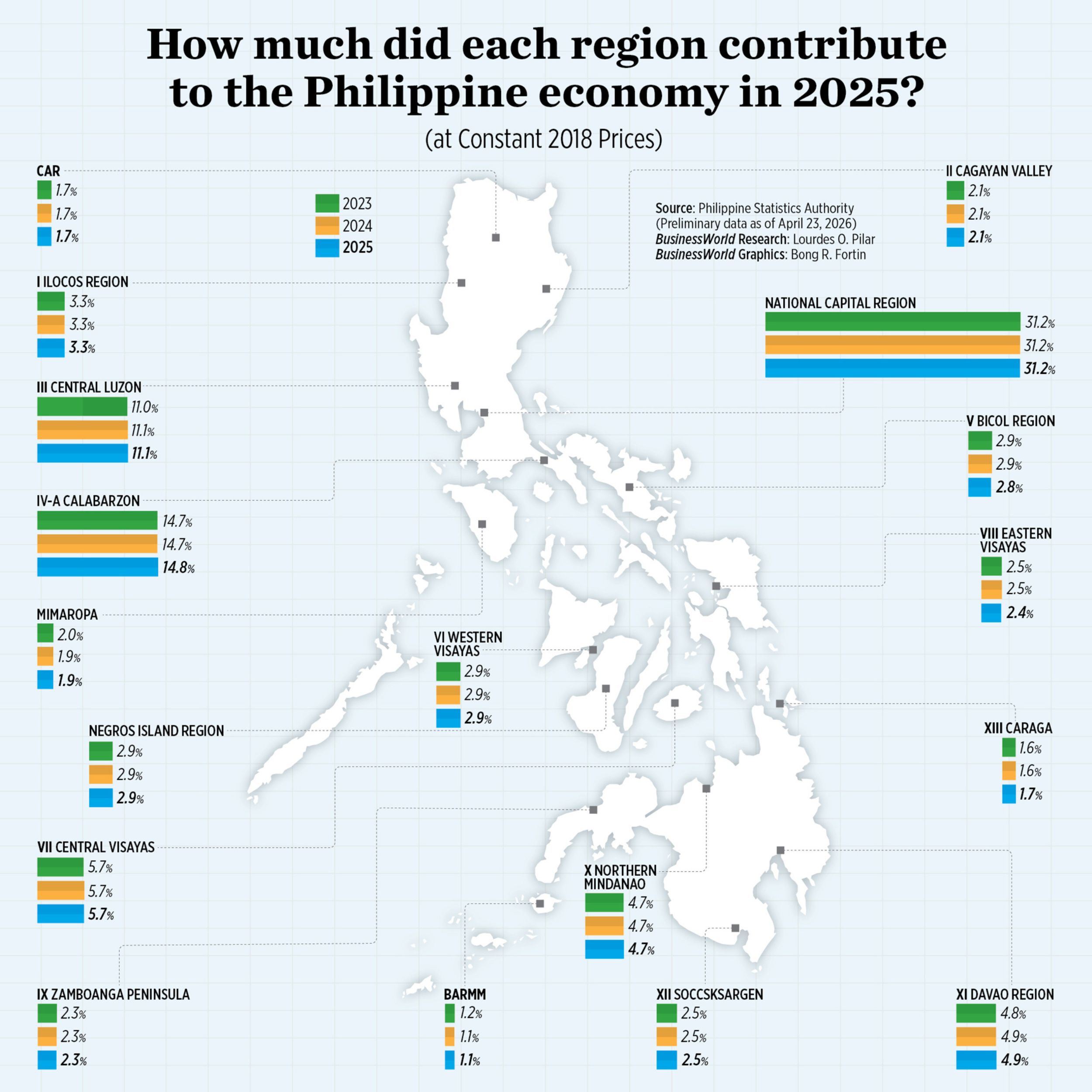
Metro Manila remained the top contributor to the overall Philippine economy last year at 31.2%, followed by Calabarzon (14.8%) and Central Luzon (11.1%).
Among the 18 regions, Western Visayas posted the strongest growth at 6.4% in 2025. This was followed by Caraga (5.7% from 6.9% in 2024) and Negros Island Region (NIR, 5.7% from 5.7%).
On the other hand, Bicol Region posted the weakest growth at 0.5% in 2025, easing from 5% in the previous year. The Eastern Visayas (1% from 6.1% in 2024) and Zamboanga Peninsula (2.6% from 4.2%) followed.
“The large variation in regional growth in 2025 — from Western Visayas (6.4%) at the top to Bicol (0.5%) at the bottom — largely reflects differences in agriculture performance, tourism recovery, infrastructure activity, and ex-posure to weather disturbances,” Ateneo Center for Economic Research and Development Senior Research Fellow Ser Percival K. Peña-Reyes said via Viber.
Mr. Asuncion said the growth in the Western Visayas was mainly driven by strong overall economic activity and per-capita output, while Caraga and the NIR were supported by faster growth in household spending.
“In contrast, regions such as Bicol, Eastern Visayas, and Zamboanga Peninsula experienced slower growth as investment activity weakened sharply, with these areas registering double‑digit contractions in gross capital for-mation,” he added.
In 2025, 83.6% of NCR’s output was driven by the services sector, which grew 5.1%, easing from 6% in 2024.
Wholesale and retail trade, which accounted for 22.4% of the services sector, eased to 3.9% from 4% in 2024.
With a 20.6% share of Metro Manila’s services sector, the financial and insurance activities sector slowed to 5.8% from 8.4% in 2024. Meanwhile, professional and business services (13.2% share) grew 4.9% in 2025, slower from the 6.7% posted in the previous year.
The total value of NCR’s service industry hit P6.05 trillion in 2025, up from P5.76 trillion in 2024.
Meanwhile, the industry sector, which accounted for 16.4% of the NCR economy also slowed to 0.7% in 2025 from 3.6% in 2024.
The PSA mainly attributed the slowdown in NCR’s industry sector to the 1.8% contraction in construction, against the 7.5% growth registered in 2024.
PSA NCR Regional Director Paciano B. Dizon said that, though there are contributions from private building construction, the decline in the construction subsector was due to the government spending freeze at the height of the flood control scandal in 2025.
“With construction, we can see how corruption would slow down not only the economy of the NCR, but it also affects, if not all, most of the economies of the other regions and the growth of the Philippines as a whole,” Mr. Di-zon said during the briefing.
Mr. Peña-Reyes said slower growth in construction was a mix of “delayed public infrastructure spending, high costs and expensive financing, weaker private real estate demand and execution challenges (weather, congestion, permitting).”
“Because construction feeds into manufacturing, real estate, and employment, its decline significantly dragged down the entire industry sector — and ultimately NCR’s overall GDP growth,” Mr. Peña-Reyes added.
Apart from the flood control scandal, Mr. Agonia said periodic bad weather also affected construction growth for public works projects.
“On the private sector side, property developers deferred projects in the metro following relatively high interest rates and the condo oversupply. In a similar vein, the government spending freeze also lowered spending appetite for private firms who usually benefit from infrastructure multiplier effects, dragging growth in the services sector,” he added.
The agriculture sector, which comprised 0.01% of NCR’s economic output, grew 4.2% in 2025 from 0.8% in 2024.
The Bangsamoro Autonomous Region in Muslim Mindanao posted the strongest growth in services at 8.5% in 2025 (from 6.1% in 2024), followed by Northen Mindanao (8% from 7.4%) and Cagayan Valley (7.4% from 6.5%).
In the industry sector, Caraga posted the strongest growth at 4.8%, against 6.1% in 2024.
Meanwhile, the Western Visayas agriculture sector posted the strongest growth among the 18 regions at 9.5%, a turnaround from the 7.4% contraction in 2024.
On the expenditure side, Caraga logged the fastest growth in household spending at 6.7% in 2025 from 4.6% in 2024.
Meanwhile, growth in government spending was fastest in the Ilocos Region, surging 15.6% last year from 4% in 2024.
Caraga posted the strongest expansion in gross capital formation at 8.5%, against 11.6% in 2024.
On a per-capita basis, Metro Manila logged the largest gross regional domestic product at P522,564 in 2025, up 3.8%.
This year, Mr. Peña-Reyes sees stable but slower economic growth for NCR “with services-led resilience offset by inflation, high rates, and global uncertainty.”
“It is not a recession scenario, but rather a compressed-growth environment, where demand is still there, but expansion is cautious and cost-constrained,” he said.
Mr. Agonia expects a “muddled growth outlook” for the NCR and the rest of the country this year.
“We expect higher oil prices and supply chain disruptions harming growth and raising inflation for the entire country. However, AONCR (areas outside of NCR) may suffer more than the capital region due to weaker regional sup-ply chains and poorer infrastructure,” he added.
Mr. Asuncion said sustained growth in the NCR will depend on household spending resilience and a recovery in investment activity.
“While services provide a stable base, renewed capital formation will be key to lifting growth toward firmer levels, especially for construction‑linked and investment‑driven segments of the regional economy,” he added. — Isa Jane D. Acabal