Trump says he is raising tariffs on South Korean imports after trade deal delays

WASHINGTON/SEOUL — President Donald J. Trump said on Monday he was raising tariffs on US imports of South Korean autos and other goods, blaming the legislature of an ally and a major trading partner for dragging its feet on enacting a deal agreed last year.
For South Korea, the decision, which officials in Seoul said caught them by surprise, is the latest setback as it tries to navigate the alliance and trade partnership amid potential challenges to its security and financial stability posed by Mr. Trump’s demands.
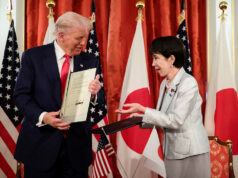
Mr. Trump and South Korean President Lee Jae Myung struck a deal in principle last July for Seoul to initiate investments in the US worth $350 billion in return for a US promise to cut tariffs on its exports.
“President Lee and I reached a Great Deal for both Countries on July 30, 2025 and we reaffirmed these terms while I was in Korea on October 29, 2025,” Mr. Trump wrote on social media.
Mr. Trump said South Korea’s legislature had not enacted the deal and as a result: “I am hereby increasing South Korean TARIFFS on Autos, Lumber, Pharma, and all other Reciprocal TARIFFS, from 15% to 25%.”
It was not immediately clear when the hike would take effect. A source familiar with internal discussions between the countries said Mr. Trump may have been prompted by recent South Korean regulatory actions against Coupang, a US-listed e-commerce company that has protested them as unfair and discriminatory.
The countries have been in talks to address Washington’s concerns about regulations on US tech firms as part of the trade deal.
Choi Seok-young, a former South Korean trade negotiator, said Mr. Trump’s message could be seen as “a political move in which the United States is exerting maximum pressure on South Korea in an effort to force concessions during the ongoing negotiations over non-tariff barriers.”
South Korea’s benchmark KOSPI index fell 1.19% before reversing early losses to trade 1.3% higher, while the won weakened 0.5% against the dollar.
The White House and the US Trade Representative’s office did not immediately respond to requests for comment.
South Korea’s presidential Blue House said the industry minister, currently in Canada, would visit the US soon and meet with Secretary of Commerce Howard Lutnick.
The Blue House said it had not been officially notified about the US tariff hikes, but South Korea’s presidential adviser would meet with related ministries to discuss measures.
A spokesperson for South Korea’s ruling Democratic Party had no immediate comment. The country’s parliament is due to begin a new session on Feb. 3, when bills are usually taken up for votes.
Mr. Trump has upended global trade by imposing tariffs on nearly every country since beginning his second term in office in 2025. In some cases, he has threatened tariff hikes and delayed them or not followed through.
EXPORTS TO US FALL IN 2025
South Korea’s exports hit a record $709.4 billion in 2025, up 3.8% from 2024, while US-bound shipments stood at $122.9 billion, down 3.8% but still making it the second-biggest market after China.
Auto exports to the US stood at $30.2 billion, accounting for 25% of the total US shipments, the biggest of any South Korean sector, but down 13.2% from 2024.
After last year’s agreement by their leaders, Washington and Seoul set tariffs on US imports of Korean autos and auto parts at 15%, down from 25%, putting them on par with their Japanese competitors. The 15% rate took effect on Nov. 1.
Higher tariffs would hit South Korean automaker Hyundai Motor and its affiliate Kia particularly hard, with their shares initially falling 4.8% and 6%, respectively, before recovering to trade 0.4% higher and 1.2% lower.
Hyundai did not immediately respond to a request for comment.
General Motors, which produces about 500,000 vehicles annually in South Korea and exports most of them to the US, also did not immediately comment.
CURRENCY CONCERNS
Under the deal struck last year, South Korea committed to invest $350 billion into US strategic sectors. Of that, $200 billion would be paid in cash in phased installments that would be capped at $20 billion a year in an effort to maintain won stability.
Earlier this month, South Korea’s Finance Minister Koo Yun-cheol told Reuters the government planned to implement the investment package as soon as possible, while noting that uncertainty over a US Supreme Court ruling on Mr. Trump’s tariffs expected soon could affect the process.
He said the planned investment of $350 billion was unlikely to kick off in the first half of 2026, given the weak won currency.
The prospect of large currency outflows has caused headaches for authorities in Seoul at a time when the won has slumped to trade at levels unseen since the global financial crisis from 2007 to 2009.
South Korea’s finance ministry said on Tuesday it would actively consult with parliament on the US investment bill. Mr. Koo was already planning to ask parliament for cooperation on the matter on Tuesday afternoon, the ministry said.
Josh Lipsky, chair of international economics at the Washington-based Atlantic Council, said Mr. Trump’s action reflected his impatience with the pace of Seoul’s enactment of the framework trade agreement, while underscoring ongoing uncertainty about tariff rates.
“It’s just another reminder that the markets were wrong to believe we were going to get into tariff stability in 2026,” Mr. Lipsky said. — Reuters