Maduro pleads not guilty to drug charges, saying he was ‘kidnapped’
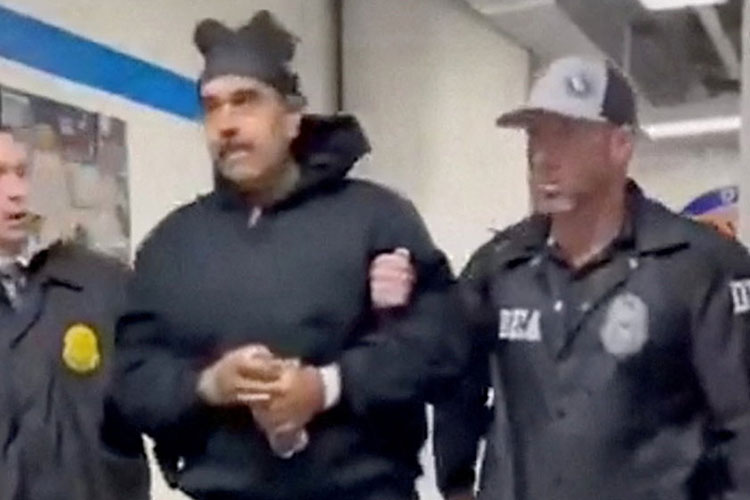
NEW YORK — Toppled Venezuelan President Nicolas Maduro pleaded not guilty on Monday to narcotics charges after President Donald J. Trump’s stunning capture of him rattled world leaders and left officials in Caracas scrambling to regroup.
“I am innocent. I am not guilty. I am a decent man. I am still president of my country,” Mr. Maduro, 63, said through an interpreter, before being cut off by US District Judge Alvin Hellerstein in Manhattan federal court.
Mr. Maduro’s wife Cilia Flores also pleaded not guilty. The next court date was set for March 17.
Dozens of protesters, both pro- and anti-Maduro, gathered outside the courthouse before the half-hour hearing.
Inside, as he stood shackled at the ankles and wearing orange and beige prison garb, Mr. Maduro declared he had been “kidnapped” and remained president of Venezuela. He listened to an interpreter through headphones as Mr. Hellerstein summarized the charges.
Mr. Maduro is accused of overseeing a cocaine-trafficking network with international drug cartels and faces four criminal counts: narco-terrorism, cocaine importation conspiracy and possession of machine guns and destructive devices.
Mr. Maduro has long denied the allegations, saying they were a mask for imperialist designs on Venezuela’s rich oil reserves.
Mr. Maduro’s defense lawyer Barry Pollack said he anticipated voluminous and complex litigation over what he called his client’s “military abduction.”
SUCCESSOR SWORN IN
Hours later in Caracas, Mr. Maduro’s vice-president, Delcy Rodriguez, was sworn in as Venezuela’s interim president with words of support for Mr. Maduro but no indication she would fight the US move.
A recent US intelligence assessment determined Ms. Rodriguez would be best positioned to lead a temporary government in Mr. Maduro’s absence, finding that opposition figures such as Nobel Peace Prize winner Maria Corina Machado or one-time presidential candidate Edmundo Gonzalez would struggle to gain legitimacy, the Wall Street Journal reported, citing people familiar with the classified report.
Asked by Reuters about the report, White House Spokeswoman Karoline Leavitt said, “The President and his national security team are making realistic decisions to finally ensure Venezuela aligns with the interests of the United States.”
While many anti-Maduro activists had assumed this would be their moment, Mr. Trump appeared to have sidelined the Venezuelan opposition for now. Instead, he has suggested Ms. Rodriguez was willing to work with Washington.
Ms. Leavitt told Fox News that Secretary of State Marco Rubio was in “constant correspondence” with the remaining Maduro government, and that Washington maintained “leverage” over Caracas.
In Caracas, senior officials from Mr. Maduro’s 13-year-old government remained in charge of the South American oil producer of 30 million people, alternating between angry defiance and possible cooperation with the Trump administration.
The intelligence assessment concluded that Ms. Rodriguez was among the few Venezuelan leaders capable of maintaining order, along with the interior and defense ministers, in a government dominated by ideological opponents of the US, the Wall Street Journal said.
Mr. Trump told NBC News the US was not at war with Venezuela but rather, “we’re at war with the people that sell drugs.”
The US would need to help address the South American country’s problems before any new elections, Mr. Trump said, calling a 30-day timeline for a vote unrealistic.
“We have to fix the country first. You can’t have an election. There’s no way the people could even vote,” Mr. Trump told NBC.
QUESTION OF LEGALITY
The US has considered Mr. Maduro an illegitimate dictator since he declared victory in a 2018 election marred by allegations of massive irregularities.
At the same time experts in international law have questioned the legality of the raid, with some condemning Mr. Trump’s actions as a repudiation of a rules-based international order.
Deputy Attorney General Todd Blanche, who previously served as Mr. Trump’s criminal defense lawyer while in private practice, told NBC News the Trump administration “did everything within the law,” and that the United States has an “absolute legal right to go and arrest people charged with horrible crimes.”
As world leaders and US politicians grappled with the extraordinary seizure of a head of state, the United Nations Security Council debated the implications of the raid, which was condemned by Russia, China and leftist allies of Venezuela.
The future governance of Venezuela also remained uncertain, after Mr. Trump asserted on Sunday that “we are in charge.” White House Deputy Chief of Staff Stephen Miller reiterated to CNN on Monday that “the United States of America is running Venezuela.”
“We set the terms and conditions. We have a complete embargo on all of their oil. So for them to do commerce, they need our permission,” Mr. Miller said.
Mr. Rubio, Secretary of Defense Pete Hegseth and other top administration officials spent more than two hours briefing congressional leaders and the heads of national security committees about the Venezuela operation on Monday evening.
Senator Chuck Schumer of New York, the Senate’s Democratic leader, told reporters the briefing was extensive but posed more questions than it answered. “Their plan for the US running Venezuela is vague, based on wishful thinking, and was unsatisfying,” Mr. Schumer said, adding that Trump officials would not rule out similar interventions in other countries.
Meanwhile, Mr. Trump has made no secret of wanting to share in Venezuela’s oil riches, telling reporters on Air Force One on Sunday that American oil companies will return to Venezuela and rebuild the sector’s infrastructure.
He told NBC News on Monday that the US may subsidize the rebuilding of the country’s oil infrastructure by US companies, a project he said could be completed in less than 18 months.
CBS News, citing two unnamed sources, said representatives of oil majors Exxon Mobil, ConocoPhillips and Chevron Corp. would meet with Energy Secretary Chris Wright on Thursday. — Reuters