Global trade headwinds to widen Philippines’ BoP and current account deficits until 2027
By Katherine K. Chan, Reporter
The Philippines’ balance of payments (BoP) and current account deficits could widen this year until 2027 as weak global trade and geopolitical stresses from the Middle East war weigh on the country’s external position, the central bank said.
The Bangko Sentral ng Pilipinas (BSP) now sees the country’s BoP position standing at a $7.8 billion deficit by yearend or -1.5% of gross domestic product (GDP).
This is wider than its earlier forecast of a $5.9-billion gap or -1.2% of GDP as well as the preliminary $5.7-billion deficit or -1.2% of GDP posted in 2025.
For 2027, it expects the BoP deficit to widen to $8.5 billion or -1.6% of GDP.
In a statement released late on Tuesday, the BSP said a “challenging” global landscape and structural issues will keep the Philippines’ BoP under pressure until next year.
“Global growth remains below pre‑pandemic trends, while world trade momentum is expected to weaken as tariff‑related front‑loading unwinds,” it added. “At the same time, elevated geopolitical tensions, particularly in the Middle East, adds downside risks mainly through higher energy prices and episodic risk‑off sentiment.”
According to the BSP, the current account position may also worsen to a $20.3-billion deficit this year or -4% of GDP from its previous projection of a $15.3-billion gap or -3% of GDP.
If realized, it would be wider than the $16.3-billion deficit or -3.3% of GDP in 2025.
The central bank likewise forecasts a wider current account gap of $21.9 billion in 2027, equivalent to 4% of GDP.
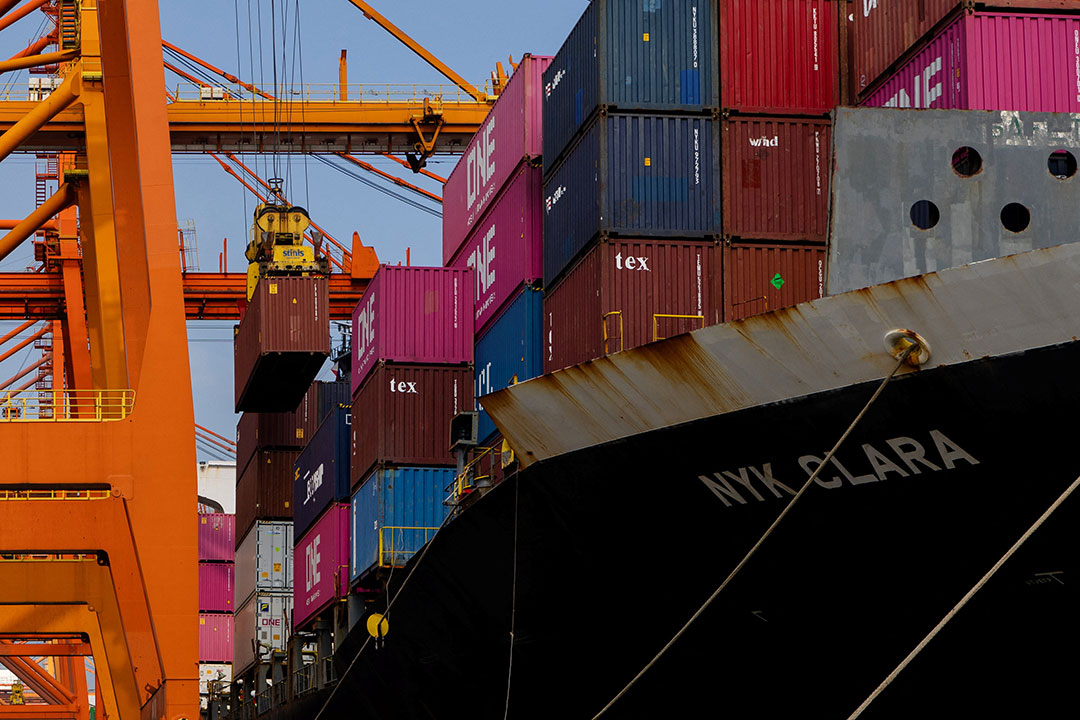
Meanwhile, reduced front loading and elevated trade costs are expected to dampen goods exports growth this year at 3% to $65.3 billion and next year at 4% to $67.9 billion.
This is faster than the previous projection of 2% to $61.2 billion, but slower than the 15.2% uptick to $63.4 billion recorded in 2025.
“After expanding by about 15% in 2025, goods exports are projected to grow more moderately at 3% in 2026 and 4% in 2027, reflecting inventory normalization, weaker global trade momentum and higher trade costs,” the BSP said.
Still, exports of electronics and agricultural-food products will boost the sector’s expansion, but may be tempered by higher electricity rates, regulatory frictions and logistics bottlenecks, it added.
On the other hand, the central bank raised its forecast for goods imports growth to 6% or $137.9 billion from 2% or $130.2 billion amid costlier oil this year. For 2027, it sees goods imports climbing by 5% to $144.8 billion.
Services imports are also expected to rise by 5% to $40.2 billion in 2026, slower than the earlier estimate of 6% to $42.3 billion. Services imports are seen to grow by 6% to $42.6 billion next year.
“(S)ervices imports, particularly outbound travel, are projected to continue to expand faster than services exports, adding further pressure to the external balance,” the central bank said.
For services exports, the BSP likewise cut its growth projection for this year to 4% or $53.6 billion from 5% or $54.7 billion previously. It sees a 4% expansion to $55.7 billion in 2027.
The central bank also trimmed its growth projection for travel receipts to 1% or $8.8 billion from 3% or $9.4 billion for 2026. The central bank sees travel receipts picking up by 2% to $9 billion next year.
Business process outsourcing revenues are also projected to grow by 4% this year to $34.8 billion from 5% to $35.2 billion. For 2027, it is also expected to inch up by 4% to $36.2 billion.
REMITTANCES
Meanwhile, the BSP kept its growth estimate for cash remittances at 3% until next year. Remittances could total $36.7 billion by yearend and $37.8 billion by end-2027.
“Cash remittances remain a key source of external stability,” the central bank said. “They are projected to grow by about 3% over the next two years, despite geopolitical tensions, as there remain no signs of mass repatriation or widespread deployment bans.”
It also sees financial account outflows hitting $12.9 billion this year, up from its $11.7 billion estimate previously. It is expected to increase to $13.8 billion by 2027.
Meanwhile, the BSP maintained its projection for foreign direct investment (FDI) inflows at $7.5 billion for 2026, adding that it sees $8 billion in FDI inflows next year.
For foreign portfolio investments, net inflows could reach $3.7 billion, lower than its $5.6-billion previous projection. Net inflows are expected to jump to $4.1 billion in 2027.
On the other hand, the central bank raised its 2026 gross international reserves forecast to $111 billion from $110 billion previously. It sees foreign reserves totaling $112 billion in 2027.
“Overall, the outlook points to an orderly but gradual adjustment, with uncertainty and sentiment pressures transmitted mainly through uptick in prices rather than sharp volume contraction,” the BSP said.
“External sustainability hinges on stable financing, resilient non-trade inflows, and adequate foreign exchange buffers. The country’s gross international reserves remain sufficient in providing cushion against external shocks over the forecast horizon,” it added.