ICC return seen as boost to Philippine credibility
By Chloe Mari A. Hufana, Reporter
REJOINING the International Criminal Court (ICC) could restore the Philippines’ standing abroad and reaffirm its commitment to the rule of law, which could define the legacy of President Ferdinand R. Marcos, Jr., analysts said.
Signing back into the Rome Statute could regain Manila’s standing in the global community, Dean of the De La Salle-College of St. Benilde’s School of Diplomacy and Governance Gary G. Ador Dionisio said, adding that renewed membership would strengthen its position in international fora.
“I think that will be the legacy of this administration, rejoining the ICC. That’s a big deal,” he told BusinessWorld in an interview. “It will increase our standing general council committee because we will uphold the rule of law.”
This move would project consistency in Manila’s commitment to multilateral mechanisms, especially with its continuous quest to uphold the 2016 ruling of the Permanent Court of Arbitration in the South China Sea.
The Philippine Palace has earlier said there are no talks yet if Manila would rejoin the tribunal following its exit in 2019 at the directive of former President Rodrigo R. Duterte, who is currently detained in The Hague over alleged crimes against humanity.
Still, analysts cautioned that the impact of re-entry would be felt more in the political arena than in the legal sphere.
Ederson DT. Tapia, who teaches political science at the University of Makati, said the decision would likely revive an accountability narrative centered on human rights, rule of law and institutional credibility as the 2028 national elections approach.
“Rejoining the ICC would be more political than legal in its impact,” Mr. Tapia said via Facebook Messenger. “Rejoining signals commitment to multilateral norms and institutional confidence.”
For Mr. Marcos, the decision is ultimately strategic, Mr. Tapia said. If the goal is institutional normalization and reinforcing multilateral commitments, there is a case for rejoining.
But if maintaining coalition stability ahead of 2028 is the priority, caution may prevail following the announcement of Mr. Duterte’s daughter, Vice-President Sara Duterte-Carpio’s presidential bid in 2028.
“Heading into 2028, [rejoining the ICC] would revive the accountability narrative: rule of law, human rights, institutional credibility,” Mr. Tapia added.
“That could benefit reform-oriented candidates while putting pressure on factions closely associated with resistance to external scrutiny. In short, it may sharpen polarization rather than ease it,” he added.
The Marcoses and Dutertes have been embroiled in a bitter feud despite delivering a landslide victory in the 2022 national elections, which put Mr. Marcos and Ms. Duterte into power.
The two top officials have since been at odds following the Vice-President’s resignation as Education secretary in June 2024, citing personal and professional issues upon stepping down.
In March 2025, Mr. Duterte was flown to The Hague for his alleged crimes against humanity stemming from his war on drugs campaign, which has reportedly killed thousands of Filipinos, mostly from the urban poor.
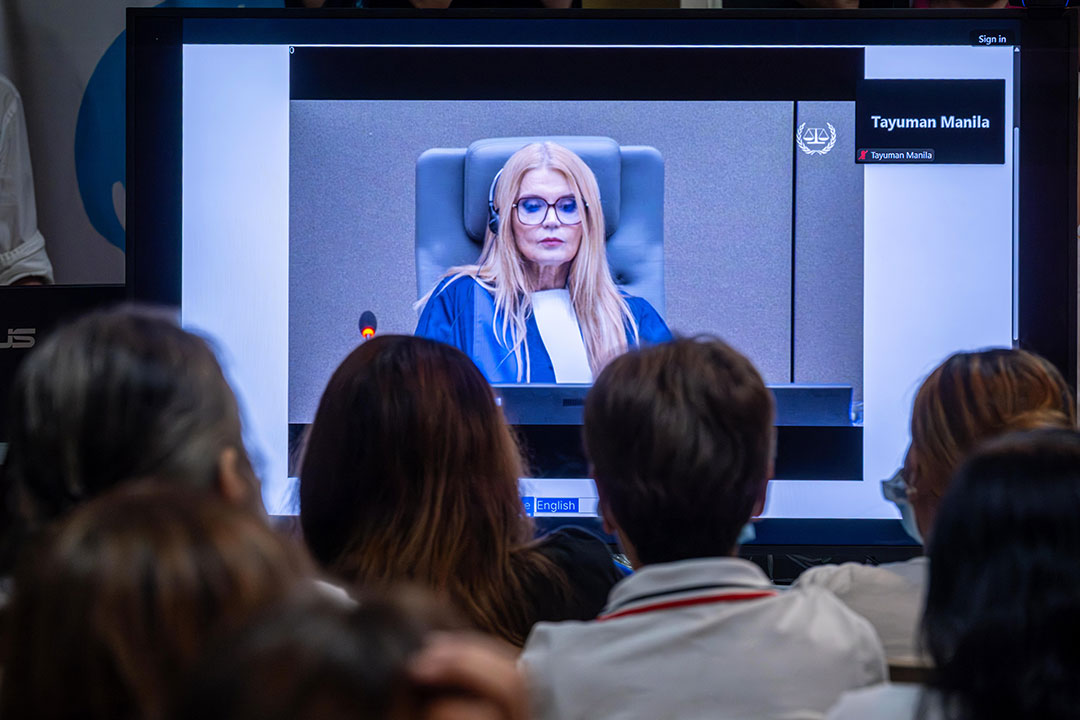
After almost a year, on Feb. 27, 2026, the Pre-Trial Chamber of the ICC concluded the confirmation of charges hearing in Mr. Duterte’s case.
The tribunal will now deliberate on whether there is sufficient evidence to proceed to trial on alleged crimes against humanity tied to the war on drugs.
Judges have up to 60 days to decide whether to confirm the charges, dismiss them, or request additional evidence.
Mr. Duterte waived his right to attend the hearing, citing his “old, tired and frail” body. If charges are confirmed, the case will advance to trial; if not, proceedings could end or be reopened depending on evidentiary findings.
While supporters of Mr. Duterte argued the tribunal has no jurisdiction after the Philippines’ 2019 withdrawal, the court maintains authority over alleged crimes committed during the period when Manila was still a party to the statute.