Home Blog Page 9968

First Gen to build 120-MW pumped-storage plant

FIRST Gen Corp. has been awarded a hydroelectric power service contract by the Energy department to develop a 120-megawatt (MW) pumped-storage hydroelectric facility in Aya, Pantabangan in Nueva Ecija province, the Lopez-led listed company said over the weekend.

First Gen, through its unit First Gen Hydro Power Corp., owns and operates the existing 132-MW Pantabangan-Masiway hydroelectric power plant project in Pantabangan.

Once completed, the Aya project will allow the storage of water pumped into a reservoir for use at a later time. The facility will store and generate electricity by moving a volume of water between two reservoirs situated at different elevations, or upper and lower reservoirs.

“While renewable energy is clean and sustainable, it isn’t always available when it’s needed,” said Ramon A. Carandang, First Gen vice-president for corporate communications. “But with a pump storage facility like the one we want to build in Pantabangan, we will be able to store some of the energy generated by the dam and deploy it when it’s needed.” Aside from energy, pumped-storage facilities can be flexibly operated to provide ancillary services to the electricity grid for grid security and stability.

First Gen said the service contract awarded to its unit gives the group five years to conduct pre-development stage activities, from a preliminary assessment and feasibility study up to financial closing and declaration of commerciality.

Through the unit, First Gen earlier signed a memorandum of understanding with the National Irrigation Administration on the development of the same Aya hydro project. First Gen is also pursuing other hydroelectric projects in Bukidnon, and Agusan del Norte.

Aside from hydro-power, First Gen power plants run on natural gas, geothermal, wind and solar. The facilities have a combined capacity of 3,492 MW as of end-2019. — Victor V. Saulon

Celebrate over 100 safety features in every Subaru vehicle this 2020

MOTOR Image Pilipinas, Inc., the exclusive distributor of Subaru vehicles in the Philippines, fortifies its commitment to safety — giving customers over 100 safety features in every single Subaru vehicle.

This month of January, Subaru is celebrating SAFETY by offering special deals for the following:

Not only that, there are also offers for our last remaining 2019 model year Subies:

Come and feel greater protection for you and your loved ones this 2020. Don’t forget that you also get a 5-year comprehensive warranty coverage when you purchase. So wait no further to bring home your very own Subaru. Visit any of our dealerships nationwide.

Nigerian rice farmers fall short after borders close

MAKURDI, NIGERIA — Thomas Tyavwva Maji is planting rice on more of his land in Nigeria’s Benue State than ever to take advantage of a surge in prices since the country shut its land borders in August.

But he says he cannot go much further. With no machinery or irrigation, limited manual labor and no spare cash for fertilizers, the 45-year-old is not expecting any dramatic change in his fortunes.

“We work until we get exhausted, manually we get exhausted,” said Maji, as a woman nearby beat hand-harvested stalks on the ground to separate the grains from the chaff.

The constraints Maji faces have bedeviled many rice farmers and millers across Nigeria for years. Despite government measures designed to spur production, farmers in Nigeria get far less from their land than other major rice growers and the West African country is only marginally less reliant on imports.

That’s a problem for a government that wants to grow all of its own food and boost the country’s agriculture, a sector that accounts for nearly a third of gross domestic product in Africa’s biggest economy.

When he came to power in 2015, Nigerian President Muhammadu Buhari pledged to help the nation become self-sufficient in rice — once a luxury but now a staple for millions of Nigerians.

In 2015, Nigeria’s central bank banned the use of its foreign exchange to pay for rice imports and has backed loans of at least 40 billion naira ($130 million) to help small-holders boost output. It also banned rice imports across land borders and kept hefty 70% tariffs on imports coming through ports.

In August last year, Nigeria went a step further and closed its land borders altogether to stamp out smuggling, often from neighboring Benin, with rice being one of the main targets.

Buhari’s spokesman, Garba Shehu, said the measures boosted rice production to 9.2 million tonnes last year from 7.2 million in 2015, making Nigeria more or less self-sufficient, though traders can import rice through ports if they pay the tariffs.

Agricultural data specialist Gro Intelligence, however, put Nigeria’s rice output at 4.9 million tonnes in 2019, up 60% from 2013 but well below local consumption of 7 million tonnes.

The US Department of Agriculture, meanwhile, expects Nigeria’s 2020 rice imports to rise 9% to 2.4 million tonnes, in part due to the high cost of unprocessed Nigerian paddy rice and elevated operating costs at mills.

In Lagos, Nigeria’s biggest city, supermarket shelves remain stocked with a plethora of imported rice brands.

In the markets where most Nigerians buy their food, sacks of Nigerian rice are piled high but imported rice is still available, even though some traders keep the foreign grain under wraps to prevent it being confiscated by customs agents.

LOW YIELDS
Small-scale farmers such as Maji account for 80% of Nigeria’s rice production with a handful of large companies, such as Coscharis Group, Dangote and Olam, growing the rest, according to the UN’s Food and Agriculture Organization (FAO).

In Benue state, virtually every aspect of Maji’s farming manual, from planting to harvesting to leveling out roads to take the crop to market.

It’s a similar story on many Nigerian farms, leaving the average yield per hectare at just over 2 tonnes — half the global average and a fraction of Egypt’s 9.5 tonnes a hectare, according to UN data.

Experts say there is little hope of improvement without significant investment in irrigation, mechanization, roads and storage. More than 12% of rice is also wasted due to poor roads and inefficient harvesting, milling and storage, consultants KPMG said in a review of the Nigeria’s rice industry.

In a good year, Maji makes about 1.5 million naira ($4,900) — nowhere close to the 5 million, at least, a tractor would cost. Without irrigation, a goal so remote he doesn’t even know the cost, he can only plant one crop a year.

“At this scale, we will not even be able to fetch a tractor. Talk less of fertilizer and other chemicals,” Maji said.

According to the FAO, less than 1% of Nigeria’s farmland is irrigated, compared with a global average of more than 20%.

Small- and medium-scale rice millers, who account for more than 80 percent of the local market, also say they’re struggling to meet increased demand without proper equipment.

At Wurukum Rice Mill in Makurdi, Iveren Asan works alongside her sister, using a loud diesel-powered generator to drive machinery processing paddy grains into consumable rice.

Nearby, rice grains that have been parboiled in vats heated by firewood dry on tarps. She said new buyers from across the country had surfaced since the border closures — but producing more would require significant investment in new machines and the higher prices were not enough on their own.

“We can’t meet the demand. We are doing the process manually, so we cannot meet the demand,” she said.

‘INCREDIBLY DISRUPTIVE’
More broadly, experts warned that extreme measures, such as border closures, taken in the name of food security were hurting Nigerians, stunting the development of other industries and holding back foreign investment.

“The border closure has been incredibly disruptive,” said John Ashbourne, an economist at Capital Economics. “It stops industries from getting the imports they need, and it pushes up prices.”

The border closure is set for review Jan. 31 but the presidency’s Shehu said land frontiers would remain shut until Nigeria’s neighbors stopped smuggling on their side — and there was “no sign of compliance yet.”

Ashbourne said even some farming has taken a hit from government policies.

After glass was added to a central bank list of items importers cannot buy with foreign exchange, some tomato paste plants shut because they couldn’t source the jars they needed.

On another farm in Benue State, Abraham Hon, 51, weaves through rows of melons and corn before reaching his rice, the crop that generates the most money.

“The prices look pretty good,” he said, as men cut stalks of rice by hand and laid them in piles on the ground. “We expect more money in the pocket this year.”

But while he and Asan are happy with their increased income, they worry about the impact of higher prices on consumers.

A 50 kg bag of rice can cost as much as 24,000 naira in Lagos — nearly double the price in July before the borders were shut and not far below the monthly minimum wage of 30,000 naira.

And consumers, who already spend more than half their income on food according to the World Bank, are feeling the squeeze.

“We will reach a point where people who are buying rice can’t afford to buy rice. They will look at other alternatives to get energy and get food on their table,” Hon said.

“That in the long term is not in the interest of we, the farmers.” — Reuters

New beauty lounge brings beauty to the masses

IT ISN’T fair that physical beauty should be a given only to those that can afford the time and treatments needed to obtain it. KimRey Face and Body Contouring Lounge in Bagumbayan, Quezon City, (right outside Eastwood) makes an effort to change all that.

“We love going to salons and we know it’s not affordable for regular working people, so why don’t we come up with an aesthetic center we can market to the working class?,” says Anna Reyes, co-founder and COO of KimRey.

Ms. Reyes co-founded KimRey with her sisters, Claire Kimble (who sits as CEO) and Vanessa Lee (who sits as President). The women grew up in the US, and they worked in the BPO industry prior to setting up KimRey (the name comes from bits and pieces of their last names). “We tried to look around for a business we would enjoy and has regular working hours since working nights in our call center took a toll on our health. One day, we tried going to a slimming/contouring place, and the moment we had our services done, we knew that was our next business venture,” said Ms. Reyes.

The menu of services offered by the clinic ranges from laser treatments and botox mesotehrapy, to IV nutrition therapy, dermal fillers, chemical peels, facials, and even an interesting treatment called the KimRey 360° Glass Skin (presumably making you look like a translucent-faced Korean pop star).

As for treatments for the body, they have body sculpting, minimally invasive lifts using ultrasound, and various non-surgical treatments designed to make one lose weight and gain definition for the body.

Speaking about the minimally invasive nature of the treatments, Ms. Reyes said, “The term ‘minimally invasive’ generally applies to surgical procedures using techniques that limit the operative site or decrease incision size thereby shortening wound healing time. By definition, surgery is invasive and requires incision. At KimRey, we don’t perform surgery, so we can consider all our procedures non-invasive. However, there are schools of thought that consider puncturing the skin minimally invasive. We offer treatments that require puncturing of the skin, like Botox, Fillers, Mesotherapy and PRP. Hence, going by that way of thinking, we can say that at KimRey, there are minimally invasive treatments.”

She also emphasized the safety of their treatments. “All treatments and procedures at KimRey are doctor-recommended and are performed under a doctor’s supervision,” she said, adding that they currently have two dermatologists in the clinic. She also adds that their staff consists of registered nurses and licensed physical therapists.

As for the equipment and the medicines used in the clinic, “All our machines and devices for facial and body contouring and all our lasers are considered the latest, most powerful and the best in medical and aesthetic dermatology. All the medicines we use in clinic procedures and treatments, as well as those being dispensed to our patients for maintenance or home use, are FDA-approved,” she said. “Certainly, our clients/patients are guaranteed of treatment safety and effectivity.”

As Ms. Reyes mentioned above, the clinic plans to cater to what they call “the working class.” Ms. Reyes discussed what they did to keep costs down for the customer: “Our doctors provide free consultations on a case-to-case basis, and it is clinic policy that professional fees are waived if a patient avails of any treatment or procedure. To bring down the cost of our services, we searched the pharmaceutical and cosmeceutical industry for FDA-approved medicines and products that are affordable but with high quality, efficacy, and effectivity. At the clinic, we have medicines, products, and consumables that are either locally manufactured or imported from the USA, Europe, and Korea. Even though we use the same high-end lasers, machines, and devices for all our treatments (as other places), we are able to adjust the cost of the treatments without them suffering in quality. We believe there is no service more affordable than one that is given for free.”

Speaking of things given for free, Ms. Reyes and her family began a charity late last year, visiting orphanages and reaching out to disadvantaged families. “The KimRey Foundation started as a charity event among our sisters and our children,” says Anna Reyes. “We began to visit orphanages to give back, while showing our kids how blessed we are.”

The definition of who the working classes are can be really spotty, depending on whom you’re asking: a Marxist will tell you that it’s anyone who does not own the means of production, but then someone will tell you that only those involved in manual and industrial labor are the working class, separating those who find their occupation in the office. We define it here as anyone earning minimum wage and below, and of course we asked Ms. Reyes if those in that income bracket (say a sales assistant) can afford their treatments (a menu we obtained didn’t include the price ranges of their servcies). “KimRey aims to provide services to people from all walks of life, from the minimum wage-earner to the well-heeled folks. Dermatological treatments and facial and body contouring procedures are associated with a hefty price tag. We aim to make these treatments accessible to all,” said Ms. Reyes.

Ms. Reyes said, “We want to reach out and make more people feel healthy, beautiful, pampered and special. We want to somehow boost the confidence of many, because we believe that one important key to success is self-confidence. If we can contribute to the success of our clients while earning enough to provide livelihood and a little more to our family and the families of our employees, then we can consider KimRey successful, too.”

KimRey Face & Body Contouring Lounge can be reached through 0917-119-5816. The clinic is located at Richmond Centre, 8001 E. Rodriguez Jr. Ave. Bagumbayan, Quezon City. — Joseph L. Garcia

Geely launches 2 new Coolray Variants

SOJITZ G AUTO Philippines (SGAP) recently introduced two more Geely Coolray variants — Comfort and Premium — following the successful launch of the Coolray Sport variant in the Philippines last September.

In a bid to set new standards in compact SUVs, SGAP and Geely made sure that all variants, though may slightly vary from each other, still embody high technology, modern design, and sober sophistication, all at a reasonably affordable price.

Comfort, the Coolray’s base variant is priced at P978,000. It fits perfectly for those who are not into luxurious features. Coolray Comfort is also equipped with the state-of-the-art 1.5-liter gasoline direct-injection turbo engine and 7-speed dual-clutch transmission, push start button, and remote start. Comfort is available in four colors — white, silver, blue, and vermilion.

On the other hand, the Coolray Premium Coolray variant affordably priced at P1,088,000, does not differ much from the Sport variant especially in terms of exterior looks. The Premium variant is also equipped with 18-inch wheels, front airdam, rear bumper diffuser, quad-tail pipes, and panoramic sunroof. Compared to the Sport, however, the rear spoiler design of the Premium is more conservative.

Inside, the Premium variant has black polyvinyl chloride (PVC) seats compared to the Sport’s premium upholstered leather seats.

Now that are three variants to choose from, customers can check which Coolray variant will suit their lifestyle. And whatever variant it would be, it will surely bring back the fun in driving.

Bargain hunting to persist as blue chips decline

By Denise A. Valdez
Reporter

THE LOCAL BOURSE is seen to attract bargain hunters this week amid the decline in share prices of blue chips.

The bellwether Philippine Stock Exchange index (PSEi) closed flat in the last session — up 7.06 points or 0.09% to end at 7,623.41 on Friday. On a weekly basis, the main index lost 1.28% due to fears on the novel coronavirus and worries over the government’s ire on Ayala-owned companies.

Value turnover for the week was trimmed 11% to P6.57 billion on average last week as net foreign selling increased to P1.65 billion from P1.4 billion in the week prior.

In a market note, AAA Southeast Equities, Inc. Research Head Christopher John Mangun said trading in PSEi-member stocks were generally muted last week, except for the likes of Ayala Land, Inc. (ALI) which saw a huge drop in prices following threats from Malacañang concerning its University of the Philippines-AyalaLand Technohub project.

Presidential Spokesperson Salvador S. Panelo said in a radio interview last Sunday that the government wants a probe of the contract between ALI and the University of the Philippines, alleging low lease rates for the university-owned land.

On the global stage, the novel coronavirus from Wuhan, China kept everyone on high alert throughout the week.

But for online brokerage 2TradeAsia.com, these “socio-political headlines” are projected to be a driver for activity in the local bourse this week.

“[W]hile attention might sway with current socio-political headlines, the timing appears ripe to gradually accumulate on large caps that have already breached attractive buy levels. Remember that recovery follows after the dust settles, especially for stocks with solid upside prospects,” it said in a market note.

Mr. Mangun said for his part that while global and local issues are pushing some investors away from the PSE, there are still some investors on the lookout for opportunities to maximize profit.

“If we see a decline in selling pressure next week, we might see bargain hunters come in and pick up shares to turn a quick profit. This may be enough to end the week with gains and possibly stabilize above the 7,700 level as it has done for most of last year,” he said.

2TradeAsia.com put the immediate support for the PSEi between 7,500-7,600 and resistance between 7,750-7,800.

Mr. Mangun said the PSEi may also benefit from the sustained optimism of retail investors who keep selecting companies that they believe will outperform for the year.

“The main index is currently trading between the range of 7,500 and 7,700. Looking at the last two years of trading, it doesn’t stay within this range for very long which means we are going to see it either come back and trade above 7,700 or lose all momentum and pierce 7,500 and test stronger support levels near 7,000,” he said.

Araneta nears start of 800-MW hydro-power facility

BUSINESSMAN Gregorio Ma. Araneta III is moving closer to start the construction of an 800-megawatt (MW) pumped storage hydroelectric facility in Pangil, Laguna as he engages with foreign firms interested to partner for the project.

In an interview with reporters last week, Mr. Araneta said at least two companies were keen to participate in building the power plant. He identified them as China CAMC Engineering Co., Ltd. and Singapore-based Equis Funds Group.

Ngayon naglalabanan yung gusto pumasok… I expect by midyear magkasundo kami kung sinong kukunin naming partner. Yung Chinese ang pinaka-aggressive [Right now those that want in are battling it out… I expect by midyear we would have decided on who we’re taking in as partner. The Chinese firm is most aggressive],” he said.

The project is being pursued by Gregorio Araneta, Inc. (GAI) subsidiary GA Energy.

On its website, China CAMC said its business is mainly focused on providing EPC (engineering, procurement and construction), investment and trade. Its portfolio of projects includes an 11-megawatt hydropower project in Mongolia.

Equis, on the other hand, has been GAI’s partner in its solar projects in Ilocos and Leyte. The company said on its website its exposure in hydropower projects is through its investments in Singapore-headquartered Vena Energy and India-based Dans Energy.

GAI expects the construction of its hydropower plant to take three-and-a-half to five years once it kicks off. While the planned capacity is for 800 MW of pump storage, Mr. Araneta said this may still be expanded later on.

The hydropower plant in Laguna is part of Mr. Araneta’s plan to build a network of renewable energy across the country, which includes the solar power plants and a previously proposed liquefied natural gas (LNG) plant in Bataan.

The plan was proposed by Mr. Araneta’s Energy Oil and Gas Holdings, Inc. (EOGHI), which is reported to be looking at building a 600-MW LNG plant expandable to up to 2,000 MW. The company had signed a memorandum of agreement with the Philippine National Oil Co. (PNOC), through PNOC Alternative Fuels Corp., during the previous administration for the project. But PNOC said the deal expired in June 2015.

PNOC, under the Duterte administration, then started negotiating with EOGHI for a lease agreement for the project, as the LNG plant will involve renting a portion of the 530-hectare property owned by the state-led agency. However, the terms were rejected by PNOC in 2017, leading to a hold up of the proposal.

Mr. Araneta said last week there are cases in court against PNOC seeking to resolve the Bataan deal. — Denise A. Valdez

Peso may climb further on market optimism

THE PESO could strengthen this week amid optimism coming from the recently signed sin tax bill.

The local unit closed at P50.815 on Friday, appreciating by 16.50 centavos from its Thursday finish of P50.98 per dollar, according to data from the website of the Bankers’ Association of the Philippines.

Week on week, it also strengthened by 7.60 centavos from its P50.891-to-dollar finish on Jan. 17.

Rizal Commercial Banking Corp. (RCBC) Chief Economist Michael L. Ricafort said the peso’s performance was supported by low global oil prices.

“Peso exchange rate closed stronger after lower global oil prices at new 1.5 month lows that could lower the import bill and trade deficit,” Mr. Ricafort said in a text message on Friday.

Reuters reported that crude prices were down by more than 2% on Friday with the Brent seen to have its largest weekly decline in more than a year after concerns on the epidemic spread of coronavirus which originated from China, which is the world’s second-largest oil consumer.

Brent crude was down to as low as $60.69 per barrel, dipping by 2.2% or by $1.35. The global benchmark fell 6.4% this week, its biggest weekly loss since Dec. 21, 2018.

Meanwhile, US crude futures ended at $54.19 a barrel, shedding 2.5% or $1.4 and registering a 7.4% week on week, largest since July last year.

Latest data from the Philippine Statistics Authority showed the country’s merchandise import bill declined eight percent year on year to $8.94 billion in November, down from the 10.8% traced in October, but a turnaround from the 9.6% growth logged in November 2018.

Merchandise imports slipped by 4.6% year on year to $99.15 billion in the eleven months to November 2019.

For his part, UnionBank of the Philippines, Inc. Chief Economist Ruben Carlo O. Asuncion said the peso appreciated on the back of the strong fourth-quarter gross domestic product (GDP) growth data.

“It seems the market was upbeat on Q4 GDP results. Strength may have been also coming from positive expectations of 2020 economic growth,” he said in a text message on Friday.

GDP growth in the fourth quarter of 2019 stood at 6.4%. This brought average GDP growth for the year at 5.9%, a little behind the six percent minimum target of the government.

Economic growth is likely to pick up in 2020 as the government catches up on spending, according to Finance Secretary Carlos G. Dominguez III.

Mr. Asuncion said optimism from the market that 2020 growth will be better is expected this week, which will likely give support for the peso.

For his part, RCBC’s Mr. Ricafort said that developments on the legislation of key fiscal reform measures could give positive sentiment in the markets.

“Sentiments on the local financial markets including the peso, could be supported by the latest sin tax law signed by President [Rodrigo R.] Duterte that could improve the country’s fiscal performance,” he said, noting that it will also be a support for the credit rating of the country.

On Jan. 22, Mr. Duterte signed into law Republic Act No. 11467 or the new “sin” tax law which is expected to generate P17 billion worth of revenues in the first year of implementation that will partly fund the government’s universal health care program.

The law will increase ad valorem tax to distilled spirits, wines, and liquors among others. It will also increase levies on electronic cigarettes.

UnionBank’s Mr. Asuncion sees the peso ranging from P50.75 to P50.95 against the dollar this week while RCBC’s Mr. Ricafort said the peso could play around the P50.60 to P51 levels. — LWTN with Reuters

Rice industry downplays ultimate impact of RCEF

By Vincent Mariel P. Galang
Reporter

THE Philippine Rice Research Institute (PhilRice) estimates that the cost of production in the Philippines was P12.72 per kilo between 2013 to 2014, while the Thai cost was equivalent to P8.86 and Vietnam’s P6.22. Only Indonesia performed worse at P15.74.

At such high cost levels, the Philippine Statistics Authority estimates that a farmer’s net return per hectare was P33,349 in 2018, up 43%.

The government’s main tool for addressing competitiveness is the Rice Competitiveness Enhancement Fund (RCEF), a feature of the Rice Tariffication Act (Republic Act 11203) signed in March. The fund will support farm mechanization, credit, training, seed provision, and other programs to help farmers eventually compete with their low-cost Southeast Asian neighbors.

RCEF is to be provided with P10 billion a year from tariffs of 35% charged on imported Southeast Asian grain. The fund will run for six years.

According to initial plans, the fund is to be distributed to about 55 rice producing provinces across the country, across 947 municipalities. It will fund about P5 billion worth of machinery via the handled by the Philippine Center for Postharvest Development and Mechanization (PhilMech); P3 billion for rice seed development to be undertaken by PhilRice; P1 billion for credit assistance via Land Bank of the Philippines (LANDBANK) and the Development Bank of the Philippines (DBP); and another P1 billion for extension services for skills development to be provided by PhilMech, PhilRice, the Agricultural Training Institute (ATI), and the Technical Education and Skills Development Authority (TESDA).

“The Rice Competitiveness Enhancement Fund ay gagamitin para matulungan natin ‘yung ating mga farmer maging competitive (RCEF will help farmers become more competitive). When you say competitive, madagdagan ‘yung kanilang ani, mababawasan natin ‘yung kanilang production cost para at the very least madagdagan ‘yung kanila kita (we mean higher yields and lower production costs so at the very least the farmers will earn more),” Department of Agriculture Director for Field Operations Roy M. Abaya said in a November interview.

Through RCEF, Mr. Abaya said that the government hopes to reduce production costs by 30%, while increasing the average yield by about 50%, with a resulting doubling in farmer incomes. The yield per hectare target is 6 metric tons (MT) from the current 4 MT. The initial RCEF disbursements were made in September.

Mr. Abaya said that by the next harvest season, during this year’s dry season, he expects significant production gains with a corresponding decline in costs. By 2021, he said costs will drop further, leading to a corresponding drop in imports as the cost differential with imports narrows.

Philippine Institute for Development Studies (PIDS) Research Fellow Roehlano M. Briones said he expects the RCEF to start showing its effects next year, though achieving competitiveness ultimately remains an open question.

“Whether rice will be competitive by 2021, that is a matter of degree. I would say with all of these programs it would be more competitive than what it is today, but whether that is enough to match the cost of production (of the rest of AEAN)… You can close some part of that gap, but you will still have that gap,” he said in a December phone interview.

He said RCEF may also not be enough to reverse years of sluggish performances by the industry.

“They will get a competitiveness boost from the additional resources through the RCEF, but this is probably not enough to reverse decades of underdevelopment plus real geographic disadvantages,” he said.

Raul Q. Montemayor, national manager of the Federation of Free Farmers, also sees an increase in the yield of farmers by 2020, but he noted that the P10-billion annual fund is not enough to help the country’s rice farmers. The bottom line is that he lacks confidence in major gains.

“At least ‘yung mabibigyan, bababa (cost) and hopefully may konting increment sa yield. (Recipients can expect gains in bringing down costs and I hope a little increment in yields) That can happen in the next season so by dry season 2020…. ‘Wag tayong mag-e-expect ng malaking gains immediately kasi maliit lang ‘yung pondo and then starting pa lang (We should not expect big gains immediately because the funds are limited and the process is just starting),” he said in a November phone interview.

“It’s actually very small compared doon sa expected losses ng farmers kasi kung we produce 19 billion kilos a year ‘yung P1 drop in price is already a P19 billion loss to the farmers. ‘Yung sinasabi nila na ito na ang nakakasalba sa farmer. It’s very far from the truth (RCEF is very small compared with the farmers’ expected losses due to rice tariffication. If we produce 19 billion kilos a year each P1 drop in price is already a P19 billion loss to the farmers. When they claim that RCEF will save the farmers, it’s very far from the truth),” he said.

He added that any uneven distribution of the fund raises the risk that some rice-growing areas will become even less competitive.

He said farmers, as they develop, will demand different forms of assistance beyond what is contemplated in the law governing RCEF.

“The concept of RCEF in terms of earmarking an amount for the sector okay kami doon, pero ‘yung paggamit n’ya, dapat gawin s’yang more flexible… tingnan kung saan ‘yung pangangailangan (we are all right with the RCEF earmarking concept but the use of funds needs to be more flexible and responsive to the need),” he said.

Pampanga State Agricultural University Professor Roy S. Kempis also noted the importance of meeting the exact needs of rice farmers beyond one-size-fits-all measures.

“A substantial part of the fund (should be) used for ‘targeted’ rice competitiveness enhancement. What I mean by ‘targeted’ rice competitiveness enhancement is to extend assistance based on a thorough understanding of the needs of the rice farm (and) farmer,” he said in a November email.

He said in Nueva Ecija, farm mechanization should be the key focus, coupled with training for the farm workers left to operate the machinery. In Tarlac, loans or assistance to acquire herbicides should not be on the program as they negatively impact rice production.

Syempre may effect naman ‘yung good seed, ‘yung irrigation during the dry season tsaka mechanization, pero at the LGU level, mag-o-orchestrate ‘yan doon kasi nandoon ang action (Of course good seed will have an effect, as will irrigation during the dry season and mechanization. But at the local government level, it all needs to be orchestrated because that’s where the action is),” Rolando T. Dy, executive director of Center for Food and Agri-Business of University of Asia and the Pacific (UA&P), said in a November phone interview.

He noted the importance of having a champion for the rice industry coordinating programs in every province, be it the governor or mayors.

He said the priority should be cash assistance, the most immediate need.

Eh aantayin mo ba ‘yung tractor eh nagugutom na ‘yung farmer? Magtatanim yan kailangan may working capital sila (What’s the use of waiting for the tractor if the farmer goes hungry. The farmer needs to plant and needs working capital),” he said.

Rene Cerilla, legal and policy development officer of the Pambansang Kilusan ng mga Samahan ng Magsasaka (PAKISAMA), said it is difficult to forecast what’s in store for rice farmers given the unfavorable experiences of the past.

“Machines hindi angkop sa lugar, hindi rin tinuturan ‘yung mga farmer kung paano gagamitin ‘yung machines (It is possible the machinery will not suit local conditions; also, there is limited training in their use)” he said in a November phone interview.

Dapat komprehensibo ang pagtingin sa mga magsasaka hindi lamang sa ani kung hindi pati sa pagpapababa ng gastos at tsaka iyong pagbigay ng full value chain doon sa produkto ng magsasaka (Farmers should be evaluated comprehensively, and not just in terms of yields but also production costs and access to the full value chain).

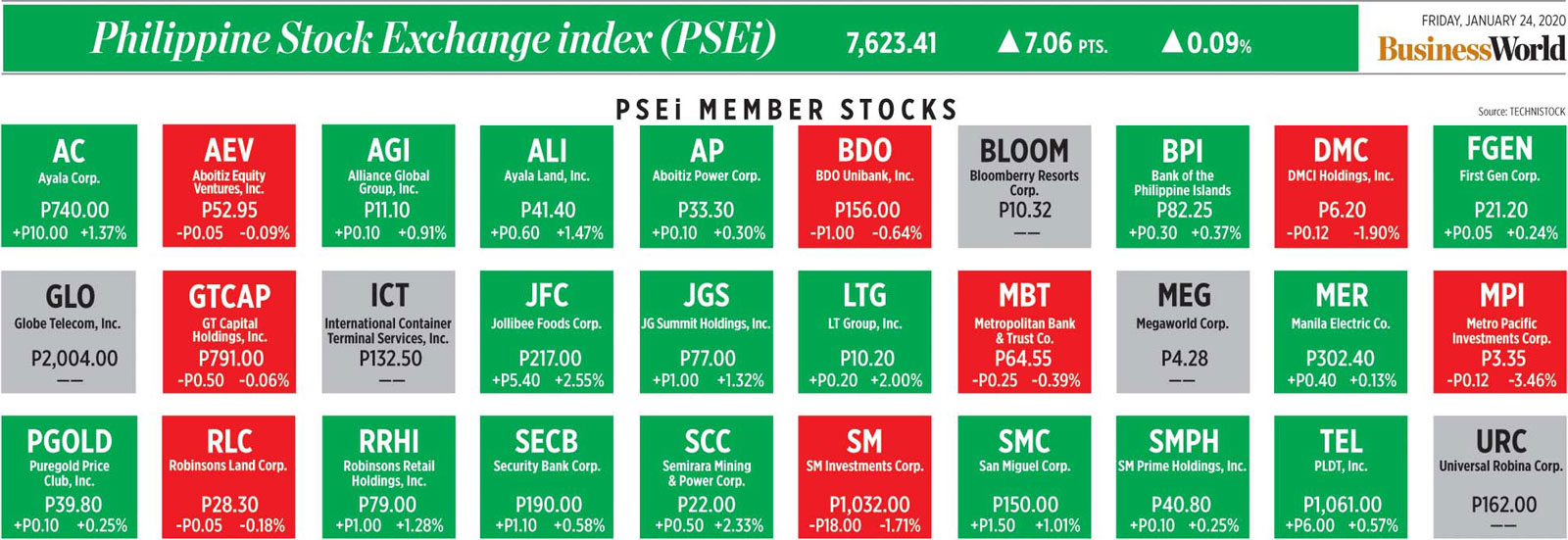
How PSEi member stocks performed — January 24, 2020

Here’s a quick glance at how PSEi stocks fared on Friday, January 24, 2020.


Region XII board issues order for P25 hike in minimum wage

PRIVATE SECTOR minimum wage workers in Region XII, also known as Soccsksargen, were granted an increase in wages nearly two years since their last wage hike.

The Department of Labor and Employment Region 12 (DoLE-12) said workers will be granted a wage increase of P25 in two tranches this year. The first tranche will begin next month while the second tranche is due on May 1.

“(W)orkers in the Non-Agriculture Sector shall be paid P326.00 pesos upon the effectivity of the wage order and P336.00 effective May 1, 2020 while workers in the Agriculture/Retail/Service sector shall be paid P305.00 upon the effectivity of the Order and P315.00 effective May 1, 2020,” DoLE-12 Director Sisinio B. Cano said in a statement.

The wage board last issued a wage order on May 11, 2018. The old minimum wage was at P290 to P311.

The new daily wages were approved on Dec. 16, 2019 by the Regional Tripartite Wages and Productivity Board (RTWPB-12). According to a report by the Mindanao Daily Mirror dated Jan. 24, the new wage order was published on Jan. 18 and will take effect in February.

Once the wage order takes effect, DoLE-12 said that the first tranche will be a P15.00 daily wage increase. The second tranche in May will be a P10 hike.

The wage order covers the entire region — South Cotabato province, Sultan Kudarat, Koronadal City, Sarangani, and General Santos City — except Cotabato City, which voted to be part of the Bangsamoro Autonomous Region in Muslim Mindanao (BARMM) through a plebiscite last year.

Inflation in Soccsksargen was 6.2% in 2018, above the 2018 headline national inflation rate of 5.2%; and 2.8% in 2019, a little over the 2019 national average of 2.5%. — Gillian M. Cortez

POGO tax collections in 2019 rise nearly 170% to P6.42B

THE government’s tax take from Philippine offshore gaming operators (POGOs) and their service providers grew nearly 170% to P6.42 billion in 2019 amid a compliance crackdown, the Department of Finance (DoF) said Sunday.

In a statement, DoF said the total tax generated by the industry totaled P6.42 billion in 2019 from the P2.38 billion a year earlier due to a “sustained campaign… to crack down on errant POGOs and their service providers that have eschewed tax payments.”

The Bureau of Internal Revenue’s (BIR) collections from withholding taxes topped the list at P5.13 billion, followed by P644.07 million in income taxes, P91.13 million in value-added taxes (VAT) and percentage taxes, P81.11 million in documentary stamp taxes and P469.13 million in other taxes from POGOs and their service providers.

According to a report to Finance Secretary Carlos G. Dominguez III, the BIR issued a total of 170 notices last year, allowing the government to collect P27.35 billion in tax liabilities from non-compliant POGOs.

BIR Deputy Commissioner for Operations Arnel SD. Guballa said the agency hopes to eventually collect at least P2 billion monthly.

“Basically we’re going hard against people who are evading taxes,” Mr. Dominguez was quoted as saying.

“Before, we didn’t get a cent from them,” Mr. Dominguez told reporters in a separate interview.

According to government records, there are around 108,914 foreign workers employed by 218 POGO service providers.

“They promised starting the beginning of this year… they will comply. They will register (their) employees, etc. But we have heard from sources that their employees come and go,” Mr. Guballa told reporters last week.

He also said foreign workers are now finding it easier to comply with documentary requirements as the BIR has resolved its problem in issuing Tax Identification Numbers (TINs).

The government requires foreign nationals and non-residents planning to work in the Philippines to obtain a TIN before securing a work permit.

However, Mr. Guballa said the bureau is still having a difficult time tracking worker numbers employed in the industry, especially the foreign ones, since many of them “come and go” on a contractual basis.

In March, Mr. Dominguez said the government loses at least P22 billion yearly in uncollected POGO taxes.

An inter-agency task force was also created to keep track of the total number of foreigners employed by POGO firms and their service providers.

This year, Mr. Dominguez said “there will be no letup” in the DoF’s crackdown on tax-evading POGOs and their service providers.

On Jan. 17, the BIR closed down Xpoint Technology Philippines Corp.’s Pasig City branch, the fourth firm to be padlocked so far, as it was not registered and was evading tax. Last year, the BIR shut down a total of three firms that were not tax-compliant.

The first was one of the biggest service providers, Great Empire Gaming and Amusement Corp.’s (GEGAC) offices in Subic Freeport and in Parañaque City in late September after failing to register for Value-Added Tax. It was then allowed to operate again after making an initial payment of P250 million and agreeing to pay the remaining P1.05 billion.

It was followed by the closure of Altech Innovations Business Outsourcing’s head office in Parañaque City and a branch in Pasay City. Altech reopened after paying P8.2 million in back taxes and committed to settle the remaining P37 million worth of unremitted withholding taxes of its 390 mostly Chinese workers.

The third closure in 2019 involved 11 branches of the “country’s biggest POGO service provider,” the New Oriental Club 88 Corp. for failure to register.

BIR said the company employed around 23,000 foreign nationals as of end-2018 but the company submitted a list to the BIR with just 6,736 foreign workers. — Beatrice M. Laforga