Home Blog Page 9964

Boulevard Holdings swings to profitability

BOULEVARD Holdings, Inc. (BHI) has swung to a net profit in the first quarter of its fiscal year ending August 2019 after recording a surge in revenues.

In a regulatory filing yesterday, the listed firm said its attributable net income in the June-to-August period stood at P1.78 million, a turnaround from the P5.59 million in losses it saw the previous year.

This was driven by a revenue jump in the three-month period to P32.82 million, nearly five times more than the P7.15 million posted a year earlier.

However, the company still saw a net loss of P4.4 million during the period, slimmer than the past year’s P6.87 million, as net loss attributable to non-controlling interests increased to P6.17 million from P1.28 million previously.

The increase in consolidated revenues is mainly from its leisure and tourism related business through its operations of Friday’s Boracay Beach Resort and Friday’s Puerto Galera Beach Resort. This segment recorded sales of P24.57 million during the period to jump 244%, largely because of the reopening of Boracay island.

“BHI management believes that (Friday’s Holdings, Inc.) hotel operations will continue to improve in the next few months due to the opening of Friday’s Puerto Galera Beach Resort,” it said.

“BHI management further believes that it will improve the patronage of the loyal customers of both Friday’s Boracay Beach Resort and the recently opened Friday’s Puerto Galera Beach Resort,” it added.

Expenses in the three months nearly tripled to P36.76 million from P12.91 million in the same period a year ago. — Denise A. Valdez

Dealers call on Art Basel to cancel Hong Kong show over virus fears

THE SPREAD of the deadly coronavirus may jeopardize Art Basel Hong Kong, one of Asia’s most prestigious art fairs, with participating galleries asking organizers to cancel the event’s eighth edition in March.

The death toll from the virus, which originated in the Chinese city of Wuhan, has risen to 425 while the number of cases has topped 20,000.

In Hong Kong, where the second fatality outside of mainland China has just been reported, museums and schools have been closed. The Hong Kong Marathon, which was set to take place on Feb. 8, was canceled. Rail service from the mainland is suspended and flights have been reduced.

The World Health Organization on Thursday declared the coronavirus outbreak a global health emergency.

“Hong Kong is not the place where anyone wants to go right now,” said Janelle Reiring, co-founder of Metro Pictures Gallery in New York. “Because of the politics, the protests and now the virus. No one wants to send people to work there the way things are.”

Art Basel Hong Kong, which drew 88,000 people last year, is scheduled to open to VIPs on March 17 at the Hong Kong Convention and Exhibition Center. UBS Group AG is the show’s lead partner.

Exhibitors would include 241 galleries from 31 countries and territories, according to the website. The Art Basel franchise, which also includes fairs in Miami and Basel, Switzerland, is part of Switzerland’s MCH Group AG. The parent company has been struggling financially, and any cancellation in Hong Kong may complicate things further.

“This is a challenging time for all of us,” the fair’s directors said in a letter to exhibitors on Thursday. “The contemplation of postponing or canceling an event of this scale — which takes a full year to produce — is a complex process, with many factors and multiple stakeholders.”

FINAL PAYMENTS
Even before the coronavirus, Hong Kong was rocked by months-long anti-government protests that turned parts of the city into battle zones on weekends, wreaking havoc on the tourism and retail sectors and plunging the economy into a recession.

While the demonstrations affected almost all industries, at the very top end, people were still spending. A five-day auction by Sotheby’s in October set a new world record for Japanese artist Yoshitomo Nara, whose painting of a cute but menacing cartoon girl — Knife Behind Back — sold for $24.9 million.

ARTIFICIAL LIFE SUPPORT
Some dealers have asked for Art Basel Hong Kong to be canceled and a few have already dropped out. One group of gallery owners recently gathered in New York to address the situation.

In January, 24 galleries signed a letter to the fair organizers demanding concessions. But the outbreak of coronavirus was a game changer, dealers said. The anxiety among galleries is further augmented by approaching deadlines to make final payments for exhibiting and to book expensive shipments of art to Hong Kong.

Richard Nagy, the owner of a prominent London gallery, wrote to organizers last Wednesday asking them to cancel the show. A copy of the e-mail was seen by Bloomberg.

“Regretfully, we believe this situation needs decisive leadership and the fatally wounded Art Basel Hong Kong 2020 needs to be put out of its misery and quickly,” Nagy’s letter said. “Having taken soundings and we can tell you, not one of our foreign clients will be attending and they are surprised the fair is still on.”

“There is absolutely no doubt in our minds that this art fair is now commercially on artificial life support,” he wrote.

There is precedent for a canceled Art Basel. The first edition of Miami Basel was postponed in 2001 after the 9/11 attacks. In addition, the fair’s contract with the galleries states that reasons for cancellation may include “economic or political situations that strongly compromise” the organization of the show, according to Nagy’s letter.

“Surely this point is now passed,” Nagy said. “Please tell us what and where the line has been drawn — at what point will Art Basel Hong Kong cancel the show? Is it 100 infected cases in Hong Kong? Is it a death in Hong Kong? Exactly where is your line in the sand drawn?” — Bloomberg


ERC: decision on power supply deals out in Feb.

THE Energy Regulatory Commission (ERC) is set to issue in February its decision on the power supply deals that went through competitive bids, including those called by the country’s largest distribution utility Manila Electric Co. (Meralco), the agency’s top official said.

Tapos na ‘yung hearings. Pina-finalize na ‘yung resolution (The hearings are completed. The resolution is being finalized),” ERC Chairperson and Chief Executive Officer Agnes VST Devanadera told reporters after a hearing at the Senate on Monday.

Asked about the specific power supply agreements (PSAs) that went through a competitive selection process (CSP) will be covered by the resolution, she said: “Lahat ‘yan February lalabas. I mean ‘yung CSP ‘yung filed.”

(All of them will be issued a decision in February. I mean those with a filed CSP.)

She answered in the affirmative when asked whether Meralco’s PSA is covered in the upcoming resolution.

A CSP has become part of the process before the ERC acts on a PSA application after the ERC and the Department of Energy came out with rules meant to bring down electricity costs. The lowest-cost bid for power supply that met the set conditions is awarded the PSA, but subject to the commission’s scrutiny and decision.

CCP cancels Pasinaya because of virus

THE Cultural Center of the Philippines’ Pasinaya 2020 “Art for Earth’s Sake” open house festival, which was to have been held on Feb. 7 to 9, has been canceled for public health and safety in response to the outbreak of the novel coronavirus.

“As the World Health Organization declared the coronavirus as a public health emergency of international concern, we urge the Filipino people not to panic and remain calm. Let us work together to prevent the virus from spreading. Let us remain vigilant and keep safe,” the cultural center’s artistic director, Chris Millado, said in a statement posted on the it’s official Facebook page on Jan. 31.

Started in 2004, the Pasinaya is a multi-arts festival which is held annually during the first weekend of February in celebration of National Arts Month.

The cultural center’s regular programs will continue as scheduled. For more information, contact 8832-3704 or visit www.culturalcenter.gov.ph.

BSP, Bank Indonesia may test cross-border retail payment linkages

THE BANGKO SENTRAL ng Pilipinas (BSP) and Bank Indonesia (BI) may consider going into a joint regulatory sandbox to test cross-border retail payment linkages following the central banks’ recently signed memorandum of understanding (MoU), according to BSP Governor Benjamin E. Diokno.

“The BSP and BI have yet to consider specific projects under the MoU,” Mr. Diokno said in an e-mailed response to BusinessWorld on Tuesday.

“However, moving forward, the agreement may be expected to facilitate initiatives between the two central banks to ease information exchange on payment systems and financial innovation, promote participation in a joint regulatory sandbox testing or establish of cross-border retail payment linkages, and introduce fintech (financial technology) businesses to each other’s jurisdictions, among others.”

The two central banks inked an MoU on Feb. 1 with the intent to create a framework of closer cooperation to help attain a “more secure, efficient and reliable payment system, and to promote digital financial innovation.

The pact came after a bilateral meeting between BSP and BI which tackled advances done in the digital economy, central banking, infrastructure financing using market instruments, and sustainable financing frameworks done by both sides.

Meanwhile, BSP Deputy Governor Chuchi G. Fonacier said the BI highlighted the Indonesia Payment System (IPS) Blueprint 2025, which is a framework they have adopted in response to the digital transformation occurring in their national payment system.

“The blueprint includes open banking standards, retail payment system, market infrastructure, data management, and regulatory, licensing and supervisory framework,” Ms. Fonacier said in an e-mailed response.

In August 2019, Bank Indonesia launched its QR Code Indonesian Standard as part of the blueprint.

“Ultimately, the IPS Blueprint 2025 should challenge the BSP and Philippine banks to continue improving synergies, embracing transformation, and supporting innovation, as these were key lessons that formed the BI’s policy action,” Ms. Fonacier said.

For its part, the BSP launched the National Retail Payments System in 2015 where electronic fund transfer schemes like the PESONet and InstaPay are part of.

So far, the volume of e-payments in the country have risen to comprise 10% of total transactions in 2018 from a mere 1% in 2013, according to a study by United Nations-based Better than Cash Alliance. — Luz Wendy T. Noble

Taking a break from the usual

CONTEMPORARY artist Gig de Pio, Sr. departs from his usual portraits and revisits abstracts in Rustan’s For the Arts’ first exhibition this year.

Born in Cebu in 1951, Mr. De Pio is best known for his portraits. He holds a degree in Fine Arts from the University of the Philippines College of Fine Arts in Diliman where he was a Jose Joya scholar and later served as a professor. In 2011, Mr. De Pio received the Araw ng Manila award from former Manila City mayor Alfredo Lim.

“[This collection] is a break (from portraiture),” Mr. De Pio told BusinessWorld at the exhibition launch on Jan. 30.

“In high school, I saw an exhibit by [National Artist for Visual Arts] Jose Joya in our province in Cebu. Abstraction blew my mind. Ever since, I really wanted to do that,” he added.

In this collection, 20 paintings reflect the artist’s view of the world through the Theory of Entropy.

“One accident is just an accident. Another accident overlaps it, and there is an event. The third one is that there is a personality that is created,” Mr. De Pio explained. “You can see that in my work.”

The canvases come in various shapes that use warm earth colors.

“Not like some abstractions where elements just crisscross, it is the inside where they meet which is my subject,” he said.

The Rustan’s For The Arts series has previously featured collections by Filipino artists such as National Artists Benedicto “BenCab” Cabrera, Fernando Amorsolo, Arturo Luz, and Anita Magsaysay-Ho.

The collection is on view at Rustan’s Makati until March 31 and will move to Rustan’s Shangri-La in April. — Michelle Anne P. Soliman

RBA keeps rate at record low

SYDNEY — Australia’s central bank held its cash rate at record lows at its first meeting of the year on Tuesday and sounded doggedly optimistic even as markets bet devastating bushfires at home and a viral epidemic in China would force aggressive easing.

The Reserve Bank of Australia (RBA), which slashed its key rate three times last year to 0.75% to help achieve its employment and inflation goals, kept forecasts for economic growth intact for this year and next at 2.75% and 3% respectively.

The outlook was supported by “the low level of interest rates, recent tax refunds, ongoing spending on infrastructure, a brighter outlook for the resources sector and, later this year, an expected recovery in residential construction,” RBA Governor Philip Lowe said in a short post-meeting statement.

The upbeat statement sent the local dollar up by 40 pips to $0.6720 from $0.6680 before the rate review.

A majority of 32 analysts polled by Reuters last week had expected the Reserve Bank of Australia to keep its benchmark rate at 0.75%.

Economists now expect a cut to 0.5% in April though financial futures are pricing in the possibility of the cash rate dropping as low as 0.25% later this year, with the economic outlook clouded by bushfires and the rapidly spreading coronavirus.

Mr. Lowe did acknowledge that the two events would “temporarily weigh on domestic growth” while reiterating that an extended period of low interest rates will be needed in Australia.

Analysts at National Australia Bank estimate travel bans introduced by the government could shave 0.15 percentage points off first-quarter gross domestic product growth, in addition to the temporary hit from the bushfires.

China is Australia’s largest trading partner while Chinese tourism and students account for about 0.9% of the nation’s A$2- trillion annual economic output. — Reuters

NGCP denies employing foreigners in key posts

PRIVATELY owned National Grid Corporation of the Philippines (NGCP) on Tuesday denied that it employs foreigners in executive and management positions.

NGCP President Anthony L. Almeda said the corporate acts of the company comply with the Constitution and other laws.

He issued the statement after lawmakers in a Senate hearing on Monday called out the country’s power grid operator for allegedly employing Chinese nationals in executive and management positions. They were referring to Wen Bo and Liu Zhiaoquiang.

“Messrs. Bo and Liu left the country in 2018 and 2015, respectively. They held technical positions in the company,” he said in a statement.

He also said any audit of NGCP should be conducted by the proper regulatory agency, citing the Energy Regulatory Commission as the independent body tasked by law and recognized by the concession agreement.

Mr. Almeda said the company has only four directors from the State Grid Corporation of China who do not perform executive or management functions.

The company said it had always been diligent in implementing its board and management directives, and that it does so “with utmost regard for the law, and other rules and regulations.”

US eyes duties due to currency undervaluation

WASHINGTON — The US Commerce department on Monday finalized a new rule to impose anti-subsidy duties on products from countries that it has determined undervalue their currencies against the dollar, including potentially China.

The move could provide a fresh irritant in US-China trade talks just weeks after the world’s two largest economies signed a Phase 1 trade agreement, and comes a day after Beijing accused Washington of spreading fear about the fast-spreading coronavirus that originated in China.

In theory, the new rule would allow the Commerce department to impose duties on China, even though the US Treasury department recently removed its designation of China as a currency manipulator as part of the Phase 1 trade deal.

Commerce said it would generally rely on the Treasury’s expertise in determining undervaluation, but the two processes could come to different conclusions since they resulted from different statutes. The draft rule was first published in May.

It said it would only impose countervailing duties on imports of specific products that both benefit from countervailable subsidies and are found by the US International Trade Commission to injure US industries.

The rule would not result in the application of such duties to all imports from a given country, because not all such imports injure US industries, it said.

Commerce said the new rule was a measured response to longstanding, bipartisan calls to use existing laws to address unfair foreign currency practices, and was part of a broad push by the Trump administration to crack down on trade imbalances.

“The Trump Administration is doing the right thing by confronting the problem head-on,” it said in a statement.

US Commerce Secretary Wilbur Ross said the new rule marked another important step intended to “level the playing field for American businesses and workers.”

Mark Sobel, a former senior US Treasury official and adviser to the London-based OMFIF economy policy think tank, said the new rule failed to address many of the concerns raised after the draft rules were published in May, and would likely be inconsistent with World Trade Organization rules.

“There is no precise way to measure currency undervaluation,” he said, adding that Commerce had no responsibility or expertise in international monetary and currency matters. “This is a unilateral policy which will alienate countries around the world.”

The Commerce department said it would not normally include monetary and related credit policy in determining whether a government had acted to reduce the exchange rate of its currency to bolster its domestic industry.

In addition to China, the new rule also could put goods from other countries at risk of higher tariffs, including Germany, Ireland, Italy, Japan, Malaysia, Singapore, South Korea, Vietnam and Switzerland.

Those countries were all on the “monitoring list” included in the Treasury department’s semi-annual currency report, which tracks currency market interventions, high global current account surpluses and high bilateral trade surpluses.

The department said its proposed rule would amend the normal countervailing duty process to include new criteria for currency undervaluation, including a finding of government action on the country’s exchange rate. — Reuters

Matilda international tour comes to Manila

THE STORY of a young girl named Matilda has told on the pages of books since 1988, on the big screen in 1996, and onstage since 2010. This year, the musical (that uses over 100 tubs of chocolate every year) comes to Manila — its 63rd city — at the Theater at Solaire beginning March 5.

Matilda the Musical has won over 85 international awards including the 2012 Olivier Award for Best Musical and a joint Best Actress award for the four young actresses who played the lead role.

Commissioned by the Royal Shakespeare Company, the musical is based on the beloved book by Roald Dahl.

Matilda the Musical (with the book by Dennis Kelly and original songs by Tim Minchin) follows the five-year-old Matilda — who is gifted with telekinesis — in overcoming struggles in her family and in school.

Thanks to audience feedback, Global Marketing Group (GMG) Productions is bringing the international production to Manila.

“It’s a title that has always scored very highly in surveys, and just the general chatter online between our theater fans in the community here. Everyone says, ‘We love Matilda. We like to see Matilda.’ So, of course, we react to that kind of response,” Robert Sewell, founder of ticketing portal TicketWorld and GMG producer, told BusinessWorld at a Matilda-themed tea party on Jan. 27 at the Diamond Hotel Philippines in Manila City.

“We always talk to everyone involved in the theater and they’ll give us their ideas, and we also do online surveys,” added Carlos Candal, owner and CEO of GMG.

“We get a very big social media following in GMG productions. People are always giving us feedback. [We also consider] the biggest shows that are going on globally — those are the ones that we want to bring in here,” he said.

The musical is directed by Tony Award winner Matthew Warchus, with sets and costumes by Tony Award winner Rob Howell, choreography by Peter Darling, orchestration, additional music and musical supervision by Christopher Nightingale, lighting design by Tony Award winner Hugh Vanstone, and sound design by Simon Baker.

Alternating as Matilda in the travelling production are Zara Yazbek Polito, Sofia Poston, and Zoe Modlinne. Haley Flaherty takes on the role of Miss Honey, while Hayden Tee will be playing Miss Trunchbull. Joining them are Stephen Jubber who takes on the role of Mr. Wormwood, Claire Taylor as Mrs. Wormwood, and Nompumelelo Mayiyane as Mrs. Phelps.

“The script is the same. You’ll find that the sets of the tour will be more elaborate, and you have a touring production that has worked together for years and years,” Mr. Sewell said of the international production.

The musical was staged in Manila by Atlantis Theatrical Entertainment Group in 2017.

“People go and watch the show for a number of reasons: they want to go and see if it’s the same as the book, [and the] same as the movie. But what we want them to take away is a fabulous theater experience. So, when we put another show on, they’re gonna think about how good it was for Matilda, and certainly will come [again] and see another,” Mr. Sewell said.

There will be special prices on selected show dates. On March 10, 8 p.m., the price across all orchestra seats will be P3,800, while the price across all balcony seats will be P1,800. On March 17, 8 p.m., and March 22, 6 p.m., all orchestra seats will be P4,000 and all balcony seats will go for P2,000. A matinee performance has been added on March 18, 2 p.m., with all tickets are sold at P2,200. For more ticket information, visit TicketWorld. — Michelle Anne P. Soliman

Consunji firm denies link to massive Pandacan fire

D.M. Consunji, Inc. said the massive fire that happened on Saturday in Pandacan, Manila did not originate from its construction yard.

“Videos taken by various netizens clearly show that the fire started outside our work area,” it said in a statement on Tuesday.

“In addition, according to the Bureau of Fire Protection, the fire broke out at around 10:38 a.m. or more than 30 minutes before the warehouse inside our construction yard caught fire at around 11:15 a.m.,” it added

But it said it would cooperate with any investigation to determine the real cause of the fire.

The company made the statement after news reports citing an initial investigation said the fire was a freak accident that could have likely started from its construction yard and spread to a nearby plastics warehouse that was moving out.

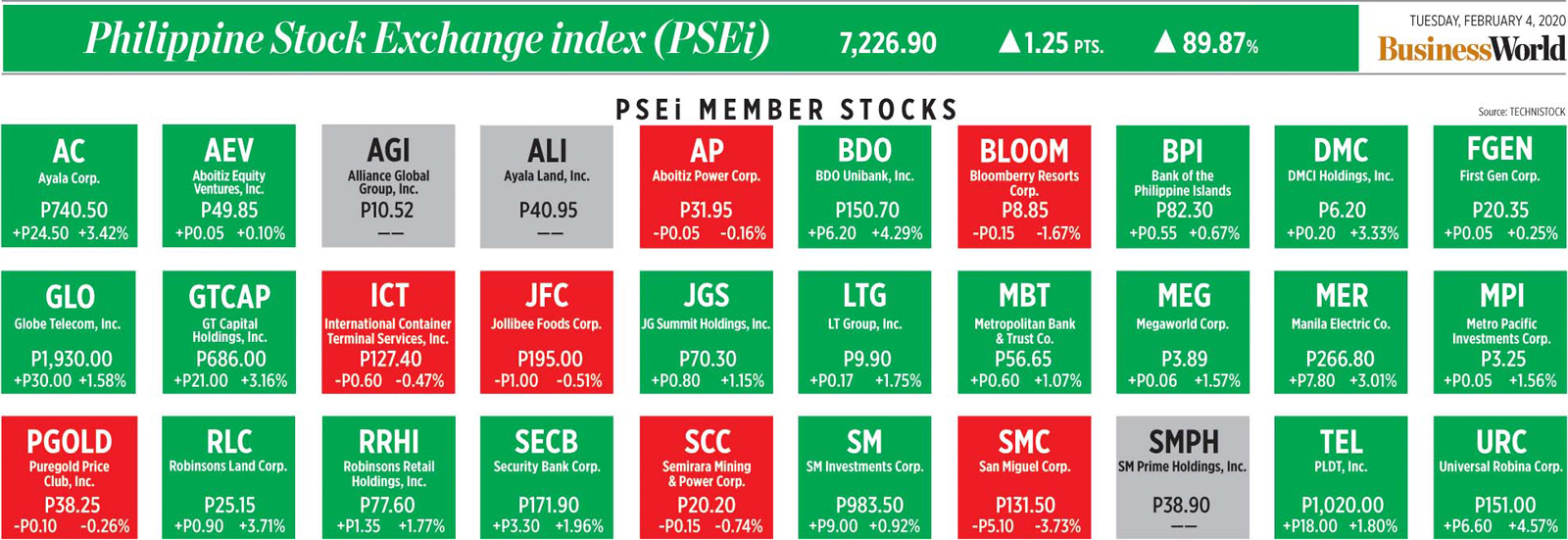
How PSEi member stocks performed — February 4, 2020

Here’s a quick glance at how PSEi stocks fared on Tuesday, February 4, 2020.