THE Department of Trade and Industry’s (DTI) export promotion arm is encouraging exporters to explore online platforms after trade shows were canceled in response to the coronavirus disease 2019 (COVID-19) crisis.
The Center for International Trade Expositions and Missions (CITEM) promotes Philippine export goods and services through various events, including overseas trade fairs. CITEM in late March said its events for the first half of 2020 have been canceled.
“Stronger digital synergy is the way forward in these trying times since events have been canceled or postponed across the world. Our exporters, particularly the micro-, small- and medium-enterprises (MSMEs), should tap strategic social media platforms and digital tools to widen their online reach and continue their working relations with their clients and stakeholders,” CITEM Executive Director Pauline Suaco-Juan said in a statement Tuesday.
“Exporters can also take advantage of available webinars on business, logistics and online marketing, among others, on how they can navigate or bounce back from their current situation,” she said.
Ms. Suaco-Juan said CITEM is also collaborating with institutions and resource speakers, including creatives and design experts, to promote the Philippines online.
She spoke at Project Ripple PH’s weekly show on Tuesday, joining business professionals and creatives to discuss “influencer marketing” in the Philippines. She will also be joining an online conversation with the Fashion and Design Council of the Philippines, PHx Fashion Conference, and SoFA Design Institute.
The DTI in a statement Monday said agricultural exports entered three new international markets, with maiden shipments of avocados sent in China, cacao products shipped to Belgium, and coconut milk arriving in Russia in March and April.
“COVID-19 may lead to market access issues and non-tariff measures. It may be more difficult to comply with stricter regulations, certifications, external and domestic regulations. The DTI-EMB commits to assist exporters, especially MSMEs, to comply with these requirements and introduce their products to the world,” DTI Export Marketing Bureau Director Senen M. Perlada said.
He has been encouraging exporters to increase their e-commerce presence, especially during the enhanced community quarantine (ECQ) imposed on Luzon. — Jenina P. Ibañez
THE farmgate price of palay, or unmilled rice, rose in several regions during the dry season to levels exceeding the government’s P19 per kilogram support price.
“To date, the national average price of dry palay is at P19.91 per kilogram, while fresh palay sells at P17.22 per kilogram, according to the Philippine Statistics Authority,” Agriculture Secretary William D. Dar said.
According to the DA, the highest farmgate price for dry palay in the last week of April was in Northern Mindanao (Region X) at P25.35 per kilogram.
Meanwhile, the lowest farmgate price was in Western Visayas (Region VI) at P17.58.
Dry palay in the Bicol Region (Region V) averaged P20.25, in Ilocos Region (Region I) P20.30, in Cagayan Valley region (Region II) P20.65, in Central Visayas (Region VII) P21, in SOCCSKSARGEN (Region XII) P21.50, and in Davao Region (Region XI) P22.93.
The National Food Authority (NFA), which serves as a buyer of last resort for domestic farmers when commercial traders are out of the market, sets its palay purchase price at P19. During the turmoil accompanying the passage of the Rice Tariffication law, palay prices reportedly fell into the single digits in some provinces.
“Compared to the prices last season, the figures we are seeing now could be a manifestation of the normalization of the rice industry, after our transition from quantitative restrictions to a tariffed trade regime,” Mr. Dar said.
“We recognize the birth pains of the RTL implementation. That is exactly the reason why we set up and rolled out immediate support mechanisms to help small rice farmers adjust and eventually make them competitive. At this time, we are seeing the initial good results,” Mr. Dar said.
Mr. Dar has directed the NFA to continue the procurement of palay at P19 per kilogram and to urge local government units, particularly in major rice-producing provinces, to purchase directly from farmer-constituents. — Revin Mikhael D. Ochave
STATE-OWNED firms have remitted P129.45 billion worth of dividends to the national government to increase the government’s war chest for containing the coronavirus disease 2019 (COVID-19) outbreak, the Department of Finance (DoF) said.
In a statement Tuesday, the DoF said P91.62 billion was remitted to the Bureau of the Treasury (BTr) during the March 24-April 29 period, during which Republic Act (RA) No. 11469 or the Bayanihan to Heal as One Act was signed into law, representing the “largest sum ever collected from government-owned and -controlled corporations (GOCCs) in span of five weeks.”
The government decided to call in its GOCC dividends ahead of time to add to its cash on hand, after the lockdown upended tax collection, leaving millions of individual taxpayers unable to file their returns after the tax deadline fell within the quarantine period.
The DoF said the remaining P37.83 billion had been remitted between Jan. 1 and March 23, prior to the effectivity of the law.
GOCCs are required by RA No. 11469 to remit to the national government unused subsidies and guarantee fees as well as national government advances, according to the DoF.
RA 11469 allows the President “to allocate cash, funds, investments, including unutilized or unreleased subsidies and transfers, held by any GOCC or any national government agency in order to address the COVID-19 emergency.”
According to the DoF, the Bangko Sentral ng Pilipinas remitted P37.48 billion, followed by the Philippine Deposit Insurance Corp. with P17.9 billion, Philippine Amusement and Gaming Corp. with P12 billion and the Tourism Infrastructure and Enterprise Zone Authority with P12 billion.
State firms overseen by the Transportation department remitted P17.05 billion, including P6 billion each from the Manila International Airport Authority and the Civil Aviation Authority of the Philippines and P5.05 billion from Philippine Ports Authority .
The Philippine National Oil Corp. also remitted P5 billion; the National Power Corp., P4 billion; the
Philippine Reclamation Authority, P3.8 billion; the Bases Conversion and Development Authority, P2.69 billion; the Philippine Charity Sweepstakes Office, P2.27 billion; as well as P2 billion each from PNOC Exploration Corp. and the Philippine Economic Zone Authority.
Other GOCCs that remitted were the National Electrification Administration (P1.55 billion) Metropolitan Waterworks & Sewerage System (P1.43 billion), Clark Development Corp. (P1.13 billion), Light Rail
Transit Authority (P1 billion) and the National Irrigation Administration (P1 billion).
The Philippine Sugar Corp. remitted P875 million; The Sugar Regulatory Administration P659.55 million; the National Housing Authority P513.24 million, the Cebu Port Authority P500 million and the Mactan Cebu International Airport Authority P500 million.
Other GOCCs that remitted were the Authority of the Freeport Area of Bataan, APO Production Unit, Inc., the Philippine International Trading Corp., the Philippine Crop Insurance Corp., the National Development Co., the North Luzon Tollways Corp., the Social Housing Finance Corp., Food Terminal Inc., the Laguna Lake Development Authority and Clark International Airport Corp., among others.
The government has spent P352.7 billion so far in responding to the COVID-19 pandemic, with the funding sourced from tax collections, budget savings, dividends from GOCCs and loans from multilateral lenders. — Beatrice M. Laforga
FITCH Solutions Macro Research said it downgraded its 2020 household spending growth outlook for the Philippines to 3.4% from 5.8% previously before the coronavirus disease 2019 (COVID-19) outbreak.
Fitch Solutions said the lockdown imposed to prevent the spread of COVID-19 has altered purchasing
patterns, with households devoting funds to priority purchases such as food and health care and cutting out non-essentials.
“For consumers in countries where a lockdown has been initiated, and for consumers who believe that their governments might implement this measure, the spending focus is narrowing further, with a concentration on priority purchases (food and non-alcoholic drink and health spending),” it said in a note issued Tuesday.
Spending meant for food and non-alcoholic beverages will continue to gain traction throughout the year even though panic-buying has subsided, Fitch Solutions said.
Consumers could also prioritize health-related products. Fitch Solutions has noted reports of a surge in vitamin sales.
“We expect more over-the-counter medication sales, with consumers seeking medicine and health-related purchases during the pandemic,” it said.
Fitch Solutions said the worst-hit segments during the outbreak include clothing and footwear, which are being crowded out even in the e-commerce channel where platforms are emphasizing food delivery. It also noted that in China, clothing and footwear sales in March fell 46.8%.
Even if they wanted to, it said, consumers would be unable to spend on non-essential because many stores selling such goods are closed.
Fitch Solutions added that consumers will also cut down on electronics purchases as well as travel during the lockdown.
“However, streaming services like Netflix will see increased demand — the streaming service has already had to place caps on video quality to avoid overburdening its platform,” it said.
Fitch Solutions said it expects school fees and education spending to fall if the authorities order tuition fee refunds and waivers while schools are shut. It noted that the Commission on Higher Education has encouraged private universities and institutes to allow delays in tuition payments during the emergency. — Luz Wendy T. Noble
THE Department of Energy (DoE) has asked ethanol producers to help raise the supply of ethyl alcohol, stocks of which are currently running low after a spike in demand for disinfecting materials during the coronavirus disease 2019 (COVID-19) outbreak.
In a statement Tuesday, the department said it has written the Ethanol Producers Association of the Philippines (EPAP) to devote a portion of their anhydrous bioethanol products to make ethyl alcohol.
Listed firm Roxas Holdings, Inc., through its two bioethanol units Roxol Bioenergy Corp. and San Carlos Bioenergy, Inc., earlier donated more than 50,000 liters of ethanol to various public agencies and groups.
“We are hoping that other bioethanol producers follow suit and heed our call for them to allocate a portion of their product towards 70% ethyl alcohol production, as part of their Corporate Social Responsibility programs,” Energy Secretary Alfonso G. Cusi said.
Mr. Cusi said in an ANC interview that the supply of alcohol is running low.
“Now we need alcohol to disinfect and we are short of alcohol,” he said.
He also said that the DoE is considering policy adjustments to suspend the 10% ethanol blending requirement for gasoline products to divert such inventory to disinfecting alcohol.
The Independent Philippine Petroleum Companies Association (IPPCA) on Monday told BusinessWorld that it supports such a suspension as it will be “more beneficial for the economy.”
EPAP has yet to reply to a request for comment at deadline time. — Adam J. Ang
LOCAL coronavirus infections may have slowed after a Luzon-wide lockdown that started on March 17, an expert from the Ateneo de Manila University’s School of Medicine and Public Health said on Tuesday.
It now takes about four days for COVID-19 cases to double from one to two days before, Ateneo associate professor John Wong said at a news briefing.
“We would expect that the flattening would continue, meaning we will have very few additional cases,” he said.
In epidemiology, the idea of slowing a virus’ spread so that fewer people need to seek treatment at a time is known as flattening the curve.
Countries worldwide including the Philippine have imposed lockdowns and asked people to observe social distancing to slow the virus spread.
The curve researchers are talking about refers to the projected number of people who will get infected over time.
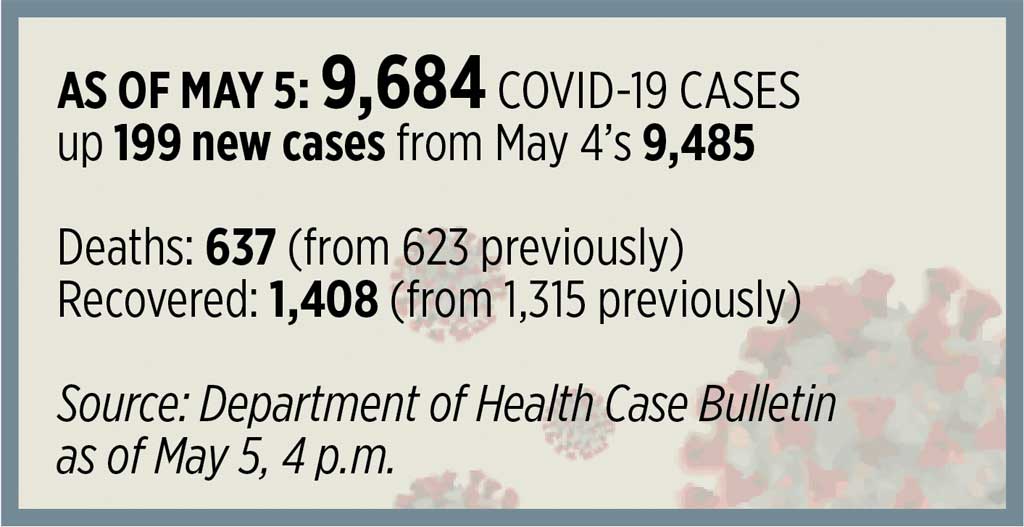
The Department of Health (DoH) reported 199 more infections yesterday, bringing the total to 9,684.
The death toll climbed to 637 after 14 more patients died, it said in a bulletin. Ninety-three more patients have gotten well, bringing the total recoveries to 1,408, it added.
Of the 199 new cases, 87% or 173 were from Metro Manila, 0.5% or one were from Central Visayas and 12.5% or 252 came from other regions, DoH said.
Mr. Wong, who is part of an inter-agency task force against the coronavirus disease 2019 (COVID-19), said the flattening of the curve became evident around April 1, two weeks after the lockdown.
It takes 4.6 days for COVID-19 cases to double in in Metro Manila, 5.8 days for the rest of Luzon, 5.4 days in Visayas and 5.3 days in Mindanao, Mr. Wong said in a report.
It now takes 5.7 days to double the death toll nationwide, 5.6 days for Metro Manila, 7.8 days for the rest of Luzon, seven days in the Visayas and 7.7 days for Mindanao, he said.
Mr. Wong noted that aside from expanding the country’s health care and testing capacities, the government should also enforce social distancing measures, cough etiquette and hygiene to contain the pandemic.
“If and when we lift the enhanced community quarantine, they will know how to behave and would be able to prevent or delay another resurgence,” he said.
Health Undersecretary Maria Rosario S. Vergeire said people should not become complacent.
“The moment that we lift our restrictions, there would be a resurgence,” she said at the same briefing. “We need to continue this into the new normal.”
Meanwhile, DoH said 1,819 health care workers have been infected with the virus, 350 of whom have recovered and 34 have died.
The agency said 117,853 people have been tested —12,367 were positive and 105,226 were negative.
The positive results were more than the confirmed cases because they still need to be validated and processed.
DoH said 43 provinces had not recorded COVID-19 cases in the past two weeks, 23 of which had no infections since the outbreak started.
THE Department of Education (DepEd) on Tuesday said it would move the opening of classes this year to August from June as the country battles a novel coronavirus pandemic.
Classes for school year 2020 to 2021 will start on Aug. 24 and end on April 30 next year, Education Secretary Leonor Briones said at a virtual news briefing.
Not all teachers and students will physically report to schools once classes start due to lockdowns enforced in some areas of the country to contain the coronavirus disease 2019, she said.
The Education chief said various approaches will be used to teach students including technology-based learning through computers and mobile phones, media such as television and radio, and other offline methods.
DepEd field units would decide which modes are the most appropriate, Education Undersecretary Nepomuceno Malaluan said at the same briefing.
Students will be made to answer a poll during enrolment about their preferred learning mode and which gadgets they own for technology-based learning, he said.
Teachers report for work starting June to prepare lessons for the school year, Ms. Briones said.
President Rodrigo R. Duterte locked down the entire Luzon island on March 17, suspending work, classes and public transportation to contain the outbreak.
People should stay home except to buy food and other basic goods, he said. The Mr. Mr. Duterte relaxed the lockdown for some areas of the island starting May 1 and extended the so-called enhanced community quarantine for Metro Manila, some cities and provinces until May 15. — Gillian M. Cortez
RAMADAN is mainly associated with fasting, but this holy month for the Islamic faith is also about sharing and community.
With public gatherings and congregational prayers in mosques suspended indefinitely because of the coronavirus disease 2019 (COVID-19) outbreak, Muslims around the country are finding ways to observe the month-long fast within the confines of quarantine even as they work to adjust to a world changed by the crisis.
Trade fairs, brick and mortar stores, and restaurants in Muslim-populated cities and towns in the country were traditionally lively during the Ramadan as they remained open at night, along with markets for people who shop for iftar, or the meal for breaking their fast.
At night, after the evening Tarawih prayer in mosques, worshippers would usually stop by at cafes and restaurants to bond with friends and family before heading home.
This year, these social and economic activities are not happening.
Restaurants and many shops are closed. With social distancing, and people confined to their homes, the vibrant social part of Ramadan is muted by the very real need to stop the spread of the virus and stay alive.
Hasna Karim-Hamad, owner of the restaurant Hashy’s Cuisine in Cotabato City, said they had to forego their annual act of charity this year as the business switches to survival mode.
“Okaynaman, but quite difficult because of the current situation. I used to be able to sponsor iftar at the mosques, but this time, it isn’t so and that makes me so sad,” she said in mixed English and Filipino.
“Last Ramadan I was able to feed for iftar like hundreds of people every day. We didn’t accept many take-out orders because we are focused on the free iftar at the mosques. We were able to perform our umrah hajj (pilgrimage). This time we cannot do this. No more free iftars at the mosques,” she narrated.
“Business at this time? Not good. The struggle is real,” she said.
Her restaurant has tapped social media to attract more customers as they compete with the rising number of online food sellers.
“We need to innovate, make new menus every day so people can look forward to what’s new in the menu. One of our struggles is competition in the online food business. There are many people selling food online, especially during Ramadan now, and people cannot go to the supermarkets to buy their needs,” she said.
“We also need to accept take-out orders, as many as we can because we have bills to settle, we have employees who depend on us especially in these trying times,” she added.
On the side of consumers, spending has been limited as people have temporarily lost their regular income and other sources of livelihood.
Overseas Filipino worker Gamson Tulawie Quijano, Jr., who came home in March for a break, has been on an extended vacation without pay due to the travel restrictions.
The 31-year-old Quijano said while he is able to spend more time with family and doing Tarawih together at home in Zamboanga, he has not been able to visit his hometown Sulu.
“I wasn’t able to return to Qatar due to COVID-19, and the extended lockdown of the National Capital Region up to May 15… my point of origin. Likewise, all incoming flights to and from my province have been suspended up to May 15. However, when these restrictions are lifted, and as soon as the domestic flights are open, I will return to work. In Sha Allah,” he said.
Official government data estimates that around 10 million Muslims live in the Philippines, with majority of them residing in Mindanao.
“This year’s Ramadan is both unique and heartbreaking,” said lawyer Alman N. Namla, an official of the Regional Human Rights Commission.
Mr. Namla said Muslims are adjusting to the new constraints by turning their homes into prayer houses instead of going to the mosques.
“We are so used to flocking the masjids (mosques) every night of Ramadan, as Muslims have done so for more than a thousand years. The masjid is part and parcel of worship in Islam, most specially in this holy month. But, as Muslims, we have to see the wisdom behind our trials and tribulations.”
Amir S. Mawalil, a former BusinessWorld correspondent, is now a member of the Bangsamoro Parliament.
OFFSHORE gaming operators that are mostly Chinese companies that employ their own citizens are not exempted from tax even after these were classified as part of the business process outsourcing sector, the Finance department said on Tuesday.
“Classification does not exempt them from tax,” Finance Secretary Carlos G. Dominguez III told reporters in a Viber message.
The law must specifically give Philippine Offshore Gaming Operators (POGO) tax exemptions, he said, citing the Bureau of Internal Revenue.
The local gaming regulator on Monday said offshore gaming operators in the country offer essential services and should be allowed to operate during the lockdown in Luzon amid a coronavirus pandemic.
The government would let them reopen provided they have paid their tax liabilities, Diane Erica Jogno, a senior offshore gaming officer at the Philippine Amusement and Gaming Corp., (PAGCOR) said on Monday.
The country’s anti-coronavirus task force allowed offshore gaming operations here, mostly based in Metro Manila, to reopen with up to 30% of their workforce after they were classified as part of the outsourcing sector.
But the IT and Business Process Association of the Philippines said at the weekend POGOs are not BPO companies, which are licensed by the Philippine Economic Zone Authority (PEZA). POGOs are under the Philippine Amusement and Gaming Corp.
In a statement, PAGCOR Assistant Vice-President for Offshore Gaming and Licensing Department Jose S. Tria, Jr. said POGO service providers are not exempted from tax because they are not registered with PEZA. — Beatrice M. Laforga
THE Senate will prioritize measures seeking to set up a trust fund for coconut farmers and expand benefits to solo parents, Senate President Vicente C. Sotto III said at an online news briefing on Tuesday.
Also to be prioritized are the proposed Medical Scholarship Act and changes to the Revised Penal code to increase penalties for perjury, he said.
The previous Congress had passed the coco levy fund bill but it was vetoed for lacking safeguards.
Congress resumed sessions on May 4 after a two-month Holy Week break. Hearings and sessions are done online because of a Luzon-wide lockdown amid a novel coronavirus pandemic. It will adjourn again on June 5.
The bill on solo parents will give them a 20% discount on their child’s medical needs, basic necessities, tuition and hospital bills of both the child and solo parent.
Mr. Sotto also said the chamber would push scholarships for medical students to increase the number of local health workers.
These measures are on top of a bill that will allow President Rodrigo R. Duterte to change the academic calendar in cases of national emergencies, and the bill seeking to lower corporate income taxes. — Charmaine A. Tadalan
Pangasinan starts COVID-19 mass testing; no new cases since April 25
PANGASINAN, which has not recorded any new coronavirus disease 2019 (COVID-19) patient since April 25, started mass testing for the virus on May 5 as the provincial government prepares for the possible easing of restrictions by May 16. Provincial Health Officer Anna Maria Teresa de Guzman, in an interview over the local government’s CapitolNewsTV said priority for testing are frontliners and the patients with mild symptoms who are currently under the care of various health facilities at the municipal level. She explained that “the moderate to severe cases” of about 400 who are admitted in hospitals have already been tested and identified which ones are COVID-19 positive. Pangasinan, still under the strict enhanced community quarantine guidelines, had 39 confirmed cases as of May 5, with 26 recoveries, nine deaths, and four still in hospital.
Construction of temporary shelters for Cotabato earthquake victims resumes
CONSTRUCTION work is resuming soon for the adopt-a-home program for families displaced by the series of earthquakes in Cotabato last year as quarantine restrictions in the province have been eased starting May 1. Vice Governor Emmylou T. Mendoza said one shelter is already “ongoing” while computations and procurement of materials and labor are ongoing for the rest. Before the restrictions imposed to mitigate the spread of coronavirus disease 2019 (COVID-19) in March, the sponsorship-based program was aiming to start building 40 shelters in the town of Tulunan, the epicenter of several earthquakes. “In the time of COVID-19, other beneficiaries returned to their old homes while others lived with their relatives,” Ms. Mendoza said via Viber. In December last year, five units were already turned over to families in the town’s Barangay Magbok. Ms. Mendoza said their overall target is 100 homes for the villages of Magbok and Paraiso. — Maya M. Padillo
When the pandemic has fizzled out, what will be the new normal?
Certainly if we are to mature and progress as a people, there has to be a reordering of priorities. Following months of isolation, simplicity and silence, we cannot return to the way things were. Hopefully, we will have realized what basically are truly important to us.
Hopefully, instead of idolizing celebrities, whether famous or notorious, we will have discovered our true heroes: Our farmers and fishers, who continued to produce our food. The truckers who deliver these to groceries and markets. Doctors, nurses, midwives and other health workers who risk and actually sacrifice their lives to care for our sick. Store clerks who man our groceries, banks, and pharmacies. Vendors who continue to man their market stalls. Barangay workers and bureaucrats who do the work of distributing cash, rice, sardines and other commodities to the needy including daily wage labanderas who could not go out to earn.
We should have developed deeper empathies for the jeepney, cab, and tricycle drivers and their families who have suffered greatly during the lockdowns when they could not earn a living. Plumbers, carpenters, mechanics and electricians who could not work. Waiters and baristas in the coffee shops where we chat with our friends. And oh, how we miss our hairdressers and barbers.
If our tragic experience has taught us anything, it should have made us realize that most of the people we need the most in our lives also happen to be among the poorest, including those who produce our food.
I am no economist, but it seems that what they call our Gini coefficient, or the gap between our rich and poor is one of the most obscenely huge in the world. We have a few really filthy rich families who land in Forbes’ lists of the richest in the world, and who account for a minuscule percentage of the total number of Filipinos. And we have the vast majority who are living below what might be termed decent lives.
We are basically a Christian nation. And yet, we pretend not to notice that 30-40% of our compatriots are still experiencing involuntary hunger, even before COVID-19. Imagine how much higher that percentage must have grown during the crisis.
Meanwhile, our media content has been heavy on entertainment and lifestyle (of the rich and famous). Going through them can give the impression that we are a first world country. Even the broadcast programs that reach the “masa” (masses) are heavy on light entertainment. Perhaps this accounts for the kind of voters we have today. Over-entertained?
To be fair, many of our big conglomerates have been doing their share in helping the needy during the crisis. They have given away food and health safety tools such as masks, thermometers and protective gear to health workers in hospitals. Some huge conglomerates continued to pay salaries to their employees, including those who cannot report for work, and have given assistance to many of the poor.
A village officer dressed as the Star Wars character Darth Vader rides a small boat to deliver relief goods to residents in the flooded Artex Compound in Malabon on May 4. — REUTERS
We do have a culture of responding to our neighbors’ needs in times of crisis. This has been demonstrated in the aftermath of typhoon Yolanda in Eastern Visayas, in the earthquake in Bohol, in the recent eruption of Taal. But is this crisis-related generosity sustainable?
It seems to me that our politicians and business leaders might want to do some really radical thinking on how we can attain a more egalitarian society. The most prosperous societies tend to be those where the minimum wage workers can live a decently comfortable life. The United States has to contend with the powerful labor unions who had to fight for their rights for years. And yet, businesses in that richest among all nations probably benefited from the increased and broadened purchasing power of their markets as a consequence of the power of the unions.
Our own economy has been kept afloat by the remittances of our heroic OFWs who had to leave home in order to give a better life, including education, to their families. Our highly paid call center agents have boosted economies such as those in Cebu because of the broad increase in purchasing power.
When Lito Osmena was governor of Cebu, he noted that labor strikes here, which led to higher average salaries especially in the industrial parks, were actually good for Cebu because of the enhanced market for local products and services. When the local shipbuilding industry had to contend with the entry of a Korean shipbuilder in Subic, Cebu welders’ salaries were increased, to stem the tide of “piracy” which was good for the economies of the small towns in Western Cebu.
Perhaps we should consider that instead of keeping our wages low as our competitive edge for investments, we should invest in raising our workers’ productivity; and develop higher value-adding industries the way Singapore did.
Hopefully, our experience with the pandemic has enabled our industrialists and other businessmen to realize that there is really little more that they need; and that they can afford to share more of their corporate incomes with their workers.
Perhaps the academe and civic and business organizations can mount a series of conferences with the government once the pandemic has fizzled out, to figure out how to restructure our economy into a sustainably more equitable and egalitarian one. “Left-leaning” parliamentarians should be part of the process. We cannot go on the way things have been.
The armed radical left has it wrong. My old friend Boy Morales, when he was chair of the National Democratic Front, once said to me “When you no longer have the support of the people, that means your politics is wrong.” The NPA has become, to my mind, a bunch of bandits who live on retainers from threatened businesses. The parliamentary struggle which is allowed under our Constitution should be accepted and respected.
We should not accept the administration’s continuing threats against so-called “leftists” as long as they are not violating the laws of the land. The process of raising consciousness about the need for greater justice must be allowed. It can be functional, if we are to undertake the radical reforms that our country needs.
Teresa S. Abesamis is a former professor at the Asian Institute of Management and Fellow of the Development Academy of the Philippines.