Home Blog Page 9450

Consensus in lease concessions due to COVID-19

(Second of two parts)

In the first part of this two-part series, we discussed how to assess whether changes in lease contracts are lease modifications, and covered lease concessions that are treated as variable rent, lease modifications, and accounted for as government grants.

We continue our discussion by reassessing lease terms, including the exercise of purchase, renewal or termination options, as well as the impairment of lease-related assets and a recent amendment issued on May 28 to IFRS 16 on pandemic-related rent concessions.

REASSESSMENT OF LEASE TERM INCLUDING THE EXERCISE OF PURCHASE, RENEWAL OR TERMINATION OPTIONS
In view of the adverse effects brought about by the COVID-19 outbreak, lessees and lessors should revisit the lease terms of their existing contracts. In particular, they must revisit whether or not the lessees are reasonably certain to exercise their options to extend or terminate the leases, and even their rights to purchase the leased assets at the end of the lease term. PFRS 16 requires that lease terms should be reassessed upon the occurrence of either a significant event or a change in circumstances that will affect the lessee’s assessment as to whether or not it is reasonably certain to exercise those options.

A change in the lease term brought about by a reassessment — as to whether or not a lessee is reasonably certain to exercise a renewal or purchase option, or not to exercise an option to terminate the lease — constitutes a lease modification. This will trigger lease modification accounting as discussed in the preceding part of this article.

IMPAIRMENT OF LEASE-RELATED ASSETS
The pandemic also has a possible effect on the impairment of the lessee’s right-of-use (ROU) asset and the lessor’s leased asset or lease receivable. PAS 36, Impairment of Assets, requires that both the lessee and lessor should assess if there are indicators that their respective lease-related assets may be impaired, and could therefore trigger an impairment test in accordance with PAS 36. In the case of a lessee, the adverse effect of the pandemic on their business might make it difficult to recover the value of their ROU asset, particularly if they are not able to negotiate for a lease concession from the lessor.

In the case of a lessor in an operating lease, the lessor might have to deal with the same impairment issue as they might encounter difficulties in recovering the value of their leased asset. Similarly, in the case of a lessor in a finance lease, the lessor should factor the impact of the outbreak on the collectability of their lease receivable in estimating credit losses in accordance with PFRS 9. Lease renegotiations are thus expected to result in balancing the interests of both parties to ensure the least amount of impairment if it cannot be avoided.

AMENDMENT TO IFRS 16 ON PANDEMIC-RELATED RENT CONCESSIONS
As discussed previously, the guidance under PFRS 16 in accounting for pandemic-related lease concessions can be difficult, especially if there are many contracts to deal with and the rent concessions qualify as lease modifications. In order to help ease the accounting burden, the International Accounting Standards Board issued on May 28 an amendment to IFRS 16 that provides an option to lessees not to account for qualified pandemic-related lease concessions as lease modifications. A lessee shall apply the amendment for annual reporting periods beginning on or after June 1. Earlier application is permitted, including financial statements not authorized for issue by 28 May 2020.

In order to apply this option, the following criteria must be satisfied:

1. The concession must be a direct consequence of the pandemic;

2. The concession results in a revised consideration that is substantially the same or lower than that immediately preceding the grant of the concession;

3. The reduction in lease payments affects only payments originally due on or before 30 June 2021; and

4. There is no substantive change in other terms and conditions of the lease.

While the amendment aims to provide relief, it also poses some challenges even to lessees. First, the amendment does not prescribe an accounting treatment for lease concessions if the expedient is invoked. However, the basis for conclusion to the amendment provides that if a qualified lease concession is not accounted for as a lease modification, then a lessee will generally account for it as a variable lease payment with a charge to profit and loss for the period. Absent one accounting treatment for the same type of concession, it can result in diversity in practice among lessees.

It is also noteworthy that while lessees that elect to apply the expedient do not need to assess whether a concession constitutes a modification, lessees still need to evaluate the appropriate accounting for each concession as the terms of the concession granted may vary.

Second, since the amendment provides an option, a lessee that avails of it may produce financial results that may be incomparable to those produced by one that does not. Treating lease concessions as variable lease payments, for example, will likely result in a higher net income for a period; however, this will also result in an unadjusted or higher ROU asset which can trigger impairment concerns.

Third, in order to qualify for the expedient, the concession should only affect lease payments originally due on or before June 30. While there are currently only a few lease concessions in the Philippines that extend beyond this date, the uncertainties surrounding the pandemic pose possible issues in respect of future concessions that may not qualify for the expedient.

Finally, while the amendment provides relief to lessees, lessors do not enjoy the same. They may therefore need to account for lease concessions in accordance with PFRS 16 as discussed above.

CONSENSUS IN CONCESSIONS
The pandemic significantly impacted our economy, with many businesses left with no choice but to rationalize operations for fear of not being able to pay their rents on time. For both lessors and lessees, there is the question of the continuing impact on their existing lease agreements if the pandemic continues.

Perhaps the best and most sustainable approach is for both parties to develop a joint strategy to compensate any rental loss suffered during the outbreak. Parties can seek help from their legal counsels to better understand their contracts in the hope that both will be able to arrive at a mutually beneficial solution. In most cases, agreements based on mutual trust and consent produce the best economic results, especially during these challenging times. After all, consensus is the foundation of contracts and the economic successes of both lessor and lessee are not separate but rather shared.

This article is for general information only and is not a substitute for professional advice where the facts and circumstances warrant. The views and opinions expressed above are those of the author and do not necessarily represent the views of SGV & Co.


Jerome B. Ching is a Senior Manager from the Assurance Service Line of SGV & Co.

Time for Jukebox Economics

Before the Asian Financial Crisis in July 1997, a group of economists which included Dr. Raul Fabella of the UP School of Economics (now a National Scientist), the late former Socio-Economic Planning Secretary Dr. Cayetano “Dondon” Paderanga Jr., former UP Professor and presently Bangko Sentral Governor Ben Diokno, and myself, were calling for a pre-emptive devaluation of the peso.

To our collective minds, the peso then was grossly overvalued. “Hot money” or volatile capital flows were propping up the peso artificially. The overvalued peso created a property bubble with the excess liquidity caused by these financial flows flowing into the non-tradable sector. The overvalued peso also created an environment conducive to the mismatching of risks. Banks and corporations borrowed cheaply in dollars and lent in pesos, profiteering from the interest rate differentials. Worse, a number of banks and corporations indulged in double mismatching, borrowing dollars short term and lending in pesos medium and long term.

The Bangko Sentral ng Pilipinas (BSP) then did nothing to discourage the hot money flows and the overvaluation of the peso. It allowed the peso to strengthen to P24 to $1, with implicit guarantees of the peso value. Exporters suffered. So did local manufacturers. However, the property boom made the factory land more valuable than the business assets, muting the pain for the tradable sector.

However, it was a crisis waiting to happen. That was the reason why the four of us wanted a devaluation of the peso — to discourage the hot money flows and the property bubble, to protect local manufacturers, to encourage exporters, and to curb banks’ reckless lending behavior.

For making the call and sounding the warning, we became the target of vested interests. PR guns were hired and we were smeared as “jukebox economists,” because presumably we didn’t have “independent” minds but were singing the tunes paid for by some people, like a “jukebox.” It was a lie peddled to defend the strong peso policy.

Well, the crisis we were warning about happened. We, the “jukebox economists,” were vindicated. The Asian Financial Crisis blew up in July 1997 with the devaluation of the Thai baht. Financial panic — contagion no less — descended on other currency markets. The peso plunged from P25 to $1 to as low as P40 to $1. Hot money suddenly pulled out of Asian financial markets and currencies plunged, leading to huge losses and severe impairment of the balance sheets of major banks and corporations. The property bubble popped. Banks were saddled with a high number of non-performing loans. Economic recession followed.

A number of factors — hot money, the devaluation of the Chinese yuan in 1994, the depreciation of the dollar against the Japanese yen — all contributed to the Asian Financial Crisis. However, the weakness of regulatory institutions and inordinate belief in free capital flows were the major factors.

We felt vindicated, but only up to a point. The idea of a competitive exchange rate still did not take root. On the contrary, during the presidency of former President Gloria Macapagal Arroyo, a strong peso was touted as an achievement.

The reason for this is that the political economy didn’t favor a competitive exchange rate and an outward looking economy. Firstly, the Philippine oligarchy is in non-tradable industries, primarily real estate and regulated service industries such as power, telecommunications, shipping, and ports. Secondly, about 40% of our exports are in import-intensive electronics with low domestic value added. The competitive exchange rate didn’t matter to most of them, particularly if they were enjoying PEZA incentives. Thirdly, farmers and small domestic manufacturers with a high domestic value-added, who would benefit from a competitive exchange rate, had a weak political voice. Fourthly, the OFW remittances accounted for a big part of the economy only in the last decade. Even then, OFWs didn’t get the right to vote until the Overseas Voting Act passed in 2003 and many haven’t exercised that right (Only about 3% vote.) Finally, the economy is dominated by monopolists, (We have the most concentrated economy in Asia, according to the World Bank) who don’t have the stomach and the competence to compete in the world market.

That was then, but this is now. We are facing an economic crisis like no other. The economy is expected to contract 5% to 7%, rivaling the economic downturn after Ninoy Aquino’s assassination in 1983. Unlike before, the overseas labor market can no longer act as a safety valve to the social volcano of high unemployment and mass hunger.

Furthermore, our institutions have proven to be wholly inadequate to cope with the effects of the pandemic. Despite all the talk of social amelioration and economic stimuli, the government has been ineffective in distributing financial assistance to the 16 million households identified in the Bayanihan Act. Keynesian deficit spending is nice in theory but crashes against the reality of our weak institutions.

Perhaps it’s time for some Jukebox Economics — an out-of-the-box solution to put money in people’s pockets and to protect the economy. I’m referring to a deliberate policy to weaken the currency vis-à-vis the dollar. What are the benefits?

A depreciated currency will immediately put additional money in the pockets of the families of overseas Filipinos, who number about a tenth of the population or 10 million. Filipinos who are technically not OFWs because they have settled overseas continue to send money to their relatives here. Even if the peso would depreciate by just P1, that would mean an additional annual income to millions of households of P29 billion! Their additional spending will have multiplier effects on the economy, benefiting also non-OFW families.

Moreover, the value of the dollar savings of our OFWs, a number of whom have lost jobs and have been sent home, will appreciate, increasing consumer confidence. Unlike the trouble-plagued Social Amelioration Fund, no bureaucracy is needed to distribute the additional money.

A weak or undervalued peso will also help exporters without government subsidies. On the other hand, there has been talk of self-reliance, especially in domestic food production. What better way to shield farmers and local manufacturers from foreign competition efficiently than through a weak peso?

Moreover, a weak peso will cheapen labor and make other domestic inputs more cost competitive to foreign investors. It will foster labor-intensive industries.

Unlike bailouts, which carry moral hazard problems, a weak currency will boost the devastated tourism industry once international flights are back.

It will also immediately increase government revenue, since import value will increase. In fact, government should remove the 10% oil import tax it recently imposed because that tends to strengthen the peso and is contrary to economic stimulus. (Additional taxes when there’s a demand shock make no sense.) Undervaluing the currency is the better and more economically efficient way to generate additional government revenues at this time.

How to do it? There are fiscal and monetary tools to achieve a weaker peso, but the most effective way is for the Bangko Sentral ng Pilipinas (BSP) to buy dollars. This will not only infuse more peso liquidity into the system and thereby lower interest rates, but it will also help BSP build more reserves and add to its ammunition to burn speculators.

Yes, the BSP is supposed to be inflation targeting and not exchange rate targeting. But these are extraordinary times that need an extraordinary response. We need a dramatic out-of-the-box solution. The truth of the matter is that the BSP has already violated tradition and crossed the Rubicon, as Nikkei Asia Review says, when it directly purchased P300 billion of Philippine government debt, effectively monetizing it. In other words, although it was once considered verboten for a central bank, the BSP helped the government print money to finance its budget deficit. (I don’t doubt the wisdom and legality of the bond repurchase, however.)

Due to the collapse of the oil and commodity markets, the risk of inflation by weakening the currency is low. Rice import liberalization will keep food inflation in check. Targeted subsidies can be given to jeepney drivers or poor electricity consumers who will suffer a bit due to exchange rate adjustments.

In sum, Jukebox Economics says a weaker currency will: a.) immediately give additional money, stimulate demand and provide relief to the families of about 10 million OFWs and overseas Filipinos, without increasing our budget deficit or be distributed by an inefficient and corrupt bureaucracy, a.) protect agriculture and local manufacturing industries and create jobs in the countryside, b.) encourage more higher value-added exports without need for additional subsidies, c.) make the country more attractive to foreign investors, d.) promote and assist the beleaguered tourism industry once international flights are resumed, e.) generate additional government revenue without additional taxes, and f.) provide additional liquidity to the financial markets backed by additional foreign reserves.

Because of the pandemic, we face an unprecedented economic crisis. It’s time again for Jukebox Economics.


Calixto V. Chikiamco is a board director of the Institute for Development and Econometric Analysis.

idea.introspective@gmail.com

www.idea.org.ph

On the new Anti-Terrorism Bill

These are initial notes relevant to, not a comprehensive assessment of, the new Anti-Terrorism Bill (ATB, Senate Bill No. 1083/ House Bill No. 6875) poised to be passed as “The Anti-Terrorism Act of 2020” (ATA) which would repeal R.A. No. 9372, the Human Security Act of 2007 (HSA).

1. Many concerns have been raised not only in Congress but also in various media about the ATB passing soon into the ATA, be these concerns in terms of its substantive content, its legislative process, its timing, its prioritization amidst a pandemic lockdown and, perhaps most importantly, its likely significant consequences for Philippine democracy, fundamental freedoms, civil liberties and human rights, especially about the Sec. 29 Detention Without Judicial Warrant of Arrest on mere suspicion of committing terrorist acts or of membership in a proscribed terrorist organization. We need not repeat, for the most part, those raised concerns which are serious. If only to give just due to these serious concerns, which are not limited to issues of constitutionality, the prudent thing now would be for the Congress leadership to withhold transmitting the ATB to the President for him to sign it into law but instead reopen legislative deliberations (like what was done for the ABS-CBN franchise renewal) OR, IF the ATB has already been transmitted to the President, for him to veto it purposively to reopen legislative deliberations. It will not do for him to merely not sign it, as it would then automatically lapse into law 30 days from transmittal to him.

2. In the meantime, the HSA will still be there as the existing anti-terrorism law which is the domestic law which primarily addresses terrorism, aside from R.A. No. 10168, The Terrorism Financing Prevention and Suppression Act of 2012 (TFPSA). It is interesting to note that the TFPSA makes reference to the HSA such as when it comes to designated terrorist organizations and persons. However, while the ATB would repeal the HSA, it would not repeal the TFPSA which the ATB in fact reiterates in Secs. 16, 35 and 36 when it comes to surveillance of suspects and interception of communications, and to investigation and freezing of bank deposits related to the financing of terrorism. So, even without an ATA, there will still be an anti-terrorism law which is the HSA and the TFPSA. As it is, there has not been much implementation experience of this 2007 anti-terrorism law, not many cases filed, hardly any jurisprudence on it, and no congressional oversight review that would ordinarily be the basis for the amendment and especially repeal of the HSA.

3. The only Supreme Court Decision on the HSA that I am personally aware of, as the lead individual petitioner, is that in Southern Hemisphere Engagement Network, Inc. vs. Anti-Terrorism Council, 632 SCRA 146 (2010), which dismissed several petitions, including those of KMU, BAYAN, KARAPATAN et al., questioning the constitutionality of the HSA immediately after its passage, declining to rule on this on procedural grounds basically of un-ripeness for adjudication. The Decision practically required that the petitioners must first be charged with violation of the HSA so that they may be said to have legal standing in an actual controversy and only then can the Court take cognizance of the case. My old friends attorney Edre U. Olalia of the National Union of Peoples’ Lawyers and Rep. Carlos Isagani Zarate of the Bayan Muna party-list group who have announced their intentions to challenge the ATA’s constitutionality upon its signing by the President should take that requirement into consideration.

It may be also interesting to note that there is a pending (?) February 2018 Petition by the Department of Justice (DoJ) against the Communist Party of the Philippines (CPP) and New People’s Army (NPA) for their proscription as terrorist organizations under Sec. 17 of the HSA docketed as Case No. R-MNL-18-00925-CV before RTC Branch 19 Manila. I am not aware of any successful service of summons to the respondents CPP and NPA which have no permanent address, much less of any entry of appearance by any counsels for respondents and their submission of a Comment. If the HSA is repealed shortly, that proceeding would no longer proceed. If ever, a new Petition for proscription of the CPP and NPA as terrorist organizations, this time under Sec. 26 of the ATA,would have to be filed. And again, there will be interesting questions of service of summons, appearance of counsels for respondents and their Comment against the Petition. Or it could be a default Order of Proscription?!?

4. Unlike the HSA which has only Sec. 17 on Proscription of Terrorist Organizations involving proceedings before a competent Regional Trial Court (RTC), the ATA would have Sec. 25 on Designation of Terrorist Individuals and Organizations, and Sec. 26 on Proscription of Terrorist Organizations. Under the ATA Sec. 25 on Designation, there are basically three modes, all unilateral by the Anti-Terrorism Council (ATC, with the Executive Secretary as Chairperson and the National Security Adviser as Vice-Chairperson) and with no court proceedings:

a. The ATC shall automatically adopt the United Nations Security Council (UNSC) Consolidated List of designated terrorist individuals and organizations.

b. The ATC may adopt requests for designations by other jurisdictions after determination that it meets the criteria in UNSC Resolution 1373.

c. The ATC may designate an individual or organization upon a finding of probable cause that the latter commits, or attempts or conspires to commit, acts defined and penalized under the ATA Secs. 4 to 12.

Under the ATA Sec. 26 on Proscription, this is upon application by the Department of Justice before the authorizing Division of the Court of Appeals against organizations which commit the same acts under the ATA Secs. 4 to 12, or which are organized for the purpose of engaging in terrorism. The application must be with the authority of the ATC upon recommendation of the National Intelligence Coordinating Agency (NICA) which shall be the Secretariat of the ATC. The Court shall give due notice and opportunity to be heard to the organization sought to be declared as terrorist. Under Sec. 27, the Court shall issue a Preliminary Order of Proscription within 72 hours from the filing of the application where it has determined that probable cause exists on the basis thereof.

Aside from the different procedures for designation under the ATA Sec. 25 (unilateral by the ATC and covering both individuals and organizations) and for proscription under Sec. 26 (with court proceedings and covering only organizations), it is not so clear whether there are different implications or consequences between designated terrorist organizations and proscribed terrorist organizations.

5. It is interesting to note that there is an existing Presidential Proclamation No. 374 dated Dec. 5, 2017 “declaring the CPP-NPA as an entity designated and/or identified as a terrorist organization pursuant to Section 3(e)(1) of RA No. 10168” [the TFPSA]. It cites as basis for this that “on 09 August 2002, the United States of America (USA) designated the CPP-NPA as a foreign terrorist organization (FTO) and to date continues to include the CPP-NPA in its list of FTOs” and also “Article VII, Section 17 of the Constitution [which] provides that the President shall ensure that the laws are faithfully executed.” The obvious questions are: given this, would a designation or proscription of the CPP-NPA as a terrorist organization under the ATA Secs. 25 or 26 still be necessary? And would Presidential Proclamation No. 374 be already sufficient basis to apply the rest of the ATA to the CPP-NPA?

6. While we are at it, we might as well bring into the discussion the “twin” Presidential Proclamation No. 360 dated Nov. 23, 2017 “declaring the termination of peace negotiations with the National Democratic Front (NDF)-CPP-NPA and all its adjuncts and organizational units.” It cites as basis for this that “in spite of the best efforts exerted by this Administration, the NDF-CPP-NPA failed to show its sincerity and commitment in pursuing genuine and meaningful peace negotiations as it engaged in acts of violence and hostilities…” and also “Executive Order No. 292 (s. 1987) [the Revised Administrative Code] provides that the President may, by way of proclamation, declare a status or condition of public moment or interest.” Obviously, the stated basis did not include the declaration of the CPP-NPA as a terrorist organization, for the proclamation of which came 12 days later. But the latter declaration can be reasonably expected to be an additional impediment to the resumption of peace talks, an important concern expressed by a close family friend Filomeno S. Sta. Ana III of the Action for Economic Reforms.

In theory, the conventional wisdom is that “we do not negotiate with terrorists.” But in practice, it happens. Even after Proclamations Nos. 360 and 374 in late 2017, there have been urong-sulong or atras-abante (one step forward, one step back, or back and forth) peace talks resumption explorations (currently, it is urong or atras) and actual short-term ceasefires on the local communist armed conflict front up until the end of April 2020, including attempted “Local Peace Engagements” with local units of the “Communist Terrorist Groups” (CTGs) at the local level pursuant to Presidential Executive Order No. 70 dated Dec. 4, 2018 on the “Whole-of-Nation Approach in Attaining Inclusive and Sustainable Peace and… to End the Local Communist Armed Conflict.” In other words, a terrorist designation in itself is not a decisive counter-factor against peace negotiations. There are other, more decisive factors, like lack of trust and confidence and the politico-military situation. Perhaps the best recent counterexample to the said conventional wisdom is the breakthrough agreement between the US and the Afghan Taliban, a US-designated FTO, for peace in Afghanistan. Negotiating with so-called “terrorists” (just like what was successfully done with the Moro Islamic Liberation Front, once tagged as “terrorist”) may soon become the “new normal.”

7. Speaking of so-called “Islamist terrorist organizations,” like, say, the most notorious Abu Sayyaf Group (Al-Harakatul Al-Islamiyyah) or the remnants of the Maute Group (Daula Islamiya fi Ranao), I doubt whether there will be any real fuss about their designation or proscription under the ATA or under whatever purported legal basis. It seems different as far as the current strong critical voices against the ATA are concerned, whereby there is even an expectation that the ATA is primarily intended against the CPP-NPA “and all its adjuncts and organizational units.” Let us not kid each other about this. The CPP-NPA is the first to admit that expectation, given the most recent Presidentially declared “all-out war” against them, “you S.O.B.s… [English translation, with much of the bile lost in the translation].”

Those current strong critical voices who are not CPP-NPA “and all its adjuncts and organizational units,” because of their serious concerns about the ATA’s likely significant consequences for Philippine democracy, fundamental freedoms, civil liberties and human rights, are perhaps well aware of German Lutheran pastor Martin Niemoller’s famous 1946 post-war confession: “They came first for the Communists, and I didn’t speak up because I wasn’t a Communist. Then they came for the Jews, and I didn’t speak up because I wasn’t a Jew. Then they came for the trade unionists, and I didn’t speak up because I wasn’t a trade unionist. Then they came for the Catholics, and I didn’t speak up because I was a Protestant. Then they came for me, and by that time no one was left to speak up.” If a communist revolution can swallow its own children, so can a fascist dictatorship.

8. The mention of the Abu Sayyaf Group, the Maute Group, and the CPP-NPA in the same breath brings us to the definition of terrorism, especially its legal definition, which should be the basis for the designation or proscription of terrorist organizations. The current strong critical voices against the ATA contend that the definition of terrorism in Sec. 4 of the ATA is over-broad or vague (constitutional issues to be raised) such as to endanger even what are truly non-terrorist organizations and individuals. The key to the ATA Sec. 4 definition is not the five enumerated acts (a) to (e) in the first part of the Section (e.g. “Engages in acts intended to cause death or serious bodily injury to any person, or endangers a person’s life”) but rather the “purpose of such act, by its nature and context” which may be any of the following that would make it terrorism:

• “to intimidate the general public or a segment thereof”

• “create an atmosphere or spread a message of fear”

• “to provoke or influence by intimidation the government or any of its international organization (sic)”

• “seriously destabilize or destroy the fundamental political, economic or social structures of the country”

• “create a public emergency”

• “seriously undermine public safety”

These formulations appear to be in accord with the UN’s 2004 description of terrorism as “any action, in addition to actions already specified by the existing conventions on aspects of terrorism, the Geneva Conventions and Security Council resolution 1566 (2004), that is intended to cause death or serious bodily harm to civilians or non-combatants, when the purpose of such an act, by its nature or context, is to intimidate a population, or to compel a Government or an international organization to do or to abstain from doing any act.”

From my own earlier study of the matter, I had in 2002 come up with this proposed core legal definition of terrorism: “the systematic employment by states, groups or individuals of acts or threats of violence or use of weapons deliberately targeting the civilian population, individuals or infrastructure for the primary purpose of spreading terror or extreme fear among the civilian population in relation to some political or quasi-political objective and undertaken with an intended audience.” You will see at the outset that the concept that states are just as capable of committing terrorist acts as are non-state armed groups. And so, if the Philippine government, particularly Congress, is truly sincere in suppressing terrorism in all its forms or sources, including state terrorism, I challenge it to incorporate this concept in our anti-terrorism law. Of course, this would need more legislative as well as public deliberation and, yes, debate, for which reasonable time should be given.

But going back to the ATA Sec. 4 definition of terrorism, to its credit, it makes clear that it “shall not include advocacy, protest, dissent, stoppage of work, industrial or mass action, and other similar exercises of civil and political rights, which are not intended to cause death or serious physical harm to a person, to endanger a person’s life, or to create a serious risk to public safety.” (Underscoring supplied) This is a clear improvement over the HSA definition of terrorism.

9. While non-state armed groups or rebel groups are capable of committing terrorist acts, not all such groups are ipso facto terrorist organizations. It depends on their conduct of armed hostilities, on whether or not its acts of armed violence meet the elements of terrorism, as discussed above, especially in terms of deliberately targeting the civilian population, individuals or infrastructure for the primary purpose of spreading terror or extreme fear among the civilian population in relation to some political or quasi-political objective. The group’s track record on this must be fairly examined. Only if there is a clear and consistent pattern, plan, or policy (in short, something systematic) of terrorist acts or methods by the group would it be justified to designate it as a “terrorist organization.” One terrorist act does not necessarily make a terrorist organization, unless the act is based on a policy of employing terrorist acts (for example, a policy of suicide-bombing targeting innocent civilians, or a policy of reprisal aerial bombing or artillery/tank shelling targeting the civilian mass base of the enemy).

As I said, there would likely be not much fuss when it comes to designation or proscription of the Abu Sayyaf Group or the remnants of the Maute Group as terrorist organizations. They may even welcome it as some sort of perverse badge of honor. But there would likely be much fuss when it comes to the CPP-NPA, also because of the possible impact on those who might be deemed its accessories or its support or front organizations in case it is designated or proscribed as a terrorist organization under the ATA. The CPP-NPA will definitely oppose any further designation or proscription of it as a terrorist organization under the ATA. It will likely again cite, among others, what it had previously dishonestly referred to as a United Nations Development Program (UNDP) report in 2005 that stated “In fairness to the CPP-NPA’s historical record of armed struggle, it has not, as a policy — and has not generally in practice — engaged in terrorism or acts of terrorism by deliberately targeting civilians.” This did not come from a UNDP report but from the Philippine Human Development Report 2005: Peace, Human Security and Human Development in the Philippines done by the independent local academe-based NGO Human Development Network (HDN) with only the cooperation support of the UNDP; it is not a UNDP report as the CPP-NPA made it out to be. At any rate, the quoted HDN statement was only one, albeit informed, view as of 2005. The ATA itself in its Sec. 27 provides that a Permanent Order of Proscription shall be valid for only three years, after which a review shall be made on whether it is to be extended or lifted. Because of the serious implications of designation or proscription of terrorist organizations under the ATA, this process must be characterized by fairness, perhaps academic-like or judicial-like rigor, and indubitable historical evidence.

10. At this point, there should be no issue about terrorism being among the most serious crimes of concern to the international community as a whole, including the Philippines which has its international obligations to cooperate in its suppression. Terrorism violates the basic right to life and the fundamental freedom from fear. The May-October 2017 Marawi Siege and the Jan. 27, 2019 Jolo Cathedral Bombing are still fresh wounds to remind us of this. There should be no issue about the need for a domestic law defining and penalizing terrorism. This was among the rulings in the Supreme Court Decision in David vs. Arroyo, 489 SCRA 160 (2006). Thus, the HSA of 2007.

11. Comes now the ATA of 2020 to replace the HSA in our statute books. To somehow counter-balance the current strong critical voices against the ATA, another friend, Prof. Rommel C. Banlaoi of the Philippine Institute for Peace, Violence and Terrorism Research, proffers what he admits to be a “very unpopular” view of “progressive provisions” in the ATA. Foremost to him is its Sec. 2 Declaration of Policy, particularly these aspects:

• “… to make terrorism a crime against the Filipino people, against humanity, and against the law of nations.”

• “In the implementation of the policy stated above, the State shall uphold the basic rights and fundamental liberties of the people as enshrined in the Constitution.”

• “The State recognizes that the fight against terrorism requires a comprehensive approach, comprising political, economic, diplomatic, military and legal means duly taking into account the root causes of terrorism…”

• “Such measures shall include conflict management and post-conflict peacebuilding,

addressing the roots of conflict…”

• “… shall not prejudice respect for human rights which shall be absolute and protected at

all times.”

ATA provisions to ensure respect for human rights include Secs. 17 and 19 on Judicial Authorization by the authorizing division of the Court of Appeals, Sec. 23 on inadmissibility or exclusion of evidence secured in violation of pertinent provisions, Sec. 24 on penalty of 10 years imprisonment for law enforcement agents or military personnel for unauthorized surveillance and making available to the aggrieved party any information maliciously procured, Sec. 29 on written notification of the judge nearest the place of apprehension of the latter’s details, Sec. 30 on rights of a person under custodial detention, Sec. 31 on penalty of 10 years imprisonment for violations of the rights of a detainee, Sec. 33 on no torture or coercion in investigation and interrogation with reference to R.A. No. 9745 or the Anti-Torture Act of 2009, Sec. 37 on penalty of four years imprisonment for malicious or unauthorized examination of bank accounts, Sec. 41 on penalty of four years imprisonment for unauthorized revelation of classified information, Sec. 43 on penalty of six years imprisonment for furnishing false evidence, forged documents or spurious evidence, Sec. 47 on the Commission on Human Rights to “give the highest priority to the investigation and prosecution of violations of civil and political rights of persons in relation to the implementation of this Act,” Sec. 48 on ban on extraordinary rendition to another country, and Sec. 51 on protection of most vulnerable sectoral groups.

There is, however, a dearth of ATA provisions that flesh out its declared policy of a “comprehensive approach, comprising political, economic, diplomatic, military and legal means,” except for the latter which constitutes the meat of the ATA. There is nothing that fleshes out in particular “Such measures… [as] conflict management and post-conflict peacebuilding, addressing the roots of conflict… duly taking into account the root causes of terrorism…” This dearth warrants the reopening of legislative deliberations in order to address it.

12. In the final analysis, only implementation and practice will tell whether “the basic rights and fundamental liberties of the people as enshrined in the Constitution” would be upheld, and whether “respect for human rights, which shall be absolute and protected at all times,” would not be prejudiced, pursuant to the ATA’s declared policy. The general and historical experience in the Philippines has been that the law and its implementation are two, sometimes very, different things. The difference may be attributed to the criminal justice system and its several pillars, most crucially that of law enforcement led by the police. And in the particular case of the ATA, it is “law enforcement agents or military personnel” who would be the front-liners in its implementation. Given particularly the recent experience of this administration’s “war against drugs,” it should not be seen as asking too much that a certain necessary measure or level of police reform be achieved first before passing or implementing the ATA. Let this be our counterpart to the call for police reform in the US now arising from the killing of George Floyd, one too many among Blacks who have lost their lives in the brutal hands of predominantly White policemen, as a function of systemic racism.

Both police and military personnel who will be assigned to ATA implementation work, such as surveillance of suspects, interception and recording of communications, filing of written applications with the authorizing division of the Court of Appeals, custody of intercepted and recorded communications, joint affidavits for this purpose, written notifications of the judge nearest the place of apprehension, informing detained persons of their rights, maintaining an official custodial logbook, and filing of the appropriate cases before the Public Prosecutor’s Office, will need some special training for this. There is no ATB provision for this as well as for the special training of designated specific divisions of the Court of Appeals or certain branches of the RTC as anti-terror courts to handle ATA cases. As a rule, the Implementing Rules and Regulations cannot fill the substantive gaps in the law itself.

And so, all told, the better part of anti-terror valor is some prudence. To reiterate our call, reopen legislative deliberations on the ATB for a better and more socially acceptable ATA, and for the necessary institutional preparation for its implementation, in the interest of Philippine democracy, fundamental freedoms, civil liberties, human rights, and the right fight against terrorism.


Soliman M. Santos, Jr. is a Judge of the Regional Trial Court of Naga City, Camarines Sur. He is a long-time human rights and international humanitarian law lawyer, legislative consultant and legal scholar, peace advocate, researcher and writer, and author of a number of books.


Why the IATF’s strategy did more harm than good

British banking giant HSBC recently published its forecast for the Philippine economy and the outlook is bleak. After clocking-in a 0.2% contraction in gross domestic product (GDP) in the first quarter, the bank forecasts a deep contraction of 7% in the second quarter, another contraction of 4.3% in the third quarter, and yet another shrinkage of 3.9% for the fourth quarter. This will bring the full year contraction rate to 3.85%. The last time the Philippines posted negative growth was in 1998.

HSBC’s forecast coincides with the projections of the National Economic and Development Authority (NEDA) which predicted an economic contraction of 4.3% to 4%.

The 10 industries most affected by government’s quarantine measures are: the arts, entertainment and recreation industry whose revenue loss amounted to 82.3% of pre-COVID levels; the travel, hotel and restaurant industry that lost 81.9% of revenues; technical repair services plunged by 77%; educational services dropped by 76.8%; construction activities dove by 74.6%; servicing of motorized vehicles sank by 73.4; financial and insurance services fell by 71.2%; sports and fitness services dropped by 70.4%; real estate plummeted by 68.6%; and professional, scientific and technical services fell by 67.1%

As of this writing, 4.9 million Filipinos have already lost their jobs and unemployment is now at an all time high of 17.7%. Out of the 998,342 micro-, small- and medium-sized enterprises (MSMEs) in operation, it is estimated that at least 40% will not survive the quarantine and its aftermath.

The economic damage of the pandemic could have been avoided had the Inter-Agency Task Force on Emerging Infectious Diseases (IATF) not prescribed such harsh quarantine measures. Granted, a level of lockdown was necessary to contain the spread of the virus, but the Enhanced Community Quarantine (ECQ) and even the General Community Quarantine (GCQ) were too severe and needlessly destroyed parts of the economy. It relegated millions to unemployment and drove thousands of MSMEs to insolvency.

If the IATF took the advice of the business sector, it would have adopted Vietnam’s strategy. Vietnam addressed the pandemic by immediately declaring a travel ban on China. It embarked on aggressive contact tracing and focused its quarantine efforts only on the hotspots — the very streets, buildings, and neighborhoods where those infected reside. Meanwhile, it allowed the economy to keep operating including all facets of commerce, factories, and services.

Vietnam’s strategy proved more effective. Its infection rates are down and so are its death rates. The economic impact on MSMEs and job losses was minimized. It shielded its economy from a recession as it is still forecasted to grow by 1.6% this year.

In contrast, the IATF prescribed a shot-gun approach to address the pandemic in the Philippines. Instead of closing only the barangays where infections were recorded, it chose to close the entire island of Luzon and key cities in the Visayas and Mindanao. Its strategy consigned the 10 industries mentioned above to the brink of death. It caused our economy to spiral into recession.

What burns acerbically is that despite such draconian measures, infections in the Philippines are still on the rise. The IATF can’t even determine where we are in the infection curve since its base data is grossly inaccurate. Let’s not forget, the IATF only started to talk about ramping-up testing and tracing in April when it should have done it in January when the first COVID-19 case was discovered. Even today, it has yet to achieve 30,000 COVID-19 tests per day.

The militaristic quarantine measures that Health Secretary Francisco Duque, General Carlito Galvez, and the rest of the IATF put into play was a mistake. They did more damage than good. Curiously, none of the members of the economic team are represented in the IATF, which is probably why Duque and Galvez implemented their shotgun strategy without regard to the effects it would have on the economy.

Unfortunately, President Rodrigo Duterte, who has the last say on the matter, was not able to discern the faults in the IATF’s militaristic plan. Sadly, our jobless countrymen and bankrupt MSMEs must bear the brunt of his lapse in judgement.

A V-SHAPED RECOVERY
In the early days of the ECQ, the IATF used fear to scare the public into obeying the harsh measures of the quarantine. As a result, the populace became excessively fearful (and paranoid) of both infection and arrest.

As we begin to re-start the economy, the fear that the IATF perpetuated has become the greatest barrier to recovery. See, fear prevents people from going out to consume goods and services. Fear causes a drop in consumer demand. A drop in demand translates to a corresponding drop of production. A drop in production consequently causes more layoffs and more companies going belly up.

The IATF failed to realize that fear will destroy the very foundation of our consumer-driven economy. This is why a V-shaped recovery is not something we can expect. The use of fear was another miscalculation of the IATF.

LONG-TERM RECOVERY
The NEDA and the Department of Finance (DoF) were banking on the Corporate Recovery and Tax Incentives for Enterprises Act, or the CREATE Law, to facilitate our long term recovery. Apart from lowering the tax burden of local firms (to help them survive), CREATE would have made us more competitive in the race to attract foreign investments, what with the flexibility to tailor-make incentive packages for them. The entry of foreign investments is vital to rebuild our industrial base and provide jobs for our displaced countrymen.

But despite the urgent call of NEDA, the DoF, and 31 business organizations from the private sector, the self serving clowns in Congress chose to prioritize the passage of the Anti-Terror Bill over CREATE. Congress is now in recess and that puts CREATE and our economic recovery program in limbo.

In one fell swoop, the IATF destroyed our once strong economy through its wrong strategy and many missteps. Congress just made our recovery harder to achieve. Sorry to say but the manner by which this pandemic is being handled is a disaster.


Andrew J. Masigan is an economist.

Diaz: Staying the course in Olympic return mission

WHILE HER PREPARATION and journey for a possible return to the Olympic Games were greatly disrupted by the coronavirus disease 2019 (COVID-19) pandemic, decorated Filipino weightlifter Hidilyn Diaz said she remains undeterred of seeing her mission through, doing everything she can to stay the course.

Currently in Malaysia with her team where they are training, Ms. Diaz said COVID-19 has thrown a curveball to what they want to accomplish but also shared that they are steadily finding their way back.

And that is something she is very grateful for.

“I’m grateful that we were able to survive the last three months. I’m grateful that I’m still here to continue my dream [of making it back to the Olympics],” said Ms. Diaz on Tiebreaker Vods’ “So She Did!” podcast episode last week.

Ms. Diaz is looking to make another trip to the Summer Games after winning a silver medal in the last edition of the quadrennial sporting meet in 2016 in Brazil.

She and her team were stuck in Selangor when the pandemic hit and subsequent lockdowns were raised by different countries, including the Philippines and Malaysia, making travel very difficult.

Ms. Diaz said early on it was tough for them as they had to make a lot of adjustments with their training regimen and routine, apart from finding an area where they are safe to continue.

But as the days went by, she shared they regained their footing and figured a way to continue with training.

They are hoping now that as the restrictions in Malaysia are eased, they get to further elevate their regimen and resume with the kind of pace they were having pre-COVID-19.

A three-time Olympian already, Ms. Diaz, 29, said the Olympics remains a strong motivation for her, never mind if her wait was stretched further with the Tokyo Games pushed back to 2021 because of COVID-19, which is why she is leaving no stone unturned in trying to get back to it.

As things stand, she is virtually qualified for the Tokyo Games, being in the top five in her category and needing to compete in at least one more qualifier to formalize her entry.

Ms. Diaz ranks No. 5 in the women’s 55kg category with 3,717.0982 points behind Jiang Huihua (4,667.8878), Liao Qiuyun (4,288.9622), Zhang Wangqiong (4,212.6639) and Li Yajun (4,099.0223) all of China.

However, only one lifter can represent a country per event in the Olympics, which would likely push Ms. Diaz to the No. 2 spot.

“Qualifying in the Olympics is very tough because you’re up against elite athletes but I’m confident of what I can do. Also we really need all the support we can get,” she said.

In the Tokyo Games, the Philippines is looking to win its first-ever gold medal.

Filipinos already qualified in the Olympics next year are pole-vaulter EJ Obiena, gymnast Carlos Yulo and boxers Eumir Felix Marcial and Irish Magno. — Michael Angelo S. Murillo

NBA young stars want insurance protection

AS THE NATIONAL Basketball Association and its players continue to negotiate an attempt to restart the season, several young stars reportedly spoke with the NBA Players Association (NBPA) on Friday about the possibility of league-financed insurance policies to protect against career-threatening injuries.

According to a report Saturday by ESPN, Miami’s Bam Adebayo, Sacramento’s De’Aaron Fox, the Los Angeles Lakers’ Kyle Kuzma, Utah’s Donovan Mitchell and Boston’s Jayson Tatum spoke with NBPA executive director Michele Roberts and senior counsel Ron Klempner about engaging with the NBA about the possible policies.

Those five were drafted in 2017, making them eligible for rookie extensions following the season.

The league and the NBPA have been hashing out details of the return-to-action plan in the wake of the NBA’s hiatus prompted by the coronavirus pandemic. The season was halted March 11 after Utah Jazz center Rudy Gobert tested positive for COVID-19.

Earlier this month, owners approved a plan to resume the season at the Walt Disney World Resort in the Orlando, Florida, area. The plan would call for 22 teams to take part, with teams sequestered in what is being called a “bubble.” Players are tentatively scheduled to arrive at Disney World from July 9–11 with the season resuming July 30.

But players around the league have reportedly become concerned about increased risks of injury with a prolonged shutdown due to COVID-19, a shortened training camp should play resume, and heightened risk of contracting and spreading the virus with players so closely confined in the bubble.

According to the ESPN report Saturday, the NBA and the union are still negotiating the revised terms of the collective bargaining agreement, and protections for players in the event of serious illness or injury has been part of the discussions.

Citing a source, ESPN said policies for players on the brink of signing max extensions worth more than $100 million could cost $500,000 to cover the remainder of this season.

Multiple outlets also reported Friday night that Nets guard Kyrie Irving lobbied some 80-plus players on a separate call to boycott the scheduled resumption of the season as a protest against racial injustice, but added he would support the players if they do decide to proceed with the scheduled restart. — Reuters

Hadley uses red-hot putter to move into contention at Colonial

TORONTO — Chesson Hadley used a superb putting display to charge up the third-round leaderboard at the Charles Schwab Challenge in Forth Worth, Texas, on Saturday before overnight leader Harold Varner III even teed off.

Hadley opened his round with four consecutive birdies and added another at the eighth and 11th holes en route to a bogey-free, six-under par 64 at Colonial Country Club that left him three shots back of Varner.

American Hadley, who has not won on the PGA Tour since his maiden triumph in 2014, showed his intentions early on the spectator-free course as his approach shot from a greenside bunker settled two feet from the cup.

After making birdie putts of 16 feet and seven feet at the next two holes Hadley then converted a 43-yard putt at the par-three fourth to reach four under on the day after only four holes.

Hadley, who missed the cut in his previous two starts before the PGA Tour halted action due to the COVID-19 pandemic, was a model of precision as he hit 12 of 14 fairways and 15 of 18 greens in regulation and did not miss any putts within 10 feet.

Varner, who is one shot clear of Jordan Spieth and Bryson DeChambeau, is among the late starters.

World number one Rory McIlroy, who is two shots back of Varner, is scheduled to tee off at 1:50 p.m. ET (1750 GMT). — Reuters

Inaugural FIBA esports tourney unravels this week; PH team named

By Michael Angelo S. Murillo, Senior Reporter

ALL IS SET for the staging of the inaugural FIBA Esports Open this week, which will feature various national teams, including that from the Philippines.

A series of exhibition e-basketball games, the FIBA Esports Open 2020 will take place from June 19 to 21.

Competing teams include Argentina, Australia, Austria, Brazil, Cyprus, Indonesia, Italy, Latvia, Lebanon, Lithuania, New Zealand, the Philippines, Russia, Saudi Arabia, Spain, Switzerland and Ukraine.

For the tournament each team will consist of seven players, five on the court and two reserves. Games will be played remotely on NBA 2K using the Pro-AM mode and allowing full customization of player avatars, uniforms and arena designs.

At the weekend, the Samahang Basketbol ng Pilipinas (SBP) named the squad that will be competing in the FIBA Esports Open 2020.

Culled from the growing esports scene in the country, the team is composed of Aljon “Shintarou” Gruzin (point guard), Rial “Rial” Polog Jr. (shooting guard), Custer “Aguila” Galas (small forward), Rocky “Rak” Brana (center/power forward), Philippe “Izzo” Alcaraz IV (center), Clark “Clark” Banzon (power forward) and Al “Alt” Timajo (center/power forward).

The entire FIBA Esports Open 2020 series will be produced from the brand-new FIBA Esports Studio located in Riga, Latvia, with a daily four-hour show featuring up to six games.

Each game will be live-streamed on FIBA’s Facebook, Twitch and YouTube channels with live commentary in English.

Matches can also be seen over the Samahang Basketbol ng Pilipinas (SBP) Facebook page.

“FIBA is extremely proud and excited to start its esports journey with the FIBA Esports Open 2020, a pilot project of exhibition games between national teams in collaboration with NBA 2K,” said Frank Leenders, FIBA Media and Marketing Services Director General in a statement.

“The esports initiative was identified by the FIBA Central Board as important and consistent with the strategic objective to enlarge the FIBA Family. In these challenging times, we feel encouraged by the enthusiasm of some of our National Federations who are already active in this space and have been our charter partners during the last few months,” he added.

The inaugural FIBA esports tournament comes as the basketball community continues to await the return of regular play after being halted by the coronavirus disease 2019 (COVID-19) pandemic in March.

Local basketball community mourns passing of pioneering coach Jorge

THE LOCAL basketball community is mourning the passing of respected and pioneering coach Nicanor “Nic” Jorge, who died in his sleep on Saturday. He was 78.

Mr. Jorge was considered a pillar in Philippine basketball, particularly in the push for grassroots development for the sport that saw him founding the Basketball Efficiency and Scientific Training Center (BEST Center) in the late 1970s.

The BEST Center since its founding has become the go-to basketball clinic for many who wanted to develop their game, some of whom went on to become stars in the Philippine Basketball Association (PBA) like Jerry Codiñera, Benjie Paras, Jun Limpot, Chris Tiu and Kiefer Ravena.

A product of the University of the Philippines, Mr. Jorge coached the Fighting Maroons when he was just 21 years old.

He also was the coach of the Philippine team that competed in the 1978 FIBA World Cup held here in Manila.

Mr. Jorge paraded his coaching skills as well in the PBA, coaching the Galleon Shippers and Manhattan Shirtmakers in the early 1980s.

He was a steady presence in the local basketball scene in the last 40 years.

Apart from overseeing the operations of the BEST Center, Mr. Jorge was secretary-general of the Basketball Association of the Philippines and a founding board member of the Samahang Basketbol ng Pilipinas Inc. (SBP).

Mr. Jorge was also a strong supporter of women’s basketball.

TRIBUTES POUR IN
With the kind of impact he had on local basketball, tributes to Mr. Jorge poured in once news of his passing came out.

Tributes came from organizations he had been part of, former basketball students and parents of those who took part in the BEST Center.

UP, SBP and the PBA celebrated his life and mourned the loss of a “valued” family member.

Former national team coach Chot Reyes highlighted how a true advocate of grassroots Mr. Jorge was.

“So many have spoken about grassroots development. He went out and did it. #RIP Coach Nic,” he wrote on Twitter.

“My story is unique because of this man. Coach Jorge, thank you for believing in me ever since I was young- ever since I started basketball. BEST Center Sports Inc. was my very first introduction to Philippine Basketball, where I developed all my fundamental basketball skills and understanding of the game,” Filipino-American female player Ella Fajardo, for her part, wrote on her Facebook page.

“Your immeasurable [sic] amounts of love and support towards my family will never be forgotten, for because of you, my sisters and I wouldn’t be the student athletes that we are today. Rest in Peace Coach, your legacy will be continued through us athletes,” added Ms. Fajardo, who is making waves in the basketball scene in the United States and represented the Philippines in the FIBA 3×3 Asia Cup last year.

For Michael Papa, whose son was of the many products of the BEST Center, Mr. Jorge’s contribution to basketball is immeasurable and thanked the coach for providing a platform for aspiring players to develop themselves not only on the court but also outside of it.

“Thank you Coach Nick Jorge… I [dreamt] of being there at the MILO BEST gym. But that dream I gave to my son Nathan Josh Papa. Rest in Peace,” Mr. Papa wrote on Facebook.

Mr. Jorge is survived by wife Marilyn, children Nick, Veronica and Victor, and Monica and grandsons Niccolo and Enzo. — Michael Angelo S. Murillo

Kyrie’s views

First things first: Opinions can and will vary over time. People are entitled — and, given the introduction of significant information, actually enjoined — to alter their thought processes and beliefs, even value systems. Outside of fundamental mores and ideals, anything is fair game. In life, the only thing constant is change. Which is to say Kyrie Irving has every right to oppose the move of the National Basketball Association to resume the 2019-20 campaign under extraordinary circumstances shortly after he got behind it.

Why Irving did a 180-degree turn is relevant to the discussion, to be sure. When the players association, of which he is a vice-president, held a conference call to discuss the issues a week and a half ago, he was, according to ESPN, an “active participant,” but one who confined queries to “mundane” matters. And the final tally, a unanimous 28-0 vote acceding to the decision of the Board of Governors to restart the season, certainly reflected his position. For some reason, however, he then went the other way — even going so far as to lead calls to sit out the proceedings. “I don’t support going to Orlando,” The Athletic quoted him as saying in a subsequent virtual meeting among close to a hundred players. “I’m not with the systematic racism and the bull—.”

Granted, Irving has subjected himself to valid criticism for his seeming flip-flop. At the time of his yes vote, civil unrest was already hogging headlines half a month removed from George Floyd’s utterly avoidable death. Why he didn’t speak up then, only he can answer. It also doesn’t help his cause that he’s convalescing from surgery to his right shoulder, and therefore cannot suit up at the ESPN Wide World of Sports Complex in Walt Disney World even if he were so predisposed. Then again, there can be no discounting the power of his message, and why it resonates to many other players.

In the short term, Irving’s impassioned views should spur discussions and move issues forward. All sides, including his, need to be heard, and the hope is that the ultimate outcome will have been arrived at following healthy debate among open-minded quarters. In this regard, he is serving his role extremely well, prompting relevant, if awkward, second-guessing and subjecting plans to all eventualities. And in compelling the crediting of contrarian considerations, collaboration is counted as critical to creating consensus.


Anthony L. Cuaycong has been writing Courtside since BusinessWorld introduced a Sports section in 1994. He is a consultant on strategic planning, operations and Human Resources management, corporate communications, and business development.

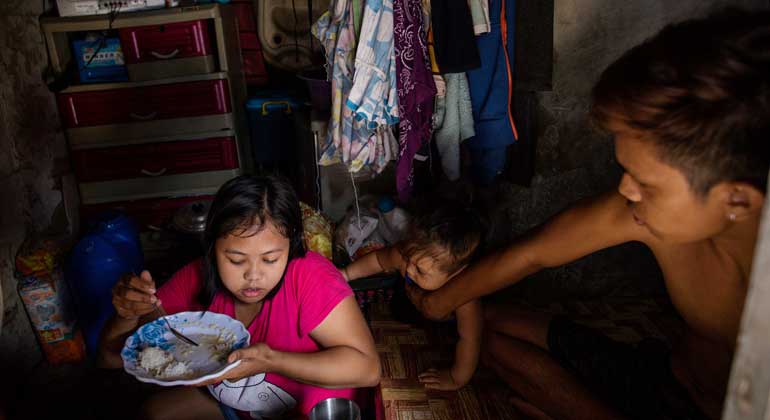
Number of Filipinos going hungry doubles on virus, survey shows

Hungry and hopeless: slum life a struggle in the lengthiest of lockdowns. Mary Jane Basbas, 21, and Jomar Santos, 23, attempt to feed their child in their shanty home, amid the coronavirus disease (COVID-19) lockdown, in Caloocan City, Metro Manila. — REUTERS

THE number of Filipinos going hungry has doubled in the past six months and more than 90% of its residents are experiencing stress as the country battles the coronavirus pandemic, according to a survey released Friday.

About 4.2 million people can’t afford to eat, soaring from December, while 91% of Filipinos aged 15 or older are feeling anxious, according to a Social Weather Stations poll conducted May 4 to 10.

Anti-virus lockdown restrictions since March have devastated jobs and hurt incomes in the Philippines, with the jobless rate surging to a record 17.7% in April. The country’s economy will contract this year, the World Bank forecast. While some businesses have been allowed to restart, many curbs remain in place particularly in the greater Manila region, which is the main driver of the economy.

President Rodrigo Duterte is set to decide on Monday whether more restrictions will be loosened. Transportation is still very limited in Manila, as the government seeks to boost activity while minimizing the risk of infections spreading. Total coronavirus cases, approaching 25,000, have risen faster this month than in May.

Interior Secretary Eduardo Año, vice-chair of the government’s virus response task force, said it may be necessary to maintain Manila’s general community quarantine status, CNN Philippines reported Friday. Another senior member of the task force, Defense Secretary Delfin Lorenzana, lent his support to a modified form of quarantine. He said in a virtual briefing that the level of quarantine restrictions will depend on the situation in the coming days, according to the report.

SWS surveyed 4,010 people using mobile phones and computer-assisted telephone interviews. The poll is non-commissioned. — Bloomberg

China vows to prioritize Philippines for coronavirus vaccine

China has pledged to prioritize the Philippines once it finds a vaccine for the novel coronavirus, Malacanang said in a statement on Friday, citing a phone call between the nations’ two leaders.

China has also promised to provide critical medical supplies and equipment to its neighbor in the battle against the global pandemic, while assuring the free flow of goods and services between them, according to the statement.

Chinese President Xi Jinping and President Rodrigo R. Duterte talked on the phone for 36 minutes on Thursday evening, during which they both vowed to “uphold peace, stability, prosperity and principles of international law, including the rule of law.”

Mr. Duterte has sought closer trade and investment ties with China since he became president in 2016, unlike his predecessor who sued China before an international court and won.

The United Nations arbitral court in the Hague favored the Philippines in that lawsuit, voiding China’s claim to more than 80% of the South China Sea based on a nine-dash line.

Mr. Duterte had vowed to pursue an independent foreign policy, announcing a pivot to China away from the US.

The tough-talking leader in February officially notified the US that he was ending a two-decade-old military pact with the US on the deployment of troops for war games.

Earlier this week, Mr. Duterte suspended the termination of the visiting forces agreement “in light of political and other developments in the region,” according to the Department of Foreign Affairs (DFA).

The suspension of the 21-year-old visiting forces agreement (VFA) is effective for half a year and may be extended by six more months, DFA told the US Embassy in a letter dated June 1.

Ending the VFA complicates Washington’s efforts to maintain an Asia-Pacific troop presence amid friction over the presence of US personnel in Japan and South Korea and security concerns about China and North Korea. — Gillian M. Cortez