Home Blog Page 9

Taiwan aims to be strategic AI partner in US tariff deal

REUTERS FILE PHOTO

TAIPEI — Taiwan aims to become a close strategic partner with the United States in the area of artificial intelligence (AI) after striking a deal to cut tariffs and boost its investment in the country, Vice Premier Cheng Li-chiun said on Friday.

The administration of President Donald Trump has pushed the major producer of semiconductors for greater investment in the United States, specifically in turning out chips that power AI.

“In this negotiation, we promoted two-way Taiwan–US high-tech investment, hoping that in the future we can become close AI strategic partners,” Mr. Cheng said in comments livestreamed from a press conference in Washington.

Mr. Cheng led the talks that clinched Thursday’s trade deal, which cuts tariffs on many of Taiwan’s exports, and directs new investments in the US technology industry, but it could also irritate China.

China regards democratically-ruled Taiwan as its own territory and strongly objects to high-level US-Taiwan exchanges. Taiwan rejects Beijing’s sovereignty claims.

US Commerce Secretary Howard Lutnick said Taiwan companies would invest $250 billion to boost production of semiconductors, energy and artificial intelligence in the United States.

The figure includes $100 billion already committed by chipmaker TSMC in 2025, with more to come, he added.

Taiwan will also guarantee an additional $250 billion in credit to facilitate further investment, the Trump administration said.

‘CLOSE PARTNERS’
Mr. Cheng called the deal “win-win”, adding that it would also encourage US investment in Taiwan. The United States is the island’s most important international backer and arms supplier, despite the lack of formal diplomatic ties.

The investment plan is company-led, rather than driven by the government, and Taiwan companies will continue to invest at home, Mr. Cheng added.

“We believe this supply-chain cooperation is not ‘move,’ but ‘build.’ We expand our footprint in the US and support the US in building local supply chains, but even more so, it is an extension and expansion of Taiwan’s technology industry.”

Investments would also cover AI servers and energy, Taiwan Economy Minister Kung Ming-hsin told reporters in Taipei, adding that it was up to companies to reveal the chip-related amounts.

TSMC ROLE
In a statement TSMC, the world’s main producer of advanced AI chips welcomed the prospect of “robust” trade pacts between the United States and Taiwan, adding that all its investment decisions were based on market conditions and customer demand.

“The market demand for our advanced technology is very strong,” it said. “We continue to invest in Taiwan and expand overseas.”

Once signed, the deal, will need to be ratified by Taiwan’s parliament, where the opposition has the most seats and which has expressed concern about the “hollowing out” of the crucial chip industry under a US trade deal.

The objective was to bring 40% of Taiwan’s entire chip supply chain and production to the United States, Mr. Lutnick told CNBC in an interview on Thursday. If they were not built in the United States, the tariff was likely to be 100%.

Mr. Kung said he did not know how the figure of 40% had been calculated but Taiwan estimated that by 2036, the production split between Taiwan and the United States would be 80/20 for the advanced chips, those of five nanometers and below.

“This round of deployment will strengthen the resilience of Taiwan–US and global semiconductor supply,” he said.

“A moderate level of global diversification is also necessary. Going forward, the biggest AI orders will come from the US market.”

The semiconductor investment was the largest in US history, Mr. Lutnick said in a post on X, alongside a picture of himself with Mr. Cheng, Taiwan’s top trade representative Yang Jen-ni and US Trade Representative Jamieson Greer.

“US advanced manufacturing coupled with this deal will bring chip production back home, create high-paying American jobs, and secure our economic and national security for decades,” he added.— Reuters

Brazil’s Bolsonaro transferred to roomier cell in new prison after judge’s order

EN.WIKIPEDIA.ORG

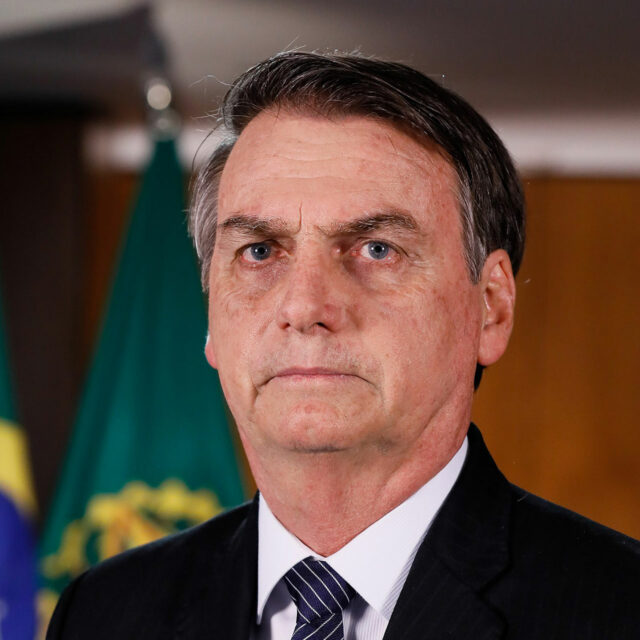
BRASILIA — Former Brazilian President Jair Bolsonaro was transferred on Thursday to Brasilia’s Papuda Penitentiary Complex, providing him with upgraded accommodations after an order from Supreme Court Justice Alexandre de Moraes, the court said.

Mr. Bolsonaro had been carrying out his 27-year sentence for plotting a coup in a much smaller cell at Brazil’s Federal Police Superintendency.

Mr. Bolsonaro’s legal defense did not immediately respond to a request for comment on the decision.

Mr. Moraes argued that Mr. Bolsonaro might be in better conditions to receive medical assistance and weekly visits from his family in the penitentiary complex than he had in the superintendency. The judge’s decision came after complaints from Mr. Bolsonaro’s family and lawyers about his condition at the cell.

Mr. Bolsonaro is set to serve his sentence in a building known as Papudinha, where other Brazilian politicians have been jailed, including Anderson Torres, Brazil’s Justice minister under his administration.

The ex-president’s new prison cell has about 65 square meters (699.65 square feet), bigger than the 12-square-meter-room he had been in up to this point. The cell includes a bedroom, a bathroom, a kitchen, a living room and an outdoor space, the court said, and added that he will serve his sentence alone.

Carlos and Eduardo Bolsonaro, sons of the former president, said in separate posts on social media that Mr. Bolsonaro should have been transferred to house arrest instead.

The far-right leader, who has a history of surgeries related to a stabbing he suffered in his abdomen during a 2018 campaign event, has been seeking permission to serve his sentence under “humanitarian house arrest”, which Mr. Moraes has denied, citing flight risk.— Reuters

South Korea’s ex-president Yoon faces first court ruling over martial law

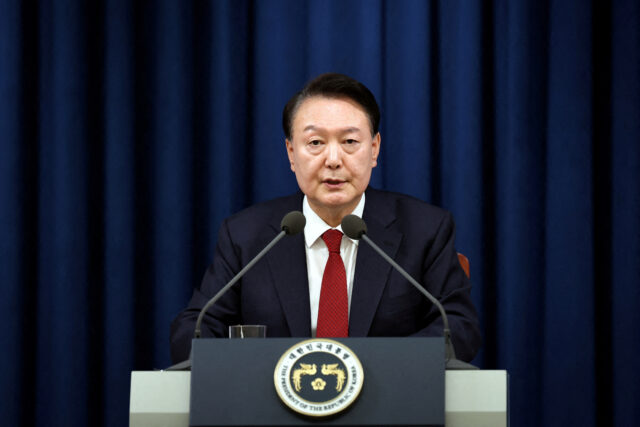
South Korean President Yoon Suk Yeol delivers a speech to declare martial law in Seoul, South Korea, December 3, 2024. The Presidential Office/Handout via REUTERS/File Photo

SEOUL — Former South Korean President Yoon Suk Yeol is due to face the first court ruling on Friday stemming from criminal charges over his failed martial law attempt, a case that could result in a long prison sentence if he is found guilty.

Mr. Yoon could receive a sentence of up to 10 years in jail if he is convicted on charges that include obstructing officials from executing an arrest warrant against him in January when he barricaded himself inside his residential compound and ordered the security service to block investigators.

He was finally arrested in a second attempt involving more than 3,000 police officers. His arrest was the first ever for a sitting president in South Korea.

Mr. Yoon, who is currently being held in the Seoul Detention Center, also faces allegations of falsifying official documents when he declared martial law in December 2024, claiming he planned to restore democratic order to the country that was under siege from the majority opposition and “anti-state” forces.

Separately, Mr. Yoon faces a number of other trials, including on a charge of masterminding insurrection. Prosecutors have asked the court to give him the death sentence on this charge, with a ruling scheduled for February.

Parliament, joined by some members of Mr. Yoon’s conservative party, voted within hours to overturn his surprise martial law decree and later impeached him, suspending his powers.

He was removed from office in April last year by the Constitutional Court that ruled he violated the duties of his office.

While his bid to impose martial law lasted only about six hours, it sent shockwaves through South Korea, which is Asia’s fourth-largest economy, a key US security ally and long considered one of the world’s most-resilient democracies.— Reuters

Trump accepts Nobel medal from Venezuelan opposition leader Machado

WWW.NOBELPRIZE.ORG

WASHINGTON — Venezuelan opposition leader Maria Corina Machado gave her Nobel Peace Prize medal to US President Donald Trump on Thursday during a White House meeting, as she tries to gain some influence over how the president shapes the South American country’s political future.

A White House official confirmed that Mr. Trump intends to keep the medal.

In a social media post on Thursday evening, Mr. Trump wrote: “Maria presented me with her Nobel Peace Prize for the work I have done. Such a wonderful gesture of mutual respect. Thank you Maria!”

Ms. Machado, who described the meeting as “excellent,” said the gift was in recognition of what she called his commitment to the freedom of the Venezuelan people.

Ms. Machado’s attempt to sway Mr. Trump came after he dismissed the idea of installing her as Venezuela’s leader to replace the deposed Nicolas Maduro. Mr. Trump openly campaigned for the prize before Ms. Machado was awarded it last month and complained bitterly when he was snubbed.

Though Ms. Machado gave Mr. Trump the gold medal that honorees receive with the prize, the honor remains hers; the Norwegian Nobel Institute has said the prize cannot be transferred, shared or revoked.

Asked on Wednesday if he wanted Ms. Machado to give him the prize, Mr. Trump told Reuters: “No, I didn’t say that. She won the Nobel Peace Prize.”

The Republican president long expressed interest in winning the prize and has at times linked it to diplomatic achievements.

The lunch meeting, which appeared to last slightly over an hour, marked the first time the two have met in person. Ms. Machado then met with more than a dozen senators, both Republican and Democratic, on Capitol Hill, where she has generally found more enthusiastic allies.

While the visit was ongoing, White House press secretary Karoline Leavitt said Mr. Trump had been looking forward to meeting Ms. Machado, but that he stood by his “realistic” assessment that she did not currently have the support needed to lead the country in the short term.

Ms. Machado, who fled Venezuela in a daring seaborne escape in December, is competing for Mr. Trump’s ear with members of Venezuela’s government and seeking to ensure she has a role in governing the nation going forward.

After the US captured Mr. Maduro in a snatch-and-grab operation this month, various opposition figures, members of Venezuela’s diaspora and politicians throughout the US and Latin America have expressed hope that Venezuela will begin the process of democratization.

HOPES OF A MOVE TO DEMOCRACY
Democratic Senator Chris Murphy, one of the senators who met with Ms. Machado, said the opposition leader had told senators that repression in Venezuela was no different now than under Mr. Maduro. Venezuela’s interim President Delcy Rodriguez is a “smooth operator” who was growing more entrenched by the day thanks to Mr. Trump’s support, he said.

“I hope elections happen, but I’m skeptical,” said Mr. Murphy, of Connecticut.

Mr. Trump has said he is focused on securing US access to the country’s oil and economically rebuilding Venezuela.

Mr. Trump has on several occasions praised Ms. Rodriguez, Mr. Maduro’s second-in-command, who became Venezuela’s leader upon his capture. In an interview with Reuters on Wednesday,  Mr. Trump said, “She’s been very good to deal with.”

Ms. Machado was banned from running in Venezuela’s 2024 presidential election by a top court stacked with Mr. Maduro allies. Outside observers widely believe Edmundo Gonzalez, an opposition figure backed by Ms. Machado, won by a substantial margin, but Mr. Maduro claimed victory and retained power.

While the current government has freed dozens of political prisoners in recent days, outside groups and advocates have said the scale of the releases has been exaggerated by Caracas.

In an annual address to lawmakers, Ms. Rodriguez called for diplomacy with the US and said should she need to travel to Washington, she would do so “walking on her feet, not dragged there.”

She also said she would propose reforms to her country’s oil industry aimed at increasing access for foreign investors.— Reuters

Philippine remittances slip to six-month low in November

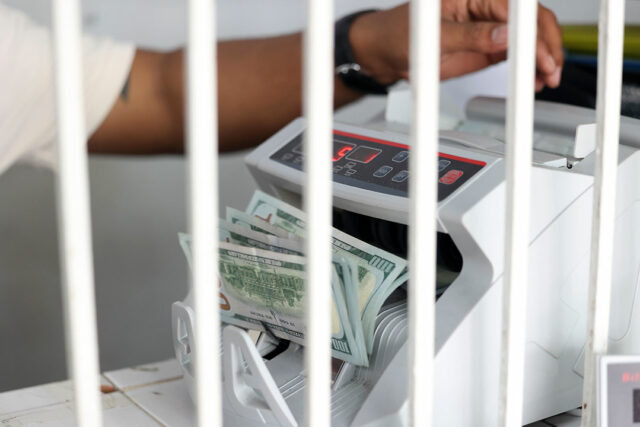
A money changer counts dollar bills at an establishment in Quezon City. The Philippine peso closed at a new record low of P59.46 against the US dollar on Thursday, Jan. 15. — PHILIPPINE STAR/MIGUEL DE GUZMAN

By Katherine K. Chan, Reporter

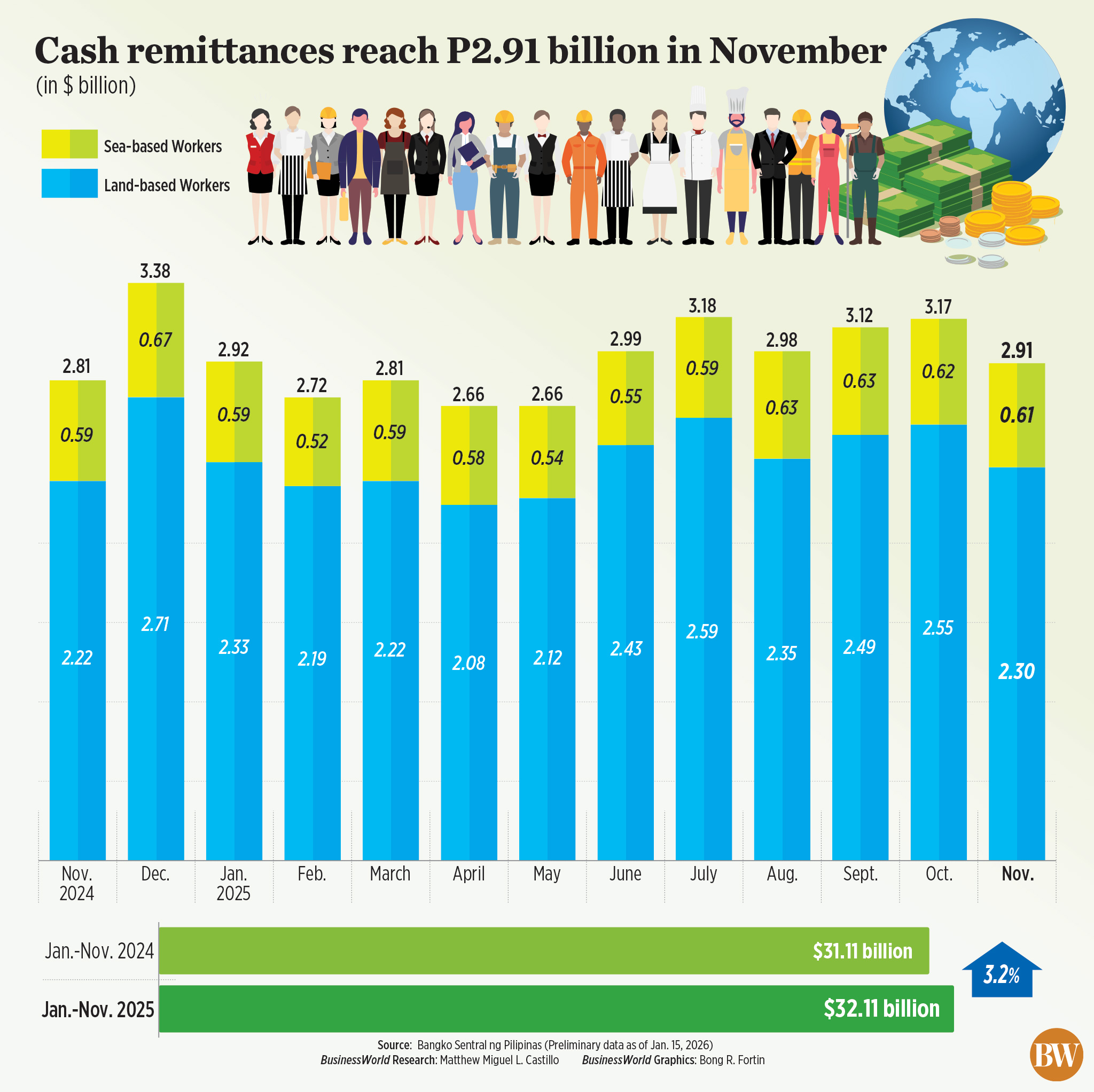
MONEY SENT HOME by overseas Filipino workers (OFW) fell to its lowest level in six months in November, the Bangko Sentral ng Pilipinas (BSP) reported.

Preliminary central bank data released on Thursday showed that cash remittances coursed through banks rose by 3.6% to $2.91 billion from $2.808 billion in the same month in 2024.

This was the lowest remittance level recorded in six months or since the $2.658 billion in May.

In terms of growth, November marked the fastest pace in two months or since the 3.7% in September.

Meanwhile, remittances declined by 8.2% from $3.171 billion in October.

“November’s dip is really just a timing story,” Jonathan L. Ravelas, a senior adviser at Reyes Tacandong & Co., said in a Viber message. “A lot of the holiday money was already sent in October, which is why we saw that month heavy with remittances — partly due to pre‑holiday transfers and even typhoon‑related aid being front‑loaded.”

Mr. Ravelas noted that the month-on-month dip was not a “red flag” as it is a usual trend seen before remittances surge in December.   

In November, land-based OFWs sent home the bulk of cash remittances, which went up by 3.6% year on year to $2.303 billion.

Remittances from sea-based workers likewise grew by an annual 3.6% to $606.592 million in November.

BSP data also showed that personal remittances, which include both cash coursed through banks and informal channels and in-kind remittances, rose by 3.6% to $3.235 billion in November from $3.121 billion in the previous year.

Metropolitan Bank & Trust Co. Chief Economist Nicholas Antonio T. Mapa said movements in the foreign exchange market likely drove the annual growth in remittances.

In November, the peso touched the P59-per-dollar level several times. It even closed at P59.17 against the greenback on Nov. 12, breaking the previous record of P59.13 seen on Oct. 28.

“Despite this development, remittances proved to be a solid and reliable source of FX (foreign exchange) while also translating into healthy purchasing power that likely helped drive holiday spending,” Mr. Mapa said in a Viber message.

11-MONTH CLIMB
As of November, cash remittances from migrant Filipinos reached $32.111 billion, climbing by 3.2% from $31.113 billion during the same period in 2024.

Remittances from land-based workers grew by 3.3% year on year to $25.66 billion as of end-November, while sea-based OFW remittances rose by 2.8% to $6.45 billion.

On the other hand, personal remittances in the 11-month period stood at $35.727 billion, up by 3.2% from $34.608 billion at end-November 2024.

“The United States remained the top source of remittances to the Philippines during January-November 2025, followed by Singapore and Saudi Arabia,” the BSP said in a statement.

Based on BSP data, money sent home from the US accounted for 40% of the remittances in the 11 months to November.

Inflows from Singapore made up 7.1% of the total remittances, followed by Saudi Arabia (6.4%), Japan (5%), the United Kingdom (4.6%), the United Arab Emirates (4.6%), Canada (3.5%), Qatar (2.9%), Taiwan (2.8%) and South Korea (2.4%).

The US was the top source of land-based remittances at end-November with 41.9% of total remittances. The rest came from Saudi Arabia (8%), Singapore (6.4%), the United Arab Emirates (5.7%) and the UK (4.5%).

Meanwhile, 32.2% of the remittances from sea-based workers were from the US, followed by Singapore (10.2%), Japan (7.1%), Germany (5.5%) and the UK (5.4%).

The BSP expects cash remittances to grow by 3% to $35.5 billion this year.

Philippines risks slowdown this year as election spending effect wanes

SHOPPERS purchase New Year’s Eve decorations in Divisoria, Manila, Dec. 27, 2025. — PHILIPPINE STAR/RYAN BALDEMOR

By Aubrey Rose A. Inosante and Katherine K. Chan, Reporters

THE PHILIPPINES risks losing economic momentum in 2026 unless reforms are carried out to extend the lift from election-related spending last year, according to a state think tank.

Growth last year has been partly driven by higher household consumption and public outlays tied to the elections, but that boost may fade once the political cycle ends, said John Paolo R. Rivera, a senior research fellow at the Philippine Institute for Development Studies (PIDS).

Without structural reforms, the economy could slow as temporary spending support unwinds, he told a webinar on Thursday.

“But for 2026, we might face post-election risks. Without reforms, momentum will fade, and sustainability depends on reforms, not on political cycles,” Mr. Rivera said.

The state think tank expects Philippine gross domestic product (GDP) to expand by 5.3% in 2026, within the government’s revised 5-6% growth target.

It also noted that Philippine GDP growth likely averaged 5% in 2025, below the government’s 5.5-6.5% target and slower than the actual 5.7% growth in 2024.

Mr. Rivera noted election years stimulate growth, but its effects are temporary and cyclical. For instance, infrastructure spending was frontloaded in early 2025 ahead of an election ban on public works.

“While fiscal expansions, such as those that we are seeing always during election periods, can temporarily stimulate the economy, and generate economic activities, they are not substitutes for structural reforms,” he said.

Mr. Rivera said good governance, transparency and accountability are needed to ensure the temporary boost from elections are converted into “durable, real and long-term gains.”

For this year, Mr. Rivera said the key headwinds or risks include a global economic slowdown and rising protectionism among developed economies.

“[Add to these] more frequent and severe climate-related shocks, fragile investment recovery, and persistent governance risk. We need to watch out for those headwinds,” he said.

At the same time, PIDS President Philip Arnold P. Tuaño said that election years in the Philippines have been associated with faster economic growth, with effects that often extend to the year immediately following the elections.

Between 2001 and 2024, average GDP growth during election years was 6.4%, compared with about 4.3% in non-election years, he said.

GDP grew by 6.9% in 2016 and 7.6% in 2022, supported by strong household expenditures and service activities, he said.

“Taken together, these studies remind us that while election years may provide temporal economic momentum, sustainable growth ultimately depends on credible governance, sound macroeconomic management, and institutions that endure beyond the political cycle,” he said.

RATE CUTS TO SPUR GROWTH
Meanwhile, recent monetary policy easing is expected to prop up domestic demand and boost growth this year, giving the Philippines an edge over its regional peers, Fitch Solutions unit BMI said.

BMI trimmed its growth forecast for the ASEAN-5 region, which is composed of Indonesia, Malaysia, the Philippines, Thailand and Singapore, to an average 3.8% for 2026, down from its earlier projection of 4.4%.

“In 2025, the ASEAN-5 benefited from the frontloading of exports,” BMI said in a report dated Jan. 12. “As this frontloading is paid back in 2026, however, we expect export growth to moderate across the ASEAN-5, weighing on regional growth.”

“However, we expect the Philippines and Indonesia to buck regional trends, with growth accelerating in 2026 as robust domestic demand offsets their relatively smaller, less-exposed external sectors,” it added.

The Fitch unit expects the Philippine economy to expand by 5.2% this year.

Also, BMI sees room for a 50-basis-point (bp) cut this year to bring the key policy rate at 4% or the lowest since August 2022.

It noted that a more accommodative monetary policy will help the economy recover from last year’s slump.

“For the Philippines, easier monetary policy will gradually feed through while infrastructure spending will rebound from the disruptions caused by the probe into misappropriated funds earmarked for flood control,” BMI said.

Severe flooding last year exposed multiple anomalous flood control projects nationwide, sparking public outrage and investigations that uncovered corruption among Public Works officials, lawmakers and private contractors behind the administration’s infrastructure program.   

The economy saw its weakest growth in over four years at 4% in the July-to-September period as the scandal slowed government spending and household consumption. As of the third quarter, GDP growth averaged 5%.

A dim growth outlook and weak investor sentiment, coupled with benign inflation, prompted the Monetary Board to deliver a fifth straight 25-bp reduction at the Dec. 11 meeting. This brought its total cuts to 200 bps since August 2024, lowering the benchmark interest rate to 4.5%.

Since then, the central bank has repeatedly said that they are approaching the end of the current easing cycle, with BSP Governor Eli M. Remolona, Jr. noting that the policy rate is already “very close” to where they want it to be.

However, Mr. Remolona left the door open for a sixth straight 25-bp cut, adding that a weaker-than-expected GDP growth could prompt them to slash key borrowing costs twice this year.

The Monetary Board is set to have its first rate-setting meeting for 2026 on Feb. 19.

Meanwhile, BMI noted that central banks across the region will likely be less aggressive in cutting rates as inflation is expected to pick up this year.

“Despite the generally less upbeat outlook for the ASEAN-5, we are still projecting fewer rate cuts in 2026, compared with 2025,” it said. “One reason is that inflation will rise back towards policy targets or long-term averages in 2026, lowering real policy rates across ASEAN-5.” 

BMI forecasts Philippine inflation to settle at 3.1% by yearend, slightly below the 3.2% seen by the BSP but at the midpoint of its 2%-4% target.

Job shortage tops worries of Philippine business leaders — WEF

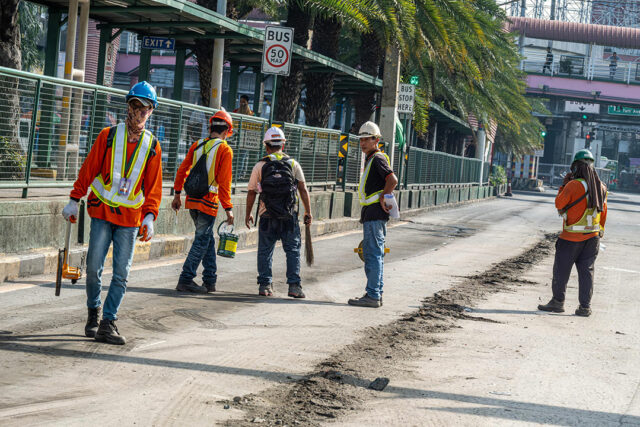
MEN are at work on a road project in Tondo, Manila, June 7, 2025. — PHILIPPINE STAR/NOEL B. PABALATE

A SHORTAGE of jobs is emerging as the biggest worry for Philippine business leaders, according to the World Economic Forum (WEF), a sign that economic growth risks falling short of what’s needed to absorb workers over the next two years.

Philippine executives ranked weak public services and social protection as their second concern in the WEF’s 2026 Global Risks Report, with respondents pointing to shortcomings in education, infrastructure and pension systems.

Business leaders also flagged the spread of misinformation and disinformation, unintended effects of artificial intelligence, and inflation as key threats to the economy.

Leonardo A. Lanzona, an economics professor at the Ateneo de Manila University, said the Philippine executives’ concern over jobs reflects the recent economic slowdown.

“As the economy screeches to a slowdown as a result of the decrease in government expenditures, aggregate demand decreases,” he said in a Messenger chat.

The lack of additional opportunities is also causing a number of businesses, particularly micro, small, and medium enterprises, to fail, Mr. Lanzona said.

“Consequently, this economic slowdown brings about significant unemployment,” he added.

In the first 11 months of 2025, the unemployment rate averaged 4.19% or equivalent to 2.25 million jobless Filipinos. This is higher than the 3.9% jobless rate, which is equivalent to 1.66 million in the same period in 2024.

“As most of the budget is eaten by debt, the situation is aggravated by lower social protection, political infighting, and a labor-saving technology such as AI (artificial intelligence) that can further reduce labor demand,” Mr. Lanzona said.

Meanwhile, the WEF report showed globally, the biggest risk over the next two years remained geoeconomic confrontation.

The WEF’s Global Risks Perception Survey captured insights from over 1,300 experts worldwide.

Other top risks cited by global business leaders included misinformation and disinformation, societal polarization, extreme weather events, and state-based armed conflict.

“Geoeconomic confrontation has emerged as the most severe risk over the next two years, while economic risks have experienced the sharpest rises among all risk categories over the two-year timeframe,” WEF Managing Director Saadia Zahidi said.

Rising inflation and potential asset worries rose as countries face high debt burdens and volatile markets amid growing concerns over an economic downturn, she said.

The WEF noted that 18% of surveyed participants identified geoeconomic confrontation as the top risk likely to trigger a material global crisis in 2026.

This was followed by state-based armed conflict (14%), extreme weather events (8%), societal polarization (7%), misinformation and disinformation (7%), and economic downturn (5%).

Meanwhile, over the next 10 years, survey participants expect extreme weather events to become even more severe. — Aubrey Rose A. Inosante

Gov’t partnerships with private sector seen to boost transparency in public works projects

Parts of Epifanio de los Santos Avenue (EDSA) in Pasay City are under rehabilitation in Pasay City on Thursday, Dec. 25, 2025, after the start of the EDSA rehabilitation project by the Department of Public Works and Highways-National Capital Region (DPWH-NCR). Heavy equipment is seen in the area as reblocking of damaged road sections and asphalt overlaying across the entire width of EDSA are being carried out from Dec. 24 to 27, 2025. — PHILIPPINE STAR/ RYAN BALDEMOR

By Aubrey Rose A. Inosante, Reporter

TAPPING PRIVATE and development partners for state infrastructure projects may help improve efficiency and transparency as the Philippine government continues to deal with the economic fallout from a corruption scandal linked to public works.

Public-Private Partnership (PPP) Center Executive Director and Undersecretary Rizza Blanco-Latorre, who took office on Dec. 11, said teaming up with private entities for infrastructure projects could be a “feasible” option for the government.

“(The) PPP option enables the public to harness private sector expertise while at the same time ensuring that project delivery is performance-based, has optimal risks allocation, and holds private partners accountable throughout the project lifecycle, she told BusinessWorld in a Viber message on Dec. 19.

The Marcos administration is facing governance concerns as a wide-scale controversy involving anomalous state flood control and infrastructure projects linked to Public Works officials, lawmakers, and contractors has highlighted the systemic corruption that continues to hamper the delivery of public services, weighing on the Philippines’ economic prospects.

In the third quarter of 2025, Philippine gross domestic product (GDP) growth slowed to a more than four-year low of 4% as the graft scandal stalled both public and consumer spending.

Analysts have said that minimizing the government’s monopoly over infrastructure projects could be a key to curbing corruption.

Under the PPP model, the government can grant subsidies, tax breaks, guaranteed revenues, or asset transfers to attract private sector partners to help fund, build, and operate projects.

“The PPP Center has established relevant project development and project management interventions, as well as capacity building support, to enable concerned implementing agencies to pursue the said PPP option,” Ms. Blanco-Latorre said.

The PPP Code enables projects usually funded by the national budget to be carried out through the model and also allows for both solicited and unsolicited proposals.

A solicited proposal refers to projects that are identified by the implementing agency from the list of their priority projects, for which bids are invited from the public, while an unsolicited proposal is submitted by private sector proponents without formal solicitation from the government.

“We reiterate, though, the critical need to diligently structure these projects as PPPs to ensure the viability of private sector participation, manage implementation risks, and truly secure the best deal for government and the public,” she said.

PPP Center data as of Dec. 19 showed that the project pipeline consists of 251 projects valued at P2.81 trillion, while 290 projects worth P3.61 trillion are under implementation.

Acting Budget Secretary Rolando U. Toledo said that both private and development partners could help the government plug infrastructure gaps, with public spending now undergoing greater scrutiny.

“Strategic use of PPPs and concessional financing can help restore credibility and accelerate delivery given the additional layer of review that is being undertaken here by the oversight agencies,” he said in a statement sent to BusinessWorld via Viber message on Dec. 20.

Proposed projects are reviewed through inter‑agency deliberations to assess viability, while ongoing projects are regularly monitored for performance, he said.

“Given the downturn in public infrastructure spending brought about by the flood control issues, it is important that private construction steps up to cover the gaps we are now facing in the infrastructure development.”

Mr. Toledo added that PPPs have “big potential” as private sector interest in undertaking projects has increased since the passage of the PPP Code. However, this also heightens the need for stronger preparation, transparency, and accountability mechanisms at all stages of project delivery.

GOVERNANCE RISKS
Infrastructure investment is a “critical” contributor to GDP as it directly contributes to output and has multiplier effects that can boost economic growth, Asian Development Bank (ADB) Country Director for the Philippines Andrew Jeffries said in an e-mailed statement on Dec. 18.

“There remains a need for public investment at scale to address critical infrastructure gaps — particularly in transport, energy, and digital connectivity — to strengthen the Philippines’ competitiveness as a destination for private investment,” he said.

“The greatest risk with a sustained reduction in public expenditure is if critical investment needs are not met, in turn depressing the country’s overall competitiveness and productivity. Regardless of the source of funds, execution and governance risks need to be managed to ensure the quality of infrastructure spending.”

Mr. Jeffries said the government should prioritize investments in social infrastructure where commercial returns are not attractive for private sector players.

“Private sector investment can increase efficiency and help in effective technology transfers. Multilateral development bank financing can be a source of long-term stable financing and best practices, and help deliver strong governance,” he added. “As the Philippines approaches upper middle-income country status, the private sector will need to play an increasingly significant role in driving innovation, job creation, and growth.”

The ADB is ready to support Philippine infrastructure development through both financing and policy support, Mr. Jeffries said.

“This support includes the ability to provide large-scale financing coupled with strong oversight of procurement, financial management, and project implementation. ADB’s support goes well beyond infrastructure project lending, however, and includes policy support and technical assistance to improve regulatory frameworks and the ease of doing business,” he said.

Improving the enabling environment for private investments and PPPs is also part of the ADB’s key support areas for the Philippines, he added.

“At the same time, recent issues also underscore that PPPs are not a substitute for strong public sector planning, governance, and oversight. In practice, the feasibility of an expanded PPP role will closely depend on sustained improvements in upstream project preparation, transparent and competitive procurement, and credible regulatory frameworks,” he said.

“Without these foundations, transferring more responsibility to private firms could shift — rather than reduce — project risks and costs.”

Nigel Paul C. Villarete, a senior adviser on PPPs at technical advisory group Libra Konsult Inc., said that it is necessary for a developing economy like the Philippines, whose spending requirements far exceed its capacity to generate revenues, to open the door for increased private sector participation in infrastructure projects while having the appropriate safeguards in place.

“While we do have a sizeable and increasing chunk of private sector investments, our annual development expenditures are still mostly public. But the possibility of boosting private investments in nation-building remains available and even necessary,” he said in a Viber message on Dec. 20. “We’re not placing or changing priority from one to the other — we’re just making use of available financing opportunities to support the main public fiscal spending, which should continue as the main source.”

However, the government must rebuild investor trust by implementing reforms, he said.

“As always investor confidence is key. No one will shell out money when uncertainties remain, more so when these include possible corruption issues. That’s why clear and proper rules and guidelines are necessary, [with] ambiguities minimized or even completely erased,” Mr. Villarete said.

“We also need to understand that private sector financing will be attractive when the private sector is allowed to generate an attractive rate of return. This is where the balance comes in. PPPs must be both attractive and safe for all sectors.”

Mr. Toledo also acknowledged that improving investor sentiment is key to ensuring the economy’s recovery amid the corruption mess.

“The main risk is if investors’ confidence remains low and therefore, it would not provide the needed boost to the GDP growth,” he said.

“Over the short term, growth outcomes will still depend on the government’s ability to instill confidence through its efficient spending and credible policies in addressing corruption.”


UAE-based G42 eyes up to $500-M investment in PHL data center — DICT

STOCK PHOTO | Image DC Studio from Freepik

THE PHILIPPINES is attracting renewed interest from global data center operators, with Abu Dhabi-based technology firm Group 42 Holding Ltd. (G42) planning to invest as much as $500 million (around P29.6 billion) in a new facility.

Department of Information and Communications Technology (DICT) Secretary Henry Rhoel R. Aguda said G42, which expressed interest toward the end of the Philippine delegation’s recent trip to Abu Dhabi, is considering an investment of $300 million to $500 million over three to five years.

“They still have a lot to do. They need to come to the Philippines and check the availability of land. With data centers, you also need power and water,” Mr. Aguda told a Palace briefing.

Combined with multiple international subsea cables linking the Philippines to global routes, the country is positioned as a potential data center hub in Southeast Asia.

Data center operators view the Philippines’ geography and connectivity as strategic, Mr. Aguda said, noting that strong digital infrastructure could allow the country to eventually export artificial intelligence (AI) services, treating AI computing like a utility delivered from local facilities.

“As for connectivity, they’re essentially already sold on that — it’s not a problem. The Philippines has many international subsea cables coming in from the north-south, northeast, and southwest routes,” he added.

Investors have also been encouraged by the near completion of the national fiber backbone, which runs from north to south, and the Luzon Bypass Infrastructure, which strengthens east-west connectivity.

Connectivity is no longer a constraint, Mr. Aguda said, with remaining considerations focused on securing suitable land with reliable power and adequate water access — key requirements for large-scale data centers.

President Ferdinand R. Marcos, Jr. was in the United Arab Emirates (UAE) earlier this week to witness the signing of a trade deal and a defense pact. During his trip, he and Mr. Aguda met with tech firm DAMAC Digital, which is exploring plans for what may become the country’s largest data center in Laguna.

The administration is offering priority support for the sector as part of its strategy to attract capital into high-value, tech-driven industries and position the Philippines as a regional hub for digital infrastructure amid rising demand from e-commerce, digital payments, and AI.

DAMAC Digital has committed over $3 billion to Southeast Asia and plans 250 megawatts of operational capacity in the region by 2026. — Chloe Mari A. Hufana

Meralco sees interest from top power firms for 200-MW RE supply

PHILIPPINE STAR/RYAN BALDEMOR

SUBSIDIARIES of ACEN Corp., First Gen Corp., San Miguel Global Holdings Corp. (SMGP), and Aboitiz Power Corp. (AboitizPower) are looking to bid for Manila Electric Co.’s (Meralco) 200-megawatt (MW) renewable energy (RE) supply requirements.

All 15 companies that expressed interest and attended Thursday’s pre-bid conference were major players in the country’s power sector.

Ayala-led ACEN Corp., along with its subsidiaries SanMar Solar, Negros Island Solar, and Sinocalan Solar Power, indicated interest in supplying Meralco’s renewable energy needs.

Lopez-led First Gen and its subsidiaries, including First Gen Hydro, Energy Development Corp., BacMan Geothermal, and Greencore Geothermal, also participated in the conference.

SMGP subsidiaries Mariveles Power Generation, and Sual Power expressed their interest in joining the bidding.

Aboitiz Power Corp.’s subsidiaries, including AP Renewable Energy, GNPower Mariveles Energy Center, Therma Luzon, and Therma Visayas, are also expected to participate. GNPower Kauswagan is owned by Power Partners, a partner of AboitizPower.

AboitizPower, SMGP, First Gen, and ACEN were the country’s leading power producers, dominating the national market share last year, according to the Energy Regulatory Commission (ERC).

Since the bid submission deadline on Feb. 16 is after the proposed effective date of Jan. 26, Meralco said the latter will be moved depending on when the ERC approves the resulting power supply contract.

The four-year agreement aims to help Meralco comply with the Renewable Portfolio Standards, which require distribution utilities to source a portion of their electricity from eligible renewable energy sources.

Suppliers, whether renewable, conventional, or a combination, can fulfill the supply requirements from their own plants or the spot market, provided that renewable energy certificates (RECs) are guaranteed. Each REC represents a megawatt-hour of electricity generated from eligible RE sources.

“As a highly regulated entity, Meralco remains fully committed to upholding the highest standards of transparency, fairness, and regulatory compliance throughout the CSP (competitive selection process),” said Lawrence S. Fernandez, chairman of Meralco’s bids and awards committee for power supply agreements.

Meralco’s controlling stakeholder, Beacon Electric Asset Holdings, Inc., is partly owned by PLDT Inc. Hastings Holdings, a unit of PLDT Beneficial Trust Fund subsidiary MediaQuest Holdings, has an interest in BusinessWorld through the Philippine Star Group, which it controls. — Sheldeen Joy Talavera

Basic Energy earmarks P1.9B for 43-MW solar project in Negros

STOCK PHOTO | Image from Pixabay

LISTED Basic Energy Corp. is allocating around P1.9 billion for the development of a 43.41-megawatt alternating current (MWac) solar power project in Cadiz City, Negros Occidental.

In a disclosure on Thursday, the company said it received a certificate of award from the Department of Energy (DoE) following its successful bid in the fourth round of the green energy auction (GEA-4).

GEA-4 projects cover technologies such as ground-mounted, roof-mounted, and floating solar; onshore wind; and integrated solar with energy storage systems.

“With the receipt of the certificate of award, the company is advancing the completion of the remaining project requirements, including the execution of the necessary agreements, in preparation for the development and delivery of the project to the Visayas grid,” Basic Energy said.

The solar project is slated to begin commercial operations on or before the end of the year.

Basic Energy Chief Executive Officer Oscar L. de Venecia, Jr. said construction has not yet started, as the company is completing remaining pre-development requirements. The start of construction will follow once these requirements are finalized, in line with the project’s overall development timeline. 

“The company is mindful of the project’s delivery commitment and is managing the development work accordingly. However, construction will only commence after the remaining pre-development requirements are completed,” he said.

Last year, he said the company allocated up to P300 million to finance pre-development activities for its renewable energy projects over the next two to three years.

Basic Energy is pursuing three solar projects with a combined potential capacity of around 150 MW and aims to build a 1-gigawatt renewable energy portfolio by 2030.

At the local bourse on Thursday, shares of the company rose 8.06% to close at P0.134 per share. — Sheldeen Joy Talavera

Peso slips to fresh record low on rate cut bets

BW FILE PHOTO

THE Philippine peso weakened to a new record low against the dollar on Thursday as markets priced in the possibility that the Bangko Sentral ng Pilipinas (BSP) could cut interest rates ahead of the US Federal Reserve.

The local currency closed at P59.46 a dollar, down two centavos from Wednesday’s record-low finish of P59.44, data from the Bankers Association of the Philippines showed.

The peso opened Thursday’s session slightly stronger at P59.43, touched an intraday high of P59.35, and weakened to as low as P59.47. Dollar trading volume rose to $1.079 billion, higher than the $951 million recorded the previous day.

“The dollar-peso closed higher on prospects of a narrowing interest rate differential, with the BSP expected to cut rates before the Fed,” a trader said by telephone.

Another trader said the peso continued to soften after recent US producer inflation and retail sales data underscored the resilience of the American economy, reinforcing expectations that the Fed will keep policy rates unchanged in the coming months.

Rizal Commercial Banking Corp. Chief Economist Michael L. Ricafort said market expectations of a BSP rate cut at its February policy meeting also weighed on the peso.

BSP Governor Eli M. Remolona, Jr. said last week that a rate cut at the Monetary Board’s Feb. 19 meeting “remains on the table” but is “unlikely,” as the central bank is nearing the end of its easing cycle.

The BSP has reduced its benchmark rate by a total of 200 basis points since August 2024, bringing the policy rate to a more than three-year low of 4.5%.

Despite the peso’s weakness, the BSP sees no need for immediate intervention. Palace Press Officer Clarissa A. Castro said the central bank continues to closely monitor exchange-rate movements and is prepared to act if necessary.

“The Bangko Sentral ng Pilipinas continues to monitor the peso-dollar exchange rate so it can take appropriate action if needed,” she told a news briefing in Filipino. “For now, the central bank is confident that intervention is not required.”

She said the peso’s depreciation reflects global developments, including the strength of the US dollar driven by expectations on Fed policy and geopolitical tensions abroad.

The government is working to mitigate the impact of a weaker peso by slowing price increases, supporting investments, and strengthening key economic sectors, she added.

MUFG Global Markets Research Senior Currency Analyst Michael Wan said the peso might remain more sensitive to oil price movements than some of its regional peers, although further oil price increases are not his base case scenario.

“Further oil price increases is not our base case, and we will look to see if the peso retraces some weakness on these recent oil price moves,” he said.

Traders said the peso could continue testing record lows until the BSP and Fed hold their respective policy meetings, unless the US central bank signals a shift toward rate cuts.

However, movements will remain data-dependent, particularly on US inflation and labor market indicators. 

For Friday, the first trader sees the peso trading from P59.20 to P59.50 a dollar, while the second trader expects a range of P59.25 to P59.50.

Mr. Ricafort said the local currency could move from P59.35 to P59.55, noting that strong foreign exchange reserves and continued net foreign buying in the local stock market might help cushion further depreciation. — Aaron Michael C. Sy