Home Blog Page 899

FEU-NRMF joins Healthway Medical Network

AYALA HEALTHCARE HOLDINGS, INC.

THE FAR EASTERN UNIVERSITY – Nicanor Reyes Medical Foundation (FEU-NRMF) Medical Center is now officially part of the Healthway Medical Network following an agreement in 2023.

The hospital, now known as Healthway FEU-NRMF Medical Center, has over 540 accredited doctors across 11 clinical departments, with 10 residency training programs and five fellowship training programs, Ayala Healthcare Holdings, Inc. (AC Health) said in an e-mailed statement over the weekend.

Healthway FEU-NRMF Medical Center’s key specializations include Cardiology, Neurology, Nephrology, Oncology, Obstetrics & Gynecology, and Surgery. It was founded in 1952 in Morayta and relocated to Quezon City in 1999.

“As the Healthway FEU-NRMF Medical Center officially becomes part of AC Health’s integrated ecosystem, we look forward to greater collaboration and synergy across our growing network of hospitals, clinics, and pharmacies as well as the broader Ayala ecosystem,” AC Health President and Chief Executive Officer (CEO) Paolo Maximo F. Borromeo said.

AC Health, through Healthway Medical Network, partnered with FEU-NRMF in November 2023. The partnership included a management agreement of up to 24 months starting January 2024 to be followed by the full turnover of hospital operations under a 35-year lease agreement.

“The Healthway FEU-NRMF Medical Center represents a renewed commitment to quality and accessible healthcare — rooted in legacy but focused on the future. It is a recognition that great institutions must continue to evolve to meet the needs of the people they serve,” AC Health Chairman Fernando Zobel de Ayala said.

“With this transition, we reaffirm our commitment not only to patient care, but to continuing that legacy of education and professional excellence,” he added.

Meanwhile, Healthway Medical Network President and CEO Jaime “Jimmy” E. Ysmael said the Healthway FEU-NRMF Medical Center strengthens the company’s presence in Quezon City.

“With our ‘Care Beyond Cure’ philosophy, we go beyond treating illness; we focus on nurturing overall well-being and delivering compassionate, human-centric care throughout the patient journey. This partnership allows us to extend that promise to even more communities,” he said.

The Healthway Medical Network, the clinics and hospitals group of AC Health, consists of four full-service hospitals and an ambulatory center, 15 Healthway Multi-Specialty Centers, and the Healthway Cancer Care Hospital.

AC Health is the healthcare subsidiary of Ayala Corp. — Revin Mikhael D. Ochave

Maserati MCPura to build on MC20 legacy and more

The Maserati MCPura supercar, powered by a V6 mill, is available in coupé and convertible versions — the latter known as Cielo.

MASERATI recently held the world premiere of the latest descendant of its MC20 super sportscar at the Goodwood Festival of Speed 2025. The MCPura, said to be 100% made in Modena “from development to production” — at the historic factory on Viale Ciro Menotti — is the “manifesto of the Trident’s characteristics of performance, elegance, and sportiness.”

The Italian marque, in a release, insisted that the MCPura “symbolizes a return to the origins of the Trident’s DNA: pure speed, pure luxury, and pure passion,” still powered by Maserati’s iconic V6 Nettuno mill.

The MCPura is being purveyed as inspired by Albert Einstein’s theory of relativity: “the new car is equated with the energy it can express if elevated to itself, i.e., to its purest form. In short, the essence of performance the Maserati way,” said the company.

The model comes in both coupé and convertible versions — the latter known as Cielo and which features a “retractable electric roof in polymer dispersed liquid crystal (PDLC) glass, the first to do so in its class, with the ability to switch from opaque to transparent in one second.”

A “shark nose” invokes a long history of racing single-seaters “that made the Modena car manufacturer a legend.” Maserati said its designers modified the appearance to accentuate it even more. The front bumper takes a stylistic cue from the GT2 Stradale, as with the rear which has a new oversized spoiler as an option.

The lower fascia, however, has been “completely revamped and designed specifically for the MCPura with aesthetic solutions capable of improving the aerodynamic performance of the car’s floor.”

The MCPura’s seats are laser-etched in Alcantara Ice, and “bring out the Trident with brand-new graphics. The resulting image is both futuristic and sporty with a double-sided backing, an iridescent red with blue and an iridescent blue with red, which enhances the forms and takes up the same shades of the exterior details.”

Before the official launch, Maserati teased the MCPura via an online presentation exclusive to select members of the international media. “Velocity” was among those invited.

From a campaign standpoint, the MCPura is said to embody “pure emotional energy” and allow buyers to “experience the luxury of driving Italian,” while offering a “pure and unfiltered” bond between car and driver.

Powering it is the aforementioned Nettuno engine, which is marked by a V 90-degree architecture. Swept volume of the six-cylinder, twin turbo is at three liters, and the mill submits 621hp at 7,500rpm, and 720Nm from 3,000rpm. Derived from Formula 1, the Nettuno has a pre-chamber combustion system with twin spark plugs. Each horsepower needs to move on 2.3 kilograms.

Asked if Maserati will again offer a V8 engine in a future product, an official replied: “From a technical standpoint, the Nettuno is a wonderful engine with many innovations. (It has) everything we need to deliver the best driving experience. We know the mood about the V8 in the market. We won’t say we’ll never use it again, but the Nettuno is very much at the center of (our) propulsion strategy at the moment.”

Replying to a question from this writer on how the MCPura builds on the MC20 legacy and evolves it, an official said, “The MC Pura continues the MC20 tradition in terms of a super sportscar. What makes it different is really the engine, the V6 engine with fabulous power. At the end of the day, we try to optimize the gran turismo factor. Maserati’s position is rooted in gran turismo. It’s a way of driving, feeling, comfortable with high performance.”

The Maserati MCPura is claimed to have a top speed exceeding 325kph, and musters a standstill-to-100kph time of around 2.9 ticks.

At the end of the day, Maserati wants the MC Pura to be known for its lightness and “very strong power,” that the one behind the wheel will feel like a pro driver. — Kap Maceda Aguila

Puma inventory headache highlights US tariff dilemma for retailers

PUMA faces a dilemma in the United States: after rushing shipments from Asia to beat incoming tariffs, the German sportswear brand is now discounting to clear stock, while planning to lift prices this year to offset rising costs.

The conflicting pressures reflect a broader challenge for retailers trying to make sure US shelves are stocked for the crucial back-to-school and holiday seasons and looking to hike prices even as demand is softening. Puma, which warned of an annual loss on Thursday, said it was cutting orders and planning to raise prices in the fourth quarter to lessen the impact of tariffs, which it estimates will take 80 million euros ($93.78 million) off its annual gross profit.

“Elevated inventory levels on our balance sheet are leading to lower full price realization,” Chief Financial Officer Markus Neubrand told journalists on Friday. “In response, we’ve adjusted our future orders to better match expected demand.”

At the end of the second quarter, Puma’s inventories were up 18.3% in currency-adjusted terms compared with the previous year, hitting 2.151 billion euros, mostly driven by North America.

But North America was also Puma’s weakest region over the last three months, with sales down 9.1% in currency-adjusted terms. Puma now expects global sales to fall this year by at least 10%, further heightening the inventory problem.

“The idea to front load imports into the US was a sensible tactical position given uncertainty, but it does come with the risk of increased discounting in a weak market,” said Adam Cochrane at Deutsche Bank Research.

Puma’s plan to reduce orders should help bring inventories down, but also reflects weaker demand from retailers, Mr. Cochrane added.

Puma generates three-quarters of its revenue from wholesale, and sales through that channel fell 6.3% in the second quarter. The company does not break out US figures, but the market accounts for around 20% of global sales.

“Looking specifically at the US, the ability to push through price increases not only appears challenging in the context of higher inventories… but also given Puma’s muted brand momentum in the region amid an increasingly competitive environment,” said Felix Dennl, analyst at Metzler in Frankfurt. Industry leader Nike raised some US prices in May, while Lululemon and On have also flagged increases, as brands adapt to paying more for their imports.

“One of the key outstanding questions is how consumers will respond to the price increases, especially since the last major inflationary episode during COVID was partially cushioned by stimulus vouchers which may have dampened price sensitivity at the time,” said UBS Analyst Robert Krankowski.

Puma was struggling even before tariffs, with products such as the relaunched Speedcat sneaker not selling as well as expected.

Chief Executive Officer Arthur Hoeld, in charge since July 1, warned 2025 would be a “reset” year and 2026 a “transition,” as he attempts a turnaround after predecessor Arne Freundt failed to revive sales.

Puma’s balancing act is one shared by all retailers in the US, where memories of record inventory pile-ups in 2022 in the wake of pandemic supply chain disruptions are still fresh. The glut that triggered deep discounting and dented profits is a situation retailers are anxious to avoid repeating. — Reuters

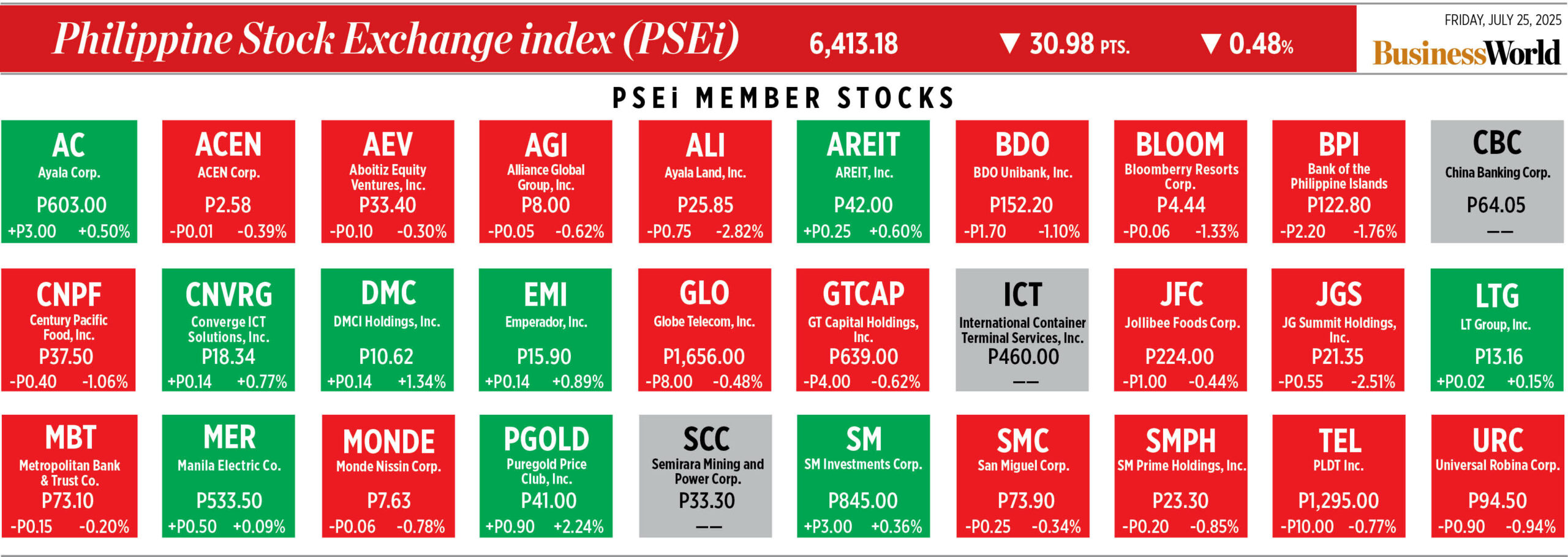
How PSEi member stocks performed — July 25, 2025

Here’s a quick glance at how PSEi stocks fared on Friday, July 25, 2025.


Scorecard: Philippine Development Plan 2023-2028

THREE YEARS into his presidency, President Ferdinand R. Marcos, Jr. faces mounting public frustration as Filipinos say many of the promises he made during his 2022 campaign remain unfulfilled. Read the full story.

Scorecard: Philippine Development Plan 2023-2028

SONA, firms’ results in focus as mart seeks leads

REUTERS

PHILIPPINE SHARES may move sideways this week, with President Ferdinand R. Marcos, Jr.’s fourth State of the Nation Address (SONA) on Monday taking center stage and as investors await more corporate results.

On Friday, the Philippine Stock Exchange index (PSEi) went down by 0.48% or 30.98 points to close at 6,413.18, while the broader all shares index retreated by 0.3% or 11.52 points to 3,796.87.

Meanwhile, week on week, the PSEi jumped by 1.74% or 109.46 points from the 6,303.72 finish on July 18.

“Despite the onslaught of typhoons Dante and Emong, the PSEi remarkably rallied… defying global anxieties over US tariffs,” online brokerage 2TradeAsia.com said in a market note.

“The local market made a comeback last week, regaining its ground above the 6,400 level as bargain hunters take opportunities. However, trading last week was tepid, implying that the climb did not have strong conviction,” Philstocks Financial Inc. Research Manager Japhet Louis O. Tantiangco said in a Viber message.

For this week, the market will look for fresh leads, with the spotlight expected to be on Mr. Marcos’ SONA, he said.

“Detailed plans on how to keep inflation low and how to re-accelerate economic growth may boost investors’ sentiment,” Mr. Tantiangco said.

In the first quarter, Philippine gross domestic product (GDP) grew by 5.4%, weaker than expected and slower than the 5.9% expansion in the same quarter last year.

Economic managers last month lowered the full-year GDP growth target to 5.5%-6.5% from 6%-8% previously.

“Investors are also expected to watch out for the upcoming second quarter corporate reports. Robust results are expected to lift the local market,” he added.

Mr. Tantiangco put the PSEi’s major resistance at 6,600 after the index was able to re-establish support at 6,400 last week.

“However, it is having a hard time securing position above its 200-day exponential moving average (EMA). Moving forward, the 200-day EMA could be tested further,” he said. “The market’s moving average convergence/divergence line is about to cross above the signal line. If this proceeds, it will signal positive momentum for the bourse.”

For its part, 2TradeAsia.com put the PSEi’s immediate support at 6,300 and resistance at 6,600.

“The week ahead demands balancing portfolio resilience against global and local headwinds. We reiterate our call to prioritize high-liquidity, domestically focused valued stocks to navigate near-term risks while capitalizing on BSP’s (Bangko Sentral ng Pilipinas’) supportive policy,” it said. 

“In these trying times, stay vigilant for potential pivots into hedge plays should inflation surprise. Markets favor the prepared — seize opportunities with caution and prudence,” 2TradeAsia.com added. — Revin Mikhael D. Ochave

I Squared Capital pledges $1B more in PHL infra investment

I SQUARED CAPITAL has committed an additional $1-billion investment in critical infrastructure projects in the Philippines, the Office of the Special Assistant to the President for Investment and Economic Affairs (OSAPIEA) said.

Secretary Frederick D. Go, who heads OSAPIEA, said I Squared’s commitment reflects the country’s growing appeal to infrastructure investors.

“These investments will improve lives — from powering homes and businesses with renewables to ensuring safer food through modern cold storage and connecting people and enterprises in the digital age,” he said in a statement over the weekend.

OSAPIEA said the US private equity firm has committed to advance critical projects across energy transition, transport and logistics, and digital infrastructure.

“I Squared has invested over $1 billion in project enterprise value in the Philippines and shared its plans to invest an additional $1 billion in critical infrastructure projects for the nation,” it added.

To date, I Squared is advancing seven strategic investments in the Philippines, including two in the last six months.

These are Aggreko Philippines, HEXA Renewables, Berde Renewables, Royale Cold Storage, Philippine Coastal Storage & Pipeline Corp., HGC, and BDX.

According to OSAPIEA, Aggreko Philippines has so far invested $200 million in modular power and is planning to double this investment, meaning HEXA Renewables is targeting an additional $350-million investment by 2027.

Meanwhile, I Squared is hoping to significantly increase Royale Cold Storage’s capacity in the near term.

“We are proud to partner with the Philippines on its infrastructure transformation,” I Squared Chairman and Managing Partner Sadek Wahba said.

“Our investments are delivering energy security, food resilience, and digital connectivity — building the foundation for inclusive economic growth and long-term prosperity,” he added.

I Squared is among the companies President Ferdinand R. Marcos, Jr. met with in his recent trip to the US. — Justine Irish D. Tabile

PHL trade concessions to US won’t ‘harm’ domestic producers, DA says

Farmers are seen in a rice field in Bustos, Bulacan, Oct. 17, 2023. — PHILIPPINE STAR/KJ ROSALES

THE Department of Agriculture (DA) said it has been assured by Philippine trade negotiators that no concessions will be made to the US that will harm domestic producers of agricultural goods.

Agriculture Secretary Francisco P. Tiu Laurel, Jr. said the reassurance covers rice and sugar, which the Philippines does not import from the US, as well as corn, chicken, fish, and pork.

Left out of his list is wheat, which the Philippines does not produce in commercial quantities, which domestic industries use for food production and animal feed.

The Philippine negotiating team, led by Secretary Frederick D. Go, who heads the Office of the  Special Assistant to the President for Investment and Economic Affairs, and Trade Secretary Maria Cristina Aldeguer-Roque, made the reassurances as they negotiate the technical details of the preliminary trade deal with the US, under which Philippine exports pay a US tariff of 19%.

President Donald J. Trump last week said the Philippines has granted duty-free access to some US imports.

The DA, citing Malacañang, said a final trade agreement is still being hammered out by trade negotiators.

“Secretary Go… assured the Philippines has not made any concessions that would harm local producers,” it said.

The Philippine negotiating team has said that any trade agreement “must strike a balance between improving market access and safeguarding the livelihoods of Filipino workers and farmers,” the DA said. — Kyle Aristophere T. Atienza

Rural dev’t NGO backs law setting palay farmgate floor at P25 per kilo

PHILIPPINE STAR/KRIZ JOHN ROSALES

THE 20th Congress needs to devote significant attention to stabilizing the rice industry, in particular a measure that will set a floor price of P25 per kilogram (kg) for palay, or unmilled rice, the Integrated Rural Development Foundation (IRDF), a non-government organization (NGO)  said.

In a statement, the IRDF said the “primary driver” of the current crisis is the Rice Tariffication Law of 2019, which removed restrictions on private-sector rice imports. In exchange, importers were required to pay tariffs on their shipments, set initially at 35% and since reduced to 15%.

The price of palay at the farmgate level has been recorded at P10 per kg in some areas, below the average production cost of P14.52 per kg estimated in 2024 by the Philippine Statistics Authority (PSA),

Production costs are also rising because of more expensive fuel and inputs, the IRDF added.

In 2024, the Philippines became the world’s largest rice importer, bringing in a record 4.8 million metric tons (MMT) of rice.

House Bill No. 1, or the proposed RICE Act, seeks to restore some regulatory powers to the National Food Authority (NFA), but the IRDF said “farmers remain exposed to price volatility and income uncertainty” if the NFA cannot influence the market with floor prices and grain procurement.

The IRDF called for a comprehensive law that provides integrated production, marketing and post-harvest support to rice farmers.

The 20th Congress should restore and strengthen the power of the NFA to regulate imports and intervene in the market to stabilize prices and buy palay at support levels, it said.

The IRDF supports the repeal of the Rice Tariffication Law, replacing it with a proposed Rice Industry Sustainable Development Act that sets the minimum farmgate price for palay at P25 per kg.

The floor price will help farmers earn at least P50,000 per hectare each harvest, equivalent to about P16,000 per month, thereby incentivizing continued planting and increasing yields.

It also supports legislation enabling the NFA to procure  10%-20% of the palay harvest. — Kyle Aristophere T. Atienza

Davao airport upgrade seen completed by 2026

CAAP

THE Department of Transportation (DoTr) said it expects to complete the P650-million upgrade of the Davao International Airport by the end of 2026.

The airport project covers the 48% expansion of the passenger terminal to 25,910 square meters by December 2026, the DoTr said, thereby raising seating capacity in the terminal to 1,500 passengers.

The government is currently evaluating an unsolicited proposal for the airport’s operations and maintenance.

The Public-Private Partnership (PPP) Center has said that the proposal is still undergoing assessment.

The P12.9-billion proposal was submitted by the Davao International Airport Consortium, according to the PPP Center.

The consortium consists of Asian Infrastructure and Management Corp.; Filinvest Infra-Solutions Ventures, Inc.; and JG Summit Infrastructure Holding Corp.

The PPP Center said the proposal will be implemented under a rehabilitate-operate-transfer arrangement with a 30-year concession agreement.

The DoTr said it is looking to tap the private sector for the operation and maintenance of up to 20 airports to help expand and upgrade the Philippines’ regional hubs. — Ashley Erika O. Jose

Artificial intelligence upskilling plan expected to be ready by early next year

Students answer test questions at a state high school in Manila. — REUTERS

THE ANALYTICS & Artificial Intelligence Association of the Philippines (AAP) said it expects the completion of the detailed implementation plan for nationwide artificial intelligence (AI) upskilling early next year.

AAP President Michelle Alarcon said the group has co-created the National AI Upskilling Plan, which was proposed by the Private Sector Advisory Council (PSAC) Education and Jobs Pillar to President Ferdinand R. Marcos, Jr.

“We will work towards having a pilot, but at least the detailed implementation plan will be there in January 2026,” she told reporters on the sidelines of AICON PH 2025.

“We are tasked to put together the plan and then the associated costs (involved). And then the government will set a realistic amount that can be released, which we have not got around to yet,” she added.

The National AI Upskilling Plan is set to have five tiers addressing the needs of beginners to professionals.

“Right now, we are trying to consolidate all the efforts from the private sector because we are the lead, and we are working with the Commission on Higher Education (CHED) and Technical Education and Skills Development Authority (TESDA),” she said.

“We kicked off weeks ago, and now we are in the process of putting details to the budget,” she added, noting that the upskilling plan is being planned around an initial budget of P1.5 billion.

She said that the PSAC has determined a need to focus on high school students, as those already in the workforce are being taken care of by their employers.

“We will also be careful about which particular segment of the youth we will need to educate on AI,” she said.

“But the rest of the sequence, we have not figured out. It also depends on the budget. Because just high school students is already a lot,” she added.

At the conference last week, the AAP also launched the Code of Ethics of AI Professionals, which it hopes will lay the groundwork for self-regulation.

“Anyone can build anything right now. The code of ethics is just an attempt to self-regulate,” she said.

She said there is no Philippine law that regulates the use of AI, noting that the European Union restricts the use of behavioral data, facial recognition, and data points dealing with physical appearance in certain AI applications.

“What we intend to do is, without any other basis for regulating, removing bias or potential bias,” she said.

She said that the Code of Ethics will serve as a placeholder until a law or an AI governance framework emerges for the Philippines.

Asked what she wants to hear from President Ferdinand R. Marcos, Jr.’s State of the Nation Address on Monday, she said that she hoped for Mr. Marcos to announce the National AI Upskilling Plan.

“If the leader of a country says that we are going to have AI upskilling for everyone, that shows that we are for innovation and that everything that is implied to be needed to power that innovation, be it digital infrastructure or upskilling or whatever, will be provided by the government,” she said. — Justine Irish D. Tabile

Philippine gross borrowing surges 78% in June

BW FILE PHOTO

THE NATIONAL Government’s (NG) gross borrowing rose 78.16% year-on-year in June, with both foreign and domestic debt expanding, the Bureau of the Treasury (BTr) said.

The BTr reported gross borrowing of P263.99 billion in June, which was up 37.28% against the May total.

Gross external debt grew 514.09% to P96.41 billion in June, which included P86.11 billion in program loans and P10.31 billion in project loans.

Meanwhile, gross domestic borrowing rose 26.50% year-on-year to P167.58 billion, including P127.68 billion in fixed-rate Treasury bonds and P39.90 billion in Treasury bills.

Domestic debt accounted for 63.48% of all gross borrowing.

Rizal Commercial Banking Corp. Chief Economist Michael L. Ricafort said the June borrowing total likely reflected the wider budget deficit that pushed the government to borrow more.

The budget deficit was P241.6 billion in June, according to the Bureau of the Treasury, bringing the first-half total of P613.9-billion.

“This could also be a function of maturing government debt in the coming months, with a large Treasury bond maturity of about P800 billion from August-September 2025, also in view of the upcoming RTB offering/issuance worth about P200 billion as early as 3Q 2025/August 2025,” Mr. Ricafort said via Viber. 

NG gross borrowing rose 1.33% to P1.59 trillion in the first six months, driven by foreign loans.

Gross external borrowing rose 50.46% to P402.35 billion during the period, with P191.97 billion in global bonds, P171.31 billion in program loans and P39.08 billion in new project loans.

Domestic debt declined 8.75% to P1.19 trillion at the end of June.

Domestic gross borrowing for the period accounted for 74.72% of total borrowing in the six months.

This consisted of P756.84 billion in fixed-rate Treasury bonds, P300 billion in fixed-rate Treasury notes and P132.31 billion in Treasury bills.

“The borrowing program of the NG exceeded (projections) halfway through June, which may be a sign that they will push for higher government spending in the latter half of the year,” Reinielle Matt M. Erece, an economist at Oikonomia Advisory and Research, Inc., said via Viber.

Finance Secretary Ralph G. Recto has said that the borrowing plan was adjusted to P2.6 trillion from P2.55 trillion to fund the budget deficit. The government is seeking to retain the 80-20 funding split in favor of domestic sources.

At the end of April, government expenditure hit P1.90 trillion, up 11.6% year-on-year.

“This may be as pessimistic trade conditions and weak investor sentiment may continue to drag down GDP (gross domestic product) growth, the government may step in to try and boost growth through faster spending,” Mr. Erece said.

The economy grew by a weaker-than-expected 5.4% in the first three months of 2025 as negative tariff sentiment dampened economic activity.

Economic managers have lowered their growth target range to 5.5%-6.5% from 6-8% previously.

The government caps its deficit at P1.56 trillion, equivalent to 5.5% of GDP.

THE NATIONAL Government’s (NG) gross borrowing rose 78.16% year-on-year in June, with both foreign and domestic debt expanding, the Bureau of the Treasury (BTr) said.

The BTr reported gross borrowing of P263.99 billion in June, which was up 37.28% against the May total.

Gross external debt grew 514.09% to P96.41 billion in June, which included P86.11 billion in program loans and P10.31 billion in project loans.

Meanwhile, gross domestic borrowing rose 26.50% year-on-year to P167.58 billion, including P127.68 billion in fixed-rate Treasury bonds and P39.90 billion in Treasury bills.

Domestic debt accounted for 63.48% of all gross borrowing.

Rizal Commercial Banking Corp. Chief Economist Michael L. Ricafort said the June borrowing total likely reflected the wider budget deficit that pushed the government to borrow more.

The budget deficit was P241.6 billion in June, according to the Bureau of the Treasury, bringing the first-half total of P613.9-billion.

“This could also be a function of maturing government debt in the coming months, with a large Treasury bond maturity of about P800 billion from August-September 2025, also in view of the upcoming RTB offering/issuance worth about P200 billion as early as 3Q 2025/August 2025,” Mr. Ricafort said via Viber. 

NG gross borrowing rose 1.33% to P1.59 trillion in the first six months, driven by foreign loans.

Gross external borrowing rose 50.46% to P402.35 billion during the period, with P191.97 billion in global bonds, P171.31 billion in program loans and P39.08 billion in new project loans.

Domestic debt declined 8.75% to P1.19 trillion at the end of June.

Domestic gross borrowing for the period accounted for 74.72% of total borrowing in the six months.

This consisted of P756.84 billion in fixed-rate Treasury bonds, P300 billion in fixed-rate Treasury notes and P132.31 billion in Treasury bills.

“The borrowing program of the NG exceeded (projections) halfway through June, which may be a sign that they will push for higher government spending in the latter half of the year,” Reinielle Matt M. Erece, an economist at Oikonomia Advisory and Research, Inc., said via Viber.

Finance Secretary Ralph G. Recto has said that the borrowing plan was adjusted to P2.6 trillion from P2.55 trillion to fund the budget deficit. The government is seeking to retain the 80-20 funding split in favor of domestic sources.

At the end of April, government expenditure hit P1.90 trillion, up 11.6% year-on-year.

“This may be as pessimistic trade conditions and weak investor sentiment may continue to drag down GDP (gross domestic product) growth, the government may step in to try and boost growth through faster spending,” Mr. Erece said.

The economy grew by a weaker-than-expected 5.4% in the first three months of 2025 as negative tariff sentiment dampened economic activity.

Economic managers have lowered their growth target range to 5.5%-6.5% from 6-8% previously.

The government caps its deficit at P1.56 trillion, equivalent to 5.5% of GDP. — Aubrey Rose A. Inosante