Home Blog Page 7517

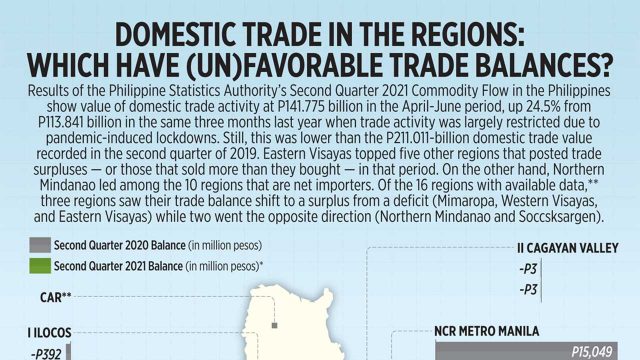
Domestic trade in the regions: Which have (un)favorable trade balances?

DOMESTIC TRADE ACTIVITY slightly bounced back in the second quarter from the previous year, albeit still lower compared with value of locally traded goods in 2019, data by the Philippine Statistics Authority (PSA) showed. Read the full story.

Domestic trade in the regions: Which have (un)favorable trade balances?

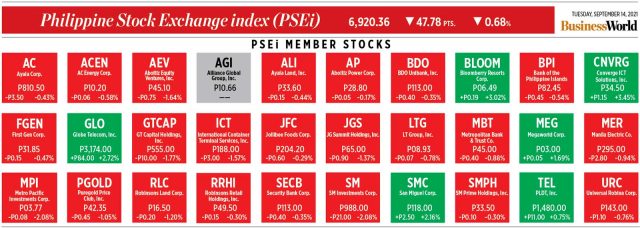
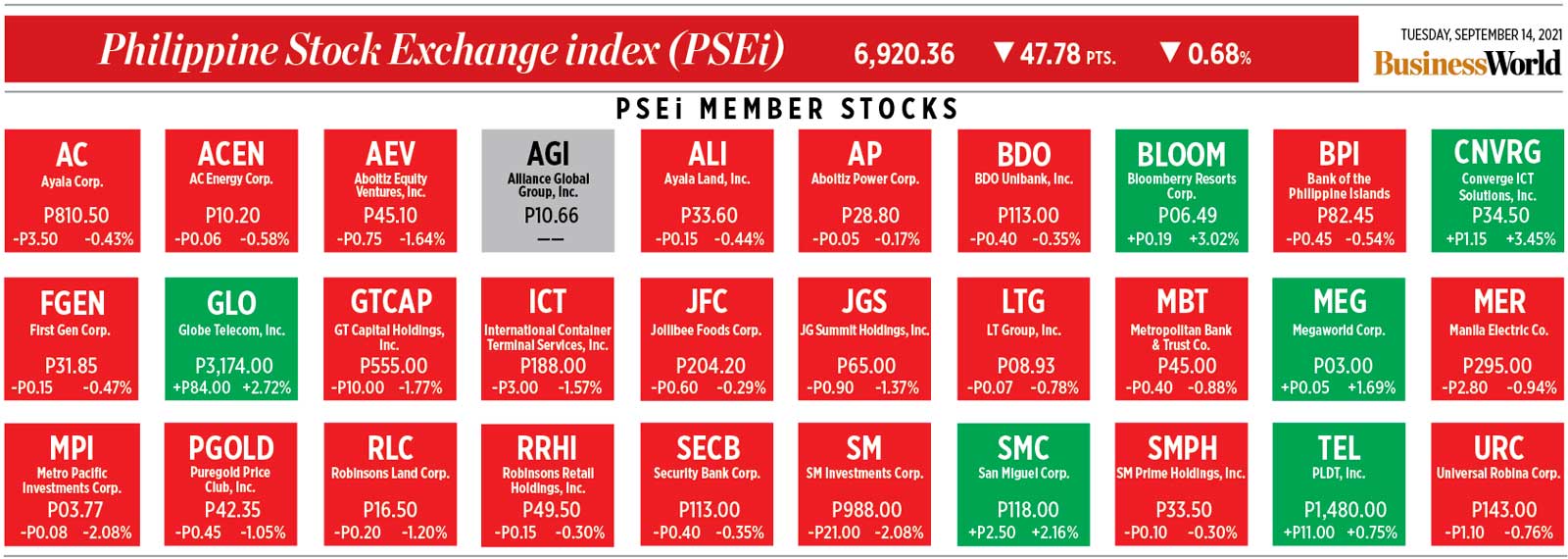
How PSEi member stocks performed — September 14, 2021

Here’s a quick glance at how PSEi stocks fared on Tuesday, September 14, 2021.


Building permit approvals more than double in second quarter

PHILSTAR FILE PHOTO

CONSTRUCTION starts as measured by building permit approvals rose 114.1% year on year to 38,389 in the second quarter, the Philippine Statistics Authority (PSA) said Tuesday.

This was the highest growth rate posted since at least 2006, according to initial data on the PSA’s OpenStat database.

The approved building permits cover 7.14 million square meters (sq.m.) of floor area valued at P84.36 billion. Floor area and value totals were up 148.2% and 194.3%, respectively, from a year earlier.

Permits for residential projects increased by 102.8% to 27,375. These projects were valued at P43.79 billion with a floor area of 4.21 million sq.m.

Single-detached homes accounted for 22,563 permits, followed by apartments at 4,457, duplexes and quadruplexes 287, condominiums 36, and other residential projects 32.

Non-residential project approvals rose 119.2% to 5,550, worth P32.83 billion and involving a floor area of 2.86 million sq.m.

The non-residential projects included 3,841 commercial buildings, 949 institutional buildings, 395 industrial buildings, 206 agricultural buildings, and 159 “other non-residential” buildings.

Permits for additions to existing structures numbered 1,174 in the second quarter, while those for alterations and repairs of existing structures numbered 4,290.

Region IV-A (Calabarzon) accounted for the largest number of approved building permits in the second quarter with 9,773, followed by Central Visayas with 5,608 and Ilocos Region with 4,659. Together, these three regions accounted for around 52.2% of total approved construction permits during the period.

By value, Calabarzon construction projects amounted to P20.09, followed by the National Capital Region (NCR) with P16.56 billion and Ilocos Region with P9.97 billion. These three accounted for 55.2% of construction value in the second quarter.

“The latest PSA data on building permits showing a stark pickup in growth was driven in large part by base effects as economic activity picked up relative to the extreme lockdowns experienced in 2020. This reflects pent-up (demand for) permits as construction activity was finally allowed to resume in some parts and on a staggered and limited basis,” ING Bank N.V. Manila Senior Economist Nicholas Antonio T. Mapa said in a statement.

Mr. Mapa also flagged the increase in permits granted in Calabarzon, which mirrored the developments noted in the Bangko Sentral ng Pilipinas’ (BSP) residential real estate price index (RREPI) report.

“The RREPI remains in contraction according to the central bank as the overall market was weighed down by the steep drop in condominium prices and prices in NCR in general. RREPI also shows that housing prices outside NCR and for single detached units have picked up, with is reflected in the permits data. This trend suggests that the Philippines is also experiencing the global phenomenon of migration from the urban centers to the areas outside the city with Filipinos in search of more space,” he said.

“Despite this development, signs of a real estate bubble have yet to manifest in a palpable manner. BSP’s RREPI remains negative and previously frothy condominium prices appear to have been deflated by the pandemic. Meanwhile, rental inflation has continued to slow and settled at 1.1% in August.”

Residential property prices declined in the first quarter, mainly dragged down by the lower cost of condominium units and duplexes due to weak demand. The RREPI was down 4.2% year on year in the three months to March, the steepest decline recorded since the index was launched in 2016.

In an e-mail, Asian Institute of Management Economist John Paolo R. Rivera said most companies have invested in the provinces where restrictions are fewer than in the NCR. “The dispersion of construction from NCR contributed to this,” he said.

Mr. Rivera is hopeful that the succeeding quarters for construction permits will continue to show improvement.

“This improvement may be driven by confidence in the economic environment both in the NCR and provincial areas. Of course, once herd immunity is achieved, the accelerator effect can fully manifest,” he said.

Meanwhile, Mr. Mapa, in a separate e-mail to BusinessWorld, said the prospects for recovery in building permits will be determined by how effective the government’s new measures and guidelines are in containing the virus.

“Should cases spike again, we could very well be returning to ECQ (enhanced community quarantine) levels, which would have a negative impact on construction activity and building permits as well,” he said, referring to the government’s strictest form of lockdown.

The Inter-Agency Task Force on Emerging Infectious Diseases on Monday released new guidelines for the pilot implementation of localized lockdowns and a new alert level system in Metro Manila beginning Thursday, the day after the modified ECQ in the Philippine capital ends.

Under the new guidelines, lockdowns will be localized at city level depending on the case transmission rates and healthcare utilization rates. The new alert system will consist of five levels, with level 5 equivalent to ECQ. — Bernadette Therese M. Gadon 

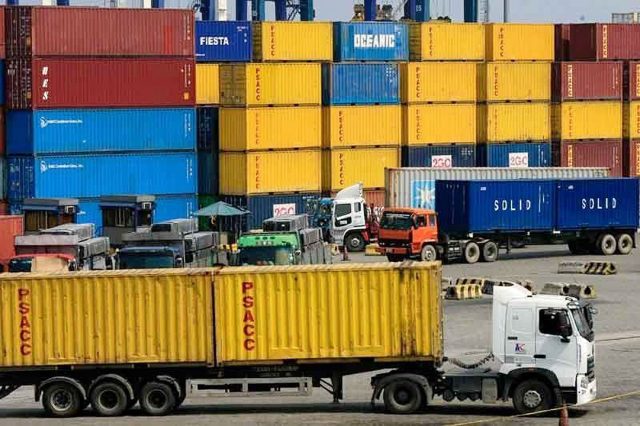
Some PPA board members not supportive of petitions to increase port charges

PHILSTAR

THE PHILIPPINE Ports Authority (PPA) said two petitions to increase port charges are currently awaiting a final decision, with some of its board members arguing that now is not the time to increase rates.

“As far as I know, one that’s pending is the tariff increase for North Harbor filed by Manila North Harbor Port, Inc. and another one is for the Port of Batangas, which was applied for by Asian Terminals, Inc. Both petitions for rate increases are still (being evaluated),” PPA General Manager Jay Daniel R. Santiago said at a virtual briefing Monday.

Asked if the decision is being delayed due to the pandemic crisis, Mr. Santiago said: “I will be transparent with you that there are some members of the board who are of the opinion that maybe now is not the time to consider the tariff increase.”

“But of course, there are contractual issues or considerations that have to be considered, kasi may concession tayong pinag-uusapan dyan (because concession agreements are involved). That is what we are weighing,” he added.

Mr. Santiago is vice-chairman of the PPA board, which is chaired by Transportation Secretary Arthur P. Tugade.

Board members include National Economic Development Authority Secretary Karl Kendrick T. Chua, Public Works and Highways Secretary Mark A. Villar, Finance Secretary Carlos G. Dominguez III, Environment and Natural Resources Secretary Roy A. Cimatu, and Trade Industry Secretary Ramon M. Lopez.

“The increase that was applied for ini-evaluate ’yan ng board at ng technical working group ng board (is being evaluated by the board and the technical working group) whether reasonable… and of course we try to input some considerations to temper it, so that it will not drastically hit our logistics sector even if you assume that we will approve the increase… later on,” Mr. Santiago said.

He added that the petition of Manila North Harbor was presented to the board in August, but was sent back to the board’s technical working group for further evaluation.

The Philippine Exporters Confederation, Inc. (Philexport) and the Export Development Council (EDC) said in July that the PPA needs to defer approval of a petition for an increase in cargo handling tariffs and passenger terminal fees at the Manila North Harbor.

The PPA should “suspend the mandatory weighing of export containers for the sake of small exporters and enterprises,” Philexport and EDC said in a statement.

Philexport said that “approving the rate hike now and allowing the mandatory weighing of export containers to continue will further add to the difficulties faced by micro, small, and medium enterprises and exporters.” — Arjay L. Balinbin

Bill seeks to make SIM card registration mandatory

STOCK PHOTO | Image by terimakasih0 from Pixabay

A SENATE BILL is seeking to make phone users register their identification details when applying for SIM cards, according to Senator Mary Grace Natividad S. Poe-Llamanzares.

On Monday, she sponsored a measure, Senate Bill (SB) No. 2395 or the proposed SIM Card Registration Act, which is intended to deter fraud.

If passed, the legislation will require all telecommunications companies make the registration of SIM cards a prerequisite to their sale.

Such a bill has the potential to expand consumer access to e-government services and develop mobile e-commerce, according to Senator Sherwin T. Gatchalian, who filed a similar bill in the 16th Congress.

He added that it will also provide new channels to access retail financial services such as remittances, payments, savings, credit, and insurance, among others.

The bill would require applicants to submit an electronic registration form and present a valid government-issued identification card (ID) or other documentation as a condition of sale.

“The privacy of consumers shall continue to be given the highest regard,” Ms. Poe said in the chamber Tuesday, adding that information may only be accessed by authorities acting on a court order.

Unregistered SIM cards have been a feature of crimes such as terrorism, bank hacks, the distribution of unsolicited obscene messages; and disinformation which could sow public disorder, she added.

Mr. Gatchalian said that the bill will seek to deter text scams, bomb threats, the transmission of ransom demands, and the use of phones to detonate bombs.

A total of 155 countries have adopted laws that require the registration of SIM cards — including countries with strong data privacy regimes such as Japan, South Korea, Australia, and much of the European Union, Ms. Poe said.

“This bill is not the be-all and end-all in our fight against any form of digital crime. It is only one of the measures that we need to put in place as Filipinos increasingly turn to digital banking and payment channels,” she said, noting that another bill regulating bank accounts, e-wallets and other financial accounts or SB 2380 was filed Monday.

“The bill that I filed seeks to penalize money mules — or those who electronically receive, acquire, or transfer money or proceeds derived from a cybercrime,” she added. — Alyssa Nicole O. Tan

NEDA’s Chua names infrastructure, innovation, climate change as priorities

KARL KENDRICK T. CHUA — PHILSTAR FILE PHOTO

SOCIOECONOMIC PLANNING Secretary Karl Kendrick T. Chua said he will focus on infrastructure, innovation and climate change before he steps down as head of the National Economic and Development Authority (NEDA).

Speaking at a forum arranged by the Philippine Institute for Development Studies, Mr. Chua said NEDA is also preparing for the country’s post-pandemic needs and putting the economy on a more solid footing for the next administration next year.

He called his priorities critical to sustaining the push towards upper-middle income status, which the Philippines hopes to attain by next year.

“As Secretary, my priority for the remainder of my term is to give the next administration a better foundation (with) more responsive infrastructure, innovation, which is the basis for sustaining our upper-middle income country status, regional equity in allocation of budget for infrastructure and social services, and most importantly, the threat of climate change,” he said in his speech.

Mr. Chua was named head of NEDA in April 2020, replacing Ernesto M. Pernia, who resigned.

His priorities at the start of his term were to fast-track registration for the national ID and prepare the economic recovery plan.

As the economy gears up for recovery, he said structural reforms in agriculture are needed, noting the distorting effect of current policy on the industry which have hampered its growth, creating a knock-on effect on manufacturing as well.

“A strong, productive agriculture sector provides the foundation for a competitive manufacturing sector, and eventually a high-skilled services sector,” he said.

He cited the Rice Tariffication Law as one of the much-needed reforms rolled out recently. Mr. Chua noted how the law loosened restrictions on imports of the staple grain, augmented supply and generated revenue from rice tariffs to modernize the industry.

“Moving forward, more are needed to improve the competitiveness of agriculture as well as other sectors through more cluster and value chain analysis,” he added.

At the same forum, Campden Hill Group, Inc. Chairman Antonio Jose U. Periquet said there is also a need to promote stronger competition across industries to bring down input costs and commodity prices, and eventually attract investment.

“There is a lack of competition in many sectors in our economy, which allows local firms to be price-setters, instead of price takers. Whereas in a situation of perfect competition, the consumer is king; here it is the producer who is king. This phenomenon explains why the only thing we seem to be able to export on a meaningful scale after decades of development, are people and coconuts. We simply cannot make things cheaply in this country,” he said.

To address this, Mr. Periquet said corporate behavior has to change to make both publicly-listed companies and private firms more responsible to society and shareholders, while stronger governments and institutions are needed to improve regulation and pave way to improve the business environment.

The structural reforms needed, he said, include an opening up to more foreign investment. — Beatrice M. Laforga

Private schools press for amendment to take away BIR discretion on preferential tax rates

PHILIPPINE STAR/ MIGUEL DE GUZMAN

PRIVATE SCHOOLS said the Senate needs to approve within the month an amendment to the tax code which explicitly makes the industry qualified to enjoy preferential tax rates, in order to avoid any situation in which the Bureau of Internal Revenue (BIR) can declare them ineligible for tax relief.

Senate Bill (SB) No. 2272, which amends Section 27 (B) of the National Internal Revenue Code will effectively clarify that the industry is entitled to a preferential tax rate as provided for by the Corporate Recovery and Tax Incentives for Enterprises (CREATE) Act. CREATE allowed private schools to pay a rate of 1% between July 2020 and June 2023 as a form of pandemic relief.

The private schools said in a joint statement Tuesday that the amendment will “rectify with finality the flawed interpretation of a provision under the CREATE Act by the BIR’s Revenue Regulations 5-2021.”

As of Monday, the enrollment in private schools was 1.4 million, down 57% from a year earlier, and 66% of the 4.3 million in 2019, according to the Department of Education’s Learning Enrollment Survey Quick Count data.

The study also indicated that most private schools do not expect a substantial number of late enrollees, as classes in public schools have also begun, while many private school students are expected to transfer to public schools due to economic difficulties.

Albay Rep. Jose Ma. Clemente S. Salceda, chairman of the House Committee on Ways and Means, has said that a BIR interpretation that renders the industry ineligible for tax relief could force the already weakened sector to shed another 21,661 jobs.

On the other hand, applying the CREATE rate of 1% until 2023 would allow schools to rehire at least 12,996 teachers for the beginning of the school year, he added.

Senator Pilar Juliana S. Cayetano last month promised to expedite the passage of SB 2272. Also in August, the House version of the bill passed on third and final reading.

“Private schools are the government’s partner in education. This partnership is even more important today, as our nation deals with the COVID-19 pandemic, which has disrupted our educational system,” Ms. Cayetano said last month.

“The country’s human capital depends on the quality of education our learners receive from both public and private educational institutions,” private school associations said in a statement Tuesday.

“This is a complementary role that must be strengthened and will prove critical for recovering from the pandemic, and sustaining Philippine economic growth and global competitiveness,” they added.

Signatories to the statement were Joseph Noel M. Estrada, managing director of the Coordinating Council of Private Educational Associations (COCOPEA) and Anthony Jose M. Tamayo, chairman of COCOPEA and president of the Philippine Association of Colleges and Universities. — Alyssa Nicole O. Tan

Exporters launch digitalization effort to help industry recover

AN EXPORT industry group is rolling out a digitalization and business continuity program to help companies recover from the effects of the pandemic.

The Philippine Exporters Confederation, Inc. (Philexport) announced the P30 program — a reference to the association’s 30-year anniversary next year — which focuses on using technology to improve business decision-making and promote collaboration among stakeholders.

The pandemic has accelerated the need for businesses to be more resilient, Philexport Executive Vice-President Senen M. Perlada said at a general membership meeting Tuesday.

“The first strategy is to embrace technology in various forms: digital technology, information technology, business technology, communication technology, product technology,” he said.

“The other strategy is to strengthen and tighten collaboration with stakeholders, as may be seen in the various forms and levels of public private partnerships and collaboration that Philexport has entered into.”

The project includes the rollout of the Philexport portal, an online information and services center for exporters.

“The overarching objective for the year-long undertaking is to set in place systems and adopt the tools that will help Philexport and its members survive and thrive,” Mr. Perlada said.

“The dynamics of this COVID-19 pandemic are actually providing us experiential data…. information, knowledge, and insights into how to make Philexport organizations resilient.”

Philexport is helping businesses set up digitalization or automation efforts, along with business continuity procedures.

“We wish to take this opportunity, while business is ‘muted’ to do house-keeping, capacity building,” Mr. Perlada said.

Exporters have been set back by global logistics delays. The global shipping industry has been facing a shortage of vessel space after demand bounced back in some countries, pushing freight rates higher and causing delays in goods shipments.

Philexport President Sergio R. Ortiz-Luis, Jr. said that the solution is not within the industry group’s sole control, even as it works with other stakeholders to address shipment problems with domestic shipping lines.

“We hope that more and more international shipping lines will respond positively to this situation ahead of the holiday purchases,” he said.

The industry group will also set up regular forums to help exporters deal with government requirements.

“(We have) another collaboration platform as we work with government agencies to ease up and inform members about regulatory requirements,” Mr. Perlada said. — Jenina P. Ibañez

Dar batting for control of irrigation agency   

JAPAN INTERNATIONAL COOPERATION AGENCY

THE NATIONAL Irrigation Administration (NIA) needs to be under the control of the Department of Agriculture (DA) in order to expand irrigation coverage.   

Meron kaming proposal na kung puwede, kung mamarapatin po ng mahal na Pangulo, ay ilipat na sa DA itong NIA (We have a proposal, which I hope the President approves, to transfer NIA to the DA) because water is agriculture. Agriculture is life,” Agriculture Secretary William D. Dar said in a television appearance Tuesday.   

Mr. Dar said the Philippines has over 1.2 million hectares of rice land that stand to benefit from unified control of irrigation development, and estimated that it would take 20 years for the government to cover such an area.   

The NIA is under the control of the Office of the President as provided for by Executive Order No. 165, signed by President Benigno S. Aquino III in May 2014.   

Meanwhile, Mr. Dar said there are proposals to open up NIA for public-private partnerships to improve the irrigation system.   

“We encourage the private sector to invest and that they be paid accordingly. That way you have more partners from the private sector investing in the development of national irrigation systems,” Mr. Dar said.   

During a recent House Committee on Appropriations hearing, Mr. Dar asked for an additional P30 billion on top of its proposed 2022 budget of P91 billion to further improve agricultural production.  

The DA’s proposed 2022 budget is well below the P231.7-billion budget it originally requested, but is 1.05% higher than its 2021 allocation.   

Meanwhile, NIA presented in the same hearing a 2022 budget proposal of P32.08 billion, down 1.18% from its 2021 budget. — Revin Mikhael D. Ochave 

Ban on poultry imports from Japan lifted  

THE Department of Agriculture (DA) has lifted a temporary ban on poultry imports from Japan, after that country’s poultry industry was deemed free of highly pathogenic avian influenza (HPAI), or bird flu.   

Agriculture Secretary William D. Dar signed Memorandum Order No. 52 on Sept. 10 which lifted the ban on Japanese domestic and wild birds and their products, including meat, day-old chicks, eggs, and semen.   

“Based on the evaluation of the DA, the risk of contamination… is negligible,” Mr. Dar said in the order.   

Japanese veterinary authorities have sent a report to the World Organisation for Animal Health (OIE) confirming the end of the bird flu outbreak.   

“In accordance with the provisions of Chapter 10.4 of the OIE Terrestrial Animal Health Code, Japan is now free from highly pathogenic avian influenza,” Mr. Dar said.   

On Dec. 14, the DA implemented the ban on Japanese poultry imports via Memorandum Order 75.   

At the time, Japan’s Ministry of Agriculture, Forestry, and Fisheries had outbreaks of the H5N8 HPAI virus in Higashi, Kagawa City, Kagawa Prefecture, and in other prefectures such as Fukuoka, Hyogo, Miyazaki, Nara, and Hiroshima. — Revin Mikhael D. Ochave 

Duterte bars Cabinet from attending Senate probe

PRESIDENT RODRIGO R. Duterte has barred Cabinet officials from attending without his approval Senate hearings investigating the government’s alleged misuse of funds against the coronavirus.

In a taped speech aired on Tuesday night, the President also accused senators of using the probe to harass people.

“I will require every Cabinet member to clear with me any invitation,” he said.

The Senate is looking at multibillion-peso deals between the government and private contractors for what it suspects were overpriced face masks and other medical supplies.

Mr. Duterte said senators have been grilling witnesses for hours, wasting time that should otherwise have been used at work. Other resource persons wait on standby and end up not being called to testify, he added.

Michael Henry Ll. Yusingco, a senior research fellow at the Ateneo de Manila University Policy Center, questioned the timing of the President’s order.

“Why insist on this requirement only at this late stage of his term?” he asked. “And why only now when the possibility of massive graft and corruption is the target of the Senate investigation?”

“It is in the best interest of the President to make sure all of these allegations are directly answered immediately,” the political analyst said.

Mr. Duterte cited as an example Health Secretary Francisco T. Duque III, who he said had not been “in control” of the agency because he’s been busy attending legislative hearings.

The President cannot invoke executive privilege when government officials are compelled to appear before legislative hearings, constitutional expert Antonio M. La Vina said, citing jurisprudence.

“The President can do this for what is called question hour, but not for a legislative investigation,” he said in a Facebook Messenger chat.

For the latter, the official must credibly invoke executive privilege, which is inapplicable here,” he added.

In 2005, ex-President Gloria Macapagal Arroyo issued an executive order that required Cabinet and other government officials to seek presidential permission first before attending legislative hearings.

But the Supreme Court in 2006 “struck down Executive Order No. 464 and the sections that, taken together, attempted to expand the scope of officers covered by executive privilege and render the claim to privilege unchallengeable by Congress due to presidential silence/nonconsent to appearance,” Mr. La Vina said.

In that ruling, the tribunal upheld the right of the President to prevent officials from participating in legislative inquiries known as a question hour, where department heads appear before lawmakers to answer questions on matters relating to their office.

In 2014, the late Senator Miriam Defensor-Santiago said former President Benigno S.C. Aquino III had no reason to forbid his Budget secretary, Florencio B. Abad, from answering congressional questions about a special budget meant to fast-track certain projects.

The Supreme Court later struck down the program for being illegal.

Ms. Santiago, a constitutional expert, said “the information that the Senate seeks is not covered by the doctrine of executive privilege.” “The doctrine of executive privilege is recognized only in relation to certain types of information of a sensitive character,” she said.

These types of information include military, diplomatic and other national security matters; presidential conversations, correspondences and discussions in closed-door Cabinet meetings and information on investigations of crimes by law enforcement agencies.

Executive Secretary Salvador C. Medialdea earlier said the Senate blue ribbon committee had summoned witnesses “for further bullying,” adding that many of them have been “criminally condemned.”

Senator Richard J. Gordon, Sr., who heads the body, said the Senate was just doing its job. Senator Ana Theresia N. Hontiveros-Baraquel has said the Senate is a co-equal government branch and the probe is part of its constitutional duty.

The presidential palace, she added, should let the Senate do its job in ensuring that the people’s money was not misused.

Meanwhile, Justice Secretary Menardo I. Guevarra said he had issued a lookout order against six officials of Pharmally Pharmaceutical Corp. and former presidential economic adviser Michael Yang, who is allegedly a financier of the company. 

Pharmally is a private contractor that cornered at least P8 billion in state contracts for medical supplies.

The Justice department also issued a lookout order against two former Budget officials suspected to have facilitated the scam.

Mr. Gordon sought Mr. Yang’s inclusion in the lookout bulletin in a letter to the agency, the Justice chief told reporters in a Viber group message.

A person under a lookout order is not barred from leaving the country but their travel will be monitored, and government authorities will be alerted if they do leave the country. — Kyle Aristophere T. Atienza and Bianca Angelica D. Añago

Duterte ally faces P100-M complaint from boxing champ

SENATOR MANNY PACQUIAO FB PAGE

SENATOR Emmanuel “Manny” D. Pacquiao filed a P100-million libel suit against President Rodrigo R. Duterte’s spiritual adviser for accusing him of corruption.

The boxing champion filed the complaint against Apollo C. Quiboloy at the Makati City Prosecutor’s Office on Tuesday.

In his 13-page complaint, the senator cited Mr. Quiboloy’s comments on TV and social media posts accusing him of having misused funds for the unfinished Sarangani Sports Training Center that eventually became a “white elephant.”

Mr. Quiboloy allegedly used his “power and influence to spread fake news and false information.”

“In a democratic society, public officials like Senator Manny Pacquiao should expect criticisms and critical evaluation of their performance from citizens whom they are expected to serve,” Marie Dinah Tolentino-Fuentes, Mr. Quiboloy’s lawyer, said in a video posted on YouTube.

She also said their client had not accused the lawmaker of any wrongdoing but only floated a question regarding the matter. Mr. Quiboloy’s comments were “constitutionally protected speech and expression,” she added.

Mr. Quiboloy earlier challenged Mr. Pacquiao to a debate as he showed photos of dilapidated bleachers and overgrown grass at the center. Mr. Pacquiao said these were old facilities at the Sarangani Province Sports Complex. “He used this deliberate falsehood to brainwash the minds of the Filipino public, recklessly propagating lies to blacken the image and reputation of an honest public servant,” according to copy of his complaint.

“He even had the audacity to quote the Holy Scripture in furtherance of his lies, misleading his flock and confusing the public, with the end in view of blackening another’s reputation.”

Mr. Pacquiao vowed that if he is awarded damages, he would use the money to build homes and help poor Filipinos. — Alyssa Nicole O. Tan