Home Blog Page 7421

Enabling recovery by empowering Filipinos

PLDT-Smart Foundation (PSF) turned over the P1M donation to the Philippine National Police (PNP) as part of its 13-year PSF-PNP educational program. Since 2008, the PSF has supported 639 college scholars. In photo (L-R) are PNP Chief Police General Guillermo Lorenzo T. Eleazar, PLDT-Smart Foundation President Esther O. Santos, and Smart Communications Vice President for Subscriber Management Melvin Nubla.

It is not an understatement to say that the world has changed drastically in the last two years. The COVID-19 pandemic, more than being a threat to health and safety, also revealed massive inadequacies and vulnerabilities in the social systems all over the world.

As a silver lining, however, it has also revealed ways on how to move forward. Digital connectivity, for instance, has become a boon for governments, businesses, and even individuals seeking to navigate life during the pandemic, with both the public and private sectors of society practically undergoing digital transformation overnight.

PLDT, Inc., the country’s largest telecommunications, internet, and digital service providers, knows the importance of connectivity in the new normal and has committed to use its network and expertise to support the government’s COVID-19 response.

For instance, along with Smart Communications, Inc., PLDT has turned over Smart Bro pocket WiFi and PLDT prepaid home WiFi units for use of frontliners and volunteers at the Office of the Vice President’s drive-thru vaccination site in Harbor Square in Manila, following up on the previous roll out of Smart WiFi connectivity in isolation sites set-up by the Office in Malabon City.

Additionally, the Philippines’ first integrated health app, mWell, was launched in partnership with PLDT Home. As a service that provides digital services that enable families to do things better at home via broadband connectivity, PLDT Home is enabling connected families to get free online check-up and consultations with mWell doctors in the areas of primary care, pediatrics, internal medicine, ob-gyn, cardiology, gastroenterology, dermatology, and COVID-19.

The goal is for Filipinos to have an avenue for convenient bookings and safer consultations for health problems. Soon to be launched by Metro Pacific Health Tech Corporation (MPHTC), a wholly-owned subsidiary of Metro Pacific Investments Corp. (MPIC), mWell is an all-in-one app set to offer telehealth to Filipinos during this pandemic through online doctor consultations, health education, wellness programs, online pharmacy services, and more.

Simple and accessible in just a few clicks, mWell app users can not only do video consultation but also buy medicines, access personalized fitness and nutrition programs including COVID-19 assessment, pregnancy trackers, and buy wellness products at the shop by Adobomall with the use of PayMaya for fast, secure, and hassle-free transactions.

PLDT and Smart’s support to the country’s fight against the pandemic has also included the rollout of fiber-powered WiFi connectivity to government-run quarantine, swabbing, isolation and vaccination sites, as well as other COVID-19 facilities.

Since last year, PLDT and Smart have been providing connectivity and communications support to frontline agencies and their personnel in different parts of the country to help front liners and patients stay connected despite the challenges of the pandemic.

From the beginning, PLDT and Smart have played a critical part in keeping the public informed of government announcements and COVID-19-related news. To ensure that the public has access to right and up-to-date information, PLDT has provided free access to government and news websites for PLDT Home WiFi and PLDT Home Volume based plans, as well as supporting the Department of Health (DoH) and the 911 National Emergency Hotline of the Department of Interior and Local Government for the launch of a hotline for COVID-19 concerns.

The access numbers for the DoH COVID-19 emergency hotline are 02894-COVID or 02-894-26843, and, 1555. The hotline number 02894-COVID or 02-894-26843 is open to all callers nationwide. The hotline number 1555 is initially accessible only to PLDT, Smart, Sun, and TNT subscribers.

To aid in creating a more efficient communication system among government agencies, PLDT provided free WiFi Internet and landline calls in critical areas including command centers, transportation systems, and health centers in Batangas City, Lucena, Zamboanga, General Santos City, and Davao.

PLDT and Smart’s connectivity solutions have also been integral to keeping the education system running despite the health and safety precautions during the community quarantine.

Most recently, PLDT Enterprises has extended fiber connectivity and internet solutions to Piddig, Ilocos Norte to support online learning, providing digital services to all 23 barangays to improve municipal governance. 

Another initiative is the mobile truck called “Vertext on Wheels”, the mobile internet truck deployed in the capital city of Ilocos Norte by PLDT and Smart, in partnership with their provincial distributor in Ilocos Norte Vertext Handyphones under their Learning Access Online (LAO) project.

LAO also provides entrepreneurial training for students for business opportunities as retailers of Smart Load, freelance agents for PLDT Home and installers for Cignal TV. Initially rolled out as a Vertext Handyphones barangay caravan throughout Ilocos Norte, Vertext on Wheels provided free Internet, free use of LTE gadgets, free document printing and discounted load offers to students, among others.

The PLDT-Smart Foundation (PSF) has also been busy supporting communities during the pandemic, as it recently turned over one million pesos in donations to the Philippine National Police (PNP) as part of its 13-year PSF-PNP educational program.

Over the years, PSF has been supporting the dependents of PNP uniformed personnel who were killed in actual performance of duty, complete disability, discharged, wounded or incapacitated in their line of duty, and those dependents who graduated with honors through the PSF-PNP Educational Assistance Program.

Aside from the donation, the PSF also turned over Smart LTE Pocket WiFi units for the scholars. Since 2008, the PSF has supported 639 college scholars.

“COVID-19 has set our agenda for the foreseeable future. At the outset, our task was clearly to keep people connected as the country went into lockdown. Moving forward, we will grow our business by helping our customers – and the country – rebuild their lives and livelihoods with powerful connectivity like fiber, 4G and now 5G, combined with innovative digital solutions,” said Manuel V Pangilinan, chairman of PLDT, Inc. — Bjorn Biel M. Beltran
Leading through crisis

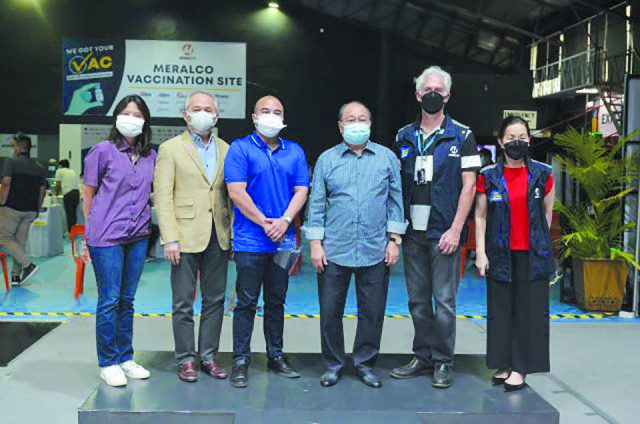
The MVP Group of Companies begins its pilot vaccination of non-medical employees at the Meralco compound. Present are MVP Group Chairman Manuel V Pangilinan with Pasig City Administrator Atty. Jeron Manzanero, center. With them (L-R) PLDT and Smart Chief Procurement Officer and Vaccine Task Force Procurement Lead Mary Rose Dela Paz, Meralco President and CEO Atty. Ray Espinosa, Metro Pacific Hospitals Holdings, Inc. Chief Operating Officer and Vaccine Task Force Co-Chair Dr. Jeff Staples, and PLDT and Smart Chief People Officer and Vaccine Task Force Co-Chair Gina Ordoñez.

By Bjorn Biel M. Beltran, Special Features Writer

The coronavirus disease 2019 (COVID-19) pandemic has been an ordeal that has left its mark on modern history, with the world still collectively reeling from its impact. Slowly but surely, however, the wounds from the crisis are mending and as governments all over the world strive to vaccinate enough people to reach herd immunity, more and more groups are stepping up to help their fellowmen.

Such a massive crisis could only be overcome with collaboration, especially among those with the most influence. The MVP Group of Companies, one of the biggest corporations in the Philippines, has been striving to do its part during the pandemic.

Embodying the spirit of bayanihan

The MVP Group has become a partner of the Department of Health (DoH) in its ‘BIDA Solusyon’ campaign, which encouraged all sectors to comply with science-backed behavioral changes in preventing the spread of COVID-19. BIDA stands for Bawal walang mask; I-sanitize ang mga kamay, iwas-hawak sa mga bagay; Dumistansya ng isang metro; Alamin ang totoong impormasyon. Aimed at empowering Filipinos in every sector, the campaign promoted a whole-of-nation, whole-of-government approach in rising above the pandemic.

The MVP Group contributed to the campaign through repurposing the East Avenue Medical Center (EAMC) into the Center for Emerging and Re-emerging Infectious Diseases (CERID), a dedicated COVID-19 facility.

The MVP Group is home to some of the country’s largest companies, including telecommunications giant PLDT, Inc.; Metro Pacific Investments Corp., whose businesses span energy, water services, toll roads, hospitals, railways and logistics; agribusiness leader Roxas Holdings, Inc.; and MediaQuest Holdings, Inc. which includes TV5, Cignal TV, The Philippine STAR, and BusinessWorld.

Manuel V Pangilinan, chairman of the MVP Group of Companies, also stated the vision behind his conglomerate’s participation in the campaign: “On behalf of all our companies and our foundations, I would like to pledge our support to promote the values of BIDA not just in our businesses, but in our daily lives as well. We are hoping that through our Group’s contribution, we could help the real BIDA who are central to our businesses — the Filipino people, the Filipino consumers.”

In addition, MVP Group pledged to help build consumer confidence through the widespread adoption of the campaign’s objectives and to release BIDA Solusyon information materials through their existing channels, including physical stores and business centers under the group such as PLDT-Smart stores nationwide, Meralco Bayad Centers, and the Light Rail Manila Corp.; tollroads in NLEx, CAVITEx, and CALAx which are equipped with contactless RFID payment in toll booths; and Maynilad which set up contactless hand wash stations with liquid soap to further promote handwashing.

This is not to mention the efforts of Tulong Kapatid, the corporate social responsibility alliance of foundations and companies under the MVP Group of Companies, which has extended aid to augment the government’s initiatives against the pandemic.

Last April, the group also announced that it is converting part of the First Pacific Leadership Academy in Antipolo, Rizal province into a COVID-19 quarantine facility for employees to aid in the decongestion of hospitals in Metro Manila.

“Our efforts to take care of our workforce aim to reduce overall community transmission, while protecting and providing breathing space to hospitals and medical front liners, who have been our anchor and support as we continue to battle this pandemic,” Mr. Pangilinan said in a statement.

One for all, all for one

The MVP Group knows that the first step towards enacting positive change is from within. This is why it also announced that it has procured 800,000 doses of COVID-19 vaccines for their personnel and household members of their employees, and have recently started rolling out vaccination.

Led by the MVP Group Vaccine Task Force, the first tranche of company-procured Moderna doses was administered to the Group’s first batch of employees at the Meralco compound in Pasig City.

The launch site is one of several facilities the Group has identified in administering all the vaccinations in National Capital Region (NCR) Plus. Among those to be activated by the second week of July are PLDT Sta. Ana in Manila, Smart Tower in Makati, Maynilad Balara in Quezon City, and NLEx Sta. Rita in Bulacan.

The pilot sites are manned mainly by frontliners from the MVP Group’s hospital arm Metro Pacific Hospitals Holdings, Inc. (MPHHI), and is expected to vaccinate an average of 700 up to 1,350 individuals per day.

The rollout will run until December, depending mainly on the arrival of Moderna and AstraZeneca vaccines.

“Any talk about ending this pandemic begins with a fundamental imperative: the successful rollout of ethically procured, safe, and effective vaccines to a significant majority of our people,” Mr. Pangilinan said. “Our vaccinees, through the essential services we offer group wide — from hospitals, telecommunications and digital services, electricity, water, tollways and road infrastructure, media and more — have been and will continue to be the key source of stability as the Philippines emerges from this global crisis.”

For areas outside NCR Plus, the Vaccine Task Force will use a combination of MPHHI’s private health care network — the Philippines’ largest — as well as other MVP Group-wide facilities and selected malls across the country.

A light for those in need

The most devastating quality of the COVID-19 pandemic is its prejudice, as seen by the disparity in which it affects its victims. The World Bank has estimated that the pandemic could push about 49 million people into extreme poverty in 2020.

In its commitment to help Filipinos to find work or create their own businesses, the foundations of the MVP Group of Companies recently distributed 60 bicycles to disadvantaged residents of Quezon City as part of the Bike for Livelihood initiative.

Working in partnership with Gretchen Ho, who founded the Donate a Bike, Save a Job project in 2020, the PLDT-Smart Foundation (PSF), One Meralco Foundation, Metro Pacific Investments Foundation and First Pacific Co. Ltd. aim to donate at least 500 bicycles this year.

The latest donation is in addition to over 300 bicycles that have been turned over to underprivileged recipients in Pasig, Manila, Caloocan, Batangas as well as contact tracers from the Philippine National Police.

To help them in their online business, residents from Quezon City also received 100 Smart phone retailer kits from First Pacific and 100 Pocket WiFi devices from Smart Communications. These digital tools will help small business owners connect to the market through online apps and platforms, the new normal for businesses.

During the launch of the Bike for Livelihood in June, Mr. Pangilinan, who initiated the project, said it could help support livelihood and transportation needs in the recipients’ respective jobs. “The best solution to poverty is livelihood. If you could provide [people] with a means of making themselves a livelihood, whether by delivering food or medicine or water, I think that’s something we should support,” he said.

“I do hope they would use it for their families, so they can uplift their way of living. At the end of day, that’s what we’re all here for. Social orientation is embedded in our Group’s DNA,” he added.

MVP at 75: Winning in life and career one game at a time

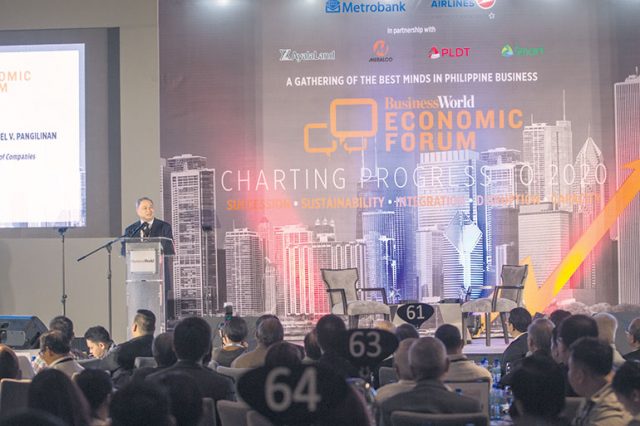
MediaQuest Holdings, Inc. Chairman Mr. Pangilinan delivers a keynote speech during the BusinessWorld Economic Forum in 2019.

By Adrian Paul B. Conoza, Special Features Assistant Editor

A remarkable leader who really worked his way up the ranks. A businessman notable for handling numerous roles across some of the Philippines’ leading companies. A sports advocate who actively supports many of the country’s athletes.

These are some of the ways to recognize Manuel V Pangilinan, or simply MVP, who celebrates his 75th birthday today.

Born on July 14, 1946 to a bank messenger and a housewife, Mr. Pangilinan had humble beginnings, and with sheer determination, he was able to elevate himself one step at a time into one of today’s successful corporate magnates.

Mr. Pangilinan is a scholar throughout his studying years, starting with elementary and high school at San Beda College, and then college at Ateneo de Manila University (ADMU), where he graduated cum laude with a Bachelor of Arts degree in Economics.

“In college, my weekly allowance at the Ateneo was P10, and that included my jeepney fares. I have a lot of classmates who have cars and others even have their own drivers. They were lucky. Someday, I said to myself, I will reach all those,” he recalled in a commencement speech in ADMU in 2006. “My scholarships in both San Beda and Ateneo were only my lucky charms.”

In 1968, Mr. Pangilinan received his Master of Business Administration (MBA) degree from the Wharton School at the University of Pennsylvania, with the help of a scholarship provided by Procter & Gamble.

Upon graduation and without any experience, MVP started his career as an executive assistant to the president at Philippine Investment Management Consultants, Inc. (PHINMA) for six years. His career then continued overseas with Bancom International Limited, a Philippine investment bank based in Hong Kong.

Amid a setback in a planned joint venture, Mr. Pangilinan worked for American Express Bank for four years, seeing an opportunity to prove what a Filipino can do in the said company.

Then, in 1981, he moved from professional management to entrepreneurship when he founded investment management and holding company First Pacific Co. Ltd.

As Wharton Magazine detailed, Mr. Pangilinan started the company with the help of four Indonesian families, including the Salim Group, and public funds. The initial plan hatched between him and Anthony Salim, the son of Salim Group’s founder Liem Sioe Liong, was for First Pacific to be “intermediaries of capital, sort of a financial supermarket where one could buy securities or get a loan or whatever”, as well as “an intermediary of goods”.

At present, First Pacific has principal businesses related to consumer food products, telecommunications, infrastructure, and natural resources. In the Philippines, these include Metro Pacific Investments Corporation (MPIC), Manila Electric Co. (Meralco), Global Business Power Corp., Metro Pacific Light Rail Corp., Maynilad Water Services, Inc., Metro Pacific Tollways Corp. (MPTC), Philex Mining Corp., PXP Energy Corp., Roxas Holdings,  Inc., PLDT, Inc., and Smart Communications, Inc., among others.

Mr. Pangilinan served as managing director of First Pacific from 1981 to 1999. He was appointed executive chairman until June 2003, after which he was named managing director and chief executive officer.

In addition to being an entrepreneur, Mr. Pangilinan also considers himself a “corporate activist” when he and First Pacific “faced the massive task of repair and renewal” of PLDT.

“Critics told us that we couldn’t change the culture of monopoly, that misdemeanors in PLDT couldn’t be eradicated, that our fixed line business had no future. But we made tough and unpopular decisions at PLDT,” he said, citing encouraging honesty and transparency and converting the mindset of bureaucrats to that of innovators and entrepreneurs as some of the changes made.

Mr. Pangilinan is the chairman of PLDT, Smart, ePLDT, Inc., PLDT Communications and Energy Ventures, Inc., MPIC, Meralco, Global Business Power, Maynilad, MPTC, NLEX Corporation, Philex Mining, PXP Energy, Landco Pacific Corp., Medical Doctors, Inc. (Makati Medical Center), Davao Doctors, Inc., Colinas Verdes Corporation (Cardinal Santos Medical Center), MediaQuest Holdings, Inc., and TV5 Network, Inc. He is also the vice chairman of Roxas Holdings.

Photo shows Manuel V Pangilinan as he receives the 2015 Ramon V. del Rosario, Sr. Award for Nation Building for his outstanding contributions to nation building and exemplary corporate citizenship.

He also serves as the president commissioner of PT Indofood Sukses Makmur Tbk, the largest food company in Indonesia.

In civic duties, Mr. Pangilinan sits as chairman of the Philippine Business for Social Progress, PLDT-Smart Foundation, Inc., and One Meralco Foundation, Inc.; co-chairman of the Philippine Disaster Resilience Foundation; and a director of the Philippine Business for Education.

He is chairman of the board of trustees of San Beda College and co-chairperson of the board of trustees of Stratbase Albert del Rosario Institute and the U.S.– Philippine Society.

He was formerly chairman of the board of trustees of ADMU and was a member of the board of overseers of the Wharton School.

Aside from being a top businessman, Mr. Pangilinan is a strong supporter of Philippine athletes and a champion of the country’s sporting programs.

He is currently the chairman of the MVP Sports Foundation, Inc., a privately-funded sports development foundation of the MVP Group of Companies focused on helping its chosen sports, namely badminton, basketball, boxing, cycling, football, golf, taekwondo, rugby, and weightlifting.

MVP is also the chairman emeritus of the Samahang Basketbol ng Pilipinas (SBP), the national sports association for basketball in the county. He first served SBP as president from 2007 to 2016.

He also sits as chairman of the Amateur Boxing Association of the Philippines, the country’s governing body for amateur boxing.

MVP has gained several honors from esteemed organizations and publications. These include Ten Outstanding Young Men of the Philippines Award for Finance in 1983, Presidential Pamana ng Pilipino Award by the Office of the President of the Philippines in 1996, Best CEO in the Philippines by Institutional Investor in 2004, CEO of the Year (Philippines) by Biz News Asia in 2004, People of the Year by People Asia Magazine in 2004, Distinguished World Class Businessman Award by the Association of Makati Industries, Inc. in 2005, Management Man of the Year by the Management Association of the Philippines in 2005, and Order of Lakandula (Rank of Komandante) by the Office of the President of the Philippines in 2006.

He was voted as Corporate Executive Officer of the Year (Philippines) and Best Executive (Philippines) at the 2007 and 2008 Best-Managed Companies and Corporate Governance Polls conducted by Asia Money.

Mr. Pangilinan also received the Best CEO award from Finance Asia Magazine in 2012 and the Executive of the Year Award from the Philippine Sportswriters Association in 2014.

In 2015, JCI Manila and the Asian Institute of Management (AIM) RVR Center for Corporate   Responsibility conferred him the 2015 Ramon V. del Rosario, Sr. Award for Nation Building for his outstanding contributions to nation building and exemplary corporate citizenship.

MVP was also awarded the First Honorary Doctorates Degree in Management by AIM in 2016; as well as Honorary Doctorates in Science by Far Eastern University in 2010, and in Humanities by Holy Angel University in 2008, Xavier University in 2007, and San Beda College in 2002.

In a commencement address delivered to the class of 2017 of Manila Tytana Colleges, Mr. Pangilinan said, “Success is about passion — passion to succeed, passion for excellence, passion to compete. There are many of you here who were born poor, but have succeeded in graduating today, some with honors. [Their] examples should lead us to believe that your passion can break the chains of poverty, that a spirit of purpose can propel your energy, that the power of ambition can enable you to achieve what you may now think is impossible.”

MPIC dedicates over a decade to shoring up ESG

Investing in power, water, transportation, and healthcare — essentials in the day-to-day lives of Filipinos — translates to contributing to national progress and improving the quality of life in the country. Anchored on services that are key to thriving communities, it is crucial to integrate sustainability in the operations of these businesses. Now, more than ever, there is a strong call to action to fulfill the pressing needs of the present without jeopardizing resources for the use of future generations.

Years prior to the pandemic and the resulting economic crisis, leading infrastructure investment firm Metro Pacific Investments Corporation (MPIC) has always been more purposeful in the conduct of its community-oriented programs, zeroing in on the long-term impact to profits, people, and ultimately, the planet.

“Protecting the planet for the benefit of present and future generations is still without a doubt our most important challenge right now,” says MPIC Chairman Manuel V. Pangilinan. “We are witnesses to the rise of new viruses and the worsening intensity of climate-related disasters. All these interrelated challenges profoundly shape the way we do business.”

Beyond the sustainability initiatives of its operating companies, MPIC has actively innovated programs that address key sustainability targets outside its direct commercial interests through Metro Pacific Investments Foundation (MPIF) and its flagship program, Shore It Up! (SIU).

Shoring Up the Business

After Typhoon Ondoy struck and submerged most parts of Metro Manila and suburbs, the natural disaster prompted the business group to seriously address climate change and environmental degradation. With a water-centric business asset through Maynilad, the Corporation recognized the effects of climate change on water and its subsequent impact on the ecosystem it surrounds.

Regardless of proximity, the degradation of coastal and marine bionetwork compromises the physical, economic, and food security of local communities, and affects the quality and quantity of marine resources. Critical ecosystem services such as food source, oxygen generation, and carbon storage are threatened and climate change adaptation by natural means slowly becomes unfeasible.

MPIC’s power assets are currently looking into increasing the use of renewable energy systems, with the end goal of reducing the impacts of CO2 and other GHGs on the ocean. However, SIU has directed its attention to the ocean itself, fundamentally creating and sustaining initiatives that aim to simultaneously mitigate the effects of climate change and enhance the lives of Filipinos.

After the MVP group of companies strategically aligned their CSR programs through impact integration assessment and distinguishing for lead advocates, MPIC decided to focus its efforts on responding to environmental issues such as climate change and ocean conservation given that most of our investments are related to natural resources.

The ocean, being the largest life support and ecosystem on Earth is essential in ensuring a sustainable future. Our growing partnerships with local government units from coastal communities have made it possible to implement our programs on Mangroves, Marine Protected Areas and Marine Guardians,” says MPIC VP for Public Relations and Corporate Communications Melody del Rosario.

On Environmental Impact

Now on its 13th year, MPIC has forged partnerships with local governments and established various programs in 11 partner sites, a highlight of which are the Mangrove Protection/Propagation and Information Centers in Alaminos City, Pangasinan; Del Carmen in Siargao Island; and Cordova, Cebu. Across all three locations, there are almost 5,300 hectares of protected mangroves.

A private-public venture with the LGUs, it serves as MPIC’s legacy project for the Filipino people — an infrastructure investment for the future of the country.

After almost a decade of partnership with the local government of Alaminos, MPIC commissioned a study with the Business for Sustainable Development (BSD) to assess the impact of SIU’s presence in the area. Around 111.92 tCO2e of carbon stock in Bued Mangrove Park, equivalent to removing greenhouse emission from 24 passenger vehicles driven for a year, were attributed to MPIF’s support and investment. For every peso invested, P0.59 of social value was created through the improved fishery sector, coastal protection, flood protection, as well as increased knowledge of mangroves.

Del Carmen’s Center reported 0% mangrove cutting since its inauguration. “The conglomerate, through the SIU program, is also working out a unique carbon offsetting scheme with the municipality of Del Carmen in Siargao Island, which is home to a contiguous 4,000-hectare mangrove forest, the second biggest of its kind in the Philippines after Palawan,” adds Ms. Del Rosario, who is also the Foundation’s president.

The implementation of its Marine Protection, Inspection, and Conservation (MPIC) Guardians program, empowering local bantay dagats in the provinces of Puerto Galera in Oriental Mindoro and Medina in Misamis, Oriental, resulted in the significant decrease of illegal fishing practices. Medina reported an increase in fish catch and fish size, citing a 40% estimated increase as of May last year.

The MPIC Guardians are also responsible for the constant monitoring of their Marine Protected Areas (MPAs) to prevent environmental degradation, thereby protecting ecologically and biologically significant marine habitats. Currently. the Guardians are surveilling around six MPAs, one in Medina and five in Puerto Galera.

On Socioeconomic Impact

SIU’s major initiatives are not singularly focused on alleviating environmental impacts to coastal communities. They also foster the involvement of the local community by providing livelihood opportunities, whether supplementary to or resulting from its programs, impacting the socioeconomic aspect as well.

The Mangrove Centers have directly employed ten Mangrove Eco-guides across all three sites, while also becoming additional eco-tourism hubs in their cities and spawning a myriad of tourism-related businesses and activities that employ locals. Del Carmen developed a full-fledged community-based ecotourism program that generated 1,000 direct employments, more than 10 homestays, 20 transport services, 20 restaurants, 1 operational mall, 146 boat tour operators, and a poverty reduction of 29% as of 2019 data.

The Alaminos Center, overall, created a social value approximately worth almost P770,000, through the establishment of tour guides/ boat owners, souvenir shops, mom-and-pop stores, and transient homes.

Thus far, MPIC has minted 36 MPIC Guardians who are helping enforce marine laws to ensure the sustainability of aquatic resources. This year, the Foundation is expanding the program to the province of Marinduque, creating a strategic brotherhood to protect the Verde Island passage.

“The fisherfolk communities are among the country’s most important but underserved sectors, that’s why MPIC and its affiliates are investing the bulk of its resources into fisherfolk and coastal community-focused programs,” says Ms. Del Rosario.

Sustainability at its Core

In March 2021, the MPIC Group Sustainability Council was approved to support the Company’s renewed focus on Sustainability. The main objective of the Council is to harmonize and coordinate the sustainability initiatives of the MPIC Group for a wider positive impact on all stakeholders.

“The establishment of the Group Sustainability Council, under the leadership and guidance of the Board, underscores MPIC’s resolve to embed sustainability in its core,” said MPIC CFO & CSO Chaye A. Cabal-Revilla. “Driven by our purpose to contribute to national progress and uplift the lives of Filipinos, we will utilize combined resources across the group to make a difference and humbly support the targets of the United Nations Sustainable Development Goals.”

Even prior to this, sustainability has been at the heart of SIU’s goals. Its initiatives address several of the United Nations Sustainability Development Goals or SDGs, a collection of 17 goals set in 2015 by the United Nations General Assembly, designed as a blueprint to achieve a better and more sustainable future for all by 2030.

Locally, SIU’s initiatives contribute to the attainment of the Philippine Biodiversity Strategy and Action Plan (PBSAP) targets, a plan to restore, rehabilitate, effectively manage and secure biodiversity by 2028, in order to maintain ecosystem services to sustain healthy, resilient Filipino communities and delivering benefits to all.

In line with this renewed commitment towards perpetuating the global standards of monitoring the sustainability initiatives of corporations, MPIC also endeavors to adhere to both the Sustainable Accounting Board Alliance (SASB) Framework, a program for organizations and individuals that support the need for more decision-useful, cost-effective sustainability disclosure; and the United Nations Global Compact (UNGC), the largest corporate sustainability initiative aimed to align strategies and operations with universal principles on good governance and ethical business practices.


Join us on Viber to get more updates from BusinessWorld: https://bit.ly/3hv6bLA

MVP leads the rebuilding of the country’s tourism competitiveness through Landco

As the global travel industry faces the adverse effects of these unprecedented times, Manuel V. Pangilinan (MVP), chairman of the MVP Group of Companies, believes in the resilience of Filipinos and leads the rebuilding of the country’s tourism competitiveness through Landco.

MVP’s trust in the Filipino’s unwavering spirit in rising above the uncertainties of the COVID-19 pandemic is underscored when he provided stability and care for 153 employees of Landco by ensuring that they are on board and their source of livelihood is secured to enable them to push forward with the planned developments that will positively impact Philippine tourism.

Erickson Y. Manzano, President and CEO

“It is an honor and privilege to be given the opportunity to help MVP turn his vision of rebuilding a stronger tourism industry into reality through Landco’s revolutionary concept of leisure tourism estates (LTE),” stated Erickson Y. Manzano, President, and CEO, Landco.

“With the company’s legacy of pioneering premium landscapes for more than 30 years, Landco innovates with its LTE as tourism and lifestyle destinations, offering a wide array of resort amenities in idyllic beachside locales that have a thriving connection to the community,” Mr. Manzano said.

“Property owners have the immense opportunity of building their dream beach homes, availing of the LTE’s resort living amenities and opting to start a new business of their own that reflects their passion and caters to the tourism market. Through these projects, Landco helps promote Philippine tourism and jumpstart local businesses,” he added.

Landco’s latest LTEs are master-planned developments with mixed-use residential and commercial lots, situated in the tourist destination of Batangas: 24-hectare Club Laiya and 15-hectare CaSoBē; and Samal Island, Davao.

These properties promote the quality of leisure tourism experience in its locality and highlight the three main principles of sustainable tourism: economic, environment, and socio-cultural sustainability.

Jobs for locals

The newly-launched developments in Batangas drive the tourism market for unique resort experiences that in effect create jobs for the local community.

Patrick C. Gregorio, Senior Consultant for Hospitality and Tourism

“By promoting domestic travel in Batangas, Millennial Resorts is helping the tourism industry recover from the challenges of the times,” asserted Patrick C. Gregorio, Landco senior consultant for Hospitality and Tourism.

Millennial Resorts, operated by Landco, trains and employs locals for its wide range of resort amenities at both properties. With the warm hospitality and world-class service of homegrown talents, the resort offers unconventional accommodations like the surreal capsule-like rooms of Cocoons to Crusoe Cabins’ beachfront view of Calatagan, Batangas’ picture-perfect sunsets.

To complement the Batangas beach experience, Millennial Resorts features water amenities such as Aquaria, a water park with a three-storey poolslide at CaSoBē and the Beach Club at Club Laiya. Captain Barbozza restaurant and bar provides a chic and casual dining experience.

The Canopy and Isle, venues for corporate events and weddings, and the Colony, a modern and hip beachside co-working space, will open soon, providing more jobs for locals.

Environmental sustainability

The two properties are aiming to be both Edge- and LEED-certified. Ecological conservation projects particularly the conservation of marine life and sea turtles are also in place.

As part of its resort experience, these beachside properties have thoughtful design elements that offer an inviting and relaxing ambiance in harmony with nature.

Promotion of local tourism

A sense of place and solidarity with the community pervade in Club Laiya and CaSoBē. Locals, tourists, and property investors share a common ground in helping preserve the historical sites, tourist attractions, and the natural beauty of the expansive white beach and picturesque sunsets of Batangas.

The Seaside District at Club Laiya, San Juan is designed as a contemporary resort destination. It is a place to see and be seen, property owners and tourists alike enjoy an active lifestyle with water sports and activities such as windsurfing, kayaking, and yachting.

Harbour Estates are lots offered within CaSoBē, Calatagan which offers a more laidback resort lifestyle in an intimate setting and complements the rich heritage of its location by providing relaxation and entertainment attractions. These estates are classified as commercial or mixed use where lots are for residential or commercial or both. Investors enjoy the stature and benefits of owning a beach property in a tourism destination.

Thriving in the new normal

Promoting tourism as a platform for overcoming these challenging times as envisioned by MVP, the journey to a better future begins with Landco’s LTEs. These undoubtedly future-proof investments equip property owners to adapt to the new normal and redefine living the good life and have work life balance in beachside properties, at the same time enjoy the anticipated increase of their investment’s market value as proven by Landco’s recent project in Punta Fuego, Batangas and contribute to the growth of local tourism.

Landco is a subsidiary of Metro Pacific Corporation. For more information about Landco and LTEs: Club Laiya and CaSoBē, visit landco.ph or FB page @LandcoPacificCorporation.


Join us on Viber to get more updates from BusinessWorld: https://bit.ly/3hv6bLA

MVP, the man and his Art 

As a fitting tribute to the man who has mastered the art of business and who has led a group of companies to their enviable and sterling position in the country’s business community, Meralco, PLDT, Smart, MPIC and First Pacific, through Meralco President and CEO Atty. Ray C. Espinosa, presented him with this commemorative coffee-table book entitled MVP: The Man and His Art.

Over the years, collecting art has become one of MVP’s enduring passions. The book gathers his personal and corporate collections that grace the walls and halls of his home and offices; it is a veritable museum without walls.

“The constant presence in our midst of these visible expressions of Filipino artistry and creativity in pleasing forms and colors has inspired and stimulated us over the years, reminding us to continually aspire for excellence as these artists have,” said Atty. Ray C. Espinosa.

Said renowned art writer Cid Reyes who penned the book: “When one thinks of Manuel V. Pangilinan, the image that comes to mind is that of a businessman, renowned for his work ethic and passion for excellence. But there is another side to the man, one seen by few but reflected in the corridors of his main offices and all over his home. This is MVP, the art lover, MVP, the collector.”

Richie Macapinlac did the photography for the book and Dopy Doplon, the design.

Padcal extension of life mine up to December 2024

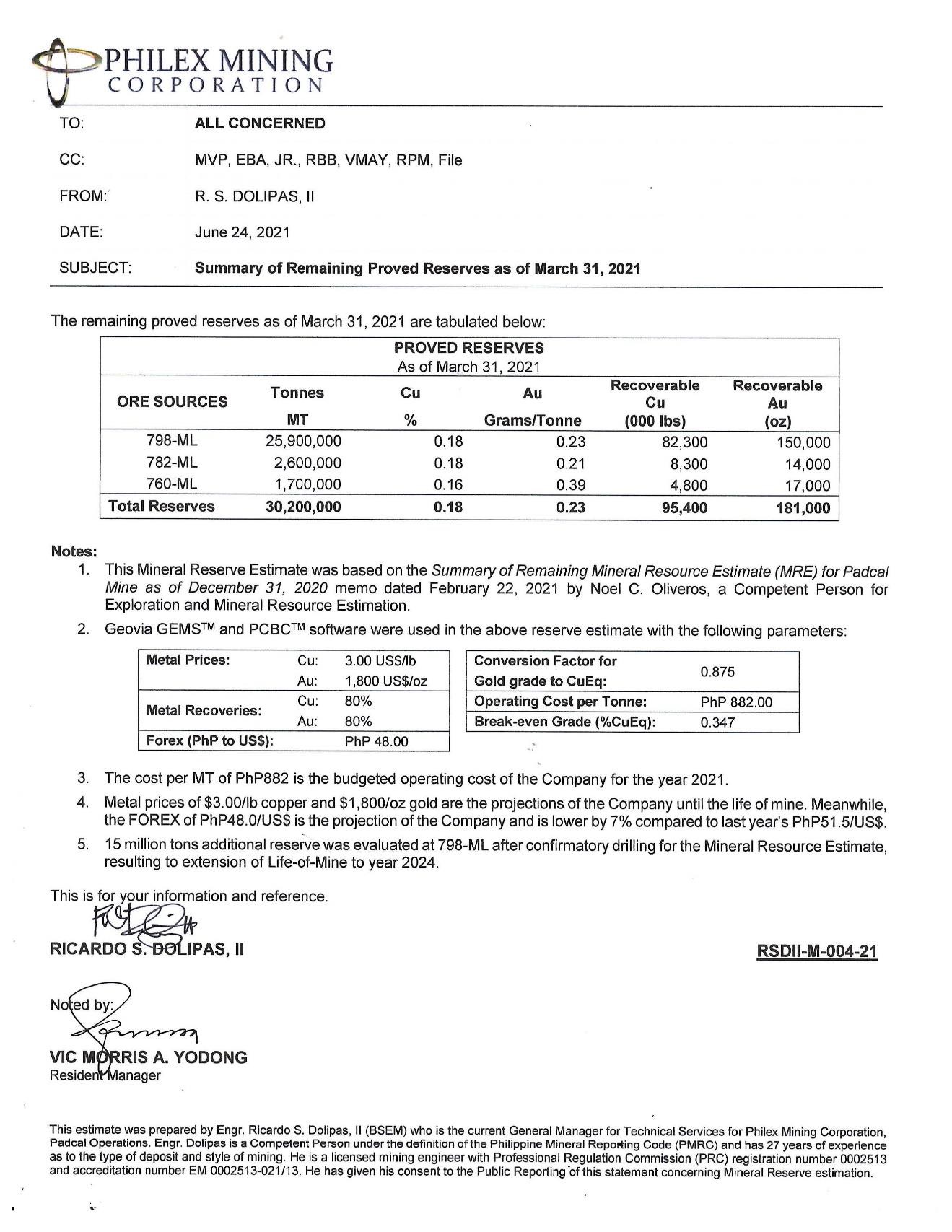
Philex Mining Corporation, one of the oldest and largest gold and copper producers in Southeast Asia, after the completion of confirmatory drilling and related technical studies on the mining methodology and Tailings Storage Facility (TSF) No. 3, has successfully identified from the end of 2022 additional mineable reserves in its Padcal Mine that are feasible for mining. The updated remaining mineable reserves as of end-March 2021 are estimated at 30.2 million tons with average gold and copper grades of 0.23 grams per ton (g/t) and 0.18%, respectively. This new estimate includes additional reserves of 16.2 million tons from the previously declared estimated mineable reserves as at the end 2020 of 17.4 million tons with an average gold and copper grades of 0.27 g/t and 0.18% that was reported in February 2021. The additional mineable reserves are expected to be mined over two years, extending the life of Padcal Mine until Dec. 31, 2024.

The latest mineable reserves estimate was undertaken by Engineer Ricardo S. Dolipas II, an accredited Competent Person by the Philippine Society of Mining Engineers (PSEM) under the Philippine Mineral Reporting Code (PMRC) Guidelines.

(Below is the mineable reserve statement from the Competent Person)

More importantly, the extended Life of Mine will ensure the continuous employment of 1,831 Padcal employees and support the social development of the host local government units (LGU) and neighboring communities especially in this time of COVID-19 pandemic. It will also give more time for the Company to bring the Silangan Project to development and commissioning stages.

The Company is currently processing all required permits and other regulatory requirements in connection with this impending Life of Mine extension.


Join us on Viber to get more updates from BusinessWorld: https://bit.ly/3hv6bLA

Remittances up for 4th straight month

PHILIPPINE STAR/ MIGUEL DE GUZMAN

By Beatrice M. Laforga, Reporter

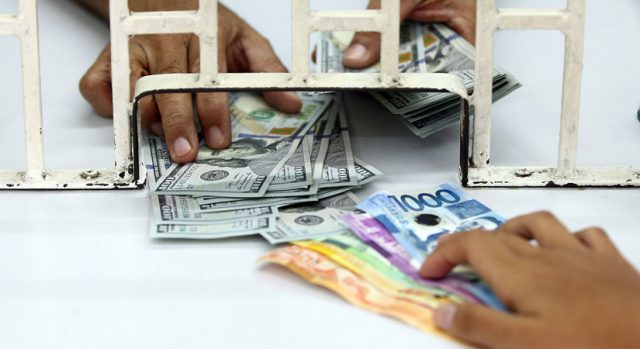
MONEY sent home by Filipinos working abroad rose by 13% in May, the fastest in nearly five years, as the global economy’s recovery picked up steam amid the pandemic.   

Preliminary data from the Bangko Sentral ng Pilipinas (BSP) showed cash remittances from overseas Filipinos reached $2.382 billion in May, up 13% from the $2.106 billion in the same month last year. This was the quickest growth rate since the 18.5% uptick logged in November 2016.

May also marked the fourth consecutive month of remittance growth since January’s 1.7% contraction.

Month on month, cash remittances by overseas Filipino workers (OFWs) inched up 3.34% from the $2.305 billion recorded in April.

The higher remittances were mainly due to the 16% rise in receipts from land-based OFWs to $1.894 billion in May. Sea-based workers sent home $488 million, up 2.7% year on year.

To date, cash remittances grew by 6.3% to $12.28 billion from January to May, against the $11.554 billion recorded in the same period last year.

The BSP noted there was an increase in remittances from the United States (US), Malaysia, South Korea, Singapore, and Canada.

“Jobs [were] slowly returning as developed economies reopen. Filipinos working overseas send more funds to offset lost income from affected family members/higher expenses at home,” BDO Unibank, Inc. Chief Market Strategist Jonathan L. Ravelas said in a Viber message on Tuesday.

The US remained the largest source of remittances, followed by Singapore, Saudi Arabia, Japan, the United Kingdom, the United Arab Emirates, Canada, South Korea, Qatar, and Taiwan. Around 78% of the overall cash remittances came from the top 10 countries.

OFW workers benefited from improving recovery prospects in the US and a rebound in oil demand, helping them to send more money back home, Security Bank Corp. Chief Economist Robert Dan J. Roces said on Tuesday.

“However, downside risks remain with the Delta variant and the threat of new lockdowns,” he said.

A low base in 2020 also helped lift the remittance data, as many OFWs lost their jobs and were repatriated during the pandemic, Rizal Commercial Banking Corp. (RCBC) Chief Economist Michael L. Ricafort said in a note on Tuesday.

“However, the relatively lower base would start to fade and could mathematically even result in some modest year-on-year rise or even year-on-year declines starting June 2021,” he said.

Meanwhile, BSP data showed personal remittances — which also accounted inflows in kind — jumped by 13.3% to $2.652 billion in May from $2.341 billion a year ago. This brought the five-month tally to $13.68 billion, up 6.6% from $12.835 billion a year ago.

Mr. Roces said OFW remittances should remain resilient, just like what happened in 2020 when it posted a softer-than-expected contraction.

OFWs struggled to send money to their families in the Philippines amid the pandemic.

“Gains should help prop up household consumption in the months ahead to contribute to the recovery,” he said.

Mr. Ricafort said OFW remittances should pick up further on a faster global economic recovery as more countries lift their quarantine restrictions and their vaccination programs gain traction.

BSP projects cash remittances to grow by 4% this year after the 0.8% decline in 2020.

Exporters want BIR to repeal new VAT rule

REUTERS

By Jenina P. Ibañez, Reporter

EXPORTERS and foreign chambers are calling for the repeal of the Bureau of Internal Revenue’s (BIR) tax refund scheme for raw materials shipped outside the country, which they said would cost Philippine jobs.

Industry leaders said Revenue Regulations (RR) No. 9-2021, which imposed a 12% value-added tax (VAT) on previously exempt raw materials and packaging supplies sold by local manufacturers to exporters, would weaken investor interest and cause multinational transfer to foreign suppliers.

VAT will also be imposed on outsourced services such as processing, manufacturing or repacking of goods to be exported.

Electronics exporters worry that the rule would hamper investor interest.

“(The VAT) would only be passed on to the export manufacturing companies. This will severely lower the ease of doing business and discourage investors,” Semiconductor and Electronics Industries in the Philippines, Inc. (SEIPI) President Danilo C. Lachica said in a press conference on Tuesday.

Multinationals in the Philippines would prefer to import parts from suppliers outside of the country instead of paying the costs associated with local suppliers, he said.

The sector’s revenues, as well as up to 50,000 employees, could be at risk, he said.

“Companies are going to move these orders outside, so instead of having 12% on the existing sales and — I’m exaggerating — you can likely have a situation where you have 12% on zero sales because they’re all coming from imported materials. So that kind of defeats the purpose.”

Wearables exporters, which have “razor thin margins,” make money based on the productivity of local production and services, Confederation of Wearable Exporters of the Philippines Executive Director Marites Jocson-Agoncillo said at the same event.

“The imposition of 12% VAT on locally sourced raw materials as well as on the local services such as our add-on capability to produce middle high-end products such as washing, embroidery of things that we put on the apparel — this directly cuts the profit center of the sector,” she said.

“This will drive exporters to import materials… We’ll be importing our threads, our cartons, our buttons. And (this) can marginalize the existence of the local support sectors such as the suppliers of the manufacturers of thread, button, zippers, and cartons.”

The 90-day VAT refund scheme, she added, “severely injures the companies’ cash flow.”

Melquiades L. Hernandez III, a member of the Pilipino Banana Growers and Exporters Association, also questioned the legal basis of the BIR regulation.

He said that there is a conflict between the Corporate Recovery and Tax Incentives for Enterprises (CREATE) law and the regulation, which BIR said was authorized by the Tax Reform for Acceleration and Inclusion (TRAIN) law. CREATE was passed later than TRAIN.

“CREATE law only limits but did not altogether remove the exemption or zero-rating of export-oriented registered business enterprises,” he said. According to CREATE, these businesses should still be entitled to VAT zero-rating on local goods and services purchases that are exclusively used in the registered activity, he added.

The export groups have sent letters to the BIR. Businesses could either take judicial action or take their concerns to the Senate.

“Being multinational companies, it’s always difficult to get sign offs, to actually be in a litigious state, but nevertheless I think compared to the previous issues that have come up, I think the multinational companies are more ready, willing, and able to take this up to the next level precisely because of the impact it will create… to the jobs that we have fought long and hard to preserve,” Concentrix APAC Regional General Counsel Michael Montero said.

Wearables exporters will take a different approach and reach out to the Senate instead.

Ms. Agoncillo said it would be difficult for her sector to take the same judicial path because the sector’s investors, which operate in various countries, see small margins in the Philippines and could instead decide to exit or reduce operations here.

“We’re really fighting for the existence of the industry,” she said.

Investor sentiment may be affected by Fitch’s negative outlook on PHL

PHILIPPINE STAR/ MICHAEL VARCAS

By Luz Wendy T. Noble, Reporter

INVESTOR SENTIMENT towards the Philippines may be affected after Fitch Ratings lowered its outlook on the sovereign to “negative” from “stable,” analysts said.

Fitch Ratings on Monday affirmed the Philippines’ credit rating at “BBB,” which is one notch above the minimum investment grade, but gave a negative outlook as it cited economic risks from the pandemic.

“We think this outlook revision represents a material negative surprise to investors,” Nomura Holdings, Inc. Chief ASEAN Economist Euben Paracuelles and economist Rangga Cipta said in a note on Tuesday.

With the negative outlook, Fitch may downgrade the “BBB” rating in the next 12 to 18 months.

However, economic managers insisted the Philippine economy is on track for a rebound.

“The negative outlook flags the risks that we are aware of, and the economic team will continue to exert effort to open the economy safely, manage risks from COVID-19, accelerate vaccine deployment, prudently use fiscal resources, and enact the remaining economic and fiscal reforms to further improve growth prospects,” Socioeconomic Planning Secretary Karl Kendrick T. Chua told reporters via Viber on Tuesday.

Bangko Sentral ng Pilipinas Governor Benjamin E. Diokno said the drag caused by the pandemic on the Philippine economy is expected to be “transitory.”

Investors appeared to have a knee-jerk reaction to the news. On Tuesday, the Philippine Stock Exchange index shed 118.74 points or 1.71% to close at 6,795.13, with all sectors in the red. The peso closed stronger at P50 per dollar on Tuesday from its P50.12 finish on Monday. During the session, the peso fell to P50.30, the weakest since June 2020.

“We expect near-term pressure on all financial markets as the Philippines suffers its first setback in terms of its once sterling credit rating,” ING Bank N.V. Manila Senior Economist Nicholas Antonio T. Mapa said in an e-mail.

Colegio de San Juan de Letran Graduate School Dean Emmanuel J. Lopez said the lowered outlook was expected since the economy remained in contraction since the first quarter of 2020.

“The biggest stumbling block however is how do we bring back the trust of the business community that seems to have been tainted by the existing political priorities that have divided the attention of the government,” Mr. Lopez said in an e-mail.

For Mr. Mapa, the government should take this as a signal to ramp up support for the economy as previous efforts have “fallen short of expectations.”

“The solution to this problem may be to bloat the deficit via a sizable rescue package that will jolt the economic engines back to life,” he said.

The budget deficit stood at P1.371 trillion in 2020, more than double the P660 billion shortfall in 2019. Last year’s fiscal gap widened to 7.63% of the gross domestic product (GDP) from 3.38% in 2019.

Economic managers have already rejected a P401-billion stimulus measure proposed by lawmakers. This year, the budget deficit is capped at P1.856 trillion or 9.3% of GDP.

“The government has been providing limited fiscal support measures, relative to its regional peers, even during lockdown periods. One could argue that this fiscal conservatism was partly due to the cabinet’s economic team trying to minimize ratings pressures,” Mr. Paracuelles and Mr. Cipta said.

Based on the International Monetary Fund’s policy tracker as of July 1, fiscal support in the Philippines coming from the two stimulus packages, Bayanihan I and II, was equivalent to 4.4% of the country’s gross domestic product (GDP) in 2020.

In its latest assessment, Fitch noted how the pandemic weakened the country’s fiscal metrics given its higher debt levels which is expected to go beyond the median increase for BBB-rated peers. It said an important consideration for the country’s rating will be the evolution of its fiscal deficit and debt levels and how it will balance fiscal consolidation to support economic recovery.

House Ways and Means Chair Jose Maria Clemente S. Salceda is optimistic the outlook on the Philippines will be stable again once the government completes its tax reform program.

“We should also reach for very low-hanging fruits such as the POGO (Philippine offshore gaming operators) tax regime and the e-sabong tax regime. President [Rodrigo R.] Duterte himself said that these areas can be revenue generators,” he said in a statement.

Finance Secretary Carlos G. Dominguez III has said the quicker vaccine rollout will help the economy recover faster, with fiscal consolidation expected by the time the virus is better contained and spending is normalized.

Vehicle sales up 45% in June

PHILIPPINE STAR/ MICHAEL VARCAS
The auto industry reported a 45% increase in sales in June, as mobility curbs continued to be eased in Metro Manila and nearby provinces. — PHILIPPINE STAR/ MICHAEL VARCAS

VEHICLE SALES in June jumped 45% compared with the same month last year as the auto industry continues to grapple with the impact of the pandemic.

Sales increased by 44.8% to 22,550 units in June compared with 15,578 units sold a year ago, a joint report from the Chamber of Automotive Manufacturers of the Philippines, Inc. (CAMPI) and Truck Manufacturers Association (TMA) released on Tuesday showed.

Sales in June 2020 tripled compared with the previous month as Luzon-wide lockdown restrictions eased and dealerships reopened, although sales figures remained more than 50% lower than the 31,950 units sold in June 2019.

Auto Sales

CAMPI President Rommel R. Gutierrez said in a statement that the industry has been recording double-digit year-on-year growth, but the monthly increase was “measly” at 2.2% from the 22,062 units sold in May.

“This is a respite amid the less buoyant consumer outlook for big-ticket items for the second quarter of this year according to a government survey,” he said.

“The auto industry continues to adjust to the effects of the pandemic at the same time striving to strike a balance between its contribution to the economy and keeping its stakeholders safe and healthy during these unprecedented times.”

Commercial vehicle sales went up 39.6% to 15,168 units in June compared with the same month last year, while also increasing 4.9% from the May figure.

Commercial vehicle sales accounted for two-thirds of total sales by CAMPI-TMA members for the month.

Passenger car sales went up 56.7% to 7,382 units compared with last year, but slipped 2.86% from the May figure.

For the first half, vehicle sales went up 56.1% to 132,767 units from 85,041 in the same six months last year.

Year to date, commercial vehicle sales increased 47.8% to 90,361 units, while passenger car sales rose 77.3% to 42,406 units.

Toyota Motors Philippines Corp. (TMP) continued to have the highest sales in June with 11,242 units sold or 49.85% market share.

Mitsubishi Motors Corp. followed with 2,933 units sold, with a 13.01% market share, while Suzuki Philippines, Inc. sold 1,795 units, with a 7.96% market share.

The car industry could recover to pre-pandemic sales as late as 2023, Mr. Gutierrez said earlier this year. — Jenina P. Ibañez

May NCR retail price growth fastest in over two years

THE RETAIL prices of general goods in Metro Manila grew at its fastest pace in over two years in May, according to data released by the Philippine Statistics Authority (PSA) on Tuesday.

The general retail price index (GRPI) rose at an annual rate of 2.1% in May, accelerating from the 2% print in April and 0.6% a year earlier.

This was the index’s quickest rise since logging a 2.7% year-on-year growth in April 2019.

Year to date, retail price growth in the National Capital Region (NCR) averaged 1.8% compared with 1.1% in last year’s comparable five months.

The PSA attributed the uptick in May mainly to the higher double-digit annual growth in mineral fuels, lubricants and related materials at 20.3%, from 20.2% in April 2021. These commodities account for around 4.2% of the retail basket in NCR.

Meanwhile, the indices of machinery and transport equipment and miscellaneous manufactured articles both posted a 0.4% growth in May, slightly up from 0.3% in April. These items make up 24.1% and 8.8% of the retail basket, respectively.

Bucking the trend was the slowing price growth of crude materials, inedible except fuels (1.7% from 1.9% in April) and chemicals, including animal and vegetable oils and fats (0.8% from 0.9%).

Compared with the previous month, growth in retail prices remained unchanged for the heavily weighted food index at 1.9%. Other commodities that saw steady growth rates were beverages and tobacco (6.4%) and manufactured goods classified chiefly by materials (1.0%).

“The substantial pickup in global crude oil prices appears to be clearly feeding through to retail prices, which was one of the main reasons for inflation for the month… The rest of the indices also saw modest acceleration in inflation as economic activity has picked up from the lows of last year,” ING Bank N.V. Manila Senior Economist Nicholas Antonio T. Mapa said in an e-mail.

Oil prices plummeted last year amid the ongoing coronavirus disease 2019 (COVID-19) pandemic that limited much of global economic activity during the period.

Dubai crude, a benchmark for oil transported to Asia, averaged $66.30 per barrel in May, more than double its rate a year ago. Having plunged to as low as $15-20 per barrel in April last year, Dubai crude prices have since rebounded to pre-pandemic levels at around $70-per-barrel in June.

At home, inflation so far averaged 4.4% at the national level this year following the six-month low of 4.1% in June. In Metro Manila, inflation averaged 3.8% year to date.

Despite the slowing inflation, economists noted the elevated global oil prices and the peso’s depreciation would likely contribute to inflationary pressures in the coming months.

“We can expect [the trend in the GRPI] to continue in June as energy prices stay elevated and issues on food supply remain,” Mr. Mapa said. — Lourdes O. Pilar