Home Blog Page 6199

US authorizes second COVID booster for Americans 50 and older

REUTERS

US health officials on Tuesday authorized a second coronavirus disease 2019 (COVID-19) booster dose of the two most commonly used COVID-19 vaccines for people age 50 and older, citing data showing waning immunity and the risks posed by Omicron variants of the virus.

The US Food and Drug Administration (FDA) agency said the new boosters — a fourth round of shots for most vaccine recipients — of the Pfizer, Inc./BioNTech SE and Moderna, Inc. vaccines are to be administered at least four months after the previous dose. They are intended to offer more protection against severe disease and hospitalization.

The FDA also authorized a second booster dose of the vaccines for younger people with compromised immune systems — those aged 12 and older for the Pfizer/BioNTech shot and 18 and older for Moderna’s.

The US Centers for Disease Control and Prevention (CDC) backed the FDA’s authorization, recommending the additional shot, particularly for older people and those with underlying medical conditions that put them at higher risk.

The decision to offer second boosters in the United States comes as some scientists have raised concern about the highly contagious and newly predominant BA.2 Omicron subvariant, which has driven up COVID-19 cases in other countries.

“If it were my relatives, I would be sending them out to do this,” top FDA official Dr. Peter Marks said during a news conference of getting booster shots. “COVID-19 has had a really disproportional adverse effect on people 65 years of age and older and those with comorbidities.”

COVID cases in the United States have dropped sharply since a record surge in January, but have seen a small uptick over the past week, according to CDC data.

BROADER BOOSTER CAMPAIGN
Marks said the FDA will soon weigh the benefits of authorizing another round of boosters – perhaps specifically targeted to combat new variants of concern – to a broader population after the summer.

“There may be a need for people to get an additional booster in the fall along with a more general booster campaign, if that takes place, because we may need to shift over to a different variant coverage,” he said.

The FDA said it looked at data from a relatively small, ongoing clinical trial in Israel to help make its decision. In addition, safety data from more than 700,000 people who received second boosters in Israel revealed no new concerns, the agency said.

Scientists and officials have debated for months if and when an additional booster shot would be needed as they parsed data on how long protection from the vaccines and boosters would last.

“It’s not clear that now is the right time for people to get a fourth dose,” Dr. William Moss, executive director of the International Vaccine Access Center at the Johns Hopkins Bloomberg School of Public Health said.

If there is a surge in cases in late fall or early winter, as is typical for respiratory viruses and influenza, an additional boost may then be needed, he said. The body’s neutralizing antibodies spurred on by a fourth booster given now may decline in just a few months, he said.

It is also unclear whether young, healthy people will need a fourth shot. The study of Israeli healthcare workers cited by the FDA suggested that the fourth dose added little additional protection in the age group.

Biden administration officials have said that the US government currently has enough doses of the vaccines to meet the demand for another round of booster shots in older Americans, even as funding for the US pandemic response has all but run out.

They say that unless Congress approves more spending, the government will not be likely to be able to be pay for future inoculations, if they are needed, particularly if the vaccines need to be redesigned to target new variants.

Around two-thirds of fully vaccinated Americans over the age of 65 and just over half of people between the age of 50 and 64 have gotten their first booster dose so far. — Reuters


Hong Kong leader says city’s brain drain ‘unarguable’

REUTERS

HONG KONG — Hong Kong leader Carrie Lam said it was “unarguable” that the global financial hub was seeing a brain drain due to stringent coronavirus rules, but said she valued the city’s international status and envisioned a “better development” after the pandemic.

Ms. Lam’s comments come amid a backlash from businesses and residents who see the rest of the world shifting to living with the virus while Hong Kong officially sticks to a “dynamic zero” COVID-19 strategy which seeks to curb all outbreaks as soon as they occur.

Ms. Lam said no one valued the international status of Hong Kong more than herself, but the government had to adopt anti-pandemic measures to protect residents.

“These measures have certain influence on corporates and individuals, although we don’t have a figure…it’s an unarguable fact that we have a brain drain and some senior management of some corporates have left Hong Kong,” she told a daily news briefing on Wednesday.

“The most important thing is Hong Kong keeps its advantages. I believe after the pandemic, Hong Kong can have a better development.”

Ms. Lam said “streamlining” certain measures, including lifting a ban on flights from nine countries and reducing quarantine for arrivals from abroad, would help ease concerns about the city’s international status.

At the start of this year, Hong Kong implemented its most draconian measures since the pandemic began over two years ago, frustrating many residents who have been largely compliant with various COVID regulations in the hope of resuming travel internationally and with the mainland.

Hong Kong’s border has effectively been shut since 2020 with few flights able to land and hardly any passengers allowed to transit, isolating a city that had built a reputation as a global financial and travel hub.

Ms. Lam’s comments come just weeks before the city is due to hold an election on May 8 to choose who will lead the territory for the next five years.

She declined to comment on whether she will run for a new term.

The rules, together with mixed messaging from the government including whether a citywide lockdown and mass testing would take place, have triggered an exodus of residents in the past two months.

The former British colony has reported more than 1.1 million coronavirus infections and more than 7,500 deaths, most of them occurring in the past five weeks. — Reuters

Successful Filipinas give tips for handling money

Determination, discipline, and direction are necessary to manage one’s personal and financial affairs, both in failure and in success, according to Manulife Philippines brand ambassador and Olympic gold-winning weightlifter Hidilyn F. Diaz and actress and entrepreneur Bea Alonzo.  

The two Filipinas were the main guests of financial services group Manulife’s March 24 webinar celebrating International Women’s Month. They shared tips on how to build a successful mindset, properly handle finances, and care for one’s mental health.  

“Before I even won my gold medal, I was already gold-driven, determined, and disciplined,” explained Ms. Diaz, who powered through three separate Olympics before she finally clinched the gold in 2021.   

This kind of mindset also helped her with her financial goals, she added. A failure that she had to overcome was her poor handling of the money that came with the 2016 silver medal win — when the winnings came, she was overwhelmed and spent too much.  

Ms. Diaz vowed not to do the same with her money from the 2021 gold medal win.  

Nandoon na yung pagiging kuripot at kailangan mag-allot (There’s now a sense of being stingy and a need to allot) for investments and for family,” she said. “I now have a financial advisor.”  

For award-winning actress Ms. Alonzo, setting personal targets gave her something to look forward to and work towards, whether it was in terms of career or finances.  

“I’m very much like Hidilyn. I’m goal oriented. Kapag meron akong gusto (If I want something), I make sure I plan ahead and I make sure I achieve that goal. It’s important to have the drive and motivation,” she explained.  

Making wise investments, living within one’s means, and planning where to put money were her guiding principles as she earned more and more throughout her life.  

However, what both successful Filipino women agreed on was the conviction not to stop setting more goals even after major achievements.  

“I’m thinking of what’s next. Maraming nagasasabi na pwede na (Many people say it’s enough that), you’re a gold medalist,” said Ms. Diaz, “But I don’t want to stop yet.”  

She confirmed that she still plans to compete in the 2024 Paris Olympics.  

Meanwhile, Ms. Alonzo expressed that she has plenty she wants to do aside from maintaining her acting career: “My dreams don’t stop here, I have other dreams too aside from being an actress. I’m also a businesswoman and entrepreneur.”  

Kimberly Anne Zandueta, a Manulife financial adviser, noted that both Filipinas are good examples of successful women who learned to manage their finances.  

“Remember the 50-30-20 rule,” she reminded. “Divide and prioritize your income this way — 50% on needs, 30% on wants, and 20% set aside as savings.” — Bronte H. Lacsamana

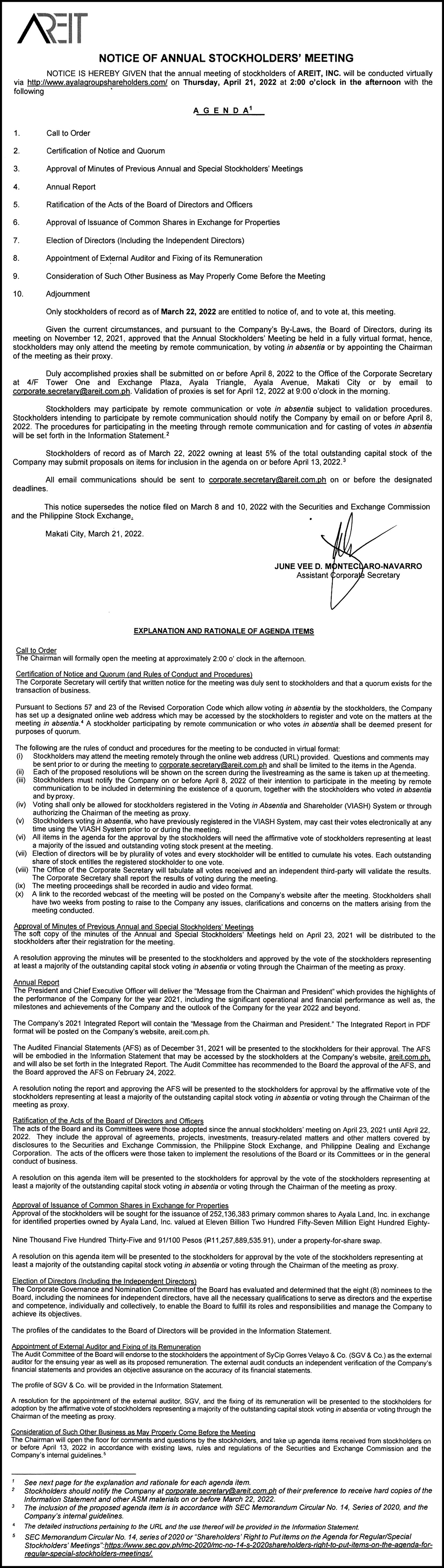
AREIT, Inc. announces schedule of annual stockholders’ meeting on April 21

Click to enlarge.

AREIT, Inc. announces schedule of special stockholders’ meeting

Click to enlarge

BW Insights | Travel Now: Safe and Sustainable Travels in the New Normal

Living in the new normal becomes a chance to rethink how we travel by considering safety and sustainability.

As the tourism sector works towards recovery and plans its post-pandemic future, how can both travelers and the industry collaborate towards a safer and more sustainable travel?

Learn that and more this March 30 (Wednesday) at 11:00 a.m. in BusinessWorld Insights’ episode themed “Travel Now: Safe and Sustainable Travels in the New Normal” LIVE and FREE in BusinessWorld’s and The Philippine STAR’s Facebook pages.

This session of #BUSINESSWORLDINSIGHTS is supported by the British Chamber of Commerce of the Philippines, Management Association of the Philippines, Philippine Chamber of Commerce and Industry and The Philippine STAR.

Ukraine isn’t naive, Zelenskiy says after Russian pledge to scale down attack on Kyiv

Army soldier figurines are displayed in front of the Ukrainian and Russian flag colors background in this illustration taken, Feb. 13, 2022. — REUTERS/DADO RUVIC/ILLUSTRATION

Ukraine reacted with skepticism to Russia’s promise in negotiations to scale down military operations around Kyiv and another city as some Western countries expected Moscow to intensify its offensive in other parts of the country.

Talks took place in an Istanbul palace more than a month into the largest attack on a European nation since World War Two that has killed or injured thousands, forced nearly 4 million to flee abroad and pummeled Russia’s economy with sanctions.

The invasion has been halted on most fronts by stiff resistance from Ukrainian forces who have recaptured territory even as civilians are trapped in besieged cities.

“In order to increase mutual trust and create the necessary conditions for further negotiations and achieving the ultimate goal of agreeing and signing (an) agreement, a decision was made to radically, by a large margin, reduce military activity in the Kyiv and Chernihiv directions,” Russian Deputy Defense Minister Alexander Fomin told reporters.

He made no mention of other areas that have seen heavy fighting, including around Mariupol in the southeast, Sumy and Kharkiv in the east and Kherson and Mykolaiv in the south.

“Ukrainians are not naive people,” Ukrainian President Volodymyr Zelenskiy said late on Tuesday.

“Ukrainians have already learned during these 34 days of invasion, and over the past eight years of the war in Donbass, that the only thing they can trust is a concrete result.”


MAJOR OFFENSIVE POSSIBLE

Russia has started moving very small numbers of troops away from positions around Kyiv in a move that is more of a repositioning than a retreat or a withdrawal from the war, the Pentagon said on Tuesday.

“We all should be prepared to watch for a major offensive against other areas of Ukraine,” spokesman John Kirby told a news briefing. “It does not mean that the threat to Kyiv is over.”

Britain’s Ministry of Defense in an intelligence update said: “It is highly likely that Russia will seek to divert combat power from the north to their offensive in the Donetsk and Luhansk regions in the east.”

Reuters could not immediately verify the claims made by either side.

The Moscow-backed self-proclaimed Donetsk People’s Republic in eastern Ukraine may consider joining Russia once it controls all of Ukraine‘s Donetsk region, its leader was quoted as saying. Kyiv has said any such move would have no legal basis.

Russia calls its assault a “special operation” to disarm and “denazify” Ukraine. The West says it launched an unprovoked invasion.

In Ukraine‘s besieged seaport Mariupol, thousands of civilians may have died, the head of the United Nations human rights mission in the country told Reuters on Tuesday.

Those who remain are suffering.

“We are eight people. We have two buckets of potatoes, one bucket of onions,” said Irina, an engineer, in her apartment where windows had been blasted out.

Elsewhere, Ukrainian forces have made advances, recapturing territory from Russian troops on the outskirts of Kyiv, in the northeast and in the south.

In the southern city of Mykolaiv, a missile blasted a hole through the main administrative building. Authorities said at least 12 people were killed and 33 injured. Read full story

Some analysts noted that Russia’s promise to reduce fighting mostly covered areas where it has been losing ground.

The general staff of the Ukrainian armed forces said Russia’s promise to curtail military operations in some areas was “probably a rotation of individual units and aims to mislead.”

The Russian military accused Ukrainian forces in cities under attack of using ceasefires to restore their combat readiness and set up firing points in hospitals and schools, Interfax news agency said.


DIPOLOMATIC PRESSURE

U.S. President Joe Biden will talk to the leaders of France, Germany, Italy and Britain on Tuesday to discuss the latest developments in Ukraine, the White House said.

French President Emmanuel Macron is scheduled to talk to Russian President Vladimir Putin on Tuesday.Read full story

Russian Foreign Minister Sergei Lavrov and U.S. deputy national security adviser for economics, Daleep Singh, will both visit India, which has called for a ceasefire but has refused to explicitly condemn Moscow. Read full storyRead full story

The U.N. food chief warned on Tuesday that the war was threatening to devastate the World Food Programme’s efforts to feed some 125 million people globally because Ukraine had gone “from the breadbasket of the world to breadlines.” Read full story


PROPOSALS

Ukrainian negotiators said that under their proposals, Kyiv would agree not to join alliances or host bases of foreign troops, but would have security guaranteed in terms similar to “Article 5”, the collective defense clause of the transatlantic NATO military alliance.

They named Israel and NATO members Canada, Poland and Turkey as countries that may give such guarantees. Russia, the United States, Britain, Germany and Italy could also be involved.

The proposals, which would require a referendum in Ukraine, mentioned a 15-year consultation period on the status of Crimea, annexed by Russia in 2014.

The fate of the southeastern Donbass region, which Russia demands Ukraine cede to separatists, would be discussed by the Ukrainian and Russian leaders.

Kyiv‘s proposals also included one that Moscow would not oppose Ukraine joining the European Union, Russia’s lead negotiator Vladimir Medinsky said. Russia has previously opposed Ukrainian membership of the EU and especially of NATO.

Medinsky said Russia’s delegation would study and present the proposals to president Putin.

To prepare a peace agreement, Medinsky later told the TASS news agency, “We still have a long way to go”. – Reuters

Relentless rains submerge Australian towns for second time in a month

STOCK PHOTO | Image by PublicDomainPictures from Pixabay

Heavy rains deluged Australia’s east coast on Wednesday, submerging roads and bridges, while tens of thousands fled their homes for the second time within weeks after fast-moving flood waters burst river banks and broke over levees.

Several towns in northern New South Wales already reeling after record floods over a month ago were pounded by an intense low-pressure system overnight. Some regions took a month‘s rainfall in under six hours, officials said.

Australia’s east coast summer has been dominated by the La Nina climate pattern, typically associated with greater rainfall, for the second straight year with rivers already at capacity after torrential rains. Sydney has already recorded 537 mm (21.1 inches) so far this month – its wettest March on record.

“Unfortunately overnight, our worst fears have been realised with significant heavy rainfall across already saturated landscapes,” New South Wales Emergency Services Minister Stephanie Cooke said during a media briefing.

In the northern New South Wales city of Lismore, among the worst impacted by record floods earlier in March, water levels in the city’s Wilsons river breached the levee height of 10.65 metres. Lismore, home to nearly 30,000 people, received around 400 mm (16 inches) of rain over a 24-hour period up to Wednesday morning, data showed.

There was no official warning that the levee had been breached after sirens malfunctioned, local media reported.

“Everything is falling apart in Lismore at the moment … second time in a month,” Mayor Steve Krieg told Nine Network.

The weather bureau forecast “bands of very localised heavier rainfall” to drop within a few hours on Wednesday, potentially leading to life-threatening flash floods with up to 200 mm predicted to pummel many regions.

Kevin Cocciola, a farmer near Lismore who lost his city office in the deluge early in March, said he has never seen successive major flooding events within “a matter of three weeks”.

“I hope it doesn’t get as high as it did three weeks ago but Lord only knows,” he told ABC television. – Reuters

China, U.S., Russia, Pakistan to hold talks on Afghanistan – China, U.S. say

STOCK IMAGE | Image by Gordon Johnson from Pixabay

A top U.S. diplomat will meet this week in China to discuss issues in Afghanistan with his Chinese, Russian and Pakistani counterparts, the Chinese foreign ministry and the State Department said on Tuesday.

The United States understands that China has invited Taliban representatives to the talks in Tunxi, a State Department spokesperson said.

Chinese special envoy for Afghanistan Yue Xiaoyong will host the meeting, said Wang Wenbin, a Chinese foreign ministry spokesman.

Russian Foreign Minister Sergei Lavrov has arrived in Tunxi for the talks, Interfax news agency cited a ministry spokeswoman as saying late on Tuesday. Lavrov has largely stayed in Russia since last month’s invasion of Ukraine but did travel to Turkey for talks with his counterpart from Kyiv.

Tom West, the U.S. special representative for Afghanistan, will attend the talks of the so-called Extended Troika: the three world powers plus Pakistan, the State Department spokesperson said.

The talks come against the backdrop of Russia’s invasion of Ukraine and as Afghanistan suffers an economic and humanitarian crisis worsened by a financial aid cutoff following the Taliban takeover as U.S.-led troops departed in August.

They also come amid widespread condemnation of the Taliban’s U-turn last week on allowing girls to attend public high schools, which has sparked consternation among funders ahead of a key aid donors conference, a U.N. official said on Tuesday. Read full story

The retention of the ban prompted U.S. officials to cancel talks in Doha with the Taliban and a State Department warning that Washington saw the decision as “a potential turning point in our engagement” with the militants. Read full story

The United States believes that it shares with other Extended Troika members an interest in the Taliban making good on commitments to form an inclusive government, cooperate on counterterrorism and rebuild the Afghan economy, the State Department spokesperson said.

The meeting takes place while foreign ministers from Afghanistan‘s neighbors meet on Wednesday and Thursday in the eastern Chinese province of Anhui, Wang said.

That meeting will be chaired by Chinese Foreign Minister Wang Yi and attended by Afghan acting Foreign Minister Amir Khan Muttaqi, and diplomats from Pakistan, Iran, Russia, Tajikstan, Turkmenistan, Uzbekistan, Indonesia and Qatar.

China Evergrande to sell Crystal City Project for $575 mln

China Evergrande Group Logo - https://www.evergrande.com/

China Evergrande Group 3333.HK said on Wednesday it will sell its Crystal City Project in the eastern city of Hangzhou for 3.66 billion yuan ($575 million) to two state-owned firms as the group’s liquidity issues dampen the progress of its projects.

The firm is selling the land-use and building ownership rights for the project, which is under construction, to Zhejiang Zhejian Real Estate Group and Zhejiang Construction Engineering Group, Evergrande said in a filing.

It will use the proceeds to repay construction fees of 920.7 million yuan owed to Zhejiang Construction Engineering and the rest for its own general working capital. The deal is expected to post a gain of about 216 million yuan.

Saddled with over $300 billion in liabilities, Evergrande has been struggling to repay suppliers, creditors and complete projects. State-owned enterprises have stepped in to help with the debt restructuring process and taken over some of its assets to quell market concerns about a disorderly collapse.

In a separate filing late on Tuesday, Evergrande said it had set up an independent committee to investigate how banks seized 13.4 billion yuan in deposits of its property services arm, Evergrande Property Services Group 6666.HK, that had been pledged as security for third party guarantees.

Preliminary investigation has found the pledge of the relevant deposits and the enforcement by banks took place in 2021, Evergrande said.

Shares of its unit China Evergrande New Energy Vehicle Group 0708.HK resumed trading on Wednesday and plunged up to 14.5%.

They have been suspended since last Monday pending news of the enforcement. But trading will be halted again on Friday per listing rules as the firm will not be able to publish its 2021 financial results by March 31.

Shares of Evergrande and Evergrande Property Services have both been suspended since last Monday. – Reuters

India bets on satellite broadband to bridge rural digital divide

STOCK VECTOR | Computer network vector created by vectorjuice - www.freepik.com

The day started well for Sayi Gharat. The nine-year-old schoolgirl managed to connect easily to her online science class, as she sat on a daybed in her grandmother’s home in western India.

But Sayi knew she would not be able to stay in the same spot for long due to the shaky mobile internet connection she relied on for her education as classes in Dunge village and across India moved online when COVID-19 struck in March 2020.

“Sometimes the network is good, sometimes it’s not good: she has to move from one room to another, from one corner to another, and even go outside,” Sayi’s grandmother, Chandrakamalkar Gharat, told the Thomson Reuters Foundation.

Two years on, Sayi is back at school, but staying online all day remains a challenge for her and tens of millions of others with poor connectivity in rural India, where the digital divide hampers education, livelihoods and healthcare access.

“It’s very hard for her – we sometimes wonder if it’s worth the trouble,” Gharat said.

There are currently more than 800 million internet subscribers in the nation of 1.3 billion people, according to the telecom regulatory authority (TRAI). Yet in rural India, only about 38% of the population is connected to the internet.

The government has made universal broadband a priority under its Digital India programme to improve governance through technology, with projects such as the Bharat Net rural broadband project aimed at connecting about 650,000 villages nationwide.

But digital inclusion “continues to remain a distant reality for most parts of rural India“, marred by delays in implementation, and a lack of access and digital literacy, according to a report from the Indian Council for Research on International Economic Relations (ICRIER), a policy think-tank.

That might now change due to recent policy moves including easier approvals for satellite broadband network rollouts, and the imminent launch of satellite broadband from India‘s Bharti Airtel and Jio Platforms, Elon Musk’s Starlink, and others.

“With the saturation of urban markets, there is keen interest among service providers to increase rural subscribership,” said Mansi Kedia, a fellow at ICRIER, and a telecoms and internet expert.

“But rural connectivity should look beyond the dominant technology – optical fibre and mobile communications. The use case for satellite broadband is the strongest in rural areas – it can help achieve connectivity at much lower costs,” she said.


CHEAP MOBILE DATA

The United Nations stated in 2016 that internet access is a human right, adding a clause to the Universal Declaration of Human Rights on the “promotion, protection and enjoyment of human rights on the internet,” including for women, girls, and those impacted by the digital divide.

India was among several countries that opposed the amendment at the time, and the country has among the most internet shutdowns in the world.

It also has one of the lowest charges for mobile data globally, helping mobile wireless to account for the bulk of the country’s 834 million internet subscribers. Only about 24 million subscribers have fixed internet connections.

Besides government programmes, private-sector and philanthropic initiatives have also helped build last-mile connectivity and increase digital literacy in rural areas.

“The big telcos will only go into rural areas if it makes economic sense, as it’s more expensive to build infrastructure, and it is for a customer base with less ability to pay,” said Michael Ginguld, a director at AirJaldi, which provides affordable networks in rural and semi-urban areas in India.

“The deeper you went into rural areas, the less demand there was – they can watch a show or a film on their phones. But this is changing, and COVID has hastened that shift, with demand for better connectivity to access education or healthcare,” he said.

AirJaldi, which has partnered with Google, Facebook and Microsoft on internet projects, reaches more than 200,000 users in about 1,500 villages in India, including some that had no mobile connectivity previously.


CLIMBING TREES

Globally, three-quarters of students who cannot access remote learning come from rural areas or poor households, according to the U.N. children’s agency (UNICEF).

During COVID-19 lockdowns, Indian media carried reports of students and teachers in villages climbing trees or trekking up hills in an attempt to get online.

Such anecdotes may soon be a thing of the past.

Earlier this year, OneWeb and Hughes Communications India – a joint venture with Bharti Airtel – said they had an agreement to bring low Earth orbit (LEO) satellite broadband services, “especially in areas outside the reach of fibre connectivity”.

Last month, Jio Platforms – owned by billionaire Mukesh Ambani – said it would launch satellite-based broadband services in India with Luxembourg-based telecom company SES, using geostationary and medium Earth orbit (MEO) satellites.

Also in the mix is Musk’s Starlink, which is waiting for its licence in India, and has already launched about 2,000 of its intended 42,000 LEO satellites to deliver internet across the globe. Amazon’s Project Kuiper is another potential entrant.

“The fixed costs for satellite broadband are high, but it has a lower cost of implementation for larger geographical coverage and lower population density, as compared to technologies such as optical fibre cable,” said Kedia.

Residents of the southern Indian village of Sittlingi, who once travelled to another village about 20 km (12 miles) away to get online, could not afford to wait for satellite broadband.

Nonprofits the Digital Empowerment Foundation and the Internet Society stepped in during the pandemic, and established a stable internet connection in the village using free, unlicensed spectrum.

That meant students were able to resume classes, farmers could sell their produce online, and an indigenous crafts centre found new buyers, said Lalitha Regi, manager of Porgai, the crafts centre.

“It was like a celebration – getting connectivity,” she said. – Reuters

Philippines wants government workers to report early to ease traffic

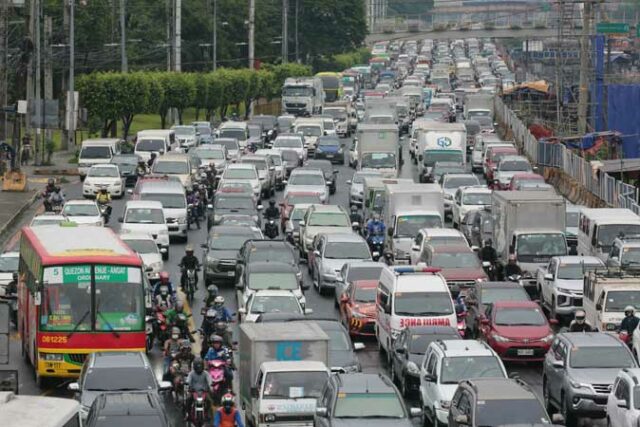
The Philippines is considering earlier work hours for government offices to ease traffic congestion in the capital that has worsened as virus restrictions eased.

The Metropolitan Manila Development Authority, which sets policies on traffic in the capital region, asked President Rodrigo Duterte to move government work an hour earlier to a 7 a.m. to 4 p.m. shift.

This will allow state workers to avoid the rush hour, the body’s chairman Romando Artes said at a televised briefing late Tuesday.

A four-day work week of 10 hours each day can also be implemented, Artes said, echoing an earlier proposal from Economic Planning Secretary Karl Chua. Pending a study on overtime pay required by law, an alternative proposal is to allow workers to work from home once a week to help lessen the number of vehicles on the road, Artes said.

Traffic jams have returned in the capital following the easing of movement restrictions as Covid-19 infections subside.

The governing body in charge of the capital region also presented a proposal to build elevated walkways and bicycle lanes to encourage workers to walk or use bikes on their way to work. Duterte whose term ends in June wants the proposals to be studied. — Bloomberg