Home Blog Page 6038

Luxury sneakers may be a step too far for cash-strapped Gen Z

SNEAKERS of Italian high fashion sneaker brand Golden Goose are displayed at its store in Beijing, China, Sept. 23, 2020. — REUTERS/TINGSHU WANG

SHANGHAI/PARIS — From $300 bucket hats to $900 sneakers and $700 T-shirts, the high-flying luxury sector is fretting over the appetite among financially stretched Gen Z consumers for such “aspirational” purchases.

Executives are troubled in particular by a hit to young Chinese shoppers, not only because mainland China has been a major driver of the industry’s growth in recent years, but also because high end consumers in the world’s second-largest economy are a decade younger than the global average of 38.

Young adults around the world have been “a very strong factor of luxury growth over the past decade,” said Gregory Boutte, chief client and digital officer at Gucci-owner Kering.

Data last week showed China’s economy slowed unexpectedly, prompting a central bank rate cut, while macroeconomic trends are disproportionately impacting the extra funds that those born between 1996 and 2012 might use to enter the world of luxury.

Whereas in North America and Europe, inflation and a rising cost-of-living are hitting discretionary incomes of young consumers especially hard, China’s problem is different.

“In the US, inflation is a huge issue, the major focus of a lot of luxury companies … In China, it’s the youth unemployment rate that’s alarming right now,” Kenneth Chow, principal at consultancy Oliver Wyman said.

Government data for July registers the unemployment rate of China’s urban population aged 16 to 24 at a record 19.9%, exacerbated by the impact of COVID-19 lockdowns and a crackdown on big tech firms that traditionally hired droves of graduates.

“This might be the first time that a lot of young adults (in China) are facing (such an) economic impact, so it will be a testing ground on how these consumers are going to spend on luxury items going forward,” Mr. Chow said.

“If a recession happens, then I will 100% buy less or maybe even stop buying altogether,” said US-based luxury lifestyle and travel TikToker Jeffrey Huang, 28, who shares his Louis Vuitton shopping trips and hauls with his 150,000 followers.

A recent Oliver Wyman study showed that some luxury brands are significantly lowering their sales expectations for the Chinese market in response to current conditions, with 80% of executives questioned not expecting a “V-shaped” recovery this year. Oliver Wyman declined to name the brands it surveyed.

Nevertheless, earnings last month from firms including LVMH and Kering painted a picture of resilience in the face of economic headwinds, with luxury players riding a wave of post-COVID spending by their wealthiest clients.

And big brands have signaled their intention to grow top end sales of $10,000 handbags and $5,000 coats rather than focus on attracting new entrants onto the bottom rung of the ladder.

Chanel, Louis Vuitton, and Dior have raised prices on high-margin leather goods several times over the past year, with Chanel planning stores dedicated to VIP consumers.

“As the prices are rising, I’m becoming more and more cautious because I feel like I did do a good amount of spending in the last year,” said Sara Yogi, a 26-year-old San Francisco, California resident, adding that she may hold off buying a $2,900 Prada bag and one costing $3,200 from Bottega Veneta which are both on her wish list.

This shift to focus on core luxury consumers also encompasses a cohort of wealthy Gen Z consumers less likely to be impacted by inflation or unemployment.

But the concern is over would-be buyers who were meant to help Gen Z account for a fifth of all spending in the luxury goods sector globally by 2025.

And brands such as Burberry have already noted weakness in sales of sneakers and slides, products Gen Z and millennial consumers have traditionally used as their entrée into the world of luxury brands.

PLAN B FOR GEN Z?
One way for luxury players to continue to attract Gen Z consumers may be to offer aspirational options at entry-level price points that can be worn often, said Yi Kejie, a 26-year-old marketing content manager.

Luxury branded mobile phone cases, earrings, hair clips, and perfumes are all popular among her Gen Z peers in China, Yi said, adding: “These are items with the lowest threshold for (them) to have that logo, that icon.”

Some luxury labels, including Balenciaga and Dior, are embracing the metaverse to seed interest with teens and young adults, offering affordable ways for them to kit out their virtual identities on gaming platforms such as Roblox.

Virtual sneakers from brands like Gucci have already proved wildly popular, with a price point of $17.99.

Whether in the real or virtual world, entry-level products call for high levels of creative investment.

“There is this young crowd of consumers that are entering into the market that requires a lot of creativity at more affordable price points,” said Bain partner Claudia D’Arpizio, adding that not all brands are equipped for this.

There is good news for brands, however.

If they do find the right offering of entry-level products, or if the economic situation of Gen Z consumers improves, the desire for luxury products remains undimmed.

“Young people in China are enthusiastic about luxury products,” Yi said. “Lockdowns, or the temporary unemployment rate won’t change their long-term preferences.” — Reuters

D.M. Wenceslao to add more sellable, leasable areas in 2023

D.M. WENCESLAO and Associates, Inc. expects to add 200,000 square meters (sq.m.) of gross leasable area (GLA) and about 30,000 sq.m. of sellable floor area (SLA) in its portfolio next year.

The addition will be through the completion of three projects, namely: Aseana Plaza, Aseana Mainstreet 2, and One Parq Suites.

Aseana Plaza and Aseana Mainstreet 2 are the two new additions to the company’s commercial leasing segment, which will add close to 200,000 sq.m. of GLA. They will follow the completion of its Parqal project this year.

“This year, the expected completion of Parqal will add another 70,000 sq.m of GLA, which will bring our total [GLA] to 232,500 sq.m.,” D.M Wenceslao Investor Relations Officer Jeffrey Lucero said at the Philippine Stock Exchange STAR Investor Day last week.

One Parq Suites will be the company’s new addition to its residential portfolio. The third residential development is expected to add 30,000 sq.m. of SLA to the company’s residential inventory that will rise in Makati City.

Meanwhile, its ongoing 15-storey residential project, Midpark Towers, was reported to be at 38% construction progress. It is situated in Aseana City and bordered by Aseana Ave. and Macapagal Blvd.

In the second quarter, the company’s attributable net profit rose to P372.23 million, a 23.7% increase from last year’s P300.8 million.

The company’s topline climbed 41.6% to P779.4 million in the second quarter, from P550.39 million a year ago.

Meanwhile, Mr. Lucero said that the company expects office vacancies to rise to 18.2% by the end of 2022.

“The office market, as you know, has been facing challenges, particularly during the pandemic. Vacancies rose because of the challenges caused by the Covid-19 (coronavirus disease 2019),” he said.

“These projections assume that POGO (Philippine Offshore Gaming Operator) market will be muted but with the POGO market recovering, we anticipate that vacancies will drop to 14.46% by the end of 2024,” Mr. Lucero said.

The company’s rental revenues from buildings amounted to P184.16 million in the second quarter, lower by 6.4% than the previous year’s P196.74 million.

On the stock market on Friday, shares in D.M. Wenceslao slipped by 0.44% or P0.03 to P6.85 apiece. — Justine Irish P. Tabile

Yields mixed on BSP moves

YIELDS on government securities (GS) were mixed last week after the Treasury fully awarded auction offerings and the central bank hiked policy rates for the fourth time this year.

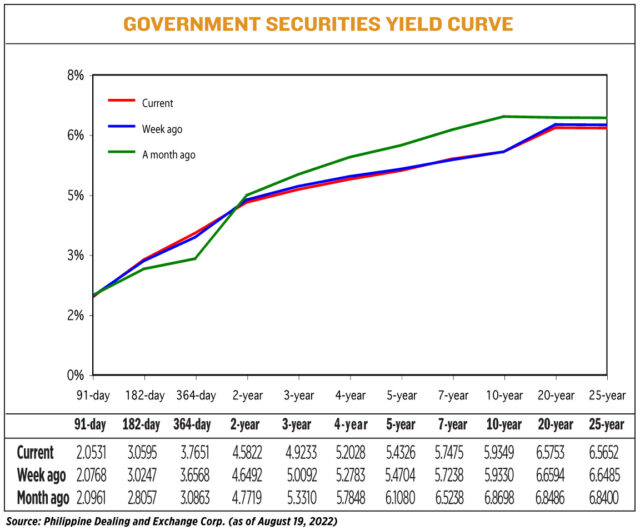
GS yields, which move opposite to prices, fell by 2.62 basis points (bps) on average week on week, based on the PHP Bloomberg Valuation (BVAL) Service Reference Rates as of Aug. 19, published on the Philippine Dealing System’s website.

“The short end [of the curve] remained elevated as inflation still remains an issue even though we could be nearing the peak,” Security Bank Corp. Chief Investment Officer for Trust and Asset Management Group Noel S. Reyes said in an e-mail.

Rates across the board showed mixed results. Yields on the short-dated T-bills of the 182- and 364-day papers climbed 3.48 bps (to 3.0595%) and 10.83 bps (3.7651%), respectively.

However, the 91-day T-bill dropped 2.37 bps to 2.0531%.

At the belly of the curve, yields on the two- and three-year T-bonds fell by 6.70 bps and 8.59 bps, respectively to 4.5822% and 4.9233%.

Likewise, the four- and five-year papers dropped 7.55 bps and 3.78 bps, accordingly, to 5.2028% and 5.4326%. Meanwhile, the seven-year T-bond went up by 2.37 bps to 5.7475%.

At the long end, rates on the 10-year debt inched up 0.19 bp to 5.9349%. Yields on 20- and 25-year papers, meanwhile, declined by 8.41 bps (6.5753%) and 8.33 bps (to 6.5652%).

A bond trader said in an e-mail that the GS movement last week was likely influenced by the Treasury’s auction results for its offer of Treasury bills (T-bills) and Treasury bonds (T-bonds).

“Given the [Treasury’s] announcement of 5.5-year retail bond issuance [last week], I think we can expect the support for the long-end to remain in the medium term. There will be some uncertainty in the short end while the market waits for the retail bond to be priced and no doubt that market participants will closely monitor the reception of the retail bond,” the bond trader said.

The Bureau of the Treasury (BTr) fully awarded its reissued 10-year T-bonds which raised P35 billion as planned, with a remaining life of nine years and 10 months. Total bids for the offer reached P128.83 billion.

As expected, the BTr plans to borrow P35 billion through five-and-a-half-year debt papers scheduled on Tuesday, Aug. 23.

“The action of the central bank was well anticipated already given that the 50-bp hike had been pre-communicated by the governor and hence there was no impact to yields that much. The main focus remained how the yield curve should move forward as it continues to remain flat,” Mr. Reyes said separately.

Meanwhile, the Bangko Sentral ng Pilipinas (BSP) hiked its policy rates for the fourth time this year last Thursday.

As expected by economists, the central bank beefed up its overnight reverse repurchase rate by 50 bps to 3.75%. Likewise, rates on the overnight deposit and lending facilities were raised to 3.25% and 4.25%, accordingly.

BSP Governor Felipe M. Medalla said last week the fourth rate hike was to “anchor” rising consumer price expectations and to maintain the central bank’s inflation target above the policy horizon.

So far, the BSP has raised a total of 175 bps this year to rein in surging inflation.

“For [this] week, I expect some uncertainty heading towards the Tuesday pricing of the retail bond but the yields should stabilize fairly quickly after the market re-aligns itself with whatever the auction result will be,” the bond trader said.

The Treasury is eyeing to borrow at least P30 billion in its first 5.5-year retail Treasury bond issuance under the Marcos administration.

Price-setting auction for these papers due 2028 will be on Aug. 23 and will be offered from Aug. 23 to Sept. 2.

For Mr. Reyes, yields will “steepen and consolidate from the belly to 10 years as mentioned above with profit taking in mind. They could move with a 5 bps to 15 bps range.” — A. O. A. Tirona

Philippines: Balance of payments

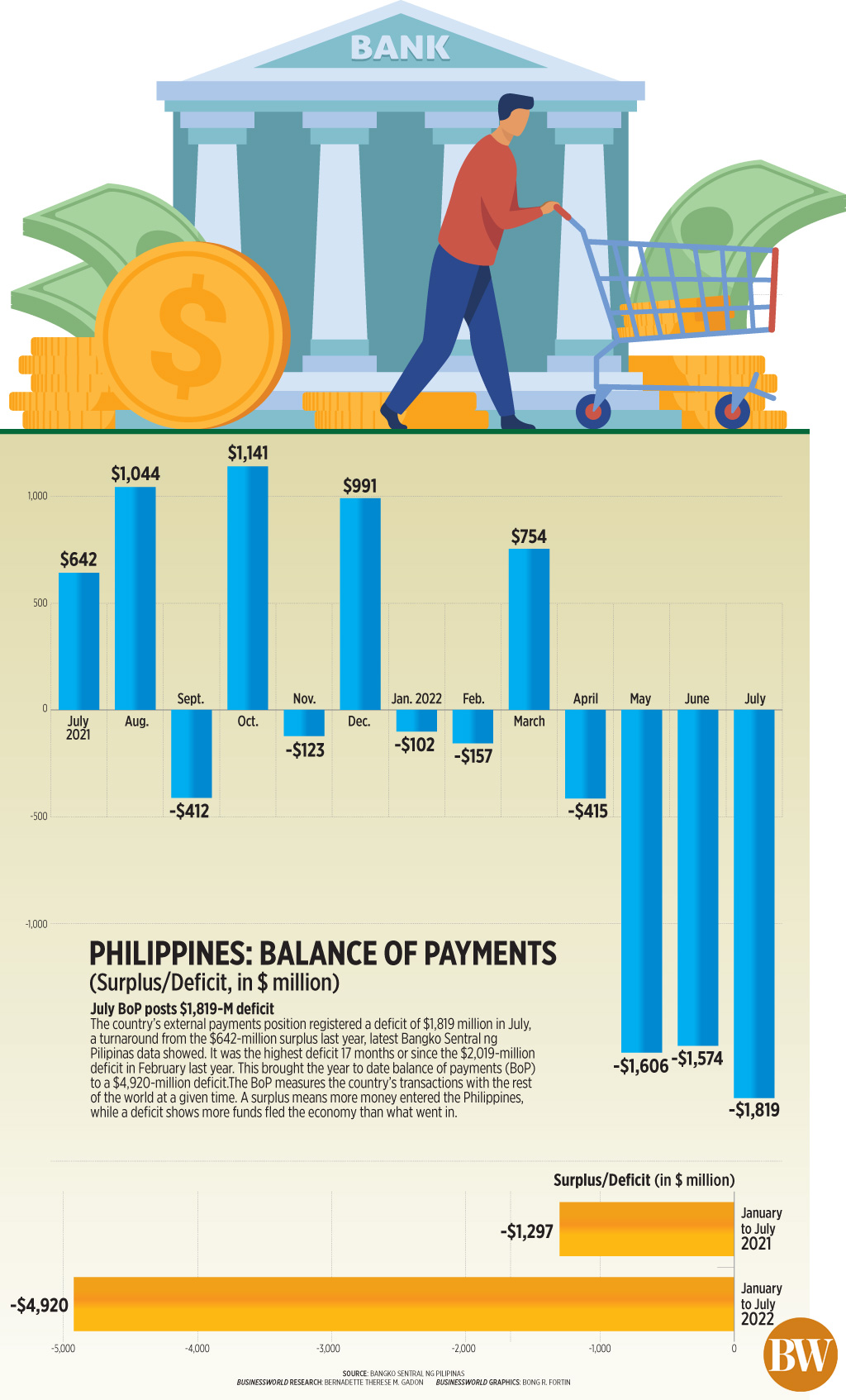
The country’s balance of payments (BoP) position remained in a deficit for a fourth straight month in July, as more dollars flowed out of the country to pay for the government’s foreign debt. Read the full story.

Philippines: Balance of payments

CAMPI-TMA: Vehicle sales up by 29.4% in July

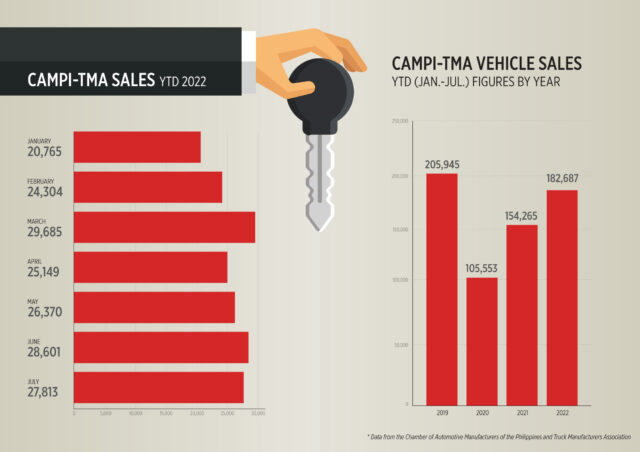
VEHICLE SALES appear to be on the up-and-up, per the July joint report of the Chamber of Automotive Manufacturers of the Philippines, Inc. (CAMPI) and Truck Manufacturers Association (TMA). Member companies of the two associations accounted for total sales of 27,813 units in July, compared to 21,498 units recorded in the same month a year ago.

In a statement, CAMPI President Atty. Rommel Gutierrez said, “The double-digit sales growth recorded in July driven by higher demand for new motor vehicles brings a high degree of confidence for continued recovery of the auto industry. This mirrors the improvement on the consumer outlook for big-ticket items based on the government report.”

During the launch of Toyota Mobility Solutions, Toyota Motor Philippines Corp. (TMP) Director Vince Socco predicted economic growth of seven to eight percent this year.

Added Atty. Gutierrez, “The improvement in the availability of jobs and employment, business recovery and containment of the pandemic are important drivers for the overall economic recovery in this post-pandemic normalcy — similarly true for the industry’s recovery as well.”

Leading total vehicle sales in July was TMP with 13,936 sold. Toyota cornered 50.11% of the market, even if sales for the month were down by 3.4%. The year-to-date sales figure for the country’s perennial triple crown winner (leading the country in passenger car, commercial vehicle, and total sales) is 94,026. In second place is Mitsubishi Motors Philippines Corp. with 5,027 vehicles sold last month (up 11.1%); YTD figure is 25,761. In third place is Ford Motor Company Philippines, Inc. with 1,797 automobiles sold; YTD, it has sold 10,753. July’s fourth-placer is Nissan Philippines, Inc., selling 1,705 vehicles (YTD: 12,893). Rounding out the top five is Suzuki Philippines, Inc. with 1,562 units sold. Its YTD figure is 11,413.

As a whole, CAMPI-TMA has sold 182,687 units YTD, equivalent to 18.4% growth compared with the same period last year (154,265). — KMA

The world’s cotton supply keeps shrinking, hit by drought, heat

SZE YIN CHAN-UNSPLASH

By Tarso Veloso, Tatiana Freitas and Marvin G. Perez

EXTREME weather is wreaking havoc upon virtually all of the world’s largest cotton suppliers.

In India, the top-producing country, heavy rains and pests have cut into cotton crops so much that the nation is importing supplies. A heat wave in China is raising concerns about the upcoming harvest there. In the US, the largest exporter of the commodity, a worsening drought is ravaging farms and is set to drag production to the lowest level in more than a decade. And now Brazil, the second-largest exporter, is battling extreme heat and drought that have already cut yields by nearly 30%.

This confluence of extreme weather events brought on by climate change has sent cotton prices soaring by as much as 30%. Earlier this year, they touched the highest level since 2011, squeezing the margins of clothing suppliers around the world and threatening to raise the costs of everything from T-shirts, to diapers, to paper and cardboard. In a call with investors last week, Children’s Place CEO Jane Elfers described the surge in cotton prices as “a huge, huge problem for us” and said the company was hoping to see some relief in the second half of the year.

The outlook for Brazil is anything but helpful. The drought there has already dried up an estimated 200,000 metric tons of supply, according to Abrapa, a group representing growers. With the nation’s 2021-2022 harvest close to complete, production is now seen at 2.6 million tons — or less.

Bom Futuro group, one of Brazil’s largest cotton producers accounting for about 10% of the nation’s planted area, has seen yields fall 27% compared with the previous season. Julio Cezar Busato, a grower in Sao Desiderio, Bahia state, has suffered from a similar decline. Dryness is reducing the number of cotton bolls, making them lighter across all of the country’s main growing regions, he said. 

Meanwhile, US output is set to plunge 28% in the season that began this month. The US expects production to hit the lowest level since the 2009-2010 season, sending stockpiles to near-historic lows, because of a drought that has become so extreme that the US government is rationing water from the Colorado River. Together, the US and Brazil account for half of the world’s cotton exports.

The decline in global supplies has become so steep that it’s overshadowing demand headwinds. The US government and analysts have been projecting a drop in demand due to a slide in clothing purchases and slowing economies, especially in Europe and Asia. And yet all signs point to “much higher” cotton prices in the coming months with crops shrinking, said Andy Ryan, senior relationship manager for Hedgepoint Global Markets in Nashville.

‘A MOUNTAIN OF MONEY’
Mr. Busato, who also serves as the head of Abrapa, sold 75% of what he expected to harvest in advance and ended up largely missing out on the big surge in prices. Because of the weather, he only produced enough to meet his already-existing contractual obligations. “I could have made a mountain of money,” he said.

The weather has created a secondary headache for the cotton buyers of the world. Untimely rains in regions including Australia, Pakistan, and even Brazil have also diminished the quality of the stock, said Peter Egli, director for Plexus Cotton Ltd.

So as not to be blindsided for another season, Brazilian farmers are set to increase their cotton-growing areas by 100,000 hectares to 1.7 million hectares for the 2022-2023 season, with plantings beginning in January. Now that most of the current crop there has been sold, farmers are looking to start hedging the 2023 harvest more aggressively. “We don’t want to lose Asian markets that we gained recently,” Mr. Busato said. –— Bloomberg

Pioneering Japanese ‘butterflies’ designer Hanae Mori, 96

HANAE MORI and one of her creations, the ‘Red Butterfly Dress’ — PHOTOGRAPHED BY HIROSHI YODA/HANAE-MORI.COM

TOKYO —  Hanae Mori, a pioneering designer who brought Japanese motifs to the global haute couture stage and created the wedding dress worn by Empress Masako, had died aged 96.

Famed for her butterfly designs, Ms. Mori was born in the rural prefecture of Shimane, recalling in later life how the stylish clothes ordered for her as a girl by her doctor father from Mitsukoshi, a noted Tokyo department store, left her feeling “embarrassed.”

Still, she later made her way to the city, where she attended university and then design school, opening her own studio there in its still partly war-ravaged center in 1951.

Working as a designer for movie directors helped hone her style, but a turning point came in 1961, when she went to Paris to do research on designer Coco Chanel and then visited New York.

“I felt strongly aware of my roots as a ‘Japanese person’,” Mr. Mori —  who her office said had died on Aug. 11 —  told the Rakuten FashionWeek Tokyo website in an interview.

“Cheap Japanese products sold in the basements of department stores… The depiction of Madame Butterfly in the opera Madame Butterfly, which I saw in New York,” she said.

“‘This is not Japan!’ I decided to try my luck with creations that were made in Japan.”

In 1965, she presented her first collection in New York, which garnered attention for its mixture of Eastern and Western themes.

Over the next decade, shows in Europe followed and she opened a fashion house in Paris, becoming the first Asian woman to be admitted to a French haute couture association.

“I chose the butterfly, symbolizing the Japanese woman spreading her wings around the world, as my theme,” she added.

Notable commissions that followed before her retirement in 2004 included the dress worn by Empress Masako at her wedding to then-Crown Prince Naruhito in 1993.

She also designed uniforms for Japan Airlines flight attendants and for Japan’s Olympic teams in the 1992 Barcelona Summer Games and the 1994 Lillehammer Winter Games. — Reuters

How PSEi member stocks performed — August 19, 2022

Here’s a quick glance at how PSEi stocks fared on Friday, August 19, 2022.


Stocks seen to pull back after robust Q2 results

PHILIPPINE SHARES may move sideways this week on profit taking after its last week’s rally as investors wait for more economic catalysts that would point to sustainability.

The Philippine Stock Exchange index (PSEi) posted gains on Friday, inching up by 39.23 points or 0.57% to close at 6,863.86, while the broader all shares index went up by 15.80 points or 0.43% to 3,635.57.

Week on week, the PSEi surged by 164.2 points or 2.45% from its close of 6,699.66 on Aug. 12.

“The local market has been riding on bullish momentum fueled by confidence towards the strength of the corporate sector evidenced by the robust results seen in our second-quarter and first-half company reports,” Philstocks Financial, Inc. Senior Research Analyst Japhet Louis O. Tantiangco said in a Viber message.

China Bank Securities Corp. Research Director Rastine Mackie D. Mercado said in an e-mail the market maintained its strength during Friday’s session “as buying appetite continued to be robust” despite the central bank’s rate hike and continuing hawkish stance.

The Monetary Board raised its benchmark interest rate by 50 basis points (bps) at its Thursday meeting.

Meanwhile, interest rates on overnight deposit facilities were raised to 3.25% and lending facilities to 4.25%.

The Bangko Sentral ng Pilipinas (BSP) forecast for this year’s baseline shifted higher as it expected inflation to breach the 2-4% target at 5.4%, while forecasts for 2023 and 2024 declined to 4% and 3.2%, respectively.

For this week, Mr. Mercado said that he expects the market to move sideways as investors are expected to pocket profits from last week’s rally.

“We don’t think that the market will continue to run away given that macro uncertainties (though easing) continue to remain high. As such, we think that the market is highly susceptible to a pullback in the coming weeks given the extent of the rally thus far in August. We expect investors [to] lock in some of those gains,” Mr. Mercado added.

Mr. Tantiangco said: “Next week, investors are expected to watch out for catalysts that would point to the sustainability of the strong results we’ve seen in the [first] half. Lack of such is seen to lead to profit taking.”

He added that: “macroeconomic concerns are expected to challenge the extension of the local market’s rally.”

These concerns include the hawkish outlook of the US Federal Reserve, the possibility of more rate hikes by the BSP, further widening of our balance of payments deficit (BoP), and lingering supply problems in agricultural commodities.

In the data released by the BSP on Friday, the country’s BoP deficit widened to $1.819 billion in July, a reversal from a year ago’s $642-million surplus.

This is the widest deficit posted in 17 months or since $2.019 billion in February 2021 and it is also higher than the $1.574 billion gap in June.

Meanwhile, Federal Reserve Chairman Jerome H. Powell will give a speech on US economic outlook at the annual global central bankers’ conference in Jackson Hole, Wyoming on Friday from which investors may get more cues on the Fed’s actions in the coming months.

China Bank Securities’ Mr. Mercado placed the PSEi’s support at 6,720 and resistance at 6,900-7,000 levels, while Philstocks Financial’s Mr. Tantiangco put support at 6,741.47, the local market’s 200-day exponential moving average, and resistance at the 7,000-7,100 range. — Justine Irish D. Tabile with Reuters

Gov’t told to talk to local gov’ts on cash aid after weekend chaos

PEOPLE flocked to the Department of Social Welfare and Development’s Dagupan City office on Saturday for cash aid. — DAGUPAN CIO

By Kyle Aristophere T. Atienza, Reporter

THE PHILIPPINE government should coordinate with local authorities after chaos marred its aid payout to poor students, experts said at the weekend, amid spiraling oil and food prices.

The government has not learned from its experiences during the coronavirus pandemic, Maria Ela L. Atienza, a political science professor at the University of the Philippines, said in a Viber message. “No clear lessons have been learned from it and previous crisis situations.”

Tens of thousands of students and parents trooped to offices of the Department of Social Welfare and Development (DSWD) nationwide at the weekend to claim their cash aid. Many of them went home with nothing, while at least one stampede was reported in Zamboanga in the country’s south.

The agency on Thursday said it would give P500 million in student cash aid — P1,000 each to elementary students from poor families, P2,000 to high school students, P3,000 to senior high school students and P4,000 to college students.

The aid is limited to three students per family, which can get the financial assistance on Saturdays from Aug. 20 to Sept. 24.

The Social Welfare department admitted failing to coordinate with local governments for the cash aid distribution. Social Welfare Secretary Erwin T. Tulfo apologized for the mess at the weekend. He told a news briefing he wanted his agency to directly give the money and avoid selective aid.

Ms. Atienza said the Local Government Code of 1991 and other laws mandate coordination between the central and local governments, as well as other agencies.

“That is the essence of decentralization and multilevel governance,” she said. “If the problem is patronage at the local level, there are accountability mechanisms to avoid these and proper guidelines should be formulated.”

Ms. Atienza said since the funds involve education aid, the Social Welfare department should have coordinated first with the Department of Education and Commission on Higher Education.

In Zamboanga City, about 5,000 people showed up in front of a school where the aid was distributed, causing a stampede that hurt 29 people.

The victims, aged 16 to 58 years, had been waiting in line for a chance to receive the aid since Friday evening, the Zamboanga City Medical Center’s Public Affairs Unit posted on Facebook.

Zamboanga City Mayor John M. Dalipe in a statement said they were “ready and willing to support and provide necessary resources to ensure the well-being of the beneficiaries.”

In Manila and nearby areas, authorities had to use riot police to prevent people from storming offices of the Social Welfare department.

“Public services require the coordination and cooperation of the National Government and local government units,” policy analyst Michael Henry Ll. Yusingco said in a Facebook Messenger chat.

“The president himself alluded to this in his first state of the nation address. And it’s surprising that his administration seems to be struggling with this.”

“If they don’t recalibrate their governance paradigm, then fiascos like this one will be repeated.”

Mayors in several cities have suggested alternative procedures in the release of the cash aid.

Iloilo City Mayor Jerry P. Treñas said DSWD should consider a school-based distribution system.

“If the reason of DSWD is to avoid going through the LGUs, the financial assistance can be coursed through the schools. It will be easier and more convenient,” he posted on Facebook on Saturday.

Earlier in the day, the mayor scolded the DSWD regional head over what he called a “terribly planned event” at the Iloilo Sports Complex.

“If there will be students who will be harmed I will be filing criminal and administrative cases against all responsible for this poor planning and execution,” he added. 

In Dagupan City, Mayor Belen T. Fernandez offered to provide the local government’s list of poor households. She also offered the city’s plaza for the distribution.

Ms. Atienza said the poor claimants should not be blamed for the chaos. “Government officials and personnel are there to be in the service of the people. They operate and use funds from people’s taxes. Even poor people pay taxes, mostly indirectly because of value-added tax and other additional taxes imposed on goods they buy,” she said.

“People, whether rich or poor, should be treated equally, she said. “Everybody should be treated with dignity. If there are limited funds, priority should be given to those genuinely in need.” 

Ms. Atienza also urged people to know “their rights and responsibilities” and learn to demand accountability and improved services. 

“During failures of leadership, government leaders should be reminded that the buck always stops with them,” Terry L. Ridon, former head of the Presidential Commission for the Urban Poor, said in an emailed statement.

Most schools are set to open classes on Monday. The Philippines is one of the last countries in the world to resume face-to-face classes, which experts said has affected student and labor quality.

More physical classes are expected by November, and experts have said the public transport sector is not prepared to face an expected increase in demand.

Analysts: Red-tagging continues with Marcos

PHILIPPINE STAR/ RUSSEL PALMA

By John Victor D. Ordoñez, Reporter

THE GOVERNMENT of Ferdinand R. Marcos, Jr. appears to be continuing his predecessor’s practice of tagging people as communists without basis, political analysts said at the weekend, after the indictment of members of a religious group for terrorist financing.

“This is a continuation of the previous administration’s policy of red-tagging, disinformation and weaponizing of the Anti-Terror Act against all critics of the government and those who work directly with the people,” Maria Ela L. Atienza, a political science professor at the University of the Philippines, said in a Viber message.

“These actions are a big challenge to the rule of law, independence of the Judiciary, accountability mechanisms and people’s rights,” she added.

Executive Secretary Victor D. Rodriguez did not immediately reply to a Viber message seeking comment.

Last week, the Department of Justice (DoJ) charged 16 members of the Rural Missionaries of the Philippines (RMP) of financing the activities of the Communist Party of the Philippines (CPP) and its armed wing, the New People’s Army (NPA).

The church members failed to answer the charges during a preliminary investigation, government prosecutors said in a statement last week.

The church group said one of the ex-rebels had falsely testified against its members in exchange for the release of her mother.

It also said the indictment showed the state’s tendency to “demonize legal democratic organizations” critical of the government.

“Instead of really addressing the root cause of insurgency in the country, instead of using an approach that forces state critics and detractors to be within the bounds of law and democratic practices, the government uses irresponsible, unlawful and cowardly means to engage those forces that they think will undermine their rule,” Arjan P. Aguirre, who teaches political science at the Ateneo De Manila University, said in a Facebook Messenger chat.

“Red-tagging is and will always be an approach of the feeble-minded and excessively insecure political bully.”

In May, Justice Secretary Jesus Crispin C. Remulla said he would be “more reserved” about accusing activists of being members of the Maoist movement.

Human rights groups earlier said his appointment was worrisome given his history of accusing certain people as communists. 

In June, Solicitor General and former Justice Secretary Menardo I. Guevarra said the country’s anti-communist task force should file complaints rather than label people as communists.

RMP is a church-based group made up of Catholic priests and lay people. The group supports farmers, fisherfolk and indigenous groups and educates them about their rights, according to its website.

The religious group’s website, along with 25 other alleged communist supporters, was ordered blocked in June by the National Telecommunications Commission upon the request of former National Security Adviser Hermogenes C. Esperon, Jr.

The country’s Anti-Terrorism Council has labeled the communist party as a terrorist group.

In April, the Supreme Court rejected an appeal seeking to reverse its decision upholding the validity of the Anti-Terrorism law, which was signed in 2020.

The Anti-Money Laundering Council has said the law would help it counter the so-called dirty money.

“All these attacks on legitimate organizations and personalities to stifle dissent must be challenged by various organizations in all arenas,” Ms. Atienza said.