Home Blog Page 5804

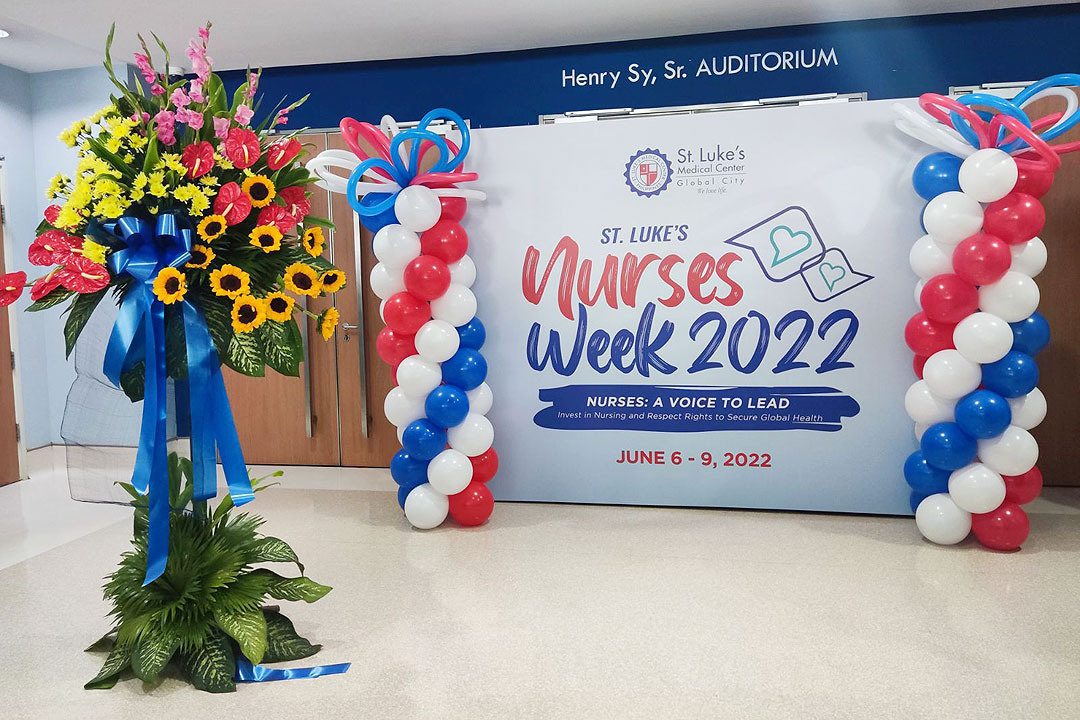
One day focused on hiring nurses as St. Luke’s marks Nurses Week 

St. Luke’s Medical Center (SLMC) in Bonifacio Global City dedicated the first day of its 2022 Nurses Week celebration to hiring nurse applicants  

Nurses Week runs from June 6 to 9.  

Successful applicants from the provinces will get six months’ free accommodation at a condotel. All successful applicants get a P10,000 signing bonus, groceries, and a pair of shoes by Japanese sports brand ASICS.  

“These are things that will make them feel welcome,” Ma. Martina Geraldine Q. Dimalibot, SLMC’s chief nursing officer, told BusinessWorld on the sidelines of the event. “The free accommodation …we came up with because it was something that made applicants think twice [about accepting the job offer].”  

Started in 2010, Nurses Week is celebrated every year in SLMC’s Bonifacio Global City and Quezon City locations to recognize the dedication and hard work of its nurses.  

“Our nurses always play a critical role in patient care,” Dr. Arturo S. De La Peña, president and CEO of SLMC, said in a press statement. “Celebrating Nurses Week is one way for us to express our gratitude and give back to our nurses who tirelessly give their time and effort to the hospital and the patients they take care of.”  

Each of the hospital’s about 2,000-strong nursing staff will receive P5,000 shopping vouchers from ASICS, a gift of steak and wine, and a limited edition “I am a St. Luke’s Nurse” AquaFlask tumbler during the celebration.  

They will also recieve free hair treatments and body massages during the celebration. 

Apart from Nurses Week, the hospital also gives its nursing staff year-round perks — including pay for work exceeding 12 hours in addition to overtime pay, Ms. Dimalibot said. 

At the height of COVID-19, SLMC’s management likewise provided free transportation, free meals, free vitamins, and complete protective equipment for all its associates.  

“We also have the ongoing Cope lines, which is [a channel] nurses can turn to when they feel down,” Ms. Dimalibot told BusinessWorld. “They can call, and someone will help them process their feelings.”  

It’s caring for the caregivers, she added. 

“They stuck with us and never turned their backs from our patients…,” said Ms. Dimalibot, herself a fellow nurse. “Everyone understands that nurses are the backbone of the hospital.” 

SLMC is the first hospital in the Philippines to receive the Pathway to Excellence designation from the American Nurses and Credentialing Center (ANCC). The designation is awarded to hospitals that meet ANCC’s six key practice standards in shared decision-making, leadership, safety, quality, well-being, and professional development. — Patricia Mirasol

S. Korea, US launch 8 missiles in response to North Korea tests

A North Korea flag flutters next to concertina wire at the North Korean embassy in Kuala Lumpur, Malaysia March 9, 2017. — REUTERS/EDGAR SU/FILE PHOTO

SEOUL — South Korea and the United States said they fired eight surface-to-surface missiles early on Monday off South Korea’s east coast, responding to a barrage of short-range ballistic missiles launched by North Korea on Sunday.

The action is a demonstration of “the capability and readiness to carry out precision strikes” against the source of North Korea’s missile launches or the command and support centers, South Korea’s Yonhap news agency cited the South Korean military as saying.

South Korean President Yoon Suk-yeol, who took office last month, has vowed to take a tougher line against the North and agreed with US President Joseph R. Biden at a May summit in Seoul to upgrade joint military drills and their combined deterrence posture.

North Korea has conducted a flurry of missile launches this year and Mr. Yoon said its missile and nuclear weapons programs have reached a level at which they pose a threat to regional and world peace.

The South “will continue to build fundamental and practical security capabilities and deter the North’s nuclear and missile threats,” Mr. Yoon said at an event for South Korea’s Memorial Day.

The militaries of South Korea and the United States fired eight surface-to-surface missiles over about 10 minutes starting at 4:45 a.m. on Monday (1945 GMT Sunday) in response to the eight missiles fired by the North on Sunday, Yonhap reported.

An official from South Korea’s Defense Ministry confirmed eight Army Tactical Missile Systems (ATACMS) had been fired.

US Indo-Pacific Command said the exercise included one U.S. Army missile and seven from South Korea.

“The ROK-US Alliance remains committed to peace and prosperity on the Korean Peninsula and throughout the Indo-Pacific,” it said in a statement, using the initials of South Korea’s official name.

North Korea’s short-range ballistic missiles, fired toward the sea off its east coast on Sunday, were probably its largest single test and came a day after South Korea and the United States ended joint military drills.

The South Korea-US bilateral exercises involved an American aircraft carrier for the first time in more than four years.

Japan and the United States also conducted a joint military exercise on Sunday in response to the latest North Korea missile tests.

North Korea, which is several weeks into battling its first known outbreak of COVID-19, has criticized previous joint drills as an example of Washington’s continued “hostile policies” toward Pyongyang, despite its talk of diplomacy.

Yonhap, citing an unidentified source, said the North’s volley on Sunday was launched from four locations, including Sunan in the capital, Pyongyang.

Leif-Eric Easley, an international studies professor at Ewha University in Seoul said South Korea’s current missile defenses are insufficient against the expanding North Korean threat.

“This calls not only for further investments in hardware but also a more multilayered approach coordinated with Japan and diplomatic efforts with Beijing to reduce arms race dynamics with Pyongyang.”

North Korea continued with its recent trend of not reporting on missile launches in state media, which some analysts have said is meant to show the tests are part of routine military drills.

Washington and Seoul officials also recently warned North Korea appeared ready to resume nuclear weapons tests for the first time since 2017. — Reuters

As Britons thank Queen Elizabeth for 70 years, monarchy looks to future

BRITAIN’s Queen Elizabeth, Prince George and Princess Charlotte stand on the balcony during the Platinum Pageant, marking the end of the celebrations for the Platinum Jubilee of Britain’s Queen Elizabeth, in London, Britain, June 5. — JONATHAN BUCKMASTER/POOL VIA REUTERS

LONDON — While millions watched the Platinum Jubilee festivities to thank Queen Elizabeth and reflect on her 70 years on the British throne, for the monarchy itself, the four-day celebrations have also very much been about looking to the future.

From parades in London and a party outside Buckingham Palace to a Service of Thanksgiving, many in Britain have been paying affectionate tributes to a 96-year-old who has reigned longer than any of her predecessors in 1,000 years.

But the queen’s absence at many of the Jubilee events because of health issues meant the celebration of her reign provided a focus on the next monarchs, her son Prince Charles and his son William.

Royal biographer Robert Lacey, the historical consultant to Netflix’s hugely popular TV drama The Crown, said the queen was laying the ground for what comes next.

“The Jubilee had a double-edged significance,” he told Reuters. “Yes, it celebrated the queen and what will one day be the past, but it’s also provided a platform for the new formula and pattern for the future.”

The queen missed out on most of the big Jubilee events due to what the palace calls “episodic mobility problems,” which have forced her to cancel public appearances recently and have highlighted her advancing years.

In her absence, son and heir Charles,73, and his son William, the second in line, have been to the fore.

In a notable finale on Sunday, the queen appeared on the balcony of Buckingham Palace flanked by the three next monarchs — Charles, William, and his eldest child Prince George.

Journalist Tina Brown, a longtime observer of the British royalty, also said Elizabeth had been focused on succession.

“Her feelings and her sentiments right now are all about estate planning for the monarchy,” she told BBC TV. “Her only care right now is that things should be put in good order for Charles and that everything can be done to make his reign easier.”

Ms. Brown and Mr. Lacey said that was why the queen used the actual 70th anniversary of her accession to the throne in February to announce she wanted Charles’ second wife Camilla to be queen consort, removing any future controversy over her role.

FLUCTUATING FORTUNES
During Elizabeth’s long tenure, the fortunes of the monarchy have often fluctuated, such as from a low that followed the 1997 death of Princess Diana, Charles’ captivating first wife, to the highs of the wedding of grandson William and his spouse Kate, and the birth of their children.

The last three years have been particularly tough on the institution.

First, the queen’s second son Prince Andrew was forced to quit public duties over his friendship with the late, disgraced US financier Jeffrey Epstein, and he later settled a lawsuit with a woman who accused him of sexually abusing her when she was 17.

He denied the allegation and has not been accused of criminal wrongdoing, but his reputation was shattered.

Meanwhile, William’s younger brother Harry and his American wife Meghan moved to Los Angeles from where they have delivered stinging attacks on Buckingham Palace, most notably an accusation of racism in an interview with Oprah Winfrey.

“We’re very much not a racist family,” William said.

While both events stained the reputation of “The Firm,” as Britain’s royal family calls itself, opinion polls in Britain suggest the lasting damage has mainly been to Andrew and Harry themselves.

Mr. Lacey said the Jubilee had reminded many people of the positives a monarchy brought, adding: “Charles and Camilla are associated with that in a way you would not have thought possible a few years ago.”

But for all the celebrations this week and plans for the future, there remain some dark clouds on the horizon.

Polls show the queen is hugely popular and older Britons are overwhelmingly in favor of the monarchy, but they also indicate young people are far more indifferent and support has slipped over the last decade.

While Harry and Meghan have kept a low profile during the Jubilee, the prince is writing a memoir due to be released later this year that could contain more explosive details.

Barbados removed Elizabeth as its head of state last November and there is a growing feeling that republican sentiments will grow in the 14 other countries that have the British monarch as their queen.

The new center-left Labor party in Australia, which voted against ditching the monarchy in 1999, has named the country’s first “assistant minister for the republic”.

“I don’t know that it will ever be the same when she’s not here anymore, that’s how we feel about it (in New Zealand),” said Patricia Burrowes, 80, who traveled from Auckland for the Jubilee celebrations.

Some at the festivities felt the monarchy would remain integral to Britain even as the queen’s role might be drawing to an end.

“It’s easy to be critical of it and say it isn’t for these times,” said Ian Higgins, 62, a mental health nurse. “But I think having something that brings people together that isn’t political but unites people is so important for this country, and the rest of the world loves it as well.”

As to whether there would be a similar outpouring for Charles when he becomes king, the feeling was mixed.

“We’ll have to wait and see,” said Amanda Mackenzie, 51, a yoga teacher from London. “We’ll have to wait and see.” — Reuters

NFTs, a technology to bridge a gap in the art world 

By Brontë H. Lacsamana, Reporter

As a digitally native extension of traditional art, non-fungible tokens (NFTs) were an interesting platform where painter Charles Bjorn Z. Calleja could release his animation — and like many Filipino artists, this revelation led him to mint his first NFT in 2021. 

“I don’t actually consider myself a digital artist. My animations are based on paintings, and I’ve been exhibiting my work for as long as I can remember in physical galleries. I do animations to see movement… It’s an extension of my art practice,” said Mr. Calleja.  

In a video interview with BusinessWorld, he recounted that he posted animations online just for fun until his friend introduced him to the Tezos-based marketplace Hic et Nunc.  

“I didn’t really have a platform for my animations and NFTs became a good way to market and monetize them since I didn’t intend to show the work in galleries,” he said.  

Since then, Mr. Calleja has had his NFT works shown at various galleries and art shows, the most recent of which was at Art Basel Hong Kong 2022, at the Tezos-based exhibition NFTs + The Ever-Evolving World of Art held from May 27 to 29.  

As the lone Filipino contributing to the exhibit, he said: “We’re putting in something new. It represents our time as we’re living in a digital generation. I think being able to represent where we are right now is contributing to the history of art.”  

He also added that NFTs don’t necessarily go against traditional art, since they can bridge the gap between long-standing art institutions and new artists and collectors.  

“The traditional and digital art worlds can help each other with this technology.”  

TEZOS BLOCKCHAIN
Art Basel’s NFT section was hosted on Tezos, an energy efficient alternative to better-known blockchain networks Bitcoin and Ethereum. What sets it apart from those is that it has a lower minting cost and a smaller carbon footprint.  

Katherine Ng, head of marketing and operations in Asia Pacific at blockchain consultancy firm TZ APAC, said that Tezos’ momentum (up over 60% in the last month) has continued even amid downturns in the market and declines in NFT prices.  

For the Tezos community, NFTs “bridge a gap in the art world, allowing artists to connect with new collectors around the world, and institutions and sell their work to anyone at any time,” she said via e-mail interview, echoing Mr. Calleja’s hope for NFT art.  

TZ APAC helped Art Basel Hong Kong present its NFT and generative art exhibition that featured over 20 generative and NFT artists from across the globe.  

This potential hasn’t been lost on other traditional art institutions either, with Sotheby’s vice-president, contemporary art specialist, and digital art co-head Michael Bouhanna tweeting just last week: “Getting into Tezos just now! Which artists should I look at?”  

Last month, the biggest Tezos marketplace, Objkt.com, surpassed $100 million in total sales since its launch in 2021.   

Generative art, in particular, has enjoyed growing popularity. Defined as digital art with assets fed into a machine algorithm, it taps into the programmable aspect of new media which can also be interactive.  

“It’s an incredibly exciting development in the NFT art ecosystem. There are more and more platforms focused on this art form, not only within the Tezos ecosystem with FXhash, but across other blockchains,” said Ms. Ng.  

EXPANSION OF THE ART SCENE
Mr. Calleja said that avenues like Art Basel Hong Kong and Art Fair Philippines, where he also exhibited his works, will effectively spread the word about NFT art.  

“I think it helps to educate the local art audience about NFTs in general… Most of the artists I know who are minting are doing digital work and it’s only a few who are really into the galleries, into the fine art side of things, so I think it helps bridge the gap and introduce NFTs as a platform for new media art, as video art, and a lot more,” he said.  

With market-based institutions from auction houses and museums to art fairs and galleries slowly opening up to the idea, it’s only a matter of time until the art scene is expanded to include more and more NFT artists.  

For TZ APAC, this will surely occur in no time in Southeast Asia, which enjoyed rapid digitalization during the pandemic. Tezos as a platform also takes care of the issue of high minting costs.  

“When I think of the market demographics of Southeast Asia as a region characterized by a young, digitally-savvy, mobile-first population, the openness towards digital assets comes as no surprise,” said Ms. Ng.   

She added that the development of this trend has shown the asset class “no longer being limited to niche circles but also established galleries, artists, and festivals.” 

Google ordered to pay Australian politician over defamatory YouTube videos

REUTERS

 – An Australian court on Monday ordered Google to pay a former lawmaker A$715,000 ($515,000), saying its failure to take down a YouTuber’s “relentless, racist, vilificatory (sic), abusive and defamatory campaign” of videos drove him out of politics.

The Federal Court found the Alphabet Inc GOOGL.O company, which owns content-sharing website YouTube, made money by broadcasting two videos attacking the then-deputy premier of New South Wales – Australia’s most populous state – that have been viewed nearly 800,000 times since being posted in late 2020.

Google has been found liable for defamation before, generally for supplying links to articles in search results, but Monday’s ruling is one of the first where the firm was deemed an active publisher – via YouTube – of content that defamed an elected official.

In Australia, a review of defamation law is examining whether online platforms should be held accountable for defamatory content they host. Google and other internet giants argue they cannot be reasonably expected to police all posts.

A Google spokesperson was not available for comment.

The court heard that content creator Jordan Shanks uploaded videos in which he repeatedly brands lawmaker John Barilaro “corrupt” without citing credible evidence, and calls him names attacking his Italian heritage which the judge, Steve Rares, said amounted to “nothing less than hate speech”.

By continuing to publish the content, Google breached its own policies of protecting public figures from being unfairly targeted and “drove Mr Barilaro prematurely from his chosen service in public life and traumatized him significantly,” Rares said.

Barilaro quit politics a year after Shanks posted the videos, and “Google cannot escape its liability for the substantial damage that Mr. Shanks’ campaign caused,” Rares added.

Shanks, who has 625,000 YouTube subscribers and 346,000 followers on Meta Platforms Inc’s FB.O Facebook, was a co-defendant until a settlement with Barilaro last year which involved the YouTuber editing the videos and paying the former politician A$100,000.

But Shanks “needed YouTube to disseminate his poison (and) Google was willing to join Mr Shanks in doing so to earn revenue as part of its business model,” the judge said.

Before the lawsuit was resolved, Shanks had continued to attack Barilaro and his lawyers publicly, and the judge said he would refer him and Google to the authorities “for what appear to be serious contempts of court by bringing improper pressure … not to pursue this proceeding”.

In a Facebook post after the ruling, Shanks, who goes by the handle friendlyjordies, mocked Barilaro by saying “you finally scored the coin from Google … without ever having the truth tested in court”.

Shanks added, without evidence, that Barilaro “withdrew (his) action against us so we wouldn’t testify or present our evidence” in support of his claims.

Barilaro told reporters outside the courthouse that he felt “cleared and vindicated”.

“It was never about money,” he said. “It was about an apology, removal. Of course, now an apology is worthless after the campaign has continued. It’s taken a court to force Google‘s hand.” – Reuters

Biden to use executive action to spur solar projects hit by probe -sources

REUTERS

 – President Joe Biden will use executive action on Monday to help bridge a solar panel supply gap and kickstart stalled U.S. projects after an investigation froze imports from key foreign suppliers, sources familiar with the matter said.

The moves come amid concern about the impact of the Commerce Department’s months-long investigation into whether imports of solar panels from four Southeast Asian nations are circumventing tariffs on goods made in China.

Mr. Biden also will invoke the Defense Production Act to drive U.S. manufacturing of solar panels and other clean technologies in the future, with the support of loans and grants, the sources added.

“There is going to be this safe harbor timeout on the … collection of duties, and that’s at the heart of what’s going to save all of these solar projects and ensure that they are going forward,” said one source familiar with the White House‘s plans.

State governors, lawmakers, industry officials and environmentalists have expressed concern over the investigation, which could result in retroactive tariffs of up to 250 percent.

It has essentially halted imports from Cambodia, Malaysia, Thailand and Vietnam, which account for more than half of U.S. solar panel supplies and 80 percent of imports.

The investigation has had a chilling effect on the industry, say clean energy groups, some of which have asked Commerce Secretary Gina Raimondo to dismiss it, though she has said she has no discretion to influence it.

The source, who spoke on condition of anonymity, said Biden‘s action would bring certainty back to the U.S. solar market and allay companies’ concerns about having to hold billions of dollars in reserves to pay potential tariffs.

The investigation, announced at the end of March, could take 150 days or more to complete.

The issue has created a unique dilemma for the White House, which is eager to show U.S. leadership on climate change, in part by encouraging use of renewable energy, while respecting and keeping its distance from the investigation proceedings.

Using executive action and invoking the DPA, which allows presidents some authority over domestic industries, allows Mr. Biden to take advantage of the tools available to him without stepping on the tariff inquiry. – Reuters

Nine dead in three mass shootings across United States

STOCK PHOTO | Shooting gun photo created by senivpetro - www.freepik.com

Shootings in three American cities killed nine people and wounded two dozen more on Saturday night and Sunday morning, the latest outbreaks of gun violence in the wake of three mass shootings that have rattled the United States.

In Philadelphia, a confrontation between two men escalated into a gunfight that sprayed bullets into a crowded bar and restaurant district, killing three people, wounding 12, and setting off panic as people tried to flee, police said.

Similarly, shooting broke out after midnight near a bar in Chattanooga, Tennessee, after midnight on Saturday, killing three and wounding 14, according to police.

In yet another shooting in the early hours of Sunday, three people were killed and two were wounded in Saginaw, Michigan, WEYI television reported, citing a police statement. Unlike the other two cases, which affected bystanders unconnected to the shooting, all five of the people in the Michigan shooting were involved in the incident, police said.

No suspects were reported in custody as of Sunday evening in any of the shootings.

The violence struck as communities in three other cities are still grieving from massacres that killed 10 people at a grocery store in Buffalo, New York; 21 victims at an elementary school in Uvalde, Texas; and four people at a medical building in Tulsa, Oklahoma.

In Uvalde, they buried 10-year-old Alithia Haven Ramirez on Sunday. She was one of the 19 schoolchildren killed in the rampage by an 18-year-old man armed with an AR-15 semiautomatic rifle.

Alithia dreamed of attending art school in Paris and loved to play soccer, according to an obituary posted by a funeral home.

Gun safety advocates are pushing the U.S. government to take stronger measures to curb gun violence.

There have been at least 240 mass shootings in the United States so far this year, according to the Gun Violence Archive, a nonprofit research group. It defines a mass shooting as one in which at least four people are shot, excluding the shooter.

U.S. President Joe Biden on Thursday called on Congress to ban assault weapons, expand background checks and implement other gun control measures to address the string of mass shootingsRead full story

Chris Murphy, the lead Democratic U.S. senator working on bipartisan gun safety talks, said on Sunday he thinks a package including investments in mental health and school safety and some changes to gun laws can pass Congress. Read full story

The brazen nature of the Philadelphia shooting left officials aghast. Philadelphia Mayor Jim Kenney called it “horrendous, despicable and senseless,” while Police Commissioner Danielle Outlaw said, “We’re absolutely devastated.”

Police believe two men got into a fight and began shooting at each other, and one of them was killed by gunfire. A police officer observed the other shooter firing into the crowd and fired at him.

The shooter dropped his gun, as police believe he was struck by the officer, but he escaped through the crowd.

The dead were aged 22, 27 and 34 while the ages of the people wounded ranged from 17 to 69.

In Chattanooga, three people were dead and 14 wounded by multiple shooters, authorities said. Two died of gunshot wounds and a third died after being struck by a vehicle while fleeing.

Chattanooga Police Chief Celeste Murphy appealed for the public’s help, asking any witnesses to call a tip line.

In Michigan, Saginaw police reported they were called to a scene where two men were pronounced dead and one woman was transported to hospital where she died of her wounds.

Two other men were being treated for gunshot wounds. – Reuters

Industry steps up lobbying ahead of bumper EU climate votes

THE MAIN entrance of the European Union Commission headquarters is seen in Brussels July 1, 2013. — REUTERS

 – European Union lawmakers have been inundated by lobbyists ahead of votes this week on more ambitious EU climate change policies, with some industries urging them to scale back the proposals.

The European Parliament is set to confirm its position on a raft of proposals to cut planet-warming emissions faster this decade, ahead of negotiations with EU countries on final laws.

Among the measures are an upgrade of Europe’s carbon market, a planned tariff to impose CO2 costs on imported goods, and an effective ban on new combustion engine car sales in the bloc from 2035.

Emails to EU lawmakers, seen by Reuters, show a last-minute lobbying push from industries unhappy with positions approved by parliament’s environment committee and up for a vote by the full assembly this week.

“We are overwhelmed by requests and solicitations from the lobbies,” Green EU lawmaker Marie Toussaint said.

A flashpoint is the committee’s plan to speed up the phase-out of the free CO2 permits the EU gives industries to help them compete with foreign rivals that do not pay for carbon emissions and discourage industries from moving to regions with weaker climate policies. It proposes to replace them by 2030 with a carbon border adjustment mechanism (CBAM) – a new levy on imports of carbon-heavy goods like cement, steel and fertilizers.

The European Commission, which drafts EU policies, had proposed a 2036 phase-out and steel industry association EUROFER last week sent lawmakers a statement warning against bringing the date forward.

Signed by 50 CEOs and published online, it urged them to avoid further scaling back of the current system “until the CBAM has proven its effectiveness and a solution for exports is in place.”

The EU says free permits must go when its new carbon border charge kicks in to avoid breaching World Trade Organization rules by giving European companies “double” protection.

Higher CO2 costs are a key tool in the EU‘s plans to fight climate change, by giving businesses a financial incentive to cut emissions. While already-soaring EU carbon prices have hiked costs for polluters in recent years, they have also raised billions of euros for national governments’ budgets.

Many industries want to keep their free permits for longer, however. Another statement sent to lawmakers by energy-intensive industries including EUROFER, Cefic and Cembureau also warned against cutting them faster. EUROFER will co-host a “dinner debate” for lawmakers on Monday to present its position ahead of the assembly votes.

A EUROFER spokesperson said Europe’s steel firms support EU climate goals and have 60 low-carbon projects underway, but accelerating free permits’ phase-out would boost their carbon costs, leaving them with less to invest in decarbonization.

Farming industry group Copa-Cogeca also wrote to lawmakers, warning that the environment committee’s plan was “too ambitious” and would put an “additional burden” on agriculture.

Copa-Cogeca said a faster introduction of the border carbon levy would further hike prices of imported fertilizers, which have soared in recent months amid surging gas and raw materials costs.

Other emails showed auto lobby groups urging lawmakers to oppose plans to end polluting car sales in 2035, while airport groups warned against proposals to hike CO2 costs for flights.

Jytte Guteland, who was parliament’s negotiator on the EU‘s 2030 emissions-cutting target, urged colleagues to keep in mind voters calling for faster action on climate change.

“Society would prefer that we do more for climate,” she said.

With some lawmakers still undecided, EU officials said the vote results were uncertain. – Reuters

CCBPI partners with DTI-SBCorp, empowers MSMEs with sustainable loan initiatives

Coca-Cola Beverages Philippines, Inc. (CCBPI) and Department of Trade and Industry’s (DTI) Small Business Corporation (SBCorp) commit to help micro, small and medium enterprises recover and strengthen their businesses through the RISE UP Tindahan program.

As part of its campaign to help uplift micro, small, and medium enterprises (MSMEs), Coca-Cola Beverages Philippines, Inc. (CCBPI) — the bottling arm of Coca-Cola in the country — recently inked a partnership with the Department of Trade and Industry’s (DTI) Small Business Corporation (SBCorp) for the RISE UP Tindahan Project.

The initiative gives CCBPI’s partner retail stores, dealers, distributors, and other MSMEs access to resources that can contribute to their recovery from the effects of the pandemic. The RISE UP Tindahan Project upholds CCBPI’s “People First” commitment of looking after its people and the communities it serves, as project beneficiaries can enjoy greater accessibility to sustainable financial loan programs that can encourage job creation, livelihood initiatives, and business growth.

Partners toward progress
According to CCBPI General Trade Director Chris Pesigan, the partnership with DTI’s SBCorp manifests the collective, urgent goal of helping the MSME sector recover, stabilize, and progress. As an industry leader in manufacturing, CCBPI sets the benchmark in the FMCG (fast-moving consumer goods) sector in terms of distribution and trade network. The partnership with DTI SBCorp — and CCBPI’s established relationships with MSMEs, allows the RISE UP Tindahan Project to reach more Filipino households across the country.

Mr. Pesigan said, “We share the vision and commitment of the Small Business Corporation to uplift our retail partners as we make these sustainable financing initiatives more accessible to many. We are proud that, given CCBPI’s extensive footprint and expansive trade network, we’re in the best position to help in reaching more MSMEs across the country and contribute to truly inclusive economic growth.”

Santiago Lim, EVP and COO of SBCorp, said, “We, at Small Business Corporation, are very much thankful for this opportunity to partner with the Coca-Cola Beverages Philippines Inc. as we reach out to more and more entrepreneurs down to the roots of our communities, not only here in the metro, but also to the rest of the provinces. Reaching out to the far ends can be a daunting task, but since we have Coca-Cola now as our partner, with your seasoned experience on the ground, we are confident that this project will be successful.”

SBCorp is a government financial institution mandated to provide financing initiatives for MSMEs across all regions of the Philippines. It operates as guided by its vision that, by 2025, it will be the leader in sustained financing alternatives for Philippine MSMEs, putting them at the forefront of inclusive economic growth. Its mission, to which RISE UP Tindahan is anchored on, is to fight for the neglected business segments of the country to get them access to the capital they need to grow. 

Accessible loan programs through quick, easy applications

The loans sourced through the RISE UP Tindahan Project are meant to help businesses adjust to the realities of doing business in the new normal. Additional funds, for example, can help MSMEs cope with rising consumer demand as the economy slowly opens back up again. SBCorp’s initiative of going into online application process has been a success, with around 40,000 applicants over the past two years. CCBPI is targeting the program’s amplified reach by leveraging its vast trade network, and now SBCorp is bridging gaps to meet the needs of micro-entrepreneurs.

“The process in RISE UP Tindahan is simple, which is key to reaching more MSMEs,” CCBPI General Trade Director Pesigan explained. “We need to overcome the challenge of inaccessibility, and part of this is making sure that procedures aren’t overly complicated — that MSMEs don’t feel intimidated or overwhelmed.”

For the benefit of MSMEs, the process for applying for a loan has been made more convenient and easier through RISE UP Tindahan. Those interested in applying can easily do so through www.brs.sbcorp.ph, with call center hotlines at 8651-3333 (NCR) and 1-800-10651-3333 (nationwide).

The RISE UP Tindahan Loan offers a loanable amount of up to P300,000 for Micro-tindahan loans (sari-sari stores), and up to P5M for SME loans (retail stores, dealers, and distributors), with three years repayment term inclusive of a grace period of up to 12 months and no collateral required.
Qualified for the loans are micro, small, and medium businesses (sari-sari stores, retail stores, distributors, etc.)  under the FMCG-accredited partner. Applicants must also be ready with documents such as their barangay business permit, and government-issued IDs among others. The loan application will undergo credit, business, and financial assessments. Applicants will then be contacted via email regarding the results of each stage.

As catalysts of bringing MSMEs at the forefront of the growing business sector, the purposeful partnership of CCBPI and DTI SBCorp leads in equipping micro-entrepreneurs with the resources to recover and thrive in an increasingly competitive landscape.

AI’s big potential in the Philippines

Julian Cua, Principal, Boston Consulting Group

BCG Manila at the forefront of AI’s growth in the country

Artificial intelligence, or simply known as AI, is one of the technologies that is beginning to reshape organizations and businesses in this time of rapid digitalization. With its numerous capabilities, AI is starting to be applied in various sectors, and its potential is being recognized and maximized in many markets.

Here in the Philippines, as businesses and organizations are starting to pay attention to the benefits of AI, there is no doubt that AI has a growing potential that should not be missed. For Julian Cua, Principal at Boston Consulting Group (BCG) Manila, the country’s strength in the technology field, coupled with emerging talent, sets a good foundation for AI’s growth in the Philippine market.

“We are able to have a lot of talents in things like programming, machine learning, engineering, data analytics, and many more,” Mr. Cua told BusinessWorld in an interview. “I do think as well that we have a good advantage when it comes to [learning] the English language, which is important for some AI applications such as natural language processing. That gives us an edge over other countries.”

The next moves for the country to take, he continued, should center on building an ecosystem that allows AI and AI-related talent to thrive and stay in the Philippines. “There needs to be good local demand and adoption for AI applications. This fuels the demand in the job market,” he added.

Mr. Cua notes that this ecosystem has started and is expected to develop in three areas, namely, 1) big companies and conglomerates that invest in advanced analytics and incubate them within their own companies; 2) startups and tech companies which are digital by nature, know the power of AI, and have the capabilities to attract and train talent; and 3) the government, as it has started pushing for digitalization through programs such as QR code interoperability and the national ID system.

Yet, to further gear AI to be a growth driver for the country, Mr. Cua states that a link should be established between AI and fueling the Philippine economy. To build such a link, sectors and individuals must determine how they can make Filipino’s lives easier, make Filipino companies more competitive, and start attracting talent to make the country more competitive.

A key factor in the building of an AI ecosystem lies in training and cultivating talent. “If you want to be an AI powerhouse, then it means that the country has to create an environment where Filipinos who are experts in AI stay and work for services and products that really support the local economy,” he stressed.

With a thriving ecosystem, AI can be optimized in various applications such as personalizing consumer interactions with companies, making them more engaging and meaningful for everyone. For instance, in the supply chain, AI is seen to solve big structural issues, while in manufacturing and service industries, AI can also help optimize processes to boost competitiveness.

“Imagine a plant that uses machine vision to spot quality defects. The plant doesn’t even have to be fully robotics. It could [have] human actors that work harmoniously with AI-driven recommendations,” Mr. Cua illustrated.

Starting in AI

With its widespread and apt applications, how can our businesses start utilizing AI? Mr. Cua said they must first understand that deploying AI-related capabilities, based on their experience at BCG, is 70% people and 30% the technology itself.

“One of the common pitfalls we see is when a company looks at AI as a solution for technology. That is a common fallacy we see because AI is indeed a technology, but it’s only one of the tools needed to help solve real world problems,” he said.

The first thing to do with people is align on their expectations of AI. They should also be clear about their objectives, identifying the specific problems they want to solve with the help of AI. “The more specific the company can get, the better it is in terms of deploying things,” Mr. Cua said. This should be followed by getting the right technical talent “who will actually help build the brains for these applications.”

On the technology front, businesses should consider whether the data fed into AI is stored in the right place, updated correctly, and encoded properly. They should also make sure that the platforms and infrastructure for the technology are set up to scale.

Another way for businesses to understand AI comes from BCG’s study in 2020, which suggests that “in order to see significant financial returns, organizations need a multidimensional, complex relationship with AI.”

This, Mr. Cua explained, means that AI and humans form bionic links where they basically learn from each other. “For an organization, it’s about understanding what those bionic links are, areas where AI and people can actually work with each other; [as well as identifying] when can people intervene and, if they intervene, how do we design the system so that it correctly interprets the intervention,” Mr. Cua explained.

For its part, BCG has been helping clients across the globe, including the Philippines, make the most out of AI — and it is set to expand its reach in this area.

“We now have a team called BCG GAMMA, [composed] of the best data scientists and data engineers out there; and they work alongside industry experts to unlock the potential of AI in specific applications for different companies,” Mr. Cua shared.

BCG GAMMA’s services are offered as a holistic package, the BCG Partner added. “We’re not just here to deploy technology. We’re looking at solving real world problems of different companies. We take a look at the engineering side, the data science side, and also the business side [in order to] make sure that we have the right initiatives to… build that transformation journey for them.”

Moreover, the global firm will expand its AI expertise with an upcoming training ground for AI talent in the country.

“We are also opening up a BCG GAMMA Hub in Manila soon to attract, retain, and recruit some of these talents to serve markets not just in the Philippines but across Asia,” Mr. Cua shared.


Spotlight is BusinessWorld’s sponsored section that allows advertisers to amplify their brand and connect with BusinessWorld’s audience by enabling them to publish their stories directly on the BusinessWorld Web site. For more information, send an email to online@bworldonline.com.

Join us on Viber to get more updates from BusinessWorld: https://bit.ly/3hv6bLA.

VistaMalls, Inc. announces schedule of annual meeting of stockholders on June 27


Spotlight is BusinessWorld’s sponsored section that allows advertisers to amplify their brand and connect with BusinessWorld’s audience by enabling them to publish their stories directly on the BusinessWorld Web site. For more information, send an email to online@bworldonline.com.

Join us on Viber to get more updates from BusinessWorld: https://bit.ly/3hv6bLA.

Agrabah: The Filipino farmers’ and fisherfolk’s new marketplace

In preparation for their Mother’s Day campaign earlier this year, Agrabah Ventures team visited a cut flower farming community in Pacol, Naga city.

By Allyana A. Almonte

The Agriculture, Forestry and Fishing (AFF) sector plays a significant role in the Philippine economy. In 2020, it involves about 25% of Filipino workers and contributes around 10.2% to the country’s gross domestic product — the highest record since 2017. This is amid the pandemic and livelihood-threatening circumstances such as low profit shares, increasing market costs, a glaring lack of youth interest in this sector, periodic droughts and floods, and limited access to a stable market.

Born out of the need to finally tackle these longstanding threats, Agrabah Ventures creates better opportunities for Filipino farmers and fisherfolk by providing a stable market channel that connects them directly with consumers and ensures that their produce are purchased at fair price.

Backed by technical and funding supports from the Asian Institute of Management (AIM) — Dado Banatao Incubator, Philippine Council for Industry, Energy and Emerging Technology Research and Development (DOST-PCIEERD), Villgro Philippines, Ashoka Foundation, ING Bank, and UNICEF, this integrated platform arranges the delivery of agricultural produce from farming communities to enterprise through a seamless digital experience of automated logistics booking.

Agrabah Ventures Co-Founders and life partners Joselito “Jun” Ocol, Jr. (chief executive officer) and Josephine Gumino-Ocol (chief operating officer), named the startup after the kingdom of Agrabah in the Disney film Aladdin, bringing the concept of creating ‘a whole new world’ for food producers to increase their income and for institutional customers to stabilize a supply chain for their business.

“The initial idea is a seafood-only e-commerce concept… We just wanted to help farmers sell their produce at a large scale, but now we want to help fix the agriculture value chain by making it more efficient,” Mr. Ocol said in an e-mail to BusinessWorld.

Since its launch in 2019, Agrabah Ventures continues to expand from being an online farm-to-market platform into a nurturing community where farmers and fisherfolk are provided with current market awareness, skills training, and income-generating connections, as well as access to agricultural technologies and financial loans.

The startup initially developed a platform that connects farmers and fishermen with institutional buyers for on-spot trading and large volume trading for crops and seaweed branded as Agrabah Wharf.

It also created Agrabah Logistics that enables carriers to connect to a network of growers wherein they can dry bulk commodity while providing a significant discount in the total logistics costs for farmers to ship across the Philippines.

In utilizing the users’ data of earnings and production capacity, Agrabah found out that farmers want to produce more but have limited resources to do so. Thus, they developed Agrabah Finance, an innovative loan aggregation platform dedicated to providing farmers, fisherfolk, service providers, merchants, and other participants in the agricultural value chain with fair and transparent money-borrowing options.

“Although they have good revenue streams, they lack documentary requirements such as ID, ITR and collateral to apply for a traditional bank loan to increase their production,” Mr. Ocol explained.

Farmers and fisherfolk who want to sell produce via Agrabah can register on their website (agrabah.ph). Once joined, Agrabah acts as the mediator for the registered individual or group by sourcing orders from big companies and employing farming communities who could meet the request for fresh products.

“When the pandemic hit the Philippines, we thought it would affect our business negatively, but it actually accelerated our growth. In collaboration with the Philippine Agri consortium members [who helped move the goods], we were able to help farmers secure orders even when physical markets were closed,” Mr. Ocol added.

The Agrabah CEO believes that the AgTech or agriculture technology startups play an important role in addressing the gap in the areas of trading, financing, and logistics surrounding the AFF sector.

“We hope that in the next 12 months through the help of our mentors and advisers, we can continuously work closely with the Department of Agriculture in making the value chain more efficient,” Mr. Ocol expressed.

More than 5,000 farmers and fisherfolk across the Philippines now join Agrabah in creating a better and sustainable marketplace where Filipino farmers and fisherfolk can fully harvest and enjoy the fruits of their labor.