Home Blog Page 5217

Focusing on what matters: A tax regime proposal

BEATRIZ PEREZ MOYA-STELLRWEB-UNSPLASH

“Focus on what matters” isn’t only a phrase that applies to maintaining a proper work-life balance or just bettering your life in general. This phrase is also the key to improving our tax administration.

Under the 2021 Bureau of Internal Revenue (BIR) Annual Report (the latest as of the date of this writing), the total revenue collections for that year amounted to P2.08 trillion. Of that amount, P1.29 trillion, or roughly 64% of the total collection, comes from large taxpayers. In other words, the other 36% comes from small and micro enterprises.

The problem isn’t entirely obvious until you take into account studies by the World Bank (WB). According to Risk-Based Tax Audits published by the WB, small taxpayers (and, presumably, micro enterprises as well) typically contribute only 5% to the revenue collections. The bulk of revenue collections come from medium-sized enterprises (contributing 20-30%) and large enterprises (contributing 60-70%).

In the Philippines, not only is there no category for “medium-sized enterprises” but small-and-medium-sized enterprises are the ones facing the brunt of the problem.

Now, here is where “focusing on what matters” comes in.

Instead of collecting from small and micro enterprises, the government should focus on improving its collections on medium and large taxpayers. To do this, we have proposed a more equitable tax regime that puts its focus to larger entities rather than small taxpayers.

EMPLOYEES
The first part of our proposal is straightforward — separate the employees from Self-employed and Professionals (SEPs). Employees are unique in that they have fixed incomes, unlike SEPs who earn significantly more but pay less taxes. Their salaries are subject to withholding tax and are remitted to the BIR by their employers. The effect of this portion is simple. It allows the government to focus on increased compliance from SEPs who should be paying a flat 10% tax.

MARGINAL INCOME EARNERS
The second portion of our proposal includes the need to increase the threshold for marginal income earners. For reference, our regulations presently recognize the concept of “marginal income earners.” Under RR No. 11-2000, marginal income earners are those who earn annual sales of P100,000. Note that this regulation was issued in the year 2000, almost 22 years ago. And with the soaring inflation rates, the P100,000 annual sales is clearly not enough to encompass those who are truly marginal income earners.

Our proposal is to increase that threshold to those earning not more than P1,000,000. This threshold would sufficiently cover marginal income earners, such as sari-sari (sundry) store owners. The next part involves encouraging them to register. To do this, we can offer a fixed amount of P1,000 to be paid annually. While this amount may seem low, keep in mind that our goal here is to encourage these taxpayers to register and to collect data, not taxes. The effort of collecting more taxes should be directed to medium and large taxpayers.

MICRO ENTERPRISES
The third part requires a review of micro enterprises, specifically the Barangay Micro Business Enterprises or BMBEs. Presently, the BIR has not released any data on how many BMBEs are registered. The problem becomes immediately apparent — we do not know if the taxpayers receiving BMBE certification (and are, therefore, being exempted from income tax) still fall within that threshold. Note that, in renewing BMBE certification, there is no audit process. It is easy for an entity to pretend to be BMBEs even if they no longer qualify.

Our proposal is to mandate the BIR to audit BMBEs every two years before renewing their tax exemption. We can also offer them to pay an optional flat tax of 10% and require them to adopt electronic invoicing. They shall be subject to Tax Compliance Verification Drives to make sure they still properly comply.

SMALL ENTERPRISES
For small enterprises, our proposal remains — offer an optional flat tax of 10% and require them to adopt electronic invoicing. The crucial part of this portion involves the adoption of a risk-based audit.

A risk-based audit is a simple concept. A benchmark is set by the BIR based on how much certain industries generally earn, i.e., profit margin and how much taxes they usually pay effectively. Businesses who pay 30% below the threshold would be considered high-risk, and be subject to a tax audit.

Presently, the BIR conducts “random” audit, but we should dispose of this practice and focus on those that are truly high risk which can generate more revenues.

MEDIUM ENTERPRISES
The goal for this portion is really just to create the “medium taxpayer” category, which is separate from small enterprises whose annual gross sales do not exceed a certain threshold, e.g., P100 billion. Presently, the BIR only recognizes a large taxpayer category. However, there is a need to distinguish medium taxpayers from the rest of the taxpayer base. Recall that, under the WB study cited above, medium taxpayers ought to contribute 20-30% to the total revenue collections.

This is the first taxpayer category the government must start focusing on collecting from. Medium taxpayers must be subjected to a regular audit every three years. Why? Medium taxpayers are those who are earning a lot already. The BIR should focus their audit on them to make sure that they are paying the right taxes. This regular audit every three years is on top of the risk-based audit explained earlier.

This means, essentially, that a medium taxpayer that is high-risk will be subjected to both the regular audit every three years and the risk-based audit. However, medium taxpayers that are low risk will still be subject to audit, but only the regular audit every three years.

In this category, medium taxpayers should be imposed a 25% income tax rate, and they should still be mandated to adopt electronic invoicing.

LARGE ENTERPRISES
The “Large Enterprises” is an established category, comprising those earning P1 billion and above in profit. Under the Corporate Recovery and Tax Incentives for Enterprises (CREATE) Law, they pay 25% corporate income tax. They are required to use electronic invoicing, as per the Tax Reform for Acceleration and Inclusion (TRAIN) Law, and, under RR No. 9-2009, they are also required to maintain Computerized Accounting Systems (CAS) under RR No. 9-2009.

Currently, the BIR has around 3,000 companies in the Large Taxpayer Service (LTS) group under the Office of the Commissioner. The immediate goal is to expand this group to 7,000-10,000 large enterprises that will be subject to risk-based and regular audit every year. From this, the target collection must be set per industry and risk level of large enterprises, owing to the fact that more than 60% of our total tax collections are from the LTS group.

CONCLUSION
The idea behind this proposed tax regime is really to focus the government’s efforts on places where it matters. In this case, focus must be directed to medium and large enterprises, and the government must relax its grip on small and micro enterprises, and especially marginal income earners. The goal of laws and government regulations, as regards these smaller businesses, must be getting them to register and helping them flourish. It is when these businesses begin to flourish as medium enterprises that we should begin to focus on collecting taxes from them.

This article reflects the personal opinion of the author and does not reflect the official stand of the Management Association of the Philippines or MAP.


Raymond “Mon” A. Abrea is member of the MAP Ease of Doing Business Committee, founding chair and senior tax advisor of the Asian Consulting Group and co-chair of Paying Taxes – EODB Task Force. He is trustee of CSR Philippines — the advocacy partner of the BIR, Department of Trade and Industry, and Anti-Red Tape Authority on ease of doing business and tax reforms.

Digitalization will not reduce fraud in PhilHealth

NATIONAL CANCER INSTITUTE-UNSPLASH

The Inquirer’s editorial of Nov. 11 reported that an Aboitiz Group-led consortium had submitted a P1-billion unsolicited proposal to digitize the claims process of the corruption-plagued Philippine Health Insurance Corp. (PhilHealth). Aboitiz InfraCapital President Cosette Canilao said digitalizing PhilHealth’s claims process is a crucial step in addressing the problem of corruption and incompetence in the state health insurance company.

In 2006 an eye doctor in Iloilo filed claims amounting to P16 million in professional fees for 2,071 operations. In 2014, a Malalag, Davao del Sur infirmary with only an 18-bed capacity received P18 million for claims, and almost P10 million in just the first semester of 2015. There is the case of a patient in a hospital in Region 1. The patient, as well as both her parents, had cancer. The family was reimbursed P1.7 million. However, an investigation found out the family was non-existent. The Commission on Audit found out that PhilHealth paid P20.3 million in hospital expenses of 961 dead patients.

Digitalizing PhilHealth’s claims process will not solve the problem of corruption in the state insurance company. It will just speed up the payment of fraudulent claims.

In the insurance business there is what is called moral hazard. It is the tendency of the insurance policy holder to increase the probability of the occurrence of a loss or damage because the compensation is greater than the loss. For example, the owner of an insured vacant and rubdown building may increase the risk of the building burning down because he will gain from the insurance compensation.

In health insurance moral hazard is multiplied threefold as the professional and the healthcare facility may be parties to the fraud. An example is the insured patient with a common cold asking a physician to recommend his hospital confinement. Doctors with slow or poor practices would be inclined to recommend confinement of individuals with feigned illness, and private hospitals with low bed occupancy rate would just be too ready to admit them.

As PhilHealth pays on the basis of a package, the doctor and the hospital would bill PhilHealth for pneumonia instead of just for a common cold. PhilHealth reimburses hospitals P6,600 and doctors P1,980 for pneumonia, and P2,800 and P840 for common cold. Digitalization will not recognize the falseness of the claim of pneumonia, it will only speed up its processing and its payment.

Moral hazard takes on greater magnitude when medically indigent people — those who cannot afford even the most basic healthcare service — are insured. According to the Department of Health, there are 38 million Filipinos who are medically indigent. Faked hospital confinement means free meals and a real bed for the indigent enrollee and revenue for the healthcare providers.

When I was with a health insurance company, we received claims for whole families. We looked into the reason for this unusual sets of claims filed by a hospital in the province. Our inquiry revealed that when the children visited their father, a field employee of a geothermal company, in the hospital, they noticed he was served three good meals every day, slept on a comfortable bed in an air-conditioned room, amenities better than those in their own home. The children, who were also insured as dependents of the employee, found reasons, mostly mild ailments, to be confined as well, even for just a couple of days. As the children blabbed about their juvenile scam to the children of their father’s co-workers, the other children pulled off the same scheme.

Some doctors, even those practicing in prestigious hospitals, can be unethical, if not greedy. In 2014, fraudulent claims filed by doctors and hospitals, both private and public, including the major medical centers in Metro Manila, against PhilHealth were estimated at P4 billion.

But the greater fault with regard to the payment of fraudulent claims lies with PhilHealth. According to PhilHealth Vice-President Oscar Abad, Jr. there are 94.9 million Filipinos registered with the insurance company as of 2020. They include employees and their dependents, self-earning people, retirees and senior citizens, and indigents.

The health insurance company I was with many years ago had 35,000 enrollees, 90% of whom were employees, the rest their dependents. An average of 6% of the insured filed claims during a one-year period, or an average of 2,100 claims were filed every year. Spread over 250 working days, the office received 8.4 claims each working day. There were three claims processors (they are called adjusters in the insurance industry), each one a registered nurse with at least one year experience as a nurse in a tertiary (Level 3) hospital. They could ask a licensed doctor retained by the company as consultant when some data in the claim did not seem right. Payment was made three days after the submission of all supporting documents — medical history, hospital charges, and professional fees.

While the percent of claimants among PhilHealth enrollees may be significantly higher due to the inclusion of retirees, senior citizens, and indigents, for purposes of illustration we will use 6% as the rate of claimants per year among PhilHealth enrollees. With 94.9 million enrollees, the number of claimants each year could be 5.7 million. Spread over 250 working days, that is 22,776 claims filed each day.

Claims are submitted to 17 regional claims processing centers. If the 22,776 claims were divided equally among 17 centers, each center could receive 1,340 claims a day. Each regional office needs a platoon of claims processors.

A medical claims processor determines if the claim is valid or eligible for compensation. To do this, she verifies that a claim for pneumonia is really for pneumonia and not for a common cold. She determines this by looking at the results of the laboratory and diagnostic tests conducted and the medicine administered and reconcile them with the diagnosis. That reconciliation requires human intelligence.

The processor must have strong analytical skills. She generally holds a bachelor’s degree in some medical field. Along with this, she has high level of healthcare experience. A registered nurse with at least one year experience in a tertiary hospital would be ideal.

Department of Health Officer-in-Charge Maria Rosario Vergeire said last September that the country’s healthcare system lacks 106,000 nurses and also faces a shortage of professionals in the healthcare fields. It is highly probable that the PhilHealth processors lack the knowledge and experience required of a medical claims processor.

While the PhilHealth processors are struggling to cope with the thousands of claims unloaded on their desks every day, the hospitals, strapped for cash, are putting tremendous pressure through a sympathetic press on PhilHealth to pay up the billions of pesos overdue them for past claims. When the situation reaches that point, both sides — the hospital administrators and the PhilHealth officials are forced to compromise.

That is when agreements are forged outside of boardrooms. PhilHealth officials could have offered to pay for claims even if they had not been sufficiently or properly processed in exchange for some consideration. Hospital administrators badly in need of cash to fund the operations of their facility agree. Those agreements are not digitalized.

Those side and private agreements account for the payment of thousands of fraudulent claims.


Oscar P. Lagman, Jr. was country manager for the Philippine operations of a multinational health insurance company in the 1980s. As a consultant in 1988, he set up the health insurance line of the local partner of a London-based non-life insurance company. In 1999, he set up the health insurance line of the Philippine operations of yet another London-based insurance company. He was program director of the Executive Development Program the De La Salle Graduate School of Business conducted in 2007 for 50 officers of PhilHealth.

On government debt, WESM prices, and the UP presidency

Today and tomorrow I am attending the Pilipinas Conference 2022, organized by Stratbase ADR Institute, held at the Ayala Museum in Makati City. I thank Stratbase president, friend, and fellow BusinessWorld columnist Dindo Manhit, for the invitation. Among the Keynote Speakers of the two-day conference are Department of Budget and Management (DBM) Secretary Amenah Pangandaman on Nov. 21, and Finance Secretary Benjamin Diokno on Nov. 22.

This morning, Secretary Pangandaman spoke about “Open Government and Digitization Efforts of the DBM.” Among the things she said are: building a CSO (certified security officer) desk in the DBM to directly link the public to the agency, a P12.47-billion budget for ICT (information and communications technology) and digitalization programs and projects in 2023 for the digital transformation of the government’s procurement process, and diminish human discretion in government transactions.

These are good initiatives by Secretary Pangandaman to help reduce waste and inefficiencies in government transactions and procurement. When waste is minimized, the need for taxes to sustain wasteful spending is also minimized. People should use their additional income and savings for corporate expansion and household needs, for more job creation, not for funding more waste in government.

Tomorrow, Secretary Diokno will talk about “Strengthening Public-Private Partnerships (PPPs) to Rebuild the Philippine Economy” — a timely topic because the Philippine government’s debt keeps rising and we need more hard infrastructure to hasten mobility of people and commodities, goods and services, without compromising more tax resources.

HIGH PUBLIC DEBT
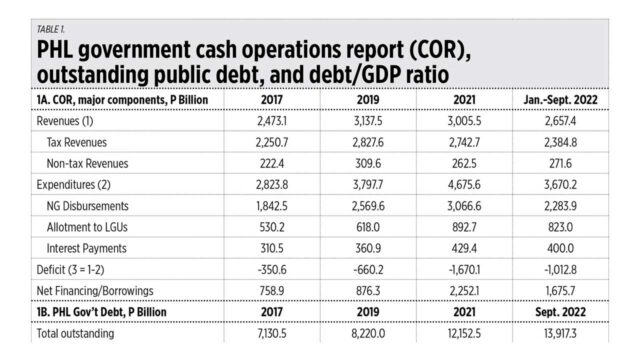
In 2019, the government had a budget deficit of P660 billion. This ballooned to P1.67 trillion in 2021, and may likely reach P1.4 trillion by end-2022. Interest payment alone was P429 billion in 2021 and this is likely to reach P530 billion this year.

The outstanding public debt (actual plus guaranteed) has increased from P8.22 trillion in 2019 to P12.15 trillion in 2021 and this is likely to reach P14.5 trillion by end-2022. Our (actual) public debt already slowed to 37% of GDP in 2019, jumped to 57% in 2021, and is projected to reach 59% of GDP this year (see Table 1).

Stagflation (stagnant growth plus high inflation) is already building up in many rich countries this year and a global recession is likely to happen next year. We should have wide leeway in both public and private resources to sustain important services without resorting to more borrowings and imposing new taxes on companies and people who are just recovering their revenues and income this year to 2019 level.

ATTACKS AGAINST DOE AND ERC LEADERSHIP
Last week, the Independent Electricity Market Operator of the Philippines (IEMOP) reported a piece of good news — high power margin (supply less demand) of 3,500+ megawatts (MW) and lower prices at the Wholesale Electricity Spot Market (WESM) for the November 2022 billing period. I summarize in Table 2 the prices from January to November billing, and added the percent contribution of coal and intermittent sources. Coal is frequently demonized but is largely responsible for why those who want it phased out still have electricity 24/7. The beloved wind-solar have combined generation of near-insignificant levels.

Recently, there have been attacks against Energy Secretary Raphael Lotilla and Energy Regulatory Commission (ERC) Chair Monalisa Dimalanta which say that they are not objective and neutral because they have worked with one of the major gencos in the country. While this might be a factor, Lotilla and Dimalanta are respected lawyers and products of UP Law who have minds of their own as government officials. Besides, policy debates like whether or not to press the National Grid Corp. of the Philippines (NGCP) to honor its contract to secure the required and exclusive ancillary services for grid stability, its being the only private monopoly nationwide and which did not do a public listing, should be discussed as societal issues, not personality issues.

The more that detractors personally attack Secretary Lotilla and Chair Dimalanta, the more they expose themselves as incapable of focusing on issues and just pursuing narrow corporate interests, not the consumer’s interest of having a stable grid free from frequent threats of power fluctuation if not blackouts.

UP PRESIDENCY
The University of the Philippines (UP) will soon have a new president. There are six nominees or candidates, all accomplished and respected individuals who have the capacity to lead the premier educational system of the country with eight constituent universities and campuses nationwide.

For me, a UP President is someone with specific, unique characteristics like the following:

One, he knows UP in and out. Two, he has an excellent academic record and achievements. And three, he has national and international stature to help mobilize resources for the university and not just rely solely on taxpayers’ money.

The candidate who best fills this big pair of shoes, I think, is the current Chancellor of UP Diliman, Dr. Fidel Nemenzo. He studied in UP from nursery and elementary to high school to college, has lived in the campus all throughout his life except when he went abroad for his graduate studies and lectures.

Dr. Nemenzo is a hard-core mathematician and academic. He finished BS Math at UP, MS and PhD Math at Sophia University in Japan, has done Math research and held teaching posts in universities in Singapore, Phnom Penh, Tokyo, Amsterdam, and Munich. His favorite research areas are number theory, elliptic curves, and coding theory. He was the past president of the Mathematical Society of the Philippines, chair of the Division of Mathematical Sciences, National Research Council of the Phils. (NRCP), and past president of the Southeast Asian Mathematical Society.

As Chancellor of UP Diliman, the biggest of the eight campuses, Dr. Nemenzo has initiated or pushed for the creation of programs in areas crucial for science and technology innovation and industrialization such as: a PhD in Data Science, a PhD in Artificial Intelligence (AI), a Master of Engineering in AI, the UP Data Commons (high performance computational facility for R&D), and the UP Center for Intelligent Systems.

With such an excellent academic record, and national and international exposure as a deep-blue academic and researcher, if he becomes the University President he should further project UP as an academic center for hard core natural and applied sciences.

While corporations are strong in applied sciences and product marketing, they lack expertise in natural sciences and basic research. Partnership with universities that are strong in the science, technology, engineering, and math (STEM) like UP is a must for them to have technological innovation and mastery. And such technological and funding partnerships would help UP rely less on government resources — which, Table 1 above shows, have been deteriorating.

Dr. Nemenzo would to be the most appropriate candidate for UP President. Not only for UP, but for the country as a whole.


Bienvenido S. Oplas, Jr. is the president of Minimal Government Thinkers.

minimalgovernment@gmail.com

Private sector key to climate action in the PHL

MARKUS SPISKE-UNSPLASH

BENEATH the palpable vibrancy of the Philippines, an island country, lies a fragile reality — climate change. Rising temperatures and climate shocks could seriously impact the nation’s ability to meet its development goals, highlighting the urgency of a climate action roadmap while posing a vital question: how can the Philippines best tackle the impacts of climate change?

The private sector will be key, reveals the new Philippines Country Climate and Development Report (CCDR), produced jointly by the World Bank and the International Finance Corp. (IFC). The report helps identify opportunities for climate action in the country, supporting low-carbon development, while recommending priority and impactful actions to protect its people, businesses, and the economy.

Given that the Philippines aims to become a high-income economy by 2040, this is crucial. Without action, climate change will impose significant economic and human costs, impacting the poorest the most. As the nation tops this year’s World Risk Index, extreme weather events in the Philippines such as floods and typhoons frequently leave behind damages and destruction worth millions of dollars — at times billions. In addition, slow-onset trends of rising temperature, changing rainfall patterns, and rising sea levels, are equally threatening, which brings adaptation to the top of the climate agenda.

Adaptation cannot eliminate the costs of climate change, but it can substantially reduce them. This is key. The CCDR estimates show that the economic damages in the Philippines could reach up to 7.6% of gross domestic product (GDP) by 2030 and 13.6% of GDP by 2040. All sectors are likely to be affected, with capital-intensive sectors expected to suffer most from extreme events, and agriculture suffering the most from slow-onset trends.

In response, the CCDR underlines that smart policies can remove obstacles, enabling the private sector to take climate action, which requires large-scale investments. Public resources alone cannot meet those funding needs, especially with constrained fiscal space due to the coronavirus disease 2019 (COVID-19) pandemic. The private sector will therefore have to play a bigger role in meeting the growing demand for climate action.

As the country’s main growth engine — creating jobs and driving the economy — the private sector’s key task at hand is to turn climate risk and associated potential costs into a viable business opportunity, in both adaptation and mitigation. The challenge is to do it in such a way that the potential benefits outweigh the potential costs.

As a leading financier of climate investments globally, we see climate action as a tremendous investment opportunity — it can be beneficial to all stakeholders involved along with positive outcomes for climate in both short- and longer-term. In alignment, the CCDR outlines key areas for collaboration with the private sector, specifically renewable energy, green buildings, and sustainable finance.

ROAD AHEAD
Though the Philippines is a relatively low emitter of greenhouse gases, emissions are expected to rise from 234 MtCO2e (Metric tons of carbon dioxide equivalent) in 2020 to 399 MtCO2e in 2030. The energy sector accounts for 54% of total emissions, while agriculture is the second largest source, accounting for a quarter of emissions.

So, shifting toward renewable energy will be key for the Philippines. Accelerated decarbonization would reduce electricity costs by about 20% below current levels, which is good for the country’s competitiveness and would also dramatically reduce air pollution.

Recently, we’ve been working with a leading integrated energy company in the country to assess the viability of renewable energy as a source of base load power in the Philippines. We are exploring a mix of technologies that can potentially displace fossil fuel-based power sources and reduce CO2 emissions in the Philippines. That can be a game changer.

Another key area in decarbonization, the CCDR highlights, is green buildings, which can cut emissions and ultimately reduce power bills for people. The Philippines has already made considerable progress in that area. IFC developed the EDGE (Excellence in Design for Greater Efficiencies) green building certification system— and it has already certified more than 875,000 square meters (sq.m.) of space in the Philippines, preventing 23,000 tons of CO2 annually and unlocking opportunities for key industry players.

While EDGE is critical to mitigate climate change, resilience of buildings should be the underlying factor for climate change adaptation. That is why developers are using the Building Resilience Index — launched in 2021 — to assess applicable hazards based on location, exploring ways to improve resilience of buildings, and disclosing the resilience level to improve transparency. More than 10 real estate developers in the Philippines are now using this tool across 1.8 million sq.m. of floor space.

Finally, the CCDR recommends working with local financial institutions and regulators to ramp up climate finance. Creating markets for climate business through innovative financial products should be a continued priority, including green and blue bonds, as well as adoption of best international standards. While strong capital markets are key to spurring further financing for green projects, protecting the coastal blue economy is critical. This is because solid waste management and marine plastics are a threat to elements of the blue economy as well as urban public health.

While achieving climate goals and ensuring a greener economy requires significant financial resources, it is not just about the money. It is also about leveraging the expertise and technologies of the private sector. Attracting foreign investors is therefore essential. Much of the technology needed to combat climate change exists in foreign markets and foreign investments can additionally bring best practices required to adapt these new technologies to the Philippine market.

Likewise, public-private partnerships (PPPs) — when properly structured — can offer an efficient and viable way to channel scarce resources available for climate action, while ensuring a fair distribution of risks and rewards among stakeholders. We welcome the government’s push in this area. As the CCDR highlights, the Philippines has a wealth of experience and a strong track record of PPPs that can be applied in the climate space.

Moving forward, as we increasingly understand that countries need to work together for a low-carbon world, we are optimistic the CCDR will help inform the nation’s dynamic climate-action agenda, helping the Philippines do its part for a resilient future.


Kim-See Lim is the regional director for East Asia and the Pacific and JEAN-MARC ARBOGAST is the country manager for the Philippines at the International Finance Corp. (IFC). IFC is a member of the World Bank Group, and the largest global development institution focused on the private sector in emerging markets.

Two out of three Filipino football fans believe that Qatar World Cup ‘spreads positivity’ — Dailymotion study

FIFA.COM

Filipino football fans are among the most invested in the 2022 FIFA World Cup in the region, according to a study conducted by video-sharing site Dailymotion. 

Two out of three core Filipino football fans believe that the World Cup in Qatar will spread positivity and unite the world. This, despite human rights issues and labor issues

Filipino fans also want exclusive content and merchandise “at a level of engagement that is higher than the rest of the Asia Pacific,” found Dailymotion’s 2022 World Cup study that surveyed 2,879 respondents from the Philippines, Indonesia, and South Korea. 

“Exclusive content in addition to highlights and post-match discussions — either in the form of engaging videos about their teams or articles going in-depth about teams or top players — is most important,” said Bichoï Bastha, chief revenue and business officer at Dailymotion, in a Nov. 15 e-mail.  

“It is safe to say that Filipino consumers want the World Cup to be successful and see this as a positive turnaround for their lives,” he added.  

Based on their level of interest in the 2022 FIFA World Cup, there are two sets of audiences: core audiences and observers.  

Core audiences in the Philippines, mostly young men, said they they would watch a few of the matches (43% compared to the rest of APAC’s 46%); watch exclusive content (32% compared to APAC’s 29%); live the experience by buying merchandise and goodies (21% compared to APAC’s 15%); or go watch the matches in bars and/or fan zones (18% compared to APAC’s 13%).  

Meanwhile, observers in the Philippines, mostly women, said they would follow matches via online scores (24%) and socialize at World Cup–related events (16%).

According to Dailymotion, 74% of views are generated on mobile based on the consumption patterns during a previous football event. 

The study found that football fans also have a strong interest in entertainment, as well as an affinity for travel- and technology-related content.   

“With these habits, it is clear that they want to broaden their understanding of the society by living experiences in the most advanced way possible,” Mr. Bastha said. “The event could be a pivot, just like the pandemic was, towards a better direction this time.”  

Pre-match, fans like to watch team build-ups as well as key moments from past matches. Post-match engagement, on the other hand, involves analytical content that dissects what went right and what didn’t for teams.  

Out of the 2,879 respondents in from Southeast Asia, 69% said they would “participate in the 2022 World Cup” through at least one of these activities: watch and read exclusive content (26%); host a party at their place (16%); go watch the match in a bar or gathering (14%); live the experience by wearing merchandise (14%); and betting or participating in fantasy leagues (11%). — P. B. Mirasol

Younger Chinese are spurning factory jobs that power the economy

RIO LECATOMPESSY-UNSPLASH

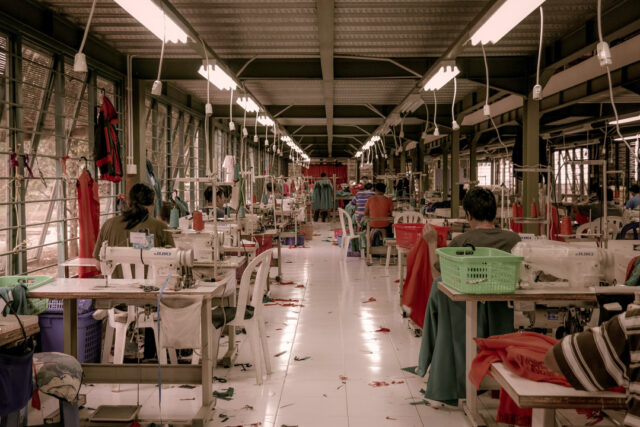
SHENZHEN — Growing up in a Chinese village, Julian Zhu only saw his father a few times a year when he returned for holidays from his exhausting job in a textile mill in southern Guangdong province. 

For his father’s generation, factory work was a lifeline out of rural poverty. For Mr. Zhu, and millions of other younger Chinese, the low pay, long hours of drudgery and the risk of injuries are no longer sacrifices worth making. 

“After a while that work makes your mind numb,” said the 32-year-old, who quit the production lines some years ago and now makes a living selling milk formula and doing scooter deliveries for a supermarket in Shenzhen, China’s southern tech hub. “I couldn’t stand the repetition.” 

The rejection of grinding factory work by Mr. Zhu and other Chinese in their 20s and 30s is contributing to a deepening labor shortage that is frustrating manufacturers in China, which produces a third of the goods consumed globally. 

Factory bosses say they would produce more, and faster, with younger blood replacing their ageing workforce. But offering the higher wages and better working conditions that younger Chinese want would risk eroding their competitive advantage. 

And smaller manufacturers say large investments in automation technology are either unaffordable or imprudent when rising inflation and borrowing costs are curbing demand in China’s key export markets. 

More than 80% of Chinese manufacturers faced labor shortages ranging from hundreds to thousands of workers this year, equivalent to 10% to 30% of their workforce, a survey by CIIC Consulting showed. China’s Ministry of Education forecasts a shortage of nearly 30 million manufacturing workers by 2025, larger than Australia’s population. 

On paper, labor is in no short supply: roughly 18% of Chinese aged 16-24 are unemployed. This year alone, a cohort of 10.8 million graduates entered a job market that, besides manufacturing, is very subdued. China’s economy, pummeled by coronavirus disease 2019 (COVID-19) restrictions, a property market downturn and regulatory crackdowns on tech and other private industries, faces its slowest growth in decades. 

Klaus Zenkel, who chairs the European Chamber of Commerce in South China, moved to the region about two decades ago, when university graduates were less than one-tenth this year’s numbers and the economy as a whole was about 15 times smaller in current US dollar terms. He runs a factory in Shenzhen with around 50 workers who make magnetically shielded rooms used by hospitals for MRI screenings and other procedures. 

Mr. Zenkel said China’s breakneck economic growth in recent years had lifted the aspirations of younger generations, who now see his line of work as increasingly unattractive. 

“If you are young it’s much easier to do this job, climbing up the ladder, doing some machinery work, handle tools, and so on, but most of our installers are aged 50 to 60,” he said. “Sooner or later we need to get more young people, but it’s very difficult. Applicants will have a quick look and say ‘no, thank you, that’s not for me.’” 

The National Development and Reform Commission, China’s macroeconomic management agency, and the education and human resources ministries did not reply to requests for comment. 

MODERN TIMES
Manufacturers say they have three main options to tackle the labor-market mismatch: sacrifice profit margins to increase wages; invest more in automation; or hop on the decoupling wave set off by the heightened rivalry between China and the West and move to cheaper pastures such as Vietnam or India. 

But all those choices are difficult to implement. 

Mr. Liu, who runs a factory in the electric battery supply chain, has invested in more-advanced production equipment with better digital measurements. He said his older workers struggle to keep up with the faster gear, or read the data on the screens. 

Mr. Liu, who like other factory chiefs declined to give his full name so he could speak freely about China’s economic slowdown, said he tried luring younger workers with 5% higher wages but was given a cold shoulder. 

“It’s like with Charlie Chaplin,” said Mr. Liu, describing his workers’ performance, alluding to a scene in the 1936 movie “Modern Times,” about the anxieties of US industrial workers during the Great Depression. The main character, Little Tramp, played by Chaplin, fails to keep up with tightening bolts on a conveyor belt. 

Chinese policymakers have emphasized automation and industrial upgrading as a solution to an ageing workforce. 

The country of 1.4 billion people, on the brink of a demographic downturn, accounted for half of the robot installations in 2021, up 44% year-on-year, the International Federation of Robotics said. 

But automation has its limits. 

Dotty, a general manager at a stainless-steel treatment factory in the city of Foshan, has automated product packaging and work surface cleaning, but says a similar fix for other functions would be too costly. Yet young workers are vital to keep production moving. 

“Our products are really heavy and we need people to transfer them from one processing procedure to the next. It’s labor intensive in hot temperatures and we have difficulty hiring for these procedures,” she said. 

Brett, a manager at a factory making video game controllers and keyboards in Dongguan, said orders have halved in recent months, and that many of his peers were moving to Vietnam and Thailand. 

He is “just thinking about how to survive this moment,” he said, adding he expected to lay off 15% of his 200 workers even as he still wanted younger muscles on his assembly lines.  

CONFLICTING ASPIRATIONS
The competitiveness of China’s export-oriented manufacturing sector has been built over several decades on state-subsidized investment in production capacity and low labor costs. 

The preservation of that status quo is now clashing with the aspirations of a generation of better-educated Chinese for a more comfortable life than the sleep-work-sleep daily grind for tomorrow’s meal their parents endured. 

Rather than settling for jobs below their education level, a record 4.6 million Chinese applied for postgraduate studies this year. There are 6,000 applications for each civil service job, state media reported this month. 

Many young Chinese are also increasingly adopting a minimal lifestyle known as “lying flat,” doing just enough to get by and rejecting the rat race of China Inc. 

Economists say market forces may compel both young Chinese and manufacturers to curb their aspirations. 

“The unemployment situation for young people may have to be much worse before the mismatch could be corrected,” said Zhiwu Chen, professor of finance at the University of Hong Kong. 

By 2025, he said, there may not be much of a worker shortfall “as the demand will for sure go down.”  

‘YOU FEEL FREE’
Mr. Zhu’s first job was to screw fake diamonds into wristwatches. After that he worked in another factory, molding tin boxes for mooncakes, a traditional Chinese bakery product. 

His colleagues shared gruesome stories about workplace injuries involving sharp metal sheets. 

Realizing he could avoid reliving his father’s life, he quit. 

Now doing sales and deliveries, he earns at least 10,000 yuan ($1,421.04) a month, depending on how many hours he puts in. That’s almost double what he would earn in a factory, though some of the difference goes on accommodation, as many factories have their own dorms. 

“It’s hard work. It’s dangerous on the busy roads, in the wind and rain, but for younger people, it’s much better than factories,” Mr. Zhu said. “You feel free.” 

Xiaojing, 27, now earns 5,000 to 6,000 yuan a month as a masseuse in an upscale area of Shenzhen after a three-year stint at a printer factory where she made 4,000 yuan a month. 

“All my friends who are my age left the factory,” she said, adding that it would be a tall order to get her to return. 

“If they paid 8,000 before overtime, sure.” — Reuters

‘Playing with fire’: UN warns as team to inspect damage at Ukraine nuclear plant

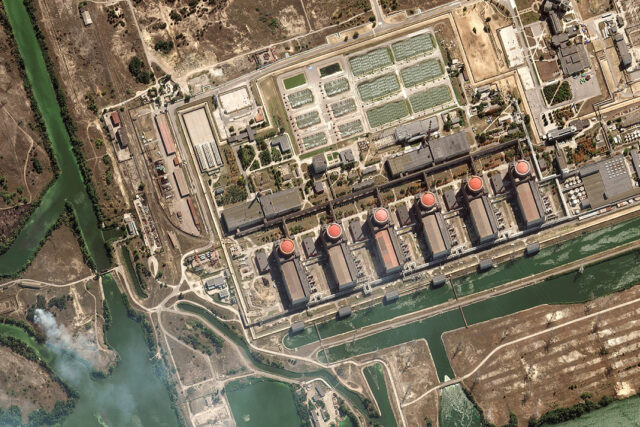
Satellite imagery shows closer view of reactors at Zaporizhzhia nuclear power plant, Ukraine, August 29, 2022. — MAXAR TECHNOLOGIES/HANDOUT VIA REUTERS

LONDON/LVIV, Ukraine — The head of the United Nations nuclear watchdog has warned that whoever fired artillery at Ukraine’s Zaporizhzhia nuclear power plant was “playing with fire” as his team prepared to inspect it on Monday for damage from the weekend strikes. 

The attacks on Europe’s biggest nuclear power plant in the south of Ukraine came as battles raged in the east, where Russian forces pounded Ukrainian positions along the front line, President Volodymyr Zelenskyy said. 

The shelling of the Zaporizhzhia nuclear power station follows setbacks for Russian forces in the Kherson region in the south and a Russian response that has included a barrage of missile strikes across the country, many on power facilities. 

The International Atomic Energy Agency (IAEA) said more than a dozen blasts shook the nuclear plant late on Saturday and on Sunday. IAEA head Rafael Grossi said the attacks were extremely disturbing and completely unacceptable. 

“Whoever is behind this, it must stop immediately. As I have said many times before, you’re playing with fire!” Mr. Grossi said in a statement. 

Russia and Ukraine blamed each other for the shelling of the facility, as they have done repeatedly in recent months after attacks on it or near it. 

Citing information provided by plant management, an IAEA team on the ground said there had been damage to some buildings, systems and equipment, but none of them critical for nuclear safety and security. 

The team plans to conduct an assessment on Monday, Mr. Grossi said, but Russian nuclear power operator Rosenergoatom said there would be curbs on what the team could inspect. 

“If they want to inspect a facility that has nothing to do with nuclear safety, access will be denied,” Renat Karchaa, an adviser to Rosenergoatom’s CEO, told the Tass news agency. 

Repeated shelling of the plant has raised concern about a grave accident just 500 km (300 miles) from the site of the world’s worst nuclear accident, the 1986 Chernobyl disaster. 

The Zaporizhzhia plant provided about a fifth of Ukraine’s electricity before Russia’s invasion, and has been forced to operate on back-up generators a number of times. It has six Soviet-designed VVER-1000 V-320 water-cooled and water-moderated reactors containing Uranium 235. 

The reactors are shut down but there is a risk that nuclear fuel could overheat if the power driving the cooling systems is cut. Shelling has repeatedly cut power lines. 

Russia’s defense ministry said Ukraine fired shells at power lines supplying the plant but Ukraine’s nuclear energy firm Energoatom accused Russia’s military of shelling the site, saying the Russians had targeted infrastructure necessary to restart parts of the plant in an attempt to further limit Ukraine’s power supply.  

‘FIERCEST BATTLES’
In eastern Ukraine, Russian forces battered Ukrainian front-line positions with artillery fire, with the heaviest attacks in the Donetsk region, Mr. Zelenskyy said in a video address. 

Russia withdrew its forces from the southern city of Kherson this month and moved some of them to reinforce positions in the eastern Donetsk and Luhansk regions, an industrial area known as the Donbas. 

“The fiercest battles, as before, are in the Donetsk region. Although there were fewer attacks today due to worsening weather, the amount of Russian shelling unfortunately remains extremely high,” Mr. Zelenskyy said. 

“In the Luhansk region, we are slowly moving forward while fighting. As of now, there have been almost 400 artillery attacks in the east since the start of the day,” he said. 

Ukraine’s military in an early Monday update confirmed heavy fighting over the previous 24 hours, saying its forces had repelled Russian attacks in the Donetsk region while Russian forces were shelling in the Luhansk region in the east and Kharkiv in the northeast. 

In the south, Mr. Zelenskyy said troops were “consistently and very calculatedly destroying the potential of the occupiers” but gave no details. 

Kherson city remains without electricity, running water or heating. 

Ukraine said on Saturday that about 60 Russian soldiers had been killed in a long-range artillery attack in the south, the second time in four days that Ukraine has claimed to have inflicted major casualties in a single incident. 

Russia’s defense ministry said on Sunday that up to 50 Ukrainian servicemen were killed the previous day along the southern Donetsk front line and 50 elsewhere. 

Reuters was not able to immediately verify any battlefield reports. 

Russia calls its invasion of Ukraine a “special operation” to demilitarize and “denazify” its neighbor, though Kyiv and its allies say the invasion is an unprovoked war of aggression. 

Oleh Zhdanov, a military analyst in Kyiv, said that according to his information, Russian offensives were taking place on the Bakhmut and Avdiivka front line in the Donetsk region, among others. 

“The enemy is trying to break through our defenses, to no avail,” Mr. Zhdanov said in a social media video. “We fight back — they suffer huge losses.” — Reuters

Who will pay for climate ‘loss and damage’?

PHILIPPINE STAR/ MICHAEL VARCAS

SHARM EL-SHEIKH, Egypt — The COP27 summit of nearly 200 countries agreed on Sunday to set up a “loss and damage” fund to support poorer countries being ravaged by climate impacts, overcoming decades of resistance from wealthy nations whose historic emissions have fueled climate change.

Pakistan’s climate minister Sherry Rehman, who was part of the campaign by developing nations to win the commitment at the two-week UN summit in Egypt, hailed the landmark decision as “downpayment on climate justice.” 

But the text of the agreement leaves open a number of crucial details to be worked out next year and beyond, including who would contribute to the fund and who would benefit. 

Here’s what you need to know about the agreement: 

WHAT IS ‘LOSS AND DAMAGE’? 

In UN climate talks, “loss and damage” refers to costs being incurred from climate-fuelled weather extremes or impacts, like rising sea levels. 

Climate funding so far has focused mostly on cutting carbon dioxide emissions in an effort to curb global warming, while about a third of it has gone toward projects to help communities adapt to future impacts. 

Loss and damage funding is different, specifically covering the cost of damage that countries cannot avoid or adapt to. 

But there is no agreement yet over what should count as “loss and damage” caused by climate change — which could include damaged infrastructure and property, as well as harder-to-value natural ecosystems or cultural assets. 

A report by 55 vulnerable countries estimated their combined climate-linked losses over the last two decades totalled $525 billion, or 20% of their collective GDP. Some research suggests that by 2030 such losses could reach $580 billion per year. 

WHO PAYS WHOM? 

Vulnerable countries and campaigners in the past argued that rich countries that caused the bulk of climate change with their historical greenhouse gas emissions should pay. 

The United States and European Union had resisted the argument, fearing spiraling liabilities, but changed their position during the COP27 summit. The EU has argued that China — the world’s second-biggest economy, but classified by the UN as a developing country — should also pay into it. 

A few governments have made relatively small but symbolic funding commitments for loss and damage: Denmark, Belgium, Germany and Scotland, plus the EU. China has not committed any payment. 

Some existing UN and development bank funding does help states facing loss and damage, though it is not officially earmarked for that goal. 

Also remaining to be worked out are the details on which countries or disasters qualify for compensation. 

WHAT DOES THE COP27 AGREEMENT SAY? 

The fund agreed at the UN summit in Egypt will be aimed at helping developing countries that are “particularly vulnerable” to climate change, language wanted by wealthy nations to ensure the money goes to the most urgent cases while also limiting the pool of potential recipients. 

The deal lays out a roadmap for future decision-making, with recommendations to be made at next year’s UN climate summit for decisions including who would oversee the fund, how the money would be dispersed — and to whom. 

The agreement calls for the funds to come from a variety of existing sources, including financial institutions, rather than relying on rich nations to pay in. 

Some countries have suggested other existing funds could also be a source of cash, although some experts say issues like long delays make those funds unsuitable for addressing loss and damage. 

Other ideas include UN Secretary-General Antonio Guterres’s call for a windfall profit tax on fossil fuel companies to raise funding. — Reuters


As Biden turns 80, Americans ask ‘What’s too old?’

TWITTER/FLOTUS

WASHINGTON — Joseph R. Biden, Jr., turned 80 on Sunday, making him the first octogenarian president in US history.

He celebrated his birthday with a brunch hosted by his wife, Jill, a celebration that got an extra lift this weekend with his granddaughter’s wedding at the White House on Saturday. 

With Mr. Biden already the oldest person to serve as president, the 2024 race for the White House is shaping up to be uncharted territory for the United States. The nearly 250-year-old democracy celebrates youth, but millions of Americans — including presidents — are now working well beyond the traditional retirement age of 65. 

Ronald Reagan was 77 when he left the White House, but Mr. Biden would be 86 by the time a second four-year term ends, should he win it. His leading potential Republican opponent, Donald J. Trump, would be 82 when he left office if he won in 2024. 

As a society, the United States is aging, and working until later in life. The 65-and-older population is projected to nearly double from 52 million in 2018 to 95 million by 2060. By 2026, more than one in four men over 65 will still be working, the nonprofit Population Reference Bureau projects. 

Some Americans have concerns about the advanced age of the two most likely 2024 candidates. 

While 71% of Democrats think Mr. Biden is “mentally sharp and able to deal with challenges,” 46% say he may not be up to the challenge of running in 2024, according to a Reuters/Ipsos poll taken Nov. 8 and 9. About a quarter of Republicans, 26%, think Mr. Trump may not be up to 2024 because of his age. 

Political affiliation aside, 68% of people surveyed think Mr. Biden may not be up for the challenge two years from now, and 49% say the same about Mr. Trump. Some 86% of Americans said they believe the cutoff for serving as president should be age 75 or younger, the poll found. 

Mr. Biden’s occasional verbal stumbles and tendency to meander off script during live appearances have been seized on by his Republican critics as proof he’s too old for the job. His supporters say the president, who overcame a childhood stutter, has been ad-libbing in public speeches for decades. 

Mr. Biden’s prospects for a second term got a boost last week when the Democrats did better than expected in midterm congressional and gubernatorial elections. 

Asked about concerns over Mr. Biden’s age, the White House said his recent record speaks for itself. 

“As then-candidate Biden said in 2019, ‘watch him,’” responded spokesperson Andrew Bates. 

“Since then, he won the most votes of anyone in American history, achieved unprecedented job creation, made big corporations pay their fair share in taxes, empowered Medicare to negotiate lower drug prices, and signed the most significant gun reform in 30 years and the biggest infrastructure investment since the 1950s,” Mr. Bates said, calling it “the most successful legislative record of any president since Lyndon Johnson.” 

“Keep watching,” he added. 

Some Biden supporters said they admired Democrats’ success under Biden, but were still uncertain about a possible next term. 

“I think he’s done a great job in the time that he has had,” said Illinois resident Paul Klenck. “I am concerned that someone well into their mid-80s would serve as president. I can’t think of a more demanding job than that.” 

Others said criticism of Mr. Biden’s age was discriminatory. 

“Some people at 60 should go nowhere near political power,” New York City resident Catharine Stimpson, 86, said in an interview. “I think the satire about him and the sneering at him is ageism. So let us look at the individual.” 

Asked about his birthday in a recent MSNBC interview, Mr. Biden had a reaction that may be familiar to anyone over 50: disbelief. “I can’t even say the age I am going to be. I can’t even get it out of my mouth,” he said. 

Mr. Biden said questions about his age were “totally legitimate” but that it was his intention to seek another term. 

AGING AMERICA, AGING LEADERS 

The outgoing Congress is one of the oldest in US history, with more than half of the House of Representatives and two-thirds of the Senate part of the “Baby Boomer” generation born between 1946 and 1964, Pew Research shows. 

Some members have years on Messrs. Biden and Trump. Outgoing House Speaker Nancy Pelosi is 82. Senate Republican leader Mitch McConnell is 80. Republican Senator Chuck Grassley of Iowa, 89, won another six-year term last week. 

Americans are not necessarily comfortable with that situation. Two-thirds of people surveyed support the idea of having an upper age limit for federal officeholders, including the president, members of Congress, and Supreme Court justices, the Reuters poll shows. 

However, Mr. Biden does not even register in the top 10 list of the world’s oldest current serving leaders, which is led by the 89-year-old president of Cameroon, Paul Biya. 

“There’s a reason why other societies look to their elders for wisdom and guidance. It’s because they have that experience, which should not be discounted,” said Deborah Kado, co-director of the longevity center at Stanford University. 

Ms. Kado and other experts on aging said they saw no signs Mr. Biden is unable to fulfill his duties. 

Stuart Jay Olshansky, an expert on aging at the University of Illinois at Chicago, said Mr. Biden may be a member of a subset of older Americans who are “super-agers,” with the mental faculties of people decades younger. 

“Age has been weaponized and people from the other party, whatever party you’re dealing with, will always try to say that there’s something wrong with this individual,” he said. “Those of us who study age as a profession say: ‘Stop using age as a weapon.’” 

The Reuters/Ipsos poll, conducted online in English throughout the United States, gathered responses from 1,003 adults, including 468 Democrats and 342 Republicans. It has a credibility interval — a measure of precision — of 4 percentage points either way. — Reuters


Why US seeks closer security cooperation with the Philippines

AMERICAN and Filipino troops attend the opening of the annual joint military exercises called Balikatan on March 28, 2022 at the Philippine military’s headquarters in Quezon City. — PHILIPPINE STAR/ WALTER BOLLOZOS

WASHINGTON/MANILA — US Vice President Kamala D. Harris visits the Philippines this week in the Biden administration’s latest high-level engagement with America’s oldest Asian ally and an increasingly vital strategic partner as tensions rise with China over Taiwan.

The following are some of the main issues surrounding her visit: 

Why is the Philippines so important to the United States? 

The Philippines is a former US colony and became a US treaty ally in 1951, five years after independence. During the Cold War, it hosted some of America’s largest overseas bases, facilities vital to the US wars in Korea and Vietnam. Philippine nationalism forced Washington to vacate those in the 1990s, but in recent years the allies have cooperated on counter-terrorism and in response to rising Chinese military pressure in the South China Sea, where the Philippines has rival claims. 

Today, because of its geography, the Philippines is central to US plans to deter and respond to any Chinese attack on Taiwan, a self-administered island China claims as its own. 

Tensions over Taiwan are expected to feature when Ms. Harris meets with President Ferdinand R. Marcos, Jr., on Monday, Manila’s ambassador to Washington Jose Manuel Romualdez told Reuters. 

Ms. Harris also plans a highly symbolic stop on the Philippine islands of Palawan in the South China Sea to show US support for its ally. 

How does the country fit into US planning for a possible conflict over Taiwan? 

Of the five US treaty allies in the Indo-Pacific — Australia, South Korea, Japan, the Philippines and Thailand — the Philippines is closest to Taiwan, its northernmost land mass of Luzon just 200 km (120 miles) away. 

Experts such as Randall Schriver, who served in the Trump administration as the top Pentagon official for East Asia, said Luzon is of great interest to the US Army, in particular, as a potential location for rockets, missiles and artillery systems that could be used to counter an amphibious invasion of Taiwan. 

He said the political environment for greater military access appeared to be improving under Marcos after a rocky period of relations during the six-year term of President Rodrigo R. Duterte, who sought closer ties with China. 

Washington has carefully courted Marcos and Harris’s visit follows two meetings between President Joseph R. Biden, Jr., and Mr. Marcos and a visit by Secretary of State Antony Blinken to Manila in August. 

How are Washington and Manila boosting security cooperation? 

The two sides have moved ahead with an Enhanced Defense Cooperation Agreement that dates back to Obama’s presidency and that languished under Duterte. EDCA allows US access to Philippine military bases for joint training, pre-positioning of equipment and the building of facilities such as runways, fuel storage and military housing, but not a permanent presence. 

To what extent the Philippines would allow its territory to be used to defend Taiwan remains unclear. Mr. Romualdez, the ambassador to Washington and a relative of Mr. Marcos, said in September it would let US forces use its bases in the event of a Taiwan conflict only “if it is important for us, for our own security.” 

The United States has proposed adding five more EDCA sites to the current five. Southeast Asia expert Gregory Poling at Washington’s Center for Strategic and International Studies said Harris’s trip could bring an announcement of an agreement. 

How would a Taiwan conflict affect the Philippines? 

Mr. Poling believes it would be extremely difficult for the Philippines to remain neutral in a Taiwan conflict given its proximity to the island and its treaty obligations to the United States. It would be the most likely destination for Taiwanese refugees and the some 150,000 Filipinos living on the island would be endangered by any Chinese attack. 

“They have commitments to the Americans under the alliance,” Mr. Poling said. “So if they want American support in the South China Sea, the Americans will expect Philippine support on Taiwan.” 

What would the Philippines expect in return? 

Mr. Schriver said that with the Pentagon’s rising concern about a possible attack on Taiwan, Washington would want assurances over access within the next year or two, though any overt planning for a Taiwan contingency is highly sensitive for Manila. 

Mr. Poling said providing Manila sufficient funding to help modernize its long-neglected armed forces was key. Washington recently announced $100 million in foreign military financing and $66.5 million for EDCA sites, but amounts are small compared to what Washington sends to the Middle East and Ukraine. 

“The second Philippine demand is a continued clear commitment to defend Filipinos in the South China Sea,” Mr. Poling said. “They have that rhetorically, but the question for both sides is, do they have it functionally? If there was a Chinese attack on a Philippine base in the South China Sea tomorrow, could the Americans actually do anything about it? And that is far less clear, which is another reason EDCA is so important.” — Reuters


Next unicorn could come from the Philippines — QBO Innovation Hub

IdeaSpace Foundation, Inc. and QBO Innovation Hub Team (L-R): Head of Community & Ecosystem Dave Del Rosario, Head of Startup Development Alwyn Rosel, Executive Director Katrina Chan, and Head of Partnerships Ross Fallorina

There’s no reason why the next unicorn should not come from the Philippines, a Filipino startup space declared.

The Philippines is filled with many startups and startup founders who have amazing ideas that can solve many problems and pain points in various industries, QBO Innovation Hubs Executive Director Kat Chan said during a media gathering hosted by QBO and IdeaSpace Foundation last Oct. 22 in Makati City.

“We believe in the ideas being generated by our Filipino startup community. All they need is that great push, the encouragement, and the resources to bring their initiatives to the next level. The next unicorn can come from the Philippines,” Ms. Chan added.

She also explained that the mission of both IdeaSpace and QBO Innovation Hub is to level the playing field in the global startup sector by providing local Filipino startups with the resources, mentoring, and the network that they need to be able to compete.

IdeaSpace and QBO are one of the pioneer movers in the Philippine startup sector. IdeaSpace Foundation is a nonprofit organization that runs founder-focused programs for early-stage startup sounders. QBO Innovation Hub, on the other hand, is a space for Filipino startups to come together, flourish, and help them succeed.

The executive director has expressed her optimism of the startup sector especially now that more and more people are finally understanding what startups are.

“There was a time when many people didn’t even know about startups — what they are, what they do. But now there’s even a drama series revolving around startups. Times have changed. Now people have realized that anybody can start a startup. If they have a great idea, they can tap into a supportive local community that can help them realize their dreams,” she said.

Ms. Chan added that IdeaSpace Foundation and QBO Innovation Hub’s support for startups is concretized in its yearly event, the Philippine Startup Week.

The Philippine Startup Week is considered the largest startup conference in the country. The week-long event brings together the local startup community and highlights the various sectors, entities, and homegrown high-potential startups contributing to the growing Philippine startup ecosystem.

This year’s edition, themed “Homegrown Heroes: Cultivating Future Tech Giants” was held last Nov. 14-18 at the Blue Leaf Pavilion in Taguig City.

Local circular economy startup closes oversubscribed seed round

Humble Sustainability, a circular economy startup from the Philippines, closed its seed round led by Swiss-based venture capital (VC) fund Seedstars International Ventures and with participation from iSeed Ventures, an early stage VC in San Francisco; and angel investors like Alan Wong, co-founder of Ula, as well as Sagar Achanta, who has held product leadership roles at Amazon, Booking.com and Disney+.

The fresh funding will enable Humble to continue bringing companies’ excess inventory back into circularity through its technology services.

Humble helps some of the largest e-commerce, logistics and retail companies in the Philippines make their returns and excess inventory the hero, while extracting high value from the items for their clients.

With a vision to create a community where any item can be brought back into circularity by anyone, Humble’s advocacy of “circular living” reduces waste from both ends, by preventing items from being disposed of and decreasing demand for the production of new items. As Humble continues to grow, it hopes to become a leader in circular economy and sustainability in the Philippines, with initiatives in mind like carbon footprint tracking, innovation grants and raw materials extraction.

Founded by passionate advocates of sustainability, Humble CEO Josef Werker and COO Niña Opida used their combined years of experience growing and scaling companies in the past to build Humble as a means to create a more sustainable Philippines.

“Our dream is to make living circular as normal as possible, starting with the way we buy things and what we do with them. We’re not environmental scientists, but we’re really passionate about making an impact in this area, and this is the decade where action has to happen,” Mr. Werker said.

Leading Humble’s seed round was Seedstars International Ventures, a seed-stage venture fund dedicated to emerging and frontier markets. Seedstars Partner Patricia Sosrodjojo said that Humble is a great fit to their fund’s thesis of supporting early-stage companies that can create meaningful impact with an attractive business model.

Aside from iSeed Ventures, Mr. Wong and Mr. Achanta, Filipino strategic investors and serial entrepreneurs such as Paco Sandejas and Richard Eldridge, among others, also participated in the round.

Mr. Werker said that their new investors bring more than capital as they are all actively involved and are bringing immense value.

“We’re really grateful for their trust and guidance; we have already learned so much. This journey started because our dream is to make a real impact towards one of the world’s greatest challenges. The crazy ride continues,” he said.

To address a seen problem of unused and wasted inventory, Humble uses two main channels to bring items back into circularity. High-quality items are sold on their e-commerce platform, Thrift by Humble, while everything else is sent to their network of business-to-business (B2B) buyers and recyclers. This allows Humble to ensure all items are sent to new, sustainable homes.

Thrift, an extension of Humble’s initial brand, was launched in October 2021 with the objective of providing consumers with a sustainable alternative to e-commerce. The products offered on the platform are high quality and the deals are hard to beat anywhere else online.

With the impressive growth that has taken place, Humble is on track to continue scaling as they expand their network to more partners and buyers from a variety of sectors. Humble is also set to hire more employees for their ever-expanding team. For available openings, write to grow@humblesustainability.com.

For those who would like to sell their items with Humble, or purchase sustainably-sourced items in bulk, reach out to team@humblesustainability.com or through their dedicated B2B platform, http://humblesustainability.com.