Home Blog Page 4736

Crypto murder case from Seoul’s Beverly Hills spurs tighter digital-asset regulation

FREEPIK

By Sangmi Cha and Hooyeon Kim

JUST before midnight on March 29 an assailant dragged a screaming woman away from an apartment block in an upscale Seoul district and bundled her into a car that sped off into the night.

Her body was found a few days later, a murder thought to stem from a dispute over crypto investment losses and an attempt to steal the victim’s digital tokens, according to South Korean authorities and local reports. Security cameras recorded the kidnapping in Gangnam, a locality likened to California’s Beverly Hills for its wealth.

The homicide adds to a string of South Korean scandals linked to digital assets, most prominently the capture of former fugitive Do Kwon after coins he created erased at least $40 billion in a crash a year ago. The latest incident injected fresh urgency into efforts to get the nation’s first standalone crypto bill passed in a parliamentary vote as early as May.

“There is finally a consensus on both sides of the aisle that we need to get a law in place as soon as possible,” Back Hyeryun, chair of the National Policy Committee at the South Korean parliament, said in an interview. “There were too many issues, so it was necessary to focus on one thing first — investor protection — to move on quickly,” she said.

BILL’S DETAILS
Back, an opposition lawmaker, has been pushing to get the bill implemented. Her office said in a statement that the fallout of the Gangnam murder case and the Kwon wipeout strengthened public consensus for a crypto code.

The prospective law is the Virtual Asset User Protection Bill, which integrates 19 crypto-related bills after a yearslong delay.

The legislation defines virtual assets and imposes penalties for transgressions like the use of nonpublic information, market manipulation and unfair trading practices, according to a draft seen by Bloomberg News. The code would give the Financial Services Commission the power to oversee crypto operators and asset custody. The Bank of Korea would also be able to probe such platforms.

The act will require insurance in case of hacks as well as reserve funds and record keeping. The rules are set to cover virtual assets such as Bitcoin, while existing capital-markets law would apply to tokens viewed as securities.

South Korea’s monthly spot crypto trading volumes sunk to about $38 billion in April from a peak of nearly $200 billion two years ago, figures from CCData show. That reflects the fallout of the collapse of Kwon’s TerraUSD and Luna coins amid a wider 2022 market rout that erased $1.5 trillion in value and blew up firms such as FTX.

But the nation remains well-known for virtual-asset manias. Leading domestic platform Upbit placed in the top 10 for volumes in the past 24 hours among exchanges globally, CoinGecko data show.

ALTERNATIVE INVESTMENT
“In Korea, wealth growth has been centered on property investment, but it is difficult for young people because real estate is costly,” Back said. “Virtual assets have become an alternative investment for them.”

Aside from the murder case and fallout over Kwon — who was found in Montenegro and is wanted by Seoul and the US — South Korea has also been investigating more than $12 billion of abnormal foreign-exchange transactions, some of which are crypto-linked.

Earlier this week, prosecutors searched the offices of local crypto exchanges Upbit and Bithumb to secure the transaction records of a lawmaker who came under fire for sizable crypto trading, according to the Yonhap News Agency.

The nation’s intensified push to impose crypto rules is part of a global drive to regulate digital assets. For instance, the European Union, Dubai, and Hong Kong have pursued frameworks that seek to protect investors and spur growth.

In contrast, the Securities and Exchange Commission and the Commodity Futures Trading Commission have cracked down on crypto outfits in the US, where partisan divides have stalled legislative efforts.

OPINION SPLIT
It will take a year for South Korea’s law to be enforced if the bill is passed this month, according to Back’s office. The framework has split opinion, with some arguing it risks stifling the industry and others saying more is needed.

“The best way to promote an industry is to impose less regulations, but with the current bill, it will only make it more difficult for new businesses to grow,” said Kim Hyoung Joong, a professor at Korea University Graduate School of Information Security and chairman of the Korea Fintech Society.

Meanwhile, Kang Seong-hoo, the head of the Korea Digital Asset Service Provider Association, said a second round of legislation is needed to cover the issuance, distribution and listing of cryptocoins.

Back said the Asian nation’s rulebook will be gradually expanded to improve oversight of crypto exchanges and services like initial coin offerings.

“The number of people investing in and using cryptocurrency has become so significant that the absence of any legal regulation and the inability to do anything in the face of fraudulent activity only means the legislature isn’t doing its job,” Back said.

BLOOMBERG

Isuzu Heart and Smile Project fetes 19th batch of graduates

Posing with the Isuzu Heart and Smile Project’s Batch 19 graduates are (from left) World Vision Operations Manager Visayas Field Officer Bonifacio Calapan, TESDA Leyte Provincial Director Rolando Bade, TESDA VIII Regional Director Gamaliel Vicente, Jr., Tacloban City Council Member Dr. Elvira Casal, Isuzu Motors Limited Senior Executive Officer for Administration Hirokazu Okubo, Isuzu Shutoken Senior Executive Officer Ryuichi Shibata, and World Vision Executive Director Rommel Fuerte. —

ISUZU, together with World Vision and Technical Education and Skills Development Authority (TESDA), commemorated the graduation of Isuzu Heart and Smile Project’s 19th batch of trainees and welcomed its 23rd batch of trainees at the TESDA Auto Mechanic Training Center (AMTraC) in Tacloban, Leyte.

A total of 16 trainees attained Automotive Servicing National Certificate IV, the highest qualification for automotive servicing, and will be deployed to their respective employers after graduation. Among the 16 graduates, 12 will be dispatched to different Isuzu dealerships nationwide, and four will continue their studies at the Isuzu Global Service Corp.

Isuzu Motors Limited (IML) Senior Executive Officer for Administration Hirokazu Okubo exhorted the graduates to excel in their work and contribute to the development of the Philippines. More than providing education to youth from the poorest communities in the country, the project also aims to produce globally competitive auto mechanics that will contribute to the further development of the automotive industry in the country.

Apart from sending 16 trainees off to their new life journey, a fresh new batch of trainees were also welcomed to the AMTraC. The 23rd batch of trainees consists of 18 scholars who were carefully selected out of the 600 applicants from different areas of the region. “Studying and graduating from this school will earn you a full-time job in the Philippines auto industry. You will also increase an opportunity to work in the automotive sector around the world,” stated Mr. Okubo. With the promise of landing a job opportunity at the end of the training program, applicants had to undergo series of examinations and interviews to finally be admitted to the AMTraC.

World Vision Executive Director Rommel Fuerte also mentioned, “We at World Vision feel blessed to be entrusted with this ministry of achieving hope, joy, and justice for all children. The AMTraC is one of those programs that is born of partnership and service to the youth.”

Isuzu Heart and Smile Project is a program established by IML in partnership with World Vision Development Foundation and TESDA to produce skilled and globally competitive auto mechanics that are ready for employment by the end of the two-year program. Despite the pandemic, the project continues and has generated 367 skilled individuals who have completed two-year automotive servicing courses since 2008. Aside from free education and accommodation to all trainees, the project also aims to provide careers in the automotive industry for all graduates. The project has a proven 91% employment rate.

For more information , visit the Isuzu Philippines Facebook page at www.facebook.com/IsuzuPhilippines.

Tech seen as agri’s best hope for attracting young people to farming

REUTERS

THE introduction of digital methods to agriculture will not only improve the government’s response when allocating assistance to farmers, but could also serve as a gateway for young people into farming, Agriculture Undersecretary Mercedita A. Sombilla said.

“There are some challenges for further improving the food security situation in the Philippines… we need real-time data to come up with intervention plans before the issue of food security comes about,” Ms. Sombilla said last week during the BusinessWorld Economic Forum 2023 at the Grand Hyatt Manila in Taguig City.

Ms. Sombilla said that the Department of Agriculture (DA) is working with development partners to organize such a database for the DA.

In turn, digitalization could serve as a means of “attracting young people to go into the agriculture sector. We need to put up the right policies,” she said.

“In the agricultural world, digital starts by adopting modern farming practices and the latest farming techniques and technologies,” said another forum participant, Juan Victor Hernandez, president and chief executive officer of Metro Pacific Logistics Co., Inc. and Metro Pacific Agro Ventures, Inc.

Mr. Hernandez said that bringing modern technologies and practices will help address low farm productivity. 

“A big portion of the issue of food security is low productivity… The majority of the subsectors of agriculture have the same story. If we can improve technology and practices, we can improve productivity in agriculture,” he added. — Ashley Erika O. Jose

How to Have Sex wins Cannes’ Certain Regard competition

REUTERS

CANNES — The provocatively titled film How to Have Sex, about three British teen girls who go on holiday with the aim of drinking, clubbing, and hooking up, won the top prize in the Un Certain Regard competition at the Cannes Film Festival on Friday.

However, there was a slight hiccup: Molly Manning Walker was not in the room when the award for her debut feature was announced. The director was on her way back from Italy and running late from the airport — prompting jury president John C. Reilly to belt out a song to distract audiences during the wait.

“I just ran here from Italy, guys,” said the British director, who was out of breath when she finally took the stage in a T-shirt and jogging shorts.

Manning Walker has said that she wanted to make a film from a girls’ point of view and that she hopes the film can start a bigger conversation around consent and what is good sex.

The Hollywood Reporter summarized the “striking” film as “a quiet stunner” while The Guardian newspaper gave it four out of five stars, calling it “an interestingly unsentimental film, without the coming-of-age cliches.”

Hounds, by Kamal Lazraq, about a father and son in Casablanca who have to deal with a kidnapping gone wrong, took the jury prize. The first Sudanese film to be included in the Cannes official selection, Goodbye Julia, took the freedom award.

Director Mohamed Kordofani thanked the Sudanese people for their support as well as for not giving up. “In the worst time of my country, I’m extremely proud to be Sudanese,” he said.

The Buriti Flower, which follows the Indigenous Kraho people in the heart of the Brazilian forest, won the ensemble prize for directors Joao Salaviza and Renee Nader Messora.

“We want to thank and remember and honor all the spirits of the Indigenous who had their lives interrupted by massacres all over our bloody continent,” said Nader Messora on Friday.

Un Certain Regard is a competition focused on arthouse films that runs parallel to the main competition, the Palme d’Or, which will be announced on Saturday. — Reuters

Unilever aims for €1.5B from vegan products

REUTERS

FOOD businesses must develop lower-carbon food products to lessen greenhouse gas emissions and sustainably feed the growing population, according to an executive at Unilever.

This is why the multinational consumer goods giant is striving for €1.5 billion in sales annually to be from plant-based products by 2025.

“The Philippines contributes very little greenhouse gas emissions [compared with other countries]. But in reality, the food we consume has a big environmental impact,” Kristine A. Go, general manager for nutrition at Unilever Southeast Asia, said during the BusinessWorld Economic Forum on Thursday.

Unilever has invested in products such as soy-based Magnum and The Vegetarian Butcher, which produces vegetable meat. Such food items contain lower salt, sugar, and fat, and reduce food waste. “The food we produce today actually accounts for 30% of greenhouse gas emissions,” Ms. Go said.

According to the United Nations Environment Programme, the global population is projected to reach 10 billion by 2050, making urgent the goal of safely and sustainably feeding the people.

“Half of our soil has been lost because 75% of our food, made of just 12 plants and five animals, use up the same amount of nutrients. Unless we rotate and diversify our diet, we end up damaging the soil, losing more water, and destroying the planet,” Ms. Go said.

Unilever’s global Foods Innovation Centre in the Netherlands, known as “Hive,” has come up with a science-based food technology wheel:

Natural and nutritious food — fortifying Unilever products with nutrients based on each country’s needs, such as Knorr Cubes in the Philippines being fortified with iron to address iron deficiency;

Microstructure and textures — plant-based products mimicking the texture of meat such as in burger patties;

Culinary experiences — making sure items like the vegan Magnum still have the recognizable taste of their original counterpart;

Innovative processing — digitizing the food process from harvesting to delivery to reduce waste and make processes more efficient;

Sustainable packaging — Unilever’s ice cream containers now being converted to paper and Hellmann’s bottles indicating the optimal temperature to preserve them;

Regenerative agriculture — local plantations producing dwarf coconut trees from interstock to help the soil, use less water, and create more livelihood opportunities.

Ms. Go said these strategies show that food can both taste good and be environmentally friendly. “It’s a lot harder to change diets and habits so that’s why we try to change our products,” she said.

On the manufacturing side, Unilever now has six factories all over the world that use innovative processing. — Brontë H. Lacsamana

BSP ‘confident’ it can meet goal to digitize 50% of transactions

BW FILE PHOTO

THE Philippine central bank is confident it can meet its target to have at least 50% of all retail payments done online by the end of this year, an official said.

Bangko Sentral ng Pilipinas (BSP) Deputy Governor and Payments and Currency Management Sector Head Mamerto E. Tangonan told reporters on Friday that the share of digital payments in the total volume of retail transactions in the country in 2022 was higher than the 30.3% seen in 2021.

“Definitely, there was an increase and we’re confident that we will make our target of 50% by 2023. The preliminary figures I saw tell me that I have reason to be happy and confident that we will meet the 2023 target,” he said.

The BSP aims to digitize 50% of the volume and value of retail transactions and to have 70% of Filipino adults be part of the formal financial system by this year under its Digital Payments Transformation Roadmap.

In 2021, the share of digital payments in the total volume of retail transactions in the country rose to 30.3% from 20.1% a year earlier, while the value of payments done online represented 44.1% of the total, up from the 26.8% share in 2020.

Mr. Tangonan said the central bank was initially concerned about base effects following the large increase seen in 2021.

“But the trend continues. It strengthens our view that the customers’ preference for payments has really been shifting towards digital,” he said.

Meanwhile, the rise in the number of online scams and phishing attacks has been slower than the growth in digital transactions, Mr. Tangonan said.

“The digital payments transactions are growing so fast, and the number of these incidents does not grow as fast. If you look at it percentage wise, it’s shrinking,” he said.

NEW PAYMENT STREAMS
The BSP is also currently working on the launch of the request to pay payment facility this year, while InstaPay Debit Pull may “require a bit more discussion,” Mr. Tangonan said.

“We’re working with the industry. We formulate the policies, (but) it’s the industry that practically delivers it… They’re getting ready to launch request to pay, and there’s discussion on debit pull,” he said.

The request to pay facility allows payees to initiate collections by simply sending a request to pay to the payor. Payors will just need to respond to the payee’s request for their payment.

Meanwhile, debit pull would allow for a more efficient way of connecting two different financial accounts or service providers, Mr. Tangonan said.

“Right now, it’s not done in the most efficient way because it has to be done bilaterally,” he said.

Based on the latest data from the central bank, the combined value of transactions done via the BSP’s automated clearing houses InstaPay and PESONet climbed by 30.1% to P3.80 trillion as of end-April from P2.92 trillion in the same period in 2022.

In terms of volume, total transactions coursed through the clearing houses grew by 28.5% to 247.77 million in the first four months of the year from 192.83 million in the comparable year-ago period.

PESONet and InstaPay are automated clearing houses launched in December 2015 under the central bank’s National Retail Payment System.

The central bank has also launched the Bills Pay PH facility that allows consumers to settle their bills using their own transaction account, even if the account of the biller is with a different service provider. — K.B. Ta-asan

The Philodrill Corp. to conduct annual stockholders’ meeting virtually on June 21


Spotlight is BusinessWorld’s sponsored section that allows advertisers to amplify their brand and connect with BusinessWorld’s audience by enabling them to publish their stories directly on the BusinessWorld Web site. For more information, send an email to online@bworldonline.com.

Join us on Viber at https://bit.ly/3hv6bLA to get more updates and subscribe to BusinessWorld’s titles and get exclusive content through www.bworld-x.com.

Elevated inflation, rate hikes, bank collapse fears drag markets in Q1

By Lourdes O. Pilar, Researcher

STUBBORN INFLATION, costlier borrowing costs, and US banking sector collapse contagion dragged domestic financial markets in the first three months of the year.

But analysts still keep their eyes peeled on central banks’ decision as inflation starts to come down.

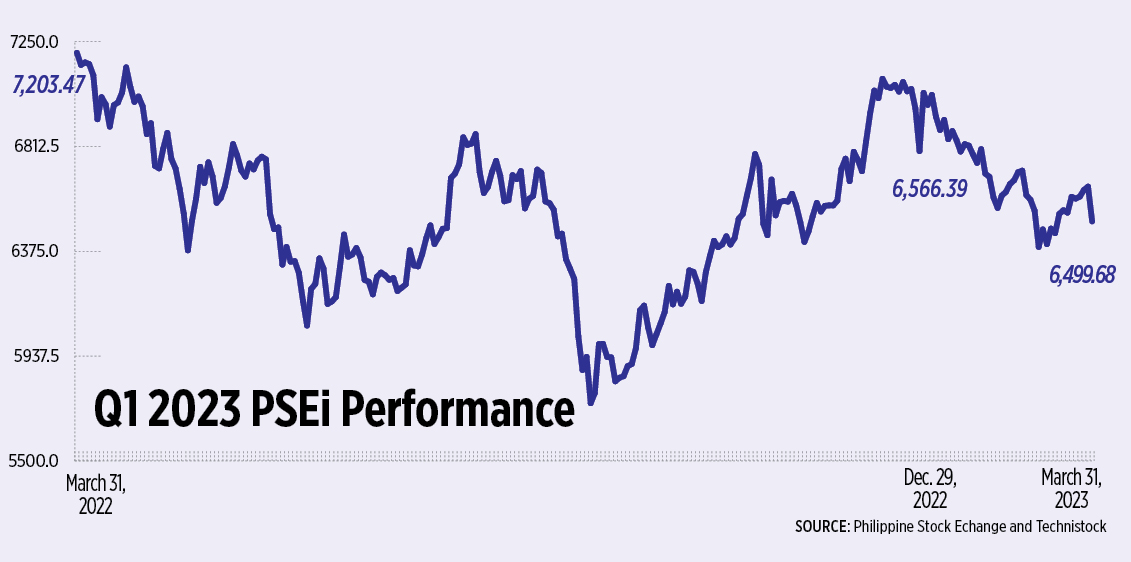
The barometer Philippine Stock Exchange index (PSEi) closed the first quarter at 6,499.68, down 1% quarter on quarter from 6,566.39 in the fourth quarter. Likewise, on year-on-year basis, the index declined by 9.8% year on year from the 7,203.47 finish in the first quarter of 2022.

Meanwhile, the peso closed P54.36 against the dollar in the first quarter, appreciating by 2.6% from the previous quarter’s end of P55.76 to a dollar. On an annual basis, the local unit retreated by 5.1% from P51.74 finish in the first quarter last year.

Demand for Treasury bills auctions saw a total subscription amounting to P443.8 billion with P167.8-billion total offered amount in the first quarter.

The oversubscription amount of P266 billion was higher than the P169.4 billion in the fourth quarter.

Meanwhile, demand for Treasury bonds increased to P1.1 trillion, almost double the P572.9 billion in the fourth quarter. The demand was higher than the aggregate offered amount of P511.2 billion in the first three months of 2023.

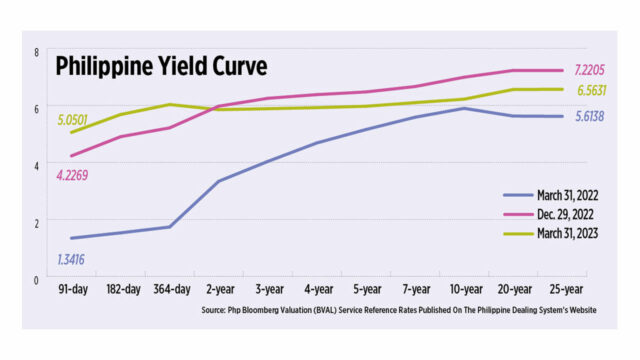
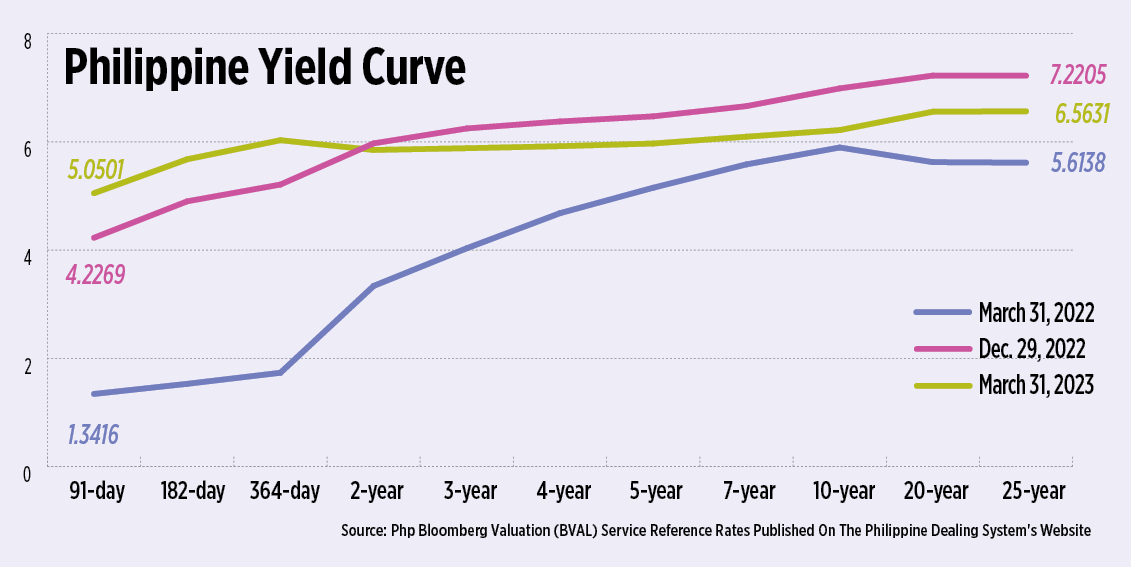
At the secondary bond market, domestic yields plunged by 15.34 basis points (bps) on quarter-on-quarter average, based on the PHP Bloomberg Valuation (BVAL) Service Reference Rates published on the Philippine Dealing System’s website.

On a year-on-year basis, yields also grew by 193.46 bps.

The US Federal Reserve has raised borrowing costs by 500 bps since March 2022, bringing the Fed funds rate to 5-5.25%. Market players are expecting the Fed to start keeping rates on hold at its next meeting on June 13-14.

The BSP maintained the key policy interest rate on the overnight reverse repurchase facility at 6.25% at its May 18 meeting, ending nine straight meetings of rate hikes. The corresponding interest rates on the overnight deposit and lending facilities remained at 5.75% and 6.75%, respectively.

Economists attributed financial market developments during the first quarter to stubborn inflation, rising borrowing costs, and sudden sell-off due to the collapse of Silicon Valley Bank and Signature Bank.

“The start of 2023 was quite optimistic, especially for Philippine equities as upbeat corporate earnings were sustained,” Union Bank of the Philippines Chief Economist Ruben Carlo O. Asuncion said in an e-mail.

Local factors such as high interest rates and stubbornly high inflation continued to persist causing investors to sit on the sidelines and opt for attractive fixed-income securities, added Mr. Asuncion.

“An external factor was the looming banking crisis in the West. For some time, fear flooded the markets causing a short sell-off on banking stocks. However, it was swiftly tapered down by news on bailouts and acquisitions,” said Mr. Asuncion.

ING Bank N.V. Manila Senior Economist Nicholas Antonio T. Mapa said in an e-mail that financial markets took their cue from the outlook on US Federal Reserve (US Fed) policy and any development that might impact that outlook moved markets.

“Troubles at banking institutions impacted the markets in so far as it might impact on US Fed policy,” said Mr. Mapa.

“To the extent that it had an impact on global yields and in turn currencies. But after the dust settled and local banks were able to effectively demonstrate that they were not in any way like those banking institutions, markets steadied,” Mr. Mapa said.

He also noted that the China’s reopening also affected markets as this could affect US Fed’s policy outlook via faster inflation induced by China’s resurgent demand.

Domini S. Velasquez, chief economist at China Banking Corp., said in an e-mail that bank woes happened abroad had spurred fears of contagion which caused risk off sentiment to emerge in financial markets.

Rachelleen A. Rodriguez, research analyst at Maybank Investment Banking Group–Philippines, said in an e-mail that the PSE financial sector index slid by 2.04% the day following the news of the collapse of Silicon Valley Bank.

“We think the sell-off was overdone considering Philippine banks’ strong capital positions, reinforced credit policies, high NPL (nonperforming loan) cover buffers and predominantly local government investment exposures,” said Ms. Rodriguez, adding that the local banks have no exposure to the failed banks in the US.

WHAT INDICATORS TO WATCH OUT FOR
Investors should continue to watch out for inflation and gross domestic product data this year as these could sway the central bank’s monetary policy decisions, said Ms. Velasquez.

“A continued downward trend may open the doors for a rate cut as soon as the fourth quarter, especially given expectations of slower economic growth this year. The current account balance is also a key indicator as it provides a picture of the country’s external position. A narrower current account deficit will provide support to the local currency,” Ms. Velasquez added.

Mr. Asuncion said that investors should observe the rate of disinflation, whether it’s increasing or decreasing and how fast.

“If inflation remains stubbornly high (although decreasing), the BSP may hold rates high for longer. Meanwhile, if the optimistic case holds, the BSP could now consider cutting rates which could provide a better outlook for debt-driven sectors such as property,” Mr. Asuncion added.

“For now it is still all about inflation. To some extent investors should also monitor real sector variables as movements for these could also influence central bank policy direction,” said Mr. Mapa

Consumer price slowed to an eight-month low of 6.6% annually in April from 7.6% in March, preliminary data from the Philippine Statistics Authority showed.

But this was still faster than 4.9% in April a year ago and marked the 13th straight month that inflation breached the central bank’s 2-4% target.

This brought the four-month inflation print to 7.9%, still far from the downward-revised 5.5% forecast given by the BSP.

“Easing inflation will provide some relief, however, the recent numbers we are seeing 7-8%, are still far from the BSP’s target of 2-4%,” Mr. Asuncion said.

“This signals the market that the BSP will not be cutting rates anytime soon, hence, the cost of borrowing will remain high in the medium term. A high interest rate environment coupled with lower demand may soften corporate earnings in the second quarter of 2023,” added Mr. Asuncion.

He expects inflation to be at the 6-7% range in the next quarter, while full-year 2023 forecast is at 6.2%.

Security Bank Corp. Chief Economist and Assistant Vice-President Robert Dan J. Roces said in an e-mail that domestic inflation is expected to temper, mostly on base effects and improving food supply.

“However, upside risks are emerging including El Niño which may affect food supply once more and jack up utility costs,” said Mr. Roces.

FIXED-INCOME MARKET
Ms. Velasquez: Market interest rates have likely peaked in the first quarter and are already on a downward path. However, central banks will remain hawkish even as they end their monetary tightening cycles due to sticky inflation. Hence, we expect the yield curve to remain relatively flat in the second quarter.

Mr. Mapa: We could see yields track inflation trends and also take their cue from the BSP policy stance.

Mr. Roces: Yields may continue to go down as inflation tempers.

Rizal Commercial Banking Corp. Chief Economist Michael L. Ricafort: Continued easing trend in long-term peso yields, fundamentally amid the easing trend in global and local inflation largely due to higher base effects.

Mr. Asuncion: With the current rate of disinflation, we expect the BSP to raise 25 bps and pause in 2Q23 and for the rest of 2023. Thus, short-term bonds will continue to be an attractive place to park capital.

EQUITIES MARKET
Mr. Asuncion: With most investors staying on the sidelines, we expect the PSEi to trade between the 6,500-6,800 range in second quarter of 2023 before picking up momentum towards the end of the year.

Mr. Roces: Rangebound to upwards on improving sentiment.

Ms. Rodriguez: We expect the PSEi to reach 7,800 by yearend 2023.

Mr. Ricafort: Important support levels at 6,250-6,400 levels, where there could still be some bargain hunting/bottom fishing activities for some long-term investors. Important resistance at 6,800-7,000 levels where there were some healthy profit taking activities.

FOREIGN EXCHANGE MARKET
Ms. Velasquez: The peso will likely remain weak in the second quarter as easing domestic inflation fuels expectation of a BSP rate pause soon. A narrower interest rate differential between the US Fed and the BSP will lead to a weaker peso.

We expect the peso to depreciate in the third quarter when businesses usually fulfill the bulk of their imports before gaining strength in the fourth quarter as remittances come in ahead of the holidays.

Mr. Roces: Volatile.

Mr. Mapa: Peso should remain pressured on current account dynamics (deficit). That being said, should the strong dollar theme fade towards the end of the year, we could see the peso recover, albeit lagging regional peers.

Mr. Asuncion: Dollar to peso is expected to hover between P54.50-P56.00 in the second quarter of 2023. Forecast range may break to the upside, given rising geopolitical tensions increase within the region the demand for safe-haven assets which benefits the dollar rise. Nevertheless, downside risks remain from the US potential recession overhang.

Preventing cervical cancer

FREEPIK

Cervical cancer is the second leading cause of cancer death among women in the Philippines. The Department of Health (DoH) estimates that almost 7,300 new cases of cervical cancer and 3,800 deaths due to the disease occur in the country every year. This May, the country is putting focus on the disease with the observance of the Cervical Cancer Awareness Month.

The main cause of cervical cancer is persistent infection with high-risk types of human papillomavirus (HPV) that are transmitted through sexual contact or intimate skin-to-skin contact. Regular cervical cancer screening is important because infection with high-risk HPV does not usually cause symptoms. The UK National Cancer Institute said that if an HPV infection develops into cancer, it may cause symptoms such as bleeding, pain or swollen glands.

According to the US Centers for Disease Control and Prevention (CDC), HPV is estimated to cause nearly 36,500 cases of cancer in men and women every year in the United States. HPV vaccination can prevent 33,700 of these cancers by preventing the infections that cause them. The number of HPV infections and cervical precancers (abnormal cells on the cervix that can lead to cancer) have dropped since HPV vaccines were first used in the US. Among teen girls, infections with HPV types that cause most HPV cancers and genital warts have dropped 88%. Among young adult women, infections with HPV types that cause most HPV cancers and genital warts have also dropped by 81%. Among vaccinated women, the percentage of cervical precancers caused by the HPV types most often linked to cervical cancer has dropped by 40%.

The Pediatric Infectious Disease Society of the Philippines (PIDSP) and Philippine Foundation for Vaccination (PFV) recommend a two-dose HPV vaccine series for females ages nine to 14 years, and a three-dose series for females ages 15 years and older. They recommend HPV vaccine for males nine to 18 years of age for the prevention of anal and genital warts and anal cancer.

The Philippine Society for Microbiology and Infectious Diseases (PSMID) recommends HPV vaccination for females until the age of 26 years for the prevention of cervical cancer and anogenital warts. They also recommend HPV vaccine for males 16 to 26 years of age for the prevention of genital warts and anal cancer.

In 2015, the DoH partially introduced the national HPV immunization program, initially as a community-based immunization program and later shifting to a school-based immunization program targeting young girls aged nine to 14 years to ensure high coverage and minimal dropout rate. Although the program provided free HPV vaccination, the Philippines still ranked last among low- to middle-income countries in terms of HPV vaccination coverage, according to a study by Lintao et. al. published last year in the journal Frontiers in Medicine.

As of 2020, 23% of the female target population received the first dose of the HPV vaccine, virtually unchanged from 2019. Meanwhile 5% received the last dose, up from 3% during the same year.

With the suspension of in-person classes due to the COVID-19 pandemic, strategies such as putting up vaccination stations at permanent health facilities or temporary posts at multi-purpose town halls and door-to-door approach were employed to provide continuous immunization. With the significant improvement in the country’s COVID-19 situation, in-person classes have resumed and the program is expected to revert to school-based immunization.

Meanwhile, low utilization of available cervical cancer screening tests such as Pap smear and visual inspection with acetic acid (VIA) hampered HPV infection and cervical cancer control and prevention in the country. Among those diagnosed with cervical cancer in the Philippines, only an estimated 50% to 60% receive some form of treatment, the study noted.

The authors acknowledged government efforts to provide financial risk protection to Filipino patients. The PhilHealth Z Benefit Packages for Cancer covers a substantial portion of the cost of cancer treatment. The Cancer, Supportive Care and Palliative Care Medicines Access Program (CSPMAP) provides free medicines for gynecologic cancers including cervical cancer not covered by PhilHealth. This program is funded by the Cancer Assistance Fund, established under the National Integrated Cancer Control Act (NICCA). Indigent and financially incapacitated patients can avail of medical and financial assistance in accordance with the Malasakit Centers Act.

Making cervical cancer one of the public health priorities — starting with its prevention — can help save lives and stave off the suffering of women and girls in the family and the community.


Teodoro B. Padilla is the executive director of Pharmaceutical and Healthcare Association of the Philippines (PHAP). PHAP represents the biopharmaceutical medicines and vaccines industry in the country. Its members are in the forefront of research and development efforts for COVID-19 and other diseases that affect Filipinos.

Scania Touring buses herald Cagsawa’s Manila-to-Bicol trips

From left are Scania Southeast Asia Managing Director Heba El Tarifi, BJ Mercantile Vice-President Leilani Lim-Tan, Cagsawa Travel and Tours General Manager Willy Ngo, and Cagsawa Director and Operations Manager William Rogando.

BJ MERCANTILE, INC., the exclusive distributor of Scania in the country, recently turned over four Scania Touring buses to Cagsawa Travel and Tours, Inc. The Swedish-built Scania Touring features an electronically controlled air suspension, thick body insulators for better noise canceling, enclosed overhead luggage compartments like those found in commercial airplanes, and USB charging slots in every seat.

“To bolster our claim of providing the most spacious cabins, we reduced the number of seats of the standard Scania Touring from 51 to 38 and adopted a two-plus-two seating configuration to offer even better elbow space and legroom,” said Cagsawa Travel and Tours, Inc. Director and Operations Manager William Rogando. “Our drivers are also well-rested as they have very comfortable private sleeping quarters at the back of the bus.”

The Scania Touring buses promise to deliver fuel economy, energy efficiency, reduced emissions, and superior uptime. They are also equipped with the latest technology to enhance the safety of passengers and other motorists. Standard safety features include Electronic Stability Program (ESP), Speed Limiter, Traction Control, Driving Mode (economy and standard), Hill Hold, and Auxiliary Brakes (retarder). Other functions that can be added to further support the driver whether they are on the open highway or in busy city environments are Adaptive Cruise Control, Lane Keep Assistance, and Blind Spot Warning.

“We are 100% committed to support Cagsawa Travel and Tours to provide the best riding experience for those shuttling between Manila and the Bicol region,” said BJ Mercantile, Inc. Sales Manager Don Ramos. “Through our fleet management system, we can help monitor driving performance, vehicle data and fleet position, thereby giving bus operators all the information they need to achieve operational excellence.”

The Scania Touring buses of Cagsawa Travel and Tours are already being used in service and the reception from passengers has been very positive. To book a seat with Cagsawa Travel and Tours, visit www.cagsawatours.ph. For more information about Scania, visit the showroom at 1132 EDSA Balintawak, Quezon City, or call (02) 8361-0088. E-mail scania.sales@bjmerc.com, visit www.scania.ph or follow the Facebook page (scaniaphilippines).

Celine Dion cancels rest of world tour due to medical condition

REUTERS

REUTERS — Canadian pop singer Celine Dion announced on Friday that she was canceling the European stretch of her world tour, scheduled to resume this summer, due to a medical condition that makes it difficult for her to perform.

The announcement comes four months after the 55-year-old Quebecoise singer said she was diagnosed with a rare neurological disorder called stiff-person syndrome that causes muscle spasms. At the time, the disorder forced her to postpone some European shows on her Courage World Tour.

“I’m so sorry to disappoint all of you once again,” the singer — best known for the Titanic movie theme song “My Heart Will Go On” — wrote on Instagram on Friday morning.

“I’m working really hard to build back my strength, but touring can be very difficult even when you’re 100%.”

The tour’s European stretch consisted of 42 shows in seven cities from late August to early October and another 17 cities during the spring of 2024. Ms. Dion said ticket holders would receive refunds.

Stiff-person syndrome causes muscle rigidity and increased sensitivity to sound, touch, and emotional stimuli that can trigger spasms. The condition led the multiple Grammy winner to postpone her Las Vegas residency in October 2021.

The tour — her first in the United States in 10 years — kicked off in Quebec City in September 2019. It was accompanied by the release of her latest album Courage.

The singer said the album’s title was inspired by the 2016 death from throat cancer of her husband and manager Rene Angelil. The couple had three children. — Reuters