Home Blog Page 4729

RE, agri investment seen improving job quality

Solar panels are being installed on the roof of a mall. — GREEN HEAT HANDOUT PHOTO

By John Victor D. Ordoñez, Reporter

THE government’s best bet for improving job quality is to let in more investment in renewable energy (RE) and agriculture, after the indicator used as a proxy for job quality worsened in April, labor groups said.

“These investments, coupled with strong linkages to manufacturing, have the potential to create decent, productive, and sustainable jobs,” Jose G. Matula, president of the Federation of Free Workers (FFW), said in a Viber message.

The jobless rate fell to a four-month low in April at 4.5% from 4.7% in March, the Philippine Statistics Authority (PSA) said on June 9.

The underemployment rate, a measure of the degree to which workers are seeking more employment or longer hours, increased to 12.9% from 11.2% a month earlier.

Mr. Matula said the government should also provide more public sector-jobs and halt the retrenchment plans of government corporations like Duty-Free Philippines Corp. (DFPC).

In March, DFPC released the implementing rules and regulations for its rightsizing plan, which the FFW said could lead to the retrenchment of over 700 rank-and-file employees.

“Truth is, we should be generating more jobs than what we are getting,” Josua T. Mata, secretary general of  Sentro ng mga Nagkakaisa at Progresibong Manggagawa, said in a Viber message.

“The government has to discard its outmoded thinking that it has no business generating jobs,” he added.

The PSA estimates that agriculture was the second-largest employer in April, accounting for 21.9% of the workforce, trailing only services, which had a 61.1% share.

In April, the Department of Trade and Industry’s Board of Investments said the renewable energy sector accounted for the most investment approvals during the first quarter, rising 156% increase to P440 billion, followed by manufacturing, which surged 416% to P17 billion.

During the period, agriculture had P929 million in approved investment. The approvals in the first quarter were expected to generate at least 16,719 local jobs.

Last year, the Philippines opened its renewable energy industry to full foreign ownership. Prior to this policy, foreign ownership in renewable energy projects had been capped at 40%.

The Department of Labor and Employment has said it is working on upskilling the workforce ahead of the expected increase in foreign investment this year.

Mr. Matula said that “enterprises in these sectors must be subsidized in order to provide living wages to their workers.”

‘Last’ Beatles record to be released this year thanks to AI — McCartney

BEATLES —WIKIMEDIA.ORG

LONDON — A “last” Beatles song, featuring the voice of late member John Lennon, will be released this year thanks to the use of artificial intelligence (AI), Paul McCartney has said.

In an interview with BBC Radio 4 that aired on Tuesday, Mr. McCartney did not name the track but said the technology was used on “a demo that John had, that we worked on.”

“So when we came to make what will be the last Beatles record… we were able to take John’s voice and get it pure through this AI (artificial intelligence), so that then we could mix the record as you would normally do,” the singer-songwriter, 80, said.

“We just finished it up, it will be released this year.”

The BBC said in an online article that the song was likely to be “Now and Then,” which Mr. Lennon recorded as a demo in 1978, two years before his death in 1980.

Mr. McCartney said director Peter Jackson had used the technology for the 2021 documentary series The Beatles: Get Back, which looks at the Fab Four making their 1970 album Let It Be.

“He was able to extricate John’s voice from a ropey little bit of cassette,” Mr. McCartney said.

“We had John’s voice and a piano, he could separate them with AI.”

The use of AI in music has sparked both excitement and fear of what the technology could bring.

Asked about it, Mr. McCartney said: “It’s a very interesting thing… it’s something we’re all sort of tackling at the moment and trying to deal with.

“…There’s a good side to it and then a scary side, and we’ll just have to see where that leads.” — Reuters

US labor board ruling could spur unionizing by gig workers, others

REUTERS

THE US National Labor Relations Board on Tuesday made it more difficult for companies to treat workers as independent contractors rather than employees, handing workers in the gig economy and other industries a potential path to join unions.

The Democrat-led board threw out a more business-friendly standard for classifying workers adopted during the Trump administration, which had said workers who operate their own businesses should generally be considered independent contractors who cannot join unions.

Instead, the agency reverted to an Obama-era test that considers a broader array of factors such as the amount of control companies exercise over workers and the degree to which workers depend on a single company to make a living.

The board’s ruling came in a case involving a union campaign by makeup artists and hairstylists for the Atlanta Opera. The board said the workers were the opera’s employees and could hold an election over whether to join a union.

Lawyers for the opera and the union organizing its workers did not immediately respond to requests for comment.

The opera cannot immediately appeal the decision. If the workers vote to unionize, the opera could refuse to bargain and bring the case back to the labor board and ultimately a federal appeals court.

Worker classification has been among the most contentious employment-related issues in the US over the last decade. The US Department of Labor is expected to soon finalize a proposed rule opposed by business groups that would narrow the circumstances in which workers qualify as independent contractors under federal wage laws.

Any change in policy is expected to increase labor costs for many industries including trucking, retail and manufacturing. But the effect on the “gig economy,” which relies heavily on independent contractors, has received the most attention.

Kristin Sharp, CEO of gig economy trade association Flex, said on Tuesday’s ruling was out of step with an increasingly tech-driven economy defined by worker flexibility.

“This decision will only generate greater confusion and uncertainty, while undermining the independent work that millions of Americans have chosen, often in lieu of traditional employment,” Ms. Sharp said in a statement.

In a 2014 ruling involving FedEx Corp. drivers, the labor board said a worker’s opportunity for profit or loss is only one factor to be considered in determining independent contractor status.

Five years later, the Trump-era board ruled that so-called “entrepreneurial opportunity” should be the main factor in evaluating classification, narrowing the ability of workers and unions to prove employee status.

The board on Tuesday said that ruling was too narrow. Entrepreneurial opportunity should be considered, the board said, but only in tandem with other factors that speak to whether workers are operating truly independent businesses. — Reuters

Juan Luna’s masterpiece

JUAN LUNA’s Hymen, oh Hyménée.

“Genius has no country. It blossoms everywhere. Genius is like the light, the air. It is the heritage of all.”

— Dr. Jose Rizal’s toast to Luna and Hidalgo, 1884, Café Ingles

On Independence Day, the Ayala Museum welcomed huge crowds of art enthusiasts of diverse backgrounds and ages. Everyone wanted to see and experience the exhibit Splendor: Juan Luna, Painter as Hero, the multi-media presentation of his masterpiece, Hymen, oh Hyménée.

There was an overwhelming response.

Most of the viewers were young — teenagers, students, and some children. They gazed at the awesome painting and enjoyed going around the old-world mansion’s maze of rooms with sketches and small paintings.

The exhibit’s production design is interesting and stunning. It evokes mystery and moods.

The framed doorways lead to hallways and rooms with textured walls and drawings. One finds an open space with Luna’s bust on a pedestal with flowers.

On June 12th, the energy level of the viewers was very high and palpable.

“I cannot think of a better way to celebrate the 125th year of the birth of our nation than by seeing the painting — in the wonderful immersive and thought-provoking exhibition Splendor. You will be overpowered by its beauty and importance in our present times,” remarked Lisa Guerrero Nakpil, Leon Gallery curator.

The art lovers and media have written glowing praises about the repatriation and unveiling of Juan Luna’s missing masterpiece Hymen, oh Hyménée (which is 125 by 250.5 centimeters).

The story of this painting is amazing.

Juan Luna had won the gold medal for the huge painting Spoliarium at the Exposición Nacional de Bellas Artes in Madrid in 1884. He was already a well-known artist.

(Spoliarium is now on permanent exhibit at the National Museum of the Philippines.)

The artist married Paz Pardo de Tavera on Dec. 8, 1886. He started painting Hymen, oh Hyménée during his honeymoon in Rome and Venice in December 1886. He finished it in 1887.

He submitted it (as part of the Spanish exhibit) in the Paris Exposition Universelle in 1889, the international event to commemorate the 100th anniversary of the French Revolution. The Eiffel Tower was inaugurated during that celebration.

Paris was considered Ground Zero for art.

Luna’s exquisite painting won the bronze medal, considered the greatest award ever given to a painting by a Filipino. This competition was “the Olympics of Art.”

The prestigious award put Luna in “the pantheon of the greatest artists of the world,” explained historian Ambeth Ocampo. “Hymen, oh Hyménée is the greatest art discovery in Philippine history.”

The title comes from Hymen, the Roman God of marriage. The painting, also known as Boda Romana (Roman Wedding), has many details of rituals that we have picked up as part of the wedding tradition.

Hymen was one of Luna’s favorite paintings. It was his prized personal possession that was not meant for public viewing. He brought it with him to Hong Kong where he suddenly passed in 1899. The painting vanished mysteriously. It was acquired by a European family in 1920. It was not seen in public for 132 years.

After many years of searching, distinguished collectors tried to buy it but failed. Leon Gallery owner Jaime Ponce de León painstakingly tracked it down. In 2014, he was invited to an aristocratic European’s “lordly mansion.” The family was willing to sell. It had been a long search. It took three years to authenticate the artwork and complete the sale. Mr. Ponce de León bought the “priceless” painting and brought home what is considered the “Holy Grail of Philippine art.”

After seven months of preparation with the Ayala Foundation, the Ayala Museum and its curators, the breathtaking masterpiece was ready to be unveiled. The grand vernissage was memorable, elegant, and well-attended.

One acknowledges the following for the exhibit: the Ayala Corp., the Ayala Foundation, Inc., Ayala Land, Inc., InLife, BPI, SMEG, Matimco, Inc., Samsung, BPI Foundation, Leon Gallery, Martin Arnaldo, Monino Duque, Gino Gonzalez, Lisa Guerrero Nakpil, Ambeth Ocampo, Ditas R. Samson, and Jason Y. Tecson.

Jaime Ponce de León explained in his speech: “It was, I thought, the greatest painting that didn’t exist. … it was a race to find it, but a race where no one would share the map to the ‘Grail.’ The dream of finding it would thus become a tireless obsession.

“Beyond the splendor and magnificence of this masterpiece is its true meaning and intention. Above all, this work is a testament and a monument to love.

“The time has come to unbox the ‘Grail.’ The mystery has been solved. It has been found.”

He called Juan Luna y Novicio, one of the nation’s “greatest architects alongside Jose Rizal and Andres Bonifacio.

“Through his brush and his palette, Luna spoke to the world of what it means to be a Filipino. And because of that, he was able to move mountains and helped create a nation.”

Congratulations to Jaime Ponce de Leon for bringing the masterpiece home and sharing it with the Filipinos.

Mabuhay!

Hymen, oh Hyménée is on loan to Ayala Museum until Dec. 31.


Maria Victoria Rufino is an artist, writer and businesswoman. She is president and executive producer of Maverick Productions.

mavrufino@gmail.com

Overseas Filipinos’ cash remittances (April 2023)

CASH REMITTANCES sent by overseas Filipino workers (OFWs) jumped by 3.7% year on year in April, as they continued to support their families amid elevated inflation. Read the full story.

Overseas Filipinos’ cash remittances (April 2023)

Starpay further expands, now accepted in Pasig market

STARPAY Corp. has further expanded its coverage as the electronic wallet services platform can now be used by consumers to buy fresh produce and general merchandise at the Pasig City Mega Market.

In a statement on Thursday, Starpay said its presence has widened after the recent rollout of the Paleng-QR Ph Plus initiative at the Pasig City Mega Market, which allows consumers to pay for their purchases by scanning the merchant’s QR code via their mobile phones.

The Paleng-QR Ph Plus is an initiative of the Bangko Sentral ng Pilipinas (BSP) and the Department of the Interior and Local Government. It seeks to promote digital payment in public markets and local transportation.

“Electronic payment lessens the need for loose change. Storeowners often scramble for cash in the morning because shoppers often pay their purchases with large bills. Starpay simplifies the transaction because the electronic payment goes straight into their e-wallet, which can easily be transferred to their nominated bank account,” the company said.

Aside from the Pasig City Mega Market, consumers could use the e-wallet platform to pay for their purchases at the Dao Public Market in Tagbilaran, Lapu Lapu City Public Market, Baguio City Public Market, Bankerohan Public Market in Davao City, and People’s Market in Naga City.

“Users like our platform because it is so easy to use. It is now being used in the different public markets in the provinces. At Starpay, we believe an e-wallet must be very convenient and safe. Our interface is very friendly and fun to use, for both buyers and vendors,” Starpay Product Head Ryan Uy said.

Regulated by the BSP, Starpay is available for download on Google Play Store, Apple App Store, and Huawei App Gallery. — Revin Mikhael D. Ochave

Investors on guard for market stress as Fed flags more hikes

WIKIMEDIA.ORG

NEW YORK — A hawkish message from the Federal Reserve amid a robust stock market rally is presenting investors with a conundrum: how to maintain exposure to rising equities while also guarding against the possible upheavals tighter monetary policy can bring.

The central bank left rates unchanged on Wednesday, as widely expected, but surprised some markets by signaling that borrowing costs will likely increase another half-a-percentage point by the end of this year as it reacts to a still-strong economy and a slower decline in inflation. Traders’ expectations for peak rates moved higher after the announcement.

Many investors believe an additional 50 basis points (bps) in rate increases — should the Fed deem them necessary — is by itself unlikely to stop a rally in US stocks that has seen the S&P 500 rise by 24% from last year’s lows. The central bank has already raised rates by 500 bps since last year and is widely seen to be near the end of its rate hiking cycle.

But some are growing worried that tighter monetary policy is increasing the chances of ructions in the financial system similar to the crisis that saw several high-profile bank collapses this year and sparked weeks of financial market volatility.

While the US economy has been largely resilient — the banking system aside — investors have cast a wary eye on areas that may be particularly vulnerable as easy money dries up. Among the potential weak spots are commercial real estate, where a wave of defaults could have repercussions for banks and the broader economy, as well as other credit market sectors.

“The risk of pushing further here without giving things a little more time is that you run the risk of things breaking,” said Josh Emanuel, chief investment officer at investment management firm Wilshire. “I’m starting to get concerned that there’s a growing risk of a credit crunch.”

At the same time, Mr. Emanuel said it was “dangerous” to be underweight equities, which have rallied on dissipating recession fears and excitement over developments in artificial intelligence (AI). As a result, he is staying away from assets that could be hit hard if market stress suddenly increases, such as small cap stocks.

The S&P 500 edged up 0.1% on Wednesday after shuffling between gains and losses. Bond yields, which move inversely to prices, inched higher. The S&P 500 has risen by 15% this year, while the Nasdaq has gained 30%.

James St. Aubin, chief investment officer at Sierra Investment Management, has been adding to equity positions during the rally but plans to reverse that stance if the trend starts to change. He remains on guard for further stresses in the banking system, which he believes can be exacerbated by higher for longer rates and an inverted yield curve, making lending less profitable for banks.

“The longer the rate curve stays inverted the more pressure it puts on the banking system because it’s a very unprofitable place to be,” he said.

He recommended increasing allocations to high-quality bonds while reducing stock holdings, noting that rising yields have made bonds cheaper and more attractive to income-seeking investors.

Mark Heppenstall, chief investment officer of Penn Mutual Asset Management, believes a burgeoning stock market rally could loosen credit conditions, threatening to exacerbate consumer prices — an undesirable outcome for the inflation-fighting Fed.

“The appreciation in equities that we’ve seen recently, some of that enthusiasm may have the impact of having the Fed becoming more active with tightening if we continue,” he said.

Of course, there is little guarantee that higher rates will end up cracking something in the economy — or that such an event, if it were to occur, would deal a catastrophic blow to stocks. The S&P 500 is up 14% from a low reached after the banking crisis in March.

Josh Jamner, investment strategy analyst at ClearBridge Investments, believes investors will soon start focusing more on fundamentals such as company earnings rather than macro concerns such as monetary policy and inflation.

“If things like AI are impacting earnings expectations, we think that will flow through in a more meaningful way because the macro backdrop is more steady,” he said.

“After having done 500 bps in a year … another 25 or 50 won’t be the key determinant for the economy,” he said. — Reuters

Infra buildup through the PPP mode

OSAKA, Japan — This second-biggest Japanese city is the birthplace of the Nomura Group, which began as a money exchange business founded by Tokushichi Nomura in 1872. It expanded through the efforts of his eldest son and namesake who established Osaka Nomura Bank in 1918 and Nomura Securities in 1925. Today, it has become Japan’s largest investment banking and securities brokerage conglomerate or “keiretsu” — listed on the stock exchanges of New York, Tokyo, Osaka, Nagoya and Singapore with more than 25,000 employees worldwide.

Nomura Global Markets Research’s latest report said infrastructure development in the Philippines would continue to accelerate in the coming years due to increased public-private partnership (PPP) projects. In March, the government of President Ferdinand R. Marcos, Jr. approved 194 flagship infrastructure projects worth P8.2 trillion, P2.5 trillion of which are expected to be funded by PPPs.

The Philippines’ renewed commitment to PPPs, which were started by the administration of President Benigno S.C. Aquino III, as well as recently passed liberalization laws will support the country’s robust infrastructure, according to Metro Pacific Investments Corp. (MPIC) head of government relations and public affairs Michael T. Toledo. He spoke at the annual Nomura Investment Forum Asia on June 7 about MPIC’s game-changing PPP projects such as the Cebu-Cordova Link Expressway, NLEX Connector Road and the Cavite-Laguna Expressway.

One example of a successful Japanese PPP project is the Osaka Bay regeneration program, which has been pursuing initiatives to restore what was once a bountiful fish garden into the nation’s seafood kitchen where there is a harmonious coexistence between the city and the bay. The project is also dealing with water pollution arising from high economic growth in the Osaka Bay region, whose population is now 20 million.

In another development, the world’s largest financial newspaper has lately taken a keen interest in Philippine business news. Last week, Nihon Keizai Shimbun’s news magazine Nikkei Asia reported that Mitsui & Co.’s plan to acquire MPIC’s core infrastructure assets was “facing delays after the Philippine Stock Exchange raised concerns over the impartiality of the adviser on the tender offer price.” It also published a story titled “Philippine company linked with Marcos ally strikes business deals” about RYM Business Management Corp., which is described as “a once-little known privately held company (that) has emerged as one of the most active deal makers (with) bets in media, banking and infrastructure.” RYM is the holding company owned by House Speaker Ferdinand Martin G. Romualdez, a first cousin of Mr. Marcos.

This came to light amidst the intramurals between the camps of Mr. Romualdez and Vice-President Sara Duterte-Carpio regarding the speakership. Camarines Norte Rep. Luis Raymund F. Villafuerte, Jr., president of the National Unity Party (NUP), recounted that Ms. Duterte’s “involvement with the House of Representatives began long before she assumed her current role.” He cited two instances of alleged meddling in the speakership issue by the erstwhile presidential daughter when she was still Davao City mayor during her father’s presidency: the sudden replacement of Pantaleon D. Alvarez by former President Gloria Macapagal-Arroyo in 2018, and Alan Peter Cayetano’s ouster by Lord Allan Q. Velasco in 2020 despite their term-sharing agreement.

“Her involvement in the legislative process, especially with regard to determining the Speaker of the House, raises questions about the preservation of democratic values,” Mr. Villafuerte said. Cavite Rep. Elpidio Barzaga of NUP thinks Ms. Duterte’s “vicious insinuations against Speaker Romualdez have added a new layer of complexity to the ongoing controversy.” For their part, Senior Deputy Speaker Aurelio D. Gonzales, Jr. and Surigao del Sur Rep. Johnny T. Pimentel, both from the PDP-Laban party, expressed their support for Mr. Romualdez, who is also the president of the Lakas-CMD party.

As members of the ruling coalition, the four congressmen are of the same mind that “a consistent disregard for the checks and balances embedded within the Constitution raises significant concerns” and “would undermine the very foundations of our democratic system.” They likewise agreed that “democracy thrives when there is a balance of power and a mutual respect among the branches of government.”

Hopefully, this issue will soon be resolved and harmony will prevail for the sake of unity that was the main pillar of the incumbents’ campaign platform in 2022. They should emulate the ruling Liberal Democratic Party here in Japan, which has forged an amicable solution with one of its junior partners that was planning to bolt the coalition in their own House of Representatives ahead of the next parliamentary elections.


J. Albert Gamboa is the chief finance officer of the Asian Center for Legal Excellence and vice-chairman of the FINEX Ethics Committee. The opinion expressed here does not reflect the views of these institutions.

Etiquette for rejecting a job offer

I received a job offer from another company giving me better pay and perks. I’m having second thoughts in accepting it because of my 15 years of service with my current employer, plus the fact that I’m comfortable with my boss, who is treating me like his own son. I’m also enjoying the company of my colleagues. Now that I’ve decided to reject the proposal of a prospective employer, I find myself at a loss how to reject such lucrative offer. Please help. — Triple Dimple.

It’s your call. You know too well about your current situation, where you’ve proven that money is not everything. Maybe, you’re still unmarried and are not yet thinking of the material demands of family life? Or maybe, you’re married to someone who can provide for almost everything? Or your family is sufficiently well off to provide for the whole family.

Whatever, you’ve made a decision and can’t be faulted for your choice.

Before doing anything, ensure that you don’t burn any bridges with the prospective employer and your current employer, who may see things differently. You should be thankful to your prospective employer for offering you that much and to your current employer who can’t afford a similar package. But you don’t have to tell your current boss about the offer as it can easily be misinterpreted.

Get on with your decision. And do it in style by keeping things professional. This means being physically present when you say ‘no’ to a prospective employer. You must be face-to-face with the offeror to show your genuine appreciation.

Send them an e-mail beforehand. Offer to discuss the matter in person. It’s not for you to request a higher bid or anything; instead, express your sincerest gratitude. You may also want to invite the prospective employer to dinner. If the employer doesn’t want to spend any further time with you, then cut cleanly and gently. The other party may not feel right after wasting considerable time and effort in conducting a series of interviews with you.

SUBSTANCE
The essential counterpart to style is substance. Using diplomatic words and phrases, you can express your rejection, which should be clear and upfront. That means finding a better way of writing an e-mail. Try the following recommendations as appropriate to your personal circumstances:

Opening statement: Be authentic in expressing your appreciation. However, express your gratefulness without using any clichés or words that can be perceived as bland and insincere. Try this: “Just a short note of appreciation for your trust and confidence in my ability to help your organization in connection with your current job opening …”

Middle statement: Explain your decision clearly and decisively. Convey appreciation for the offer. Then proceed with a brief explanation of your decision to decline the offer. For example: “You have an excellent compensation package that is difficult to resist. However, after weighing everything about my current job, I must respectfully decline your offer.”

Closing statement: Express goodwill. Wish them well in one brief concluding sentence, such as: “Thank you for accommodating me during the hiring process. I wish I could meet you personally to relay this message. But if it’s no longer necessary, I hope you find the right person for the job.”

FRUSTRATION
Remember that when you decline a job offer, there may be an adverse impact on other applicants in the shortlist. What if the number two and three candidates have already received their rejection letter? Imagine the complexity of such a situation. This means the prospective employer will be left holding the bag.

The disappointment can be much bigger for that employer.

This is also a valuable lesson for employers. Never release any rejection letters to the other candidates on the short list until you’ve received the acceptance of the number one candidate. Better do it after one month after the lucky candidate has acclimatized with the new work environment. Sometimes, it’s better not issue any rejection letters at all, so that employers would have a fallback later on.

In conclusion, a rejection letter is a double-edged sword. It can create disappointment in the rejected candidates and in the employer whose job offer was rejected by the number one candidate. While the intention is to create goodwill for both the employer and the applicants, there are times you may get the opposite result without warning.


Join Rey Elbo’s July 23-29, 2023 Kaizen Study Mission to Toyota City, Japan. For details, chat with him on Facebook, LinkedIn, Twitter or e-mail elbonomics@gmail.com or via https://reyelbo.com

The LGBTQIA++: Marginalized and powerless. Who is? And are they?

CHANDLERVID85-FREEPIK

The justification for “Pride Month” hinges on the argument that the LGBTQIA++ (as unilaterally labeled by the Supreme Court, see its Memorandum dated May 12, 2023) is a “marginalized” community, hence in need of special recognition and (by implication) protection.

MARGINALIZED BUT CELEBRATED?
But is the LGBTQIA++ truly a marginalized community? As previously stated in this column (“The Supreme Court celebrates Pride Month. It shouldn’t.”; June 2 and 9, 2023), “it would be profoundly inappropriate to excuse the Supreme Court’s decision to give particular treatment to the LGBTQIA++ by classifying it as a ‘marginalized community’ because, a.) as provided for in the immediately preceding paragraphs here; b.) there is the indecipherable issue of what and who exactly makes up the LGBTQIA++ community; even setting aside the question of how the courts can determine if one is really a member of that community so as to enable the legal apportionment of rights, there are also the inherent contradictions (e.g., how can ‘L’ be said to have any commonality with ‘T,’ and what shared interests could ‘L’ and ‘G’ have vis-à-vis “B”?, and so on) that have been long ignored and needs to be addressed; then, finally, c.) how can a community that has ‘every June of the year’ set aside to celebrate it be seriously called marginalized?

“A community with likely a 2-5% share of the Philippine population, smaller than the indigenous peoples (20%) and Muslims (10%), and yet able to make universities, local government units, businesses, and even the Supreme Court itself feel obligated to pay homage to it can hardly be considered marginalized. The LGBTQIA++’s influence goes beyond the month of June: corporate policies, university courses, advertising, public parades, restaurants and churches compelled to adapt their facilities, even legislation or ordinances proposed or enacted. The LGBTQIA++ are practically extolled and celebrated every day all year round. That is not a marginalized community.”

MARGINALIZED BUT WHO EXACTLY ARE THEY?
No jurisprudence, in fact no law, recognizes the LGBTQIA++ as a “protected class.” Indigenous peoples, handicapped children, single mothers, Muslims, and even entrepreneurs have actual specific Constitutional or congressional laws that particularly recognize them and their rights. In the case of the LGBTQIA++, no law explicitly recognizes it. Not even the Safe Spaces Act refers to it. Instead, what the latter does mention is “sexual orientation.”

Yet, the term “sexual orientation” itself is questionable for legal or policy purposes because in order for it to merit the status of a “protected class” for purposes of “equal protection” clause considerations, then it becomes necessary to establish that such a “class … exhibit[s] obvious, immutable, or distinguishing characteristics that define them as a discrete group.” The LGBTQIA++ inherently cannot not satisfy that condition. (See Bowen v. Gilliard, 483 US 587, 603, 1987; quoting Massachusetts B. of Retirement v. Murgia, 427 U.S. 307, 313–14, 1976)

The American Psychological Association (APA) itself describes sexual orientation as a “range of behaviors and attractions” and reports that “research over several decades has demonstrated that sexual orientation ranges along a continuum, from exclusive attraction to the other sex to exclusive attraction to the same sex.” Even more tellingly, the APA also declares that “there is no consensus among scientists” on why particular orientations develop. In other words, despite extensive research already done on the LGBTQIA++, scientists still cannot conclude whether sexual orientation is determined by “genetic, hormonal, developmental, social, [or] cultural influences.”

That the APA cannot unconditionally provide a categorical definition of homosexuality logically prevents it from being an identifiable discernible group particularly for policy purposes. This point is confirmed by Dr. Paul McHugh, former chief of psychiatry at Johns Hopkins Medical School, as well as legal scholar Gerard Bradley:

“‘Sexual orientation’ should not be recognized as a newly protected characteristic of individuals under federal law … In contrast with other characteristics, it is neither discrete nor immutable. There is no scientific consensus on how to define sexual orientation, and the various definitions proposed by experts produce substantially different groups of people.

“Nor is there any convincing evidence that sexual orientation is biologically determined; rather, research tends to show that for some persons and perhaps for a great many, ‘sexual orientation’ is plastic and fluid; that is, it changes over time. What we do know with certainty about sexual orientation is that it is affective and behavioral — a matter of desire and/or behavior.” (see “Memo to Supreme Court: State Marriage Laws Are Constitutional,” Anderson and Schaerr, 2015)

HOW DO YOU PROVE YOU’RE LGBTQIA++?
The point is that much of what can constitute identity or orientation cannot be seen through clothing or even at skin level. And yet, by implicit recognition of the LGBTQIA++ (e.g., by the Supreme Court and even the Legal Education Board), by proposed legislation such as the SOGIE (Sexual Orientation and Gender Identity Expression) bills, and the enactment of the Safe Spaces Law we are supposed to punish individuals (e.g., employers, faculty administrators, business owners, ordinary service employees, etc.) for failing to identify a particular kind of people supposedly entitled to special legal protection.

Put another way, how does an LGBTQIA++ actually prove that discrimination has indeed taken place due to gender identity or sexual orientation (and not for any other reason), and proving that such a status of gender identity or sexual orientation did exist at the time of the supposed discrimination? No legislation or proposed legislation or jurisprudence tells us. Nothing reasonably guides us in identifying the evidence that must be presented to our courts that at the time of the supposed discrimination taking place the person making the claim is indeed a member of the LGBTQIA++ and that discrimination occurred because of someone’s sexual orientation or gender identity and not for another (justifiable) reason. This difficulty — it should be reiterated — is heightened because of the possibility that sexual orientation can unilaterally change through time.

PROTECTING THE POWERFUL?
Hence why it is no surprise that the LGBTQIA++ or “sexual orientation” have never been held by the US Supreme Court, including in Windsor (2013) and even Obergefell (2015), to be a “suspect” (i.e., “protected”) class for which “heightened scrutiny” of laws would need to be applied. On the other hand, the US Supreme Court confirmed (rightly) that “race is a suspect class and gender a quasi-suspect class (which invokes heightened scrutiny but not quite strict scrutiny).”

Nevertheless, this also has to be considered: even assuming that the LGBTQIA++ are identifiable and even assuming that the LGBTQIA++ should be classified as a “protected” class, what Philippine law or policy actually and expressly discriminates against them? Even marriage laws (i.e., the Family Code) does not discriminate on the basis of sexual orientation. The members of the LGBTQIA++, like any individual, are all protected under the same constitutional rights as everyone else. That is why this “honoring” by government offices and politicians of the LGBTQIA++ by way of urging Pride Month on everyone is not “equality,” it is privilege.

To be a “‘protected class” under equal protection jurisprudence, a group must be “politically powerless in the sense that they have no ability to attract the attention of the lawmakers.” Yet, as chief Justice John Roberts pointed out during oral arguments in Windsor (Memo to the Supreme Court) and of which the same observation can be made in the Philippines, “‘political figures are falling over themselves’ to support gay marriage. Indeed, support for same-sex marriage and for LGBT (lesbian, gay, bisexual, and transgender) non-discrimination laws has been embraced by the President of the United States and the Democratic Party — the largest political party in the nation.”

EQUALITY, NOT PRIVILEGE.
In sum, there are inherent and logical difficulties in identifying who exactly are the members of the LGBTQIA++ that can appropriately make them the subject of additional and special legal protection. And even if such can be done, to portray them as a “marginalized” community, deprived of “equality” and thus in need of additional protection over and above that provided by the Constitution and our laws, is not supported by law, jurisprudence, reason, and facts.


Jemy Gatdula is a senior fellow of the Philippine Council for Foreign Relations and a Philippine Judicial Academy law lecturer for constitutional philosophy and jurisprudence

https://www.facebook.com/jigatdula/

Twitter  @jemygatdula

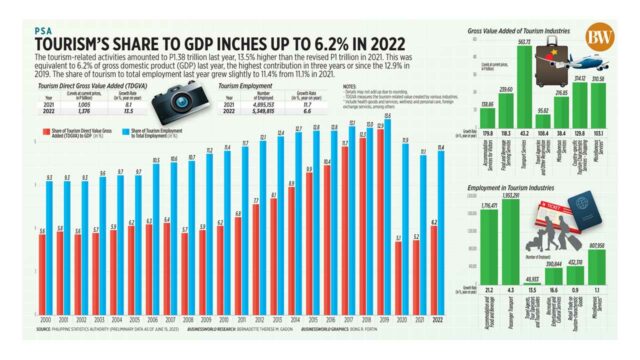
PSA: Tourism’s share to GDP inches up to 6.2% in 2022

THE TOURISM INDUSTRY’S contribution to Philippine economic output rose in 2022, driven by the continued easing of travel restrictions, data released on Thursday showed. Read the full story.

PSA: Tourism’s share to GDP inches up to 6.2% in 2022

PLDT, Smart partner with DA, TikTok for agro-enterprises

PHOTO FROM JGSUMMIT.COM.PH

PLDT Inc. and its wireless unit Smart Communications, Inc., in partnership with the Department of Agriculture’s Agricultural Training Institute (DA-ATI) and TikTok Philippines, have launched a bazaar program to boost the online presence of agro-enterprises.

In a statement on Thursday, PLDT said the Buy Local Bazaar aims to strengthen the online presence of more than 50 agro-enterprises and expand their market reach on the TikTok platform.

TikTok has a shopping feature that allows sellers and brands to sell products directly via its LIVE videos.

The bazaar is under the companies’ eBizNovation program, which is a digital skilling-to-e-commerce program for micro, small and medium enterprises, and cooperatives to help them grow their market reach and eventually generate more sales.

“PLDT and Smart firmly believe in the role of technology in extending livelihood opportunities that can help increase profits over time,” said PLDT and Smart Head of Stakeholder Management Team Stephanie V. Orlino.

PLDT and Smart have had a partnership since 2019 with DA-ATI through the Digital Farmers Program where they provide digital literacy training to farmers, fisherfolk, and agro-enterprises.

“DA-ATI acknowledges the crucial role of digital technologies in helping our country’s primary producers become more globally competitive, productive, and resource-efficient. We continuously find ways to provide our local farmers and fisherfolk with opportunities for development, such as financial and technical support, among others,” said DA-ATI Director Remelyn R. Recoter.

Ms. Recoter said the deals with private companies have enabled the agency to advance its mission to “build more economies of scale and solidify the sector’s path to overall industrialization and modernization.”

“Since the launch of TikTok Shop in the Philippines a year ago, our community of merchants and creators has continued to grow,” said TikTok Philippines Head of Policy Kristoffer Eduard M. Rada.

“The Buy Local Bazaar program with the support of PLDT, Smart, and DA-ATI is among the many avenues we provide to empower enterprising Filipinos with the means to engage with the larger community on TikTok, grow their social presence, and build authentic connections with their consumers,” he added.

Hastings Holdings, Inc., a unit of PLDT Beneficial Trust Fund subsidiary MediaQuest Holdings, Inc., has a stake in BusinessWorld through the Philippine Star Group, which it controls. — Sheldeen Joy Talavera