Home Blog Page 4485

Share of working children rises to 4.7% in 2022

PHILSTAR FILE PHOTO

THE share of children doing work rose to 4.7% of the child population in 2022, up from 4.3% a year earlier, the Philippine Statistics Authority (PSA) estimated.

The 2022 percentage is equivalent to 1.48 million, or five of every 100 children. The year-earlier percentage was equivalent to 1.37 million.

The PSA defines children as those who are between five and 17 years old. They are considered to be working if they are engaged in a family business, or any job, regardless of pay, for at least one hour per week.

The services sector accounted for 49.5% of working children, up from 45.4% in 2021. The 43.2% share of agriculture declined from 45.7% in 2021. Industry accounted for 7.3%, down from 9% previously.

In 2022, 75.6% of working children logged 20 hours or less each week, up from 55.9% a year earlier.

Child work was most prevalent in the Soccsksargen region, where the working population was 12.3% of all children in 2022. This was followed by Northern Mindanao at 8.6% and the Bangsamoro autonomous region at 7.3%.

A separate category is child labor, which the PSA defines as those engaged in hazardous work or work exceeding 40 hours that subjects the child to “any form of exploitation” and harm to their safety and health. 

The PSA estimated that child laborers numbered 828,000 in 2022, or 56% of all working children, down from 935,000 in 2021.

Of the estimated 828,000 working children engaged in child labor in 2022, 548,000 or 66.2% were boys while 280,000 or 33.8% were girls.

The industry most likely to employ child labor was agriculture, which accounted for 68.8% of all child laborers, up from 61.9% in 2021. Services had a child labor share of 25.9% and industry 5.3%.

Soccsksargen had the highest share of child labor of all the regions with 12.5%. This was followed by the Central Visayas (10.5%) and the Bangsamoro (10.4%). — Lourdes O. Pilar

House panel approves tax provisions of Bulacan airport economic zone bill

SAN MIGUEL CORP.

A HOUSE committee has approved the tax and revenue provisions of a bill proposing to create the Bulacan Airport City Special Economic Zone.

“The new airport will primarily address the long-term population and economic growth of Metro Manila and Luzon provinces, given the limited expansion of the Ninoy Aquino International Airport,” House economic affairs committee chairman and Negros Occidental Rep. Gerardo P. Valmayor, Jr. said.

“The Bulacan area is the only area adjacent to the NCR (National Capital Region) where urban build-up is sparse,” House ways and means chairman and Albay Rep. Jose Ma. Clemente S. Salceda added.

He said establishing an economic zone at Bulacan Airport City will link the ecozones of Manila and Clark.

President Ferdinand R. Marcos, Jr. vetoed the measure in July 2022 as it may “pose substantial fiscal risks” and be in “conflict with other agencies’ mandates and authorities,” he said in the first veto message of his term.

Mr. Salceda said House Bill No. 2228 includes specific limits on the territorial coverage of the ecozone; a “defined relationship” between government agencies and the ecozone; and a fiscal incentives framework following the Tax Code.

The measure also includes cost-sharing for the zone’s defense and security costs; governance mechanisms in accordance with other ecozone laws; limits on the rule-making functions of the zone’s managers; and audit procedures.

Under the measure, “registered enterprises operating within the Bulacan Ecozone may apply for pertinent fiscal incentives under Title XIII of the National Internal Revenue Code of 1997.”

Special corporate income tax or corporate income tax will be collected from enterprises operating in the ecozone, with 40% to be remitted to the National Government (NG), 40% to the local government, and 20% allocated for infrastructure development projects within the ecozone.

The Bulacan Airport City special economic zone will be overseen by the Office of the President.

The approved provisions will be relayed to the main committees processing the bill, the economic affairs and trade and industry panels. — Beatriz Marie D. Cruz

Four rail projects granted P600 million in feasibility study funding

JOHANNES PLENIO-UNSPLASH

TRANSPORTATION Secretary Jaime J. Bautista said on Tuesday that P600 million in funding has been obtained for feasibility studies on four railway projects.

“The budget for the feasibility studies came from the Public-Private Partnership Center of the Philippines and Official Development Assistance (ODA). Some came from our existing budget,” Mr. Bautista said on the sidelines of a Post-SONA (State of the Nation Address) briefing at the Hilton Hotel.

The four projects, with a combined 1,024 kilometers of track, are the Philippine National Railway (PNR) North Long Haul line, the Panay Railway, the North Mindanao Railway, and the San Mateo Railway.

According to Mr. Bautista, procurement is now ongoing for consultants that will prepare the feasibility studies.

Mr. Bautista said preparing the studies “will take more than a year. It is not easy to do feasibility studies.”

AIRPORT PROJECTS
Meanwhile, Mr. Bautista said that the Department of Transportation (DoTr) and its agencies are seeking to start soon on rehabilitating the country’s main gateway for air travel.

“One major project that the DoTr will implement this year is the modernization and the upgrading of the Manila International Airport (MIA),” Mr. Bautista said.

“This will result in an increased capacity of the MIA, considering that this airport is already congested with only a capacity of 32 million passengers per year but is now handling more than 40 million,” he said.

Mr. Bautista said that the airport is currently handling around 140,000 passengers a day, higher than the 115,000 passengers it served a year earlier.

“Part of the terms of reference is the (project proponent’s) upfront payment. We are still finalizing the amount but the initial amount that we are looking at is P30 billion,” Mr. Bautista said.

Mr. Bautista also said that the DoTr is looking at making progress with other airports, including the New Manila International Airport, which will be built in Bulakan, Bulacan.

“The MIA is currently handling around 50 million passengers. In the next few years, the passengers here in the Philippines could reach 70 million to 100 million and the MIA cannot handle more passengers. That is why we need more airports,” he said.

Mr. Bautista said San Miguel Corp. is making substantial progress on the four-runway airport in Bulacan.

“The land development (there) is almost 70-75% complete and we hope that by next year they can start to construct the runway or passenger terminal building,” he said.

“This concession agreement was approved by the previous administration. Although still at the land development stages, we hope that before the end of President Ferdinand R. Marcos, Jr.’s administration there will be partial operations,” he added. — Justine Irish D. Tabile

Marcos mum on issues such as debt, human rights and graft, analysts say

PRESIDENT FERDINAND R. MARCOS, JR. — PHILIPPINE STAR/KRIZ JOHN ROSALES

By Kyle Aristophere T. Atienza, Reporter

PHILIPPINE President Ferdinand R. Marcos, Jr. failed to offer a plan to boost key industries and largely ignored the country’s ballooning debt in his second address to Congress, economists and political analysts said on Tuesday.

He was mum on human rights and transparency, programs for the Bangsamoro region in southern Philippines, and on military modernization amid rising tensions with China, they added.

“He tends to focus more on commending government agencies rather than highlighting what needs to be improved in the government,” Arjan P. Aguirre, who teaches political science at the Ateneo de Manila University, said in a Facebook Messenger chat.

Presidential Communications Office chief Cheloy Velicaria-Garafil did not immediately reply to a Viber message seeking comment.

Mr. Marcos Jr. started his second state of the nation address (SONA) with figures showing easing inflation and touted the country’s 7.6% economic growth last year.

“We are transforming the economy,” he said. “We are stabilizing the prices of all critical commodities.”

“The speech flooded the audience with so much data but said nothing about the context of those numbers,” former Bayan Muna Rep. Teddy Casino tweeted. “Sure, we had the highest gross domestic product growth in 46 years, but he failed to mention that this was after the worst drop in the economy since World War II.”

Action for Economic Reforms earlier said supply-side bottlenecks, which Mr. Marcos had allegedly failed to solve during his first year in office, continue to jack up prices.

Emy Ruth Gianan, who teaches economics at the Polytechnic University of the Philippines, lamented the President’s failure to tackle the country’s debt, which she said is a major concern for ordinary Filipinos and investors.

“He did not discuss public debt,” she said in a Facebook Messenger chat. “He only covered resource generation, particularly tax and customs collection, saying these increased last year. The reasons behind the increase should have been clarified because we’re coming from a year of slow collection.”

In his speech, Mr. Marcos focused on agriculture, which he said is a state priority. He trumpeted his accomplishments for the sector, including the construction of farm-to-market roads and Kadiwa centers that brought prices down and benefited 1.8 million families.

Mr. Marcos offered little assessment of his programs’ impact on farmer productivity and efficiency, Raul Montemayor, national manager of the Federation of Free Farmers, said in a Viber message.

“Of the priority legislative measures, he mentioned only amendments to the Anti-Smuggling Act, the Cooperative Code and the Fisheries Code. There was no mention of the Land Use Act, which he advocated in his first SONA,” he said.

Mr. Marcos also failed to mention a proposal to reinstate the pre-shipment inspection system for imports, “which is a more effective deterrent to smuggling than running after the smugglers.”

Ms. Gianan said the President should have touched on the manufacturing sector. “There weren’t specific discussions on which areas of manufacturing were revived and vital to increasing overall production.”

Philippine manufacturing growth cooled in June, with output expanding to its slowest in 11 months, according to S&P Global.

“The President covered all critical areas of economic and political governance, but he did not touch on the more critical issues of graft and corruption in government,” former central bank Deputy Governor Diwa C. Guinigundo said in a Viber message.

He cited a recent Pulse Asia Research, Inc. poll that showed fighting corruption was the fifth most urgent national concern of Filipinos, after inflation, low wages, joblessness and poverty.

Mr. Marcos should have discussed his plans to strengthen democratic institutions, Mr. Aguirre said.

He said the President’s silence on good governance “speaks volumes about the lack of sense of urgency about the deteriorating quality of our democratic institutions.”

HUMAN RIGHTS
“He should have mentioned something about how to improve our elections, promote party development, open the government through digitalization and decriminalize libel.”

While the President did talk about the devolution of National Government roles, the Bangsamoro Autonomous Region in Muslim Mindanao, peace and order and the rule of law, “there were no substantive discussions about concrete plans,” Maria Ela L. Atienza, who teaches political science at the University of the Philippines, said in a Viber message.

She said the President also avoided discussing the country’s human rights situation and how he plans to work with various sectors including the opposition. He also did not say anything about the state of press freedom in the Philippines, she added.

“He avoided dwelling so much on foreign policy except in the area of getting investments and favorable agreements as a result of his foreign trips,” Ms. Atienza said. “He avoided the International Criminal Court issue and the West Philippine Sea.”

“The President was mum on the recent incursions by the Chinese Coast Guard in the West Philippine Sea,” Chester B. Cabalza, founder of Manila-based International Development and Security Cooperation, said via Messenger chat.

The SONA was also a missed opportunity to push the passage of the Philippine Maritime Zones bill, which would help in upholding Philippine territorial integrity, UP political science professor Herman Joseph S. Kraft said in a Viber message.

In his speech, Mr. Marcos asked Congress to support his priority measures, including the excise tax on single-use plastics, value-added tax on digital services, rationalization of the mining fiscal regime and a motor vehicle user’s charge, and reforms in military and police pensions.

Meanwhile, Senator Sherwin T. Gatchalian said he fully supports the President’s initiative to come up with a strategy to combat inflation. “The President wants to strengthen the agriculture sector by ending agriculture smuggling and price manipulation,” he said in a statement.

“As a legislator, I am fully committed to supporting legislation that paves the way for policies supporting the farm sector’s sustained growth,” he added.

Also on Tuesday, the Trade department said it would seek more foreign direct investments.

“We will build up the [investment] pipeline over time,” Trade Secretary Alfredo E. Pascual told SMNI Channel. “Once the investments accumulate, more will be implemented. Foreign investments are important because they bring not only capital but also technology and market.”

Ebb Hinchliffe, American Chamber of Commerce of the Philippines, Inc. executive director, welcomed Mr. Marcos’ plans to improve the business environment.

“We are encouraged that the President highlighted the need to ensure that an enabling business environment is in place to attract investments,” he said in a Viber message. “We share his administration’s goal of securing the Philippines’ reputation as an attractive and reliable investment destination.”

The Management Association of the Philippines (MAP) is drafting a memo with the Anti-Red Tape Authority and Interior and Local Government department to address ease of doing business concerns in the country, MAP President Benedicta Du-Baladad told a news briefing.

“MAP has always been open to collaboration with the government when it comes to aspects such as transparency, good governance, etc.” — with Revin Mikhael D. Ochave and Jan Jiminel Cacdac


Egay develops into a super typhoon; Luzon storm signals raised

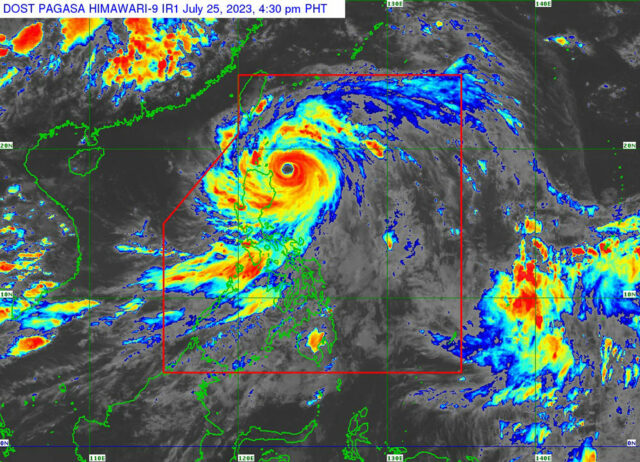
TROPICAL CYCLONE Egay (international name: Doksuri) turned into a super typhoon on Tuesday morning, the Philippine’ weather bureau said, raising more areas under storm signals in parts of the main island of Luzon.

In a 2 p.m. bulletin, the Philippine Atmospheric, Geophysical and Astronomical Services Administration (PAGASA) said Egay was last spotted at 230 kilometers east of Tuguegarao City in Cagayan province.

It was moving northwestward at a speed of 10 kilometers per hour (kph) with maximum sustained winds of 185 kph and gustiness of up to 230 kph.

Due to severe impacts from typhoon-force winds, PAGASA hoisted Tropical Cyclone Wind Signals in some parts of Luzon.

Signal No. 5, the highest wind signal, was raised over the eastern portion of Babuyan Islands. PAGASA said strong winds could threaten lives and property.

Signal No. 4 was up in the northeastern portion of mainland Cagayan and the rest of Babuyan Islands.

Signal No. 3 was raised in the northeastern portion of Isabela, the rest of Cagayan, Apayao, the eastern portion of Ilocos Norte and the northeastern portion of Kalinga and Batanes.

The rest of Isabela, the northern and central portions of Aurora, Quirino, the rest of Kalinga, the northeastern portion of Nueva Vizcaya, the rest of Ilocos Norte, Ilocos Sur, Abra, Mountain Province, Ifugao, the northeastern part of Benguet and the northeastern portion of La Union were under Signal No. 2.

Signal No. 1 was placed in Quezon including Polillo Islands, the rest of Aurora, the rest of Nueva Vizcaya, the rest of Benguet, the rest of La Union, Nueva Ecija, Pangasinan, Tarlac, Zambales, Bulacan, Pampanga, Bataan, Marinduque, Cavite, Metro Manila, Rizal, Laguna, Batangas, Camarines Norte, Camarines Sur, Albay and Catanduanes.

“The wind signals warn the public of the general wind threat over an area due to the tropical cyclone,” PAGASA said. “Local winds may be slightly stronger/enhanced in coastal and upland/mountainous areas exposed to winds. Winds are less strong in areas sheltered from the prevailing wind direction.”

“Egay is nearing its peak intensity,” the weather bureau said. “A short window of high favorable environment in the near term will allow it to either maintain its intensity in the next 12 hours or slightly intensify.”

Based on its track forecast, a slight northward or southward shift could result in a landfall or close approach over northern mainland Cagayan or Batanes, PAGASA said.

The super typhoon is expected to leave the Philippine area of responsibility on Thursday morning and cross the Taiwan Strait and make landfall near Fujian, China on Friday morning. — Sheldeen Joy Talavera

Marcos eyes Islamic banking, Halal food ties in Malaysian trip

FREEPIK

PHILIPPINE President Ferdinand R. Marcos, Jr. on Tuesday afternoon departed for his three-day visit to Malaysia, vowing to boost ties in agriculture, Islamic banking and the Halal industry.

“My visit will focus on the renewed partnership in the fields of agriculture, food security, digital economy, tourism, people-to-people exchanges as well as explore new avenues for cooperation particularly in areas of the Halal industry and Islamic banking,” he said in a pre-departure speech.

Mr. Marcos Jr. said the Halal industry is expected to become a trillion-dollar industry in the international market as global demand continues to expand.

“Malaysia is one of the global leaders in this sector and this visit aims to forge synergies with Malaysia for the Philippines to enjoy a share of this market,” he said.

Mr. Marcos was set to meet with Malaysian Prime Minister Dato’ Seri (Anwar) Ibrahim and Malaysian King Al-Sultan Abdullah Sultan Ahmad Shah.

He is also expected to meet with Malaysian business leaders “to showcase trade and investment opportunities (in the Philippines).”

“I hope that through the investment forum, roundtable discussions and business meetings organized by the Department of Trade and Industry, we will build new bridges between our economies and create in-roads to new ventures that will see our bilateral trade volumes and investments increase,” he added. — Kyle Aristophere T. Atienza

Marcos accepts resignation of 18 police officers

PHILIPPINE STAR/ MIGUEL DE GUZMAN

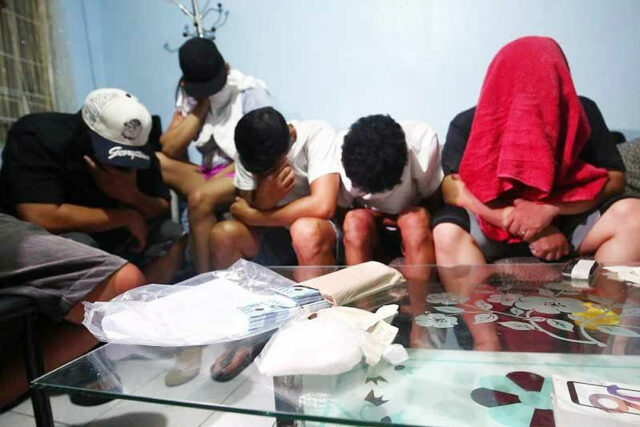
PRESIDENT Ferdinand R. Marcos, Jr. on Tuesday accepted the resignation of 18 third-level officers of the Philippine National Police (PNP) linked to illegal drug activities, according to the presidential palace.

“In a letter to the President, PNP Chief Benjamin Acorda, Jr. informed the former that the Ad Hoc Advisory Group conducted a thorough investigation into the alleged involvement of 953 third-level officers in illegal drugs activities,” it said in a statement.

The 18 officers submitted their courtesy resignation pending investigation, it added. “The above officials are continuously being monitored,” the palace said, citing Mr. Acorda Jr.

In his second state of the nation address to Congress on Monday, Mr. Marcos Jr. said he would accept the resignation of unscrupulous cops involved in illegal drugs.

Interior and Local Government Secretary Benjamin C. Abalos, Jr. in January urged all police colonels and generals to resign after a probe found many of them were involved in illegal drugs.

Human rights abuses continued in the first six months of Mr. Marcos’ rule, Human Rights Watch said on Jan. 12.

In a global report, the global watchdog said drug war killings, communist tagging and attacks against journalists continue to damage the country’s democratic institutions.

Political analysts have said the Marcos government should enforce the law and prosecute top generals with illegal drug ties instead of asking them to quit. — KATA

School supply price guide out  

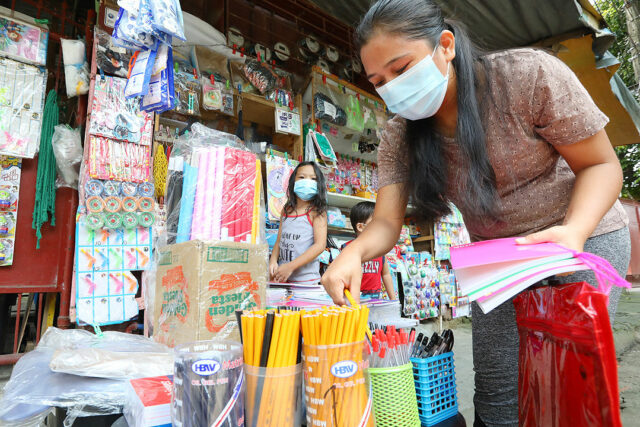
A woman shops for school supplies in San Mateo, Rizal. — PHILIPPINE STAR/ WALTER BOLLOZOS

THE DEPARTMENT of Trade and Industry (DTI) on Tuesday issued a price guide for school supplies ahead of the school year. 

In a statement, the agency said the price guide covers specific brands of notebooks, pad paper, pencils, ballpoint pens, crayons, erasers, sharpeners, and rulers. 

As of July, prices of notebooks range from P23 to P52, while Grades 1-4 pad paper costs P21 to P28 and intermediate pad paper retails for P31 to P48.75. 

Pencils cost P11 to P17, while ballpen prices range from P9.75 to P19, DTI said. Depending on the brand, consumers may buy a box of crayons with eight colors for as low as P12 to as high as P34. A 12-color pack costs P32, while the price of a 16-color pack varies from P24 to P69. — Revin Mikhael D. Ochave

Binga Dam releases water 

BAGUIO CITY — Binga Dam in Itogon, Benguet released water at 2 p.m. on Tuesday, the National Power Corp. Binga Dam office said. 

Gate No. 4 was opened after the dam’s reservoir reached 569.12 meters of water level, near its 575m level. 

The water level at the dam is expected to continue rising as Super Typhoon Egay brings moderate to heavy rains in Benguet. 

Authorities advised residents, particularly the villages of Dalupirip and Tingdan in Itogon town, to exercise extreme caution with the opening of gate No. 4 of the dam. 

Northern portions of Benguet have been battered by heavy rains since Tuesday morning. — Artemio A. Dumlao

Activist harassment scored 

CONGRESSMEN on Tuesday filed a resolution calling for an investigation of alleged state harassment of human rights defenders in the Southern Tagalog region. 

“The use of the Anti-Terror law against human rights defenders who were involved in humanitarian and fact-finding missions sets a dangerous precedent for all human rights workers in the Philippines,” the party-list representatives said in House Resolution 1129. 

It said Anakbayan Southern Tagalog coordinator Kenneth Rementilla and Jasmin Yvette Rubia, secretary-general of Mothers and Children for the Protection of Human Rights, were issued summonses on June 26 for allegedly violating the Anti-Terror Law. 

“[The President] said in his state of the nation address that the rule of law is strong in the country, but this proves that there is no rule of law in the country,” Party-list Rep. Raoul Danniel A. Manuel, one of the authors of the resolution, said in a statement. — Beatriz Marie D. Cruz 

Davao coop blamed for death 

THE SUPREME COURT has affirmed an appellate court ruling that found Davao del Norte Electric Cooperative guilty of negligence for installing low-hanging electrical wires that led to the death of a motorcycle rider. 

In an 18-page decision dated June 14 and made public on July 21, the tribunal said the electric cooperative was to blame after rider Victorino C. Lucas got entangled in a high-tension power cable in 2001.
“The court arrives at the ineluctable conclusion that the petitioner, as a public utility and provider of electrical services, indeed failed to exercise due diligence in…  including the implementation of all known and possible safety and precautionary measures in order to protect the residents nearby from vehicular and other forms of accidents,” Associate Justice Henri Jean Paul B. Inting said in the ruling. 

The High Court imposed a 6% interest on the appellate court’s P684,802 award to the victim’s heirs. — John Victor D. Ordoñez

Contempt dismissal sought 

KARAPATAN Secretary-General Cristina E. Palabay on Monday asked a Muntinlupa court to dismiss contempt charges against her after she denounced former Senator Leila M. de Lima’s six-year imprisonment.  

In an 11 page-motion, she said there was nothing contemptuous in what she said, adding that she was just exercising the right to free speech.  

“There is no clear and present danger to the administration of justice that would constitute the alleged act as contemptuous,” she said.  

A Muntinlupa court cleared Ms. De Lima, one of ex-President Rodrigo R. Duterte’s staunchest critics, of drug trafficking charges for reasonable doubt. The main witness, former Bureau of Corrections chief Rafael Z. Ragos, took back his testimony against her. 

The former lawmaker, who was arrested in 2017 and accused of taking drug money months after leading a Senate investigation into Mr. Duterte’s war on drugs, originally faced three charges and was also cleared in another case in 2021.  

In a statement, Karapatan said the contempt charges showed the continuing harassment of human rights defenders through trumped-up charges. — John Victor D. Ordonez