Home Blog Page 3764

PhilPaSS Plus transactions climb to P129 trillion in Q3

TRANSACTIONS done through the Philippine Payment and Settlement System (PhilPaSS) Plus reached P129 trillion in the third quarter of 2023 amid the increase in settlements between financial institutions.

This was 0.5% higher than the P128.32 trillion in the same quarter in 2022, the Bangko Sentral ng Pilipinas (BSP) said in its report on economic and financial developments in the third quarter of 2023.

PhilPaSS Plus is a real-time gross settlement system that processes and settles high-value transactions between banks through the demand deposit accounts of the lenders maintained with the BSP. The growing number of settlements by financial institutions prompted the BSP to upgrade the PhilPaSS system to PhilPaSS Plus on July 26, 2020.

Meanwhile, the total volume of transactions settled and processed by PhilPaSS Plus climbed 3.22% to 374,986 in the third quarter from the 363,277 seen a year prior.

This, as transactions made through financial market infrastructures (FMIs) and clearing switch operators (CSOs) grew by 10.1% year on year, and transactions between financial institutions (FIs) rose 8.4% annually.

“The increase in FMI and CSO transactions was due mainly to the growth in Delivery vs Payment (DvP)/National Registry of Scripless Securities (NROSS) and automated clearing houses (ACHs) transactions, which expanded year on year by 41% and 8.3%, respectively,” the BSP said.

The central bank said the growth in DvP/NROSS transactions came amid increased transactions in the government securities market as players preferred safer assets due to uncertainties in domestic and external markets.

“Moreover, the increase in ACHs transactions (i.e., transactions done via PESONet and InstaPay) can be attributed to the BSP’s continued efforts in digitalizing retail payments through the launching of Paleng-QR Ph Plus,” it said.

The growth in PESONet and InstaPay transactions can also be attributed to the waiver of transfer fee charges by some banks for transfers of P1,000 and below during the quarter, the BSP said.

“During the third quarter, payments among individuals, corporates, and government accounted for 38.6% of the volume of transactions at the PhilPaSS Plus, followed by transactions made through FMIs and CSOs at 33.8%, and transfers among FIs at 16.3%. The remaining 11.3% came from transactions with BSP units, government collections and payments, and intra-account transfers,” the central bank added.

“In terms of value, transactions with BSP units (68.4%), FMIs and CSOs (18.3%), and payments among individuals, corporations, and government (6.2%) made up about 92.8% of the total value of transactions,” it said.

Meanwhile, the volume of retail transactions — or customer payments to government, businesses, and individuals — stood at 184,240 in the third quarter, down by 0.5% year on year.

On the other hand, transactions via ACHs grew by 8.3% annually.

“The year-on-year growth in ACHs transactions may be attributed to the BSP’s initiatives in promoting digital retail payments across the country, which include among others Paleng-QR, Bills Pay PH, and QR Ph,” the central bank said.

“While there was lesser volume of retail transactions recorded in third quarter of 2023, the total value of transactions in these categories increased to P13.3 trillion, higher by 4.8% year on year,” it added. — K.B. Ta-asan


House of Investments unit buys Tarlac property for P2.7B

A UNIT of Yuchengco-led House of Investments (HI) has bought a 184-hectare property in Tarlac province in northern Philippines as part of efforts to improve its property portfolio and diversify revenue sources.   

In a regulatory filing on Wednesday, the company said Tarlac Terra Ventures, Inc., on Dec. 29 bought land from Rizal Commercial Banking Corp. (RCBC) for P2.7 billion. The lot is at the Central Techno Park in Luisita Industrial Park.

House of Investments said the property was bought through a deed of conditional sale. It added that Tarlac Terra Ventures has three years to pay for the lot.

The listed firm said the transaction allows Tarlac Terra Ventures to “own an asset that appreciates over time.”

“The property is located in a prime area in Tarlac that has potential for value appreciation,” it said. “The prospect of the property for future development is viewed to provide future revenues for HI.”

House of Investments’ core businesses are in car dealership, construction, education, and property management services. It also has portfolio investments in pharmaceuticals, energy, and death care.   

House of Investments shares rose by 7.03% or 23 centavos to close at P3.50 each. — Revin Mikhael D. Ochave

Not yet scrapped

FREEPIK

FOOD WASTAGE has become an environmental issue. The numbers are staggering. About one-third of food production for human consumption is scrapped. In 2022, this amounted to a worldwide waste of 1.3 billion tons of uneaten food worth $1 trillion. Compare this to Philippines’ 2022 GDP of $404 billion. The waste is even more staggering in the face of hunger in the world.

We’re not sure though how leftovers are calculated. Is the “trashed” food from a fast-food chain counted as waste, even when some collector picks it up to be eaten, or even resold?

What about “reconstituted” leftovers that are not really scrapped? The mantra of conservationists to “reuse, reduce, recycle” should also apply to food, not just toothbrushes. As a post-holiday reflection on food waste (as well as expanded waistlines), we should be mindful of our cultural definition of leftovers.

Local cuisine is hospitable to rescuing uneaten portions for further delight. Is this a function of economic status where the idea of wasted food seems obscene? Or maybe it’s just culinary creativity.

Certain recipes specify leftovers as main ingredients like the lechon paksiw (roast pig scraps stewed in vinegar). For this dish, only a leftover version exists as one cannot go straight to the saucy concoction without going through the roasted stage first. Even the inferior lechon with a chewy and tough skin achieves redemption in its recycled state. And this even has two versions using plain vinegar or the former sauce for marination.

Holiday leftovers, which by today can more properly be described as “remains,” challenge the homemaker. What does she do with all leftovers from guests who did not show up, perishable gifts, and assorted meals from Christmas Past (a culinary version of Uncle Scrooge’s ghosts)?

While clothes can be consigned to garage sales or businesses specializing in “previously owned” attire, perishable stuff like food can only be given away before their “best before” date. Aside from the usual second versions of a particular viand, here are some tips from someone who prefers to be considered an authority on behavioral economics rather than housekeeping mentorship.

Put leftovers in different containers with expiry dates. This categorizes the leftovers by their shelf life, the last day of which is defined as when the meat starts to host a colony of microbes and give off a distinct smell. Clearly, the longer lasting leftovers (like ham and cheese) can be consumed later, maybe at Easter.

Give it away. Forwarding food like text messages and fake news that one has received is considered recycling. Leftovers do not fall in this category, and the farther away from freshness and the Version 1 state, the more difficult it is to give away food. Especially to one who knows your home address. The key factor in this donation is edibility. The older food is in terms of carbon dating, the more embarrassing it is for the donor to unload it to anyone. (Yes, even garbage collectors have their standards.)

The tale of the wandering fruitcake is instructive. Because of the alcoholic content, this gift is often recycled (pay it forward) more than once and beyond one calendar year. There must be a “fruit cake” day declared where one is obliged to keep and eat the already moldy remains and declare it at the end of its earthly journey.

Leftovers are not limited to food.

If consumption rises at an unusually high rate during the holiday season, clearly a lot of it goes beyond normal use. How many of those umbrellas, stationery, and candy trays can be used by the gift recipient? He must give them away too. The desk diary is a special case. It seems to have dropped o- the corporate giveaway list. One must buy it at a bookstore since phones seem to have replaced the appointment book that records passwords, phone numbers, birthdays, and lunch dates.

Cash as a received gift is an exception. There is no leftover or recycling challenge involved, only ethical problems depending on the source. And is there really a problem of expiry dates and getting too much of it? (Where’s the nearest laundry?)

Still, the best leftovers deal with the immaterial. Warm memories of reunions and friendships are never scrapped. Photos of holiday celebrations are posted and reposted. And they never age… until compared to previous years’ posts.


Tony Samson is chairman and CEO of TOUCH xda

ar.samson@yahoo.com

Transforming PHL banking through data democratization

TRUSTPAIR.COM

DATA democratization is like providing all team members in a basketball game with the same coach’s playbook. Limiting access to only select players hinders the team’s ability to execute cohesive plays and make effective decisions on the field. However, when the entire team has access to the playbook, they can understand the game plan, anticipate moves, and work together seamlessly to score more points and win the game. In banking, democratizing data empowers every employee to have a deep understanding of the business strategies and trends, leading to better collaboration and improved outcomes for the organization as a whole.

THE ROLE OF DATA IN THE PHILIPPINE BANKING SYSTEM
Today, financial institutions must possess the capability to amass, comprehend, and exploit data effectively to secure a competitive edge and achieve success. The same holds for local banks where, as Mc-Kinsey highlights, the combined value generated by the three major fintech and digital banks in the Philippines surpassed that of all traditional banks in the country over the past two years.

For the latter to thrive, they must acquire, comprehend, and capitalize on data swiftly. According to a report by IDC, organizations with a high degree of data intelligence experience a 40% financial improvement, and a 20% enhancement to operations compared with those grappling with a lower level of data intelligence.

Nevertheless, analyzing and acting upon organizational data has usually been confined to specific groups of employees within businesses for an extended period. This, in turn, has impeded decision-making and even led to decisions being made without robust data to substantiate them, placing organizations at a disadvantage.

REALIZING THE FULL POTENTIAL OF DATA
Want to know why democratizing data enables organizations to pivot towards data-driven practices? It’s because it allows employees of all stripes to access the data they need readily, empowering them to act on insights and with greater efficacy. For instance, this can be leveraged for customized and personalized customer experiences, ultimately leading to heightened levels of customer satisfaction and loyalty.

By embracing data democratization, banks arm their employees with highly available, reliable, and secure data. Not only does this enable processes to be streamlined and bottlenecks to be overcome, it also ensures data can be used to identify and comprehend emerging market and behavioral trends.

DATA DEMOCRATIZATION IN A PREDOMINANTLY HYBRID LANDSCAPE
The era where an organization’s data resided solely in a singular location is long gone. In today’s landscape, both business and technical users must possess the ability to fully harness data that spans diverse infrastructures, including cloud, distributed systems, and mainframes. When assessing data intelligence tools, organizations should prioritize solutions that not only enable data democratization within the business but also seamlessly integrate across diverse IT systems.

This need becomes increasingly critical as a growing number of organizations adopts hybrid solutions to leverage the advantages offered by both the cloud and the mainframe. In a recent survey conducted by Rocket Software, a staggering 93% of respondents strongly felt that their organizations should embrace a hybrid infrastructure model that encompasses both the mainframe and the cloud.

BENEFITS TO USERS ACROSS THE ORGANIZATION
Different roles have different goals. Therefore, data intelligence tools must provide benefits to users across the entire organization and be user-friendly enough for employees with varying backgrounds to leverage. This requires an intuitive interface and clear visualizations.

Tools with intuitive interface and clear visualization allow users to quickly and comprehensively identify critical data, regardless of their level of expertise in data science. It also allows users to create robust plans for change, such as updating data flows and managing cloud migration, ensuring that data management is efficient and effective.

This enables business users to gain a comprehensive view of the organization’s data landscape and understand the trustworthiness of the data. Data teams can focus on delivering exceptional value, IT can plan for IT modernization initiatives more effectively, and lines of business can execute business reporting more efficiently.


Praveen Kumar is the vice-president for Asia Pacific at Rocket Software.

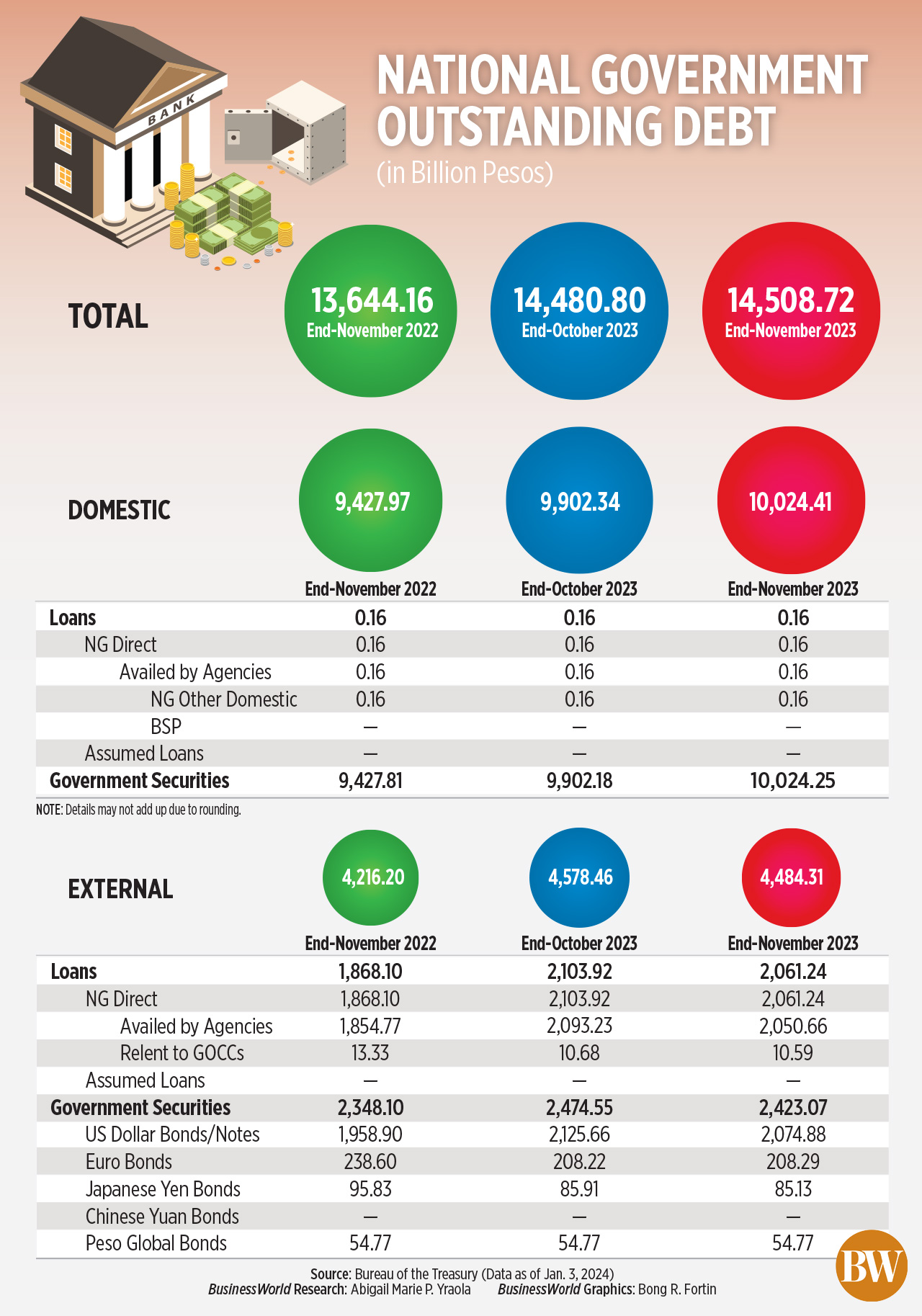
National Government outstanding debt

THE NATIONAL Government’s (NG) total outstanding debt hit a fresh high of P14.51 trillion as of end-November, the Bureau of the Treasury (BTr) said on Wednesday. Read the full story.


National Government outstanding debt

You can’t reverse the ageing process but these 5 things can help you live longer

AT THIS time of year many of us resolve to prioritize our health. So, it is no surprise there’s a roaring trade of products purporting to guarantee you live longer, be healthier and look more youthful.

While an estimated 25% of longevity is determined by our genes, the rest is determined by what we do, day to day.

There are no quick fixes or short cuts to living longer and healthier lives, but the science is clear on the key principles. Here are five things you can do to extend your lifespan and improve your health.

1. Eat a predominantly plant-based diet

What you eat has a huge impact on your health. The evidence overwhelmingly shows eating a diet high in plant-based foods is associated with health and longevity.

If you eat more plant-based foods and less meat, processed foods, sugar, and salt, you reduce your risk of a range of illnesses that shorten our lives, including heart disease and cancer.

Plant-based foods are rich in nutrients, phytochemicals, antioxidants, and fiber. They’re also anti-inflammatory. All of this protects against damage to our cells as we age, which helps prevent disease.

No particular diet is right for everyone but one of the most studied and healthiest is the Mediterranean diet. It’s based on the eating patterns of people who live in countries around the Mediterranean Sea and emphases vegetables, fruits, wholegrains, legumes, nuts and seeds, fish and seafood, and olive oil.

2. Aim for a healthy weight

Another important way you can be healthier is to try and achieve a healthy weight, as obesity increases the risk of a number of health problems that shorten our lives.

Obesity puts strain on all of our body systems and has a whole myriad of physiological effects including causing inflammation and hormonal disturbances. These increase your chances of a number of diseases, including heart disease, stroke, high blood pressure, diabetes and a number of cancers.

In addition to affecting us physically, obesity is also associated with poorer psychological health. It’s linked to depression, low self-esteem, and stress.

One of the biggest challenges we face in the developed world is that we live in an environment that promotes obesity. The ubiquitous marketing and the easy availability of high-calorie foods our bodies are hard-wired to crave mean it’s easy to consume too many calories.

3. Exercise regularly

We all know that exercise is good for us — the most common resolution we make this time of year is to do more exercise and to get fitter. Regular exercise protects against chronic illness, lowers your stress, and improves your mental health.

While one of the ways exercising helps you is by supporting you to control your weight and lowering your body fat levels, the effects are broader and include improving your glucose (blood sugar) use, lowering your blood pressure, reducing inflammation, and improving blood flow and heart function.

While it’s easy to get caught up in all of the hype about different exercise strategies, the evidence suggests that any way you can include physical activity in your day has health benefits. You don’t have to run marathons or go to the gym for hours every day. Build movement into your day in any way that you can and do things that you enjoy.

4. Don’t smoke

If you want to be healthier and live longer then don’t smoke or vape.

Smoking cigarettes affects almost every organ in the body and is associated with both a shorter and lower quality of life. There is no safe level of smoking — every cigarette increases your chances of developing a range of cancers, heart disease, and diabetes.

Even if you have been smoking for years, by giving up smoking at any age you can experience health benefits almost immediately, and you can reverse many of the harmful effects of smoking.

If you’re thinking of switching to vapes as a healthy long-term option, think again. The long-term health effects of vaping are not fully understood and they come with their own health risks.

5. Prioritize social connection

When we talk about living healthier and longer, we tend to focus on what we do to our physical bodies. But one of the most important discoveries over the past decade has been the recognition of the importance of spiritual and psychological health.

People who are lonely and socially isolated have a much higher risk of dying early and are more likely to suffer from heart disease, stroke, dementia, as well as anxiety and depression.

Although we don’t fully understand the mechanisms, it’s likely due to both behavioral and biological factors. While people who are more socially connected are more likely to engage in healthy behaviors, there also seems to be a more direct physiological effect of loneliness on the body.

So if you want to be healthier and live longer, build and maintain your connections to others.

Hassan Vally is an associate professor in Epidemiology at Deakin University.

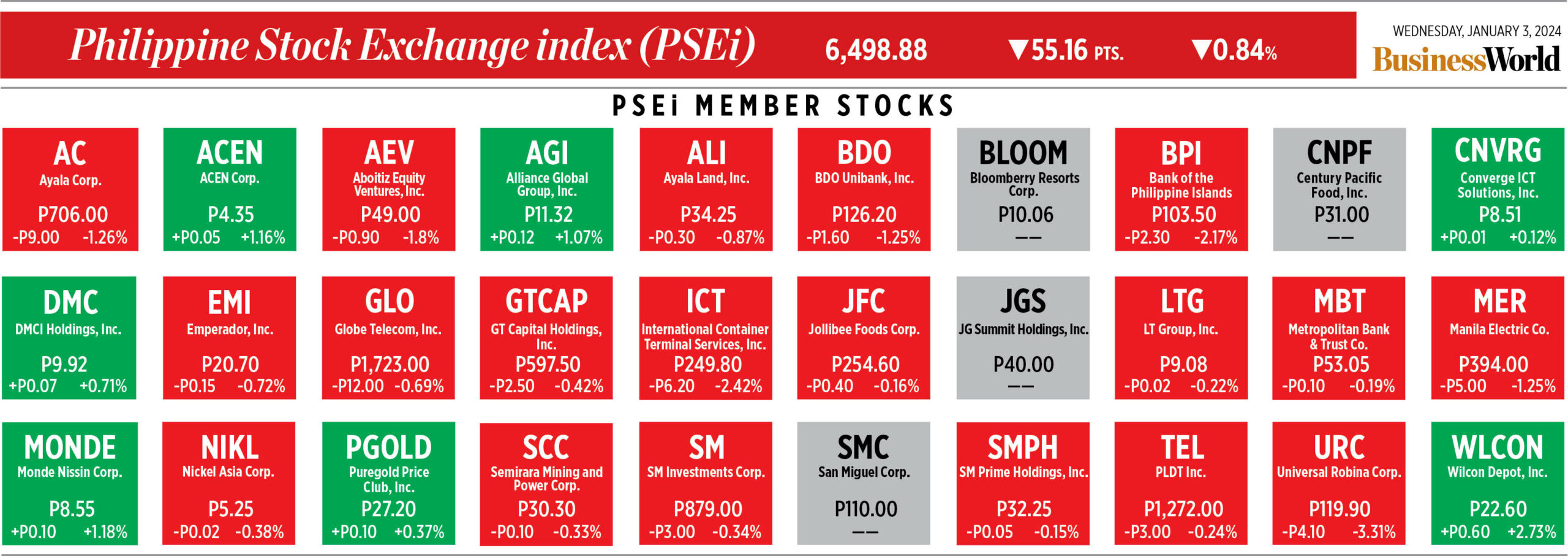
How PSEi member stocks performed — January 3, 2024

Here’s a quick glance at how PSEi stocks fared on Wednesday, January 3, 2024.


Peso rises ahead of Fed minutes

BW FILE PHOTO

THE PESO appreciated against the dollar on Wednesday on dovish expectations from the minutes of the US Federal Reserve’s December meeting to be released overnight.

The local unit closed at P55.57 per dollar on Wednesday, strengthening by 10 centavos from the P55.67 finish on Tuesday, based on Bankers Association of the Philippines data.

The peso opened Wednesday’s session weaker at P55.70 against the dollar. Its intraday best was its close of P55.57, while its worst showing was at P55.815 versus the greenback.

Dollars exchanged rose to $1.88 billion on Wednesday from $1.26 billion on Tuesday.

“The peso appreciated amid dovish expectations prior to the release of Fed minutes overnight,” a trader said in an e-mail.

Fed officials in December predicted 75 basis points (bps) of rate cuts in 2024, driving money market bets for around double that amount of cuts that prompted a cross-market year-end rally, Reuters reported.

Futures markets still see a 70% chance of the Fed starting to lower US borrowing costs from their current 22-year high from March.

The US central bank last month kept the fed funds rate unchanged at 5.25-5.5% for the third straight time after it hiked borrowing costs by a cumulative 525 basis points from March 2022 to July 2023.

The Federal Open Market Committee will hold its first policy meeting for the year on Jan. 25-26.

Dovish Fed bets caused the dollar to drop slightly on Wednesday, Rizal Commercial Banking Corp. Chief Economist Michael L. Ricafort said in a Viber message.

The dollar eased slightly on Wednesday though it stayed near a two-week high, underpinned by a confluence of factors including elevated US Treasury yields and a cautious turn in risk sentiment that weighed on Wall Street, Reuters reported.

Trading was thinned in Asia with Japan out on a holiday, with the greenback paring some of the morning gains over the course of the trading day in the region.

Still, against a basket of currencies, the greenback stood not too far from a two-week top of 102.25 hit on Tuesday, and was last at 102.13.

For Thursday, the trader said the peso could strengthen further as the market expects a slower Philippine inflation print for December. The data will be released on Friday.

The trader sees the peso moving between P55.40 and P55.65 per dollar on Thursday, while Mr. Ricafort expects it to range from P55.50 to P55.70. — AMCS with Reuters

Local stocks decline on PMI data, profit taking

REUTERS

STOCKS dropped on Wednesday amid data showing slower Philippine manufacturing activity growth, profit taking after Tuesday’s rally and amid a trading halt that was lifted before noon.

The Philippine Stock Exchange index (PSEi) declined by 55.16 points or 0.84% to end at 6,498.88 on Wednesday, while the broader all shares index fell by 15.73 points or 0.45% to close at 3,450.24.

Market sentiment soured following the slowdown in the S&P Global Philippines Manufacturing Purchasing Managers’ Index (PMI) in December, Philstocks Financial, Inc. Research Analyst Claire T. Alviar said in a Viber message. 

The S&P Global Philippines Manufacturing PMI stood at 51.5 in December, lower than the nine-month high of 52.7 in November. A PMI reading above 50 denotes better operating conditions than in the preceding month, while a reading below 50 shows a deterioration.

The December figure was the weakest in three months or since the 50.6 reading in September.

“Trading in the market was halted by the exchange in the morning, then it resumed before the market recess and continued in the afternoon,” Ms. Alviar added. 

The PSE halted trading on Wednesday morning. Trading resumed at 11:56 am.

“The Philippine Stock Exchange, Inc. encountered a technical issue that prompted it to halt trading at 9:32 a.m. on Jan. 3, 2024, Wednesday… PSE and its third-party front-end system provider continue to investigate the matter to identify the root cause,” the bourse operator said in a statement.

While the trading break did not necessarily cause Philippine shares to drop, activity was still disrupted, China Bank Capital Corp. Managing Director Juan Paolo E. Colet said.

“A market glitch for more than two hours is a terrible way to greet the new year. If we aim to boost trading volumes in the local stock market, then we need to ensure the reliability of the PSE’s infrastructure,” Mr. Colet said.

Profit taking after Tuesday’s climb caused the PSEi to drop on Wednesday, Rizal Commercial Banking Corp. Chief Economist Michael L. Ricafort said in a Viber message.

All sectoral indices finished lower on Wednesday. Financials declined by 22.90 points or 1.31% to 1,723.71; services went down by 16.67 points or 1.01% to 1,625.77; industrials retreated by 57.13 points or 0.62% to 9,104.49; holding firms dropped by 34.35 points or 0.54% to 6,289.02; mining and oil decreased by 30.64 points or 0.31% to 9,855.29; and property inched down by 6.66 points or 0.23% to 2,828.95. 

Value turnover went down to P3.11 billion on Wednesday with 182.7 million shares changing hands, from P3.66 billion with 379.8 million issues the previous day.

Advancers edged out decliners, 74 against 71, while 49 names ended unchanged.

Net foreign selling stood at P260.5 million on Wednesday versus the P443.11 million in net buying seen the previous session.

Mr. Ricafort put the PSEi’s immediate support at 6,320-6,410. — RMDO

‘Improved planning’ needed after Panay outages — NGCP

JUDGEFLORO

THE National Grid Corp. of the Philippines (NGCP) has called for improved energy resource planning following the outages on Tuesday at multiple power plants on Panay Island.

“The unscheduled maintenance shutdowns of the largest power plants in Panay Island were the primary cause of the power interruption. We emphasize the need for improved planning to ensure sufficient generation per island, with a well-balanced mix of fuels and technology,” NGCP said in a statement on Wednesday.

On Tuesday, the NGCP issued a yellow alert for the Visayas grid after multiple power plants tripped, including units of Panay Energy Development Corp. and Palm Concepcion Power Corp. (PCPC).

Due to the plant outages, some 452 megawatts (MW) were unavailable to the grid.

As of 5 p.m. on Wednesday, about 203 MW of power is being produced on Panay, augmented by 24.6 MW from “sources elsewhere in the Visayas.”

“We reiterate that load restoration will be done conservatively, by matching loads to restored generation, to prevent repeated voltage failure. NGCP is ready to transmit power once it is available,” the grid operator said.

The Visayas grid needs about 300 MW to stabilize and is awaiting a PCPC facility, which has a 135-MW capacity, to synchronize back onto the grid.

In a statement, the Department of Energy (DoE) reminded the NGCP to “adhere to its responsibilities as system operator in ensuring supply security and reliability of the grid.”

“NGCP is in a position to anticipate system disturbance such as what happened yesterday, which unfortunately resulted in the isolation of Panay from the rest of the Visayas grid due to the simultaneous tripping of power plants that caused multiple power interruption affecting other power plants and distribution utilities (DUs),” Energy Undersecretary Rowena Cristina L. Guevara said.

Meanwhile, the Energy Regulatory Commission (ERC) said it requested additional data from the NGCP and the generation companies to assist in its review of the incidents.

“The ERC understands the inconvenience this situation has caused to the consumers of Panay, and we assure the public that every effort is being made to restore power as quickly as possible,” ERC Chairman Monalisa C. Dimalanta said.

Overall, the plant outage has affected a distribution utility and seven electric cooperatives, according to the NGCP.

These are MORE Electric and Power Corp., Guimaras Electric Cooperative, Inc., Iloilo Electric Cooperative, Inc. (ILECO I), ILECO II, ILECO III, Capiz Electric Cooperative, Inc., Antique Electric Cooperative, Inc., Aklan Electric Cooperative, Inc., and Guimaras Electric Cooperative, Inc. — Sheldeen Joy Talavera

Market for AS power enters pilot operations

BW FILE PHOTO

THE pilot stage of the market for reserve power has been launched, with full commercial operations targeted for later in the month, the Independent Electricity Market Operator of the Philippines (IEMOP) said.

In a statement on Wednesday, the IEMOP said pilot operations began on Dec. 26, 2023.

The pilot stage will allow the optimization of the market operator and system operator interfaces and automated real-time dispatch of committed ancillary services (AS). AS contracts are entered into in order to ensure that the grid will have sufficient power should supply be disrupted unexpectedly.

The pilot stage will trial central scheduling and dispatch of contracted ancillary services using enhanced systems of the market operator and system operator, or the National Grid Corp. of the Philippines.

IEMOP operates the Wholesale Electricity Spot Market (WESM), the trading floor for electricity.

With the set integration of the reserve market for AS power into the WESM on Jan. 26, the system operator will be able to procure reserves from the spot market to meet the reserve requirements of the system.

The IEMOP said that the reserve market provides a venue for generators to offer reserve capacities competitively. “These reserve offers are co-optimized with energy offers to determine the best mix of energy and reserve supply that will result in the most competitive prices for electricity.”

“Ultimately, the co-optimization of the scheduling of reserves and energy has the objective of reducing the overall cost of both energy and reserves,” the IEMOP said.

“The operation of the Reserve Market in the Philippine WESM is a testament to our shared commitment to the growth of the Philippine Energy Sector; a growth that ensures reliability, embraces innovation, and promotes competition, all leading to transparency and reasonableness of our power rates,” Energy Regulatory Commission (ERC) Chairperson Monalisa C. Dimalanta said.

Asked to comment, Bienvenido S. Oplas, Jr., president of Minimal Government Thinkers said that the reserve market will expand power supply by encouraging generation companies (gencos) to build more power plants.

“Most of new generation capacity will be contracted by DUs (distribution utilities), RES (retail electricity suppliers) and ECs (electric cooperatives). But some generation capacity will be for reserves by the system operator or embedded with DUs themselves,” Mr. Oplas said in a Viber message.

“The market for new capacity has expanded so more gencos will be encouraged to put up more new power plants,” he added.

In an advisory last week, the Department of Energy said that the WESM Governance Arm has yet to issue a certification on the completeness of the preparations.

The software certification by the independent auditor is still pending while the ERC is still reviewing the simulation results for additional constraints submitted by the IEMOP for the approval of the price determination methodology. 

Meanwhile, the Philippine Electricity Market Corp. (PEMC) said in a statement that it will assess and monitor the co-optimized market once fully operational to ensure the delivery of its commitment and intent of the enhanced WESM design.

“Our commitment to fulfill PEMC’s responsibility to facilitate the readiness certification for the full commercial operations of the co-optimized Energy and Reserve Market have remained steadfast,” PEMC President Elvin Hayes E. Nidea said. — Sheldeen Joy Talavera

Exportable agri commodities focus of new DA dev’t plan

REUTERS

THE Department of Agriculture (DA) said it is seeking to expand agricultural and fisheries exports and has set into motion the drafting of the Philippine Agricultural Export Development Plan (PAEDP).

According to a special order signed by Agriculture Secretary Francisco Tiu Laurel, Jr., the DA will create a national steering committee and technical working group to prepare the plan.

The DA said the national steering committee will set the policy direction that the plan will then flesh out.

It added that a technical working group will help create the mechanisms to facilitate exports and ensure that activities and programs are aligned with the Philippine Export Development Plan (2023-2028).

“Member agencies shall create their respective core group that will (assist in) the creation of the PAEDP and provide technical assistance on matters related to export development,” the DA said.

The DA added that the technical working group will seek to identify priority commodities with the strongest export potential.

The steering committee will be headed by Mr. Laurel with all DA undersecretaries as members, while Assistant Secretary for Policy Research and Development Noel A. Padre will head the technical working group.

Agricultural exports declined 13.3% to $1.61 billion during the third quarter of 2023, accounting for 8.2% of total exports, according to the Philippine Statistics Authority.

Leading exports were edible fruit and nuts as well as peel of citrus fruit melons, valued at $492.09 million or 30.5% of the total.

Among the top five exported commodities were animal and vegetable fats; preparations of vegetables, fruit, nuts or other parts of plants; tobacco and manufactured substitutes; and preparations of meat of fish, crustacean, mollusks and other aquatic invertebrates.

President Ferdinand R. Marcos, Jr. has said that the government is focusing on increasing exports of agricultural products to make the economy more competitive. — Adrian H. Halili