Home Blog Page 267

Nearly 200,000 families in Mindanao affected by shear line

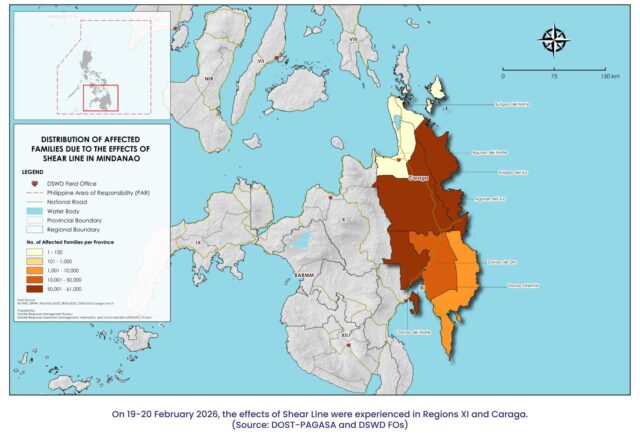
Visualization of the distribution of affected families due to the effects of the shear line.—DOST-PAGASA
Nearly 200,000 families in Mindanao were reported affected by shear line, according to Department of Social Welfare and Development (DSWD) on Monday.

Areas affected include Region XI and Caraga, covering at least 469 villages, or barangays, DSWD said in a 6:00 a.m. progress report.

Of affected families, 2,672 are taking shelter in 74 open evacuation centers, while 22,205 are staying with friends and relatives.

DSWD also reported 27 totally damaged houses and 53 partially damaged houses due to effects of shear line.

Humanitarian assistance of nearly P46 million has been provided to affected families as of report.

Meanwhile, shear line — a zone where cold northeast monsoon winds meet warm easterlies, creating rain clouds — is expected to affect eastern parts of Southern Luzon and Visayas, according to Philippine Atmospheric, Geophysical and Astronomical Services Administration (PAGASA) on Monday.

Cloudy skies with scattered rains are expected in Albay, Sorsogon, Masbate, and Samar, PAGASA said in a 4:00 a.m. advisory.

It also warned of possible flash floods and landslides during moderate to occasionally heavy rains.

The conditions are likewise expected in Palawan and rest of Visayas, while rest of country will be affected by prevailing easterlies and northeast monsoon. — Edg Adrian A. Eva

SM Prime sustains its commitment to future sustainability leaders

SM Prime Holdings, Inc. (SM Prime) continues to advocate sustainability education with its SM Sustainability Scholarship Program in partnership with the University of the Philippines – Los Baños (UPLB).

SM Smart City AVP and Head of Corporate Communications and PR Rida Reyes Castillo (second from right) and Senior PR Manager Kirk Maurice Campos (far left) formally turned over the scholarship assistance to UPLB Vice-Chancellor for Student Affairs Dr. Janette Malata-Silva (center) with Office of Scholarship and Grants Coordinator Ivy Selarde (right).

UPLB Scholars

Now in its third year, the program continues to support scholars taking up sustainability-driven courses, reinforcing SM Prime’s long-term commitment to nurturing sustainability champions for the country.


Spotlight is BusinessWorld’s sponsored section that allows advertisers to amplify their brand and connect with BusinessWorld’s audience by publishing their stories on the BusinessWorld Web site. For more information, send an email to online@bworldonline.com.

Join us on Viber at https://bit.ly/3hv6bLA to get more updates and subscribe to BusinessWorld’s titles and get exclusive content through www.bworld-x.com.

RTOA Davao unveils electric taxis, signals shift toward sustainable transport

LTFRB Region XI Director Nonito “Dondon” Llanos and RTOA Region XI President Ryan Sia lead the ribbon-cutting ceremony, formally marking the launch of EV taxis under the RTOA fleet.
The Regional Taxi Operators Association (RTOA), the largest coalition of local taxi operators in Davao City, has announced a pilot rollout of electric vehicles in its fleet, signaling a strategic shift toward more sustainable urban transport in the region. The initiative was unveiled during a press conference in Davao City, where RTOA presented the initial batch of electric taxi units now cleared to operate as part of its active fleet.
Representing approximately 70% of taxi operators in Davao, RTOA’s initiative reflects a collective effort by local operators to embrace cleaner mobility solutions while ensuring full compliance with existing transport regulations set by the local government and agencies such as the Land Transportation Franchising and Regulatory Board (LTFRB).
“As proud Davaoeños, we stand ready to help lead the shift to sustainable mobility for our kababayans,”  shared RTOA President Ryan Sia. “For decades, we have served Davaoeño commuters, and we welcome every opportunity to raise the standard of service they deserve. Today, we take a meaningful step forward — honoring our responsibility to the public and our duty to the future. We are honored to walk alongside the government in modernizing the local taxi fleet, moving hand in hand with operators and drivers toward a cleaner, safer, and more progressive Davao City.”
RTOA will proactively share operational learnings from the pilot, covering vehicle performance, charging patterns, cost efficiency, and rider feedback, with the local government and transport regulators, including the LTFRB, to help inform a collaborative road map for electric mobility in Davao.
The group noted that regular updates from the pilot can guide practical decisions on charging infrastructure rollout and policy refinements, ensuring that regulations and support systems evolve in step with real-world operating conditions and build a more sustainable environment for EV adoption.
The initiative has the expressed support of the LTFRB, reinforcing RTOA’s position that the adoption of electric vehicles should proceed through established regulatory channels.
“LTFRB acknowledges the importance of the Electric Vehicles Industry Development Act or EVIDA law. It’s very necessary that we have to move forward, we have to transform our taxis into better, comfortable, reliable, environmental, friendly taxis to make sure that the triple S: satisfaction, security, and success will be experienced by our taxi drivers, operators and our passengers,” said LTFRB XI Regional Director Nonito “Dondon” Llanos III during the event.
As RTOA prepares to scale its electric fleet, Mr. Sia said the pilot is only the start — an early but important step that strongly positions local taxi operators to stay competitive as electric mobility takes hold in the Philippine transport landscape.

Spotlight is BusinessWorld’s sponsored section that allows advertisers to amplify their brand and connect with BusinessWorld’s audience by publishing their stories on the BusinessWorld Web site. For more information, send an email to online@bworldonline.com.

Join us on Viber at https://bit.ly/3hv6bLA to get more updates and subscribe to BusinessWorld’s titles and get exclusive content through www.bworld-x.com.

Tariff ruling limits Trump’s leverage but won’t end uncertainty for trade partners

REUTERS

WASHINGTON – The US Supreme Court’s decision to strike down a large swath of President Donald Trump’s tariffs has weakened his ability to threaten and impose tariffs at a moment’s notice, but it won’t end gnawing uncertainty for trade partners or companies.

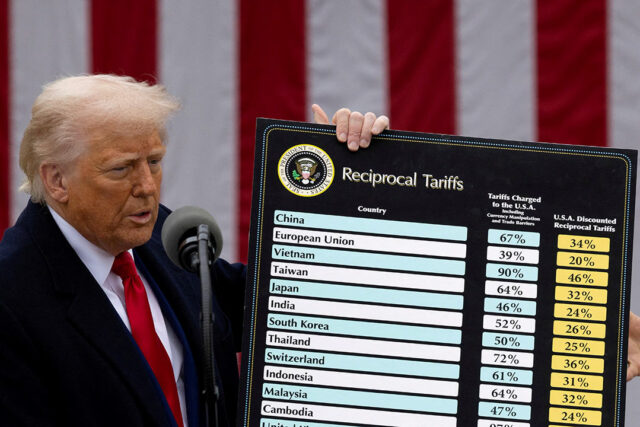
Trump responded within hours to the ruling on Friday, slapping a new 10% tariff on all imports and ordering new trade investigations that could lead to additional levies in months, while insisting that trade and investment deals reached with nearly 20 countries – most with higher tariffs – should remain untouched.

Less than 24 hours later, he raised the rate of the new tariff to 15% – the maximum level allowed under the law.

Wendy Cutler, a former US trade official and senior vice president at the Asia Society Policy Institute, said Trump’s rapid-fire change was emblematic of the president’s desire – and ability – to keep trading partners on their toes.

“The uncertainty, in his view, just gives him enormous additional leverage beyond the actual tariffs. Because people are worried about what he’ll do.”

But Cutler and other trade experts agree Trump’s wings have been clipped. The 10% replacement tariff lasts only 150 days, and new tariffs imposed under other statutes will take longer to implement, robbing the president of the “anytime, anywhere for any reason” cudgel he used to impose tariffs before his use of the International Emergency Economic Powers Act was nixed.

“He’s lost his favorite tool,” Cutler said. “Particularly for foreign policy matters and things that irk him on other countries that have nothing to do with trade, he’s lost the ability to offer a credible threat.”

William Reinsch, a former senior US government official who is now with the Center for Strategic and International Studies, said the Supreme Court’s solid 6-3 ruling diminished Trump’s ability to threaten other countries.

“It takes away his ability to wave the big stick around,” he said, although the economic impact will be limited, with the 10% tariff and other duties expected in coming months replacing some if not all the tariffs now deemed illegal.

Michael Froman, president of the Council on Foreign Relations, said the ruling and the administration’s response left many questions unanswered, including how importers could get refunds for duties collected illegally, and what further tariffs were still coming.

“Perhaps the most consequential impact of the Supreme Court’s decision is that it should curtail the threat or use of tariffs as the president’s preferred form of leverage or punishment outside the trade domain,” said Froman, who served as former President Barack Obama’s chief trade negotiator from 2013 to 2017.

That development could provide relief to countries scarred by Trump’s unpredictability and repeated use of tariff threats to punish them over non-trade matters, extract concessions and secure foreign investments.

The US president had invoked IEEPA to impose tariffs over a range of non-trade issues, leaving countries bruised and skittish, and heightening uncertainty for companies around the world. He threatened tariffs against European countries over their opposition to his claims on Greenland, against Canada for allowing the importation of electric vehicles from China, and against Brazil for its treatment of far-right former President Jair Bolsonaro, a Trump ally.

NO MORE ‘TRADE BAZOOKA’

Josh Lipsky, chair of international economics at the Atlantic Council, cautioned that it was too early to predict the impact of the Supreme Court’s ruling on Trump’s leverage, given uncertainty about fresh tariffs and the president’s willingness to use a range of tools.

“It’s a significant blow to his international economic trade agenda. It’s not a crippling one, necessarily, because of the other authorities, but we have to see how they play out in practice,” he said. “It feels like the ‘tariff armada’ has come to the rescue despite IEEPA. But how that plays out in terms of leverage is a different question in the months ahead.”

It is also unclear what will happen to nearly 20 framework deals or firmer trade agreements that the Trump administration has reached with countries in recent months that were based on the IEEPA tariff threats.

Trump, US Trade Representative Jamieson Greer and Treasury Secretary Scott Bessent insisted on Friday that the deals should remain in effect, even if those rates were higher than the temporary universal tax.

Analysts said they doubted countries could seek to abrogate or renegotiate deals, out of concern of triggering Trump’s ire.

Miriam Sapiro, a former senior US trade official and adjunct professor of international and public affairs at Columbia University, said Trump might have lost his “trade bazooka,” but she didn’t expect the existing deals to unravel. However, the ruling could give countries more leverage in new or ongoing negotiations with the Trump administration, Sapiro said.

“There’ll still be interest in doing deals because of the uncertainty and the desire to keep the US as a strong ally and strong partner,” she said. “But countries do have a bit more bargaining power than they might have felt they had previously.”

From Trump’s perspective, she said, using IEEPA was a risk he was willing to take because it helped reel in some trade deals quickly, although details still needed to be worked out in some cases and enforcement could be challenging.

Greer told Fox News’ “Special Report” program that IEEPA was the appropriate tool at the time, given Trump’s desire to move quickly and flexibly, and said it had helped open market access for US firms. “We don’t regret it,” he said. “We’ll just use a different tool.”

Initial reactions from overseas were measured as countries assessed the Supreme Court decision. South Korea said it would review the ruling and US response and planned to continue “amicable” talks over implementation of a tariff agreement finalized in November with $350 billion in investment pledges.

Tom Ramage, an economic policy analyst at the Korea Economic Institute of America, said the Trump administration’s continued ability to tap other tariff measures would likely persuade South Korea and its companies to maintain their commitments.

“Anything less could increase the likelihood that the president will impose further retaliation, especially if the administration seeks to make an example of countries that want to back out of negotiated deals,” he wrote on KEI’s website. — Reuters

Mexican drug lord killing sparks revenge attacks; cars and businesses set ablaze, highways blocked

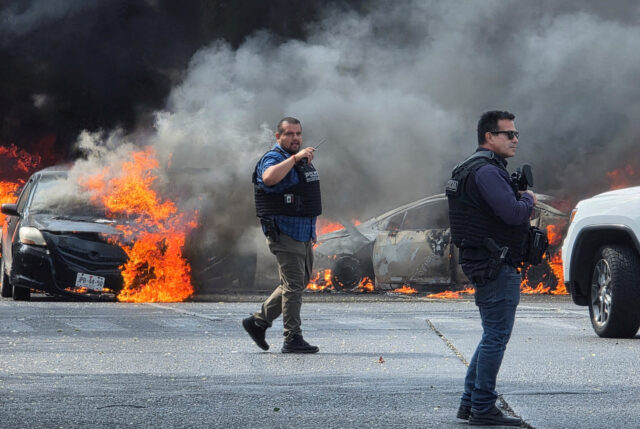
Police officers secure the area where vehicles were set on fire by organized crime members to block a road following a military operation in which a government source said Mexican drug lord Nemesio Oseguera, commonly known as "El Mencho," was killed, in Zapopan, Mexico, Feb. 22, 2026. REUTERS/GILBERTO GALLO

WITHIN hours of the killing of Mexican drug lord Nemesio Oseguera, better known as El Mencho, in a military raid on Sunday, gunmen suspected to be his supporters blocked highways across several states and set cars and businesses ablaze.

In some towns tourists and residents were urged to stay indoors, while truckers were advised to take safe routes or return to their depots until the violence abated.

Several airlines, including Air Canada, United Airlines, and Aeromexico, on Sunday cancelled flights to Puerto Vallarta, a beachside resort town where stunned tourists filmed plumes of smoke rising into the sky from fires.

The burst of violence across more than half a dozen states painted a familiar scene for Mexicans who have spent two decades watching successive governments wage war on drug cartels, ravaging broad swaths of the country.

A member of Mr. Oseguera’s Jalisco New Generation Cartel told Reuters that the blazes and sporadic gunfire were carried out in revenge for the government’s killing of Mr. Oseguera, and warned of further bloodshed as groups move to take control of his cartel.

“The attacks were carried out in revenge for the leader’s death, at first against the government and out of discontent,” the person said, speaking on condition of anonymity.

“But later the internal killings are coming, by the groups moving in to take over.”

In Mexico’s Pacific coast, a five-hour drive from the military operation in the town of Tapalpa that took down the leader of the powerful Jalisco New Generation Cartel, stunned beachgoers on a pier in Puerto Vallarta took out their cell phones to film thick waves of smoke obscuring blue ocean views, showed a video shared with Reuters.

Daniel Drolet, a Canadian who has wintered in Puerto Vallarta for years, said in a phone interview that he was concerned of a new era of violence taking root in the typically placid resort zone.

“I have never seen anything like this before,” he said.

In the state of Jalisco, authorities reported that gunmen had attacked a base for the National Guard military police, and recommended guests remain inside hotels and suspended public transit.

Other scenes of criminal activity and military response were captured in videos shared by government security sources with Reuters: A green military tank made its way through a residential neighborhood in the state of Aguascalientes. Roadblocks paralyzed the highly transited Mexico-Puebla highway. In the state of Colima, cartel members standing in pick-up trucks blocked a road.

A trucking industry group said in a statement it was “profoundly worried” by the highway violence and recommended that truckers keep to safe areas or return to their operating yards until conditions improved.

The state of Guanajuato, a CJNG stronghold, reported 55 incidents across 23 municipalities, with 18 arrests, but said by evening all incidents were under control.

Carlo Gutierrez, who lives in Guadalajara, Jalisco’s capital, said that friends on WhatsApp groups were encouraging people to stay home.

“There is fear and a lot of caution,” he said of the city, one of three main Mexican venues for World Cup soccer matches this summer.

VIOLENCE IN WAKE OF CARTEL ARRESTS, KILLINGS
Authorities have not reported any casualties beyond several cartel members and officials killed during the military operation.

Previous cartel arrests and killings have led to outbreaks of violence – whether by members avenging their fallen leader or rival gangs muscling in on their territory – prompting Mexican authorities to hesitate before launching major campaigns.

In 2019, Ovidio Guzman, a son of Sinaloa Cartel kingpin Joaquin “El Chapo” Guzman, was detained but quickly released, setting off widespread gun battles. His arrest in 2023 set off more violence.

The 2024 arrest of Sinaloa Cartel boss Ismael “El Mayo” Zambada triggered a bloody power struggle in the criminal group that continues unabated more than a year later.

“I’m watching the scenes of violence from Mexico with great sadness and concern,” said US Deputy Secretary of State Christopher Landau, who previously served as ambassador to Mexico, in a post on social media.

“It’s not surprising that the bad guys are responding with terror. But we must never lose our nerve.”

Mexico’s President Claudia Sheinbaum in a social media post acknowledged the violence, but struck a tone of calm.

“In most of the national territory activities are happening with absolute normalcy,” she said. — Reuters

Hundreds protest in Verona ahead of Olympics closing ceremony

A general view shows the Olympic rings on the Cortina Curling Olympic Stadium, which will host the curling, wheelchair curling, and Paralympic closing ceremony during the Milano Cortina Winter Olympic Games 2026, in Cortina, Italy, Jan. 25, 2025. REUTERS/CLAUDIA GRECO

VERONA, Italy — Hundreds of people marched through the streets of Verona a few hours before the Olympics closing ceremony to protest against housing costs and environmental concerns linked to the Winter Games.

The rally, “Olympics? No thanks”, was organized by university groups and associations that oppose hosting an event they say disrupts forests, pours concrete onto fragile land and deepens social inequality.

“We are here to defend our territory from speculation… and from the impossible cost of attending events,” said Giannina Dal Bosco, a 76‑year‑old activist.

Tickets for the ceremony were priced from 950 euros ($1,120) to a top level of 2,900 euros. It started at 8:30 p.m. (1930 GMT) inside Verona’s ancient Roman arena.

One banner read: “Fewer Games for the few, more homes for everyone.”

Francesca, 34, who traveled from Vicenza, about 60 kilometers (40 miles) away, said the landscape had been “disfigured” by new Olympic structures.

“They built concrete monstrosities like the bobsleigh track, which will serve no purpose,” she said. “Public money has been wasted that could have been used for hydrogeological safety and housing plans.”

Several protesters wore keffiyeh scarves and waved Palestinian flags.

Protesters marched for around two hours outside the security perimeter, from the 16th‑century Porta Palio to the 19th‑century Arsenal Square.

They briefly stopped at the point closest to the red zone, unsuccessfully asking to be allowed inside. Before the march moved on, activists painted the words “FIVE CIRCLES, A THOUSAND DEBTS” in large letters on the road.

Verona’s mayor Damiano Tommasi said high‑profile events such as the Olympics always carried the risk of people seeking visibility and trying to exploit the moment, and that it was appropriate to deploy a heightened level of security.

A much larger demonstration — drawing nearly 10,000 people — took place in Milan on the first day of the Games and later turned violent. ($1 = 0.8482 euros). — Reuters

Tehran is ready for nuclear concessions if US meets demands, Iranian official says

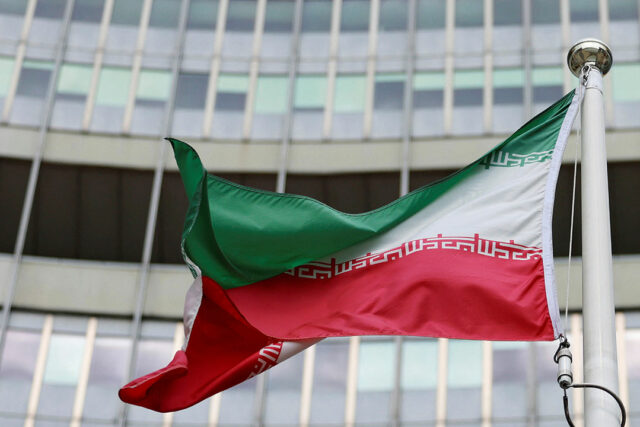
THE Iranian flag flutters outside the IAEA headquarters in Vienna, Austria, June 9, 2025. — REUTERS/LISA LEUTNER

DUBAI — Iran has indicated it is prepared to make concessions on its nuclear program in talks with the US in return for the lifting of sanctions and recognition of its right to enrich uranium, as it seeks to avert a US attack.

Both sides remain sharply divided — even over the scope and sequencing of relief from crippling US sanctions — following two rounds of talks, a senior Iranian official told Reuters.

However, Reuters is reporting for the first time that Iran is offering fresh concessions since their talks ended last week, when the sides appeared far apart and heading closer to military conflict. Analysts say the move suggests Tehran is trying to keep diplomacy alive and stave off a major US strike.

The official said Tehran would seriously consider a combination of sending half of its most highly enriched uranium abroad, diluting the rest and taking part in creating a regional enrichment consortium – an idea periodically raised in years of Iran-linked diplomacy.

Iran would do this in return for US recognition of Iran’s right to “peaceful nuclear enrichment” under a deal that would also include lifting economic sanctions, the official said.

In addition, Iran has offered openings for US companies to participate as contractors in Iran’s large oil and gas industries, the official said, in negotiations to resolve decades of dispute over Tehran’s nuclear activities.

“Within the economic package under negotiation, the United States has also been offered opportunities for serious investment and tangible economic interests in Iran’s oil industry,” the official said.

The White House did not respond immediately to queries on the issue.

Washington views enrichment inside Iran as a potential pathway to nuclear weapons. Iran denies seeking nuclear weapons and wants its right to enrich uranium to be recognized.

Iran and the United States resumed negotiations earlier this month as the US builds up its military capability in the Middle East. Iran has threatened to strike US bases in the region if it is attacked.

The Iranian official said the most recent discussions underscored the gap between the two sides, but stressed that “the possibility of reaching an interim agreement exists” as negotiations continue.

IRAN SEEKS ‘LOGICAL TIMETABLE’ FOR LIFTING SANCTIONS
“The last round of talks showed that US ideas regarding the scope and mechanism of sanctions relief differ from Iran’s demands. Both sides need to reach a logical timetable for lifting sanctions,” the official said.

“This roadmap must be reasonable and based on mutual interests.”

Iran’s Foreign Minister Abbas Araqchi said on Sunday he expects to meet with US President Donald Trump’s special envoy Steve Witkoff in Geneva on Thursday, adding there is still “a good chance” of a diplomatic solution.

Mr. Araqchi said on Friday that he expected to have a draft counterproposal ready within days, while Mr. Trump said he was considering limited military strikes.

Citing officials on both sides and diplomats across the Gulf and Europe, Reuters reported on Friday that Tehran and Washington are sliding rapidly towards military conflict as hopes fade for a diplomatic settlement.

On Sunday, Mr. Witkoff said the president was curious as to why Iran has not yet “capitulated” and agreed to curb its nuclear program.

“Why, under this pressure, with the amount of seapower and naval power over there, why haven’t they come to us and said, ‘We profess we don’t want a weapon, so here’s what we’re prepared to do’? And yet it’s sort of hard to get them to that place,” Mr. Witkoff said on Fox News.

READINESS TO COMPROMISE ON NUCLEAR WORK
Behnam Ben Taleblu, senior director of the Iran program at the Foundation for Defense of Democracies, said Iran’s leadership is seeking to buy time via the talks.

“Iran will use that time for various reasons, including to avoid a strike and to harden nuclear, missile, and military facilities,” he said.

While rejecting a US demand for “zero enrichment” – a major sticking point in past negotiations – Tehran has signalled its readiness to compromise on its nuclear work.

Washington has also demanded that Iran relinquish its stockpile of highly enriched uranium (HEU). The International Atomic Energy Agency last year estimated that stockpile at more than 440 kg of uranium enriched to up to 60% fissile purity, a small step away from the 90% that is considered weapons grade.

Ali Larijani, a close adviser to Iran’s supreme leader, told Al Jazeera TV that Iran was ready to allow extensive IAEA monitoring to prove it is not seeking nuclear weapons.

The agency has been calling on Iran for months to allow for inspection of three nuclear sites that were struck by the US in June last year at the close of a 12-day Israeli bombing campaign. Since then, Tehran has said its uranium enrichment work has stopped.

Satellite images show that Iran has advanced work at a location reportedly bombed by Israel last year, recently building a concrete shield over a new facility at a sensitive military site and covering it in soil, experts say.

BENEFITS FOR BOTH SIDES
Among US demands are restrictions on Tehran’s long-range ballistic missiles and an end to its support for regional proxy groups.

Iran has flatly rejected discussing its missiles, while sources have told Reuters, without elaborating, that “the issue of regional proxies is not a red line for Tehran”.

Iranian authorities have said that a diplomatic solution would provide economic benefits for both Tehran and Washington.

The Iranian official said Tehran would not hand over control of its oil and mineral resources.

“Ultimately, the US can be an economic partner for Iran, nothing more. American companies can always participate as contractors in Iran’s oil and gas fields.” — Reuters

Further easing seen amid growth woes

Last-minute shoppers flock to Blumentritt Market, Dec. 31, 2025. — PHILIPPINE STAR/RYAN BALDEMOR

By Katherine K. Chan, Reporter

THE BANGKO SENTRAL ng Pilipinas (BSP) may extend its easing cycle this year to provide the Philippine economy with more support as lingering uncertainty continues to test consumer and business confidence, analysts said.   

“Against this backdrop of softer demand, elevated real rates, and lingering confidence issues, the door remains open for additional monetary easing,” ING Think Regional Head of Research for Asia-Pacific Deepali Bhargava said in a commentary.

This came even after BSP Governor Eli M. Remolona, Jr. said the policy path ahead is now less certain as they deemed that monetary policy easing may be insufficient to boost economic growth.

At its first policy review of the year, the central bank last week trimmed the key interest rate by 25 basis points (bps) to an over three-year low of 4.25%.

The sixth straight cut brought its total reductions to 225 bps since it began easing in August 2024. 

However, Mr. Remolona earlier left the door open to supporting growth further through monetary policy as long as inflation remains manageable.

In 2025, Philippine economic growth slumped to a post-pandemic low of 4.4% after it posted a 3% expansion in the final quarter of the year, as weak confidence continued to stall investments, consumption and government spending amid the flood control mess. 

This was below the BSP’s 4.6% full-year projection and led the country to miss its growth targets for a third straight year.

Mr. Remolona has said that they expect confidence to recover in a few months as current data point to improving market sentiment, noting that their next policy decision will hinge on how fast confidence will be regained.

Still, the BSP sees Philippine gross domestic product (GDP) growth settling below the government’s 5%-6% target this year as it slashed its projection to 4.6% from 5.4% previously.

For 2027, it expects the GDP to expand by 5.9%, also lower than its earlier estimate of 6.3%.

GROWTH CONCERNS
Continued government underspending may continue to dampen both fiscal outlays as well as household and business confidence, Ms. Bhargava said.

“The latest (fourth-quarter) data show that soft government spending has become a more persistent drag, weighing not only on fiscal outlays but also on business and household confidence,” she said.

“We expect this pressure to persist at least through the first half of 2026, given ongoing investigations and unresolved political uncertainty that continue to dampen sentiment.”

Government spending has fallen for four consecutive months, after it declined by 9.61% year on year to P498.3 billion in November, latest Treasury data showed.

Ms. Bhargava also noted that real rates remain high even as the central bank has eased for a sixth time in a row.

“Real rates remain elevated at around 2.25% even after today’s rate cut, with the latest inflation print at roughly 2%,” she said. “This keeps monetary conditions tighter than what current economic momentum seems able to absorb.”

Maybank economists Azril Rosli and Suhaimi Ilias likewise see the BSP delivering one more final 25-bp cut this year to help the economy rebound following its underperformance last year.

“The Philippine economy grew at its weakest pace in five years in 2025 at 4.4% (2024: 5.7%), undershooting the official national target of 5.5-6.5% growth,” they said in a commentary. “In view of this, we still see room for one final 25-bp cut this year to 4%.”

Meanwhile, Nomura Global Markets Research Chief ASEAN Economist Euben Paracuelles and Research Analyst Yiru Chen maintained their view that the BSP will bring its key policy rate further down to 4%, especially after the central bank veered away from its “nearing the end of the easing cycle” sentiment.

“BSP also sounded dovish by removing the line that the end of the easing cycle is near. We reiterate our forecast that BSP will cut again by 25 bps in April,” they said in a note.

The Monetary Board is set to hold its next rate-setting meeting on April 23.

Trump’s 15% global tariff threatens Philippines’ export recovery — analysts

President Donald J. Trump has said he will impose a 15% tariff on US imports from all countries, after the US Supreme Court struck down his previous tariff program. — REUTERS

By Beatriz Marie D. Cruz, Reporter

THE United States government’s plan to impose a new 15% tariff on imports may dampen the Philippines’ export recovery and disrupt supply chains, according to analysts.

“Under a 15% tariff, there might be a disruption in the supply chain, because other countries might negotiate or diverge [to other markets],” Philippine Exporters Confederation, Inc. President Sergio R. Ortiz-Luis, Jr. said in a phone call.

“Unfortunately, our competitors here in the ASEAN (Association of Southeast Asian Nations) are supported by their governments, but we aren’t,” he added.

Mr. Ortiz-Luis said the Philippine government must resume negotiations with its US counterparts to ensure exports remain competitive.

Philippine Institute for Development Studies Senior Research Fellow John Paolo R. Rivera said the new tariffs could dampen export recovery, especially for electronics, garments, and agricultural sectors.

“The renewed threat of a 15% global tariff signals that protectionist risks remain and could dampen export recovery if implemented, especially for semiconductors and intermediate goods integrated into US supply chains,” he said in a Viber message.

US President Donald J. Trump said he wants to impose a new 15% duty on US imports from all countries, starting Tuesday, Reuters reported. (Read related story “Asian economies weigh impact of fresh Trump tariff, uncertainties” on S1/11).

This after the US Supreme Court struck down his previous tariff program, ruling that Mr. Trump had exceeded his authority when he imposed higher tariffs under an economic emergency law.

Government officials emphasized that the US remains an important trading and investment partner.

“We will continue to engage with (the US). A stable and predictable arrangement with the US will be very beneficial to our stakeholders,” Trade Undersecretary Allan B. Gepty said in a Viber message.

Finance Secretary Frederick D. Go earlier said that the majority of the country’s exports — like semiconductors and key agricultural goods — were already exempted before the US Supreme Court’s ruling.

The US has long been the Philippines’ biggest export market. From January to December 2025, the value of Philippine exports to the US stood at $13.44 billion.

“We don’t know under what authority he (Mr. Trump) will impose those tariffs, and if these will last. We will have to wait until the dust settles to properly assess the impact of his new universal tariffs,” Foundation for Economic Freedom President Calixto V. Chikiamco said in a Viber message.

Reuters reported the new US tariffs are grounded in a separate but untested law, known as Section 122, that allows tariffs up to 15% but requires congressional approval to extend them after 150 days.

Foreign Buyers Association of the Philippines President Robert M. Young said its members have been resuming talks with its US buyers.

“We have survived, for the last eight months, the US’ 19% tariff. So, I think we have to just go on with what we are doing, and we’ll try our best to just lower our price to be competitive with other ASEAN nations,” he said via telephone.

Mr. Trump in July last year slapped a 19% duty on goods from five ASEAN members — the Philippines, Cambodia, Malaysia, Thailand, and Indonesia.

“In the meantime, we are preparing already for our expansion and our additional orders. We are keeping our fingers crossed that we will be given the best deal that we can get,” Mr. Young said.

Reacting to the US Supreme Court’s decision, Mr. Young called it a “much-needed boost for Philippine industries,” noting that it may contribute to local job creation.

To further support Philippine exporters, the government should also focus on improving infrastructure and ease of doing business, he said.

The Philippines should also leverage its membership in the Regional Comprehensive Economic Partnership and strengthen ties with its ASEAN partners by positioning itself as an alternative production base, Mr. Rivera said.

“At the same time, exporters should diversify markets and upgrade value-added production to reduce vulnerability to unilateral tariff actions and global policy swings,” he added.

Mr. Chikiamco said the country’s potential inclusion in the Comprehensive and Progressive Agreement for Trans-Pacific Partnership (CPTPP) would help boost market access.

The CPTPP comprises Australia, Brunei Darussalam, Canada, Chile, Japan, Malaysia, Mexico, New Zealand, Peru, Singapore, Vietnam, and the United Kingdom. The Philippines in November last year formally applied to join the trade bloc.

Philippine investment scams turn retail fronts into traps

STOCK PHOTO | Image by Pvproductions from Freepik

By Alexandria Grace C. Magno, Reporter

ON A HUMID afternoon in Manila, Trisha C. Valisno remembers sitting in a small storefront she once believed would fund her future. The shelves were neatly arranged. Staff greeted walk-in clients. A business permit was posted on the wall. Friends shared screenshots of payouts in group chats.

It felt like a safe bet.

“I was really looking for ways to make my money grow,” Ms. Valisno, a user-generated content creator on TikTok, said in an Instagram message. In her 20s at the time, she wanted a larger sum to invest in property. A friend introduced her to Lushapple.ph, describing it as a retail venture that generated steady profits. Investors were told they could earn as much as 40% in returns.

The company had what appeared to be proper documentation. It showed a Department of Trade and Industry (DTI) registration online and rented a physical space where clients could see the products it claimed to sell.

“I thought it was legitimate because they had a DTI permit. They even posted it,” Ms. Valisno said. “I didn’t know that wasn’t enough.”

By the time the Securities and Exchange Commission (SEC) issued an advisory in 2023 warning that Lushapple.ph was not licensed to sell securities and appeared to operate like a pyramid scheme, many investors had already committed money.

Ms. Valisno, who lost P200,000 (around $3,500), said early payouts helped build confidence. Some members got returns and posted about them online. A few showed off cars and vacations.

“Once you’re hooked on the profits, you don’t withdraw,” she said. “You add more.”

That cycle is common in schemes that blend retail activity with investment promises. Initial payouts, often funded by newer deposits, create a sense of legitimacy. Investors reinvest gains instead of cashing out.

Red flags only became clear when payouts slowed. Messages in group chats turned anxious. Some said the owner’s bank account had been frozen due to large transfers. Then the SEC advisory circulated more widely.

“I’d already invested before I saw it wasn’t registered,” Ms. Valisno said. “It was too late.”

Her experience reflects a broader evolution in Philippine scams. Fraud is no longer confined to anonymous text blasts or obvious get-rich-quick pitches. Increasingly, schemes present themselves as ordinary businesses — retail stores, online sellers, trading groups — with polished branding and physical offices.

The shift has made scams harder to spot.

A 2025 State of Scams report by the Global Anti-Scam Alliance, BioCatch and ScamAdviser found that 31% of 1,000 surveyed Filipinos had lost money to scams. Investment fraud was the most common type. In many cases, victims were drawn in by promises of high returns and testimonials shared on social media.

Payment methods have also changed. While wire transfers remain common across Southeast Asia, digital wallets are widely used in the Philippines. Funds can move instantly, and recovery is often difficult once money is withdrawn or transferred through multiple accounts.

John Paolo R. Rivera, a senior research fellow at the Philippine Institute for Development Studies, said scams persist because they exploit economic vulnerability and gaps in digital trust.

“Many Filipinos, especially microentrepreneurs and low-income households, remain credit-constrained,” he said in a Viber message. When access to formal loans is limited or slow, offers of fast returns or easy financing become attractive, he pointed out.

‘NEGATIVE SPILLOVERS’
Periods of inflation, weak job growth or rising household debt can heighten that vulnerability. Scammers position themselves as an alternative to traditional banks, promising speed and flexibility.

At the same time, the rapid expansion of social media and online payment platforms has outpaced consumer awareness. Fake investment pages can be created and removed quickly. Encrypted messaging apps allow organizers to coordinate privately. Regulators face limits in tracking operators who can shift identities and accounts with ease.

“If unchecked, these scams erode public trust in legitimate financial institutions, discourage investment, and siphon money from productive use,” Mr. Rivera said. “They also create negative spillovers for the digital economy, as consumers become more hesitant to transact online.”

Filipinos are vulnerable to investment scams when financial pressure meets promises of fast, high returns, according to BDO Securities Corp. President John Tristan D. Reyes.

He said a “get-rich-quick” mindset often takes hold when income growth feels slow. Fear of missing out also plays a role, especially when friends or relatives claim to have earned large profits, making schemes appear credible.

“Put together, it’s easy to see why people still get drawn into these scams,” he said via Viber.

Weak consumer protection and financial exclusion add to the problem, he added. Informal work, informal lending and cash-based transactions make informal investment schemes seem familiar and less suspicious.

“The baka-sakali (taking a chance) mindset and herd behavior make people more willing to take risks,” Mr. Reyes said. He added that authorities should strengthen enforcement, so perpetrators are held accountable.

He said scams do more than wipe out savings. They strain household budgets, push families into debt, and damage trust in financial institutions. That loss of trust can drive people back to cash-only transactions, limiting spending and slowing economic activity.

Michael L. Ricafort, chief economist at Rizal Commercial Banking Corp., said financial education and cybersecurity must keep pace with evolving tactics.

“These initiatives need to evolve since cybercriminals also reinvent themselves to bait unsuspecting victims with too-good-to-be-true propositions,” he said via Viber.

He added that stronger cybersecurity measures would help sustain confidence in e-wallets, digital payments and online commerce.

The SEC has shifted its enforcement strategy. Instead of relying mainly on SIM-card registration rules, it is working with digital platforms to take down fraudulent websites directly.

The agency has worked with platforms such as TikTok and plans similar action with Facebook, Viber and Facebook Messenger.

The SEC also launched iMessage, an upgraded online ticketing system that lets users track complaints in real time. Still, some victims hesitate to report scams, citing doubts about follow-through or lengthy processes.

The SEC has stepped up advisories and enforcement actions, but officials acknowledge the challenge.

For scammers, legitimacy is part of the pitch. Renting office space, posting permits and showcasing customer feedback can create a powerful narrative. In communities where word-of-mouth matters, a trusted friend’s endorsement may carry more weight than a regulator’s warning.

Ms. Valisno said that was the case for her. The woman who introduced the opportunity was known to her circle. The storefront existed. Early investors appeared to benefit.

“It didn’t look like a scam,” she said.

The lesson, she said, was harsh. Checking regulatory registration before investing is critical. High guaranteed returns are a warning sign. And once funds are transferred, recovery is uncertain.

As the Philippine economy digitizes and more transactions move online, the stakes grow. The same platforms that expand access to finance also widen the reach of fraud.

For Ms. Valisno, the loss reshaped how she views opportunity. She still wants her money to grow. But she now asks more questions.

“I just wish I had known what to check,” she said.

PHL might miss digital payments targets, says BSP

STOCK PHOTO | Image by Pikisuperstar from Freepik

THE PHILIPPINES might fail to reach its payments digitalization targets by 2028 as the Bangko Sentral ng Pilipinas (BSP) noted that progress has been slow amid worries over emerging cyber risks.

BSP Governor Eli M. Remolona, Jr. said digitalization efforts are ongoing, but it might take beyond 2028 before the country can meet its targets under the Philippine Development Plan.

“Well, digitalization continues. It’s a good thing,” he told Money Talks with Cathy Yang on One News on Friday.

“At the same time, it brings with it some risks. We worry a lot about cyber risks. So, even as we encourage digitalization, we’re also trying to get the banks to also make sure that they defend themselves against cyber risks.”

Asked if the country remains on track with its target, Mr. Remolona said: “To be honest… it (digitalization) has been slow. We’re on track, but maybe it will take a couple more years than we thought to get where we want to go.”

The BSP wants digital payments to make up 60%-70% of the total volume of retail payments by 2028 in line with the Philippine Development Plan.

In 2024, online payments accounted for a 57.4% share in terms of volume and 59% in value terms in the country’s total monthly retail transactions, according to the BSP’s 2024 Status of Digital Payments in the Philippines report. These are up from 52.8% and 55.3%, respectively, in 2023. 

Earlier this month, BSP Deputy Governor Lyn I. Javier said social engineering, such as phishing scams, account takeover and identity theft, emerged as the top cyberthreat of the local banking system in the first half of 2025. This made up 76% of the total amount lost to financial fraud during the period.

This was followed by hacking, which accounted for 13% of the total losses, and card-not-present fraud with 8%.

The BSP deputy governor noted that the financial system’s digital shift is being challenged by more frequent, targeted and more scalable cyberthreats, and that interconnectedness has allowed more cybercriminals to penetrate the system through its vulnerabilities.

Among the BSP’s priority legislative agenda for the 20th Congress is the Digital Payments Bill, which seeks to advance the use of digital payments in financial transactions between the National Government and the public.

This, as BSP Deputy Governor Mamerto E. Tangonan has noted that digital collections comprise only 25% of the government’s total collections.

The 20th Congress has been working on measures aimed at modernizing the government’s payment systems.

In early February, Senator Emmanuel Joel J. Villanueva filed Senate Bill No. 1821, a measure seeking to require all government agencies and relevant entities to adopt digital payment methods for the disbursement of government funds and collection of taxes, fees, tolls, imposts and other revenues.

It is currently pending for hearing in the Senate Banks, Financial Institutions and Currencies Committee.

Enhancing the digital payments system, particularly by making cross-border payments safer and more seamless within the Southeast Asian region, is also one of the BSP’s key initiatives as part of the Philippines’ chairship in the Association of Southeast Asian Nations (ASEAN) this year.

Since last year, the central bank has formalized the ASEAN Regional Payment Connectivity program, established 26 cross-border payment linkages as of August 2025, and has been developing a multilateral remittances service for overseas workers, migrants and small businesses under Project Nexus. — Katherine K. Chan

Pinoy traditions drive sari-sari store sales surge during Chinese New Year — Packworks

During Chinese New Year celebrations, Filipinos have turned cultural traditions and ‘suwerte’ (luck) into a shopping list, fueling a sales surge in sari-sari stores nationwide as families prepare to welcome prosperity for the year ahead.

Filipino tech startup Packworks, through its business intelligence tool Sari IQ, analyzed over a million monthly transactions across its network of 300,000 stores over a three-year period. The study compared sales trends for holiday-related items two weeks before and after Chinese New Year from 2023 to 2025. The data reveals that items linked to abundance and luck, such as hopia, Chinese wine, and Asian noodles, posted sales increases, reflecting how Filipino beliefs influence consumption during the occasion.

Hopia, a round pastry of Chinese origin symbolizing togetherness and good fortune, steadily grew sales from 2023 to 2025. Its median gross merchandise value (GMV) rose 20% in 2025, up from 14% increase in 2023. The Visayas regions led the sales growth. Central Visayas (Region VII) saw a massive 240% spike in sales and a 200% increase in transactions in 2025. This popularity reflects the region’s enduring Chinese cultural influence, particularly in Western and Central Visayas, hubs home to significant Chinese-Filipino communities such as Iloilo, which is home to approximately 14,000 Chinese-Filipinos.

Meanwhile, Chinese wine, often linked with holiday toasts and wishes for prosperity, saw its median GMV leap 36% in 2025, from a mere 3% in 2023. Growth was seen across most regions, with Central Luzon (Region III) maintaining a consistent 100% sales increase each year, along with Eastern Visayas, showing steadily rising growth from 72% in 2023, and highest surge of 107% in 2024 and 115% in 2025. This trend highlights the intersection of Chinese influence and the local tradition of ‘tagay’ (communal drinking).

Asian noodles, a staple symbolizing long life, saw a 10% sales increase in 2025, rebounding from a 3% decline the previous year. SOCCSKSARGEN (Region XII) recorded the highest sales in 2025 with 25% increase, likely driven by a 36% rise in stores selling the product, the highest among all regions. Western Visayas had the largest jump in transactions at 25%, reflecting the region’s Chinese culinary influences and its growing community of Chinese-Filipinos. Meanwhile, Central Luzon and Eastern Visayas continued to sustain sales growth over the three-year period, with Central Luzon recording 27% in 2023, 15% in 2024, and 17% in 2025; and Eastern Visayas showing steady although gradually decreasing growth at 28%, 18%, and 9%. These trends reflect steady top-up purchases of affordable and culturally symbolic items in sari-sari stores in these regions.

Packworks Chief Data Officer Andoy Montiel said these patterns reflect how Filipinos weave tradition into purchasing decisions.

“Our historical data underscores how deeply traditional beliefs and cultural influences are embedded in the Filipino psyche, proving that commerce is inseparable from culture. The sales trends show that for the average Filipino, Chinese New Year isn’t just a holiday, but a window for ‘investing’ in prosperity. These cultural nuances are mirrored in the sari-sari store ecosystem, proving that in our local market, heritage often leads the hand that shops,” Mr. Montiel said.

The Filipinos’ “prosperity basket” also extends to kitchen essentials used for holiday feasts. Soy sauce, a staple introduced in Chinese cuisine, saw sales rise 9% in 2025, while seasoning granules and MSG grew by 7%. Cooking oil also saw around a 13% increase in both sales and transactions. Furthermore, sweet products like chocolates and sugar, symbolizing a “sweet” year ahead, experienced notable growth. Chocolates saw a 36% boost in sales in 2025, while sugar maintained a strong presence following a massive 47% spike in 2024.

“Our latest insights prove that to stay relevant, brands and FMCGs must move beyond passive stocking and traditional distribution toward a hyper-localized, insight-led strategy. By aligning product availability with these deeply ingrained cultural cues, brands can capture the latent demand that often goes unseen in modern trade, effectively turning cultural nuances into a competitive advantage at the grassroots level,” Packworks Co-Founder and Chief Platform Officer Hubert Yap said.

Packworks expects a 10% GMV growth and a 4% increase in transactions for this year’s Chinese New Year celebrations, as more Filipinos are buying the same product per transaction, particularly during the festive occasion.


SparkUp is BusinessWorld’s multimedia brand created to inform, inspire, and empower the Philippine startups; micro, small and medium enterprises (MSMEs); and future business leaders. This section will be published every other Monday. For pitches and releases about startups, e-mail to bmbeltran@bworldonline.com (cc: abconoza@bworldonline.com). Materials sent become BW property.