Home Blog Page 2618

Why Europe is a useful ally in the WPS territorial disputes

PHOTO FROM ARMED FORCES OF THE PHILIPPINES

Tensions between the Philippines and the People’s Republic of China remain high, with both countries continuing to skirmish and posture within the disputed territories in the West Philippine Sea (WPS). On Sept. 30, the Philippines held joint naval exercises alongside Australia, Japan, New Zealand, and the United States, under the auspices of Multilateral Maritime Cooperative Activity (MMCA). According to an Armed Forces of the Philippines spokesperson, the participating vessels were “tailed” by the Chinese navy. Although the incident did not result in any direct confrontations, it is evidence of the tense situation in the WPS.

The presence of ships from four other countries is a manifestation of the Philippines’ efforts at deepening security ties with its neighbors and traditional allies. This includes the signing of the Japan-Philippines Reciprocal Access Agreement (RAA), and the call to review the US-PH Mutual Defense Treaty (MDT).

Although the Philippines continues to rely on its allies in the Asia-Pacific region to boost its naval presence in the disputed territories, this column argues that the country should recognize and harness the diplomatic support the country receives from European states.

Europe may be geographically distant, and many of its states are focused on the Ukraine invasion, but the region continues to follow occurrences in the South China Sea. This is evident when one considers the public pronouncements of the European Union (EU) and its member states, such as Denmark, France, or Germany. It is also manifested in statements issued by non-EU countries, such as Norway and the United Kingdom. Since the 2016 decision by the Permanent Court of Arbitration in the Hague, which recognized the Philippine territorial claims in the WPS, European countries have expressed support for the Philippines against Chinese incursions into the disputed area. Of particular significance was a 2023 joint statement by EU and member state delegations in the Philippines recognizing the legitimacy of the arbitral award and emphasizing support for the freedoms of navigation and overflight, which are enshrined in the United Nations Convention on the Law of the SEA (UNCLOS).

Since the promulgation of the tribunal’s decision, skirmishes have continued in the disputed territories. Some noteworthy incidents include a Chinese vessel’s use of a military grade laser to blind Philippine sailors, which resulted in a diplomatic rebuke from Malacañang, as well as statements of opposition from the Swedish and Danish embassies in the Philippines. In March of this year, the Polish mission to the Philippines expressed its opposition to China’s ships blocking the movement of Philippine vessels, even using water cannons to deter them.

Although European actors’ statements may appear to be mere lip service, their statements are exercises of what International Relations scholars generally refer to as soft power. Such articulations may appear relatively ineffective compared to the sending of ships, as the US or Japan do, but they are ways to express opposition towards Chinese actions, and support for the Philippine position.

Apart from abstract articulations of support, however, recent developments have allowed for Europe to provide more material support to the Philippines. For example, the EU published its Strategy for Cooperation in the Indo-Pacific in 2023, which reconfigures the forms of cooperation between the 27-country bloc and countries, such as the Philippines. Initial results of this include the establishment of the EU-Philippines Subcommittee on Maritime Cooperation, the adoption of the EU-funded Indo-Pacific Regional Information Sharing (IORIS) Platform, and the provision of more crisis management exercises through the Critical Maritime Routes Indo-Pacific (Crimario) project. Each of these instruments deepen the EU’s involvement in the Sino-Philippine territorial dispute.

Beyond its engagements with the EU, the Philippines likewise has sought to strengthen its bilateral ties with individual European states and diversify its portfolio of security partners in responding to Chinese hegemonic ambitions. In this year alone, some of the agreements in the works include: 1.) a draft military interoperability agreement with France, 2.) the finalization of a defense cooperation pact with Germany, and, 3.) the signing of a security agreement with Sweden allowing the Philippines to procure fighter jets and Swedish-made defense equipment. Other initiatives from previous years include French participation in the “Balikatan” exercises, the deepening of defense cooperation with the Netherlands and Poland, and the visit of two German warships to the Philippines, among others.

Although efforts are underway to deepen European involvement in the Sino-Philippine territorial dispute, there is potential to build more areas of cooperation. The construction of a more robust security posture for the Philippines entails looking beyond our traditional allies in the Asia-Pacific region, and tapping into the potential for more consistent material European support. This is feasible considering the EU and individual European states’ records as reliable economic and security partners for the Philippines. Thus far, Europe has provided diplomatic support to the Philippine position in the territorial dispute, and there are nascent initiatives for deeper cooperation. However, these can be intensified further. The Philippine National Security Strategy can benefit from building upon its existing partnership with the EU and other European states.


Dr. Manuel R. Enverga III is the Jean Monnet chair and director of the European Studies Program at the Ateneo de Manila University. His teaching and research are focused on the areas of EU-Philippine relations, digital diplomacy, and global flows. He also hosts The Eurospeak Podcast, where he invites guests to talk about European influences on contemporary popular culture.

Vincent Carlo L. Legara currently works as a lecturer at the European Studies Program and at the Department of Political Science of the Ateneo de Manila University. He is also a junior political risk and security analyst for Polysentry.
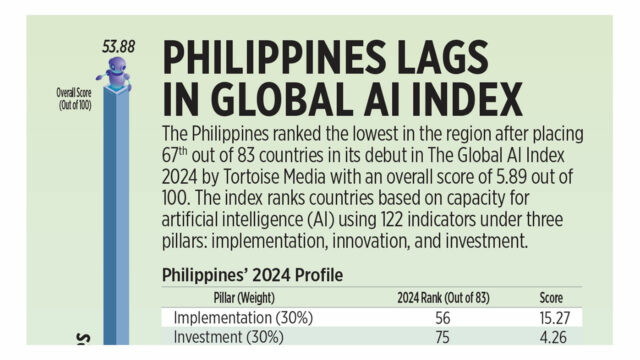
Philippines lags in Global AI Index

The Philippines ranked the lowest in the region after placing 67th out of 83 countries in its debut in The Global AI Index 2024 by Tortoise Media with an overall score of 5.89 out of 100. The index ranks countries based on capacity for artificial intelligence (AI) using 122 indicators under three pillars: implementation, innovation, and investment.

Philippines lags in Global AI Index

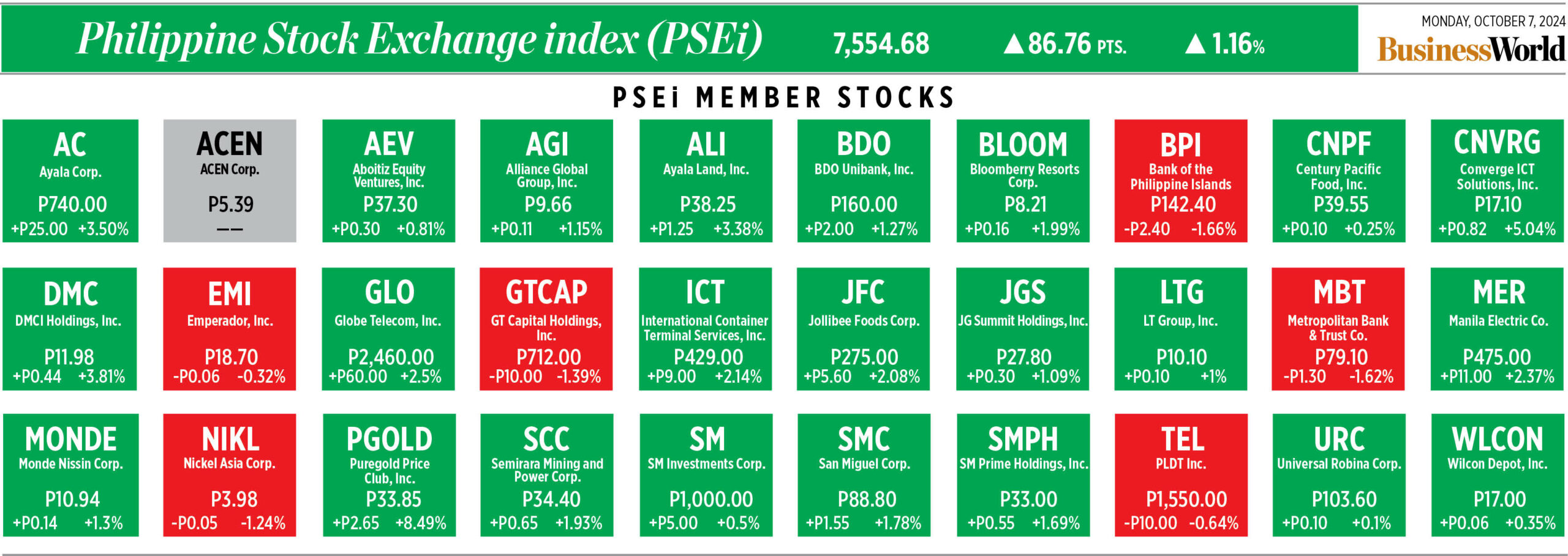
How PSEi member stocks performed — October 7, 2024

Here’s a quick glance at how PSEi stocks fared on Monday, October 7, 2024.


Gov’t revenue seen taking hit from House capital reform bill

DOF.GOV.PH

THE Department of Finance (DoF) said on Monday that the House of Representatives version of a capital markets reform bill could result in a P140 billion reduction in government revenue over four years, further limiting the fiscal space available.

Finance Assistant Secretary Karlo Fermin S. Adriano said the DoF is open to cutting stock transaction taxes to 0.1% from 0.6% and reducing the dividends tax rate for non-resident investors.

Nevertheless, he urged legislators to consider the DoF’s fourth package of the Comprehensive Tax Reform Program, adding that amendments contained in the House-proposed Capital Markets Efficiency Promotion Act (CMEPA) are already included in the DoF-submitted legislation. The DoF’s version, he said, could net about P10.76 billion.

“The DoF recognizes the intent of the proposed CMEPA, but we are already pursuing similar objectives through the Passive Income and Financial Intermediary Taxation Act (PIFITA),” he said in a Senate ways and means committee hearing.

“We are okay now with reducing the stock transaction tax from 0.6% to 0.1%… we are (also) okay with reducing the dividends particularly for non-residents, which is also covered by CMEPA,” he added.

CMEPA and PIFITA are among the legislative priorities outlined of President Ferdinand R. Marcos, Jr. for the 19th Congress. The House approved both the bills on final reading while the Senate’s versions remain at the committee level.

“Given that currently we’re still in a tight fiscal position, we hope that we could push for Package 4 instead of CMEPA, especially that many of the capital market provisions in CMEPA are also found in Package 4,” Mr. Adriano said.

The DoF’s Package 4, formerly known as PIFITA, is seeking to levy a flat 20% tax rate on interest income, including savings deposits, treasury bonds and bills, and corporate bonds, among others, according to Mr. Adriano’s presentation to the tax panel.

The DoF’s fourth package also provides for a 5% gross receipts tax on banks, lending investors and other financial intermediaries’ lending and non-lending activities. It also proposes a 2% value-added tax (VAT) on health maintenance organizations and pension funds. 

Taking note of the DoF’s position on the measure, Senator Sherwin T. Gatchalian, who heads the Senate ways and means committee, said the Legislative-Executive Development Advisory Council (LEDAC) is now pushing for capital market tax reforms instead of the more expansive PIFITA.

House Bill (HB) No. 9277, or the CMEPA measure, seeks to cut stock transaction tax to 0.1% from 0.6% currently. The measure also proposes to set the dividend tax rate for non-resident investors to 10% while removing the 7% gross receipts taxes on derivative gains by financial institutions.

It also reduced tax rates on lotto winnings above P10,000 to 10% from 20%. The House’s CMEPA version also exempted property insurance policies worth less than P100,000 from documentary stamp tax while levying a maximum P200 tax on policies more than P1 million.

The Senate’s version of CMEPA includes tax overhauls to “the debt sector, bonds and debentures… and also the entire insurance industry,” according to Mr. Gatchalian, citing their interconnectedness to capital markets.

The DoF is open to working with the capital market reforms bill, requesting that Congress tweak the tax measure to make it “revenue neutral,” Mr. Adriano said.

He noted the DoF tried adding tax provisions that would make CMEPA revenue-positive for the government. “We tried to insert provisions… basically giving us positive revenue, including the gross receipts tax on financial intermediaries and excise tax on pickup (trucks).”

“It’s still not enough to counter the revenue negative impact of CMEPA,” he added.

Mr. Gatchalian said the Senate version of the measure would only result in P78 billion in foregone revenue, with no reduction in tax rates for lotto ticket sales and an excise tax on pickup trucks. “We made some modifications in the last few weeks,” he added.

It would be easier for the Senate to pursue CMEPA as it’s a “smaller bill” compared to PIFITA, he said, citing the need to expedite deliberations on reforms to the capital markets and passive income tax structures before the chamber begins discussions on the proposed 2025 national budget.

“If you ask me personally, I would prefer discussing CMEPA in the next few months for two reasons: one, it’s an easier bill to discuss because the components are only few and interrelated… and second, we can easily pass a smaller bill compared to a bigger bill,” he said. — Kenneth Christiane L. Basilio

Korea Overseas Infra to build P9-billion mass housing project in New Clark City

THE Bases Conversion and Development Authority (BCDA) said state-owned Korea Overseas Infrastructure and Urban Development Corp. is set to build a P9-billion mass housing project in New Clark City.

On the sidelines of the Philippines-Korea Business Forum on Monday, BCDA President Joshua M. Bingcang said that the BCDA signed a memorandum of understanding on the project with Korea Overseas Infra.

“This is something that is most welcome because it’s a foreign direct investment and not ODA (official development assistance),” Mr. Bingcang said.

“It will address the housing needs in New Clark City. Because it has been, in the past, a concern among government workers who are being asked to relocate to New Clark City,” he added.

Under the MoU, Korea Overseas Infra will build the first 3,000 housing units in New Clark City, which will be made available to government and minimum-wage workers.

“It will contain 4PH (Pambansang Pabahay Para sa Pilipino Housing) elements. The proposal is for 12 buildings, and I think three buildings will be dedicated for 4PH,” he said.

“The model that we are looking at in that arrangement is (for units at around the) P5,000 to P7,000 monthly lease price range,” he added.

The mass housing project will rise on a five-hectare site and will break ground before the end of the year, he said.

“For this five-hectare site, you will see an investment of around P9 billion. And of course, the indirect benefits will be jobs during construction, technology transfer, as well as the domino effect on the local economy,” he added.

The BCDA also signed a MoA with South Korea’s RMS Platform to conduct a feasibility study on information and communication technology (ICT) applications in New Clark City.

“We want (an) ICT application for governance and business processing for the initial locators that we expect to come in the coming years,” he said.

He said that the feasibility study is expected to take around six months, with a follow-up meeting scheduled for Tuesday.

“We’ll lay down our assignments … So that after six months, they’ll come back and then present to us the business model that fits our project,” he added.

At the same event, the Philippine Chamber of Commerce and Industry (PCCI) signed a memorandum of understanding with the Federation of Korean Industry (FKI).

Under the agreement, PCCI and FKI will seek to promote cooperation in trade and investment among Philippine and South Korean businesses.

According to the PCCI, the parties will focus on energy, defense, infrastructure, ICT and innovation, agriculture, manufacturing, and tourism, among others.

We therefore look forward to the full implementation of the MoU that we signed with the FKI earlier today,” PCCI President Enunina V. Mangio said.

“We believe that with this agreement and with the unwavering support of the Korean Embassy in Manila, we can further unleash a wave of opportunities that will strengthen our friendship towards mutual prosperity,” she added. — Justine Irish D. Tabile

Lipa City to be next focus of ASF vaccination campaign in Batangas

STOCK PHOTO | Image by Barbara Barbosa from Pexels

THE Department of Agriculture (DA) on Monday said that it has expanded its controlled African Swine Fever (ASF) vaccine rollout in Batangas to Lipa City.

Agriculture Assistant Secretary for Poultry and Swine Constante J. Palabrica said that the DA started vaccinating about 300 to 350 hogs at the government-controlled International Training Center on Pig Husbandry in Lipa last week.

“We just vaccinated the grower hogs last Saturday; after 14 days we will check their blood if antibodies have developed,” Mr. Palabrica told reporters.

He said that about 500,000 ASF vaccine doses will be procured this month, while about 150,000 more are awaiting purchase orders.

They started the emergency inoculation of hogs in August in Lobo, Batangas, following a resurgence of ASF in the province. About 10,000 vials were allocated for the exercise, which is expected to be completed by the end of October.

The Food and Drug Administration granted the AVAC ASF Live Vaccine from Vietnam a Certificate of Product Registration for controlled government use, with commercial availability expected to follow.

“Our challenge now is how to conduct the mass vaccination. That’s what we are trying to study,” Mr. Palabrica said.

He added that it takes an average of three weeks to conduct blood testing on hogs before they can be given the ASF vaccine. The development of antibodies against the virus is expected to take a few weeks.

As of Oct. 2, 122 municipalities across 30 provinces had active ASF cases, according to the Bureau of Animal Industry. The first ASF case was detected in 2019.

The provinces with the highest number of active cases were North Cotabato with 131, Quezon 98, Batangas 72, Camarines Sur 43, and La Union 35.

Mr. Palabrica said the DA is also targeting 80% herd immunity against the ASF by inoculating about 5 million hogs in Batangas. — Adrian H. Halili

San Miguel Food resolves 12 trademark disputes with Gold Label, IPOPHL says

THE Intellectual Property Office of the Philippines (IPOPHL) said San Miguel Food and Beverage, Inc. (SMFB) settled 12 trademark disputes with Gold Label Resources, Inc. (GLRI).

In a statement on Monday, IPOPHL said that the two parties signed a compromise agreement on Sept. 30, resolving the disputes.

“The agreement involves 12 cases and concerns, which consist of two under appeal, four as inter partes cases, and six lodged under Mediation Outside Litigation (MOL),” the IPOPHL said.

MOL is a service of the IPOPHL Bureau of Legal Affairs that allows parties to settle their intellectual property concerns before a dispute arises.

Agreements settled under the service are enforceable and legally binding. 

According to the IPOPHL, the dispute between the two parties started when the GLRI used SMFB’s registered trademark GOLD LABEL.

The Intellectual Property Code of 1997 provides that a trademark is not registrable if it resembles an existing registered market, as it is likely to deceive or cause confusion.

However, instead of elevating the dispute for adjudication, IPOPHL said that SMFB and GLRI agreed to enter the MOL and mediation tracks to expedite the resolution of their six pending cases.

IPOPHL said that the compromise agreement between SMFB and GLRI is a first of its kind under MOL.

“It paves the way for healthier relationships, encourages open communication, and ultimately contributes to a culture of collaboration,” IPOPHL Director General Rowel S. Barba said. — Justine Irish D. Tabile

ADB could approve $500-million loan for PHL soon

BW FILE PHOTO

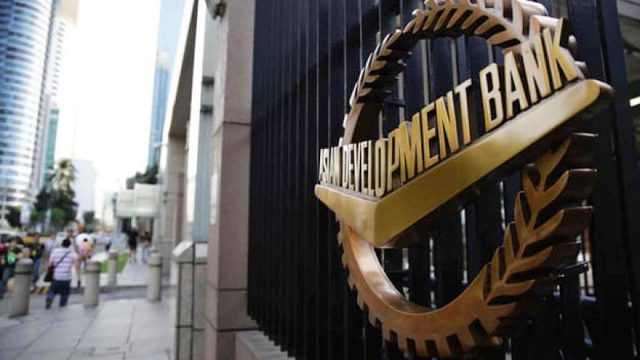
THE Asian Development Bank (ADB) expects to approve this year a $500-million loan to help the Philippines adopt public financial management (PFM) reforms.

“We have completed several policy-based reform programs which focused on enhancing PFM. And in fact, two important new policy-based programs will be approved and committed later before the end of this year,” Winfried F. Wicklein, director general of ADB’s Southeast Asia Department, told a forum.

“One is the PFM Reform Program Sub-Program 1, which will go to our board soon, and then also the Second Disaster Resilience Improvement Program.”

The Philippines is seeking a $500-million loan from the ADB under the PFM Reform Program Sub-Program 1. It is also looking at another $500 million under the Second Disaster Resilience Improvement Program. Both will be funded by the Manila-based bank.

The proposed loans would help achieve the targets set in the government’s Public Financial Management Roadmap, which seeks to ensure the efficient use of government funds.

The roadmap and the resulting enhancements to public spending are expected to help the Philippines achieve upper-middle income status, Mr. Wicklein said.

According to the World Bank’s income classification system, the Philippines remained a lower middle-income country with a gross national income per capita of $4,230 in 2023.

However, the chances of attaining upper middle-income status could be hampered by the Philippines’ infrastructure deficit, as well as shortcomings in education, health, and job creation, among others, according to Mr. Wicklein.

“Achieving middle- and higher-income status will require continuous reforms, and this includes a robust public financial management reform strategy and roadmap,” he said.

“It targets the enhancement of systems needed for ensuring efficiency and effectiveness of the use of public funds.”

The roadmap would also help “ensure that the money is targeted for quality public services for the Filipino people,” Mr. Wicklein also said.

The PFM, which was approved by President Ferdinand R. Marcos, Jr. last month, addresses strategic focus areas: planning and budgeting linkages; cash management; public asset management; accounting and auditing; PFM capacity development; and the digital PFM.

The Philippines was the biggest recipient of financial assistance from the ADB last year at $8.4 billion. — Beatriz Marie D. Cruz

PHL, S.Korea sign tourism cooperation agreement 

STOCK IMAGE VIA KOREANAIR.COM

THE Department of Tourism (DoT) and South Korea’s Ministry of Culture, Sports, and Tourism signed an agreement outlining their tourism cooperation program for 2024-2029, which will include an exchange of tourism-industry professionals.

In a statement on Monday, DoT said the deal that was signed on Oct. 7 at the Malacañang Palace and supplemented the memorandum of understanding (MoU) signed by the two countries in 2006.

The tourism cooperation “will further enhance the longstanding relations between our two nations in tourism and people-to-people exchanges,” Tourism Secretary Ma. Esperanza Christina G. Frasco said. 

“We anticipate this will increase demand for more Philippine destinations and tourism products from our number one source market, South Korea, and provide more opportunities for the economic advancement of our people, with the expected growth in our tourism numbers,” she added.

Under the agreement, both countries will exchange tourism professionals and administrators to exchange notes on practices in hotels, resorts, cruise ships, ports, tourism products, and other industries.

The MoU also allows for the exchange of information on tourism development, the establishment of tourism safety cooperation mechanisms, and contingency coordination.

The two countries will also organize joint promotions and marketing aimed at increasing the volume of tourist traffic and encouraging tourism investment.

Under the MoU, a joint working group will be formed to oversee the program.

As of Oct. 7, visitor arrivals from South Korea hit 1.23 million, or 27.16% of all foreign tourist arrivals. — Justine Irish D. Tabile

Ease of compliance seen determining success of new VAT on foreign DSPs

REUTERS

By Beatriz Marie D. Cruz, Reporter

COMPLIANCE with a new value-added tax (VAT) by foreign digital service providers (DSPs) will hinge on how seamless the online registration and payment process can be made, analysts said.

The revenue target for the new 12% VAT on DSPs was set at P105 billion a year following the signing of Republic Act No. 12023, highlighting the pressure on the government to raise funds for its various spending commitments. 

“Since the main targets of the law are nonresident foreign providers, the main challenge is making compliance such as registration, filing, and payment easy for the taxpayers,” Eleanor L. Roque, tax principal of P&A Grant Thornton, said via Viber. 

The agencies involved must also ensure that foreign companies accurately declare and remit their taxes, she added.

Under the law, foreign DSPs must designate a representative or agent registered under Philippine law to assist in tax compliance.

The digital services VAT is expected to level the playing field between domestic brick-and-mortar stores and nonresident tech firms such as Netflix, Amazon, and Spotify.

To help ensure tax compliance, the Bureau of Internal Revenue (BIR) must ensure that its system allows foreign firms to easily register and file their tax returns, former Finance Secretary Margarito B. Teves said.

“The BIR needs to ensure that the registration process and requirements for foreign DSPs is simple and straightforward. This can be done through the use of an online registration system wherein businesses could submit requirements online,” Mr. Teves said in an e-mail.

The bureau must also conduct taxpayer education campaigns and form a dedicated unit to monitor foreign firms’ tax compliance, Mr. Teves said.

“It can make use of third-party sources such as existing industry analysis reports or even partner with industry associations and business organizations to help identify and locate these foreign DSPs, check their activities, and ensure that they are paying the corresponding taxes,” he added. 

The proper documentation of digital transactions would help the authorities ensure that the appropriate taxes are paid, Philippine Retailers Association President Roberto S. Claudio said.

“All online deliveries coming from outside the Philippines should be accompanied by receipts and subject to Customs check,” he said in a Viber message.

The government should also enforce strong border controls to ensure that it collects the proper duties and taxes from nonresident DSPs, Mr. Claudio added.

The Philippines is the latest country in the ASEAN (Association of Southeast Asian Nations) to introduce a VAT on nonresident digital services.

Other ASEAN countries have some form of VAT in place on digital services. Indonesia charges 11%, Vietnam 10%, Laos 10%, Cambodia 10%, Singapore 9%, Malaysia 8%, and Thailand 7%.

Benedicta Du-Baladad, founding partner and chief executive officer of Du-Baladad and Associates, said the government may also consider exempting some digital services from VAT.

“While our tax applies to all digital services, certain jurisdictions exclude several transactions from the imposition of the tax, like: financial and communication services, intra-group transactions, and online services by government institutions,” she said via Viber.

“These exclusions simplify the imposition of the tax and reduce instances of B2B (business-to-business) transactions.”

RA 12023 only allows VAT exemptions for digital services sold on a subscription basis to educational institutions recognized by the Department of Education, the Commission on Higher Education, and state universities and colleges.

It also exempts from VAT the services of bank, non-bank financial intermediaries performing quasi-banking functions, and other non-bank financial intermediaries.

Under the law, foreign DSPs whose gross sales or receipts for the past year exceed P3 million must register for VAT. It also subjects foreign companies providing services to the government to a 5% VAT.

The law covers online search engines, online marketplaces, cloud services, online media and advertising, online platforms, and any digital content providers.

The law’s implementing rules and regulations (IRR) are due 90 days after the law takes effect.

The BIR must also make its own arrangements for administering the tax.

NEA approves credit facility to support power co-ops’ non-network, grid projects

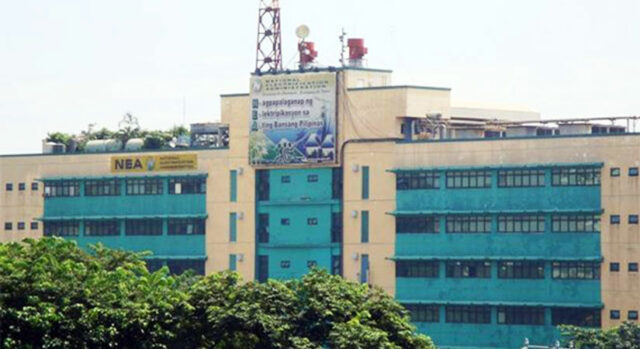
THE National Electrification Administration (NEA) approved a credit facility to support non-network and smart-grid capital expenditure (capex) requirements of electric cooperatives (ECs).

“As a result of our series of discussions with the ECs and to provide them with easy access to funding, we are proposing to establish a Credit Facility for non-network capex projects and smart grid requirements for electric cooperatives,” NEA said in a memorandum dated Oct. 1.

NEA said it recognizes the need for the ECs to be globally competitive, with the facility to support digitalization and automation initiatives.

“In order to address the efficient, reliable and safe operation of the ECs’ distribution system particularly the interconnectivity of all substations through Supervisory Control and Data Acquisition, Distribution Automation System, Advance Metering infrastructure, Geographical Information System, Outage Management System and Digital Dashboard Command Center, among others, must be funded,” NEA said.

Under the policy, ECs will be entitled to borrow up to P50 million per project based on validated cost.

Non-network projects and smart grid projects will have a maximum repayment period of 15 years and 20 years, respectively, with a grace period of up to one year on principal payment. 

NEA noted that the proposed projects are subject to evaluation by its Technical Services Sector, Corporate Planning Office or Information Technology Communication Services Department. — Sheldeen Joy Talavera

Easier to tax, easier to pay, easier to collect

“Only a crisis — actual or perceived — produces real change. When that crisis occurs, the actions taken depend on the ideas that are lying around. That, I believe, is our basic function: to develop alternatives to existing policies, to keep them alive and available until the politically impossible becomes the politically inevitable.”

This quote comes from Milton Friedman, arguably the most influential economist of the 20th century. A man of small stature and big ideas, his theories caused a wave of deregulation across governments that simplified or eliminated bureaucratic rules to increase economic activity and innovation with the goal of financial success for all.

But I digress. Let’s talk tax.

Moves to deregulate and simplify have also struck a chord with Filipinos. In recent years, there have been concerted efforts by both Congress and the Executive through the President and the BIR to simplify tax regulation with the goal of inviting businesses (both foreign and local) to enter and thrive in the country as it works to emerge stronger from the pandemic.

BIR STRATEGIC PILLAR: DIGITALIZATION AND SIMPLIFIED PROCESS
The Bureau of Internal Revenue (BIR) under Commissioner Romeo Lumagui’s administration has set four strategic pillars in its 2024 Priority Programs and Projects according to Revenue Memorandum Circular (RMC) 42-2024: Provide excellent service to taxpayers; Develop highly digital processes; Intensify audit and enforce process; and Strengthen integrity and professionalism of the employees and the institution. To that end, the BIR has in recent years digitalized and simplified processes for the convenience of taxpayers. Easier to tax, easier to pay, easier to collect.

In the past, taxpayers needed to go to their Revenue District Office (RDO) for transactions like Tax Identification Number (TIN) inquiry, cancellation and verification, registration, and closure of business. Now, with the BIR’s Online Registration and Update System (ORUS) as outlined in RMC 121-2023 and RMC 12-2023, these transactions may be processed online. RMC 91-2024 also further clarified the procedures of business registration, closure, and transfer.

In RMC 37-2024, as amended by Revenue Memorandum Order (RMO) 20-2024, inquiries regarding a taxpayer’s TIN can now be done from the comfort of home by sending a simple e-mail containing the necessary information to tin.inquiry@bir.gov.ph. Further, RMC 31-2024 states that for TIN Verification purposes, the result displayed by ORUS or BIR’s Chatbot Revie is sufficient proof of the correctness of the TIN, except in certain instances where a TIN Verification Slip is required.

Another instance where compliance was simplified concerns receipts, invoices, and certificates authorizing registration (eCAR). Back then, these documents had validity periods that required taxpayers to apply for new receipts/invoices after the expiry date or revalidate an eCAR if presented beyond the validity period. Now, with the issuance of Revenue Regulations (RR) 6-22 and RR 12-2024, the validity periods of these documents have been removed, reducing the burden on the taxpayers. With this development, the cost and time incurred to secure new receipts, invoices, and eCARs are reduced. It also reduces the workload of BIR personnel, thereby promoting efficiency.

These are just some of the changes made to digitalize and simplify the process, in the hope that more taxpayers voluntarily comply in aid of the BIR’s collection efforts.

CONGRESS AND TAX REFORM
Congress has also been pursuing tax reform initiatives that have made compliance simpler and easier with the recent passage of the Ease of Paying Taxes (EoPT) Law. For its part, the BIR has put in significant effort to implement the EoPT law and clarify its provisions. Here are some of the RMCs issued this year to clarify some pertinent provisions of the law.

Thanks to the EoPT Law, the annual registration fee was eliminated, as clarified in RMC 14-2024, and the civil penalties were reduced for small and micro taxpayers per RR 6-2024. Also, the obligation of the taxpayer to preserve and maintain books of account and other accounting records from 10 years to five years was also shortened as per RR 7-2024.

Taxpayers were further classified under RR 8-2024 as Micro, Small, Medium, and Large according to their gross sales. This classification would enable the BIR to enforce less stringent requirements and reduce penalties for smaller businesses, while applying more stringent requirements for larger entities.

Refunding Value-Added Tax (VAT) has also been simplified under RR 3-2024 and clarified under RMO 23-2024 as amended by RMO 42-2024.  Now, VAT Taxpayers are classified as Low, Medium, and High Risk, with those classified as Medium Risk now facing reduced verification or audit of their sales and purchases. Low Risk taxpayers now need no verification of their sales and purchases. This in turn makes processing VAT refunds faster and less taxing for the BIR and the taxpayer.

Moreover, in the past, returns and taxes must have been filed and paid in the Authorized Agent Bank (AAB) or with the Revenue Collection Officer (RCO) where the taxpayer is registered. With RR 4-2024 and the recent RMC 87-2024, filing and payment of returns can now be processed through any AAB, Authorized Tax Software Provider, or RCO with the elimination of the “wrong venue” penalty.

These efforts brought relief to many taxpayers with the reduction of the cost of compliance. Certainly, proper implementing rules and guidelines from the BIR help taxpayers to easily understand and follow these tax rules.

WORKS IN PROGRESS
There are still some initiatives of the BIR that are works in progress. Some of these are the full implementation of the Electronic Invoicing/Receipting System (EIS) and the integration of the EIS with the BIR System. Another is the issuance of an Acknowledgement Certificate (AC) within three working days from receipt of complete documents under RMC 5-2021. In practice, this is usually not the case for many taxpayers registering their Computerized Books of Account. The review process is still tedious for some RDOs, as it still takes weeks and even months to complete and issue the AC.

On another note, a significant issue in the tax assessment process is still being experienced by many taxpayers with payments to nonresident foreign corporations regarding the proper taxation of cross-border services as enumerated in RMC 5-2024 and RMC 38-2024. The BIR should issue further clarifications and guidelines when determining the taxability of these cross-border services to leave no room for the BIR case officers to interpret, thereby reducing the likelihood of huge and improper tax assessments.

The right against wrongful assessments is still a top taxpayer concern. The House’s EoPT version had a provision creating a Taxpayer’s Bill of Rights and Obligations and creating a Taxpayer’s Advocate Office. This was not included in the final version of the law. The taxpayers are hopeful that a separate bill will be passed to provide fair treatment to taxpayers and put in place protections against wrongful assessments.

To conclude, the BIR’s efforts to simplify, standardize, and reduce tedious tax procedures and requirements are inspiring and commendable. While there is much more to be done for taxpayers, as our country still ranks 171st out of 190 countries in starting a business and 95th in paying taxes, as can be seen on the website of the World Bank Group’s Ease of Doing Business Index, it is believed that the Philippines is on the right path with the earnest efforts being put in motion by the government. As Teddy Roosevelt, the reforming US President, famously said, “Do what you can, with what you have, where you are.” That’s how things get done, taxation included.

Let’s Talk Tax is a weekly newspaper column of P&A Grant Thornton that aims to keep the public informed of various developments in taxation. This article is not intended to be a substitute for competent professional advice.


Michael L. Milan is an associate of the Tax Advisory & Compliance division of P&A Grant Thornton, the Philippine member firm of Grant Thornton International Ltd.

pagrantthornton@ph.gt.com