Home Blog Page 2532

Disney introduces new US park perk: Skip the long lines for $400

The Radiator Springs Races is one of the rides at the Disney California Adventure Park that are included in the Lightning Lane Premier Pass. — DISNEYLAND.DISNEY.GO.COM

WALT DISNEY CO. is introducing a new theme-park perk for rides such as Indiana Jones and Rise of the Resistance, where the waits can be over an hour long. For $400 a person, guests can skip the lines at many popular attractions.

Resorts in Southern California and Florida will begin testing the Lightning Lane Premier Pass starting Oct. 23 and Oct. 30, respectively, according to company websites. The pass allows a visitor to use the Lightning Lane entrance once at numerous busy rides for a whole day.

Only “very limited quantities” of the Lightning Lane Premier Pass will be available, Disney said. The rollout of the feature coincides with a slowdown in business at the company’s resorts.

The current prices will run through Dec. 31. After that, Disney expects the new pass to be priced at $300 to $400 a day per guest, based on the date and demand.

Earlier this month, Disney increased the price of tickets to its two Disneyland theme parks in California by about 6% on most days. The most expensive — typically weekends and holidays — climbed 6.2% to $206. The lowest-priced admission, available for at least 15 days in January and February, will stay at $104, unchanged since 2019.

The new line-cutting option builds on a number of features for guests who are willing to spend more see more of the attractions. For example, a Lightning Lane Multi Pass lets guests choose rides where they want to skip the lines, starting at $32 per ticket per day. A Lightning Lane Single Pass is a one-time option to skip the line for a top attraction. They vary by date and attraction.

For the very well-heeled, there’s a VIP Tour. Prices can range from $500 to $700 an hour for groups of up to 10, according to the PlanDisney website. — Bloomberg

UNDP: About 4 in 100 Filipinos are considered ‘multidimensionally poor’

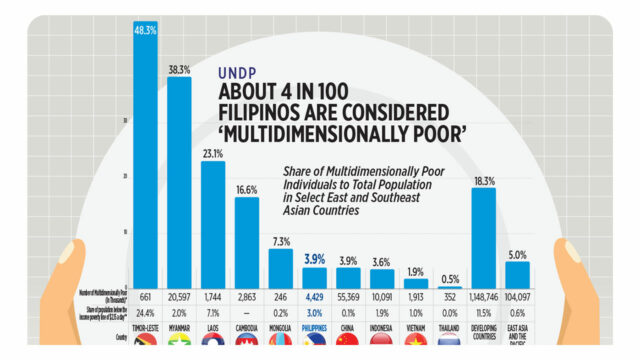
The share of “multidimensionally poor” in the Philippines reached 3.9% or 4.43 million Filipinos, according to the latest estimates from the Global Multidimensional Poverty Index by the United Nations Development Program (UNDP) and the Oxford Poverty and Human Development Initiative (OPHI). This was better than the 18.3% share in developing countries and the 5% in the East Asia and the Pacific region. The report added that around 3% of Filipinos are living below the income poverty line of $2.15 a day.

UNDP: About 4 in 100 Filipinos are considered ‘multidimensionally poor’

How PSEi member stocks performed — October 17, 2024

Here’s a quick glance at how PSEi stocks fared on Thursday, October 17, 2024.


Senate urged to let automatic power price hikes within approved brackets

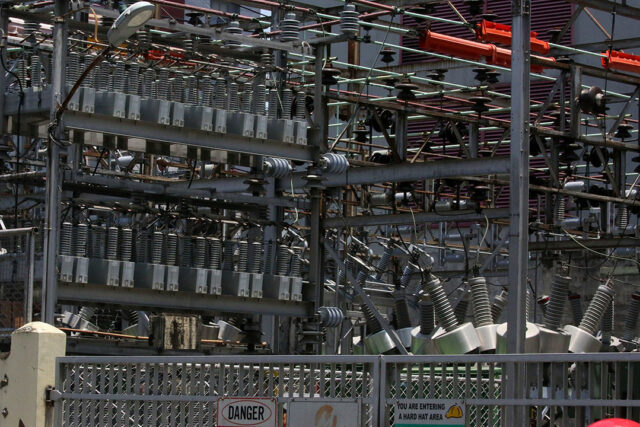
PHILIPPINE STAR/EDD GUMBAN

By John Victor D. Ordoñez, Reporter

THE Department of Energy (DoE) on Thursday urged senators to amend the Energy Regulatory Commission (ERC) charter to allow price increases without regulatory approval as long as these fall within a set benchmark or bracket.

This would allow the regulator to do away with the cumbersome approval process that power distributors have complained about, Energy Undersecretary Sharon S. Garin told a Senate hearing looking at changes to the 23-year-old Electric Power Industry Reform Act (EPIRA).

“If the distribution utility applies for this (price increase) and it is within the benchmark and they can prove that they followed a fair, transparent procurement process, then it should not be a full-blown process but just a summary procedure that will be shorter,” she said.

The energy official said the move would also free the ERC from its time-consuming function as a quasi-judicial court when hearing price petitions.

At the hearing, Senator Sherwin T. Gatchalian pushed to empower the ERC to speed up the approval of power supply deals amid constant blackouts in the country.

“The resetting of rates is one of the most important activities of the Energy Regulatory Commission because it determines the appropriate rates entities should charge,” he said.

Ms. Garin added that her agency is also finalizing proposals for penalties the ERC can impose in cases of economic sabotage in the power generation sector.

“We are trying to finalize how to define economic sabotage as far as energy is concerned and maximize the penalty for a fault made by industry players,” she said in mixed English and Filipino.

In his third address to Congress, President Ferdinand R. Marcos, Jr. sought a review of EPIRA to address issues hounding the energy sector, particularly high energy prices.

Energy Undersecretary Rowena Cristina L. Guevarra told senators in May that 4,000 megawatts of power might be added to the country’s power generation capacity by the end of the year.

She said some power plants that eye setting up shop this year are falling behind in the application process but are ready to start operations.

“Our goal is that people have access to electricity in a reliable manner and not in intermittent energy,” Senator Pilar Julianna S. Cayetano, who heads the energy committee, told the hearing.

“We need our regulatory bodies to be on the ball, to be able to react quickly and not three years later, not five years later,” she added.

House of Representatives bills seeking to amend EPIRA are pending with its energy committee.

The House energy panel is considering changes to the ERC charter that will speed up the approval process through benchmark rates, according to a draft bill dated Sept. 1 previously obtained by BusinessWorld.

It is also considering a new provision in the charter that requires the ERC to rule on administrative cases within 30 days.

Philippine lawmakers have committed to fast-track amendments to EPIRA, which is one of the President’s priority measures.

Analysts earlier said lawmakers should limit cross-ownership and address privatization concerns under EPIRA to boost competition.

Think tank Center for Energy Research and Policy said cited the need to reform the power procurement process and increase investment incentives to boost competition.

It has also recommended enhancing the regulatory powers of the Department of Energy and the ERC.

EPIRA restructured the electric power industry by privatizing the generation, transmission, distribution and supply of power in 2001.

Under Section 5 of the law, cross-ownership — the concentration of ownership in two or more related businesses — is only outlawed between a transmission company and any company in generation and distribution.


Australia eyes more than P4B a year to support PHL mining, RE, infrastructure

DEPARTMENT OF EDUCATION FACEBOOK PAGE PHOTO

By John Victor D. Ordoñez, Reporter

AUSTRALIA plans to provide the Philippines more than P4 billion yearly until 2029 in official development assistance (ODA) to support mining, infrastructure, renewable energy (RE) and agriculture, as part of the country’s five-year development partnership plan with the Southeast Asian nation.

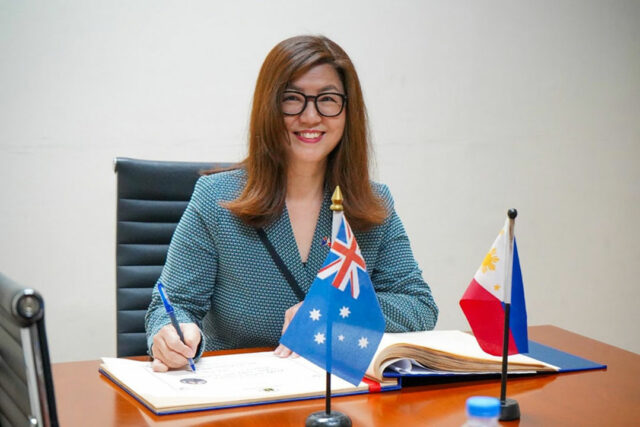
“We are talking about multiples of more than P4 billion per year of predominantly official development assistance in the Philippines to help [it] achieve good economic reforms,” Australian Ambassador to the Philippines Hae Kyong Yu told a news briefing in Makati after the launch of the program.

She said the Australian Embassy in Manila has brought in Australian mining tax experts to work with their Philippine counterparts as Congress deliberates on a measure that seeks to develop a new tax regime for the industry.

The embassy has also been encouraging players in the Australian mining industry to partner with mining companies in the Philippines on mining best practices.

Senators are set to continue floor debates on a proposal for a five-tier margin-based royalty rate system for the sector ranging from 1% to 5%, and a five-tier windfall profit tax system from 1% to 10%.

The House of Representatives approved its version of the measure in September last year.

Senate Bill No. 2826 seeks a royalty of 5% from large-scale miners inside mineral reservations based on gross output, while those outside reservations will follow the five-tier margin regime.

The government expects to generate P6.26 billion in yearly revenues from the mining tax regime, according to the Department of Finance.

The existing tax system for mining companies requires them to pay corporate income, excise, royalty, local business and real property taxes, as well as fees to indigenous communities.

President Ferdinand R. Marcos, Jr. on Wednesday urged the Senate to fast-track the measure’s approval.

Ms. Yu noted that about P3.6 billion of Australian’s planned annual funding assistance would be in the form of official development assistance.

In the past two decades, funding assistance from Australia to the Philippines has reached about P63 billion.

“We will support Philippine government agencies to implement key economic reforms, partner with the Philippines in key sectors including infrastructure, RE, telecommunications and digitization,” Australian Foreign Affairs and Trade Secretary Jan Adams said in a speech at the launch of the partnership.

Canberra will also work with Manila to improve its cash transfer and social protection programs for poor Filipinos. It will also partner with Philippine institutions to boost human capital and skill development programs to raise the employability of Philippine workers.

“These are sectors where Australia believes we have a comparative advantage… We’ll be looking to help develop your mining sector,” Ms. Yu said.

Two-way trade between the countries reached P378 billion last year, while more than 250 Australian companies employed 44,000 Filipinos.

Trade and investment between Canberra and Manila could grow by 10% this year, Luisa Rust, minister-counselor and senior trade and investment commissioner of the Australian Embassy, earlier told reporters.

“The development partnership plan builds on our countries’ close partnership, and sets out how we will pursue our shared development priorities so that together, we can shape a peaceful, stable and prosperous region,” Ms. Yu said.

Marcos leads inauguration of Sorsogon sports complex

FORMER Vice-President Maria Leonor “Leni” G. Robredo greets President Ferdinand “Bongbong” R. Marcos, Jr. as former Senator Paolo Benigno A. Aquino IV looks on at a holding area before the President inaugurated a 12,000-capacity sports arena in Sorsogon province. — PCO

PRESIDENT Ferdinand R. Marcos, Jr. on Sunday led the inauguration of a 12,000-capacity sports arena in Sorsogon in the Bicol region, at an event attended by his closest rival in the 2022 presidential race.

The arena, which can accommodate up to 20,000 for full-house sports activities, could serve as a national training camp for Filipino athletes, he said in a speech. It is a step toward increasing the number of Filipino Olympians, he added.

The President said the arena could be used for conferences, summits, concerts and competitions.

Mr. Marcos briefly shook hands with former Vice-President Maria Leonor “Leni” G. Robredo and ex-Senator Paolo Benigno “Bam” A. Aquino IV at a holding area before leading the inauguration.

Senate President Francis “Chiz” G. Escudero, who was Sorsogon governor before returning to the Senate in 2022, said he had invited Ms. Robredo to welcome the President on behalf of the Bicol region.

“We may have opposing beliefs and opinions, but I know that we are one in our goal to improve the lives of every Filipino,” Mr. Marcos said in his speech in Filipino.

Mr. Marcos lost to Ms. Robredo by a hair in the 2016 vice presidential race. He filed an election lawsuit, alleging fraud, that the Supreme Court unanimously dismissed in 2021.

He made a comeback in 2022 by beating Ms. Robredo in the presidential election. He became the first candidate in the history of the Fifth Republic to win by a majority, getting nearly 59% of the vote. — KATA

Criticism vs public officials’ performance not always slanderous, Supreme Court says

PHILSTAR FILE PHOTO

THE Supreme Court (SC) ruled that statements against public officials are not always defamatory or slanderous if they pertain to the performance of their official duties unless done with malice.

In a ruling, written by Senior Associate Justice Marvic M.V.F. Leonen, the high court’s Second Division said that actual malice must be proven to count remarks against public officials as defamatory or slanderous, citing Article 358 of the Revised Penal Code.

The Code provided that there is oral defamation or slander when (1) there is an allegation of a crime, fault, or flaw; (2) made orally; (3) publicly; (4) maliciously; (5) towards a person, alive or dead; and (6) such allegation tends to cause dishonor on the person defamed.

“In interpreting laws criminalizing defamation of public officers, this Court notes that protection of these fundamental rights is primordial,” the 15-page decision, promulgated on Dec. 6, 2023, read. It was publicly released on Oct. 16.

“Recognizing that free speech empowers the citizens in exacting accountability from public officers, conviction for defamation involving statements related to their discharge of official duties entails proof that they were made with actual malice. Actual malice cannot be presumed,” it added.

The ruling stemmed from a Lanao del Norte village officer who accused her neighbor of grave oral defamation and other light threats following a series of confrontations.

The village officer had mediated in a barangay conciliation to settle disputes between two individuals.

The mother of one party, however, said the village officer should not have mediated “because she is dumb, has not gone to school, and is ignorant.” The ruling noted that many people allegedly heard the statements.

This prompted the village officer to raise the issue before the Municipal Trial Court, which convicted the accused of oral defamation but junked the light threat charge. The accused appealed the ruling before the Court of Appeals, which also upheld her conviction.

The accused then filed a petition before the SC, which ruled in her favor.

The high court said the remarks made by the accused were related to the official’s duties as a village officer and the prosecution failed to prove actual malice.

“Being ‘sensitive’ has no place in this line of service, especially when allowing otherwise has the potential to create a chilling effect on the public,” the top court’s decision read. — Chloe Mari A. Hufana

Voters prey to ‘client’ politics

PHILIPPINE STAR/MICHAEL VARCAS

FILIPINO VOTERS remain easy prey for clientelistic campaigning, a political science analyst said, as the Tulfo-led ACT-CIS dominate a party-list survey conducted by research firm Acquisition Apps, Inc.

“The angle of clientelism is also facilitated by the fact [that] the emerging middle class and electorate are themselves brought up in clientelistic norms,” Hansley A. Juliano, who teaches political science at the Ateneo de Manila University, said in a Facebook Messenger chat.

“It doesn’t say anything new about Filipino voters: they remain vulnerable and due to lack of progressive legislation/policy regulation that uplifts their economic conditions, they will remain vulnerable, which makes them easy prey for clientelistic campaigning,” he added.

Mr. Juliano was reacting to a survey made by Acquisition Apps which showed ACT-CIS is poised to win three seats at the House of Representatives in next year’s midterm elections.

In an e-mail statement on Wednesday night, the survey showed the group garnered the top rank with 11.21% voter preference.

Other party-lists projected to win two seats were 4Ps party list (3.66%); Ako Bicol Party list (3.58%); 1-Rider Party list (2.82%); ACT Teachers Party list (2.67%); and GABRIELA Party list (2.51%).

Meanwhile, Malasakit@Bayanihan Party List (1.83%), AGRI (1.68%), Duterte Youth Party List (1.68%), Senior Citizens Party List (1.60%), and Ako Bisaya Party List (1.52%) are among 39 incumbent party-list groups expected to secure a seat.

Two newcomers were seen winning a seat, with Solid North Party List (1.07%) and FPJ Panday Bayanihan (FPJPB) Party list (1.00%).

The survey was conducted last Oct. 1 to 4, with 2,400 respondents. — Chloe Mari A. Hufana

45 OFWs from Lebanon arrive

BUREAU OF IMMIGRATION PHOTO

FORTY-FIVE overseas Filipino workers (OFWs) were repatriated on Thursday from war-torn Lebanon, according to the Department of Migrant Workers (DMW).

In a Facebook post, the agency said the 45 OFWs and two children were aboard Kuwait Airways 417 from Beirut.

This batch is one of the biggest groups the DMW has assisted through voluntary repatriation since fighting erupted in the Middle Eastern country in late 2023, it said in a separate Viber message to BusinessWorld.

The 45 repatriated Filipinos were on top of 480 OFWs and a total of 30 dependents who have been sent home due to the fighting, based on DMW data.

The Middle East has been facing increased tensions attack of Hamas in Israel since Oct. 7, 2023.

Hezbollah, a Lebanese militant group in support of Palestine, has been launching a series of attack against Israel to show support.

As a result, the Israel Defense Forces retaliated by also launching attacks against Lebanon. — Chloe Mari A. Hufana

Marcos thanks Israel for OFW help

PRESIDENT FERDINAND R. MARCOS, JR. — PCO.GOV.PH

PHILIPPINE President Ferdinand R. Marcos, Jr. on Wednesday thanked Israel for supposedly taking care of Filipinos amid its clashes with militant groups opposed to its occupation of Palestine.

“Israel’s swift assistance in ensuring their [Filipinos] safety, especially during these challenging times, means a great deal to us,” he said in a statement late on Wednesday, following a phone call with Israeli President Isaac Herzog.

Mr. Marcos did not fully disclose what he and Mr. Herzog had discussed during their phone call.

He nevertheless said Israel remains one of the Philippines’ “trusted bilateral partners in the Middle East region, citing “historic friendship that predates the establishment of the Israeli state.”

“We remain hopeful for a swift path to peace, and together, may we continue to build on the strong bonds between our nations.”

The Israeli military earlier this month launched a wave of air raids on southern Lebanon as Jerusalem marked the anniversary of Hamas attacks on Oct. 7, 2023. 

Israel’s air raids and ground invasion of southern Lebanon were at neutralizing “Hezbollah targets” that it said were “immediate threat” to northern Israeli communities.

Hezbollah militants have shown resistance to Israeli forces amid the Israel-Hamas war in the Gaza Strip.

The Lebanese health ministry said Israeli airstrikes across southern Lebanon and the capital Beirut killed 27 people on Wednesday, based on an Al Jazeera report.

The United Nations peacekeeping mission in Lebanon known as United Nations Interim Force in Lebanon (UNIFIL) said Israeli forces continued to fire at its watchtower in the south, amid growing international criticism of Israel’s attacks on UNIFIL peacekeepers over the past days.

“Yet again we see direct and apparently deliberate fire on a UNIFIL position,” the peacekeeping mission said in a statement on Wednesday.

“This morning, peacekeepers at a position near Kfar Kila observed an IDF Merkava tank firing at their watchtower,” it added. “Two cameras were destroyed, and the tower was damaged.”

UNIFIL on Sunday said Israeli troops “forcibly entered” its position near the village of Ramia with two tanks crossing the UN-mandated blue line and fired smoke rounds near peacekeepers.

The Philippines last month joined 123 other countries in favoring a United Nations resolution urging Israel to end its occupation of Palestinian territories within a year.

Israeli settlement activities involved the transfer of its nationals “into the occupied territories, the confiscation of land, the forced transfer of Palestinian civilians, including Bedouin families,” according to the November resolution.

The settlements also involved “the exploitation of natural resources, the fragmentation of territory and other actions against the Palestinian civilian population,” among other issues.

The Gaza Strip is one of the two territories occupied by Palestinians — the other being the West Bank, which the Israeli government has been trying to invade in recent years. The two areas, along with East Jerusalem, came under Israeli occupation after the 1967 Arab-Israeli war. Since the war, Israel has responded to Palestinians’ demand for a homeland through military force. — Kyle Aristophere T. Atienza

MCIA to set up green framework

BW FILE PHOTO

THE MACTAN-CEBU International Airport (MCIA) has signed an agreement with Airports Council International (ACI) Asia-Pacific & Middle East to establish a sustainability framework as part of its commitment to reach net zero ambition.

“We aspire to inspire other airports across the Philippines and Asia to follow suit. Together, we can drive sustainable tourism, ensuring that destinations worldwide offer enriching and responsible experiences for generations to come,” Athanasios Titonis, chief executive officer of Mactan-Cebu International Airport, said in a statement on Thursday.

In a media release, MCIA, managed by Aboitiz InfraCapital GMR Megawide Cebu Airport Corp. (Aboitiz InfraCapital GMCAC), said it signed a memorandum of understanding to develop a comprehensive framework on green and sustainable efforts to reach net zero.

Net zero refers to reducing greenhouse gas emissions to as close as zero as possible while offsetting any remaining greenhouse gases in the atmosphere.

The net zero roadmap will include carbon footprint projection, adoption of governance frameworks, and proposals in utilizing greener and sustainable options in areas like fuel consumption, and operations.

The program will also provide capital expenditure guidance on planning, implementation strategies, carbon offsetting measures, while also connecting airports with financial institutions for possible funding.

“As the industry continues to face increasing pressure to minimize its carbon footprint, we recognize that robust action is required to ensure that airports are prepared for a sustainable future. Through our Net Zero Roadmap program, we offer tailored support to airports like Mactan Cebu International, helping them create practical, effective plans,” ACI Asia-Pacific & Middle East Director General Stefano Baronci said. — Ashley Erika O. Jose

P90-M smuggled fuel seized

PHILSTAR FILE PHOTO

THE Bureau of Customs (BoC) on Thursday said it impounded a tanker found transferring P90 million worth of fuel to four trucks to avoid paying taxes.

On Wednesday, a fuel tanker and four lorries were caught transferring smuggled fuel at the Batangas port, the BoC said in a statement.

The subsequent fuel marking testing on the subject fuel showed failed results, “which meant that the fuel did not have proper markings indicating payment of duties and taxes.”

The seized vessel has an estimated value of P300 million, BoC said. Its cargo contains 1.8 million liters with a cost of P50 per liter, valued at around P90 million.

Likewise, the trucks were valued at P3 million each, or P12 million in total.

Juvymax R. Uy, who serves as deputy commissioner at the Customs’ intelligence group said that two lorry trucks contained 40,000 liters and 14,000 liters of unmarked fuel, respectively.

Customs Intelligence and Investigation Service Director Verne Y. Enciso, said it has been monitoring the “paihi” modus, in which larger tankers off-load fuel to smaller vessels to escape tax payments.

To determine whether the proper taxes are paid, the bureau uses a unique chemical to mark imported and locally refined petroleum products. This would help avoid smuggling and misdeclaration of fuel products.

“Our operation against these individuals and groups is not a one-time thing. We have been monitoring them for months and finally, they are now in our hands,” Customs Commissioner Bienvenido Y. Rubio was quoted in the statement.

Offenders will face possible charges for violating the Customs Modernization and Tariff Act and the Tax Reform for Acceleration and Inclusion Law. — Beatriz Marie D. Cruz